# A-State Website Governance

Tools, resources, and in-depth guidance for creating A-State website pages and content using Modern Campus CMS

# Overview

## <span style="font-weight: 300;">**GOVERNANCE**</span>

<span style="font-weight: 300;">***Version 1-0 | February 18, 2025***</span>

---

<span style="font-weight: 300;">The </span>**Arkansas State University**<span style="font-weight: 300;"> website is only as powerful as the organization and quality of its content. And we know as content creators it can be challenging to know where to start, and what to focus on.</span>

<span style="font-weight: 300;">Here you’ll find all the tools and resources you need to:</span>

- <span style="font-weight: 300;">get a user login and proper permissions</span>
- <span style="font-weight: 300;">obtain training information</span>
- <span style="font-weight: 300;">understand content workflow</span>
- <span style="font-weight: 300;">identify the primary audience you're speaking to</span>
- <span style="font-weight: 300;">determine if you need a new page</span>
- <span style="font-weight: 300;">pick the correct page template</span>
- <span style="font-weight: 300;">write quality, on-brand content</span>
- <span style="font-weight: 300;">choose images that engage your audience</span>

# What do you need the most help with?

<span style="font-weight: 300;">Check out the following questions and choose the resource that most closely matches your query. You can also come back here to check out another resource if you don’t find the answer you’re looking for.</span>

#### **Who manages the website?**

**Review the** [**Website Governance Charter**](https://kb.astate.edu/books/a-state-website-governance/page/1-web-governance-charter-577)**.**<span style="font-weight: 300;"> This document outlines the overall structure for the governance of the website. Here, you’ll find who is in charge of the day-to-day running of the site and strategic advisors throughout the college.</span>

#### **How do I get added to the website and what will I be allowed to do?**

**Review the** [**User Roles, Training &amp; Workflow Document**](https://kb.astate.edu/books/a-state-website-governance/page/2-user-roles-training-workflow)**.**<span style="font-weight: 300;"> This document outlines the processes for creating new users and training them to use the website and maintain their content. Additionally, this provides an overview of who can help you create and edit content when new pages are requested or content needs to be updated.</span>

#### **How do I identify a page’s goal and audience?**

**Review the** [**New Page Prep**](https://kb.astate.edu/books/a-state-website-governance/page/4-new-page-prep) **Document.** <span style="font-weight: 300;">Whether you’re creating a new page or editing an existing one, this worksheet can help establish why this page exists, and who this page is for. Taking this step before writing &amp; editing will allow you to holistically understand the needs of this page and create content accordingly. </span>

#### **How do I know when to add a new page or edit the site structure?** 

**Check out the** [**Page Creation &amp; Site Structure Guidelines**](https://kb.astate.edu/books/a-state-website-governance/page/3-page-creation-site-structure-guidelines)**.** <span style="font-weight: 300;">We’re going to define when it’s okay to make a new page and when content should be added to already existing pages. We will also provide some guidelines to follow around keeping the site structured appropriately.</span>

#### **How do I create a page?** 

**Review the** [**Page Templates**](https://kb.astate.edu/books/a-state-website-governance/page/5-page-templates) **resource.**<span style="font-weight: 300;"> We’re going to outline some page structure ideas in templates for you to use when creating pages, based on the content you have. Grab a layout you like and recreate in your CMS with the recommended patterns. </span>

#### **How do I choose patterns for the page I’m building?**

**Review the** [**Pattern Library**](https://kb.astate.edu/books/a-state-website-governance/page/6-pattern-library)**.**<span style="font-weight: 300;"> We will outline the different kinds of patterns available on the new site, and how they can be used. Use this library to help decide what pattern to use after you’ve chosen a page template.</span>

#### **How do I write page content?** 

<span style="font-weight: 300;">We’ve got two resources for you here.</span>

**Review** [**Brand Voice Guidelines**](https://kb.astate.edu/books/a-state-website-governance/page/7-brand-voice-guidelines)**.** <span style="font-weight: 300;">We’re going to help you understand your brand, and what this means when you create content. </span>

**Review** [**Copywriting Best Practices**](https://kb.astate.edu/books/a-state-website-governance/page/8-copywriting-best-practices)**.** <span style="font-weight: 300;">We’re going to point out some writing do’s and don'ts that will help get your creative juices flowing. This way you can highlight what’s important to your audience in a way they will understand. </span>

#### **How do I choose quality photos and videos?** 

**Check out** [**Multimedia Dos and Don’ts**](https://kb.astate.edu/books/a-state-website-governance/page/9-multimedia-do-donts)**.**<span style="font-weight: 300;"> We’re going to help you make quality, on-brand photo and video selections that elevate the pages you’re creating.</span>

#### **How do I get my page seen and placed higher in search engine results?** 

<span style="font-weight: 300;">Check out </span>[**Search Engine Optimization**](https://kb.astate.edu/books/a-state-website-governance/page/10-search-engine-optimization) <span style="font-weight: 300;">to better market your page and ensure the content gets seen by your intended audience.</span>

#### **How do I make sure my content does not break accessibility guidelines?**

**Review the** [**Accessibility Guidelines**](https://kb.astate.edu/books/a-state-website-governance/page/11-accessibility-guidelines)<span style="font-weight: 300;"> to make sure you don’t accidentally break rules that could lead to legal action and create pages that maintain the accessibility standards for your website.</span>

#### **I’m seeing terms that I don’t understand the meaning of.**

**Check out the** [**Glossary &amp; Key Terms**](https://kb.astate.edu/books/a-state-website-governance/page/12-glossary-key-terms) **resource.**<span style="font-weight: 300;"> We’re going to define the terminology that you will see throughout our documentation. This can be a handy guide to refer back to while acquainting yourself with the process of creating &amp; managing content on the site. </span>

#### **Still have questions?**

<span style="font-weight: 300;">If you can’t find an answer to your question, please contact the Director of Marketing and Communications.</span>

# 1. Web Governance Charter

<span style="font-weight: 300;">Web governance refers to people, policies, procedures, standards, and guidelines that govern the creation and maintenance of the </span>**Arkansas State University**<span style="font-weight: 300;"> official website and digital properties. </span>

<span style="font-weight: 300;">The overall goals of Web Governance are to:</span>

1. <span style="font-weight: 300;">Detail roles, responsibilities, and workflows for creating content and updating the website</span>
2. <span style="font-weight: 300;">Assist site users in creating digital content that aligns with our brand and engages the site audience(s)</span>
3. <span style="font-weight: 300;">Maintain long-term consistency and integrity of our website.</span>

<span style="font-weight: 300;">To that end, this policy outlines the management and governance of our web environment. </span><span style="font-weight: 300;">  
  
</span>

### <span style="color: #cc092f;">**University Communications &amp; Marketing**</span>

<span style="font-weight: 300;">The day-to-day operation of the website is the responsibility of </span>**Marketing and Communications** <span style="font-weight: 300;">and the </span>**Web Advisory Committee.**<span style="font-weight: 300;"> The committee works closely with university stakeholders to understand both the holistic, strategic goals of the website as a marketing tool and to implement the technical tactics to achieve those goals.</span>

<span style="font-weight: 300;">The </span>**Chief Marketing &amp; Communications Officer** <span style="font-weight: 300;">has the final say on what and how content is put on the website and is the top liaison between the team and the rest of the </span>**Arkansas State**<span style="font-weight: 300;"> community. </span>

#### **Goals:**

- <span style="font-weight: 400;">Maintain a </span>**modern**<span style="font-weight: 400;">, </span>**attractive**<span style="font-weight: 400;">, and </span>**user-friendly**<span style="font-weight: 400;"> website that</span> **highlights Arkansas State’s brand strengths, qualities, and values**
- <span style="font-weight: 300;">A site that </span>**targets prospective undergrad and grad students**<span style="font-weight: 300;">, without sacrificing the needs of secondary audiences (current students, faculty, staff, alumni, accreditors, and the larger university community)</span>
- <span style="font-weight: 300;">An information architecture that </span>**organizes content in an efficient and logical manner**<span style="font-weight: 300;"> for primary target audiences, while preserving deeper content structures to meet secondary audience needs</span>
- <span style="font-weight: 300;">Incorporate </span>**SEO best practices**<span style="font-weight: 300;"> to improve site visibility</span>

#### **Web Advisory Committee:** 

<span style="font-weight: 300;">The Web Advisory Group provides insight and support and shares suggestions and concerns on behalf of all areas of the college for the continued enhancement of the website.</span>

<span style="font-weight: 300;">The Web Advisory Committee includes representatives from:</span>

- <span style="font-weight: 400;">Marketing and Communications, Co-Chair</span>
- <span style="font-weight: 400;">Accreditation and Assessment, Co-Chair</span>
- <span style="font-weight: 400;">Assistant Director of Accreditation</span>
- <span style="font-weight: 400;">Information Technology Services, Co-Chair</span>
- <span style="font-weight: 400;">Academic Affairs and Faculty</span>
- <span style="font-weight: 400;">Online Learning</span>
- <span style="font-weight: 400;">Student Affairs</span>
- <span style="font-weight: 400;">Enrollment Management</span>
- <span style="font-weight: 400;">Advancement &amp; Alumni</span>

<span style="font-weight: 400;">The Web Advisory Group may provide any concerns or suggestions regarding the website to the attention of the Director of Marketing, Communications, and Advancement and the Webmaster at any time. The group will meet annually to review successes, and concerns, and provide suggestions in shaping the future of the website. As liaisons to the college community, the Web Advisory Group members offer unique perspectives while also understanding the core strategy and goals of the website. Their feedback is valued by the Marketing, Communications, and Advancement team.</span>

<span style="font-weight: 400;">The Web Advisory Group will meet annually. The Chair will set an agenda, lead meetings, and share minutes.</span>

##### **Responsibilities:** 

- <span style="font-weight: 400;">Attend meetings</span>
- <span style="font-weight: 400;">Report successes, concerns, and suggestions</span>
- <span style="font-weight: 400;">Understand site goals, objectives, and performance</span>
- <span style="font-weight: 400;">Provide regular web feedback and suggestions related to their particular department to improve the website</span>
- <span style="font-weight: 400;">Understanding the entire digital ecosystem</span>
- <span style="font-weight: 400;">Communicate the work of the Group to their department</span>

# 2. User Roles, Training, & Workflow

### <span style="color: #cc092f;">**Roles &amp; Permissions**</span>

<span style="font-weight: 300;">The University Communications &amp; Marketing team assigns roles in the content management system. Users fall into three categories of roles, with the following permissions: </span>

- **Contributors:**

<span style="font-weight: 300;">University employees that closely understand site goals &amp; objectives and are responsible for:</span>

1. <span style="font-weight: 300;">Ensuring content is kept up to date across their department pages </span>
2. <span style="font-weight: 300;">Follows copywriting and user experience best practices mentioned in governance documents</span>
3. <span style="font-weight: 300;">Works with members of the A-State community to make any necessary edits</span>
4. <span style="font-weight: 300;">Can publish page updates to the site directly</span>
5. <span style="font-weight: 300;">Can publish changes/additions to new events, date changes, outdated content, etc.</span>
6. <span style="font-weight: 300;">Can request new pages as needed to align department content with website goals but cannot add new pages without approval from an Administrator</span>

- **Administrators**

<span style="font-weight: 300;">Members of the Marketing &amp; Communications Department and the Web Advisory Committee and are responsible for:</span>

1. <span style="font-weight: 300;">Reviews and publishes content to align with sitewide goals (IE, marketing objectives), SEO optimization, accessibility, and final editorial review</span>
2. <span style="font-weight: 300;">Reviews and approves new page requests from Contributors</span>
3. <span style="font-weight: 300;">Adds and edits content and pages as needed</span>
4. <span style="font-weight: 300;">Maintains overall quality control of content on website</span>

### <span style="color: #cc092f;">**Training New Users**</span>

<span style="font-weight: 300;">The </span>**Marketing and Communications Team**<span style="font-weight: 300;"> is responsible for organizing and conducting all trainings. All roles are expected to review the training and governance materials to properly understand how to create and edit content in a way that maintains quality across the site. There are three mandatory trainings for all users: </span>

1. **CMS Training**<span style="font-weight: 300;">: Cover how to technically add elements to pages and use the platform from the backend</span>
2. **Governance Training**<span style="font-weight: 300;">: Covers the rules and guidelines outlined in this document and the patterns in Modern Campus specific to Arkansas State</span>
3. **Content Development, SEO, &amp; Accessibility**<span style="font-weight: 300;">: Covers the Arkansas State brand and the best practices of content development, search engine optimization, and accessibility </span>

### **<span style="color: #cc092f;">Editorial Workflow</span>** 

<span style="font-weight: 300;">Editorial workflows are the processes that determine who is responsible for what when creating or editing a page.</span>

#### **Existing Page Workflow:**

1. <span style="font-weight: 300;">The Contributor edits and updates the page and publishes the changes.</span>

#### **New Page Workflow:**

**The Marketing &amp; Communications Team** <span style="font-weight: 300;">reserves the right to reject new page requests and may suggest editing a current page instead of adding a new one. The process will go as follows:</span>

1. <span style="font-weight: 300;">A Contributor completes the </span>[**Goal &amp; Audience Worksheet**](https://kb.astate.edu/books/a-state-website-governance/page/4-new-page-prep)<span style="font-weight: 300;"> and reads </span>[**Page Creation &amp; Site Structure Guidelines**](https://kb.astate.edu/books/a-state-website-governance/page/3-page-creation-site-structure-guidelines)<span style="font-weight: 300;">. </span>
2. <span style="font-weight: 300;">The Contributor submits their new page request to an Administrator.</span>
3. <span style="font-weight: 300;">An Administrator will review the request. If approved, the contributor will create the new page. If the request is denied, the Administrator will make a recommendation for where to put the content on an existing page.</span>
4. <span style="font-weight: 300;">Once the content meets the requirements for the website, the Administrator will publish the page.</span>

### <span style="color: #cc092f;">**Page Maintenance Schedule**</span>

<span style="font-weight: 300;">How can I ensure the content on a page is kept up to date? How often should we be checking in and making sure it’s useful to our audience?</span>

#### **Regular Updates: Semesterly Review**

<span style="font-weight: 300;">The frequency with which a page may have to be updated depends on the purpose of the page itself. Departments with many different deadlines and events (financial aid, departments that offer frequent workshops, etc.) will need to be checked and updated often to ensure old dates/events are not featured and users are not confused. Contributors should work with their departments/offices to ensure these pages are kept up to date. Other pages will not need to be checked as frequently.</span>

<span style="font-weight: 300;">At a minimum, most pages should be checked before the start of each semester to ensure no outdated content stays on the website for too long. There will be some pages where content remains untouched (policies, directions, etc.). </span>

<span style="font-weight: 300;">Contributors will receive an email before the start of each semester reminding them to review their content.</span>

#### **Content Audit: Yearly Review**

<span style="font-weight: 300;">Each July, Contributors will conduct a content audit. The audit will ensure that content is accurate, up-to-date and in alignment with the A-State brand. They will also ensure that the content aligns with best practices of web design and content writing using the rubric below.</span>

<table id="bkmrk-%C2%A0-1-%28poor%29-2-3-%28sati" style="background-color: #e06666;"><tbody><tr><td> </td><td>**1 (Poor)**

</td><td>**2**

</td><td>**3 (Satisfactory)**

</td><td>**4**

</td><td>**5 (Excellent)**

</td></tr><tr style="background-color: #ffffff;"><td>**Purpose**

*<span style="font-weight: 400;">Is the message of the page delivered clearly and in alignment with the strategic goals of the organization and the page?</span>*

</td><td><span style="font-weight: 400;">The purpose of the page is unclear, little to none CTAs are used, and the institution's message is not or hardly conveyed.</span>

</td><td> </td><td><span style="font-weight: 400;">The purpose of the page is clearly attempted but there are opportunities to clarify the purpose, use CTAs, and invoke the institution's messaging.</span>

</td><td> </td><td><span style="font-weight: 400;">The purpose of the page is clear and fulfills the user tasks pertinent to the page with clear CTAs and relevant messaging.</span>

</td></tr><tr style="background-color: #f5cbcc;"><td>**Audience**

*<span style="font-weight: 400;">Is the page speaking to the right people?</span>*

</td><td><span style="font-weight: 400;">The target audience of the page is unclear and does not align with any user tasks.</span>

</td><td> </td><td><span style="font-weight: 400;">The target audience is clear but there's more opportunity to fulfill user tasks.</span>

</td><td> </td><td><span style="font-weight: 400;">The target audience of the page is clear and aligns with pertinent user tasks.</span>

</td></tr><tr style="background-color: #ffffff;"><td>**Tone/Voice**

*<span style="font-weight: 400;">Does the content portray the desired voice and tone?</span>*

</td><td><span style="font-weight: 400;">The tone and voice do not align with the institution and would not engage a persona.</span>

</td><td> </td><td><span style="font-weight: 400;">The tone and voice of the page mostly align with the institution but more could be done to provide consistency, amplify the voice of the institution, and engage a persona.</span>

</td><td> </td><td><span style="font-weight: 400;">The content embodies the defined voice, tone, and attributes to engage a persona.</span>

</td></tr><tr style="background-color: #f5cbcc;"><td>**Structure/ Organization**

*<span style="font-weight: 400;">Is the information conveyed easily and effectively?</span>*

</td><td><span style="font-weight: 400;">The structure of the page makes a persona scroll deep into the page to find an answer to a common question/user task.</span>

  
<span style="font-weight: 400;">The size, spacing, and placement of headings may be confusing to personas.</span>

  
<span style="font-weight: 400;">The page is particularly text-heavy and does not attempt to use content types to convey information in an effective way.</span>

</td><td> </td><td><span style="font-weight: 400;">The structure of the page is sensible but some of the information is buried.</span>

  
<span style="font-weight: 400;">The size, spacing, and placement of headings tells personas what they're looking at but more could be done to increase the overall clarity of the page.</span>

  
<span style="font-weight: 400;">There's more opportunity to make the page easily scannable while conveying the same information and incorporating engaging content types.</span>

</td><td> </td><td><span style="font-weight: 400;">The structure of the page follows a logical information hierarchy with important information at the top that connects to the purpose of the page.</span>

  
<span style="font-weight: 400;">Headings are descriptive, well-sized, well-spaced, and well-placed headings.</span>

  
<span style="font-weight: 400;">The information is easily scannable and effectively leverages content types.</span>

</td></tr><tr style="background-color: #ffffff;"><td>**Readability**

*<span style="font-weight: 400;">What is the reading level of the content?</span>*

</td><td><span style="font-weight: 400;">Readability score of 12+</span>

</td><td> </td><td><span style="font-weight: 400;">Readability score of 9-10th grade</span>

</td><td> </td><td><span style="font-weight: 400;">Readability score of 7th grade or lower</span>

</td></tr></tbody></table>

# 3. Page Creation & Site Structure Guidelines

<span style="font-weight: 300;">We’re going to define when it’s okay to make a new page and when content should be added to already existing pages. We will also provide some guidelines to follow around keeping the site structured appropriately.</span>

### <span style="color: #cc092f;">**Planning to add a new page?**</span>

<span style="font-weight: 300;">Before creating a page, answer these questions, thinking about your content and the section in which you would be adding this content:</span>

**Is it marketing content?**

<span style="font-weight: 300;">If yes, it should be incorporated as a new section on an already existing page. If the section begins to get too long when all information is added to it, then a new page can be added instead.</span>

**Is it task-focused content?**

<span style="font-weight: 300;">If yes, a new page can be created to house this information. Consider adding a section to the parent page that links to this new page.</span>

**Is it featuring a specific news story or event?**

<span style="font-weight: 300;">If yes, feature this content on an already existing page using news/events display types.</span>

**Do you know who will be maintaining this content?**

<span style="font-weight: 300;">If no, a new page should not be created if no one will be maintaining &amp; updating this content.</span>

**Is there a landing page that can “house” this content?**

<span style="font-weight: 300;">If yes, think about whether this landing page could fit another pattern to feature this content. If no, consider if this new page should serve as a landing page for related content in the future.</span>

### <span style="color: #cc092f;">**Dos and don’ts of accordions**</span>

<span style="font-weight: 300;">Sometimes, you may have a lot of information to add to a page. Rather than making the page extra long, you decide to put all of this content into an accordion. </span>**This is not always the best practice**<span style="font-weight: 300;"> when it comes to the user’s experience of reading this page. Before adding an accordion to a page, answer these questions:</span>

**Is there any content that is imperative for your audience to know?**

<span style="font-weight: 300;">If yes, it is important to not hide any important content into an accordion. This can easily be missed or skimmed over by a user who doesn’t know what they should be looking for.</span>

**Is the content explaining a service, opportunity, or resource for students?**

<span style="font-weight: 300;">If yes, it should probably get its own page, especially if it has enough content to fill up more than 2 accordion tabs.</span>

**Is the content linking off to resources from other organizations?**

<span style="font-weight: 300;">If yes, this content could comfortably fit into an accordion.</span>

**If you’re not sure**<span style="font-weight: 300;"> whether or not your content should live in an accordion, try writing out all your content outside of the accordion first. If the page gets to be too long, then consider using an accordion. Remember, if there’s any content that is imperative for your audience to know, leave that out and above the accordion to ensure that users see it.</span>

### <span style="color: #cc092f;">**Site structure guidelines**</span>

<span style="font-weight: 300;">When thinking about adding a new page, consider these guidelines:</span>

- **Keep interior navigation lean.**<span style="font-weight: 300;"> When a page lives in a web of sibling pages &amp; child pages, the navigation experience can get confusing for users.</span>
- **Group related pages together.**<span style="font-weight: 300;"> Use parent pages to structurally group multiple pages with related content.</span>
- **Combine identical information**<span style="font-weight: 300;"> from different pages together onto one page. This will make it easier to update content in only one place when things change.</span>
- **Avoid creating one-off pages** <span style="font-weight: 300;">that will only be relevant once. These pages are often forgotten and left outdated on the site.</span>
- **No dedicated FAQ pages.**<span style="font-weight: 300;"> Instead, incorporate answers to common questions as content on relevant pages.</span>
- **No dedicated news &amp; events pages.**<span style="font-weight: 300;"> Instead, use news or events content types to feature this content on already existing pages.</span>

**No dedicated “About Us” pages**<span style="font-weight: 300;">. Instead, incorporate this content throughout already existing pages.</span>

# 4. New Page Prep

<span style="font-weight: 300;">Use this worksheet to establish why a new page is necessary, who this page is for, and what content and assets will be featured on the page. Taking this step before writing &amp; editing will allow you to holistically understand the needs of this page and create content accordingly.</span>

### <span style="color: #cc092f;">**What is the primary goal of the page?**</span>

<span style="font-weight: 300;">It’s important to establish what this page and its content are hoping to accomplish. </span>**Look at the list of possible page goals below.**<span style="font-weight: 300;"> Pick out all the goals that apply to this page. You should try to have 4 goals or fewer.</span>

- <span style="font-weight: 300;"> Promote an event</span>
- <span style="font-weight: 300;"> Share A-State news or announcements</span>
- <span style="font-weight: 300;"> Market an A-State offering</span>
- <span style="font-weight: 300;"> Get people to take a particular action</span>
- <span style="font-weight: 300;"> Draw traffic to an online resource</span>
- <span style="font-weight: 300;"> Fundraising</span>
- <span style="font-weight: 300;"> Tell a story about a member of the A-State community</span>
- <span style="font-weight: 300;"> Share policy or procedure information</span>
- <span style="font-weight: 300;"> Highlight an A-State initiative</span>
- <span style="font-weight: 300;"> Create a connection with alumni</span>
- <span style="font-weight: 300;"> Share guides or step-by-step instructions</span>
- <span style="font-weight: 300;"> Other…</span>

### <span style="color: #cc092f;">**Ready to refine?**</span>

<span style="font-weight: 300;">Great! Look back at the list of primary goals, and </span>**select your top 2 goals**<span style="font-weight: 300;">. Rewrite the goals to be more specific to the content you are sharing. The more specific you are, the easier it will be to write &amp; gather content that supports the page’s goals.</span>

- **Goal 1:**

- **Goal 2:**

### **How do I know if I’m successful in achieving the goals for this page?**

<span style="font-weight: 300;">We can help make our goals more measurable by defining the content that supports those goals and identifying success criteria for when we meet those goals. For each goal, identify the following:</span>

- **What content supports this goal?** <span style="font-weight: 300;">Look at the kind of content planned for this page. Does this content support the page’s goal? Does additional content need to be gathered?</span>
- **What is the goal’s purpose?**<span style="font-weight: 300;"> Why is this goal important? What will the benefit be for A-State?</span>
- **How is it measurable?**<span style="font-weight: 300;"> Come up with quantifiable measurements for each goal.</span>
- **What defines success?**<span style="font-weight: 300;"> Identify a benchmark for each measurement that will help to define when you are reaching your goal.</span>

<span style="font-weight: 300;">Using a copy of the table below, refine your goals &amp; make them measurable.</span>

<table id="bkmrk-goal-what-content-su" style="height: 284px;"><tbody><tr style="background-color: #efefef;"><td style="background-color: #efefef; height: 57px; width: 48.1094px;">**Goal**

</td><td style="height: 57px; width: 232.641px;">**What content supports this goal?**

</td><td style="height: 57px; width: 197.438px;">**What is the goal’s purpose?**

</td><td style="height: 57px; width: 162.758px;">**How is it measurable?**

</td><td style="height: 57px; width: 168.055px;">**What defines success?**

</td></tr><tr style="background-color: #ffffff;"><td style="background-color: #efefef; height: 111px; width: 48.1094px;">**\#1**

</td><td style="height: 111px; width: 232.641px;"> </td><td style="height: 111px; width: 197.438px;"> </td><td style="height: 111px; width: 162.758px;"> </td><td style="height: 111px; width: 168.055px;"> </td></tr><tr style="background-color: #ffffff;"><td style="background-color: #efefef; height: 116px; width: 48.1094px;">**\#2**

</td><td style="height: 116px; width: 232.641px;"> </td><td style="height: 116px; width: 197.438px;"> </td><td style="height: 116px; width: 162.758px;"> </td><td style="height: 116px; width: 168.055px;"> </td></tr></tbody></table>

### <span style="color: #cc092f;">**Who is my audience?**</span>

<span style="font-weight: 300;">It’s important to define who we are writing &amp; creating content for. </span>**Typically, there are two levels of audiences: primary audiences and secondary audiences.**<span style="font-weight: 300;"> Primary audiences consist of people who you must reach, while secondary audiences consist of people who you may like to reach. While there can be a lot of overlap, selecting a primary one will help focus the writing &amp; content gathering process. </span>

**Here are some examples of audiences:**

- <span style="font-weight: 300;">High school students</span>
- <span style="font-weight: 300;">Adult learners</span>
- <span style="font-weight: 300;">Parents</span>
- <span style="font-weight: 300;">High school counselors</span>
- <span style="font-weight: 300;">Current students</span>
- <span style="font-weight: 300;">Community members</span>
- <span style="font-weight: 300;">Employers</span>
- <span style="font-weight: 300;">Faculty or staff members</span>
- <span style="font-weight: 300;">Alumni</span>

<span style="font-weight: 300;">Make sure you define your primary and secondary audiences before beginning content writing and page creation.</span>

- **Primary audience:**

- **Secondary audience:**

### <span style="color: #cc092f;">**What assets do I have? What else do I need?**</span>

<span style="font-weight: 300;">Consider storytelling elements, images, forms, videos, student stories, etc. Remember, pages should be more than a few paragraphs of text on the page.</span>

- **Assets I have:**

- **Assets I need:**

### <span style="color: #cc092f;">**Final Logistics &amp; Questions**</span>

- <span style="font-weight: 300;">Write a brief description or introduction to your new page. </span>
- <span style="font-weight: 300;">Where will the new page live? What section of the site will this be under? </span>
- <span style="font-weight: 300;">Who will be responsible for maintaining the page? List the title or department that will be responsible for the upkeep of the page.</span>

# 5. Page Templates

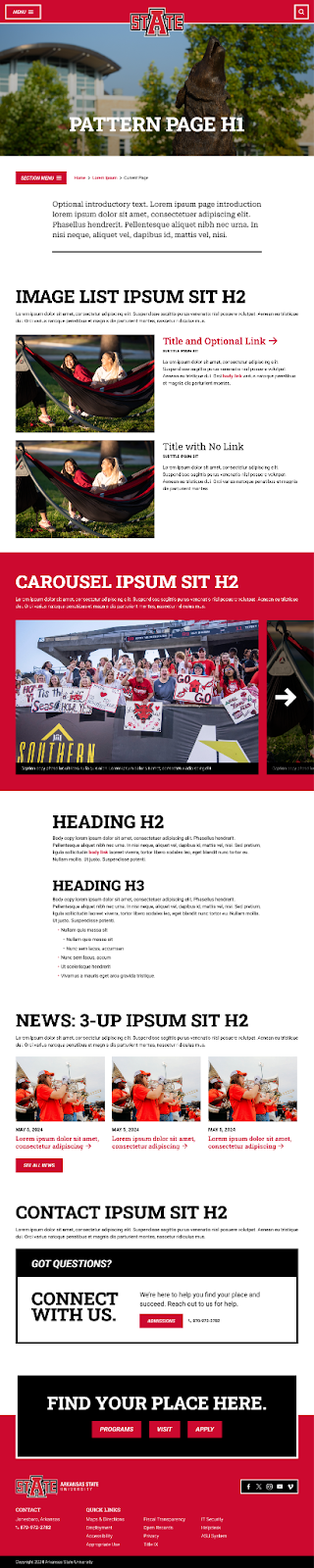
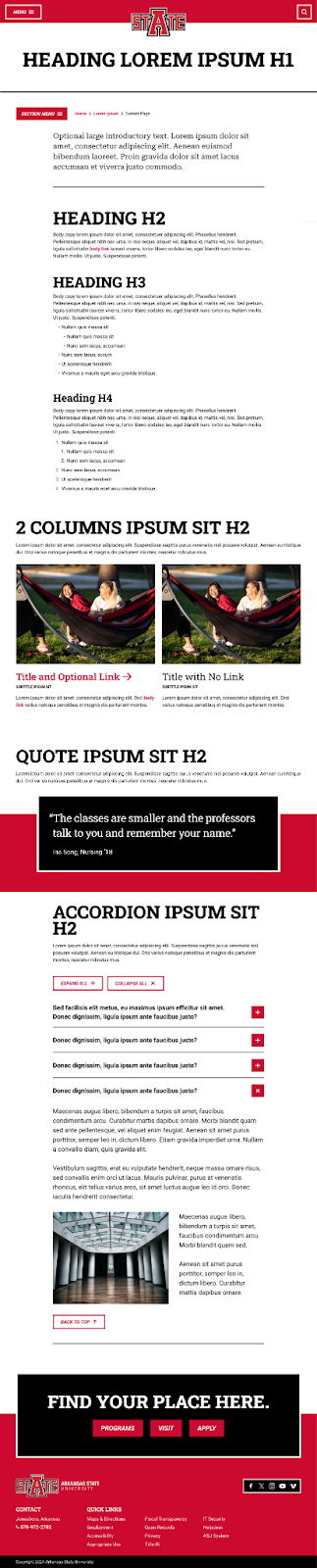
<span style="font-weight: 300;">We’re going to outline some page structure ideas in templates for you to use when creating pages, based on the content you have. Determine which kind of page aligns most with the content you have, and recreate it in your CMS with the recommended patterns.</span>

### <span style="color: #cc092f;">**How to determine your page template**</span>

<span style="font-weight: 300;">Page templates allow the user to have a consistent experience across the site, and makes it easier for us to build out pages according to user expectations. The following questions can help you determine which page template you should select. </span>

**Is this page at the first hierarchical level of the site?**

<span style="font-weight: 300;">If yes, use the</span> [**Top-Level Landing Page**](#bkmrk-top-level-landing-pa)<span style="font-weight: 300;"> template.</span>

**Is this page providing an overview for a range of programs, services, or opportunities?**

<span style="font-weight: 300;">If yes, use the </span>[**Guide Page**](#bkmrk-guide-page)<span style="font-weight: 300;"> template.</span>

**Is this page introducing one specific department, office, or group that is relevant to prospective or current students?**

<span style="font-weight: 300;">If yes, use the </span>[**Overview Page**](#bkmrk-overview-page)<span style="font-weight: 300;"> template.</span>

**Is this page sharing detailed information about one topic?**

<span style="font-weight: 300;">If yes, use the </span>[**Basic Page**](#bkmrk-basic-page)<span style="font-weight: 300;"> template.</span>

**Is this page sharing curated resources for a specific audience?**

<span style="font-weight: 300;">If yes, use the </span>[**Curated Page**](#bkmrk-curated-page)<span style="font-weight: 300;"> template.</span>

**If none of the questions above seem to apply**<span style="font-weight: 300;"> to the page you’re working on, go with the </span>[**Basic Page**](https://kb.astate.edu/books/a-state-website-governance/page/5-page-templates#bkmrk-basic-page) <span style="font-weight: 300;">template. You may always modify or add to these templates to make them fit user needs better.</span>

### <span style="color: #cc092f;">**Templates**</span>

#### **<span style="color: #000000;">Top-Level Landing Page</span>**

<table border="1" id="bkmrk-purpose-a-high-impac" style="height: 1138px; width: 100%; border-collapse: collapse;"><tbody><tr style="height: 29px;"><td style="width: 28.2716%; height: 10px; vertical-align: top;">**Purpose**</td><td style="width: 38.395%; height: 10px; vertical-align: top;">A high-impact page that prioritizes imagery &amp; linking deeper into the site.</td><td rowspan="6" style="width: 33.3333%; height: 1138px; vertical-align: top;">[![Templates1.png](https://kb.astate.edu/uploads/images/gallery/2025-06/scaled-1680-/templates1.png)](https://kb.astate.edu/uploads/images/gallery/2025-06/templates1.png)</td></tr><tr style="height: 28px;"><td style="width: 28.2716%; height: 28px; vertical-align: top;">**Content**</td><td style="width: 38.395%; height: 28px; vertical-align: top;">Include imagery, videos, testimonials, and CTAs.</td></tr><tr style="height: 29px;"><td style="width: 28.2716%; height: 29px; vertical-align: top;">**Suggested Patterns**</td><td style="width: 38.395%; height: 29px; vertical-align: top;">Photo Collage, Image List, WYSIWYG, CTA Bar, Outcomes Feature, Contact</td></tr><tr style="height: 29px;"><td style="width: 28.2716%; vertical-align: top; height: 29px; border-style: none;"> </td><td style="width: 38.395%; vertical-align: top; height: 29px; border-style: none;"> </td></tr><tr style="height: 29px;"><td style="width: 28.2716%; vertical-align: top; height: 29px; border-style: none;"> </td><td style="width: 38.395%; vertical-align: top; height: 29px; border-style: none;"> </td></tr><tr style="height: 1013px;"><td style="width: 28.2716%; vertical-align: top; border-style: none; height: 1013px;"> </td><td style="width: 38.395%; vertical-align: top; border-style: none; height: 1013px;"> </td></tr></tbody></table>

#### **Guide Page**

<table border="1" id="bkmrk-purpose-a-scannable-" style="height: 1138px; width: 100%; border-collapse: collapse;"><tbody><tr style="height: 29px;"><td style="width: 28.2716%; height: 10px; vertical-align: top;">**Purpose**</td><td style="width: 38.395%; height: 10px; vertical-align: top;">A scannable page that gives high-level overviews for a range of options, presenting each option equally.</td><td rowspan="6" style="width: 33.3333%; height: 1138px; vertical-align: top;">[![Templates2.png](https://kb.astate.edu/uploads/images/gallery/2025-07/scaled-1680-/templates2.png)](https://kb.astate.edu/uploads/images/gallery/2025-07/templates2.png)</td></tr><tr style="height: 28px;"><td style="width: 28.2716%; height: 28px; vertical-align: top;">**Content**</td><td style="width: 38.395%; height: 28px; vertical-align: top;">Include consistent links and an overview of how to compare options.</td></tr><tr style="height: 29px;"><td style="width: 28.2716%; height: 29px; vertical-align: top;">**Suggested Patterns**</td><td style="width: 38.395%; height: 29px; vertical-align: top;">3 Column, Stats + Photo, Accordion, Directory Embed, Contact</td></tr><tr style="height: 29px;"><td style="width: 28.2716%; vertical-align: top; height: 29px; border-style: none;"> </td><td style="width: 38.395%; vertical-align: top; height: 29px; border-style: none;"> </td></tr><tr style="height: 29px;"><td style="width: 28.2716%; vertical-align: top; height: 29px; border-style: none;"> </td><td style="width: 38.395%; vertical-align: top; height: 29px; border-style: none;"> </td></tr><tr style="height: 1013px;"><td style="width: 28.2716%; vertical-align: top; border-style: none; height: 1013px;"> </td><td style="width: 38.395%; vertical-align: top; border-style: none; height: 1013px;"> </td></tr></tbody></table>

#### **Overview Page**

<table border="1" id="bkmrk-purpose-a-scannable--0" style="height: 1138px; width: 100%; border-collapse: collapse;"><tbody><tr style="height: 29px;"><td style="width: 28.2716%; height: 10px; vertical-align: top;">**Purpose**</td><td style="width: 38.395%; height: 10px; vertical-align: top;">A scannable page that introduces one specific offering, department, group, or service.</td><td rowspan="6" style="width: 33.3333%; height: 1138px; vertical-align: top;">[![Templates3-A.png](https://kb.astate.edu/uploads/images/gallery/2025-07/scaled-1680-/templates3-a.png)](https://kb.astate.edu/uploads/images/gallery/2025-07/templates3-a.png)</td></tr><tr style="height: 28px;"><td style="width: 28.2716%; height: 28px; vertical-align: top;">**Content**</td><td style="width: 38.395%; height: 28px; vertical-align: top;">Primarily text content, with some stories or imagery included for visual variety.</td></tr><tr style="height: 29px;"><td style="width: 28.2716%; height: 29px; vertical-align: top;">**Suggested Patterns**</td><td style="width: 38.395%; height: 29px; vertical-align: top;">Image List, Carousel, WYSIWYG, News 3-Up, Contact</td></tr><tr style="height: 29px;"><td style="width: 28.2716%; vertical-align: top; height: 29px; border-style: none;"> </td><td style="width: 38.395%; vertical-align: top; height: 29px; border-style: none;"> </td></tr><tr style="height: 29px;"><td style="width: 28.2716%; vertical-align: top; height: 29px; border-style: none;"> </td><td style="width: 38.395%; vertical-align: top; height: 29px; border-style: none;"> </td></tr><tr style="height: 1013px;"><td style="width: 28.2716%; vertical-align: top; border-style: none; height: 1013px;"> </td><td style="width: 38.395%; vertical-align: top; border-style: none; height: 1013px;"> </td></tr></tbody></table>

#### **Basic Page**

<table border="1" id="bkmrk-purpose-a-succinct%2C-" style="height: 1138px; width: 100%; border-collapse: collapse;"><tbody><tr style="height: 29px;"><td style="width: 28.2716%; height: 10px; vertical-align: top;">**Purpose**</td><td style="width: 38.395%; height: 10px; vertical-align: top;">A succinct, primarily informational page which describes one topic in detail.</td><td rowspan="6" style="width: 33.3333%; height: 1138px; vertical-align: top;">[![Templates4-Basic.png](https://kb.astate.edu/uploads/images/gallery/2025-07/scaled-1680-/templates4-basic.png)](https://kb.astate.edu/uploads/images/gallery/2025-07/templates4-basic.png)</td></tr><tr style="height: 28px;"><td style="width: 28.2716%; height: 28px; vertical-align: top;">**Content**</td><td style="width: 38.395%; height: 28px; vertical-align: top;">Text content with images or lists as needed.</td></tr><tr style="height: 29px;"><td style="width: 28.2716%; height: 29px; vertical-align: top;">**Suggested Patterns**</td><td style="width: 38.395%; height: 29px; vertical-align: top;">WYSIWYG, 2 Column, Quote, Accordion</td></tr><tr style="height: 29px;"><td style="width: 28.2716%; vertical-align: top; height: 29px; border-style: none;"> </td><td style="width: 38.395%; vertical-align: top; height: 29px; border-style: none;"> </td></tr><tr style="height: 29px;"><td style="width: 28.2716%; vertical-align: top; height: 29px; border-style: none;"> </td><td style="width: 38.395%; vertical-align: top; height: 29px; border-style: none;"> </td></tr><tr style="height: 1013px;"><td style="width: 28.2716%; vertical-align: top; border-style: none; height: 1013px;"> </td><td style="width: 38.395%; vertical-align: top; border-style: none; height: 1013px;"> </td></tr></tbody></table>

#### **Curated Page**

<table border="1" id="bkmrk-purpose-a-page-gathe" style="height: 1137px; width: 100%; border-collapse: collapse;"><tbody><tr style="height: 29px;"><td style="width: 28.2716%; height: 10px; vertical-align: top;">**Purpose**</td><td style="width: 38.395%; height: 10px; vertical-align: top;">A page gathering a range of helpful links and resources for one specific audience.</td><td rowspan="6" style="width: 33.3333%; height: 1137px; vertical-align: top;">[![Templates5-Curated.png](https://kb.astate.edu/uploads/images/gallery/2025-07/scaled-1680-/templates5-curated.png)](https://kb.astate.edu/uploads/images/gallery/2025-07/templates5-curated.png)</td></tr><tr style="height: 28px;"><td style="width: 28.2716%; height: 27px; vertical-align: top;">**Content**</td><td style="width: 38.395%; height: 27px; vertical-align: top;">Lists of links, with and without images, and callouts for specific pieces of information that users should know.</td></tr><tr style="height: 29px;"><td style="width: 28.2716%; height: 29px; vertical-align: top;">**Suggested Patterns**</td><td style="width: 38.395%; height: 29px; vertical-align: top;">2 Column, Accordion, News 3-Up, Calendar 3-Up, Contact</td></tr><tr style="height: 29px;"><td style="width: 28.2716%; vertical-align: top; height: 29px; border-style: none;"> </td><td style="width: 38.395%; vertical-align: top; height: 29px; border-style: none;"> </td></tr><tr style="height: 29px;"><td style="width: 28.2716%; vertical-align: top; height: 29px; border-style: none;"> </td><td style="width: 38.395%; vertical-align: top; height: 29px; border-style: none;"> </td></tr><tr style="height: 1013px;"><td style="width: 28.2716%; vertical-align: top; border-style: none; height: 1013px;"> </td><td style="width: 38.395%; vertical-align: top; border-style: none; height: 1013px;"> </td></tr></tbody></table>

# 6. Pattern Library

<span style="font-weight: 300;">We will outline the different kinds of patterns available on the new site, and how they can be used. Use this library to help decide what patterns to use after you’ve chosen a page template.</span>

<span style="font-weight: 300;">Read on to learn about the different types of patterns or explore the </span>[**full pattern library**](https://kb.astate.edu/books/a-state-website-pattern-library "full pattern library")<span style="font-weight: 300;">.</span>

### <span style="color: #cc092f;">**Types of patterns**</span>

[**Visual patterns**](https://kb.astate.edu/books/a-state-website-pattern-library/chapter/visual-pattern)

<span style="font-weight: 300;">These patterns rely on imagery to leave an impression on users.</span>

[**Organizational patterns**](https://kb.astate.edu/books/a-state-website-pattern-library/chapter/organizational-patterns)

<span style="font-weight: 300;">These patterns focus on organizing primarily textual information to make it easy for users to understand information &amp; options.</span>

[**Typographic patterns** ](https://kb.astate.edu/books/a-state-website-pattern-library/chapter/typographic-patterns)

<span style="font-weight: 300;">These patterns focus on prioritizing &amp; presenting text on the page. </span>

[**Connected patterns** ](https://kb.astate.edu/books/a-state-website-pattern-library/chapter/connected-patterns)

<span style="font-weight: 300;">These patterns are used to share or connect with other content on the site, such as news, events, and social media.</span>

### <span style="color: #cc092f;">**How to choose a pattern**</span>

<span style="font-weight: 300;">Before adding a pattern, think about what kind of content you have:</span>

**Do you have access to high quality images or other media?**

<span style="font-weight: 300;">If yes, consider using a </span>[**visual pattern** ](https://kb.astate.edu/books/a-state-website-pattern-library/chapter/visual-pattern)<span style="font-weight: 300;">to display this content.</span>

**Do you need to share a variety or group of important information through text?**

<span style="font-weight: 300;">If yes, an </span>[**organizational pattern**](https://kb.astate.edu/books/a-state-website-pattern-library/chapter/organizational-patterns)<span style="font-weight: 300;"> would be best to display content in a clear &amp; consistent manner.</span>

**Do you have important announcements or timely information to share through text?**

<span style="font-weight: 300;">If yes, consider using a </span>[**typographic pattern** ](https://kb.astate.edu/books/a-state-website-pattern-library/chapter/typographic-patterns)<span style="font-weight: 300;">to ensure this information is highly visible and emphasized.</span>

**Are you looking to link to social media?**

<span style="font-weight: 300;">If yes, a </span>[**connected pattern**](https://kb.astate.edu/books/a-state-website-pattern-library/chapter/connected-patterns)<span style="font-weight: 300;"> may have the flexibility you need to share links.</span>

**Are you looking to share news or events?**

<span style="font-weight: 300;">If yes, some </span>[**connected patterns**](https://kb.astate.edu/books/a-state-website-pattern-library/chapter/connected-patterns)<span style="font-weight: 300;"> allow you to dynamically or manually link to that content.</span>

### <span style="color: #cc092f;">**Visual Patterns**</span>

- [<span style="font-weight: 300;">Carousel</span>](https://kb.astate.edu/books/a-state-website-pattern-library/page/carousel)
- [<span style="font-weight: 300;">Image</span>](https://kb.astate.edu/books/a-state-website-pattern-library/page/image)
- [<span style="font-weight: 300;">Image List</span>](https://kb.astate.edu/books/a-state-website-pattern-library/page/image-list)
- [<span style="font-weight: 300;">Photo Collage</span>](https://kb.astate.edu/books/a-state-website-pattern-library/page/photo-collage)
- [<span style="font-weight: 300;">Story Display</span>](https://kb.astate.edu/books/a-state-website-pattern-library/page/story-display)
- [<span style="font-weight: 300;">Video</span>](https://kb.astate.edu/books/a-state-website-pattern-library/page/video)

### <span style="color: #cc092f;">**Organizational Patterns**</span>

- [<span style="font-weight: 300;">2 Column</span>](https://kb.astate.edu/books/a-state-website-pattern-library/page/2-column)
- [<span style="font-weight: 300;">3 Column</span>](https://kb.astate.edu/books/a-state-website-pattern-library/page/3-column)
- [<span style="font-weight: 300;">Accordion</span>](https://kb.astate.edu/books/a-state-website-pattern-library/page/accordion)

### <span style="color: #cc092f;">**Typographic Patterns**</span>

- [<span style="font-weight: 300;">Contact</span>](https://kb.astate.edu/books/a-state-website-pattern-library/page/contact)
- [<span style="font-weight: 300;">CTA Bar</span>](https://kb.astate.edu/books/a-state-website-pattern-library/page/cta-bar)
- [<span style="font-weight: 300;">Outcome Feature</span>](https://kb.astate.edu/books/a-state-website-pattern-library/page/outcomes-feature)
- [<span style="font-weight: 300;">Quote</span>](https://kb.astate.edu/books/a-state-website-pattern-library/page/quote)
- [<span style="font-weight: 300;">Statistics</span>](https://kb.astate.edu/books/a-state-website-pattern-library/page/statistics)
- [<span style="font-weight: 300;">Stats + Photo</span>](https://kb.astate.edu/books/a-state-website-pattern-library/page/stats-photo)

### <span style="color: #cc092f;">**Connected Patterns**</span>

- [<span style="font-weight: 300;">Calendar 3-Up</span>](https://kb.astate.edu/books/a-state-website-pattern-library/page/calendar-3-up)
- [<span style="font-weight: 300;">Directory Embed</span>](https://kb.astate.edu/books/a-state-website-pattern-library/page/directory-embed)
- [<span style="font-weight: 300;">Instagram</span>](https://kb.astate.edu/books/a-state-website-pattern-library/page/instagram)
- [<span style="font-weight: 300;">News 3-Up</span>](https://kb.astate.edu/books/a-state-website-pattern-library/page/news-3-up)

# 7. Brand Voice Guidelines

### **<span style="color: #cc092f;">What is a brand?</span>** 

<span style="font-weight: 300;">“A brand is the identity and story of a company that makes it stand out from competitors that sell similar products or services. The goal of branding is to earn space in the minds of the target audience and become their preferred option for doing business.” - Hubspot</span>

<span style="font-weight: 300;">Whether you realize it or not, your school is a brand. You have a unique story and a unique experience to “sell” to students and your website should represent this. From open houses and campus tours to emails, social media, and your website, everyone should know your brand and understand their role in maintaining the brand values. If you boast a “friendly, welcoming environment,” on campus then you want everyone from the professors to the administrators to the cleaning staff to feel and show that too. Your digital content, including the website, should operate the same way.</span>

<span style="font-weight: 300;">Current high school students, first-gen students, and adult students alike rank the website as the most used and most helpful information source they use during their search process (RNL, </span>[<span style="font-weight: 300;">E-Expectations Trend Report</span>](https://learn.ruffalonl.com/rs/395-EOG-977/images/2023_E-Expectations_Report.pdf?_gl=1*vdg826*_ga*MTQ1MTk1NDMyNC4xNjk5Mzg0NDcz*_ga_LJVH05YF0P*MTY5OTM4NDQ3My4xLjEuMTY5OTM4NDY3MC41OS4wLjA)<span style="font-weight: 300;">). Therefore, it is critical that your website leverages your brand and the experience that students will have at your school, so take the time to get to know your brand and what you have to offer that sets you apart from other schools. Then, be sure to implement that experience into your web content. </span>

### <span style="color: #cc092f;">**What is the A-State brand?**</span>

<span style="font-weight: 300;">Brand goals are determined by strategic priorities and create a unique value proposition that will entice prospective students and help them succeed in reaching their goals. For A-State brand identity to succeed, the visual and language guidelines need to be expressed clearly and consistently across all materials, platforms, and channels. </span>

<span style="font-weight: 300;">The A-State brand reflects a dynamic, inclusive, and forward-thinking identity, rooted in community pride and academic excellence. Our brand values include:</span>

1. **Every Red Wolf Counts:**<span style="font-weight: 300;"> A-State emphasizes creating a close-knit, supportive environment where students can find a sense of home and connection​​.</span>
2. **Innovation and Research**<span style="font-weight: 300;">: With its R2 designation as a "High Research Activity" institution, A-State highlights experiential learning opportunities, collaborative projects with organizations like NASA and USDA, and a commitment to impactful research​​.</span>
3. **Accessibility and Opportunity**<span style="font-weight: 300;">: A-State positions itself as accessible and affordable, with strong support for first-generation and non-traditional students. The university focuses on guiding students through admissions, financial aid, and academic success with minimal barriers​​.</span>
4. **Pride and Tradition**<span style="font-weight: 300;">: Red Wolf traditions, campus life, and NCAA Division I athletics foster a strong school spirit and pride​.</span>
5. **Global Engagement**<span style="font-weight: 300;">: The A-State community is comprised of a vibrant mix of cultures and offers study abroad opportunities and international campuses to enhance global perspectives​​.</span>

**Mission Statement**<span style="font-weight: 300;">: Arkansas State educates leaders, enhances intellectual growth, and enriches lives.</span>

**Core Message:***<span style="font-weight: 300;"> A-State is a “big time” university that is student-friendly and innovative. We offer world-class academics, exciting student research opportunities, a vibrant campus life experience, NCAA Division I athletics, etc. The two words we feel describe it are dynamic and distinguished. We want our website to indicate that we are a destination university.</span>*

<span style="font-weight: 300;">Overall, the A-State brand communicates a welcoming and empowering environment where students are equipped to achieve their personal and professional aspirations while making meaningful contributions to their communities and beyond.</span>

### <span style="color: #cc092f;">**How do I put the brand into action?**</span>

<span style="font-weight: 300;">Content—written and visual—should reflect these on both a macro and micro level. It’s not just about which words we use or who appears in the images; it’s about ensuring that the story we tell across the website consistently aligns with these values. </span>

<span style="font-weight: 300;">To put the A-State brand into action, it’s essential to integrate our brand values and mission into every aspect of communication, ensuring consistency and resonance with target audiences.</span>

<span style="font-weight: 300;">Start by focusing on one or two of the brand values. They are essential features that we want our audiences to associate with A-State, and elaborate on the mission statement and core message described above. </span>

1. **Community and Belonging**<span style="font-weight: 300;">: Showcase stories of students finding a home at A-State, participating in traditions, and connecting through clubs, athletics, and events.</span>
2. **Innovation and Research**<span style="font-weight: 300;">: Highlight research projects, faculty accomplishments, and partnerships with organizations like NASA and USDA.</span>
3. **Accessibility and Opportunity**<span style="font-weight: 300;">: Feature testimonials from first-generation and non-traditional students, and provide clear, accessible information on financial aid and resources. Remember to check for accessibility. We need to walk the walk if we’re going to talk the talk.</span>
4. **Pride and Tradition**<span style="font-weight: 300;">: Celebrate A-State’s unique traditions, Red Wolf pride, and NCAA Division I athletics in engaging ways.</span>
5. **Global Engagement**<span style="font-weight: 300;">: Include content that showcases cultural events, study abroad programs, and the wide-ranging backgrounds of students at A-State.</span>

<span style="font-weight: 300;">By embedding A-State’s brand values and goals into every piece of communication, the university can effectively tell its story, inspire action, and build meaningful connections with its audience.</span>

# 8. Copywriting Best Practices

<span style="font-weight: 300;">Follow these style guidelines and best practices to write engaging and clear pages.</span>

### <span style="color: #cc092f;">**Writing Style Guide**</span>

<span style="font-weight: 300;">Style refers to the guidelines that editors and writers follow whenever they refer to persons, places and things; whenever they capitalize, abbreviate, punctuate or spell. </span>

<span style="font-weight: 300;">Explore our </span>[**Writing Style Guide**](https://kb.astate.edu/books/writing-style-guide "Writing Style Guide")**.**

### <span style="color: #cc092f;">**Where Do I Begin?**</span>

<span style="font-weight: 300;">Before writing content for your page, read through:</span>

[**New Page Prep Worksheet**](https://kb.astate.edu/books/a-state-website-governance/page/4-new-page-prep "New Page Prep Worksheet")**:** <span style="font-weight: 300;">Who are you writing for? What’s the purpose of the new page? What resources do you have? </span>

[**Page Creation Guidelines**](https://kb.astate.edu/books/a-state-website-governance/page/3-page-creation-site-structure-guidelines "Page Creation Guidelines")**:**<span style="font-weight: 300;"> Is your content going in the right place?</span>

**Keep in mind:**<span style="font-weight: 300;"> The goal of your page, and your copy, is to inspire action in your audience.</span>

<span style="font-weight: 300;"> </span>

### <span style="color: #cc092f;">**What type of page am I writing/editing?**</span>

<span style="font-weight: 300;">When writing or editing content, it’s important to first understand the primary purpose of the page you’re working on. This understanding shapes how you approach the tone, structure, and functionality of the content. Some of the tips provided in this guide will be more relevant to your specific page type, while others may have less bearing. Exercise your best judgment, but always prioritize clarity, usability, and alignment with A-State’s brand values.</span>

- **Identify the Page’s Purpose**

1. **Is it marketing-focused?** <span style="font-weight: 300;">Marketing-heavy pages are designed to capture attention, inspire engagement, and persuade the reader to take action (e.g., request information, schedule a visit, or apply). These pages often require a more dynamic and engaging tone, as well as the use of strong visual elements, storytelling, and clear calls-to-action (CTAs). Consider how the page will communicate A-State’s unique value proposition and make a strong impression on prospective students.</span>
2. **Is it transactional or straightforward?** <span style="font-weight: 300;">Transactional pages serve a more functional role, such as providing specific information or guiding users through a process (e.g., submitting an application, reviewing tuition fees, or checking degree requirements). While the content may be more straightforward, it’s still important to frame the information in a way that’s user-friendly, clear, and engaging. Even these pages can subtly reinforce the A-State brand through thoughtful language, tone, and organization.</span>

2. **Keep the Prospective Student at the Center**<span style="font-weight: 400;">: </span><span style="font-weight: 300;">No matter the type of page, always write with the prospective student’s needs, questions, and journey in mind. Consider:</span>
1. **How will this page help them**<span style="font-weight: 400;">? </span><span style="font-weight: 300;">Ensure the content provides value, whether it’s answering questions, clarifying a process, or inspiring them to envision themselves at A-State.</span>
2. **What can they learn about A-State from this page**<span style="font-weight: 400;">? </span><span style="font-weight: 300;">Every page, whether functional or marketing-focused, should contribute to the overall story of A-State. Even a seemingly transactional page, like one explaining financial aid, can emphasize the university’s commitment to accessibility and student support.</span>


- **Framing Content Effectively**

1. **For transactional pages:**<span style="font-weight: 300;"> While these pages are more utilitarian, consider how to frame the content in a way that draws users into the experience. Use clear headings, concise language, and straightforward navigation to make the information easy to find and understand. Add value by highlighting how A-State simplifies or supports the process being explained.</span>
2. **For marketing-heavy pages:**<span style="font-weight: 300;"> Leverage the full suite of tools available—visual elements, storytelling, and strategic organization of content. Use page display types (e.g., image galleries, testimonials, CTAs) to market A-State’s strengths effectively. Ensure that every element of the page works cohesively to create an inspiring and memorable experience.</span>


- **Leveraging A-State’s Brand Values**

1. **Reinforce the A-State identity**<span style="font-weight: 300;"> through the tone, imagery, and storytelling used in your content.</span>
2. **Highlight brand values like**<span style="font-weight: 300;"> innovation, inclusivity, and community pride to build trust and connection with your audience.</span>


<span style="font-weight: 300;">Whether your page is primarily marketing or transactional, always strive to create a seamless user experience that aligns with A-State’s mission and values. Every page is an opportunity to connect with prospective students, showcase A-State’s strengths, and help guide users on their journey.</span>

### **<span style="color: #cc092f;">Writing for the Web Tips</span>** 

<span style="font-weight: 300;">Writing for the web doesn’t have to be daunting. You </span>*<span style="font-weight: 300;">can</span>*<span style="font-weight: 300;"> write! Follow these tips to craft effective, audience-focused content.</span>

- **Always Ask: "Why Should They Care?"**

1. <span style="font-weight: 400;">Write for your audience.</span><span style="font-weight: 300;"> Think about the prospective student.</span>
1. <span style="font-weight: 300;">Use personas to guide your tone and content.</span>
2. <span style="font-weight: 300;">Speak </span>*<span style="font-weight: 300;">to</span>*<span style="font-weight: 300;"> readers, not </span>*<span style="font-weight: 300;">at</span>*<span style="font-weight: 300;"> them. Use “you” (not “students”) and “we” (not “the school”).</span>

3. <span style="font-weight: 400;">Focus on benefits.</span><span style="font-weight: 300;"> Instead of listing what your office/program offers, show how it benefits the audience.</span>
1. <span style="font-weight: 300;">Example: Instead of “Our mission is…,” rewrite it to reflect how it impacts students directly.</span>
2. <span style="font-weight: 400;">Student-focused example:</span><span style="font-weight: 300;"> “At \[Department Name\], we’re here to help you \[specific benefit\].”</span>


- **Start Strong**

1. <span style="font-weight: 400;">Make your headline count.</span><span style="font-weight: 300;"> A great headline grabs attention and encourages readers to keep going.</span>
2. <span style="font-weight: 300;">Use the Eugene Schwartz method: Every sentence compels the reader to move to the next.</span>
3. <span style="font-weight: 300;">If the tone allows, align your headline with your brand personality—even if it’s transactional.</span>


- **Tell Student Stories**

1. <span style="font-weight: 400;">Why stories?</span>
1. <span style="font-weight: 400;">Human connection.</span><span style="font-weight: 300;"> They make your services relatable.</span>
2. <span style="font-weight: 400;">Originality.</span><span style="font-weight: 300;"> Your student, faculty, and alumni stories are unique to your institution.</span>

3. <span style="font-weight: 400;">What makes a story?</span>
1. <span style="font-weight: 400;">Character:</span><span style="font-weight: 300;"> The audience (your student) who wants something.</span>
2. <span style="font-weight: 400;">Problem:</span><span style="font-weight: 300;"> A challenge they face.</span>
3. <span style="font-weight: 400;">Guide:</span><span style="font-weight: 300;"> Your program or service that helps.</span>
4. <span style="font-weight: 400;">Call to Action:</span><span style="font-weight: 300;"> The steps they take.</span>
5. <span style="font-weight: 400;">Success:</span><span style="font-weight: 300;"> The outcome they achieve.</span>

5. <span style="font-weight: 300;">Show how your audience can avoid failure, succeed, and act. Use buttons and links to drive engagement.</span>


- **Keep It Clear and Easy**

1. <span style="font-weight: 400;">Be conversational.</span><span style="font-weight: 300;"> Write in a way that feels natural to your audience.</span>
2. <span style="font-weight: 300;">Use:</span>
1. <span style="font-weight: 300;">Bullet points and lists for scannability.</span>
2. <span style="font-weight: 300;">Short sentences and paragraphs.</span>

4. <span style="font-weight: 400;">Check readability.</span><span style="font-weight: 300;"> Aim for a 9th-grade level for broad content (use tools like HemingwayApp).</span>
1. <span style="font-weight: 300;">Exceptions: Technical or detailed content (policies, procedures, etc.).</span>


- **Tips for Engaging Copy**

1. <span style="font-weight: 400;">Draw inspiration.</span><span style="font-weight: 300;"> Use content from other departments or competitors as a starting point, then make it your own.</span>
2. <span style="font-weight: 400;">Avoid weak language.</span>
1. <span style="font-weight: 300;">Skip adverbs and passive voice.</span>
2. <span style="font-weight: 300;">Use strong, specific verbs (e.g., “cultivate” instead of “form”).</span>

4. <span style="font-weight: 400;">Break the rules—strategically.</span>
1. <span style="font-weight: 300;">Use contractions.</span>
2. <span style="font-weight: 300;">Starting sentences with “and,” “but,” or “because” is okay for emphasis.</span>
3. <span style="font-weight: 300;">Use sentence fragments sparingly for impact.</span>

6. <span style="font-weight: 400;">Revisit your work.</span><span style="font-weight: 300;"> Write a draft, then return with fresh eyes to revise and refine.</span>


- **Stay True to Your Brand**

1. <span style="font-weight: 300;">Reflect your institution’s unique values in every piece.</span>
2. <span style="font-weight: 300;">Highlight what sets you apart:</span>
1. <span style="font-weight: 300;">What’s unique about your program or services?</span>
2. <span style="font-weight: 300;">What outcomes can students expect?</span>


<span style="font-weight: 300;">By following these guidelines, you’ll write content that’s clear, engaging, and action-driven.</span>

# 9. Multimedia Do & Don’ts

### <span style="color: #cc092f;">**How important is multimedia?**</span>

<span style="font-weight: 300;">Multimedia content is a key display type in the A-State visual language. Prospective students prefer multimedia content that is:</span>

- <span style="font-weight: 300;">Authentic</span>
- <span style="font-weight: 300;">Concise</span>
- <span style="font-weight: 300;">Visual</span>
- <span style="font-weight: 300;">Peer-approved</span>
- <span style="font-weight: 300;">Purpose-driven</span>
- <span style="font-weight: 300;">Mobile-friendly</span>

### <span style="color: #cc092f;">**What makes a photo/video “on-brand” for A-State?**</span>

<span style="font-weight: 300;">A-State photography should fall in line with the success criteria for the brand:</span>

- <span style="font-weight: 300;">Convey the supportive, community-oriented nature of A-State</span>
- <span style="font-weight: 300;">Showcase the aspects of A-State that are unmatched by our competitors</span>
- <span style="font-weight: 300;">Highlight the value of an A-State education as a soft launching pad that helps students succeed and prepares them for next steps in education or career</span>
- <span style="font-weight: 300;">Support a mobile-friendly web experience that considers users with varying bandwidth access </span>

<span style="font-weight: 300;">Every effort should be made to ensure photography and video aligns with A-State brand voice. Photography and videography should have an authentic feel, use rich color, and support A-State brand identity and key messages.</span>

**All photos used must be properly sourced and cleared for use, ensuring they are either owned by Arkansas State University, licensed for use, or fall under public domain or copyright-free guidelines. Unauthorized or copyrighted images should not be used without proper permissions. Website contributors should use the** [**A-State Photography Portal**](http://photos.astate.edu) **and avoid using clipart or external stock photography, if possible.**

### <span style="color: #cc092f;">**Style Guidelines**</span>

#### **General Qualities**

<span style="font-weight: 300;">All photography, regardless of subject and distance, should share the following qualities:</span>

- <span style="font-weight: 300;">Be well-lit – Having adequate brightness and contrast</span>
- <span style="font-weight: 300;">Be authentic – Relying on non-posed scenes with genuine expressions</span>
- <span style="font-weight: 300;">Have dynamic angles – Leaning into asymmetry and interesting points of view</span>
- <span style="font-weight: 300;">Use a journalistic lens - the viewer should feel invested in the subject</span>

####  **Portraits**

<span style="font-weight: 300;">Highlight the strength and personality of individuals</span>

- <span style="font-weight: 300;">Pair these with quotes or bios</span>
- <span style="font-weight: 300;">Non busy backgrounds – To keep the attention on the subject’s face</span>
- <span style="font-weight: 300;">Choose simple backgrounds when possible – uncluttered walls, foliage</span>
- <span style="font-weight: 300;">Shallow depth of field – blur out irrelevant details</span>
- <span style="font-weight: 300;">Genuine expression – Ensure faces convey genuine emotion – pride, happiness, determination. Avoid blank expressions and “fake” smiles.</span>
- <span style="font-weight: 300;">Cropped just below the shoulders</span>

[![Multimedia-1.png](https://kb.astate.edu/uploads/images/gallery/2025-07/scaled-1680-/multimedia-1.png)](https://kb.astate.edu/uploads/images/gallery/2025-07/multimedia-1.png)

####  **Situations**

<span style="font-weight: 300;">Show off how learning and interaction works at A-State</span>

- <span style="font-weight: 300;">Include the environment if it contributes to understanding the subject – for example, a lab, classroom, or street scene</span>
- <span style="font-weight: 300;">Invite the viewer into the scene – have a strong focal point and avoid too many backs of people</span>

<span style="font-weight: 300;">[![Multimedia-2.png](https://kb.astate.edu/uploads/images/gallery/2025-07/scaled-1680-/multimedia-2.png)](https://kb.astate.edu/uploads/images/gallery/2025-07/multimedia-2.png)</span>

####  **Environments**

<span style="font-weight: 300;">Convey the character of a large space, for tone-setting</span>

- <span style="font-weight: 300;">Use occasionally</span>
- <span style="font-weight: 300;">Landscape shots of campus that establish the location as well as show off an exciting and bustling campus life</span>
- <span style="font-weight: 300;">Local landmarks, street scenes, and hot spots</span>

<span style="font-weight: 300;">[![Multimedia-3.png](https://kb.astate.edu/uploads/images/gallery/2025-07/scaled-1680-/multimedia-3.png)](https://kb.astate.edu/uploads/images/gallery/2025-07/multimedia-3.png)</span>

####  **Objects**

<span style="font-weight: 300;">Used to symbolically represent subject matter and give a future-focused appearance</span>

- <span style="font-weight: 300;">Use occasionally</span>
- <span style="font-weight: 300;">Stock is okay– used selectively</span>
- <span style="font-weight: 300;">Avoid cliches (examples: a gavel or beaker for “science”, dollar bills for “money”)</span>

<span style="font-weight: 300;">[![Multimedia-4.png](https://kb.astate.edu/uploads/images/gallery/2025-07/scaled-1680-/multimedia-4.png)](https://kb.astate.edu/uploads/images/gallery/2025-07/multimedia-4.png)</span>

#### **Incorrect Usages**

<table border="1" id="bkmrk-avoid-abstract%2C-impe" style="width: 70%; border-collapse: collapse;"><tbody><tr><td style="width: 50%; vertical-align: top;">AVOID Abstract, impersonal illustrations in place of custom images.</td><td style="width: 50%; vertical-align: top;">[![Multimedia-5_a.jpg](https://kb.astate.edu/uploads/images/gallery/2025-07/scaled-1680-/multimedia-5-a.jpg)](https://kb.astate.edu/uploads/images/gallery/2025-07/multimedia-5-a.jpg)</td></tr><tr><td style="width: 50%; vertical-align: top;"><span style="font-weight: 400;">AVOID Overly filtered/stylized shots. Especially images that flatten the content using cool-toned filters.</span></td><td style="width: 50%; vertical-align: top;">[![Multimedia-5_b.jpg](https://kb.astate.edu/uploads/images/gallery/2025-07/scaled-1680-/multimedia-5-b.jpg)](https://kb.astate.edu/uploads/images/gallery/2025-07/multimedia-5-b.jpg)</td></tr><tr><td style="width: 50%; vertical-align: top;">AVOID Extreme angles and stylized lens techniques (such as fish eye, zoom, and blur).</td><td style="width: 50%; vertical-align: top;">[![Multimedia-5_c.jpg](https://kb.astate.edu/uploads/images/gallery/2025-07/scaled-1680-/multimedia-5-c.jpg)](https://kb.astate.edu/uploads/images/gallery/2025-07/multimedia-5-c.jpg)</td></tr><tr><td style="width: 50%; vertical-align: top;">AVOID Over-laying distracting graphics/text.</td><td style="width: 50%; vertical-align: top;">[![Multimedia-5_d.jpg](https://kb.astate.edu/uploads/images/gallery/2025-07/scaled-1680-/multimedia-5-d.jpg)](https://kb.astate.edu/uploads/images/gallery/2025-07/multimedia-5-d.jpg)</td></tr></tbody></table>

### **<span style="color: #cc092f;">Shot Recommendations</span>** 

<span style="font-weight: 300;">Based on the Designed Screens and Sitemap, the following is a list of recommended shots for populating the website: </span>

#### **Campus Photography**

<span style="font-weight: 300;">Campus photos play an important role in giving students the context of their surroundings. Photographers should capture a good balance of simple, establishing shots and more personal shots displaying bustling student life. </span>

##### **Campuses**

- <span style="font-weight: 300;">Photos with and without campus signage.</span>
- <span style="font-weight: 300;">Large groups of students walking around the campuses:</span>
- <span style="font-weight: 300;">Shots capturing the motion on campus: students commuting from place to place.</span>
- <span style="font-weight: 300;">Smaller groups of students and individuals with recognizable campus features in the background.</span>
- <span style="font-weight: 300;">Exterior shots of important facilities on each campus. Capture a range of facilities that are academically significant and can be used on program-specific pages.</span>
- <span style="font-weight: 300;">Campuses in different seasons/decorated for specific holidays. </span>

##### **Amenities**

<span style="font-weight: 300;">Show off A-State amenities in an engaging way. It may be useful to photograph facilities in a plain, establishing way, but also show them in use. Add human subjects to these shots as well as showing multiple subjects interacting.</span>

- <span style="font-weight: 300;">Housing</span>
- <span style="font-weight: 300;">Health and Safety</span>
- <span style="font-weight: 300;">Offices and Faculty </span>
- <span style="font-weight: 300;">Fitness Centers</span>
- <span style="font-weight: 300;">Libraries</span>

#### **Local Culture**

<span style="font-weight: 300;">The campuses aren’t the only part of A-State story. The local area have a large influence over the culture. Photographers should capture the essence of the local culture and show what a beautiful place A-State is. These images can be used on the About and Visit pages. </span>

#### **Student Life**

<span style="font-weight: 300;">Show off the student life by using an intimate, personal lens. Get up close and personal with students in their natural environment. Student features are not only a great way to highlight a unique story of success, but demonstrate how others can follow in their footsteps. These vignettes can act as a vehicle for showing the impact of certain clubs, programs, mentors, and facilities on campus.</span>

<span style="font-weight: 300;">Ideally, the students whose stories are being highlighted are the same ones being photographed for the website.</span>

- <span style="font-weight: 300;">The viewer should feel like they’re getting an inside look at this student’s life on campus. </span>
- <span style="font-weight: 300;">Photographers should capture a good mix of posed portraits and shots of the student in action. Depending on what is being highlighted, either of these could be useful.</span>

<span style="font-weight: 300;">Student stories are a great way to add a personal touch to other information across the site. When gathering stories, keep in mind how they might add substance to the following:</span>

- <span style="font-weight: 300;">Pathways of study (e.g. different types of students and applicants) </span>
- <span style="font-weight: 300;">Program information (e.g. a story highlighting the Biology program and how a student took advantage of A-State resources) </span>
- <span style="font-weight: 300;">Clubs and organizations (e.g. the president of a student organization)</span>
- <span style="font-weight: 300;">Faculty (e.g. how a student was inspired and mentored by a faculty member)</span>
- <span style="font-weight: 300;">Facilities (e.g. a student who took advantage of a creative space on campus to create a work of art)</span>
- <span style="font-weight: 300;">Athletics (e.g. how a student balances their academic and athletic interests)</span>

#### **Faculty and Alumni**

<span style="font-weight: 300;">When gathering photographs of faculty members and alumni, treat them similarly to students by humanizing them and showing them in a social context. These photos should build upon A-State community image, how do you want to come across to those who don’t know you? Showing a welcoming, diverse cast of characters that allows viewers to create a personal connection.</span>

<span style="font-weight: 300;">As well as gathering posed portraits, photographers should show faculty supporting students:</span>

- <span style="font-weight: 300;">Tutoring Services</span>
- <span style="font-weight: 300;">Academic Advising</span>
- <span style="font-weight: 300;">Skills Development Resources</span>
- <span style="font-weight: 300;">Disability Services </span>

<span style="font-weight: 300;">Build out the community image by showing Alumni stories and the possibilities that await after a A-State education. These can be used in tandem with program information in order to demonstrate how students could use their degree in the future. </span>

#### **Program Highlights**

<span style="font-weight: 300;">Academic programs are the “products” you offer. As such, we recommend that your Program Detail pages are engaging and visually appealing, highlighting the experiences students will have while studying at A-State.</span>

<span style="font-weight: 300;">In addition to one hero image, </span>**use at least one more photo per program**<span style="font-weight: 300;">. More may be needed if a program has more to offer. Images may come in the form of a student or faculty story, a carousel, in the WYSIWYG editor, or any other pattern.</span>

- <span style="font-weight: 300;">The Hero image should not be too visually overwhelming since there will be text placed on top of it. Avoid busy computer screens, faces getting overlapped by text, and nondescript placeholder imagery.</span>

<span style="font-weight: 300;">Gathering a wide range of generic shots of programs can provide content for other pages across the site. A lot of topics on the site do not yield visually interesting photo opportunities, so photographers should create a repository of program images to accurately represent the student experience. The following topics would benefit from supplemental program imagery:</span>

- <span style="font-weight: 300;">Registration</span>
- <span style="font-weight: 300;">Applications and Admissions </span>
- <span style="font-weight: 300;">Online Programming</span>
- <span style="font-weight: 300;">Program Catalogs</span>
- <span style="font-weight: 300;">Testing and Placement</span>
- <span style="font-weight: 300;">Workforce Development</span>
- <span style="font-weight: 300;">Fees and Financial Aid</span>
- <span style="font-weight: 300;">Academic Support</span>

#### **News and Events**

<span style="font-weight: 300;">News stories should be populated with an appropriate image. As these swap out for new stories, ensure that all featured articles and events have an accompanying image. This may be a big lift since there are a lot of existing articles and upcoming events, so employ stock imagery here if necessary. </span>

### <span style="color: #cc092f;">**Image Storage and File Naming**</span>

#### **Naming Images**

<span style="font-weight: 300;">When you upload a new image, it will be uploaded to the A-State media library in the CMS. Naming images clearly allows other users - or maybe even yourself! - to find a relevant image at a later date if they do not have one on hand. </span>

**When uploading your image, please follow these naming convention guidelines:**

- <span style="font-weight: 300;">Briefly describe the image. Try to keep the description under 5 words </span>
- <span style="font-weight: 300;">You can eliminate “stop words” such as “in,” “and,” “the,” etc.</span>

- <span style="font-weight: 300;">File names should always be lower case</span>
- <span style="font-weight: 300;">Use hyphens to separate words. </span><span style="font-weight: 300;">Do not use spaces.</span>
- <span style="font-weight: 300;">File names should have only letters or numbers (or hyphens)</span>
- <span style="font-weight: 300;">If there are multiple versions of the same image, add the image size at the end</span>
- <span style="font-weight: 300;">If you have a particular keyword for the page, trying to insert it into the file name is a plus</span>

**Good image titles:**

- <span style="font-weight: 300;">chemistry-professor-lecture.jpg</span>
- <span style="font-weight: 300;">students-collaborating-writing-center-400x400.jpg</span>
- <span style="font-weight: 300;">students-collaborating-writing-center-1080x720.jpg</span>

**Bad image titles:**

- <span style="font-weight: 300;">Untitled1.jpg</span>
- <span style="font-weight: 300;">IMG\_3084.jpg</span>
- <span style="font-weight: 300;">Screen Shot 2019-03-08 at 1\_08\_55 PM.png</span>

**Alt text:**

- <span style="font-weight: 300;">Alt text is used for both accessibility and SEO purposes.</span>
- <span style="font-weight: 300;">Describing the image clearly is priority #1. See the Accessibility guidelines for more information.</span>

#### **Image Sizes**

<span style="font-weight: 300;">Follow these sizing requirements to optimize the designs and display of imagery.</span>

[**Image Sizes (PDF)**](https://drive.google.com/file/d/1uAHHFecK1pmPuKZEx54otZPttTUmwsp0/view?usp=drive_link)

### <span style="color: #cc092f;">**Videos: Best Practices**</span>

<span style="font-weight: 300;">A-State already has some quality videos on its YouTube channel and across the site but many of the videos are outdated. Whether you’re choosing from existing video assets or creating from scratch, keep the following guidelines top of mind.</span>

#### **Keep it real**

<span style="font-weight: 300;">Use diverse, user-generated content that is authentic. Staged photos and videos won’t pass the sniff test. Prospective students don’t want to be sold to. They want to be understood and respected. They want to be spoken to like adults. They want to see themselves in someone else.</span>

- <span style="font-weight: 300;">Featured A-State students, faculty, &amp; alumni should feel confident, direct, and successful.</span>
- <span style="font-weight: 300;">Focus on polished ‘real talk’: overcoming obstacles, and achieving goals</span>
- <span style="font-weight: 300;">Keep the visual fabric rich</span>
- <span style="font-weight: 300;">Allow groups to bring natural energy to the conversation</span>
- <span style="font-weight: 300;">Consider user-generated content (with permission) </span>

#### **Make it snappy**

<span style="font-weight: 300;">Short. Timely. Layered context. Prospective students are impatient. They want to get as much information as possible as quickly as possible. Value their time by focusing on what’s really important.</span>

- <span style="font-weight: 300;">Focus on snackable video content. 1-2 minutes is ideal. No mini-lectures</span>
- <span style="font-weight: 300;">Use simple captions to provide additional context and to add a layer of A-State branding and voices</span>

#### **Ensure Accessibility**

<span style="font-weight: 300;">Accessibility isn’t just a nice-to-have; it’s essential for providing equal access to information and ensuring that all audiences, including those with disabilities, can fully engage with your video content. While automatic captions generated by platforms like YouTube are a starting point, they often fall short in terms of accuracy and clarity. To meet accessibility standards and offer a more inclusive viewing experience, consider the following:</span>

1. **Accurate, Human-Edited Captions**


- <span style="font-weight: 300;">Review and correct autocaptions to ensure timing, spelling, and grammar accurately reflect the spoken dialogue.</span>
- <span style="font-weight: 300;">Include captions for all speech, as well as relevant non-speech audio elements (e.g., laughter, applause, background music, sound effects). This ensures that viewers who are Deaf or hard of hearing can follow along without missing context.</span>

- **Transcripts for Supplemental Access**


- <span style="font-weight: 300;">Provide a full transcript of the video content— including descriptions of important on-screen actions or visuals not described in the dialogue. This benefits users who rely on screen readers and allows those without the ability to watch video to still access the information.</span>
- <span style="font-weight: 300;">Post transcripts alongside the video or make them easily accessible via a link in the description.</span>

- **Audio Descriptions for Visual Content**


- <span style="font-weight: 300;">If your video heavily relies on visuals (such as diagrams, text overlays, or demonstrations) to convey information not spoken aloud, consider adding audio descriptions. These narrations fill in details that blind or low-vision users may otherwise miss.</span>
- <span style="font-weight: 300;">Integrate these descriptions into the main audio track or provide a secondary audio track that can be enabled as needed.</span>

- **Clear, Legible On-Screen Text**


- <span style="font-weight: 300;">If using titles, lower-thirds, or text overlays, ensure high contrast between text and background, and choose an easy-to-read font size and style. This benefits all viewers, including those with low vision or dyslexia.</span>

- **Screen Reader-Friendly Metadata**


- <span style="font-weight: 300;">Ensure that any metadata associated with the video (titles, tags, descriptions) is written in a clear and descriptive manner. Screen reader users rely heavily on this information to understand the content before pressing play.</span>

- **Compliance with Accessibility Guidelines**


- <span style="font-weight: 300;">Familiarize yourself with the Web Content Accessibility Guidelines (WCAG) and strive to meet or exceed their recommendations. Adhering to these standards helps ensure your videos are accessible to the widest possible audience.</span>

<span style="font-weight: 300;">By thoughtfully implementing these practices, you not only create a more inclusive environment for all current and prospective students, faculty, and staff but also strengthen your overall brand credibility. Accessible video content is an investment that honors Butte College’s commitment to diversity, inclusion, and equal opportunity.</span>

#### **YouTube has SEO, too!**

<span style="font-weight: 300;">The internet’s second-largest search engine! Beyond hosting your videos on YouTube and embedding them onto your site, YouTube is an extremely powerful search tool. </span>

<span style="font-weight: 300;">Leverage your keyword research and insert keywords into appropriate YouTube metadata AND the video itself.</span>

- <span style="font-weight: 300;">SAY the keyword in the video</span>
- <span style="font-weight: 300;">Include keyword in video title, description, &amp; tags</span>
- <span style="font-weight: 300;">Leverage hashtags to drive traffic to videos</span>

# 10. Search Engine Optimization

**We’ll help you:**

- <span style="font-weight: 300;">Understand SEO at a high-level</span>
- <span style="font-weight: 300;">Learn about your target audience perspectives</span>
- <span style="font-weight: 300;">Illustrate SEO best practices to optimize your content and help users find the information</span>

### <span style="color: #cc092f;">**What is SEO?**</span>

<span style="font-weight: 300;">Search Engine Optimization (SEO) is a practice designed to increase the visibility and ranking of your website in search engine results. When you write content for a website, SEO involves using specific techniques and strategies to make your content more attractive and understandable to search engines like Google.</span>

<span style="font-weight: 300;">The primary goal of SEO is to ensure that when people search for information related to your content, your web pages appear prominently in the search results, leading to increased traffic and visibility for your site.</span>

#### **The Role of Content in SEO**

<span style="font-weight: 300;">For a content author, SEO is crucial because it's not just about creating informative and engaging content, but also about making sure that this content is discoverable by your target audience. This involves strategically using relevant keywords, which are terms and phrases that your audience might use to search for the content you've written.</span>

<span style="font-weight: 300;">Additionally, SEO encompasses optimizing your content structure, using descriptive titles and headings, adding meta descriptions, and ensuring your content is accessible and easy to navigate. By integrating SEO practices into your content creation process, you enhance the likelihood of your content reaching and resonating with the right audience.</span>

### <span style="color: #cc092f;">**Important Perspectives**</span>

#### **Target Audience**

<span style="font-weight: 300;">Understanding keyword intent and target audience is crucial for effective SEO efforts. By aligning your content and optimization strategies with user search intent, you can provide relevant information and meet their needs.</span>

<span style="font-weight: 300;">Considering your target audience's preferences helps tailor your SEO to resonate with them, driving higher-quality traffic and improving engagement. This ultimately enhances your website's visibility and success in search engine rankings.</span>

#### **Expertise, Experience, Authoritativeness, Trustworthiness (EEAT)**

<span style="font-weight: 300;">EEAT is crucial for SEO. Demonstrate expertise, relevant experience, and authoritativeness through your content. Build trust through accurate content, reputable sources, and testimonials. Prioritize quality and relevance to improve search visibility and user satisfaction.</span>

<span style="font-weight: 300;">Do not write generic content that could be written on any other college site. Write content that is specific for our target audiences and in alignment with our brand.</span>

### <span style="color: #cc092f;">**Keyword Research**</span>

<span style="font-weight: 300;">Identifying a relevant keyword for your page that aligns with what your users are searching for is pivotal to increasing the number of people visiting the page over time. For example, if users are searching for "register for classes," on the Registration page, it's important to work the phrase "register for classes" into the content.</span>

<span style="font-weight: 300;">As a content editor, understanding that the main topic of your page often naturally aligns with your target keyword can simplify the SEO process. In many cases, the primary subject or theme of your content is precisely what your audience will search for.</span>

<span style="font-weight: 300;">For instance, if you're creating a page about 'undergraduate admissions,' this phrase itself likely represents your target keyword, as it directly reflects what prospective students might search for. To further refine this, adding your school's name or another qualifier, like a specific program or geo-location (state), can transform it into a more targeted keyword.</span>

<span style="font-weight: 300;">This approach requires minimal research and often relies on your intuition and understanding of your audience. Trusting your instincts in these scenarios is not just acceptable; it’s an efficient way to ensure your content resonates with and is easily discoverable by your intended users. Remember, sometimes the most effective keyword strategy is to think like the person who will be searching for your content, making common sense and simplicity key assets in your SEO toolkit.</span>

<span style="font-weight: 300;">Should there be instances where you want to refine your keyword strategy further, or if you're aiming to expand your content's reach, conducting more thorough keyword research becomes valuable.</span>

<span style="font-weight: 300;">This is especially relevant when you're exploring new topics, addressing niche subjects, or targeting specific audience segments where your intuition might need the backing of data. In higher education, this is most commonly needed for program pages. For example, the Monthly Search Volume (MSV) for “2 year nursing degree” is 720, while the MSV for “nursing AAS” is 480. The content on your page should reflect what people are searching for, so you would want to work the phrase “2 year nursing degree” into the content more than “nursing aas.”</span>

<span style="font-weight: 300;">In cases where more keyword research is needed, leveraging various keyword research tools can provide insights into the specific terms and phrases your audience is using, helping you tailor your content more effectively to their search behaviors. These tools can help you uncover related keywords, gauge popularity through search volume, thereby enabling you to optimize your content in a way that's more likely to generate increased traffic to your site.</span>

#### **Free Keyword Research Tools**

<span style="font-weight: 300;">While in-depth keyword research tools are paid, there are free tools out there that you can use to find a keyword for your page.</span>

- [<span style="font-weight: 300;">Google Trends</span>](https://trends.google.com/trends/)
- [<span style="font-weight: 300;">Wordstream</span>](https://www.wordstream.com/keywords)
- [<span style="font-weight: 300;">Ubersuggest</span>](https://app.neilpatel.com/en/ubersuggest/overview)

<span style="font-weight: 300;">Type in some suggested phrases that your audience may search for and considering their perspective, you will want to balance the highest volume with the keywords that make most sense grammatically from their perspective. SEO and keyword research is part art, part science, and this step of the process is really an exercise in balancing the two.</span>

<span style="font-weight: 300;">For example: Ubersuggest</span>

1. **Enter Your Keyword/Page Topic:** <span style="font-weight: 300;">In the search bar on the Ubersuggest homepage, type in your keyword, in this case, 'register for classes'. Then, press enter or click the search button.</span>
2. **Review Keyword Overview:** <span style="font-weight: 300;">Ubersuggest will present an overview of your keyword, including search volume, SEO difficulty, paid difficulty, and cost per click (CPC). The search volume indicates how many times the keyword is searched per month.</span>
3. **Analyze Keyword Ideas:** <span style="font-weight: 300;">Scroll down to the 'Keyword Ideas' section. This area provides a list of related keywords, along with their respective MSVs, trends, and difficulty scores. Look for variations or related terms that might be relevant to your content. For example, 'how to register for college classes' or 'class registration process'.</span>
4. **Evaluate Content Ideas:**<span style="font-weight: 300;"> Ubersuggest also offers a 'Content Ideas' section, which shows popular web pages related to your keyword. This can provide insights into what kind of content is successfully attracting traffic for similar keywords, which can inspire your own content creation.</span>
5. **Apply Insights to Your Content:** <span style="font-weight: 300;">Use the insights gathered from Ubersuggest to refine your content. Consider incorporating related keywords that have high search volumes but lower difficulty scores to increase your chances of ranking higher.</span>

### <span style="color: #cc092f;">**Meta Tag Guide**</span>

<span style="font-weight: 300;">Meta titles and descriptions play a crucial role in attracting search engine users and driving traffic to your pages. By crafting concise and engaging meta tags, you can improve search engine visibility, enhance click-through rates, and provide users with relevant information about your college's programs and pages.</span>

#### **Meta Titles**

- **Keep it concise:**<span style="font-weight: 300;"> Limit your meta titles to around 50-60 characters to ensure they display properly in search results. Do not exceed 60 characters.</span>
- **Include target keywords:** <span style="font-weight: 300;">Incorporate relevant keywords that accurately represent the page content and align with user search intent.</span>
- **Make it compelling:**<span style="font-weight: 300;"> Craft a compelling and unique meta title that entices users to click on your page in search results.</span>
- **Maintain relevance:** <span style="font-weight: 300;">Ensure that the meta title accurately reflects the content of the page, setting clear expectations for users.</span>

#### **Meta Descriptions**

- **Be informative:** <span style="font-weight: 300;">Write informative meta descriptions that provide a concise summary of the page's content, addressing user needs.</span>
- **Utilize keywords:**<span style="font-weight: 300;"> Include relevant keywords naturally within the meta description to improve search engine visibility.</span>
- **Focus on benefits:** <span style="font-weight: 300;">Highlight the unique value proposition or benefits users will gain from visiting the page.</span>
- **Maintain optimal length:** <span style="font-weight: 300;">Keep meta descriptions around 150-160 characters to ensure they are fully displayed in search results.</span>

#### **General Tips**

- <span style="font-weight: 300;">Avoid duplicate meta titles and descriptions across pages to prevent confusion for search engines and users.</span>
- <span style="font-weight: 300;">Incorporate local SEO elements when applicable, such as location-based keywords or geo-specific information.</span>
- <span style="font-weight: 300;">Regularly review and update meta titles and descriptions based on performance and changes in search trends.</span>
- <span style="font-weight: 300;">Use tools like Yoast SEO or SEMrush to analyze and optimize meta titles and descriptions for better SEO performance.</span>
- <span style="font-weight: 300;">Remember, while optimizing meta titles and descriptions is important for SEO, it's equally essential to ensure they accurately represent the content and provide value to users. Balancing optimization with user experience will contribute to better search visibility and higher click-through rates.</span>

### <span style="color: #cc092f;">**Page Structure Guide**</span>

1. **Page Title (&lt;title&gt; tag):** <span style="font-weight: 300;">Include relevant keywords, accurately describe the page content, and be within the recommended character limit (typically around 50-60 characters).</span>
2. **Meta Description (&lt;meta name="description" content=""&gt;):**<span style="font-weight: 300;"> Write a concise and compelling description that summarizes the page content and entices users to click. Optimize it with relevant keywords and keep it within the recommended length (around 150-160 characters).</span>
3. **Heading Structure (&lt;h1&gt;, &lt;h2&gt;, etc.):**<span style="font-weight: 300;"> Use a clear and hierarchical heading structure that aligns with the page content. Use the primary keyword or related variations in the main heading if possible (&lt;h1&gt;) and/or in subheadings (&lt;h2&gt;, &lt;h3&gt;, etc.) to organize and break down the content. Ensure headings follow best practices as laid out in the </span>[<span style="font-weight: 300;">Accessibility Guidelines</span>](https://wwfyc5-3000.csb.app/accessibility)<span style="font-weight: 300;">.</span>
4. **URL Structure:** <span style="font-weight: 300;">Create clean, descriptive, and keyword-rich URLs that accurately reflect the page content. Use hyphens to separate words and keep the URL concise.</span>
5. **Introduction and Opening Paragraph:** <span style="font-weight: 300;">Begin the page with an engaging introduction that captures the reader's attention and provides a clear overview of the page's purpose and relevance. Incorporate primary keywords naturally within the opening paragraph.</span>
6. **Content Body:** <span style="font-weight: 300;">Develop high-quality, informative, and well-structured content that is relevant to the page topic. Incorporate keywords strategically throughout the content, but ensure it reads naturally and provides value to the reader. Use subheadings (&lt;h2&gt;, &lt;h3&gt;, etc.) to organize different sections of the content. Page snippets already have headings included in the styling.</span>
7. **Keyword Placement:** <span style="font-weight: 300;">Place primary keywords and related variations strategically throughout the content, including in headings, subheadings, body paragraphs, and image alt tags. However, prioritize user experience and readability, avoiding keyword stuffing.</span>
8. **Internal Linking:** <span style="font-weight: 300;">Incorporate relevant internal links within the content to guide users to related pages or resources on your website. This helps with navigation and enhances the overall user experience.</span>
9. **Image Optimization:** <span style="font-weight: 300;">Optimize images by adding relevant alt tags and using descriptive file names that provide a brief description of the image using targeted keywords where appropriate.</span>
10. **Call-to-Action (CTA):** <span style="font-weight: 300;">Include clear and compelling CTAs within the content to encourage user engagement, such as signing up for a newsletter, contacting the school, or exploring related resources.</span>
11. **Image Compression:**<span style="font-weight: 300;"> Optimize the page's loading speed by minimizing file sizes. Compress images before uploading into the CMS using tools such as </span>[<span style="font-weight: 300;">https://imagecompressor.com/</span>](https://imagecompressor.com/)<span style="font-weight: 300;">.</span>

# 11. Accessibility Guidelines

### <span style="color: #cc092f;">**Why is accessibility important?**</span>

**All users deserve to easily access a website and enjoy the experience.**<span style="font-weight: 300;"> Nearly 20% of the U.S. population lives with a disability that makes accessing the internet difficult, or impossible. When the A-State website was designed and developed, all the colors and heading styles were chosen to ensure the site met, and exceeded globally accepted website accessibility standards for companies and institutions of all sizes: </span>[<span style="font-weight: 300;">WCAG 2.1 </span>](https://www.w3.org/TR/WCAG21/)<span style="font-weight: 300;">and Section 508 of the Rehabilitation Act of 1973. </span>

**Any changes, unintentional or otherwise, that are made to the default colors and fonts on the new website risk frustrating users, missing business opportunities, and creating** [**potential legal problems**](https://rdwgroup.com/blog/accessibility-lawsuits-target-website/)**.**

### <span style="color: #cc092f;">**Compliance Requirements**</span>

<span style="font-weight: 300;">To remain compliant, follow the guidelines listed below.</span>

#### **Headings**

**Any text that serves as a heading should use heading tags.**

- <span style="font-weight: 300;">Headings should use &lt;h1&gt;-&lt;h6&gt; tags, not merely text styled to look large.</span>
- <span style="font-weight: 300;">&lt;h1&gt; is reserved for the page title only, and there can only be one per page.</span>

**Headings must be sequential.**

- <span style="font-weight: 300;">A heading level cannot be skipped (e.g. &lt;h2&gt; cannot be followed by &lt;h4&gt;).</span>
- <span style="font-weight: 300;">Regardless of the visual style in the design, the underlying tags must follow the correct order.</span>

[![headings.png](https://kb.astate.edu/uploads/images/gallery/2025-06/scaled-1680-/headings.png)](https://kb.astate.edu/uploads/images/gallery/2025-06/headings.png)

#### **Lists**

**Use a bulleted list &lt;ul&gt; or numbered list &lt;ol&gt; for lists.**

- <span style="font-weight: 300;">Do not use paragraphs &lt;p&gt; with line breaks.</span>
- <span style="font-weight: 300;">Do not use spaces to simulate indentation.</span>

#### **Images**

**All images should have descriptive alternative text.**

- <span style="font-weight: 300;">The “alt” attribute should describe the contents of the image in a few words, not be the filename, the word “photo”, or repeat the text of a nearby link or heading.</span>
- <span style="font-weight: 300;">Avoid the “title” attribute.</span>

**Avoid uploading images with text in them.**

- <span style="font-weight: 300;">If absolutely necessary, the text should be included in the image’s alternative text, and the text embedded in the image should have a contrast ratio of at least 4.5:1 between text color and background color. Test with this tool: </span>[<span style="font-weight: 300;">http://webaim.org/resources/contrastchecker/</span>](http://webaim.org/resources/contrastchecker/)
- <span style="font-weight: 300;">Logos are permitted.</span>

#### **Tables**

**Tables should have column and/or row headers using &lt;th&gt;.**

- <span style="font-weight: 300;">The headers cannot be blank.</span>
- <span style="font-weight: 300;">They should contain text that describes the data in the associated columns or rows.</span>

#### **Links**

**Link text should provide information about its destination.**

- <span style="font-weight: 300;">Don’t use “click here”. Link the name of the destination instead.</span>
- <span style="font-weight: 300;">Non-specific links like “learn more” or “see all” should be rewritten or contained in a paragraph or list item that provides context.</span>
- <span style="font-weight: 300;">Avoid the “title” attribute.</span>

#### **Text**

**No interface element should be referenced solely based on its visual characteristics.**

- <span style="font-weight: 300;">Incorrect examples: “Click the blue button.” “Content in the circle to the right.”</span>
- <span style="font-weight: 300;">“Above” and “below” are permitted.</span>

**Language changes must be marked.**

- <span style="font-weight: 300;">Add &lt;span lang="xx"&gt;&lt;/span&gt; around text in a language other than English, where xx is the 2-letter language code from this chart: </span>[<span style="font-weight: 300;">https://www.w3schools.com/tags/ref\_language\_codes.asp</span>](https://www.w3schools.com/tags/ref_language_codes.asp)

**Be careful when changing the color, font family, or size of text.**

- <span style="font-weight: 300;">If this is necessary, ensure the text color and background color have a contrast ratio of at least 4.5:1 using this tool: </span>[<span style="font-weight: 300;">https://webaim.org/resources/contrastchecker/</span>](https://webaim.org/resources/contrastchecker/)

#### **Forms**

**All form fields should have a label.**

- <span style="font-weight: 300;">Form fields are: text fields, checkboxes, and radio buttons &lt;input&gt;, dropdown menus &lt;select&gt;, and text areas &lt;textarea&gt;.</span>
- <span style="font-weight: 300;">Labels should be associated with the fields they describe: &lt;label for="name"&gt;Name:&lt;/label&gt;&lt;input id="name" type="text"&gt;</span>

**Group related form fields using a fieldset and describe it with a legend.**

- <span style="font-weight: 300;">Required for radio buttons &lt;input type="radio"&gt; and checkboxes &lt;input type="checkbox"&gt;</span>
- <span style="font-weight: 300;">The &lt;legend&gt; should be the first element inside the &lt;fieldset&gt;.</span>

#### **Audio**

**All audio (such as radio shows or podcasts) should have a transcript.**

- <span style="font-weight: 300;">Link to the transcript after the audio player.</span>

#### **Video**

**All videos should have captions and audio descriptions.**

- <span style="font-weight: 300;">The captions should contain the audio content.</span>
- <span style="font-weight: 300;">The audio descriptions should contain the visual content. </span>
- <span style="font-weight: 300;">Consult with your video service provider (Brightcove, Vimeo, YouTube, or other) regarding how to add captions. If supported, run the automated captioning feature, and then edit for accuracy.</span>
- <span style="font-weight: 300;">If the video player doesn’t provide a separate track for audio descriptions, the captions should also describe the visual content in a few words (the people, actions, and places in the video) during pauses in the audio.</span>

#### **Motion**

**Any motion longer than 5 seconds or auto-updating information:**

- <span style="font-weight: 300;">Cannot flash more than 3 times per second.</span>
- <span style="font-weight: 300;">Must have a mechanism to pause, stop, or hide it.</span>

**Animated GIFs should stop moving within 5 seconds and not loop infinitely.**

#### **Documents &amp; Embeds**

**Documents should be avoided as much as possible.** <span style="font-weight: 300;">If the information can be displayed on a page, that should always be the first option. </span>

- <span style="font-weight: 300;">PDFs should be tagged.</span>
- <span style="font-weight: 300;">All of the other content requirements above apply.</span>
- <span style="font-weight: 300;">Make sure any files linked to the content are corrected for accessibility. Follow these checklists: </span>
- <span style="font-weight: 300;">Word – </span>[<span style="font-weight: 300;">https://webaim.org/techniques/word/</span>](https://webaim.org/techniques/word/)
- <span style="font-weight: 300;">Excel – </span>[<span style="font-weight: 300;">https://webaim.org/techniques/excel/</span>](https://webaim.org/techniques/excel/)
- <span style="font-weight: 300;">PowerPoint – </span>[<span style="font-weight: 300;">https://webaim.org/techniques/powerpoint/</span>](https://webaim.org/techniques/powerpoint/)
- <span style="font-weight: 300;">PDF – </span>[<span style="font-weight: 300;">https://webaim.org/techniques/acrobat/</span>](https://webaim.org/techniques/acrobat/)


### <span style="color: #cc092f;">**How to Use the Accessibility Checkers**</span>

<span style="font-weight: 300;">After you click “Publish,” you’ll be presented with the “Final Check.” Click Run All Checks. </span>

- **Spelling**<span style="font-weight: 300;">: Shows any words the CMS does not recognize. This may include terms that are spelled correctly but it will also show you any obvious spelling errors.</span>
- **Links**<span style="font-weight: 300;">: Shows any broken internal or external links</span>
- **Accessibility**<span style="font-weight: 300;">: Checks if the page is W3C Valid </span>

<span style="font-weight: 300;">**Accessibility (Axe)**: Checks for Section 508 and Web Content Accessibility Guidelines (WCAG) compliance</span>

[![accessibility1.png](https://kb.astate.edu/uploads/images/gallery/2025-06/scaled-1680-/accessibility1.png)](https://kb.astate.edu/uploads/images/gallery/2025-06/accessibility1.png)

<span style="font-weight: 300;">If you receive an error, the screen will show:</span>

[![accessibility2.png](https://kb.astate.edu/uploads/images/gallery/2025-06/scaled-1680-/accessibility2.png)](https://kb.astate.edu/uploads/images/gallery/2025-06/accessibility2.png)

<span style="font-weight: 300;">Click on the errors to see the errors. **Do not publish without fixing these errors**. Reach out the Marketing and Communications Team if you have problems fixing these errors.</span>

[![accessibility3.png](https://kb.astate.edu/uploads/images/gallery/2025-06/scaled-1680-/accessibility3.png)](https://kb.astate.edu/uploads/images/gallery/2025-06/accessibility3.png)

<span style="font-weight: 300;">Once you receive green checkmarks, click publish. </span>

# 12. Glossary & Key Terms

<span style="font-weight: 300;">We’re going to define the terminology that you will see throughout our documentation. This can be a handy guide to refer back to while acquainting yourself with the process of creating &amp; managing content on the site.</span>

### <span style="color: #cc092f;">**General Terminology**</span>

**Audience**

<span style="font-weight: 300;">The people for whom the content on a page is for. A page can have multiple audiences, but the more specific a page’s audience, the easier it will be to write the content for that page.</span>

*<span style="font-weight: 300;">Example: prospective students</span>*

**Pattern**

<span style="font-weight: 300;">A piece of structured content that can be put in a page’s body.</span>

*<span style="font-weight: 300;">Example: 2-column pattern</span>*

**Navigation**

<span style="font-weight: 300;">The system by which a user gets around a site.</span>

*<span style="font-weight: 300;">Example: a main menu is one form of navigation</span>*

### <span style="color: #cc092f;">**Site Structure**</span>

**Parent page**

<span style="font-weight: 300;">In the site’s structure, the page that is hierarchically directly above the current page.</span>

**Child page**

<span style="font-weight: 300;">In the site’s structure, the page that is hierarchically directly below the current page.</span>

**Sibling page**

<span style="font-weight: 300;">In the site’s structure, the page that is hierarchically at the same level as the current page.</span>

<table border="0" id="bkmrk-in-the-diagram-to-th" style="width: 70.4938%; border-collapse: collapse; border-style: none;"><tbody><tr><td style="width: 31.4815%;">[![keywords-img.png](https://kb.astate.edu/uploads/images/gallery/2025-06/scaled-1680-/keywords-img.png)](https://kb.astate.edu/uploads/images/gallery/2025-06/keywords-img.png)</td><td style="width: 36.5572%; vertical-align: top;">*<span style="font-weight: 300;">In the diagram to the left, consider page B as the current page. This means that: Page A is the parent page of B, Page C is a sibling page of B, and Page D is a child page of B.</span>*</td></tr></tbody></table>

### <span style="color: #cc092f;">**Patterns**</span>

**WYSIWYG**

<span style="font-weight: 300;">Stands for “what you see is what you get”. This pattern allows for all kinds of rich text editing, including headings, paragraph text, images, lists, and quotes. This is the most flexible pattern available. When in doubt about which pattern to use, try using a WYSIWYG.</span>

**Accordion**

<span style="font-weight: 300;">A pattern which allows for keeping information in individual “tabs” for the user to access. The tabs are presented stacked on top of one another, and can be opened to view more information.</span>

**CTA**

<span style="font-weight: 300;">Stands for “call to action”. CTAs should be used throughout the site to guide users to key pages and experiences that they need to know.</span>

# New Website Known Issues

We appreciate the feedback from across campus regarding the new website. We wanted to provide a list of commonly reported issues we are aware of.

### Search

Our site search is powered by Google. On the day of launch, we submitted details on our new site to Google, but we are waiting for them to crawl our site and remove old pages from their search results. We are following this closely, as we know search is crucial in helping find information. In the meantime, please explore the site using the menu navigation.

### Faculty and Staff Directory

- Filter list has duplicates, multiple departments
- Faculty/staff have multiple departments listed with no spaces
- Emails and phone numbers may wrap to a new line in strange ways

We are continuing to import people from our old website, as not all may have been imported prior to launch. If you find people that are missing or have incorrect data, please [open a ticket](https://redwolv.es/WebsiteTicket).