Department of Health Sciences & Risk Management
- Disaster Preparedness and Emergency Management Program (AAS, BS, MS, Minor)
- Disaster Preparedness & Emergency Management Student Handbook
- Disaster Preparedness & Emergency Management Minor
- Bachelor of Science in Disaster Preparedness & Emergency Management 8-Semester Degree Plan
- Master of Science Graduation Check List
- Health Studies (BS Professional Track, BS Non-Professional Track)
- Program Application
- Health Studies Welcome Letter
- Health Studies Non-Professional Track 8-Semester Degree Plan
- Health Studies Professional Track 8-Semester Degree Plan
- Nutrition & Dietetics Programs - Minor, BS, MS (RD & Non-RD tracks)
- MS in Nutrition & Dietetics
- Nutritional Science Minor
- MS in Nutrition & Dietetics - RD Track Preceptor Handbook
- The A-State RD/RDN Guide
- 8-Semester Degree Plan
- _
- Occupational and Environmental Safety and Health Program (BS)
- Public Health (BS)
- Public Health (PBHL) Bachelor of Science 8-semester plan
- Public Health (PBHL) Bachelor of Science Course Schedule
Disaster Preparedness and Emergency Management Program (AAS, BS, MS, Minor)
Disaster Preparedness & Emergency Management Student Handbook
DPEM 2026-27 Student Handbook with Appendices. 26-27.pdf
Disaster Preparedness & Emergency Management Minor
Bachelor of Science in Disaster Preparedness & Emergency Management 8-Semester Degree Plan
DPEM 8-Semester-Plan-2026.docx
Master of Science Graduation Check List
2026-27 MS in DPEM Check Sheet.docx
Health Studies (BS Professional Track, BS Non-Professional Track)
Program Application
ARKANSAS STATE UNIVERSITY- JONESBORO
COLLEGE OF NURSING AND HEALTH PROFESSIONS
DEPARTMENT OF HEALTH STUDIES
APPLICATION INFORMATION
THANK YOU FOR YOUR INTEREST IN A-STATE’S HEALTH STUDIES PROGRAM. PLEASE BE SURE THAT YOU HAVE COMPLETED EVERY STEP BELOW, AND THAT YOU HAVE ENCLOSED ALL DOCUMENTS BEFORE SUBMITTING YOUR APPLICATION. STUDENTS APPLYING TO THE HEALTH STUDIES PROGRAM MUST ALSO APPLY FOR ADMISSION TO ARKANSAS STATE UNIVERSITY. CONTACT THE OFFICE OF ADMISSIONS AND RECORDS, P. O. BOX 1630, STATE UNIVERSITY (JONESBORO), AR 72467 OR PHONE (870) 972-3024.
IF YOUR CGPA IS BELOW 2.5, YOU ARE NOT ELIGIBLE FOR ADMISSION AT THIS TIME.
Application materials are accepted throughout the academic year with the following deadlines:
Fall start March 15th
Spring start October 15th
NOTES ON THE APPLICATION AND SELECTION PROCESS
- The submitted application packet is to consist of a completed application form and college/university transcripts of all college work attempted.
- Applications are not reviewed on a first come/first served basis.
- The minimum cumulative grade point average (CGPA) for admission is 2.50.
- Factors considered in the application process include the following:
- Cumulative grade point average
- Completion of 45 semester credit hours
- For the non-professional track: completion of HP 2112, Introduction to the U.S. Healthcare System.
- For the professional track: completion of OTA 2022 Emergence of OT Science OR PTA 2252 Clinical Education I OR equivalent for other allied health graduates.
- Applications received after October 15th for Spring or March 15th for fall will not be accepted.
- Foreign-born applicants must submit test scores of English proficiency with their application. English proficiency documentation includes one of the following:
- Test of English as a Foreign Language (TOEFL) – minimum score of 83 on the preferred internet-based test (iBT), 570 on the paper-based test, or 213 on the computer-based test
- International English Language Testing System (IELTS) – minimum score of 6.5 and a spoken band score of 7
- Pearson Test of English Academic (PTE) – minimum score of 56
Only a completed application packet, consisting of the application form and transcripts of all college and/or high school work attempted, will be accepted for review. The application may be taken to Eugene W. Smith Hall - Room 410, or mailed to the following address:
Health Studies Program
Attention: BSHS Program Director
College of Nursing and Health Professions
Arkansas State University - Jonesboro
P.O. Box 910
State University, AR 72467
Arkansas State University is an equal opportunity institution and will not discriminate based on race, color, religion, sex, national origin, age, impediment/disability, or unlawful factors in the admission and treatment of students.
ARKANSAS STATE UNIVERSITY - JONESBORO
COLLEGE OF NURSING & HEALTH PROFESSIONS
DEPARTMENT OF HEALTH STUDIES
APPLICATION FORM
Please select one of the following:
An application for admission to Arkansas State University - Jonesboro:
[_ ] has been submitted OR
[_ ] is being submitted to the Office of Admissions and Records, P.O. Box 1630, State
University, AR 72467 (phone 870-972-3024).
Date of submission (month ________ , day__________ , year _________ ).
OR
[__] Current student of A-State Jonesboro
Name:_____________________________________________________________________________
Last First Middle
A-State ID#_____________________ Phone Number:________________________
(current A-State Student)
Present Address: ____________________________________________________________________
____________________________________________________________________
City State Zip
Permanent Address: _________________________________________________________________
(if different)
____________________________________________________________________
City State Zip
Notification of admission decision should be sent to the A-State email address listed below or other if not a current A-State student.
Email: A-State: ______________________________________________________________________
Other: ______________________________________________________________________________
High School/Hometown: ____________________________________________________________
Including this semester, how many college credits do you currently have? _______________
What is your current cumulative GPA_________________________________________________
List all colleges, universities or other secondary institutions attended since high school, credits earned, and degree(s) if applicable. Transcript submission is not required for current A-State students. Transfer students should submit transcripts from each institution.
|
College/University
|
#Credits/Degree
|
Date Attended
|
|
|
|
|
|
|
|
|
|
|
|
|
|
|
|
|
Do you have proficiency in another language? No Spanish Other: _____________
Were you born in a foreign country? Yes No If yes, what country? ___________________
All applicants, please respond to the following question:
Do you have work experience in a health care institution? If so, briefly describe:
_______________________________________________________________________________________________________________________________________________________________________________________________________________________________________________________________________________________________________________________________________________________________________________________________________________________________________________________________________________________________________________________________________________________________________________________________________________________________________________________________________________________________________________________
All applicants, please read the following statement, sign, and date:
I hereby affirm that all information supplied on this application is complete and accurate. It is my understanding that I will not be considered for admission to this program until I have submitted all credentials specified.
_______________________________________ __________________________
Signature Date
Only a completed application packet, consisting of the application form and transcripts of all college and/or high school work attempted, will be accepted for review. The application may be taken to Eugene W. Smith Hall - Room 410, or mailed to the following address:
Health Studies Program
Attention: BSHS Program Director
College of Nursing and Health Professions
Arkansas State University - Jonesboro
P.O. Box 910
State University, AR 72467
Health Studies Welcome Letter
Bachelor of Science in Health Studies Program
Bachelor of Science in Health Studies Prerequisite Courses:
- Professional Track- completion of OTA 2022 Emergence of OT Science OR PTA 2252 Clinical Education I OR equivalent for other allied health graduates.
- Non-Professional track- completion of HP 2112, Introduction to the U.S. Healthcare System.
The Bachelor of Science in Health Studies program is available as either a face-to-face program at the traditional Arkansas State University – Jonesboro campus or through AOS or as a 100% online program.
Admission Requirements:
- Program Application (paper for face-to-face program, online for AOS program)
- Official Transcripts
- Completion of at least 45 credit hours
- 2.5 Cumulative GPA
Multiple pathways are available to admittance at A-State, you should reach out to an enrollment specialist or academic advisor for assistance with the admissions process. The program director will be happy to connect you with someone to help with the admissions process.
Program Requirements:
Many traditional, face-to-face courses are offered in the 15-week format during the fall and spring semesters and 5-week or 10-week format during the summer term. Online general education courses and Health Studies program courses are offered in the 7-week format during fall, spring and summer semesters.
To earn your Bachelor of Science in Health Studies, you need to complete 120 credit hours of coursework whether you take the Professional Track or Non-Professional Track. The program includes 38 credit hours of general education courses, 47 credit hours of major courses, 3-17 credit hours of support courses and 6-18 credit hours of electives dependent upon track pursued.
Program Tracks:
Professional Track- provides a transition from an Associate’s degree in Applied Sciences such as PTA, OTA, radiography, respiratory therapy, surgical technology, etc. to a Bachelor’s degree.
Non-professional Track- includes a 120-credit hour degree plan. This degree does not lead to a professional credential or state licensure. It does prepare students for roles in community health, support services, health care navigation, claims services, medical sales and patient services.
Previously earned credit hours and transfer credit hours:
Transfer credit hours will be evaluated during the admission process. If you have previously earned degrees in a related discipline or experiential learning, please reach out to the program director, an enrollment specialist, or academic advisor to discuss potential options for prior learning assessments or articulated credits.
Please reach out with any questions about the Bachelor of Science in Health Studies program.
Welcome to A-State! We are excited for you to join our PACK!
Dr. Deanna Barymon
Assistant Professor and Program Director
Health Studies Program
Department of Health Sciences & Risk Management
College of Nursing and Health Professions
Arkansas State University – Jonesboro
Health Studies Non-Professional Track 8-Semester Degree Plan
Arkansas State University- Jonesboro
Health Studies – Non-professional Track
Bachelor of Science
Suggested Curriculum 2026-27
Year 1 FALL Year 1 SPRING
ENGL 10103 Composition I ENGL 10203 Composition II
UNIV 11033 Making Connections SPCH 10003 Oral Communication
2 credits Electives 2 credits Electives
MATH 11003 College Algebra 3 credits Physical Science
BIOL 24003 Human A&P I 1 credit Physical Science lab
BIOL 24001 Human A&P I Lab 3 credits Social Science
Year 2 FALL Year 2 SPRING
PSYC 11003 Intro to Psychology HPMT 22102 Intro to US Healthcare
HPMT 22003 Medical Terminology HEAL 10003 Princ of Personal Health
SOCI 20103 Social Problems or DPEM 22233 HC Emergency Mgmt
SCWK 22233 Social Problems 3 credits US History or Government
DIET 22203 Basic Human Nutrition 3 credits Humanities
3 credits Fine Arts 1 credit Elective
Year 3 FALL Year 3 SPRING
HPMT 33403 Cultural Competence in HP HPMT 33783 Issues in Mental Health
HPMT 33103 Introduction to Disease HPMT 33343 Quality Improvement in HC
HPMT 33233 Preventive Health HPMT 33463 Intro to Pharmaceuticals
HPMT 33353 Public Health HPMT 33673 Critical Issues in Health
3 credits Elective 3 credits Elective
Year 4 FALL Year 4 SPRING
PHIL 33703 Ethics in Health Professions or 4 credits Electives
DPEM 33503 Prin of Disaster Management HPMT 44103 Patient Education
HPMT 44203 Chronic Illness HPMT 44443 Healthcare Management
HPMT 44303 Patient Safety MLSC 44202 Interpreting Lab Data
HPMT 33453 Healthcare Advocacy & Navigation HPMT 44543 Healthcare Service Delivery
3 credits Elective
Upon completion of the curriculum, the student is awarded a baccalaureate degree in Health Studies.
Health Studies Professional Track 8-Semester Degree Plan
Arkansas State University- Jonesboro
Health Studies – Professional Track
Bachelor of Science
Suggested Curriculum 2026-27
Year 1 FALL Year 1 SPRING
ENGL 10103 Composition I ENGL 10203 Composition II
UNIV 11033 Making Connections* 3 credits US History/Government
2 credits Electives 2 credits Electives
MATH 11003 College Algebra* 3 credits Physical Science
BIOL 24003 Human A&P I 1 credit Physical Science lab
BIOL 24001 Human A&P I Lab 3 credits Computer class (AAS-req)
Year 2 FALL Year 2 SPRING
Completion of professional AAS degree (e.g. PTA, OTA, Paramedic, etc.) – 38 cr. hrs.
Year 3 FALL Year 3 SPRING
6 credits Fine Arts/Humanities HPMT 33783 Issues in Mental Health
PSYC 11003 Introduction to Psychology HPMT 33343 Quality Improvement in
HPMT 33353 Public Health Health Care
HPMT 33233 Preventive Health HPMT 33463 Intro to Pharmaceuticals
HPMT 33673 Critical Issues in Health
SPCH 10003 Oral Communication
Year 4 FALL Year 4 SPRING
PHIL 33703 Ethics in Health Professions or 4 credits Upper Division Electives
DPEM 33503 Prin of Disaster Management HPMT 44103 Patient Education
HPMT 44203 Chronic Illness HPMT 44443 Healthcare Management
HPMT 44303 Patient Safety MLSC 44202 Interpreting Lab Data
HPMT 33453 Healthcare Advocacy & Navigation HPMT 44543 Healthcare Service Delivery
3 credits Social Science
Upon completion of the curriculum, the student is awarded a baccalaureate degree in Health Studies.
*Specific Making Connections and Math general education courses may be required by the professional AAS degree chosen.
Nutrition & Dietetics Programs - Minor, BS, MS (RD & Non-RD tracks)
MS in Nutrition & Dietetics
RD Track Student Handbook
This handbook provides policies, procedures, and program information for the Coordinated Program in Dietetics at Arkansas State University (A-State). It supplements the A-State Student Handbook and the College of Nursing & Health Professions (CNHP) resources.
Program Overview
Program Introduction
Registered Dietitians/Registered Dietitian Nutritionists (RD/RDNs) are food and nutrition experts who work in a variety of settings, including hospitals and health care facilities, food and nutrition-related business and industry, community and public health, education, research, government agencies, and private practice.
This handbook provides students with important information regarding the Coordinated Program in Dietetics. The policies and procedures outlined herein are consistent with university policies and are intended to supplement information contained in the Arkansas State University Student Handbook.
Contact Information
Dr. Tiffany Sterling, EdD, RD, LD, FAND, Director, Coordinated Program in Dietetics, P.O. Box 910, State University, AR 72467
Email: dietetics@astate.edu
Arkansas State University Mission and Vision
"Arkansas State University educates leaders, enhances intellectual growth and enriches lives."
Arkansas State University aspires to be an academic leader recognized for innovation and quality in teaching and learning, international standing in strategic research areas, and commitment to outreach and service to the Delta and beyond.
Arkansas State University was founded in 1909 and has grown into a comprehensive public university serving students throughout Arkansas and beyond. The university is dedicated to excellence in teaching, research, and service and is home to more than 100,000 alumni. Dr. Calvin White, Jr. became Interim Chancellor of the A-State Jonesboro campus on July 1, 2026.
College of Nursing and Health Professions
The mission of the College of Nursing and Health Professions is to prepare leaders to meet the current and future global healthcare demands and positively impact health and wellness in the Mississippi Delta region and beyond through innovative scholarship and outreach.
Coordinated Program in Dietetics
The Coordinated Program in Dietetics is housed within the Department of Health Sciences and Risk Management in the College of Nursing and Health Professions.
The Coordinated Program (CP) in Dietetics at Arkansas State University integrates didactic instruction with a minimum of 1,080 hours of supervised practice and prepares students for entry-level dietetics practice.
Supervised practice experiences are completed in foodservice, community, and clinical settings, with approximately half of the supervised practice hours occurring in clinical practice.
Students earn a Master of Science in Nutrition and Dietetics (MSND) upon completion of 53 credit hours. The program is delivered fully online.
Upon successful completion of all program requirements, graduates receive a Verification Statement and are eligible to take the Commission on Dietetic Registration (CDR) credentialing examination for RD/RDNs. After passing the examination, graduates may use the RD/RDN credential.
In addition to earning the RD/RDN credential, some states require licensure or certification for practice. Information regarding state licensure requirements is available through the Commission on Dietetic Registration (CDR) and individual state licensure boards.
Program Mission (Required element 2.1.a)
The Dietetics Program at Arkansas State University seeks to meet the need for Registered Dietitians/Registered Dietitian Nutritionists (RD/RDNs) in the Delta region and beyond by providing quality, equitable, and inclusive education and experiences for all students.
Goals and Objectives (Required element 2.1.b-c)
Goal 1: Perform as a knowledgeable, competent entry-level dietitian.
Objectives:
- At least 80% of students complete program requirements within three years (150% of program length).
- At least 80% of graduate survey respondents who report seeking employment are employed in nutrition and dietetics or related fields within 12 months of graduation.
Graduate Performance on Registration Exam:
- At least 80% of program graduates take the CDR credentialing exam for dietitian nutritionists within 12 months of program completion.
- The program’s one-year pass rate (graduates who pass the registration exam within one year of first attempt) on the CDR credentialing exam for dietitian nutritionists is at least 80%.
Goal 2: Pursue service to the profession of nutrition and dietetics.
Objectives:
- At least 70% of graduates pursue service to the profession through precepting, leadership, civic engagement, or professional organization participation within three years after graduation.
Program outcome data are available upon request. Please contact the Program Director at dietetics@astate.edu for additional information. (Required element 7.2.c)
Accreditation Status (ACEND) (Required element 7.2.a)
The Coordinated Program in Dietetics at Arkansas State University is accredited by the Accreditation Council for Education in Nutrition and Dietetics (ACEND) of the Academy of Nutrition and Dietetics.
Accreditation Council for Education in Nutrition and Dietetics, Academy of Nutrition and Dietetics, 120 South Riverside Plaza, Suite 2190, Chicago, IL 60606-6995
Phone: 800-877-1600 ext. 5400
Website: eatrightpro.org/acend
Admission and Enrollment
Admission Criteria (Required element 7.2.g)
To be considered for admission to the fully online MSND degree program, applicants must meet Graduate School admission requirements as well as program-specific requirements. Meeting minimum requirements does not guarantee admission. Students are admitted on a space-available basis.
Selection materials include:
- Current résumé
- Personal statement
- Letters of recommendation
Prerequisite Course Requirements:
- Required Upper-Level Prerequisites (24 credit hours):
- Lifecycle Nutrition
- Nutritional Biochemistry
- Nutrition Assessment
- Food Science
- Nutrition Counseling
- Community Nutrition
- Medical Nutrition Therapy
- Applied Statistics - Junior-level or higher
- Foundational Prerequisites (27 credit hours):
- Basic Human Nutrition
- Concepts of Chemistry with Lab
- Concepts of Organic & Biochemistry OR Survey of Organic Chemistry
- Anatomy & Physiology I with Lab
- Anatomy & Physiology II with Lab
- Microbiology with Lab
- Introduction to Sociology
- Introduction to Psychology
- ServSafe Food Protection Manager Certification
- Minimum cumulative GPA of 3.0
- Personal statement (500-1,000 words)
- Two letters of recommendation from faculty or supervisors
The Coordinated Program in Dietetics accepts applications only from eligible Arkansas State University students enrolled in either the Bachelor of Science in Nutrition and Dietetics program or the Graduate Prerequisite Program. External applications are not accepted. Applicants may enter the program without a Didactic Program in Dietetics (DPD) Verification Statement provided all required prerequisite coursework has been completed satisfactorily. Applications are submitted through the Arkansas State University application system. Application deadlines are established approximately two weeks prior to ACEND notification deadlines. Applicants are notified of their admission status on or before November 1 for Summer admission and on or before March 1 for Fall admission. Admitted applicants are not required to accept or decline an offer of admission until on or after November 10 for Summer admission and on or after March 10 for Fall admission.
English Proficiency Requirements
The Master of Science in Nutrition and Dietetics Coordinated Program requires a high level of proficiency in English so that all students will be able to successfully meet academic requirements, supervised practice competencies, and professional communication expectations necessary for entry-level dietetics practice.
Applicants whose primary language is not English or who did not attend K-12 school in the United States must demonstrate English language proficiency through one of the following:
- Test of English as a Foreign Language (TOEFL)
- For exams taken before January 21, 2026: minimum TOEFL iBT score of 86
- For exams taken on or after January 21, 2026: minimum TOEFL iBT score of 4.5
- International English Language Testing System (IELTS)
- Overall score of 7.0
- Minimum spoken band score of 7.0
- Pearson Test of English Academic (PTE)
- Overall score of 63
- Accuplacer Exit ESL
- Score of 109
All test scores are valid for two (2) years.
Exemptions may apply. Applicants should consult Arkansas State University Undergraduate and Graduate Admissions requirements for additional information.
English as a Second Language (ESL)
Students who do not meet the required English language proficiency requirements may enroll in Arkansas State University's English as a Second Language (ESL) program through the International Center for English.
Students enrolled in the ESL program must maintain an average of 85 or higher in levels 0 through 4. In the final or 5th level of the ESL program, an average of 90 or higher must be maintained. Upon successful completion of the ESL program, students must take the internet-based Test of English as a Foreign Language (TOEFL). Upon successfully meeting the proficiency requirement, students may apply for admission to the Master of Science in Nutrition and Dietetics Coordinated Program.
Additional Professional Communication Requirement
Because registered dietitian nutritionists routinely communicate with patients, clients, caregivers, preceptors, faculty, and members of interprofessional healthcare teams, students must demonstrate effective written, verbal, and interpersonal communication skills throughout enrollment in the program. Students who demonstrate deficiencies in communication skills that interfere with academic or supervised practice performance may be required to participate in remediation activities as determined by the Program Director.
Essential Functions (Required elements 8.1.a.1, 8.1.a.3)
Students must possess the intellectual, physical, emotional, and ethical abilities necessary to complete the curriculum and perform essential functions of professional dietetics practice.
Observation - Students must be able to observe a patient accurately at a distance and close at hand. Observation necessitates the functional use of the sense of vision and tactile sensation, enhanced by the functional sense of smell.
Communication - Students must be able to utilize appropriate verbal (in English), nonverbal, and written communication with patients, families, preceptors, members of the healthcare team, and others. Communication includes not only speech, but listening, reading, writing, interpreting information from a variety of sources, and computer literacy. Appropriate communication may also rely on the student's ability to make a correct judgment in seeking assistance and consultation in a timely manner. Recognition and respect for the ethnic, cultural, religious, and socioeconomic needs of patients and families are also part of effective communication skills.
Motor - Students must have sufficient motor skills to gain access to patients in a variety of care settings. Students should have sufficient motor function to elicit information from patients by palpation, auscultation, percussion, and other assessment maneuvers. Students must be able to sit, bend, reach, walk, and stand for extended periods. Students should have no restrictions in the following: climbing, stooping, kneeling, reaching, standing, walking, pushing carts, lifting up to 20 pounds, carrying up to 20 pounds, writing, typing, feeling, talking, hearing, and seeing. Frequent interaction via computer, interpretation of visual presentations on a screen, and repetitive hand movements are also required.
Intellectual-Conceptual, Integrative, and Quantitative Abilities - These abilities include measurement, calculation, reasoning, analysis, synthesis, and evaluation. Problem-solving and critical thinking are important skills demanded of dietitians and require all of these intellectual abilities. Students must have the intellectual ability to comprehend and recall large amounts of didactic information under time constraints and apply this information to the practice of dietetics and foodservice management.
Behavioral and Social Attributes - Students must possess the emotional health required for full use of their intellectual abilities, to exercise good judgment, and efficiently complete all responsibilities of the program. The development of mature, sensitive, effective, and professional relationships with patients and members of the healthcare team is essential. Students must be able to tolerate demanding workloads and function effectively under stress. Students must be able to adapt to changing environments, display flexibility, and function in the face of uncertainties inherent in healthcare environments.
Professional behaviors assessed throughout the program include commitment to learning, interpersonal skills, communication skills, effective use of time and resources, use of constructive feedback, problem-solving, professionalism, responsibility, critical thinking, and stress management.
Students who require accommodations should contact Arkansas State University Access and Accommodations. Reasonable accommodations are determined through the university's established process. Students should be aware that those limitations that interfere with patient care, safety, or require the use of an intermediary may be incompatible with independent professional practice.
Distance Learning Requirements (Required elements 7.2.j, 8.1.d.1, 8.1.d.2)
Students are responsible for maintaining access to technology required for participation in online coursework and supervised practice activities.
Students must have:
- Reliable high-speed internet access
- A computer compatible with university-supported software and learning platforms
- Access to Microsoft 365 applications
- A webcam, microphone, and speakers or equivalent functionality
Students are responsible for meeting current Arkansas State University technology requirements and recommendations published by Information Technology Services. Canvas is the official learning management system used by Arkansas State University. Students are expected to possess basic technology skills necessary for participation in online learning environments. Student identity in online courses is verified through BioSig-ID™ and other university-approved methods as applicable.
Cost and Financial Resources
Fees and Expenses
Estimated Total Two-Year MSND Program Tuition and Fees: $18,550 (Required element 7.2.e.1)
Estimated Required Program-Specific Costs (Required element 7.2.e.2)
- Graduate Application Fee: $30
- Criminal Background Check: $95
- Typhon Group Scheduling System: $100
- Immunizations: $300
- Academy of Nutrition and Dietetics Membership: $58
- CPR Healthcare Provider Certification: $60-$90
- ServSafe Manager Certification Course: $100-$200
- Scrubs and Slip-Resistant Shoes: $150
- Student Name Tag: $10
- Child Maltreatment Check: $10
- Drug Screen: $45
- Physical Examination: $35
- TB Mask Fitting: $25
- Second-Year Flu/TB Test: $30
- Lab Coat: $30
- Professional Liability Insurance: $25 annually
- Exam Review Course: $400
- Registration Examination: $250
Estimated Total Required Program-Specific Costs: ~$1,750-$1,900
Estimated Variable Costs Related to the Program (Required element 7.2.e.3)
- Computer: Approximately $500
- Books: $1,025
- Health Insurance: $1,800
- Vehicle Insurance: $1,800
- Transportation/Parking: $550
Estimated Total Variable Costs: ~$5,600-$5,700
Total Additional Expenses: $7,350-$7600
Estimated Total Program Cost: $26,150
Financial Aid Information (Required element 7.2.f)
Students may qualify for financial aid and scholarships through Arkansas State University. Students should contact the Financial Aid and Scholarships Office regarding eligibility for scholarships, financial aid, student loans, and loan deferment options during enrollment.
Student Support and Program Policies
Pack Support (Required element 8.1.a.1-3)
Pack Support is an Arkansas State University resource that connects students with campus resources, information, and support services.
Pack Support can assist students experiencing:
- Academic difficulties
- Financial challenges
- Food insecurity
- Housing concerns
- Illness or hospitalization
- Concerns related to harm to self or others
The Pack Support for Faculty system allows faculty members to identify students who may be experiencing academic or personal challenges so that appropriate support and intervention services can be provided. Students have access to a variety of university support services, including academic advising, counseling services, tutoring resources, health services, financial aid services, and other campus resources designed to promote student success. For additional information, contact PackSupport@astate.edu.
The Coordinated Program is committed to maintaining a learning environment in which students are treated with dignity, respect, professionalism, and fairness by faculty, staff, and preceptors.
Student Support Services
Arkansas State University provides numerous support services to assist students academically, professionally, and personally.
Counseling Center
The Counseling Center provides:
- Personal counseling
- Academic counseling
- Career counseling
- Outreach programming
- Workshops and presentations
Services are provided by licensed mental health professionals and supervised trainees.
Financial Aid and Scholarships
The Financial Aid and Scholarships Office assists students in identifying and obtaining funding for educational expenses.
Services may include:
- Federal financial aid
- Scholarships
- Grants
- Loans
- Financial counseling
Dean B. Ellis Library
The university library provides:
- Books and journals
- Electronic databases
- Interlibrary loan services
- Research support
Resources support nutrition and dietetics as well as related health science disciplines.
Access and Accommodation Services
Access and Accommodation Services coordinates accommodations for qualified students with disabilities under:
- Section 504 of the Rehabilitation Act
- Americans with Disabilities Act (ADA)
Services may include:
- Academic accommodations
- Auxiliary aids
- Accessibility support
Students seeking accommodations should contact the office directly.
Student Performance Monitoring and Evaluation (Required elements 8.1.b.1 and 8.1.b.2)
Student learning and professional development are evaluated throughout the academic and supervised practice components of the Coordinated Program. Student progress is monitored through both formal and informal assessment methods.
- Formal evaluation methods may include:
- Examinations
- Written assignments
- Competency-based rubrics
- Written supervised practice evaluations
- Projects and presentations
- Informal evaluation methods may include:
- Feedback from faculty and preceptors
- Clinical documentation review
- Professional communication
- Participation in discussions and learning activities
Students experiencing academic or professional performance concerns may be required to participate in remediation activities designed to support successful progression in the program.
Students also evaluate courses, supervised practice rotations, preceptors, and learning experiences to assist with ongoing program improvement.
Retention and Remediation (Required elements 8.1.b.2, 8.1.c.1, 8.1.c.2)
Students are expected to maintain satisfactory academic performance, professional behavior, ethical conduct, and the ability to meet program requirements. When concerns arise regarding a student's academic performance, professional behavior, ethical conduct, or progression in the program, the student may be required to meet with the Program Director and other appropriate representatives to evaluate the concern and determine appropriate corrective actions.
Possible outcomes include:
- Development of a remediation plan
- Academic counseling
- Referral to university support resources
- Additional monitoring and evaluation
When remediation is required, a written action plan may be developed that identifies areas of concern, program expectations, required corrective actions, timelines for completion, and methods for evaluating progress. Students who do not successfully complete required remediation activities may be dismissed from the program. Students dismissed from the program may be referred to appropriate university resources, including:
- Health Professions Advisor
- Wilson Center for Academic Advising
- Pack Support
- Other appropriate university support services
Additional probation, retention, and readmission policies are available in the Arkansas State University Bulletin.
Coursework Remediation (Required elements 8.1.b.1, 8.1.b.2, 8.1.c.1, 8.1.c.2)
Program faculty monitor student performance throughout the curriculum to ensure achievement of academic standards and required competencies. Most didactic courses utilize weighted grading systems in which examinations generally constitute a substantial portion of the final course grade. Students who do not demonstrate competency as defined by course or program requirements may be required to complete remediation activities.
When competency requirements are not met:
- The student must participate in required remediation activities.
- The student may be required to meet with the course instructor and Program Director.
- Additional requirements are outlined in the Dietetics Program Remediation Policy.
Students who fail a required course will receive academic counseling regarding available options and may be advised regarding alternative academic or career pathways. Students may be eligible to apply for readmission one additional time. Readmission is not guaranteed and is subject to program review, available space, and compliance with program policies.
Supervised Practice Policies
Supervised Practice Hours (Required element 1.6)
Students complete a minimum of 1,080 supervised practice hours through the following practicum experiences:
Practicum I (NSP 6123)
- Food Service
- 180 hours
Practicum II (NSP 6223)
- Food Service
- 180 hours
Practicum III (NSP 6323)
- Community
- 180 hours
Practicum IV (NSP 6424)
- Clinical
- 270 hours
Practicum V (NSP 6524)
- Clinical
- 270 hours
Total Hours
- 1,080 minimum supervised practice hours
Actual totals may vary slightly depending on schedules, holiday calendars, and site-specific requirements.
Completion Standards (Required Elements 8.1.b, 8.1.c, 8.1.g)
To successfully complete supervised practice experiences, students must:
- Earn a minimum average of 75% on graded activities.
- Achieve all required competency requirements.
- Receive ratings of at least 3 on supervised practice evaluation tools.
- Complete all required supervised practice hours.
- Accurately document supervised practice hours in the Typhon management system.
If required supervised practice hours are not completed:
- A grade of Incomplete (I) will be assigned until required hours are completed and documented.
- Failure to complete required hours may result in a grade of F.
Students receiving a grade of F in a practicum course are not permitted to progress in the program and must reapply for admission if space is available.
Additional Supervised Practice Information (Required Elements 1.6, 8.1.g)
- Approved professional activities may count toward supervised practice hours when approved by the Program Director or practicum instructor.
- Simulations, case studies, and other alternate supervised learning activities may count toward supervised practice hours when permitted by ACEND standards and approved by the practicum instructor.
Students are responsible for maintaining accurate records of supervised practice hours and experiences in the Typhon management system.
Preceptor and Supervised Practice Site Selection (Required Elements 6.1, 6.2, 7.2.k, 8.1.g)
Students are responsible for identifying potential supervised practice sites and preceptors. The Coordinated Program in Dietetics provides guidance throughout the process, maintains a database of previously approved sites and preceptors, and assists students who encounter difficulty securing placements. While the program makes reasonable efforts to assist students in identifying appropriate supervised practice experiences, placement at a specific site or geographic location cannot be guaranteed. Students should anticipate that travel may be required to complete supervised practice experiences. The availability of qualified sites and preceptors varies by geographic location. In some cases, students may need to travel, temporarily relocate, or complete rotations outside their local area to meet program requirements and required competencies. The program assists students in securing geographically accessible supervised practice sites whenever possible.
Students are not required to identify supervised practice sites and preceptors at the time of application. However, all required clinical supervised practice sites must be secured and approved before the start of supervised practice experiences. Supervised practice sites are evaluated annually through review of student evaluations, preceptor feedback, and program faculty assessment to ensure continued adequacy and appropriateness for competency attainment. (Required element 6.1.c)
Site and Preceptor Approval Process (Required elements 6.1.a-b, 6.2.a-b)
Before a supervised practice experience may begin:
- The student must identify a proposed site and preceptor.
- The Program Director or Practicum Instructor must review and approve the proposed site and preceptor.
- The Program Director or Practicum Instructor must determine that the site can provide sufficient learning experiences and opportunities to meet required competencies.
- The Program Director or Practicum Instructor must confirm that the preceptor possesses appropriate credentials, education, and experience for the supervised practice area.
- Required affiliation agreements must be fully executed before the rotation begins.
- Any site-specific onboarding requirements, such as immunizations, tuberculosis testing, criminal background checks, or drug screening, must be completed.
The Program Director or Practicum Instructor provides preceptor orientation materials and is available to meet with preceptors as needed to review program expectations, competencies, evaluation procedures, and supervised practice requirements.
Acceptable Preceptors (Required Element 5.2.a)
Acceptable preceptors may include:
- Registered Dietitians/Registered Dietitian Nutritionists (RD/RDNs)
- Licensed Dietitians (LDs)
- Certified Dietitian Nutritionists (CDNs)
- Registered Nurses (RNs)
- Nurse Practitioners (NPs)
- Clinical Nurse Specialists (CNSs)
- Physician Assistants (PAs)
- Certified Diabetes Care and Education Specialists (CDCESs)
- Food Service Directors
- Certified Dietary Managers (CDMs)
- Long-Term Care Administrators
- Other qualified professionals approved by the Program Director or Practicum Instructor
General Criteria for Preceptors (Required Elements 5.2.a, 5.2.a.1, 5.2.a.2)
Preceptors must:
- Possess education and professional experience appropriate for the supervised practice area.
- Hold any licenses, certifications, or credentials required by federal, state, or facility regulations.
- Be capable of providing learning experiences that allow students to achieve required competencies.
- Be available throughout the supervised practice experience.
- Demonstrate a willingness to mentor, teach, supervise, and evaluate students.
- Communicate effectively with program faculty.
- Demonstrate professionalism and effective interpersonal skills.
- Support the Academy of Nutrition and Dietetics Code of Ethics and Standards of Practice.
- Participate in program orientation and evaluation activities as required.
- Utilize the Typhon management system for required evaluations and documentation.
Area-Specific Requirements (Required Elements 5.2.a, 6.1.c)
Clinical Nutrition Rotations
- Primary preceptors must be Registered Dietitians/Registered Dietitian Nutritionists (RD/RDNs).
- Exceptions may be approved by the Program Director when a qualified healthcare professional is providing specialized nutrition-related services and required competencies can be achieved.
Community Nutrition Rotations
- May be supervised by RD/RDNs or other qualified professionals working in nutrition, public health, health promotion, or community-based programs.
Food Service Management Rotations
- May be supervised by RD/RDNs, Food Service Directors, Certified Dietary Managers (CDMs), Dietetic Technicians, Registered (DTRs), or other qualified foodservice professionals approved by the Program Director or Practicum Instructor.
Rotation Site Guidelines (Required Elements 1.6.a-b, 6.1.c, 8.1.g)
Students complete a minimum of:
- 360 hours in Food Service Management
- 180 hours in Community Nutrition
- 540 hours in Clinical Nutrition
All rotations are generally completed in person. Telehealth experiences or alternative supervised practice activities may be considered on an individual basis and must comply with ACEND and program requirements.
Sites must provide sufficient experiences to allow students to achieve all required competencies.
Examples of Food Service Management Sites
- Hospitals
- Long-term care facilities
- School nutrition programs
- University dining services
Examples of Community Nutrition Sites
- WIC Programs
- SNAP-Ed Programs
- School nutrition programs
- Summer Food Service Programs
- Child and Adult Care Food Programs
- Food banks
- Commodity Supplemental Food Programs
- Congregate meal programs
- Home-delivered meal programs
- Grocery stores employing RD/RDNs
Examples of Clinical Nutrition Sites
- Large hospitals
- Community hospitals
- Long-term care facilities
- Outpatient clinics
- Dialysis centers
Other sites may be approved by the Program Director or Practicum Instructor when sufficient opportunities exist to achieve required competencies. Students should receive exposure to a variety of disease states, healthcare settings, and patient populations throughout supervised practice experiences.
Insurance Requirements (Required element 8.1.g.3)
Prior to beginning supervised practice experiences, students must provide documentation of the following:
- Health insurance
- Automobile insurance
- Professional liability insurance
Students are responsible for obtaining and maintaining professional liability insurance throughout the supervised practice component of the program. Professional liability coverage must provide:
- $1,000,000 per occurrence
- $3,000,000 aggregate coverage
Failure to maintain required insurance may result in inability to participate in supervised practice experiences.
Travel to Supervised Practice Sites (Required element 8.1.g.4)
While the program makes reasonable efforts to assist students in identifying appropriate supervised practice experiences, placement at a specific site or geographic location cannot be guaranteed. Students should anticipate that travel may be required to complete supervised practice experiences. The availability of qualified sites and preceptors varies by geographic location. In some cases, students may need to travel, temporarily relocate, or complete rotations outside their local area to meet program requirements and required competencies. Students are responsible for transportation, travel-related expenses, and liability associated with travel to and from supervised practice sites. Travel time does not count toward supervised practice hours.
Injury or Illness During Supervised Practice (Required element 8.1.g.5)
Students who become ill or sustain an injury during a supervised practice experience may be referred to an emergency department, urgent care facility, or private healthcare provider for evaluation and treatment. Students are responsible for all costs associated with medical care and must maintain health insurance coverage throughout enrollment in the program. Arkansas State University and supervised practice facilities are not responsible for medical expenses incurred as a result of illness or injury during supervised practice experiences.
Criminal Background Checks and Drug Testing (Required element 8.1.g.6)
All students admitted to the Coordinated Program must successfully complete a criminal background check prior to beginning the program. The criminal background check must have been completed within six months of the first day of classes. Some supervised practice facilities may require additional criminal background checks, drug testing, fingerprinting, or other screening procedures as a condition of placement. Students are responsible for all costs associated with required screening procedures. Failure to satisfy program or supervised practice facility requirements may prevent participation in supervised practice experiences and may delay progression or completion of the program.
Student Replacement of Employees and Compensation (Required elements 8.1.g.7, 8.1.k.3)
Students completing supervised practice experiences will not be used to replace employees or perform routine staffing functions. Planned staff-relief experiences may occur when educationally appropriate and necessary to achieve program competencies. Such experiences are designed to enhance learning and are supervised in accordance with program requirements. Students are not compensated for supervised practice hours completed as part of program requirements.
Supervised Practice Attendance (Required elements 8.1.g.1, 8.1.g.2)
Students are responsible for coordinating supervised practice schedules directly with their assigned preceptors and complying with site-specific attendance expectations. If illness, emergency situations, severe weather, or other circumstances prevent attendance at a supervised practice experience, students are expected to notify the preceptor as soon as possible and communicate significant attendance concerns to program faculty in a timely manner. Students are expected to demonstrate professional communication and accountability regarding attendance, schedule changes, and missed supervised practice experiences. Students are required to complete all supervised practice hours and competency requirements for graduation. The program provides approximately 1,080 supervised practice hours.
Failure to meet attendance expectations, complete required hours, or demonstrate professional conduct during supervised practice experiences may result in remediation, delayed progression, or other actions as outlined in program policies.
Typhon Group (Required element 8.1.g.2)
Typhon is the management system used to:
- Track supervised practice hours
- Maintain student documentation
- Complete evaluations
- Monitor progression through supervised practice experiences
Students access Typhon using secure login credentials. Students are responsible for maintaining accurate and current records in Typhon, including supervised practice hours and required documentation. Program faculty review records to monitor student progression and completion of program requirements.
Professional Dress Code (Required Element 8.1.g.1)
Students are expected to maintain a professional appearance during supervised practice experiences. Failure to comply with dress requirements may result in dismissal from the site until appropriate attire is obtained. Time missed is counted as an absence.
Students must wear:
- Program name badge
- Arkansas State University identification badge
Clinical Rotations
Students are expected to wear professional attire appropriate to the practice setting.
Acceptable attire includes:
- White lab coat
- Scrubs
- Business-casual professional attire approved by the facility
Attire must be clean, neat, in good repair, and appropriate for patient care and professional interactions.
Not permitted:
- Jeans unless specifically approved by the site
- Shorts
- T-shirts unless specifically approved by the site
- Exercise clothing
- Clothing that is excessively tight, revealing, torn, or otherwise inappropriate for a professional healthcare environment
Shoes
- Closed-toe
- Closed-heel
- Low-heeled when appropriate for the setting
- Clean and in good condition
Tennis shoes or athletic shoes may be worn only when approved by the supervised practice site.
Hair
- Hair net must be worn in foodservice areas
- Facial hair must be neat and trimmed
Food Service Rotations
Requirements include:
- Slip-resistant shoes
- Minimal jewelry
- No gum chewing
- No candy while working
Community Rotations
Dress requirements vary by site.
When approved, students may wear:
- A-State T-shirt
- Plain red, black, or white T-shirt
- Jeans without holes
- Knee-length shorts
- Closed-toe shoes
Additional Appearance Standards
- Name badge visible at all times
- Nails kept trimmed
- Nail enhancements may be prohibited
- Excessive makeup is discouraged
- Strong perfumes, lotions, or colognes should not be worn
- Students should maintain good personal hygiene
Students must comply with appearance standards established by supervised practice facilities, including requirements regarding tattoos, facial piercings, jewelry, hair, nails, fragrances, and other grooming practices. Students must comply with any additional appearance, dress, grooming, safety, and identification requirements established by supervised practice facilities. Facility requirements supersede program dress code requirements.
Orientation Days for Supervised Practice
Attendance at all practicum orientation sessions is mandatory. Students must complete orientation requirements before beginning supervised practice experiences.
Professional Expectations and Student Conduct
Professional Behaviors (Required elements 8.1.b.1, 8.1.b.2, 8.1.c.1, 8.1.c.2)
Professional behavior is expected in all academic and supervised practice settings.
Examples include:
- Following the Code of Ethics for the Profession of Dietetics
- Regular attendance and punctuality
- Timely completion of assignments
- Respectful interactions with faculty, peers, patients, and staff
- Compliance with dress code expectations
- Acceptance of constructive feedback
- Adherence to university, college, and program policies
- Professional and ethical conduct at all times
Professional behaviors are evaluated throughout coursework and supervised practice experiences. Areas evaluated may include critical thinking, interpersonal skills, communication skills, use of constructive feedback, problem-solving, professionalism, responsibility, and stress management. Students demonstrating deficiencies in professional behavior may be subject to remediation and disciplinary procedures as outlined in this handbook.
Failure to demonstrate professional behavior may lead to disciplinary action.
Academic Integrity and Ethics
Arkansas State University promotes high standards of academic integrity and professional ethics.
Violations are considered serious misconduct and may result in sanctions up to and including expulsion. Withdrawal from a course, program, or the university does not eliminate responsibility for academic misconduct violations. The College Student Academic Honor Code operates in conjunction with the University Code of Conduct and Academic Integrity Policy.
Major categories of misconduct include:
- Lying or willful misrepresentation
- Cheating or unapproved collaboration
- Plagiarism
- Facilitating academic dishonesty
Lying or Willful Misrepresentation
Lying or willful misrepresentation involves making false statements with the intent to deceive.
Examples include:
- Fabricating sources or quotations
- Altering research results
- Omitting conflicting data
- Altering graded work and resubmitting it
- Providing false information regarding absences
- Reusing assignments without approval
- Falsifying academic records
- Recording supervised practice hours not actually completed
- Submitting false evaluations
- Forging signatures
- Recording meetings or lectures without permission
- Creating fraudulent university or medical documentation
Cheating or Unapproved Collaboration
Cheating is any act intended to gain an unfair academic advantage.
Examples include:
- Copying another student's work
- Providing or receiving unauthorized assistance during examinations
- Using unauthorized materials during examinations
- Obtaining assignments or examinations improperly
- Unauthorized collaboration
- Impersonating another student
- Altering grades or records
- Falsifying academic documents
- Interfering with another student's academic work
Possible Sanctions
- Failing grade on an examination or assignment
- Failing grade in the course
- Referral to the student conduct system
- Additional disciplinary action, including possible expulsion
Plagiarism
Plagiarism is presenting another person's work, ideas, or writing as one's own.
Examples include:
- Submitting another person's work for credit
- Using ideas without attribution
- Quoting without citation
- Submitting work not completed by the student
Possible Sanctions
- Revision and resubmission of work
- Grade reduction
- Failing grade on the assignment
- Failing grade in the course
- Referral through student conduct procedures
Facilitating Academic Dishonesty
Facilitating academic dishonesty involves intentionally assisting another person in violating academic integrity standards.
Examples include:
- Writing assignments for another student
- Sharing assignments when not permitted
- Assisting during an examination
- Allowing another student to submit your work
- Distributing unauthorized testing materials
- Providing resources for dishonest purposes
Standards apply to:
- Coursework
- Laboratories
- Supervised practice experiences
Honor Code Procedures
Students who are aware of an honor-code violation are encouraged to report it to:
- A faculty member
- The Program Director
- The Department Chair
When evidence supports a violation:
- The student receives written notification.
- A hearing is scheduled.
- The student is provided information regarding the charges and hearing procedures.
College Code of Ethics Committee
The committee:
- Includes student and faculty representatives from CNHP.
- Reviews cases referred for consideration.
- May dismiss cases.
- May impose educational or disciplinary sanctions.
- May refer cases to the Dean of Students.
Possible sanctions include:
- Educational activities
- Reprimands
- Restrictions
- Restitution requirements
The committee does not have authority to suspend or expel students.
Students have appeal rights as outlined in the Arkansas State University Student Handbook.
Tobacco and Nicotine Use Policy
Students enrolled in the Coordinated Program are expected to comply with all tobacco, nicotine, smoke-free, and vape-free policies established by Arkansas State University and any supervised practice facility, agency, organization, or community site where program-related activities occur.
Because supervised practice experiences are completed in a variety of locations throughout the United States, students are responsible for understanding and following all applicable facility, organizational, state, and local regulations regarding the use of tobacco and nicotine products, including electronic cigarettes and vaping devices.
Failure to comply with facility or program tobacco and nicotine policies may result in:
- Removal from the supervised practice site
- Facility-imposed disciplinary action
- Inability to complete supervised practice requirements
- Delayed progression or dismissal from the program, when appropriate
Equal Opportunity and Affirmative Action
Arkansas State University is committed to equal opportunity and affirmative action.
All students admitted to the Dietetics Program are provided equal access regardless of:
- Race
- Color
- National origin
- Religion
- Sex
- Sexual orientation
- Gender identity
- Age
- Marital status
- Veteran status
- Disability
- Genetic information
The university complies with applicable federal and state regulations regarding nondiscrimination.
Questions concerning equal opportunity policies may be directed to the university's Affirmative Action Program Coordinator.
Disciplinary and Termination Procedures (Required element 8.1.j)
Students are expected to demonstrate professional conduct in all academic, supervised practice, and program-related activities.
Professionalism concerns may include, but are not limited to:
- Excessive tardiness or absences
- Failure to follow course, program, or supervised practice site policies
- Inappropriate communication or behavior
- Sleeping during supervised practice activities
- Failure to maintain patient, client, faculty, staff, or student confidentiality
- Unprofessional conduct toward faculty, preceptors, staff, patients, clients, peers, or community partners
- Failure to comply with program requirements
When concerns regarding student conduct, professionalism, ethics, or performance arise, the following process will generally be followed:
- The concern is documented and discussed with the student.
- The student may be required to meet with the faculty member, preceptor, and/or Program Director.
- A remediation or corrective action plan may be developed when appropriate.
- Student progress will be monitored and reevaluated within an established timeframe.
- Additional disciplinary action may be taken if concerns persist or if the violation is determined to be serious in nature.
Possible outcomes include:
- Verbal or written warning
- Remediation plan
- Increased monitoring
- Temporary removal from supervised practice activities
- Assignment of an unsatisfactory grade
- Dismissal from a course or practicum experience
- Dismissal from the program
Serious violations involving academic misconduct, patient or client safety, unlawful behavior, breaches of confidentiality, falsification of records, or other conduct that threatens the welfare of others may result in immediate disciplinary action, including dismissal from the program.
Documentation related to disciplinary actions and remediation plans will be maintained in the student's educational file in accordance with university policies.
Dismissal from the Program (Required element 8.1.j)
Students may be dismissed from the Coordinated Program for reasons including, but not limited to:
- Failure to maintain a cumulative GPA of 3.0 or higher
- Earning two grades of C
- Earning a combination of two grades of C and/or F
- Failure to successfully complete required remediation activities
- Academic misconduct as defined by Arkansas State University policies
- Serious or repeated violations of professional or ethical standards
- Failure to comply with program, supervised practice, or university requirements
Students dismissed from the program for academic misconduct are not eligible for readmission to the Coordinated Program. Students may be eligible to apply for readmission one additional time. Readmission is not guaranteed and is subject to program review, available space, and compliance with program policies.
Privacy, Records, and Complaints
Grievances and Complaints (Required element 8.1.h.1)
Students are encouraged to resolve concerns through the following process:
- Course instructor or supervised practice preceptor
- Program Director
- Dean of the College of Nursing and Health Professions, when appropriate
University grievance procedures outlined in the Arkansas State University Student Handbook apply. Individuals who file complaints, participate in investigations, or raise concerns in good faith will not be subjected to retaliation. Complaints will be addressed in a fair, timely, and confidential manner to the extent permitted by law and university policy.
ACEND Contact Information (Required element 8.1.h.2)
Accreditation Council for Education in Nutrition and Dietetics (ACEND), Academy of Nutrition and Dietetics, 120 South Riverside Plaza, Suite 2190, Chicago, IL 60606-6995
Phone: 312-899-0040, Ext. 5400Email: ACEND@eatright.org Website: www.eatright.org/ACEND
Student Access to Educational Records (Required element 8.1.k.1)
Students have the right to inspect and review their educational records in accordance with the Family Educational Rights and Privacy Act (FERPA) and Arkansas State University policies.
Requests to review program records should be submitted to the Program Director. Access to records will be provided in accordance with university procedures governing educational records. Student information, evaluations, records, and communications are maintained in accordance with university privacy, security, and FERPA requirements. Students may access their program file upon written request.
Privacy of Information
Student records related to advising, evaluations, registration, and program performance are maintained in secure university systems. Access is limited to authorized faculty and staff. Arkansas State University complies with the Family Educational Rights and Privacy Act (FERPA), which provides students with rights regarding review and access to their educational records.
Students wishing to review records maintained by the program should contact the Program Director.
Family Educational Rights and Privacy Act (FERPA)
FERPA protects the privacy of student educational records.
Students have rights regarding:
- Access to educational records
- Review of educational records
- Protection of educational information
Questions regarding FERPA may be directed to:
- registrar@astate.edu
- Office of Admissions, Records, and Registration
Cell Phones and Electronic Devices (Required elements 8.1.d.1, 8.1.d.2)
Electronic devices may be used when approved by faculty or supervised practice sites.
Students may not:
- Take unauthorized photographs in clinical settings.
- Store protected patient information on personal devices.
- Use devices for academic dishonesty.
Students must comply with all university, facility, HIPAA, FERPA, and information security requirements when using electronic devices for academic or supervised practice activities.
HIPAA violations or academic misconduct may result in disciplinary action, failure, or dismissal.
Student Identity Verification (Required Element 8.1.d.2)
Arkansas State University utilizes BioSig-ID™ to verify student identity in online courses. Students are required to complete identity verification activities as assigned. Federal regulations require verification that the student who registers in an online course is the same student who participates in and completes course activities. Failure to comply with identity verification requirements may affect access to course content and assessments.
BioSig ID Authentication
Federal regulations require Arkansas State University to verify the identity of students enrolled in online courses.
BioSig ID is the identity-verification system used within Canvas.
How BioSig ID Works
- Students create a biometric password using a mouse, stylus, or finger.
- The biometric signature is unique to the student.
- Authentication is required for quizzes, examinations, and other course activities.
- Verification occurs directly within Canvas.
Students should review university instructions regarding BioSig ID setup and use.
Social Media Guidelines
Social media includes any electronic platform used to communicate, share, post, or distribute information.
Examples include:
- Blogs
- Websites
- Snapchat
- YouTube
- Online discussion forums
Student Responsibilities
Students are solely responsible for content they post online.
Students must not post:
- Protected patient information
- Patient photographs
- Patient videos
- Information that violates HIPAA requirements
Students should avoid posting content that is:
- Harassing
- Threatening
- Discriminatory
- Unprofessional
Violations may result in disciplinary action up to and including dismissal from the program.
Students are encouraged to remember that future employers may review publicly available social media content.
Program Completion and Administrative Information
Graduation and Program Completion Requirements (Required elements 7.2i, 8.1e)
To receive the Master of Science in Nutrition and Dietetics (MSND) degree from Arkansas State University and complete the Coordinated Program in Dietetics, students must:
- Complete all required degree courses with a grade of C or better.
- Degree courses are those listed as major requirements in the MSND curriculum.
- Students may earn no more than one grade of C in degree coursework.
- Complete all university and program requirements for the degree.
- Maintain a cumulative GPA of 3.0 or higher.
- Successfully complete all supervised practice experiences and achieve all required competencies.
Verification Statement Requirements and Procedures (Required elements 7.2.i.1, 8.1.e.1, 8.1.f.1)
A Verification Statement is issued only after all degree, supervised practice, and program requirements have been completed and verified by the Program Director. The Verification Statement verifies that the student has met all academic and supervised practice requirements in accordance with Arkansas State University and Accreditation Council for Education in Nutrition and Dietetics (ACEND) standards.
To receive a Verification Statement, students must:
- Successfully complete all requirements for the Master of Science in Nutrition and Dietetics (MSND) degree.
- Successfully complete all supervised practice requirements and achieve all required competencies.
- Complete all required program obligations, including:
- Purchase of the CDR/RD Exam Review Course
- Completion of the self-assessment survey
- Completion of the exit survey
Students must complete all program requirements and receive a Verification Statement within six years of admission to the Coordinated Program in Dietetics unless otherwise approved by the Graduate School Dean. Students who do not meet all degree, supervised practice, and program requirements are not eligible to receive a Verification Statement. The Verification Statement is required by the Commission on Dietetic Registration (CDR) to establish eligibility for the Registration Examination for Registered Dietitians/Registered Dietitian Nutritionists (RD/RDNs). Following verification of program completion, the Program Director will submit the required registration eligibility documentation to CDR. Students are then responsible for scheduling, paying for, and completing the Registration Examination. Verification Statements are issued electronically by the Program Director following confirmation that all degree, supervised practice, and program requirements have been met.
Credit for Prior Education and Experience (Required element 7.2.l; 8.1.i.1)
The Coordinated Program follows Arkansas State University policies regarding transfer credit for academic coursework. The program does not currently assess prior learning for supervised practice credit. Students must complete all supervised practice experiences required by the program regardless of previous employment, volunteer activities, certifications, or other professional experience. Should ACEND-approved prior learning assessment opportunities become available in the future, the program will evaluate their applicability and communicate any policy changes to students.
Academic and CP Schedule (Required element 8.1.k.2)
Students generally follow the Arkansas State University academic calendar.
Additional scheduling information is available in:
- Course syllabi
- Practicum course information
- Communications from program faculty and preceptors.
Program Delay or Interruption (Required elements 8.1.e.2, 8.1.k.2)
Students whose progress is interrupted because of health concerns, personal circumstances, military service, family obligations, or other factors should meet with the Program Director to discuss available options. Program interruption, leave of absence, or withdrawal may affect the student's anticipated graduation date, supervised practice schedule, and eligibility for program completion. Interruptions may extend completion beyond the normal program timeline.
Students who withdraw from the university must apply for readmission. Readmission is dependent upon space availability. Students must complete all program requirements and receive a Verification Statement within six years of initial enrollment in the Coordinated Program.
Leave of Absence (Required element 8.1.k.2)
Students unable to meet attendance requirements should contact the Program Director to discuss a leave of absence. Approval is determined on an individual basis. The student is responsible for initiating the request. Students requesting a leave of absence must notify the Program Director in writing. Approval of a leave of absence does not guarantee the availability of the student's original supervised practice schedule, preceptor assignments, or anticipated graduation date upon return to the program.
Attendance
Regular participation is required in all online courses. Students who do not log into a course during the first eleven class days of a fall or spring semester, or first five class days of a five-week term may receive a WN (Withdrawal for Non-Attendance) and be administratively withdrawn.
Inclement Weather (Required element 8.1.g.1)
Because the MSND program is delivered online, classes are generally not canceled when the Jonesboro campus closes due to weather. If technology disruptions affect access:
- Faculty may provide deadline extensions.
- Students should notify instructors as soon as possible.
Students experiencing severe weather, hazardous travel conditions, natural disasters, power outages, or other emergency conditions in their local area that may affect participation in coursework or supervised practice activities should notify course instructors, preceptors, and program faculty as soon as possible. Accommodations, schedule adjustments, or make-up activities may be considered on a case-by-case basis. During supervised practice experiences, students must follow closure, delay, emergency, and weather-related procedures established by the supervised practice facility.
Professional Meetings
Students are encouraged to attend professional meetings and conferences.
Benefits include:
- Professional development
- Networking opportunities
- Exposure to current issues in dietetics
Approved meetings may count toward professional activity documentation. Students are responsible for associated travel expenses.
Outside Employment
Working while completing the Coordinated Program can be challenging. Students who choose to work are encouraged to schedule employment during evenings and weekends so program requirements remain the priority.
Advisors and Registration
Each student is assigned an academic advisor to assist with progression through the program.
Students should:
- Meet with their advisor prior to registration.
- Consult with their advisor before making schedule changes.
- Follow the curriculum plan provided by the program.
- Review information in the Student Handbook and University Bulletin.
Students are responsible for their own educational planning and for complying with university and program requirements.
Students who interrupt enrollment should meet with both their advisor and the Program Director to determine an appropriate plan for returning to the program.
Withdrawal and Refund of Tuition and Fees
Students considering withdrawal should consult:
- Their instructor
- Their academic advisor
University policies regarding:
- Schedule changes
- Withdrawals
- Tuition refunds
- Fee refunds
are outlined in the University Bulletin.
Grading System
Each course syllabus outlines:
- Course requirements
- Grading criteria
- Assignment expectations
Students are responsible for understanding and meeting all course requirements.
Exit Survey
Graduating students complete an exit survey evaluating the overall quality of the program.
Survey results are used for program assessment and continuous improvement.
Nutritional Science Minor
| Upper-Level Nutrition Courses | Lower-Level Foundational Prerequisites |
|---|---|
| Required Courses: 6 hours – These 2 courses are required | |
| DIET 22203 Basic Human Nutrition | No Prerequisites |
| DIET 33103 Lifecycle Nutrition | DIET 22203 Basic Human Nutrition |
| Elective Courses: 15 hours – Pick 5 courses from the list below | |
| DIET 33203 Nutritional Biochemistry | DIET 22203 Basic Human Nutrition; CHEM 11052 or CHEM 33003 Fundamental Concepts of Organic and Biochemistry or Survey of Organic Chemistry |
| DIET 33153 Food & Society | No Prerequisites |
| DIET 33243 Quantity Foods | MATH 11003 College Algebra |
| DIET 33133 Food Service Management | No Prerequisites |
| DIET 33163 Nutrition Education | DIET 22203 Basic Human Nutrition |
| DIET 33143 Food Science & Lab | BIOL 20001 Microbiology for Nursing and Health Professions Lab BIOL 20003 Microbiology for Nursing and Health Professions CHEM 12101 Fundamental Concepts of Chemistry Lab CHEM 12103 Fundamental Concepts of Chemistry |
| DIET 33253 Nutrition Assessment | DIET 22203 Basic Human Nutrition |
| DIET 44453 Community Nutrition | DIET 22203 Basic Human Nutrition SOCI 10103 Intro to Sociology |
| DIET 44553 Nutrition Counseling | DIET 22203 Basic Human Nutrition PSYC 11003 Intro to Psychology |
| DIET 44463 Sports Nutrition | DIET 22203 Basic Human Nutrition |
| DIET 44553 Infant & Child Nutrition | DIET 33203 Nutritional Biochemistry |
MS in Nutrition & Dietetics - RD Track Preceptor Handbook
PROGRAM INFORMATION
Welcome
The faculty and staff of the Coordinated Program in Dietetics wish to offer sincere thanks to you for the significant contributions you make to our students, our program and the profession of dietetics. Without you, the preceptors, there would be no dietetic education programs to train future professionals. We recognize you perform your preceptor roles in addition to your other duties without extra pay or tangible rewards. Performing the role of preceptor takes valuable time away from demanding jobs and schedules. We applaud your professional commitment and are here to support your efforts.
Please contact us with any question, need, or issue, as we are a phone call or email away. We encourage you to share your thoughts and provide valuable ideas for program improvement.
Dr. Tiffany Sterling, EdD, RD, LD, FAND
Director, Coordinated Program in Dietetics
College of Nursing and Health Professions
PO Box 910
State University, AR 72467
Office 870-680-8598
Email: dietetics@astate.edu
Dietetics Program
The Coordinated Program in Dietetics at Arkansas State University is administered by the Department of Health Sciences & Risk Management within the College of Nursing and Health Professions. The program provides for the achievement of knowledge and performance requirements for entry-level dietitians through integration of active online learning with a minimum of 1,080 supervised practice hours. Supervised practice experiences occur in food service, community, and clinical settings, with half of hours occurring in the clinical setting. This allows students to build upon foundation knowledge and competencies for future proficiency in the clinical area of dietetics.
Students earn a Master’s of Science degree in Nutrition and Dietetics upon completion of the required 53 hours. The master’s program is delivered 100% online. Upon successful completion of the Master of Science in Nutrition and Dietetics (MSND) and all supervised practice requirements, graduates receive a Verification Statement and are eligible to take the Commission on Dietetic Registration (CDR) credentialing examination for Registered Dietitians/Registered Dietitian Nutritionists (RD/RDNs). After passing the examination, they become registered dietitians.
In addition to registered dietitian credentialing, many states have regulatory laws for dietitians and nutrition practitioners. Frequently, these state requirements are met through the same education and training required to become and maintain status as a registered dietitian.
Program Mission
The Dietetics Program at Arkansas State University seeks to meet the need for registered dietitians in the delta region and beyond by providing quality, equitable, and inclusive education and experiences for all students.
Program Goals and Objectives
The successful graduate will:
Goal 1: Perform as a knowledgeable, competent entry-level dietitian.
Objectives:
- At least 80% of students complete program requirements within three years (150% of program length).
- At least 80% of graduate survey respondents who report seeking employment are employed in nutrition and dietetics or related fields within 12 months of graduation.
Graduate Performance on Registration Exam:
- At least 80 percent of program graduates take the CDR credentialing exam for dietitian nutritionists within 12 months of program completion.
- The program’s one-year pass rate (graduates who pass the registration exam within one year of first attempt) on the CDR credentialing exam for dietitian nutritionists is at least 80%.
Goal 2: Pursue service to the profession of nutrition and dietetics.
Objectives:
- At least 70% of graduates pursue service to the profession through precepting, leadership, civic engagement, or professional organization participation within three years after graduation.
Outcomes data are available upon request.
Program of Study
Degree: Master of Science
Major: Nutrition & Dietetics
|
Core Courses: |
Sem. Hours |
|---|---|
|
NUTR 66143, Health Care Delivery in the U. S. |
3 |
|
HSRM 64413, Research in HSRM |
3 |
|
NUTR 66303, Nutritional Epidemiology |
3 |
|
NUTR 66043, Data Analysis in the Health Professions |
3 |
|
Sub-total |
12 |
|
Major Requirements: |
Sem. Hours |
|
HSRM 64423, Leadership in HSRM |
3 |
|
NUTR 66243, Metabolic Nutrition |
3 |
|
NUTR 66253 Nutrition in Critical Illness |
3 |
|
NUTR 66263, Advanced Medical Nutrition Therapy |
3 |
|
NUTR 66843 Ethics of Health Care |
3 |
|
Sub-total |
15 |
|
Support Courses: |
Sem. Hours |
|
NUTR 66033, Topics in Food Service |
3 |
|
NUTR 66003, Management of Nutrition Services |
3 |
|
NUTR 66133, Food and Nutrition Public Policy |
3 |
|
Sub-total |
9 |
|
Supervised Practice Courses: |
Sem. Hours |
|
NUTR 61223, Practicum 1 |
3 |
|
NUTR 62223, Practicum 2 |
3 |
|
NUTR 63223, Practicum 3 |
3 |
|
NUTR 64224, Practicum 4 |
4 |
|
NUTR 65224, Practicum 5 |
4 |
|
Sub-total |
17 |
|
Total Degree Hours: |
53 |
PRECEPTOR ROLE IN SUPERVISED PRACTICE
Responsibilities of Preceptors
- Conduct a thorough orientation to the supervised practice setting.
- Meet with the student you precept on a regular basis.
- Permit students to shadow and learn from you
- Facilitate a positive professional learning environment.
- Provide opportunities for the student to practice what he/she has learned.
- Provide assistance and supervision as needed.
- Evaluate the student’s progress through verbal and written evaluations.
Let the student and the practicum instructor know early in the rotation if the student is not meeting expectations so he/she can learn and adjust. Evaluation results should not be a surprise at the end of a rotation.
- Complete required supervised practice documentation in a timely manner.
- Be a positive role model.
- Participate in preceptor training: read preceptor handbook; complete preceptor online training (Appendix B), including self-assessment tool (Appendix C); attend university training sessions. Preceptor online training provides 8 CPEUs at no cost; visit the dietetics preceptor training program. *This training was updated by ACEND in 2023. If you have previously completed it before 2023, you may complete it again and earn CEUs.*
- Privacy of student information: Preceptors must adhere to the Family Educational Right and Privacy Act (FERPA) which affords students certain rights in regard to their educational records. Consult the graduate bulletin for the complete policy.
Responsibilities of Practicum Instructors
- Communicate any changes in procedures, curriculum, rotation descriptions or competencies/learning outcomes to preceptors and students.
- Monitor progress of students through the competency evaluation forms.
- Address any concerns raised by either preceptors or students in a timely manner.
- Conduct regular site visits with preceptors and students.
- Incorporate preceptor feedback into the program assessment process.
- Work with preceptors to develop alternatives and solutions to challenges and difficulties as they arise.
Benefits of Precepting: Positive Outcomes of Working with Students
Help with work load: Students need to develop proficiency at gathering assessment data and doing the very things that can be the most time consuming for you. Once students are properly trained and oriented to your facility, they can be very helpful.
A fresh perspective: A second set of eyes looking for the same things you do can provide additional information or a new perspective on a situation or problem. Students have very little prior history influencing their decisions and can often bring fresh creativity to the work place.
Up to Date Information: Nutrition knowledge is constantly evolving and growing with continuous research. Students have access to the most current information in the field. Although they lack experience, their didactic education is fresh and they can be a resource on developing topics as well. Allowing them to share their knowledge makes the student feel valued and builds confidence.
Further Develop Your Management Skills: Precepting requires many management skills, from time and project management to coaching and personnel development. If management is a personal career goal, this can be a very valuable learning experience for you.
Opportunity to get a Special Project Done: Use student case studies and projects to do an analysis or project that you have identified as important to your organization but haven’t had the time or resources to complete. This allows the work to be a win-win situation for you and the student and can be rewarding as well.
Supporting Student Success
Communicate: It is critical to communicate not only with the student, but with the Practicum Instructor and others in your organization regarding the student and their learning experience.
- Communicate regularly with your practicum instructor at Arkansas State University.
- Make sure others in your organization know the student is going to be there and what should and should not be expected of them.
- Communicate on a planned and routine basis w ith the student regarding the specific competencies they must achieve.
Orient: Providing a thorough orientation to the student saves you time and protects the student, the organization, and your clients. As much as possible, make information available in writing so they can refer back to it.
- Provide a tour and maps of the facility, if necessary, along with hints for how to get around. Many organizations have HIPAA training and emergency action plan training. Be sure to pass this along to the student as well, although A-State has provided HIPAA training.
- Many organizations have an orientation that covers the mission and goals of the organization, plus policies and procedures. Providing an organizational chart with names, job titles and working relationships can also be helpful to understanding the function of a department or organization.
- Students must be oriented to security and technology such as phones, computers, copy machines, ID cards, etc.
- Make sure they know what they can use and what they cannot use, as well as where they can and cannot go.
- Finally, orient them to your job, resources to which you have access, office supplies, patient education materials and forms.
Handling Difficult or Problem Situations
It is always preferable to address the student directly with a reminder of clear expectations, before contacting the A-State Practicum Instructor. Remind the student of the expectation, and why it is important. Never ignore a problem and assume the student knows what is expected. If a student ignores a clear expectation that you have reminded them about twice, always contact the Practicum Instructor to describe the situation and share your concerns. The sooner we are aware, the sooner we can work on resolution. This information should never be a surprise to the student.
1. Absence or Tardiness. Absences from the supervised practice facility must be reported to the preceptor and the Practicum Instructor. The preceptor should be notified prior to the time the student is expected to be present; the Practicum Instructor should be notified shortly thereafter. It is not the responsibility of the preceptor to notify the Practicum Instructor that a student was absent. Students understand that they must accumulate a specific number of hours in each supervised experience and that all hours missed must be made up, at your convenience, including emergencies. Options must be acceptable to you and your schedule. Absence and tardiness reflect poorly on the student’s professional behavior and work ethic and may result in corrective/disciplinary action.
2. Emergency Absence. Students are expected to contact both the preceptor and the Practicum Instructor prior to the start time if they have an emergency and will be late or absent.
3. Inappropriate Dress. This may be the first time a student has ever dressed for a professional workplace. While we attempt to be as specific as possible regarding proper attire, some issues may need to be pointed out or reinforced.
4. Making personal phone calls, texting or sending personal email messages while at supervised practice facility. Students are instructed to use cell phones and electronic devices as a student resource (textbook or calculator) or as a phone only in case of family emergency UNLESS specified otherwise by the preceptor and/or individual facility policy. They should get your permission if they need to make a call due to an emergency. Generally, their full attention should be on their learning experience.
5. Negative, disrespectful or unprofessional behavior. Like any other behavior, clear expectations, timely correction and modeling appropriate behavior is the way to correct this behavior. Explain why it is important to behave in specific ways in certain circumstances. If you need help handling this type of behavior, discuss this with the Practicum Instructor.
6. Excessive knowledge gaps. You may wish to discuss the previous coursework and background of the student. They simply may not have been taught certain material yet. However, if they are not recalling information that they have been taught, they will need to develop a plan to augment their knowledge and review material. It is not your job to teach this material; it is a good idea to contact the Practicum Instructor and get their assistance in helping the student with this plan. It is in the student’s personal best interest to address these issues as well, as they will be attempting to pass the RD exam and become a competent entry-level dietitian at the completion of the program.
7. Personality conflicts. This usually is not a matter of the student doing anything wrong. On some RARE occasions, certain personalities simply do not mix. It is best to discuss this with the Practicum Instructor to see if any action is warranted or resolution can be reached.
Continuing Education Hours
The commission on Dietetic Registration allows for continuing education hours to be awarded for precepting students. One to three hours are awarded depending on the amount of contact time with the student. Forms may be found at https://www.cdrnet.org/cpeu-credit-for-preceptors.
STUDENT ROLE IN SUPERVISED PRACTICE
Student Admission and Preparation
- A selective admissions process is used to select the most qualified students for the Coordinated Program. Students apply for admission for either Summer or Fall entry into the program. Application deadlines are established approximately two weeks prior to ACEND notification deadlines. Applicants are notified of their admission status on or before November 1 for Summer admission and on or before March 1 for Fall admission. A grade point average of 3.0 or better on a 4.0 scale is required for admission. Students must have earned an undergraduate degree from an accredited institution including the following courses:
- Required Upper-Level Prerequisites (24 credit hours):
- Lifecycle Nutrition
- Nutritional Biochemistry
- Nutrition Assessment
- Food Science
- Nutrition C ounseling
- Community Nutrition
- Medical Nutrition Therapy
- Applied Statistics - Junior-level or higher
- Foundational Prerequisites (27 credit hours):
- Basic Human Nutrition
- Concepts of Chemistry with Lab
- Concepts of Organic & Biochemistry OR Survey of Organic Chemistry
- Anatomy & Physiology I with Lab
- Anatomy & Physiology II with Lab
- Microbiology with Lab
- Introduction to Sociology
- Introduction to Psychology
- Once accepted, students complete the following requirements upon starting the program:
- CPR certification
- ServSafe certification
- Certified Background Check
- Academy of Nutrition and Dietetics membership
- Required immunizations including Hepatitis B and TB skin test
- Personal health insurance
- Student professional liability insurance
- HIPAA training
Responsibilities of A-State Students
- Make initial contact with preceptor to determine time, location, dress code and parking for the first day.
- Prepare for and participate in all supervised practice activities. Assume responsibility for your own learning.
- Comply with all policies of the Dietetics Student Handbook.
- Comply with all policies and procedures of the facility.
- Refrain from making personal calls, texts, and emails while at the facility.
- Communicate regularly with preceptors regarding expectations, progress, questions and problem areas.
- Plan and organize assignments for the day and week. Take responsibility for accomplishing the learning objectives for the experience.
- Present necessary paperwork and evaluations to preceptor ahead of the deadline, to allow adequate time for review and signatures.
- Be willing to take some risks and stretch outside of personal comfort zone in order to grow and learn.
- Be respectful of knowledge and experience gained through professional practice.
- Realize that preceptors receive no extra pay or tangible rewards for working with students. They are simply volunteers who want to pay back to the profession.
- Be grateful for and receptive to both positive feedback and suggestions for improvement, as both can be helpful.
- Manage health and personal lives in order to be able to give the supervised practice experience your full focus and energy.
Supervised Practice from a Student’s Perspective
I am not an intern. As a student in a Coordinated Program supervised practice experiences, I can be anywhere in my professional program, from an entry-level student to my final semester. However, I am not done with my didactic program, as an intern would be. Thus, I may have gaps in my knowledge, and I hope that you will be understanding. I am here to learn. Supervised practice experiences are an extension of classroom learning. Feel free to provide supplemental learning material to facilitate my ability to function in your setting.
I am not like your last student. Students come from a wide range of backgrounds. Some of us are very young and inexperienced and have rarely worked before while others are pursuing second careers, are more mature and have a great deal of work experience. I might be very comfortable with patients or could need more exposure to develop confidence with patients. We come from a wide range of cultural and experience backgrounds that are sure to enrich your workplace.
No matter who I am, this is all new to me. Please be patient and encourage me to take risks in order to develop confidence. For the most part, every experience that I enter is a foreign environment. It is similar to starting a new job every couple of months! Please take the time to orient me to the physical environment and policies, and even to describe the culture at your particular facility.
Share with me your “tips and tricks.” Please let me learn from your experiences by sharing the “tricks of the trade” and techniques you have developed along the way. How do you manage time and work load? How do you handle difficulty situations? If a particularly good learning opportunity arises, please include me in it.
Please remember that I am still in school. We students are in supervised practice experiences and also have a full load of coursework to attend to during evenings and weekends. We are expected to be flexible and give you our full attention for the hours we have committed to, but additional hours beyond our experience requirements may be impractical given our course load.
Excerpts from Dietetics Student Handbook Related to Supervised Practice
Insurance Requirements
All students are required to have health, automobile and professional liability insurance and provide documentation to the program director before beginning supervised practice rotations.
Travel
While the program makes reasonable efforts to assist students in identifying appropriate supervised practice experiences, placement at a specific site or geographic location cannot be guaranteed. Students should anticipate that travel may be required to complete supervised practice experiences. The availability of qualified sites and preceptors varies by geographic location. In some cases, students may need to travel, temporarily relocate, or complete rotations outside their local area to meet program requirements and required competencies. Students are responsible for transportation, travel-related expenses, and liability associated with travel to and from supervised practice sites. Travel time does not count toward supervised practice hours.
Injury or Illness at Supervised Practice Sites
Students who become ill or sustain an injury during a supervised practice experience may be referred to an emergency department, urgent care facility, or private healthcare provider for evaluation and treatment. Students are responsible for all costs associated with medical care and must maintain health insurance coverage throughout enrollment in the program. Arkansas State University and supervised practice facilities are not responsible for medical expenses incurred as a result of illness or injury during supervised practice experiences.
Drug Testing and Criminal Background Checks
All students admitted to the Coordinated Program must successfully complete a criminal background check prior to beginning the program. The criminal background check must have been completed within six months of the first day of classes. Some supervised practice facilities may require additional criminal background checks, drug testing, fingerprinting, or other screening procedures as a condition of placement. Students are responsible for all costs associated with required screening procedures. Failure to satisfy program or supervised practice facility requirements may prevent participation in supervised practice experiences and may delay progression or completion of the program.
Student Replacement of Employees
Students completing supervised practice experiences will not be used to replace employees or perform routine staffing functions. Planned staff-relief experiences may occur when educationally appropriate and necessary to achieve program competencies. Such experiences are designed to enhance learning and are supervised in accordance with program requirements. Students are not compensated for supervised practice hours completed as part of program requirements.
Professional Dress Code
Students are expected to maintain a professional appearance during supervised practice experiences. Failure to comply with dress requirements may result in dismissal from the site until appropriate attire is obtained. Time missed is counted as an absence.
Students must wear:
- Program name badge
- Arkansas State University identification badge
Clinical Rotations
Students are expected to wear professional attire appropriate to the practice setting.
Acceptable attire includes:
- White lab coat
- Scrubs
- Business-casual professional attire approved by the facility
Attire must be clean, neat, in good repair, and appropriate for patient care and professional interactions.
Not permitted:
- Jeans unless specifically approved by the site
- Shorts
- T-shirts unless specifically approved by the site
- Exercise clothing
- Clothing that is excessively tight, revealing, torn, or otherwise inappropriate for a professional healthcare environment
Shoes
- Closed-toe
- Closed-heel
- Low-heeled when appropriate for the setting
- Clean and in good condition
Tennis shoes or athletic shoes may be worn only when approved by the supervised practice site.
Hair
- Hair net must be worn in foodservice areas
- Facial hair must be neat and trimmed
Food Service Rotations
Requirements include:
- Slip-resistant shoes
- Minimal jewelry
- No gum chewing
- No candy while working
Community Rotations
Dress requirements vary by site.
When approved, students may wear:
- A-State T-shirt
- Plain red, black, or white T-shirt
- Jeans without holes
- Knee-length shorts
- Closed-toe shoes
Additional Appearance Standards
- Name badge visible at all times
- Nails kept trimmed
- Nail enhancements may be prohibited
- Excessive makeup is discouraged
- Strong perfumes, lotions, or colognes should not be worn
- Students should maintain good personal hygiene
Students must comply with appearance standards established by supervised practice facilities, including requirements regarding tattoos, facial piercings, jewelry, hair, nails, fragrances, and other grooming practices. Students must comply with any additional appearance, dress, grooming, safety, and identification requirements established by supervised practice facilities. Facility requirements supersede program dress code requirements.
Professional Behaviors
Professional behavior is expected in all academic and supervised practice settings.
Examples include:
- Following the Code of Ethics for the Profession of Dietetics
- Regular attendance and punctuality
- Timely completion of assignments
- Respectful interactions with faculty, peers, patients, and staff
- Compliance with dress code expectations
- Acceptance of constructive feedback
- Adherence to university, college, and program policies
- Professional and ethical conduct at all times
Professional behaviors are evaluated throughout coursework and supervised practice experiences. Areas evaluated may include critical thinking, interpersonal skills, communication skills, use of constructive feedback, problem-solving, professionalism, responsibility, and stress management. Students demonstrating deficiencies in professional behavior may be subject to remediation and disciplinary procedures as outlined in this handbook.
Failure to demonstrate professional behavior may lead to disciplinary action.
Cell Phones and Electronic Devices
Electronic devices may be used when approved by faculty or supervised practice sites.
Students may not:
- Take unauthorized photographs in clinical settings.
- Store protected patient information on personal devices.
- Use devices for academic dishonesty.
Students must comply with all university, facility, HIPAA, FERPA, and information security requirements when using electronic devices for academic or supe rvised practice activities.
HIPAA violations or academic misconduct may result in disciplinary action, failure, or dismissal.
Coordinated Program Core Knowledge and Competencies for the RD
During the CP, students will meet the competencies expected of dietetics students who progress to entry-level professionals. Students must successfully complete both the academic course requirements and supervised practice experiences in order to receive a Master of Science degree.
Domain 1. Scientific and Evidence Base of Practice: Integration of scientific information and research into practice.
Knowledge
Upon completion of the program, graduates are able to:
KRDN 1.1 Demonstrate how to locate, interpret, evaluate and use professional literature to make ethical, evidence-based decisions.
KRDN 1.2 Select and use appropriate current information technologies to locate and apply evidence-based guidelines and protocols.
KRDN 1.3 Apply critical thinking skills.
Competencies
Upon completion of the program, graduates are able to:
CRDN 1.1 Select indicators of program quality and/or customer service and measure achievement of objectives.
CRDN 1.2 Evaluate research and apply evidence-based guidelines, systematic reviews and scientific literature in nutrition and dietetics practice.
CRDN 1.3 Justify programs, products, services and care using appropriate evidence or data.
CRDN 1.4 Conduct projects using appropriate research or quality improvement methods, ethical procedures and data analysis utilizing current and/or new technologies.
CRDN 1.5 Incorporate critical-thinking skills in overall practice.
Domain 2. Professional Practice Expectations: Beliefs, values, attitudes and behaviors for the professional dietitian nutritionist level of practice.
Knowledge
Upon completion of the program, graduates will be able to:
KRDN 2.1 Demonstrate effective and professional oral and written communication and documentation.
KRDN 2.2 Describe the governance of nutrition and dietetics practice, such as the Scope of Practice for the Registered Dietitian Nutritionist and the Code of Ethics for the Profession of Nutrition and Dietetics.
KRDN 2.3 Assess the impact of a public policy position on nutrition and dietetics practice.
KRDN 2.4 Discuss the impact of health care policy and different health care delivery systems on food and nutrition services.
KRDN 2.5 Identify and describe the work of interprofessional teams and the roles of others with whom the registered dietitian nutritionist collaborates.
KRDN 2.6 Demonstrate cultural humility, awareness of personal biases and an understanding of cultural differences as they contribute to diversity, equity, and inclusion.
KRDN 2.7 Describe contributing factors to health inequity in nutrition and dietetics including structural bias, social inequities, health disparities and discrimination.
KRDN 2.8 Participate in a nutrition and dietetics professional organization and explain the significant role of the organization.
KRDN 2.9 Defend a position on issues impacting the nutrition and dietetics profession.
Competencies
Upon completion of the program, graduates will be able to:
CRDN 2.1 Practice in compliance with current federal regulations and state statutes and rules, as applicable, and in accordance with accreditation standards and the Scope of Practice for the Registered Dietitian Nutritionist, Standards of Practice, Standards of Professional Performance, and Code of Ethics for the Profession of Nutrition and Dietetics.
CRDN 2.2 Demonstrate professional writing skills in preparing professional communications.
CRDN 2.3 Demonstrate active participation, teamwork and contributions in group settings.
CRDN 2.4 Function as a member of interprofessional teams.
CRDN 2.5 Work collaboratively with NDTRs and/or support personnel in other disciplines.
CRDN 2.6 Refer clients and patients to other professionals and services when needs are beyond individual scope of practice.
CRDN 2.7 Apply change management strategies to achieve desired outcomes.
CRDN 2.8 Demonstrate negotiation skills.
CRDN 2.9 Actively contribute to nutrition and dietetics professional and community organizations.
CRDN 2.10 Demonstrate professional attributes in all areas of practice.
CRDN 2.11 Show cultural humility in interactions with colleagues, staff, clients, patients and the public.
CRDN 2.12 Implement culturally sensitive strategies to address cultural biases and differences.
CRDN 2.13 Advocate for local, state or national legislative and regulatory issues or policies impacting the nutrition and dietetics profession.
Domain 3. Clinical and Customer Services: Development and delivery of information, products and services to individuals, groups, and populations.
Knowledge
Upon completion of the program, graduates will be able to:
KRDN 3.1 Use the Nutrition Care Process and clinical workflow elements to assess nutritional parameters, diagnose nutrition related problems, determine appropriate nutrition interventions, and develop plans to monitor the effectiveness of these interventions.
KRDN 3.2 Develop an educational session or program/educational strategy for a target population.
K RDN 3.3 Demonstrate counseling and education methods to facilitate behavior change and enhance wellness for diverse individuals and groups.
KRDN 3.4 Practice routine health screening assessments, including measuring blood pressure and conducting waived point-of-care laboratory testing (such as blood glucose or cholesterol).
KRDN 3.5 Describe concepts of nutritional genomics and how they relate to medical nutrition therapy, health and disease.
KRDN 3.6 Develop nutritionally sound meals, menus, and meal plans that promote health and disease management and meet client’s /patient’s needs.
Competencies
Upon completion of the program, graduates will be able to:
CRDN 3.1 Perform Medical Nutrition Therapy by utilizing the Nutrition Care Process including use of standardized nutrition terminology as a part of the clinical workflow elements for individuals, groups and populations of differing ages and health status, in a variety of settings.
CRDN 3.2 Conduct nutrition focused physical exams.
CRDN 3.3 Perform routine health screening assessments including measuring blood pressure, conducting waived point-of-care laboratory testing (such as blood glucose or cholesterol), recommending and/or initiating nutrition-related pharmacotherapy plans (such as modifications to bowel regimens, carbohydrate to insulin ration, B12 or iron supplementation).
CRDN 3.4 Provide instruction to clients/patients for self-monitoring blood glucose considering diabetes medication and medical nutrition therapy plan.
CRDN 3.5 Explain the steps involved and observe the placement of nasogastric or nasoenteric feeding tubes; if available, assist in the process of placing nasogastric or nasoenteric feeding tubes.
CRDN 3.6 Conduct a swallow screen and refer to the appropriate health care professional for full swallow evaluation when needed.
CRDN 3.7 Demonstrate effective communication and documentation skills for clinical and client services in a variety of formats and settings, which include telehealth and other information technologies and digital media.
CRDN 3.8 Design, implement and evaluate presentations to a target audience.
CRDN 3.9 Develop nutrition education materials that are culturally and age appropriate and designed for the literacy level of the audience.
CRDN 3.10 Use effective education and counseling skills to facilitate behavior change.
CRDN 3.11 Develop and deliver products, programs or services that promote consumer health, wellness and lifestyle management.
CRDN 3.12 Deliver respectful, science-based answers to client/patient questions concerning emerging trends.
CRDN 3.13 Coordinate procurement, production, distribution and service of goods and services, demonstrating and promoting responsible use of resources.
CRDN 3.14 Develop and evaluate recipes, formulas and menus for acceptability and affordability that accommodate the cultural diversity and health needs of various populations, groups and individuals.
Domain 4. Practice Management and Use of Resources: Strategic application of principles of management and systems in the provision of services to individuals and organizations.
Knowledge
Upon completion of the program, graduates will be able to:
KRDN 4.1 Apply management theories to the development of programs or services.
KRDN 4.2 Evaluate a budget/financial management plan and interpret financial data.
KRDN 4.3 Demonstrate an understanding of the regulation system related to billing and coding, what services are reimbursable by third party payers and how reimbursement may be obtained.
KRDN 4.4 Apply the principles of human resource management to different situations.
KRDN 4.5 Apply safety and sanitation principles related to food, personnel and consumers.
KRDN 4.6 Explain the processes involved in delivering quality food and nutrition services.
KRDN 4.7 Evaluate data to be used in decision-making for continuous quality improvement.
Competencies
Upon completion of the program, graduates will be able to:
CRDN 4.1 Participate in management functions of human resources (such as training and scheduling).
CRDN 4.2 Perform management functions related to safety, security and sanitation that affect employees, clients, patients, facilities and food.
CRDN 4.3 Conduct clinical and client service quality management activities (such as quality improvement or quality assurance projects).
CRDN 4.4 Apply current information technologies to develop, manage and disseminate nutrition information and data.
CRDN 4.5 Analyze quality, financial and productivity data for use in planning.
CRDN 4.6 Propose and use procedures as appropriate to the practice setting to promote sustainability, reduce waste and protect the environment.
CRDN 4.7 Conduct feasibility studies for products, programs, or services with consideration of costs and benefits.
CRDN 4.8 Develop a plan to provide or develop a product, program or service that includes a budget, staffing needs, equipment and supplies.
CRDN 4.9 Explain the process for coding and billing for nutrition and dietetics services to obtain reimbursement from public or private payers, fee-for-service and value-based payment systems.
CRDN 4.10 Analyze risk in nutrition and dietetics practice (such as risks to achieving set goals and objectives, risk management plan, or risk due to clinical liability or foodborne illness).
Domain 5. Leadership and Career Management: Skills, strengths, knowledge and experience relevant to leadership potential and professional growth for the nutrition and dietetics practitioner.
Knowledge
Upon completion of the program, graduates will be a ble to:
KRDN 5.1 Perform self-assessment that includes awareness in terms of learning and leadership styles and cultural orientation and develop goals for self-improvement.
KRDN 5.2 Identify and articulate one’s skills, strengths, knowledge and experiences relevant to the position desired and career goals.
KRDN 5.3 Practice how to self-advocate for opportunities in a variety of settings (such as asking for support, presenting an elevator pitch).
KRDN 5.4 Practice resolving differences or dealing with conflict.
KRDN 5.5 Demonstrate the ability to resolve conflict.
KRDN 5.6 Demonstrate an understanding of the importance and expectations of a professional in mentoring and precepting others.
Competencies
CRDN 5.1 Perform self-assessment that includes awareness in terms of learning and leadership styles and cultural orientation and develop goals of self-improvement.
CRDN 5.2 Identify and articulate one’s skills, strengths, knowledge, and experiences relevant to the position desired and career goals.
CRDN 5.3 Prepare a plan for professional development according to Commission on Dietetic Registration guidelines.
CRDN 5.4 Advocate for opportunities in the professional settings (such as asking for additional responsibility, practicing negotiating a salary or wage or asking for a promotion).
CRDN 5.5 Demonstrate the ability to resolve conflict.
CRDN 5.6 Promote team involvement and recognize the skills of each member.
CRDN 5.7 Mentor others.
CRDN 5.8 Identify and articulate the value of precepting.
Dietetics Preceptor Training Program
- The Accreditation Council for Education in Nutrition and Dietetics preceptor training web site is https://acend-s-school.thinkific.com/courses/preceptor-training-course
- Enrollment is free.
- You do not have to be a DTR or RD to use this training program.
- This is a FREE course with eight (8) CPEUs.
- There are eight modules that include:
- Preparing for your role as a preceptor
- Planning for student learning
- Facilitating student learning
- Assessing student learning
- Students like feedback, and they often identify it as one of the most important qualities of a good preceptor.
- Students who receive regular feedback about their performance are likely to perform significantly better, develop better judgment, and learn faster than students who do not.
- Communicating effectively
- Managing your time
- Keeping current
- Discussions and preceptor advice on rotation activities
- You may download or print a certificate for your records.
Characteristics of Effective Preceptors Self-Assessment
Instructions: First, read and rate yourself on each characteristic listed below by placing an “x” in one of the four rating boxes. Then, for each characteristic rated at sometimes or never, develop an action plan for how you will practice in these areas.
|
Characteristic |
Always |
Usually |
Sometimes |
Never |
|---|---|---|---|---|
|
Is Organized and Focused |
Is Organized and Focused |
Is Organized and Focused |
Is Organized and Focused |
Is Organized and Focused |
|
I pre-plan precepting learning activities |
||||
|
I am prepared for precepting activities |
||||
|
I am on time for precepting activities |
||||
|
I take the time to explain concepts fully and clearly |
||||
|
I am careful and precise in answering questions |
||||
|
I summarize major learning points |
||||
|
I focus on the identified learning objectives |
||||
|
I identify what I consider most important |
||||
|
Values Student-Preceptor Interactions |
Values Student-Preceptor Interactions |
Values Student-Preceptor Interactions |
Values Student-Preceptor Interactions |
Values Student-Preceptor Interactions |
|
I encourage discussion |
||||
|
I invite students to share knowledge, experiences, and opinions |
||||
|
I welcome and encourage questions |
||||
|
I use eye-contact with my students |
||||
|
I clarify thinking by identifying my reasons for questions |
||||
|
I can tell if the student understands me or not |
||||
|
I have interest and concern in the quality of my precepting |
|
Characteristic |
Always |
Usually |
Sometimes |
Never |
|---|---|---|---|---|
|
I encourage active learning, that is, the students are involved and engaged rather than simply observing |
||||
|
Is Dynamic and Enthusiastic |
Is Dynamic and Enthusiastic |
Is Dynamic and Enthusiastic |
Is Dynamic and Enthusiastic |
Is Dynamic and Enthusiastic |
|
I am enthusiastic about my professional responsibilities, including precepting |
||||
|
I vary the speed and tone of my voice |
||||
|
I use humor appropriately with students |
||||
|
I have an interesting style of presentation/ teaching |
||||
|
Relates Well to Students |
Relates Well to Students |
Relates Well to Students |
Relates Well to Students |
Relates Well to Students |
|
I have a genuine interest in students |
||||
|
I respect students as persons |
||||
|
I attempt to relate to students as individuals |
||||
|
I adapt to the differences in individual students |
||||
|
I am valued for advice beyond that directly related to the supervised practice experience |
||||
|
I am accessible to students |
||||
|
I am approachable and friendly |
||||
|
Uses an Analytical Approach |
Uses an Analytical Approach |
Uses an Analytical Approach |
Uses an Analytical Approach |
Uses an Analytical Approach |
|
I discuss recent developments in the field |
||||
|
I discuss points of view other than my own |
||||
|
I share the origins of my ideas and concepts |
||||
|
I provide references for interesting and involved points |
||||
|
I explain why the student’s work is correct or incorrect |
|
Characteristic |
Always |
Usually |
Sometimes |
Never |
|---|---|---|---|---|
|
I have students apply concepts to demonstrate understanding |
||||
|
I provide constructive and timely feedback |
||||
|
Is Competent and Confident |
Is Competent and Confident |
Is Competent and Confident |
Is Competent and Confident |
Is Competent and Confident |
|
I demonstrate mastery in the area in which I am precepting |
||||
|
I keep up-to-date in the area in which I am precepting |
||||
|
I am confident in my expertise in the area in which I am precepting |
||||
|
I am confident in my skill as preceptor |
||||
|
Models Professional Behavior |
Models Professional Behavior |
Models Professional Behavior |
Models Professional Behavior |
Models Professional Behavior |
|
I show respect for others |
||||
|
I demonstrate empathy for others |
||||
|
I take responsibility for my actions |
||||
|
I recognize my own limitations |
Sources:
- MH Oermann, A Study of Preceptor Roles in Clinical Teaching. Nursing Connections (1996 Winter) 9(4): 57-64.
- An extended summary of Association for Medical Education in Europe Medical Education Guide No 20 R M Harden and J R Crosby Published in Medical Teacher (2000) 22, 4, pp 334-347 Tay Park House, 484 Perth Road, Dundee DD2 1 LR (www.amee.org)
- Irby, David M. Clinical Teacher Effectiveness in Medicine. (October 1978). Journal of Medication Education, 53: (October 1978): 18-24.
From the Academy of Nutrition and Dietetics Accreditation Council for Education in Nutrition and Dietetics: preceptor training web site is https://acend-s-school.thinkific.com/courses/preceptor-training-course
The A-State RD/RDN Guide
Everything You Need to Know About Becoming a Registered Dietitian Through A-State
Before You Read: Quick Answers
Program Selection
Choose the RD-Track Coordinated Program if:
- You want to become a Registered Dietitian (RD/RDN)
- You need the supervised practice hours required for RD eligibility
- You need a Verification Statement
- Your goal is to sit for the CDR credentialing exam
Choose the Non-RD MS in Nutrition & Dietetics if:
- You want advanced nutrition knowledge
- You are not seeking RD/RDN eligibility through the degree
- You do not need supervised practice hours or a Verification Statement
Contact dietetics@astate.edu before applying if you are uncertain which program best fits your goals.
Can I become an RD/RDN through the non-RD master's program?
No. The non-RD Master of Science in Nutrition & Dietetics is not an ACEND-accredited program and does not provide a Verification Statement. Students seeking RD/RDN eligibility should pursue an ACEND-accredited pathway, such as A-State's RD-track Coordinated Program. Students who already possess a DPD Verification Statement may use the non-RD master's degree to meet the graduate degree requirement before applying to a Dietetic Internship.
What's the difference between a Coordinated Program and a Dietetic Internship?
A Coordinated Program (CP) integrates graduate coursework and supervised practice into one ACEND-accredited program. A Dietetic Internship (DI) is a separate supervised practice program that students apply to and complete after meeting eligibility requirements. Because supervised practice is built into A-State's Coordinated Program, students do not complete a separate Dietetic Internship after graduation.
I already have a master's degree. Do I still need the RD-track?
Possibly. A graduate degree alone does not provide eligibility for the RD/RDN credential. To become an RD/RDN, students must complete an ACEND-accredited pathway that includes supervised practice and results in a Verification Statement. Depending on your educational background, prerequisite coursework may still be required before admission to the RD-track Coordinated Program.
Can I apply to a Dietetic Internship with the non-RD master's degree?
Generally, no. Most ACEND-accredited Dietetic Internships require applicants to have completed an ACEND-accredited Didactic Program in Dietetics (DPD) and possess a DPD Verification Statement. The non-RD Master of Science in Nutrition & Dietetics does not provide a DPD Verification Statement and, by itself, does not establish eligibility for most Dietetic Internships.
I'm currently enrolled in the non-RD program but want to become an RD/RDN. What are my options?
Students who decide to pursue the RD/RDN credential after enrolling in the non-RD program should contact the Program Director as early as possible. Prerequisite coursework and admission to the RD-track Coordinated Program are separate requirements and must be completed before entering the RD-track Coordinated Program.
Applying to the RD-Track Coordinated Program
Can anyone apply to the RD-track Coordinated Program?
No. Currently, applications are only accepted from eligible Arkansas State University students enrolled in either the BS in Nutrition & Dietetics program or the Graduate Prerequisite Program. Students interested in becoming an RD/RDN through A-State who are not currently enrolled in one of these programs should contact dietetics@astate.edu to discuss the most appropriate pathway.
Do prerequisite courses have to be completed at A-State?
No. Prerequisite coursework completed at other regionally accredited institutions may be accepted if determined to be equivalent to A-State’s requirements. However, completion of prerequisite courses at another institution does not by itself make a student eligible to apply to the RD-track Coordinated Program. Currently, applications are only accepted from eligible students enrolled in A-State’s BS in Nutrition & Dietetics program or Graduate Prerequisite Program. Students should contact the Program Director before enrolling in coursework elsewhere to discuss transferability and program eligibility.
How do I know which prerequisites I am missing?
Prerequisite evaluation occurs as part of the application process. Applicants should review the prerequisite list and compare it to their academic records before applying. If you have not completed all prerequisite coursework, or if you are unsure whether your previous coursework meets prerequisite requirements, select "No" when asked whether you have completed the required prerequisite courses. This will route your application to the Graduate Prerequisite Program, where remaining prerequisite requirements can be identified and completed before applying to the RD-track Coordinated Program.
Will my previous coursework transfer?
Transfer credit is evaluated according to Arkansas State University policies. Previous coursework may satisfy prerequisite requirements if determined to be equivalent.
I completed prerequisite courses at another college. Should I answer "Yes" or "No" on the application?
If you are not currently enrolled in A-State's BS in Nutrition & Dietetics program or Graduate Prerequisite Program, select "No." Applications from students who select "No" are routed to the Graduate Prerequisite Program, where prerequisite coursework and eligibility can be evaluated through the admissions process.
Admissions & Eligibility
Can I apply if my bachelor's degree is not in nutrition?
Yes. A bachelor's degree does not have to be in nutrition and dietetics. Students with degrees in a variety of academic disciplines may be eligible to pursue the RD/RDN credential through A-State's Coordinated Program after completing the required prerequisite coursework.
Do I need a DPD Verification Statement?
No. A-State's Coordinated Program does not require a DPD Verification Statement for admission. Students may be admitted without a DPD verification statement provided they complete all prerequisite coursework and meet admission requirements.
What GPA do I need to apply?
While GPA of 3.0 is required, applicants with an overall GPA below 3.0 may still be considered for admission. The admissions committee reviews the entire application, including performance in prerequisite coursework, academic trends, professional experiences, recommendations, and other admission materials. Strong performance in prerequisite courses may help demonstrate readiness for graduate-level study, even when the cumulative GPA falls below 3.0.
How competitive is admission?
Admission decisions are based on a holistic review of each applicant. Factors considered may include performance in prerequisite coursework, cumulative GPA, academic trends, recommendations, professional experiences, and personal statement. Meeting minimum admission requirements does not guarantee admission, and applicants with strong prerequisite performance may be considered even if their overall GPA falls below 3.0.
Can I apply before I finish all prerequisites?
Yes. Conditional admission may be offered if remaining prerequisite courses are completed before the program begins.
Is the GRE required?
No. The GRE is not required for admission to A-State's Nutrition & Dietetics graduate programs.
Program Structure
What degree will I earn?
Students who successfully complete the program earn a Master of Science in Nutrition and Dietetics (MSND).
How long does the program take?
The program is designed as a two-year master's degree. Students must complete all program requirements within six years of admission.
Can I complete the RD-track program part-time?
No. The RD-track Coordinated Program follows a prescribed sequence of coursework and supervised practice experiences. Students should expect full-time enrollment and are not able to complete the program on a part-time basis.
How many supervised practice hours are required?
Students complete a minimum of 1,080 supervised practice hours in foodservice, community nutrition, and clinical nutrition settings.
Are practicums online?
Generally, no. The MSND program is delivered fully online; however, supervised practice experiences are generally completed in person at approved foodservice, community, and clinical sites. Students typically complete practicums in or near the area where they live, although travel may occasionally be required to meet program requirements and achieve required competencies.
Practicum Questions
Do I need to find practicum sites before I apply?
No. You do not need to have practicum sites or preceptors identified when you apply or are admitted. However, students should begin working on supervised practice placement as soon as they commit to the program. Identifying qualified sites, securing willing preceptors, and completing required affiliation agreements can take considerable time and effort. A-State provides guidance and assistance throughout the placement process, but students who start early are typically the most successful in securing their preferred practicum experiences and locations.
Do I have to find my own practicum sites?
Students are responsible for identifying potential practicum sites and preceptors. However, A-State provides guidance throughout the process, maintains a database of previously approved sites and preceptors, and assists students who encounter difficulty securing placements. Students are not expected to arrange sites independently without support.
Can I use my current workplace as a practicum site?
Possibly. Many students complete supervised practice experiences at their place of employment when appropriate opportunities and qualified preceptors are available. However, students cannot earn practicum hours while "on the clock" performing their regular job responsibilities. Supervised practice hours must be completed during separate, approved learning experiences and cannot be counted toward paid work time. All sites and preceptors must be reviewed and approved by the program and must provide opportunities to meet required competencies.
Can I complete my supervised practice in another country?
No. All supervised practice experiences must be completed in the United States.
Will I have to travel for practicums?
Possibly. While the program works to identify geographically accessible placements, specific sites or locations cannot be guaranteed. Some students may need to travel or temporarily relocate for certain experiences.
Can previous work experience count toward supervised practice hours?
No. Students must complete all supervised practice hours required by the program regardless of previous employment or professional experience.
Do I need health insurance?
Yes. Students must maintain health insurance, automobile insurance, and professional liability insurance before beginning supervised practice experiences.
Program Logistics
Can I work full-time during the program?
Most students find full-time employment difficult during supervised practice. Practicums average approximately 25 hours per week, and most preceptors supervise students during regular weekday business hours. Students who work typically find evening, night, or weekend schedules most compatible with practicum requirements.
Can I complete the program while living outside Arkansas?
Yes. The program is delivered online, and supervised practice experiences may be completed in many areas throughout the United States. Currently, Colorado placements are not available.
Can I move during the program?
Possibly. Students considering relocation should contact the Program Director as early as possible since supervised practice placements and affiliation agreements may be affected.
After Graduation
What happens after graduation?
After successfully completing the MSND degree, 1,080 hours of supervised practice, and all program requirements, graduates receive a Coordinated Program Verification Statement. The Program Director then submits eligibility information to the Commission on Dietetic Registration (CDR), allowing graduates to register for the RD/RDN examination. Once the exam is passed, graduates may use the Registered Dietitian (RD) or Registered Dietitian Nutritionist (RDN) credential. Depending on the state where they plan to practice, additional licensure or certification requirements may apply.
International Applicants
Can I apply if my bachelor's degree was earned outside the United States?
Yes. Applicants with degrees from institutions outside the United States may be considered for admission if they meet program and university admission requirements.
How are international transcripts evaluated?
International transcripts are reviewed as part of the admissions process. Official transcripts must be submitted with your application. In many cases, Arkansas State University can complete an internal evaluation of international coursework. Some institutions do not issue official transcripts directly to U.S. universities. In those cases, applicants may be required to obtain a credential evaluation through a NACES-member evaluation service such as WES or ECE and have the evaluation sent to Arkansas State University. Applicants should work with the Office of International Admissions to determine what documentation is required for their specific situation.
Can I send my transcripts for review before I apply?
No. Transcript evaluation occurs through the admissions process after an application has been submitted. Faculty do not provide unofficial transcript evaluations before application.
Can I complete supervised practice in my country?
No. All supervised practice experiences must be completed within the United States.
Can I complete supervised practice in my state?
Usually. Students may complete supervised practice in many areas throughout the United States if appropriate sites, qualified preceptors, and affiliation agreements can be secured. Please note that supervised practice placements are not currently available in Colorado.
Will completing this program make me eligible for the RD/RDN exam?
Yes. Students who successfully complete all degree requirements, supervised practice requirements, and program competencies receive a Coordinated Program Verification Statement and may become eligible to take the CDR credentialing exam.
Need help with international admissions?
A-State RD-Track at a Glance
- Degree Awarded: Master of Science in Nutrition & Dietetics (MSND)
- Delivery Format: Fully Online
- Supervised Practice Hours: 1,080
- Credentialing Pathway: ACEND-Accredited Coordinated Program
- DPD Verification Statement Required for Admission: No
- Separate Dietetic Internship Required: No
- GRE Required: No
- Practicum Locations: United States only; CO placements not available
- Important Dates:
- Start Terms: Summer I and Fall I
- Summer 2027 Application Deadline: October 16, 2026
- Summer 2027 Admission Decisions Released: November 1, 2026
- Summer 2027 Student Acceptance/Denial Deadline: November 10, 2026
- Fall 2027 Application Deadline: February 12, 2027
- Fall 2027 Admission Decisions Released: March 1, 2027
A-State Graduate Program Prerequisites
| Upper-Level Course | Required Prerequisites |
|---|---|
| Lifecycle Nutrition | Basic Human Nutrition |
| Nutritional Biochemistry | Basic Human Nutrition; Concepts of Organic & Biochemistry; Anatomy & Physiology I with Lab; Anatomy & Physiology II with Lab |
| Nutrition Assessment | Basic Human Nutrition |
| Food Science | Basic Human Nutrition; Concepts of Chemistry with Lab; Microbiology with Lab |
| Nutrition Counseling | Basic Human Nutrition; Introduction to Psychology |
| Community Nutrition | Basic Human Nutrition; Introduction to Sociology |
| Medical Nutrition Therapy | Nutrition Assessment; Nutritional Biochemistry |
| Applied Statistics (Junior-level or higher) | Possibly College Algebra, depending on the statistics course selected |
Apply to the graduate prerequisite program: https://degree.astate.edu/online-programs/healthcare/ms-nutrition-and-dietetics/registered-dietitian/
Supervised Practice (Practicums)
A-State's Coordinated Program includes 1,080 hours of supervised practice across five practicums. Students complete supervised practice experiences in foodservice management, community nutrition, clinical nutrition, and outpatient settings. Experiences are completed at approved sites throughout the United States under the supervision of qualified preceptors.
The MSND RD-Track Student FAQ provides additional details on selecting practicum sites, preceptor qualifications, and expectations for each rotation: https://kb.astate.edu/books/department-of-health-sciences-risk-management/chapter/ms-in-nutrition-dietetics-rd-track-student-FAQ
Practicum 1 – Food Service (180 hours)
- Two sites: school/university kitchen + long-term care
- Assignments include inventory, job analysis, marketing event, mock audit, plate waste, and tray accuracy
Practicum 2 – Hospital Food Service (180 hours)
- Single site
- Assignments include inventory, tray delivery, menu costing, HACCP, scheduling, and mock audit
Practicum 3 – Community Nutrition (180 hours)
- Multiple sites (WIC, Extension, food banks, public health, nonprofits)
- Assignments include a nutrition program, blog post, and two nutrition assessments
Practicum 4 – Clinical (270 hours)
- Hospital + long-term care
- RD preceptors required
- Assignments include:
- nutrition assessments
- Swallow screen
- patient education sessions
- Case study
- In-service
- QA project
- NG tube assignment
Practicum 5 – Advanced Clinical/Outpatient (270 hours)
- Hospital + outpatient clinics (diabetes, dialysis, cardiac rehab, etc.)
- Assignments include:
- nutrition assessments
- Nutrient intake report
- patient education sessions (diabetes, ESRD, pharmacotherapy)
- Written case study
- NG tube assignment
Understanding Verification Statements
Why Is a Verification Statement Important?
A Verification Statement is the document that confirms you have completed the requirements of an ACEND-accredited program. Without the appropriate Verification Statement, you cannot establish eligibility for a Dietetic Internship or the RD/RDN credentialing exam.
Types of Verification Statements
DPD Verification Statement
- Issued after completing an ACEND-accredited Didactic Program in Dietetics (DPD)
- Required to apply to a Dietetic Internship (DI)
- DIs cannot accept applicants without a DPD verification statement
Dietetic Internship (DI) Verification Statement
- Issued after completing an ACEND-accredited DI and holding a graduate degree
- Grants eligibility to take the RD/RDN exam
Coordinated Program (CP) Verification Statement
- Issued after completing an ACEND-accredited Coordinated Program
- Includes both coursework and supervised practice
- Grants eligibility to take the RD/RDN exam
Components of Becoming an RD/RDN
Typical Pathway to Becoming an RD/RDN
- Earn a bachelor's degree and complete prerequisite coursework (if needed)
- Apply to and complete an ACEND-accredited pathway
- Take and pass the CDR credentialing exam
- Obtain state licensure (if required)
Component 1: Earn a Bachelor's Degree
- Must be from a regionally accredited institution
- If you did not complete an ACEND-accredited DPD as part of your bachelor's degree, you cannot apply to a Dietetic Internship (DI)
- Students without a DPD can still become RDs/RDNs through a Coordinated Program (CP)
A-State BS Program Note: A-State's BS in Nutrition & Dietetics is not an ACEND-accredited Didactic Program in Dietetics (DPD) and does not provide a DPD Verification Statement. Instead, it serves as a pathway into A-State's ACEND-accredited Graduate Coordinated Program.
A-State BS in Nutrition & Dietetics: https://degree.astate.edu/online-programs/undergraduate/health-sciences/bachelors-nutrition-and-dietetics/
Component 2: Complete ACEND-Accredited Coursework
Two Pathways to Becoming an RD/RDN
Route A: DPD + Graduate Degree + Dietetic Internship (DI)
- Complete an ACEND-accredited DPD
- Earn a graduate degree
- Apply to and complete a DI
- Earn a DI verification statement → exam eligibility
- No DPD verification = No DI eligibility
Route B: Coordinated Program (CP)
- Coursework and supervised practice integrated into one program
- Graduate degree included or completed alongside CP
- No DI application required
- Earn a CP verification statement → exam eligibility
- Ideal for students without a DPD
ACEND Program Directory: https://www.eatrightpro.org/acend/accredited-programs/program-directory
Component 3: Pass the RD/RDN Exam
- Administered by CDR
- Computer-based exam
- Eligibility granted after receiving a DI or CP verification statement
Exam Information: https://www.cdrnet.org/RDN
Component 4: Obtain State Licensure
- Licensure requirements vary by state
- State Licensure Map: https://www.cdrnet.org/LicensureMap
Career Pathways for RD/RDNs
Registered Dietitians work in a variety of settings including:
- Hospitals and health systems
- Outpatient clinics
- Long-term care facilities
- WIC and public health agencies
- Universities and colleges
- School nutrition programs
- Food and nutrition industry
- Corporate wellness programs
- Sports nutrition programs
- Private practice
- Dialysis centers
- Government agencies
- Research organizations

Resources & Contact Information
Dietetics Program
- Program Questions: dietetics@astate.edu
- MSND RD-Track Student FAQ: https://kb.astate.edu/books/department-of-health-sciences-risk-management/chapter/ms-in-nutrition-dietetics-rd-track-student-FAQ
Admissions and Enrollment
- Admissions: astateonline@astate.edu
- Registration Team: onlineregistration@astate.edu
- RD-Track and Graduate Prerequisite Program Information: https://degree.astate.edu/online-programs/healthcare/ms-nutrition-and-dietetics/registered-dietitian/
- A-State BS in Nutrition & Dietetics: https://degree.astate.edu/online-programs/undergraduate/health-sciences/bachelors-nutrition-and-dietetics/
Financial Aid and Tuition
- Financial Aid: onlinefinaid@astate.edu
- Financial Aid Website: https://www.astate.edu/admissions-and-aid/financial-aid-and-scholarships/index.html
- Tuition Information: https://degree.astate.edu/tuition/
Military Students
Military Student Services: militaryonline@astate.edu
Student Support Resources
- Access and Accommodations: https://www.astate.edu/student-life/student-support/index.html
- A-State Student FAQ: https://kb.astate.edu/books/student-FAQ/chapter/student-FAQ
- Academic Calendar: https://kb.astate.edu/books/academic-calendars
- University Bulletin: https://catalog.astate.edu/index.php
RD/RDN Credentialing Resources
- Commission on Dietetic Registration (CDR): https://www.cdrnet.org/RDN
- State Licensure Map: https://www.cdrnet.org/LicensureMap
- ACEND Website: https://www.eatrightpro.org/acend
- ACEND Program Directory: https://www.eatrightpro.org/acend/accredited-programs/program-directory
- ACEND Frequently Asked Questions: https://www.eatrightpro.org/acend/accreditation-process/frequently-asked-questions
- Academy of Nutrition and Dietetics: https://www.eatrightpro.org
- ACEND Accreditation Questions: ACEND@eatright.org
8-Semester Degree Plan
Bachelor of Science in Nutrition and Dietetics
|
Freshman Year |
|||||
|
ENGL 10103 |
Composition I |
3 |
ENGL 10203 |
Composition II |
3 |
|
MATH 11003 |
College Algebra |
3 |
DIET 22203 |
Basic Human Nutrition |
3 |
|
UNIV 11033 |
Making Connections |
3 |
BIOL 24103 |
Human Anatomy and Physiology II |
3 |
|
BIOL 24003 |
Human Anatomy and Physiology I |
3 |
BIO 24101 |
Human Anatomy and Physiology II Lab |
1 |
|
BIOL 24001 |
Human Anatomy and Physiology I Lab |
1 |
ARHS 10003 or MUSC 10003 or THTR 10003 |
Fine Arts Visual or Fine Arts Music or Fine Arts Theatre or |
3 |
|
|
Open Elective |
3 |
|||
|
Total: |
13 |
Total: |
16 |
||
|
Sophomore Year |
|||||
|
CHEM 12103 |
Fundamental Concepts of Chemistry |
3 |
CHEM 11052 |
Fundamental Concepts of Organic and Biochemistry |
2 |
|
CHEM 12101 |
Fundamental Concepts of Chemistry Lab |
1 |
ENGL 21103 or ENGL 21203 or PHIL 11003 |
Intro to World Literature I or Intro to World Literature II or Intro to Philosophy |
3 |
|
SPCH 10003 |
Oral Communication |
3 |
BIO 20003 |
Micro for NRS & Allied Health |
3 |
|
HIST 21103 or HIST 221203 or PLSC 20003 |
The United States to 1876 or The United States Since 1876 or Introduction to US Government |
3 |
BIO 20001 |
Micro for NRS & Allied Health Lab |
1 |
|
PSYC 11003 |
Introduction to Psychology |
3 |
SOCI 10103 |
Introduction to Sociology |
3 |
|
|
Open Elective |
3 |
STAT 35203 |
Applied Statistics |
3 |
|
Total: |
16 |
Total: |
15 |
||
|
Junior Year |
|||||
|
DIET 33103 |
Life Cycle Nutrition |
3 |
DIET 33253 |
Nutrition Assessment |
3 |
|
DIET 33203 |
Nutrition Biochemistry |
3 |
DIET 33163 |
Nutrition Education |
3 |
|
DIET 33133 |
Food Service Management |
3 |
DIET 33263 |
The Nutrition Care Process |
3 |
|
DIET 33153 |
Food and Society |
3 |
DIET 33143 |
Food Science and Lab |
3 |
|
|
Open Elective |
3 |
|
Open Elective |
3 |
|
Total: |
15 |
Total: |
15 |
||
|
Senior Year |
|||||
|
DIET 44403 |
Medical Nutrition Therapy I |
3 |
DIET 44543 |
Medical Nutrition Therapy II |
3 |
|
DIET 44463 |
Sports Nutrition |
3 |
DIET 44533 |
Infant and Child Nutrition |
3 |
|
DIET 44553 |
Nutrition Counseling |
3 |
DIET 44573 |
Introduction to Research |
3 |
|
DIET 33243 |
Quantity Foods |
3 |
DIET 44453 |
Community Nutrition |
3 |
|
|
Open Elective |
3 |
|
Open Elective |
3 |
|
Total: |
15 |
Total: |
15 |
||
|
Total Degree Hours: |
120 |
||||
_
Occupational and Environmental Safety and Health Program (BS)
OESH 8-Semester Degree Plan
|
YEAR 1 |
YEAR 1 |
||||||
|
FALL |
SPRING |
||||||
|
Course # |
Course name |
Hours |
Gen. Ed. |
Course # |
Course Name |
Hours |
Gen. ed. |
|
|
Making Connections |
3 |
X |
ENG 10203 |
Composition II |
3 |
X |
|
CHEM 14103 |
Fundamental Concepts of Chemistry |
3 |
X |
SPCH 10003 |
Oral Communications |
3 |
X |
|
CHEM 14101 |
Fundamental Concepts of Chemistry Lab |
1 |
X |
PSY C 11003 |
Introduction to Psychology |
3 |
X |
|
ENG 10103 |
Composition I |
3 |
X |
PHIL 11003 |
Intro to Philosophy |
3 |
X |
|
MATH 11003 |
College Algebra |
3 |
X |
HIST 11203 |
World History since 1500 |
3 |
X |
|
HIST 21103 |
US History to 1876 |
3 |
X |
|
|
|
|
|
Total Hours 16 |
Total hours 15 |
||||||
|
YEAR 2 |
YEAR 2 |
||||||
|
FALL |
SPRING |
||||||
|
Course # |
Course name |
Hours |
Gen. Ed. |
Course # |
Course Name |
Hours |
Gen. ed. |
|
BIOL 24003 |
Human Anatomy and Physiology |
3 |
X |
BIOL 20003 |
Microbiology – Nursing |
3 |
|
|
BIOL 24001 |
Human Anatomy and Physiology – Lab |
1 |
X |
BIOL 20001 |
Microbiology – Nursing – Lab |
1 |
|
|
CHEM 33003 |
Survey of Organic Chemistry |
3 |
|
OESH 33033 |
Principles of Environmental Health |
3 |
|
|
OESH 33203 |
Toxicology |
3 |
|
STAT 35203 |
Statistics |
3 |
|
|
OESH 33003 |
Fundamentals of Occupational Health and Safety |
3 |
|
CM 33003 |
Construction Physics |
3 |
|
|
DPEM 33503 |
Principles of DPEM |
3 |
|
ARHS 10003 |
Fine Arts Visual |
3 |
X |
|
|
|
|
|
|
|
|
|
|
Total hours 16 |
Total hours 16 |
||||||
|
YEAR 3 |
YEAR 3 |
||||||
|
FALL |
SPRING |
||||||
|
Course # |
Course name |
Hours |
Gen. Ed. |
Course # |
Course Name |
Hours |
Gen. ed. |
|
OESH 33103 |
Recognition of Occupational Hazards |
3 |
|
OESH 33603 |
Water, Wastewater, Solid and Hazardous Waste Treatment |
3 |
|
|
OESH 44073 |
Fire Safety and Prevention |
3 |
|
OESH 33503 |
Industrial Hygiene Sampling and Analysis |
3 |
|
|
DPEM 33573 |
Business Continuity in DPEM * |
3 |
|
OESH 33403 |
Control of Occupational Hazards |
3 |
|
|
Open Elective |
Open Elective |
3 |
|
OESH 44503 |
Accident Investigation and Analysis |
3 |
|
|
Open Elective |
Open Elective |
3 |
|
OESH 33703 |
Epidemiology |
3 |
|
|
Total hours 15 |
Total hours 15 |
||||||
|
YEAR 4 |
YEAR 4 |
||||||
|
FALL |
SPRING |
||||||
|
Course # |
Course name |
Hours |
Gen. Ed. |
Course # |
Course Name |
Hours |
Gen. ed. |
|
OESH 44003 |
Internship |
3 |
|
OESH 44903 |
Air Pollution |
3 |
|
|
OESH 44103 |
OSHA Standards and Practices |
3 |
|
OESH 4123 |
Issues in Industrial Hygiene |
3 |
|
|
OESH 44203 |
Environmental Health and Safety Management |
3 |
|
Open Elective |
Open Elective |
3 |
|
|
OESH 44303 |
Construction Safety |
3 |
|
OESH 44603 |
Ergonomics |
3 |
|
|
|
|
|
|
DPEM 44533 |
Disaster and Mental Health** |
3 |
|
|
Total hours 12 |
Total hours 15 |
||||||
OESH Career Pathways
This graphic shows many of the possible career pathways available to Occupational and Environmental Safety and Health professionals.
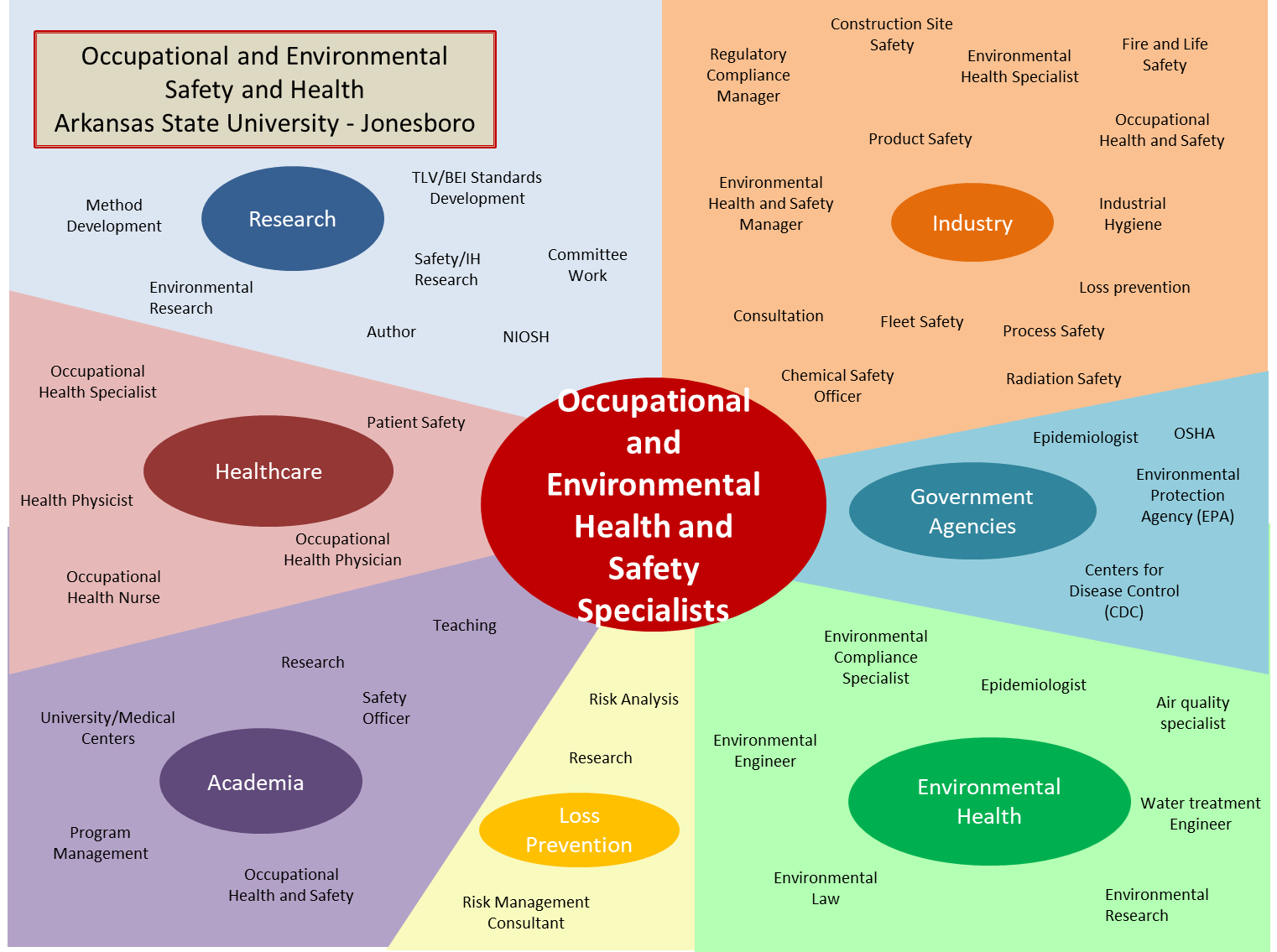
Public Health (BS)
Public Health (PBHL) Bachelor of Science 8-semester plan
PBHL sample 8 semester plan.pdf
Public Health (PBHL) Bachelor of Science Course Schedule
AState_Public_Health_Schedule_2026–2027.pdf