Laboratory Safety
- Broken Glassware Disposal
- Chemical Hygiene Plan
- Chemical Right to Know Poster
- Chemical Spill Response Guide
- Chemical Storage Guide
- Laboratory Hazard Assessment
- Emergency Eyewash and Safety Shower Program
- Field Research Safety Guidelines
- Medical Surveillance
- Medical Surveillance Form
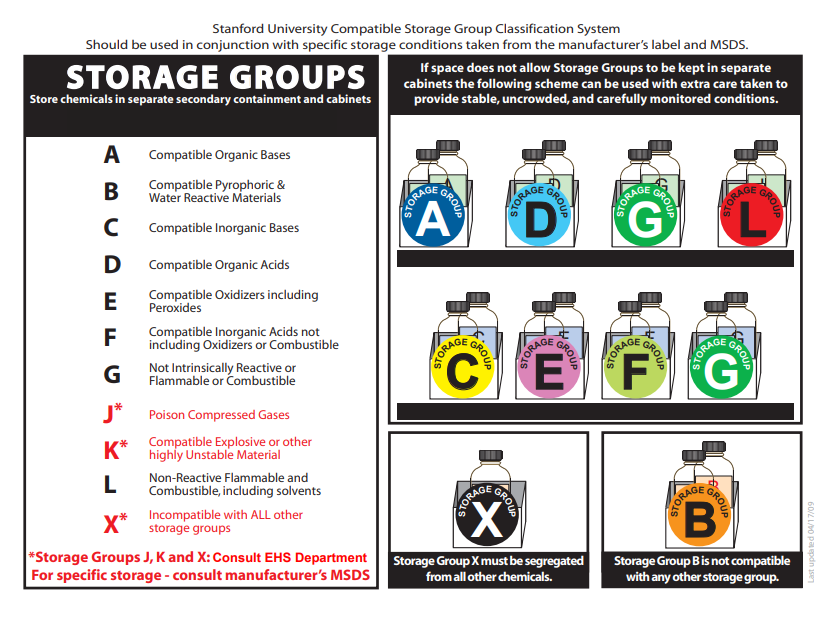
- CHEMICAL COMPATIBILITY STORAGE CODES
- Chemical Control Banding Methodology
Broken Glassware Disposal
Broken Glassware Disposal
Glassware must not be disposed of with normal trash. Building Services Personnel and others have been
injured when carrying trash bags with broken glassware in them.
• Several cuts or lacerations due to the improper disposal of laboratory glassware have been
reported on the campus. In an effort to eliminate or minimize these injuries, certain procedures
will be followed when discarding broken or unserviceable glassware.
• Broken glassware should immediately be cleaned up. A laboratory should already have a small
brush and dust pan available to clean up after small accidents. Forceps or duct tape can be used
to pick up the smaller pieces of broken glass.
• Discarded glassware must not contain any hazardous wastes, Medical Waste, Pathological
Waste or Radiological Wastes.
• If the glassware contains hazardous wastes or Radiological Wastes, please call complete the
Hazardous Waste Disposal form.
• If the glassware contains or is contaminated with any pathological or biological materials, call
ext. 2862 for disposal instructions.
What you need to know:
• Discarded glassware must be placed in a small puncture proof, double-lined cardboard box or a
container specifically designed for the disposal of glassware
• The box must be securely sealed with tape.
• Any cardboard box may be used, provided it is sturdy and of a size that will not weigh more than
40 pounds when full.
• The container must be labeled as to the contents.
o CAUTION LABORATORY GLASSWARE ONLY!
o NO HAZARDOUS WASTE, MEDICAL WASTE, PATHOLOGICAL WASTE OR RADIOLOGICAL
WASTES
o Complete Broken Glassware Disposal Form
• Never allow Custodial Services to handle broken glassware.
• Never use laboratory glassware boxes for the disposal of
o Sharps
o Biohazardous materials
o Liquid wastes
o Chemically contaminated laboratory glassware/plastics or plastic-ware
o Chemical containers that can’t be disposed of as regular solid waste
Glassware must not be disposed of with normal trash. Building Services Personnel and others have been
injured when carrying trash bags with broken glassware in them.
Laboratory glass that is disposed of in cardboard boxes must be appropriately decontaminated, where
necessary, prior to disposal. If you have any questions about this disposal procedure, please contact
Environmental, Health and Safety for additional information or instructions.
Empty Containers
Empty containers of five (5) gallons or less may be placed in dumpsters if they meet the definition of the
Resource Conservation Recovery Act (RCRA) empty container rule.
Any container that previously held a hazardous chemical or waste is defined as empty if:
• No hazardous materials can be poured, pumped or drained from the container, AND,
• No hazardous materials remain in the container that can be feasibly removed, AND,
• the walls of the container must not contain any significant residual materials, AND,
• The label is removed or defaced, AND,
• The lid is removed, AND,
• The container is placed directly into a dumpster.
Triple-rinsing is not required to comply with the RCRA empty container definition
Chemical Hygiene Plan
ARKANSAS STATE UNIVERSITY
CHEMICAL HYGIENE PLAN
Purpose and Scope: The purpose of the program outlined in this plan is to set forth procedures, engineering
controls, personal protective equipment (PPE) and work practices that are capable of protecting all employees
from recognized hazards posed by hazardous chemicals used within the facility. This plan covers all faculty,
staff and students (collectively referred to as employees) that work within the facility.
General Principles: Minimize all chemical exposures. Avoid underestimation of risk posed by hazardous
chemicals. Provide adequate ventilation using engineering controls. Observe Permitted Exposure Limits (PELs)
and Threshold Limit Values (TLVs) where these are prescribed. Comply with appropriate Chemical Hazard
Protocol(s).
Chemical Hygiene Responsibilities:
EHS Director : Develop and implement appropriate chemical hygiene policies and practices. Promulgate
current legal requirements concerning regulated substances. Determine the required levels of protective
apparel and equipment. Review/ update the Chemical Hygiene Plan annually. Respond to researcher
queries regarding new procedures/ chemicals. Monitor new procedures and determine appropriate
employee protection. Ensure employee exposures do not exceed PELs. Monitor exposure if there is
suspicion of levels of exposure in excess of action level or PEL (available on the MSDS for the
substance) for a given substance. Notify employee of monitoring results within 5 working days or
receipt. Establish and maintain for each employee an accurate record of any measurements taken to
monitor exposure or of any medical consultation or examination given as a result of exposure. Ensure
that the records are available to that employee. If initial monitoring indicates levels in excess of OSHA
PEL, then work with that substance must stop until such time that measures are taken (through
engineering controls or work practices) to reduce employee exposure level below the PEL for that
substance. Additional monitoring must be done after the new measures to show that employee exposure
level is then below the PEL before work with substance can resume.. Provide chemical hygiene training
to all new employees and students per 40CFR1910.1450(f)(2).
Facility Manager: Monitor procurement, use and disposal of chemicals used in the lab. Ensure that
facilities and training for any material being ordered are adequate. Perform regular, formal chemical
hygiene and housekeeping inspections including routine inspections of emergency equipment.
Faculty/Supervisors: Ensure that the staff and students know and follow the chemical hygiene rules and
project-specific protocols, that PPE is available and in working order, that staff and students know the
location of the chemical hygiene plan and where to find a SDS for the substances with which they may
come into contact, and that appropriate training has been provided. Keep a copy of all SDSs that are
shipped with the substance from the supplier. Provide an inventory of all hazardous chemicals to EHS
annually before June 15. Check chemical fume hood for proper operation monthly; request annual hood
certification by Arkansas State University EHS
Staff/Students: Plan and conduct each operation in accordance with the chemical hygiene program and
project-specific protocols. Develop and maintain good personal chemical hygiene habits. Review the
SDS of a chemical before working with it. Never remove or deface the label on a container containing a
hazardous substance.
The Laboratory Facility: Each laboratory should be equipped with a fire extinguisher, chemical fume hood,
emergency eyewash and drench shower where appropriate as determined by the EHS Director. All work
conducted and the scale of the work must be appropriate to the physical facilities available. A minimum of 6
room air changes per hour is required. The EHS Director, or his designee, shall certify chemical fume hoods
annually to ensure a minimum face velocity of 100 lfpm. Hoods shall be used as work areas, not storage areas.
Storage of chemicals should reflect compatibility and common sense. Access to exits, emergency equipment
and utility controls shall never be blocked.
Chemical Hygiene Rules:
Avoid “routine” exposure. Do not smell or taste chemicals. Use a hood if the TLV (available on the
SDS) of a substance is <50 ppm.
Do not apply cosmetics, eat, drink, smoke or chew in laboratories. Do not store or handle food or
beverages in laboratories.
Use appropriate PPE. At a minimum, all persons, including visitors, when in a laboratory in which
chemicals are in use or a chemical process is in progress, shall wear eye or face protection.
Avoid inappropriate apparel (loose clothing, sandals, etc.) horseplay and pipeting by mouth.
Do not work alone in the building; do not work alone in the laboratory if the procedures being conducted
are hazardous. Post an appropriate sign on the door and leave the lights on whenever an ongoing
operation is left unattended.
Deposit hazardous waste in and appropriately labeled, closed container; waste characterization, label and
container are provided by the EHS Director or his designee. Do not discharge hazardous waste to the
sewer.
In the event of a spill, the priority of actions shall be: personnel decontamination, spill containment,
cleanup.
Keep laboratories clean and uncluttered. Label all containers containing chemicals.
If a substance is produced in the lab for use outside of the lab by another user, then the facility manager
must comply with the Hazard Communication standard (29CFR1910.1200) for that substance.
Particularly Hazardous Substances (carcinogens, reproductive toxins and acute toxins) shall be handled
per specific protocols approved by the EHS Director.
All manipulation of free nanoparticles MUST be performed in a HEPA-filtered bag in/out chemical
fume hood, exhausted glove box, biological safety cabinet or an exhausted enclosure specifically
designed for handling nanoparticles. Contamination of the exhaust system must be avoided in order to
protect maintenance personnel; a bag in/out HEPA filter MUST be in place between the work enclosure
and the building’s ductwork.
Training: All employees shall be trained to the standards required by 29CFR1910.1450(f)(4), which includes:
Methods and observations that may be used to detect the presence or release of a hazardous chemical
(such as monitoring conducted by the employer, continuous monitoring devices, visual appearance or
odor of hazardous chemicals when being released, etc.). The physical and health hazards of chemicals in
the work area. The measures employees can take to protect themselves from these hazards, including
specific procedures the employer has implemented to protect employees from exposure to hazardous
chemicals, such as appropriate work practices, emergency procedures, and personal protective
equipment to be used.
Chemical Right to Know Poster
Chemical Spill Response Guide
Laboratory Spill Response Guidelines
All laboratories should have a written emergency plan, a spill kit to contain and/or clean, documented
training in spill response and a broken glass receptacle. At a minimum a chemical spill kit should contain:
• A 5 gallon bucket with a closeable lid
• Absorbent (vermiculite, cat litter or other multi-purpose absorbent)
• Scoop
• Small broom
• Required PPE (if not already available in the lab)
A few additional items that may be useful in a spill kit but are not required are:
• pH paper
• Sponge
• Small plastic zipper bags
• Sodium bicarbonate (for acid spills)
• Citric acid or boric acid (for base spills)
Additional information can be found in the A-State Laboratory Safety Manual, Biological Safety Manual
and the Radiation Safety Manual.
When in doubt or if you have any questions, do not hesitate to reach out the department of
environmental, health and safety at 870-972-2862 or 870-972-3644.
Biological
Biological spills outside biological safety cabinets will generate aerosols that can be dispersed in
the air throughout the laboratory. Wait 30 minutes prior to initiating spill clean up to allow
aerosols to settle or be removed by the ventilation system.
BSL 1 Level Spill
• Wear disposable gloves.
• Soak paper towels in disinfectant and place over spill area.
• Place towels in plastic bag for disposal.
• Clean spill area with fresh towels soaked in disinfectant.
BSL 2 Level Spill
• Alert people in immediate area of spill.
• Put on protective equipment.
• Cover spill with paper towels or other absorbent materials.
• Carefully pour a freshly prepared 1 in 10 dilution of household bleach around the edges
of the spill and then into the spill. Avoid splashing.
• Allow a 20-minute contact period.
• Use paper towels to wipe up the spill, working from the edges into the center.
• Clean spill area with fresh towels soaked in disinfectant.
• Place towels in a plastic bag and decontaminate in an autoclave.
Chemical
In the event of a chemical spill, the first priority shall be personnel decontamination. Any
personnel that have been exposed to hazardous chemicals on the skin or in the eyes should use
the emergency eyewash or safety shower as soon as possible. If no one has been exposed or all
exposed personnel have been adequately treated, the next priority shall be containment of the
spill to keep it from leaving the immediate area. Once the spill is contained, the last step is
clean up. Whether or not lab workers can clean up a hazardous chemical spill will depend on
the type of chemical that has been spilled and the quantity. No lab worker should attempt to
clean up a spill that they do not feel comfortable cleaning. Below are some basic criteria for
determining whether or not you can clean up a chemical spill.
Spills that can be cleaned up by lab personnel
OSHA defines these types of spills as incidental spills. Lab personnel may clean up a hazardous chemical
spill if:
• The quantity of spilled chemical is small (less than one liter).
• The chemical is known.
• The chemical is not a highly hazardous chemical or a chemical that may require respiratory
protection.
• The personal protective equipment required to clean up the spill safely is available.
• The materials to clean up the spill are available.
• The hazards presented by the chemical are well understood.
If all of these criteria are met, then lab personnel may first contain the spill and then clean up the spill.
Spill cleanup materials shall be placed in a container and labeled as chemical waste. Fill out the waste
request form available on the EHS website to have the materials removed from the lab
Spills that require EHS assistance
Some spills may not require a HAZMAT team response but may be outside the scope of cleanup by lab
personnel. A hazardous chemical spill that may require EHS assistance includes:
• A spill that is greater than 1 liter but less than 5 gallons (20 L).
• A small spill of a highly hazardous material inside a chemical fume hood.
In these cases, lab personnel must make sure the spill is contained and keep others out of the area until
the spill is cleaned up by EHS personnel.
Spills that require HAZMAT response
Some spills are too large or too dangerous for lab personnel or EHS to handle. Outside assistance is
required in these cases. A hazardous chemical spill that may require a HAZMAT team response includes:
• A spill larger than 5 gallons (20 L.)
• A spill that cannot be contained to the site (may leave the university.
• A spill of a highly hazardous chemical outside of a chemical fume hood or other containment
device.
The procedure for responding to this type of spill is given below.
1) Evacuate the immediate area.
2) If a person or people became contaminated during the spill, take them to the nearest safety
shower that is outside the immediate area where the spill occurred. The person or people
should remove contaminated clothing and remain under the shower for 15 minutes if the area is
safe to do so. While one person should remain with each person that is placed under the
shower, all others should evacuate the building.
3) Pull the fire alarm to indicate evacuation of the building.
4) Do not shut down the HVAC system. The areas most likely to have a spill are those where the
HVAC system will be pulling contaminant away from the office areas. A shutdown of the HVAC
system will upset that balance.
5) Notify the local authorities (including the fire department) that this is a chemical spill, not a fire
so that the local hazmat team can be dispatched.
6) Notify the EHS director after the local authorities have been contacted.
7) If the constituents of the spill are known, provide the SDS for each constituent to the hazmat
team.
8) Once the local authorities give the all clear to return to the building, EHS shall do a quick
building check to make sure critical operations are again online before allowing all others to reenter.
Spills of unknown material
All of the above scenarios assume that the material spilled is known. The procedure for spills of
unknown materials is given below.
1) Evacuate the immediate area and close the door to the area.
2) Post a sign that indicates the area must not be entered until the spill is cleaned.
3) Attempt to determine the materials in the spill by asking others that work in the area.
4) If that exact nature of the spill cannot be determined, consult EHS.
5) Try to determine if the spill could be a material that is unsafe to clean up. In other words, if
there is no possible way it is a highly hazardous material then EHS should be able to safely clean
up the spill.
6) If there is the possibility that the spill is a highly hazardous material and the nature of the spill
cannot be determined, it will be necessary to contact the local authorities. If this happens to be
the case, follow steps 3-8 of the procedure for a large chemical spill.
Radiation Spill
Spreading of radiation beyond the spill area can easily occur by the movement of personnel
involved in the spill or cleanup effort. Prevent spread by confining movement of personnel until
they have been monitored and found free of contamination. A minor radiation spill is one that
the laboratory staff is capable of handling safely without the assistance of safety and
emergency personnel. All other radiation spills are considered major.
Minor Radiation Spill
• Alert people in immediate area of spill.
• Notify Radiation Safety Officer (870-972-3644 or 911).
• Wear protective equipment, including safety goggles, disposable gloves, shoe covers,
and long-sleeve lab coat.
• Place absorbent paper towels over liquid spill. Place towels dampened with water over
spills of solid materials.
• Using forceps, place towels in plastic bag. Dispose in radiation waste container.
• Monitor area, hands, and shoes for contamination with an appropriate survey meter or
method. Repeat cleanup until contamination is no longer detected.
Major Radiation Spill
• Attend to injured or contaminated persons and remove them from exposure.
• Alert people in the laboratory to evacuate.
• Have potentially contaminated personnel stay in one area until they have been
monitored and shown to be free of contamination.
• Call Radiation Spill Emergency Response number (870-972-3644 or 911).
• Close doors and prevent entrance into affected area.
• Have person knowledgeable of incident and laboratory assist emergency personnel
Chemical Storage Guide
Chemical Storage Guide
Laboratory Hazard Assessment
| LABORATORY HAZARD ASSESSMENT LSE 404 | |||||||
| Required Personal Protective Equipment | Required Engineering Controls | ||||||
| Task | Safety Glasses | Lab Coat | Gloves (Type) | Other PPE (List) | Chemical Fume Hood | Biological Safety Cabinet | Other (list) |
| Dissection of specimens in Carosafe | X | Nitrile | Long pants and closed-toe shoes | ||||
Emergency Eyewash and Safety Shower Program
Scope
This program outlines the eye/face wash and shower equipment requirements for the rinsing of
employees exposed to injurious materials. Each department shall provide eye/face wash and safety
shower equipment within the work area where employees and/or students may be exposed to injurious
corrosive materials or other dangerous chemicals. Emergency eyewash, eye/face wash and safety
shower units are not a substitute for proper primary protective devices. Personal Protective Equipment
(eye and face protection and protective clothing) should be worn to protect the user from flying
particles and splashing liquids.
Responsibilities
Environmental, Health and Safety is responsible for:
• Preparing, reviewing and periodically revising this program.
• Monitoring compliance with this program.
• Provide consultation on placement of emergency showers and eye wash stations.
• Testing emergency eyewash and safety shower equipment quarterly and annually.
Deans, Directors and Department Heads are responsible for:
• Providing emergency safety shower and eyewash or eye/face wash equipment within the work
area where employees and/or students may be exposed to injurious corrosive materials or other
dangerous chemicals.
• Ensuring departmental compliance with all the procedures outlined in this program.
Facilities Management is responsible for:
• Repair, install or decommission emergency eyewash and safety shower equipment.
Supervisors of Departments/Labs, PI’s and Instructors are responsible for:
• Weekly and monthly flushing of emergency eyewash and safety shower equipment.
Equipment Performance
• Emergency shower heads must be located between 82 inches and 96 inches from the surface on
which the user stands.
• Emergency shower heads must be capable of delivering at least 20 gallons of water per minute,
at a velocity that will not be injurious to the user.
• Control valves must be of the Stay‐Open type.
• Emergency showers must be equipped with tepid water, 60°F‐100°F. UNM cold water comes
from the tap at greater than 60°F in most circumstances, therefore it does not required
tempering.
• Emergency showers should be equipped with a drain to prevent building damage. Drains should
be plugged in order to prevent accidental discharge of chemicals to the sanitary sewer system.
The plug should be flush‐mounted to prevent a tripping hazard. Plugs may be removed in the
event the shower is used and it was not accompanied by a large chemical spill (highly toxic
chemical that endangers public areas or is adjacent to a drain).
Eyewash Units (Including Eye/Face Wash Units)
• Eyewash units shall be installed with the nozzles between 33 inches and 45 inches from the floor
and at least 6 inches from the wall or nearest obstruction.
• Eyewash units must provide a controlled flow of flushing fluid to both eyes simultaneously at a
velocity that will not be injurious to the user.
• There must be no sharp projections anywhere in the operating area of the unit.
• Discharge nozzles must be protected from airborne contaminants. Whatever means is used to
provide this protection must not require a separate motion, by the user, to remove it when
activating the unit.
• Eyewash units must be capable of delivering 0.4 gallons of flushing fluid per minute for 15
minutes.
• Eye/face wash units must be capable of delivering 3.0 gallons of flushing fluid per minute for 15
minutes.
• Eyewash units must be designed with enough room to allow the eyelids to be held open with
the hands while the eyes are in the stream of flushing fluid.
• Control valves must be of the Stay‐Open type.
Hand Held Drench Hose
• Hand‐held drench hoses must be capable of delivering 3.0 gallons of flushing fluid per minute
for 15 minutes.
• Hand‐held drench hoses must provide a controlled flow of flushing fluid to both eyes
simultaneously at a velocity that will not be injurious to the user.
• Discharge nozzles must be protected from airborne contaminants. Whatever means is used to
provide this protection must not require a separate motion, by the user, to remove it when
activating the unit.
• Control valves must be of the Stay‐Open type.
• Hand‐held drench hoses should not be used as a substitute for an eyewash unit unless it meets
the performance indicators listed in the above section and it is not feasible to install an eyewash
unit.
Installation
Emergency showers must be located such that they are accessible, require no more than ten (10)
seconds to reach, and are within 55 feet of the potential hazard. This functionally means each lab should
be equipped with a safety shower. In spaces where the laboratory showers are not located within the
lab, there must be an unobstructed and clear path that the user can follow without the use of vision.
Eyewash units (including eye/face wash and hand‐held drench hoses) must be located such that they are
accessible, require no more than ten (10) seconds to reach, and are within 55 feet of the potential
hazard (10 feet where strong corrosives are the hazard). NOTE: Remember the injured worker may have
to locate the unit while blinded by a contaminant. Emergency eyewash and showers must be kept
accessible. Items (furniture, equipment, materials) shall not be stored or placed in such a manner that
would block access to them.
Testing Procedures
Testing on the equipment should follow the following schedule:
Emergency showers are tested at least monthly in accordance with the following:
• Verify adequate flow from the unit.
• Verify that the control valve is of the stay‐open type and is operating properly.
• Operate for a period of time (2‐3 minutes) sufficient to flush any stale water from the supply
lines.
• If equipped, remove the floor plug to make sure it is functioning properly; replace plug after
test.
• Record the inspection on the attached tag.
Eyewash units are tested at least monthly in accordance with the following:
• Verify flow from the unit.
• Verify that the control valve is of the stay‐open type and is operating properly.
• Verify that the flushing streams rise to equal heights and that the fluid will wash both eyes
simultaneously.
• Operate for a period of time (2‐3 minutes) sufficient to flush any stale fluid from the supply
lines.
• Record the inspection on the attached tag.
Hand‐held drench hose units are tested at least monthly in accordance with the following:
• Verify flow from the unit.
• Verify that the control valve is of the stay‐open type and is operating properly.
• Verify that the flushing streams rise to equal heights and will wash both eyes simultaneously.
• Operate for a period of time sufficient to flush any stale fluid from the supply lines.
• Verify that the hose is free to extend from the mounting bracket and is easy to maneuver.
• Record the inspection on the attached tag.
Weekly Flushing
Operate safety showers, eyewash and eye/face units weekly for a period of 2‐3 minutes to flush any
stale fluid and bacteria/viruses from the supply lines.
Shower and Eye/Face Wash Use
Immediate and proper use of emergency eye/face wash and safety showers is essential to minimizing
injury. The following procedures should aid in minimizing injury due to contact with harmful materials:
• Go immediately! Do not waste a moment. Time is of the essence.
• For safety shower:
o Pull the handle to activate the shower.
o Immediately remove contaminated clothing. Do this while under the shower when gross
contamination has occurred. Have someone assist with clothing removal when possible.
o If equipped, have the assistant remove the drain plug to allow water to drain.
o Flush exposed area for at least 15 minutes.
o Seek medical attention after flushing the exposed area.
o Notify your supervisor as soon as possible.
• For eye/face wash station:
o Activate the hands‐free lever. If eyewash is of the hand‐held type, have someone hold it
for you, if possible.
o Get your eyes directly into the stream of water.
o If you have contacts, gently remove them while flushing.
o Hold your eyes open with your fingers.
o Gently roll your eyes to ensure complete flushing.
o Flush for at least 15 minutes.
o Seek medical attention after flushing.
o Notify your supervisor as soon as possible.
Training
Supervisors shall train all persons that might be exposed to potentially injurious materials on the
location and proper operation of eyewash, eye/face wash and safety shower units. Contact
Environmental Health & Safety (870) 972-3644 for course materials or other assistance with this
training
Field Research Safety Guidelines
Scope
The field research safety guidelines provided in the attached document are intended to provide
assistance to principal investigators (PI), research supervisors, postdoctoral associates, technicians,
other employees, graduate students, and undergraduate students with the primary motivation of
promoting safety and minimizing risks associated with the execution of research activities in a field
setting, where there is an elevated risk of harm compared to routine activities.
General Principal Investigator Responsibilities
University-sponsored research is performed by and/or under the supervision of a principal investigator
or research supervisor, who is responsible not only for the intellectual/academic execution of the
research, but also for promoting the safety of all individuals involved in the research effort. When
research conducted by student/employees occurs in the field (off-campus), special care and precautions
may be warranted.
Principal investigators/research supervisors should draft a generalized field safety policy for their
individual labs that can encompass a number of smaller, more project-specific field safety plans (an
example of a field safety plan is provided in Appendix B). Principal Investigators are the best authorities
on risks potentially encountered while conducting research at their field sites and should draw upon their
judgment and personal experiences in drafting these plans. Generalized field safety policies should
address the following categories, where applicable:
1. Personnel Safety Training - Provide guidelines on the availability and necessity of first aid and/or CPR
training, first aid kits, and other field safety gear necessary for specific field situations.
2. Communications - Provide phone numbers or contact information for PI’s or other important lab and
field personnel. Other emergency contact information should also be provided, depending upon the
field circumstances.
3. Hazards - Discuss specific chemical, physical, and/or environmental hazards that are important for
your research group to know about. Discuss forms of transportation to be used, decide if special training
is required, and address safety concerns (e.g. ATVs, boats)?
See below for more details on each of these issues and an example of a field research plan, which
includes safety and communication components.
Safety Training and Personnel Considerations
Safety Training: An annual training event for First Aid and/or CPR certification needs to be scheduled for
those principal investigators, postdoctoral associates, technicians, graduate, and/or undergraduate
students who wish to be certified. Find out more about upcoming classes and reserve your spot for a
class by contacting the director of Red Wolf Wellness.
Personnel Staffing: Normal procedure is for at least two persons to work together in the field. In certain
circumstances, the situation may arise that only one person can go into the field. While Arkansas State
University discourages lone workers in field situations, should the situation present itself, approval from
the principal investigator/research supervisor should be established, as well as consent from the lone
field worker. Both parties must understand the risks, and a proper protocol for communication should
be established prior to undertaking the field work.
If a student/employee encounters dangerous working conditions (flooding river, inclement weather,
unsafe boats, unsafe sampling location, etc.), the student/employee may discuss the dangers with the
principal investigator/research supervisor, and if not satisfied that the work can be performed safely,
may cease work without repercussions, until the student/employee considers the conditions to be safe.
Ultimately, it is the responsibility of the principal investigator/research supervisor to foster the safety
and wellbeing of students/employees. At the same time, students/employees need to be forthcoming
about their preparedness. Additionally, a field research safety plan should be implemented and all
parties aware of the procedures/protocols.
Communications
Any group that includes students/employees conducting field research needs to adopt a
communications protocol ensuring that adequate communications equipment accompanies
students/employees in field settings.
The written field research plan should include a ‘Communications’ section that outlines a
communication protocol that the principal investigator/research supervisor implements and that the
field researchers follow. At a minimum, this protocol should include emergency contact numbers, an
emergency communication protocol, and communications equipment requirements (e.g., cell phones,
satellite phones).
Cellular phones should be carried by each field team while conducting field work for use in case of
emergency
The principal investigator/research supervisor should make clear the communications equipment
expectations for all students/employees conducting field work. In most cases, a student’s/employee’s
cell phone will suffice for communications equipment. The field research plan communication protocol
should detail circumstances when personal cell phones are inadequate, such as when research is
conducted outside of cell phone coverage, or if research is conducted abroad and U.S. cell phones may
not work with basic U.S. cell phone plans. In these circumstances, the principal investigator/research
supervisor should either provide alternate communications equipment (cell phone with international
access or satellite phone, for instance) or develop a field research plan (see below) that includes planned
communications between the field researcher and the PI or other designated party.
Communications Plan Component of Field Research Plan
At the principal investigator’s/research supervisor’s discretion, field communications plans may be
included in the field research plan to facilitate communication between field researchers and the PI or
other parties such that persons not accompanying the student(s)/employee(s) know when and where
the students/employees are conducting field research. If the students/employees have not safely
returned by some predetermined time, emergency services will be contacted on their behalf. The
purpose of a field research plan is to avoid a circumstance where a student/employee field crew is
conducting field work without the knowledge of some person not on the field research crew. The field
research plan is also designed to keep in contact with a field team if they are conducting field work for
an extended period of time. If the field team were to encounter an emergency and be unable to contact
emergency services for whatever reason, the emergency contact would attempt to contact the field
crew at a designated time. If contact is not established, emergency services would then be contacted.
When appropriate, field communications plans should be filed with the emergency contact before the
field crew departs. Field communications plans should contain sufficient detail about the location of the
field research such that the emergency contact can, if required, direct emergency services to the
research site. The field communications plan should also detail a date and time at which, if
communication between the field crew and the emergency contact cannot be established, the
emergency contact will implement emergency measures. The PI/designee must verify that each member
of the research team is in possession of and understands the field communications plan. An example of
a field communications plan can be found in Appendix A.
Potential Fieldwork Hazards and Special Circumstances
This list is by no means exhaustive. Each field site has its own set of unique conditions and potential
hazards that should be discussed with the research advisor and team. Each principal investigator should
develop field safety guidelines for the students/employees involved in fieldwork and discuss specific
strategies for avoiding or mitigating field hazards.
All-Terrain Vehicles: All users should be properly trained in the safe use and operation of vehicles that
may be used in the field. Operators must be over the age of 18 years old and must sign and submit
Appendix E, Release of All Claims for Personal Injury and Property, Student and Arkansas State
Employees Operating Boats or All-Terrain Vehicles prior to travel.
Animals/Wildlife: Particularly when working in remote areas, animals/wildlife may be of particular
concern. Each field location will have its own unique fauna and the potential threat posed by these
animals should be considered. Particular attention should be paid if working in an area during mating
season or when offspring are present, as these situations may make certain animals more likely to be
aggressive. If the fieldwork involves intentional animal handling, hazards such as bites, infection, etc.
should be addressed.
Biological Hazards: Contamination of air, water and food sources by local bacteria and viruses should be
considered. Immunization may be considered for things like tetanus or other diseases if engaged in
activities that put researchers at greater risk. Routine prevention measured should be taken, such as
dressing to avoid tick exposure, mosquitos, etc. Consider the potential for water-borne diseases, and
have access to clean water, or take appropriate steps to use personal water purification devices while
working/camping. Be aware of insect borne diseases such as Zika, etc. and review protective strategies.
Boating Safety: All users should be properly trained in the safe use and operation of boats. Personal
floatation devices must be available for all passengers and must be worn at all times when in a boat.
Safety should be considered not only while on the open water, but also during docking procedures, as
this is often when accidents and injuries can occur. Operator must be over the age of 18 years old,
Complete a Boating Education Course, carry proof while operating the boat and must sign and submit
Appendix E, Release of All Claims for Personal Injury and Property, Student and Arkansas State
Employees Operating Boats or All-Terrain Vehicles, prior to travel.
Cellular Access: When working in a rural area, be aware that cell phone coverage may be limited, and
not available for emergency assistance. Also, consider that not all rural areas have 911 emergency
phone numbers in place. If this is the case, know the direct phone number for local emergency services
such as ambulance, fire and police and update field communications plan accordingly.
Chemical Safety: If working with hazardous chemicals while in the field, all precautions should be taken
that would normally be taken in the Arkansas State University research lab. Proper personal protection
should be worn (gloves, goggles, face shield, etc.) and proper ventilation should be available. Additional
safety precautions may need to be considered if transporting chemicals to a field site. Also consider
what waste disposal procedures may need to be in place. Contact EHS with any questions.
Electrical Hazards: Consider any electrical hazards that may be present at a field site, including high
voltage power lines, etc. Research equipment/instrumentation should be checked for signs of wear prior
to deployment in the field (frayed lines, stripped wires, etc.). Care should be taken when operating
electrical equipment near water sources.
Environmental Hazards: Natural environment and weather conditions may pose a hazard to personal
safety. Each field site will have its own unique set of conditions that may need to be considered. The
principal investigator should discuss potential hazards with personnel prior to field deployment. Issues
of concern may include the potential for hyperthermia, hypothermia, sunburn, dehydration, high
altitude (altitude sickness), frostbite, flash flooding, rock and mud slides, etc. Proper personal gear
should be available appropriate to the field site and its weather/environmental conditions.
Equipment Hazards: Equipment used in the field such as chainsaws, pumps, motors, etc. may pose a
safety hazard if not operated properly. All users should be trained in the safe operation of any
equipment to be used in the field.
First Aid: First aid kits should be available at all field sites and should be routinely checked for adequate
supplies and expired materials. Each principal investigator should decide on whether all field team
members need to be certified in first aid procedures (e.g. Red Cross certification).
Navigation/Remote Sites: Adequate navigational equipment should be available if travelling to remote
sites. All users should be familiar with the use of the equipment (e.g., GPS units).
Social/Cultural Consideration: If the fieldwork has the potential for interaction with people of other
cultures, the principal investigator is responsible for the training of field personnel with respect to
relevant social or cultural considerations.
Transportation Considerations
Driver Certification: Students, staff and faculty driving University owned, leased, or rented vehicles must
be in the University Vehicle Safety Program. The University’s Vehicle Safety Program can be found online
at Vehicle Safety Program (astate.edu).
Use of Personal Vehicle
Unless logistically unfeasible, it is strongly recommended that a University vehicle be used for all
University-sponsored research trips involving transportation of students, staff, and faculty. This ensures
that the University’s insurance coverage applies to any accidents and loss prevention measures. The
University’s auto liability insurance applies to only University owned, leased or rented vehicles; personal
vehicles are not covered. The principal investigator/research supervisor is responsible for identifying
funds to cover the cost of department vehicle use or vehicle rental. Rental arrangements must be made
through the Travel Services.
Note that the University’s auto liability insurance policy applies to University owned, leased, or rented
vehicles driven by University-approved drivers while in the United States. If research requiring vehicle
use occurs outside of the US, auto insurance must be purchased separately. In such situations, the
principal investigator/research supervisor is responsible for identifying funds to cover the cost of auto
insurance.
The use of personal vehicles for University-sponsored research is strongly discouraged. If it is absolutely
necessary that a student/employee use a personal vehicle in conjunction with University-sponsored
research, the student or staff member must be advised in writing that their own auto insurance is the
only insurance that would respond in the event of an accident/incident with their own vehicle even
while on University business. The student/employee, and specifically the person named on the vehicle’s
insurance policy, assumes full insurance risk. For any student/employee that uses a personal vehicle in
the execution of research, Appendix D, Acknowledgement- Use of Personal Automobile form, must be
completed by the owner of the vehicle prior to the travel. The signed Acknowledgement form must be
retained by the Department for a period of three years from the date of the vehicle’s use in accordance
with the University’s record retention policy.
Students/employees have the right to refuse using a personal vehicle for research, with no
repercussions. If a personal vehicle is used, the student/employee is entitled to mileage reimbursement
at the standard University rate. In such situations, the principal investigator/research supervisor is
responsible for identifying funds to cover the cost mileage reimbursement.
Non-University Employees: Non-University employees are permitted to travel in University vehicles, but
must sign and submit, Appendix D, Acknowledgement – Use of Personal Automobile before travel
begins. University students, employees and registered volunteers may travel in University vehicles and
may apply to become certified drivers of University vehicles.
In the event of a motor vehicle accident
1. Call 911
2. Injury evaluation of all persons.
3. Call supervisor
4. Call motor pool
5. Call risk management
6. Call insurance company. Card is found in vehicle.
7. You must request a copy of the police report. Have it sent to risk@astate.edu
Emergency Contact Information
Emergency Contacts Number Notes
Emergency Services 911 Contact first in any life
threatening emergency.
University Police Department 870-972-2093 Contact in the event an accident
happened on campus.
University Risk Management 870-972-2817 Contact in the event that any
Arkansas State owned or rented
vehicle is involved in an
accident, and following any
emergency in which emergency
services were contacted.
University Motor Pool 870-972-3904 Contact in the event that any
Arkansas State owned or rented
vehicle is involved in an
accident.
University Travel Services 870-972-3903 Contact in the event that any
Arkansas State rented vehicle is
involved in an accident.
List of Appendices
Appendix A – Field Communication Plan Sample
Appendix B – Field Safety Plan Example
Appendix C – Arkansas State University Off-campus incident/accident/injury report
Appendix D – Use of Personal Automobile Consent Form
Appendix E - Release of All Claims for Personal Injury and Property, Student and Arkansas State
Employees Operating Boats or All-Terrain Vehicles
Appendix F – Release of All Claims for Personal Injury and Property Damage Student Travel
Participation
APPENDIX A
EXAMPLES
Field Communication Plan
1. A field research crew that includes undergraduate students conducts field work at tidal marsh field
sites on the Delaware River which is accessed by boat. The PI develops a communications protocol, and
requires that a cell phone (in a water-proof case) accompany the field crew at all times. When the field
crew anchors the boat and conducts research in the marsh, the cell phone must accompany them to
avoid a circumstance where the boat loses anchor and floats away stranding the field crew. The field
crew files a research plan with the PI (if the PI does not accompany the crew) or with the PI’s spouse (if
the PI does accompany the crew) before leaving. The field plan details the sites (including lat/lon) and
approximate times that the sites will be visited. The field plan also notes a time by which emergency
services should be notified in the event that communication between the field crew and the emergency
contact cannot be established.
2. An undergraduate student obtains an Arkansas State Undergraduate Research Fellowship to conduct
periodic individual field research in forests close to their home in upstate New York during the summer.
The student fills out a new field research plan that includes her parents as the emergency contact, and
she gives this research plan to her parents before departing on field work. The student’s parents
institute emergency procedures if the student has not been in contact by the pre-determined time. In
this scenario, the PI is not necessarily contacted prior to every field trip. See Detailed Example Field
Plan (see attached-Appendix B).
APPENDIX B
EXAMPLE
Student Field Research Safety Protocol
General Information Principal Investigator Nathaniel Weston
Field Research Program Delaware River Estuary
Brief Description of Research Field research is conducted at tidal freshwater and
saltwater marsh sites along the Delaware River.
Sites are accessed by land or by boat. Activities
include measuring rates of gas exchange,
measuring and collecting plant biomass and soil
samples, installing surface elevation tables (SETs)
and boardwalks, measuring SETs and conducting
GPS surveys.
Communications - Phone Numbers
Emergency
911
Arkansas State University Police 870-972-2093
Principle Investigator’s Cell Phone Nathaniel
Weston
xxx.xxx.xxxx
Principle Investigator’s Office Phone Nathaniel
Weston
xxx-xxx-xxxx
Department Office
Arkansas State Risk Management Sandra
Bramblet
870-972-2817
Communications Protocol
Communications Instrument Every group conducting field research must have a
cell phone with them, including on the boat when
field access by boat is required.
Emergency Communication Protocol Call 911 in any life-threatening or potentially lifethreatening emergency. 911 will put you in
contact with the Coast Guard as well as other
emergency services, in cases of boat failure. If,
after emergency service have been contacted you
are able to, contact Arkansas State University
Public Safety, the Principal Investigator, and the
department to alert them to the situation. If a
motor-vehicle or boating accident has occurred,
contact Ashley Feick.
Field Research Plans
Field Research Plan A third party (Angie Fondaco, Dr. Frank Galgano,
a member of the laboratory, etc) not
accompanying the field research team must be
informed of the field plans and again informed
when the field crew has returned. The location of
sites visited and anticipated timing of the trip
needs to be communicated. This person is
responsible for contacting the field crew if they
have not returned within a reasonable amount of
time.
Personnel Requirements
Number of researchers There must be 2 or more persons in any field
research trip to tidal marsh sites. Undergraduate
students must be accompanied by a graduate
student, technician, post-doc or PI.
Personal Training
First Aid / CPR All personnel conducting significant (i.e., PI,
technician, student summer researchers) field
research must be Red Cross First Aid and CPR
trained. A copy of the certification will be kept on
file.
Boat Training All personnel leading field research trips that
include boat use are required to take a boat
education course and be Arkansas Boater
Education certified. These certificates will be kept
on file.
Safety Equipment
First-aid Kit A fully stocked first aid kit must be available in the
vehicle and boat when in use.
Boat Safety Kit A boat safety kit, including a whistle, horn, fireextinguisher, a lifejacket (one per passenger), and
a throwable life-saving device (cushions) must be
on board the boat during operation.
Transportation Protocol
Truck and Trailer Operation Only authorized personnel may operate the field
truck with the boat-trailer attached. Special
consideration must be given to driving the truck
with the boat-trailer attached. Undergraduate
students may not drive the truck when the boat
trailer is attached. Undergraduate students may
operate the truck if van certified by the
University.
Boat Operation Only personnel possessing an Arkansas Boating
Safety Certificate and approved by the Principal
Investigator are authorized to operate the boat.
Hazards-Physical
Water A significant portion of this research is conducted
on (in a boat), near (in tidal marshes) or in
(wading) water. Personnel who do not know how
to swim should wear a lifejacket when
appropriate. During colder field conditions when
wearing waders, be aware that falling into water
with waders on is extremely dangerous. Waders
will fill with water and make surfacing difficult. If
your waders fill with water and you are unable to
surface, remove them as quickly as possible.
Boating Travel by boat must be conducted safely. The boat
utilizes an outboard engine with a propeller that
will do significant bodily damage if the motor is in
gear. Persons should never be near the rear of the
boat when the engine is on, even in neutral. An
additional hazard in travelling by boat is that the
boat may unexpectedly strike objects in the water,
causing persons who are standing to fall. Always
sit while the boat is in motion.
Never smoke or use open flame or spark in the
boat. The boat is powered by a gasoline/oil mix
stored in portable containers. These containers
are not fully sealed (they need to be vented) and
thus risk of fire and explosion is present. Always
remove the gas tanks from the boat when filling.
The boat may not be operated between sunset
and sunrise.
Walking in the Tidal Marsh Traversing portions of tidal marsh are an
inevitable part of field research. Proper footwear
must be worn at all times (close-toed, tightly laced
shoes, boots, or waders). Do not overload yourself
when walking in the marsh.
Walking on boardwalks poses the threat of
slipping and falling. Mud causes boardwalks to be
slick. Take care when walking on boardwalks.
Heat, Sunburn, Dehydration On hot, sunny days, care must be taken to avoid
dehydration, sunburn and overheating. Drink
water, wear sunscreen and protective clothing,
and take adequate breaks.
Frostbite, hypothermia On cold days, care must be taken to avoid
frostbite, lowering of core body temperature and
hypothermia. Wear protective clothing (waders,
multiple layers, gloves).
Hazards-Biological
Marsh plants Several of the plants encountered in the tidal
marsh field sites (Zizaniaaquatica at Salem and
Polygnum at Rancocas) are abrasive and will cause
slight skin rashes. Wear long pants and long
sleeves when working at these sites in late
summer and fall. Some plants also pose the risk of
causing puncture wounds. Be attentive and utilize
protective eye wear when appropriate.
Black flies, mosquitoes and green-heads At some times of year, biting insects (black flies,
mosquitoes and green-heads) will be found in tidal
marsh ecosystems. Wear protective clothing (long
pants and long sleeves) and use insect repellant to
minimize exposure.
Ticks and Lyme disease Ticks in the mid-Atlantic region may carry Lyme
disease. Wear protective clothing and use insect
repellant. If you find a tick on yourself, remove it
promptly. If tick bites are detected, monitor
yourself for signs of Lyme disease and promptly
seek medical attention if found.
Hazards-Chemical
Not applicable
Hazards-Specific Field Equipment
Generator A gasoline powered generator may be used in the
field. The generator produces an electric current
(120 V) which is hazardous in wet conditions such
as a tidal marsh. Take care to site the generator
so that it does not come in contact with water. If
an extension cord is used, be sure that the
termination of the extension cord and any
connections do not come in contact with water.
No smoking or open flames may be near the
generator, due to the possibility of gasoline fumes
igniting.
Demolition Hammer The demolition hammer produces potentially
damaging levels of noise. Wear protective ear
gear when using or working near the demolition
hammer. The demolition hammer and the
stainless steel rod that is hammered become
extremely hot. Use caution when handling after
hammering.
Grinder The grinder will cause significant bodily harm if it
comes into contact with your person while in
operation. Use caution. The stainless steel rod is
also extremely hot following cutting with the
grinder, and should be cooled before handling.
GPS tripod The spikes on several of the tripods used for the
GPS equipment are sharp, and will cause bodily
injury if mishandled. Take care when using and
transporting this equipment.
Signatures
I have read and understand these safety protocols and procedures, and I will follow these policies and
procedures.
_________________________________ _______________
Name Date
_________________________________ _______________
Principal Investigator Date
APPENDIX C
ARKANSAS STATE UNIVERSITY
OFF CAMPUS INCIDENT/ACCIDENT/INJURY REPORT
Please go the Risk Management to complete the Incident Reporting Form or use this link:
Incident Report • CampusOptics
APPENDIX D
ACKNOWLEDGEMENT – USE OF PERSONAL AUTOMOBILE
To be signed by the Vehicle Owner; Student Vehicles owned by Parents must be signed by Parent
I, the undersigned, acknowledge that I am the owner of the following vehicle (the “Vehicle”):
_____________________ (Year, Make and Model) __________________________________
(License Plate #)
I understand that the Vehicle is contemplated to be used in connection with travel to and from a field
research location at _______________________________ during the period from ___________ to
______________ (the “Field Work”) in connection with a class or research project sponsored by
Arkansas State University (“University”).
I acknowledge that the use of my Vehicle for travel to and from the Field Work location is completely
voluntary. I understand that other options for transportation to the Field Work site have been made
available by the University, either in the form of University-owned vehicles or University-rented vehicles.
I understand that University does not carry or maintain automobile insurance coverage or any other
insurance coverage for my Vehicle in connection with the Field Work. Any personal injury or property
damage sustained by me or third parties that occurs in connection with the use of the Vehicle for the
Field Work will not be covered by the University but, rather, will be subject to my own personal auto
insurance coverage.
I understand that I will be reimbursed for mileage at the standard University rate.
I represent that I have adequate automobile insurance to cover any personal injury to myself or any
third party or property damage owed by me or any third party that may arise out of the use of the
Vehicle for the transportation to and from the Field Work.
I understand that I must provide proof of insurance and submit a copy to the PI or department head,
before travel commences. Attach proof to this document.
Acknowledging all of the above, I hereby grant permission for the Vehicle to be used for transportation
to and from the Field Work location.
I certify that I have read and understand the above statements and that they are true and accurate, and
that the signing of this Acknowledgement is voluntary.
READ ABOVE CAREFULLY BEFORE SIGNING BELOW.
Student/Employee Driver’s Printed Name: __________________________ ASTATE ID: ___________
Student/Employee Driver’s Signature: ______________________________ Date: _______________
(Please sign in ink. Typed signatures are not acceptable)
Vehicle Owner’s Printed Name (if different than above): ____________________________________
Vehicle Owner’s Signature (if different than above): ___________________________ Date: ________
(Please sign in ink. Typed signatures are not acceptable)
Appendix E
RELEASE OF ALL CLAIMS FOR PERSONAL INJURY AND PROPERTY DAMAGE
STUDENT AND ARKANSAS STATE EMPLOYEES OPERATING BOATS OR ALL-TERRAIN
VEHICLES
I, (name):___________________________, a student or employee at Arkansas State University over the age
of eighteen (18) will be using or participating in an activity where a boat, motor boat, canoe, kayak, raft, tube
or all-terrain vehicle (the “Boat/ATV”) will be used. I will be at the following location(s) during this activity
_______________________________________ on ___________________ (date(s)).
I AM AWARE that using or participating in travel when using a boat or all-terrain vehicle carries the risk of
personal injury, property damage, or other losses.
I HEREBY FULLY RELEASE AND DISCHARGE Arkansas State University, the Arkansas State University System,
its Board of Trustees, its officers, agents, and employees from any liability for negligence and all claims for
personal injury, property damage, or other losses resulting from my participation in operating a Boat/ATV or
participating in an activity that uses such Boat/ATV vehicles.
I HEREBY ASSSUME ALL RISKS of personal injury, property damage, or other losses resulting from my
participation in operating a Boat/ATV or participating in an activity that uses such Boat/ATV vehicles.
I FURTHER AGREE TO INDEMIFY AND HOLD HARMLESS Arkansas State University, the Arkansas State
University System, its Board of Trustees, its officers, agents, and employees from all claims, suits actions,
injuries, damages, and losses sustained by me and arising out of, connected with, or in any way associated
with participation in an activity that uses a Boat/ATV vehicle.
I HAVE FULLY READ AND UNDERSTAND THE FOREGOING. I agree to the terms and conditions as stated.
Initial the following:
I shall obey all state, federal and local boating and recreational regulations, laws, ordinances, and lawful
directives from appropriate emergency or law enforcement personnel, while operating a boat or all-terrain
vehicle. The student or employee of Arkansas State University is solely responsible for any citation or
violation occurring during the use of, or the result of using a boat or all-terrain vehicle.
Who Needs a Boating Education Card?
Anyone born on or after Jan. 1, 1986, and of legal age to operate a motorboat or sailboat, must have
successfully completed an approved AGFC Boating Education Course and carry proof while operating a
motorboat or sailboat on Arkansas water.
• To operate a motorboat powered by an engine of 10 horsepower or more, a person must be 12
or older, or be under the direct supervision of a person at least 18 years old.
• To operate a personal watercraft, a person must be 16 or older, be 12 to 15 years old and be
under the direct supervision of a person at least 18 years old or be under 12 and be under the
direct supervision of a person at least 21 years old.
STUDENT or EMPLOYEE NAME (Print)_________________________
STUDENT or EMPLOYEE NAME (Signature)______________________ DATE _______________
Department _________________________
*Department Contact ____________________ Contact Phone Number ________________
*Attach form to appropriate travel request and submit to Travel Services PRIOR TO TRAVEL.
Appendix F
RELEASE OF ALL CLAIMS FOR PERSONAL INJURY AND PROPERTY DAMAGE STUDENT TRAVEL
PARTICIPATION
student-trip-release.pdf (astate.edu)
I,_______________________________, a student at Arkansas State University over the age of eighteen (18),
have chosen to participate in student travel to ___________________________________ on ____________.
I AM AWARE that participating in travel carries the risk of personal injury, property damage, or other losses.
I HEREBY FULLY RELEASE AND DISCHARGE Arkansas State University , the Arkansas State University System,
its Board of Trustees, officers, agents, and employees from any and all claims for personal injury, property
damage, or other losses up to and including death, resulting from my participation in this travel.
I HEREBY ASSUME ALL RISK of personal injury, property damage, and other losses up to and including death
which may result from my participation in this travel.
I FURTHER AGREE TO INDEMNIFY AND HOLD HARMLESS Arkansas State University, its , the Arkansas State
University System, its Board of Trustees, officers, agents, and employees form all claims, suits, actions,
injuries, damages, and losses sustained by me and arising out of, connected with, or in any way associated
with my participation in this travel.
I HAVE FULLY READ AND UNDERSTAND THE FOREGOING
STUDENT (print name)_________________________
STUDENT (Signature)___________________________ DATE _______________
Department _________________________
*Department Contact ____________________ Contact Phone Number ________________
*Attach form to appropriate travel request and submit to Travel Services PRIOR TO TRAVEL.
Medical Surveillance
Occupational Health & Safety Medical Surveillance
While EHS strives to provide services and guidance in all areas of workplace safety compliance, there are
some situations where outside expertise is necessary. A-State does not employ an Occupational Health
Specialist and there are areas where that type of physician is necessary to meet safety, health and
compliance requirements. If your job involves any of the following, then enrollment in medical
surveillance may be necessary:
• Work with animals in research
• Work with blood or other potentially infectious materials from humans (or non-human
primates)
• Work that requires the use of a respirator
Enrollment in medical surveillance is simple.
1) Contact Environmental Health and Safety (mdooley@astate.edu) or call 870-972-3644 to get
started.
2) Fill out the Medical Surveillance Form.
3) Take the form to your appointment with Occupational Health Partners (EHS will help set up this
appointment).
4) Occupational Health Partners will follow up with you if any additional action is necessary
(immunizations, consults with your personal physician, etc.).
Note that special training is required for any of the job functions that require you to be enrolled in
medical surveillance. Please contact EHS for details based on your specific job requirements.
Medical Surveillance Form
ARKANSAS STATE UNIVERSITY, MEDICAL SURVEILLANCE PROGRAM
General Information
Full Name: ____________________________________________________________________________
Date of Birth: ________________
What possible hazardous exposures exist in your position/research?
Animals: □ Lab animals (mice/rats/guinea pigs, etc.) □ Birds
□ Farm animals □ Wild animals □ Insects
□ Aquatic animals
Human or primate: □ Blood □ Tissues, fluids or other potentially infectious materials
□ Human cell culture
Environmental: □Chemicals □ Dust □ Noise
Will you be exposed to animals that may have rabies? □ Yes □ No
Will you be involved in recombinant DNA or human gene transfer research? □ Yes □ No
Are you pregnant or planning to become pregnant in the near future? □ Yes □ No
Medical History □ I have no significant medical history
Current medications: ___________________________________________________________ □ None
□ Anemia □ Hearing Problems □ Rheumatic/Scarlet Fever
□ Arthritis □ Heart Problems □ Seizures/Epilepsy
□ Cancer □ Heat Stroke □ Stomach/Bowel Problems
□ Diabetes □ High Blood Pressure □ Tuberculosis
□ Difficulty Smelling □ Joint or Muscle Problems □ Vision Problems
□ Dizziness or Fainting □ Kidney or Liver Disease
□ Other:_____________________________________________________________________________
Do you have a medical condition that impairs your immune system (HIV, chemotherapy, radiation, etc.)?
□ Yes □ No
Allergy History
Do you currently have or have you ever had any of the following conditions?
Asthma/Wheezing? □ Yes □ No If yes, when? _____________________
Chronic cough/Bronchitis? □ Yes □ No If yes, when? _____________________
Eczema/Skin rash? □ Yes □ No If yes, when? _____________________
Hay fever/Seasonal allergies? □ Yes □ No If yes, when? _____________________
Itchy, irritated eyes? □ Yes □ No If yes, when? _____________________
Shortness of breath? □ Yes □ No If yes, when? _____________________
Other lung/breathing problems? □ Yes □ No If yes, when? _____________________
Allergies to food or medicine? □ Yes □ No
If yes, list:____________________________________________________________________________
Allergies to pollen, grass, weeds, trees, yeas or molds? □ Yes □ No
If yes, list:____________________________________________________________________________
Allergies to latex, chemicals or other substances? □ Yes □ No
If yes, list:____________________________________________________________________________
Allergies to animals? □ Yes □ No
If yes,list:____________________________________________________________________________
Immunization History
Tetanus: Td _______ or Tdap _________
Hepatitis B ________ (date of series completion if there is risk of exposure to human or primate derived
materials)
Rabies: _________ (if applicable)
The above information is accurate to the best of my knowledge.
______________________________________ _________________________
CHEMICAL COMPATIBILITY STORAGE CODES
Storage Group A: Compatible Organic Bases
Identifier Name
100‐46‐9 Benzylamine
100‐85‐6 Benzyltrimethylammonium hydroxide
108‐91‐8 Cyclohexylamine
111‐42‐2 Diethanolamine
109‐89‐7 Diethylamine
75‐04‐7 Ethylamine
107‐15‐3 Ethylenediamine
110‐89‐4 Piperidine
102‐71‐6 Triethanolamine
121‐44‐8 Triethylamine
Storage Group B: Compatible Pyrophoric And Water Reactive Materials
Identifier Name
7783‐70‐2 Antimony pentafluoride
98‐88‐4 Benzoyl chloride
353‐42‐4 Boron triflouride compound with methyl ether (1:1)
594‐19‐4 Tert‐Butyllithium
156‐62‐7 Calcium cyanamide
16853‐85‐3 Lithium aluminum hydride
4111‐54‐0 Lithium diisopropylamide
7580‐67‐8 Lithium hydride
7439‐93‐2 Lithium metal (e.g., in THF)
124‐63‐0 Methanesulfonyl chloride
917‐54‐4 Methyllithium solution (and other alkyls)
7440‐09‐7 Potassium metal
17242‐52‐3 Potassium amide
16940‐66‐2 Sodium borohydride
7646‐69‐7 Sodium hydride
7440‐66‐6 Zinc (fume or dust)
Storage Group C: Compatible Inorganic Bases
Identifier Name
1336‐21‐6 Ammonium hydroxide
17194‐00‐2 Barium hydroxide
1305‐62‐0 Calcium hydroxide
21351‐79‐1 Cesium hydroxide
1310‐65‐2 Lithium hydroxide
1 Adapted from Stanford University’s ChemTracker Storage System. Used with permission from Lawrence M.
Gibbs, Stanford University.
1310‐58‐3 Potassium hydroxide
1310‐82‐3 Rubidium hydroxide
1310‐73‐2 Sodium hydroxide
18480‐07‐4 Strontium hydroxide
Storage Group D: Compatible Organic Acids
Identifier Name
64‐19‐7 Acetic acid
79‐10‐7 Acrylic acid
65‐85‐0 Benzoic acid
98‐07‐7 Benzotrichloride
98‐88‐4 Benzoyl chloride
10043‐35‐3 Boric acid
79‐11‐8 Chloroacetic acid
627‐11‐2 Chloroethyl chloroformate
77‐92‐9 Citric acid
79‐44‐7 Dimethylcarbamyl chloride
64‐18‐6 Formic acid
6915‐15‐7 Malic acid
108‐31‐6 Maleic anhydride
7697‐37‐2 Nitric acid
139‐13‐9 Nitrilotriacetic acid
79‐09‐4 Propionic acid
7783‐00‐8 Selenious acid
76‐05‐1 Trifluoroacetic acid (TFA)
76‐03‐9 Trichloroacetic acid
Storage Group E: Compatible Oxiders, Including Peroxides
Identifier Name
21205‐91‐4 9‐BBN
13473‐90‐0 Aluminum nitrate
7789‐09‐5 Ammonium dichromate
7790‐98‐9 Ammonium perchlorate
13446‐10‐1 Ammonium permanganate
7727‐54‐0 Ammonium persulfate
10022‐31‐8 Barium nitrate
10124‐37‐5 Calcium nitrate
1305‐79‐9 Calcium peroxide
19004‐19‐4 Cupric nitrate
506‐93‐4 Guanidine nitrate
937‐14‐4 3‐Chloroperoxybenzoic acid
7722‐84‐1 Hydrogen peroxide
10099‐74‐8 Lead nitrate
13840‐33‐0 Lithium hypochlorite
10377‐60‐3 Magnesium nitrate
10034‐81‐8 Magnesium perchlorate
13138‐45‐9 Nickel nitrate
7697‐37‐2 Nitric acid
79‐21‐0 Peracetic acid
7601‐90‐3 Perchloric acid
7778‐50‐9 Potassium dichromate
7757‐79‐1 Potassium nitrate
7722‐64‐7 Potassium permanganate
7727‐21‐1 Potassium persulfate
17014‐71‐0 Potassium superoxide
7761‐88‐8 Silver nitrate
15630‐89‐4 Sodium carbonate peroxide
7775‐09‐9 Sodium chlorate
7758‐19‐2 Sodium chlorite
2893‐78‐9 Sodium dichloro‐s‐triazinetrione
10588‐01‐9 Sodium dichromate
7681‐52‐9 Sodium hypochlorite
7631‐99‐4 Sodium nitrate
7632‐00‐0 Sodium nitrite
10101‐50‐5 Sodium permanganate
1313‐60‐6 Sodium peroxide
7775‐27‐1 Sodium persulfate
7791‐10‐8 Strontium chlorate
10042‐76‐9 Strontium nitrate
1314‐18‐7 Strontium peroxide
87‐90‐1 Trichloro‐s‐triazinetrione (Trichloroisocyanuric acid, TCCA)
Storage Group F: Compatible Inorganic Acids, Not Including Oxidizers Or Combustibles
Identifier Name
7790‐93‐4 Chloric acid
10034‐85‐2 Hydrioic acid
7647‐01‐0 Hydrochloric acid
7664‐39‐3 Hydrogen fluoride solution
7664‐38‐2 Phosphoric acid
7664‐93‐9 Sulfuric acid
Storage Group G: Not Instrinsically Reactive Or Flammable Or Combustible
Identifier Name
71751‐41‐2 Abamectin [avermectin b1]
640‐19‐7 Acetamide, 2‐fluoro‐
62‐74‐8 Acetic acid, fluoro‐, sodium salt
1752‐30‐3 Acetone thiosemicarbazide
53‐96‐3 2‐Acetylaminofluorene
79‐06‐1 Acrylamide
814‐68‐6 Acrylyl chloride
111‐69‐3 Adiponitrile
309‐00‐2 Aldrin
60‐09‐3 4‐Aminoazobenzene
92‐67‐1 4‐Aminodiphenyl
82‐28‐0 1‐Amino‐2‐methylanthraquinone
54‐62‐6 Aminopterin
504‐24‐5 4‐Aminopyridine
61‐82‐5 Amitrole
101‐05‐3 Anilazine [4, 6‐dichloro‐N‐(2‐chlorophenyl)‐1, 3, 5‐triazin‐2‐amine]
90‐04‐0 o‐Anisidine
7440‐36‐0 Antimony
7440‐38‐2 Arsenic
1303‐28‐2 Arsenic pentoxide
7784‐34‐1 Arsenic trichloride
1327‐53‐3 Arsenic trioxide
86‐50‐0 Azinphos‐methyl
7440‐39‐3 Barium
56‐55‐3 Benz[a]anthracene
98‐87‐3 Benzal chloride
55‐21‐0 Benzamide
98‐16‐8 Benzenamine, 3‐(trifluoromethyl)‐
100‐14‐1 Benzene, 1‐(chloromethyl)‐4‐nitro‐
98‐05‐5 Benzenearsonic acid
108‐98‐5 Benzenethiol
92‐87‐5 Benzidine
50‐32‐8 Benzo[a]pyrene
57‐64‐7 Benzoic acid, 2‐hydroxy‐, compound with (3as‐cis)‐1,2,3,3a,8,8a‐hexahydro‐1,3a,8‐
trimethylpyrrolo[2,3,b]indol‐5‐ylmethylcarbamate ester (1:1)
100‐44‐7 Benzyl chloride
140‐29‐4 Benzyl cyanide
7440‐41‐7 Beryllium powder
91‐59‐8 Beta‐naphthylamine
82657‐04‐3 Bifenthrin
92‐52‐4 Biphenyl
534‐07‐6 Bis(chloromethyl) ketone
542‐88‐1 Bis(chloromethyl)ether
28772‐56‐7 Bromadiolone
75‐25‐2 Bromoform (tribromomethane)
74‐83‐9 Bromomethane
75‐63‐8 Bromotrifluoromethane (halon 1301)
81‐88‐9 C.I. Food red 15 (Rhodamine B)
97‐56‐3 C.I. Solvent yellow 3
7440‐43‐9 Cadmium
1306‐19‐0 Cadmium oxide
2223‐93‐0 Cadmium stearate
7778‐44‐1 Calcium arsenate
56‐25‐7 Cantharidin
51‐83‐2 Carbachol chloride
644‐64‐4 Carbamic acid, dimethyl‐, 1‐[(dimethylamino)carbonyl]‐5‐methyl‐1h‐pyrazol‐3‐yl ester
63‐25‐2 Carbaryl [1‐naphthalenol, methylcarbamate]
1563‐66‐2 Carbofuran
56‐23‐5 Carbon tetrachloride
57‐74‐9 Chlordane
115‐28‐6 Chlorendic acid
532‐27‐4 2‐Chloroacetophenone
4080‐31‐3 1‐(3‐Chloroallyl)‐3,5,7‐triaza‐1‐azoniaadamantane chloride
75‐45‐6 Chlorodifluoromethane (HCFC‐22)
67‐66‐3 Chloroform
107‐30‐2 Chloromethyl methyl ether
5344‐82‐1 1‐(o‐Chlorophenyl)thiourea
542‐76‐7 3‐Chloropropionitrile
63938‐10‐3 Chlorotetrafluoroethane
75‐88‐7 2‐Chloro‐1,1,1‐trifluoro‐ethane (HCFC‐133a)
75‐72‐9 Chlorotrifluoromethane (CFC‐13)
1982‐47‐4 Chloroxuron
10025‐73‐7 Chromic chloride
7440‐47‐3 Chromium
64‐86‐8 Colchicine
56‐72‐4 Coumaphos
5836‐29‐3 Coumatetralyl
1319‐77‐3 Cresol (mixed isomers)
95‐48‐7 o‐Cresol
535‐89‐7 Crimidine
4170‐30‐3 Crotonaldehyde
123‐73‐9 (e)‐Crotonaldehyde
64‐00‐6 m‐Cumenyl methylcarbamate
21725‐46‐2 Cyanazine
506‐68‐3 Cyanogen bromide
506‐78‐5 Cyanogen iodide
675‐14‐9 Cyanuric fluoride
66‐81‐9 Cycloheximide
94‐75‐7 2,4‐D (2,4‐Dichlorophenoxyacetic acid)
2971‐38‐2 2,4‐D Chlorocrotyl ester
94‐11‐1 2,4‐D Isopropyl ester
94‐82‐6 2,4‐DB
919‐86‐8 Demeton‐s‐methyl
101‐80‐4 4,4'‐Diaminodiphenyl ether
101‐77‐9 4,4'‐Diaminodiphenylmethane
615‐05‐4 2,4‐Diaminoanisole
95‐80‐7 2,4‐Diaminotoluene
25376‐45‐8 Diaminotoluene (mixed isomers)
333‐41‐5 Diazinon
53‐70‐3 Dibenzo(a, h)anthracene
132‐64‐9 Dibenzofuran
96‐12‐8 1,2‐Dibromo‐3‐chloropropane
106‐93‐4 1,2‐Dibromoethane (ethylene dibromide)
84‐74‐2 Dibutyl phthalate
99‐30‐9 Dichloran [2, 6‐dichloro‐4‐nitroaniline]
95‐50‐1 1,2‐Dichlorobenzene
541‐73‐1 1,3‐Dichlorobenzene
106‐46‐7 1,4‐Dichlorobenzene
91‐94‐1 3,3'‐Dichlorobenzidine
75‐27‐4 Dichlorobromomethane
764‐41‐0 1,4‐Dichloro‐2‐butene
75‐71‐8 Dichlorodifluoromethane (cfc‐12)
111‐44‐4 Dichloroethyl ether
75‐09‐2 Dichloromethane (methylene chloride)
91‐93‐0 3,3'‐Dimethoxybenzidine‐4,4'‐diisocyanate
91‐97‐4 3,3'‐Dimethyl‐4,4'‐diphenylene diisocyanate
127564‐92‐5 Dichloropentafluoropropane
97‐23‐4 Dichlorophene [2, 2'‐methylene‐bis(4‐chlorophenol)]
120‐83‐2 2,4‐Dichlorophenol
105‐67‐9 2,4‐Dimethylphenol
696‐28‐6 Dichlorophenylarsine
76‐14‐2 Dichlorotetrafluoroethane (cfc‐114)
62‐73‐7 Dichlorvos
1464‐53‐5 Diepoxybutane
38727‐55‐8 Diethatyl ethyl
814‐49‐3 Diethyl chlorophosphate
297‐97‐2 O,O‐Diethyl O‐pyrazinyl phosphorothioate
78‐53‐5 O,O‐Diethyl S‐[2‐(diethylamino)ethyl] phosphorothiolate
71‐63‐6 Digitoxin
101‐90‐6 Diglycidyl resorcinol ether
94‐58‐6 Dihydrosafrole
55‐91‐4 Diisopropylfluorophosphate (DFP)
60‐51‐5 Dimethoate
60‐11‐7 4‐Dimethylaminoazobenzene
57‐97‐6 7,12‐Dimethylbenz[a]anthracene
91‐93‐0 3,3'‐Dimethoxybenzidine‐4,4'‐diisocyanate
2524‐03‐0 Dimethyl chlorothiophosphate
91‐97‐4 3,3'‐Dimethyl‐4,4'‐diphenylene diisocyanate
105‐67‐9 2,4‐Dimethylphenol
131‐11‐3 Dimethyl phthalate
77‐78‐1 Dimethyl sulfate
2300‐66‐5 Dimethylamine dicamba
534‐52‐1 4,6‐Dinitro‐o‐cresol
78‐34‐2 Dioxathion
82‐66‐6 Diphacinone
957‐51‐7 Diphenamid
122‐39‐4 Diphenylamine
107‐49‐3 Diphosphoric acid, tetraethyl ester
541‐53‐7 Dithiobiuret
72‐20‐8 Endrin
50‐14‐6 Ergocalciferol
563‐12‐2 Ethion
13194‐48‐4 Ethoprop
541‐41‐3 Ethyl chloroformate
759‐94‐4 Ethyl dipropylthiocarbamate [EPTC]
371‐62‐0 Ethylene fluorohydrin
107‐21‐1 Ethylene glycol
96‐45‐7 Ethylene thiourea
542‐90‐5 Ethylthiocyanate
52‐85‐7 Famphur
55‐38‐9 Fenthion [o, o‐dimethyl o‐[3‐methyl‐4‐(methylthio)phenyl]ester, phosphorothioic acid]
144‐49‐0 Fluoroacetic acid
359‐06‐8 Fluoroacetyl chloride
51‐21‐8 Fluorouracil
944‐22‐9 Fonofos
107‐16‐4 Formaldehyde cyanohydrin
23422‐53‐9 Formetanate hydrochloride
76‐13‐1 Freon 113 [ethane, 1, 1, 2‐trichloro‐1, 2, 2‐trifluoro‐]
76‐44‐8 Heptachlor
87‐68‐3 Hexachloro‐1, 3‐butadiene
118‐74‐1 Hexachlorobenzene
77‐47‐4 Hexachlorocyclopentadiene
67‐72‐1 Hexachloroethane
1335‐87‐1 Hexachloronaphthalene
70‐30‐4 Hexachlorophene
822‐06‐0 Hexamethylene‐1, 6‐diisocyanate
51235‐04‐2 Hexazinone
51‐75‐2 Hn2 (nitrogen mustard‐2)
555‐77‐1 Hn3 (nitrogen mustard‐3)
79‐19‐6 Hydrazinecarbothioamide
123‐31‐9 Hydroquinone
102‐36‐3 Isocyanic acid, 3,4‐dichlorophenyl ester
465‐73‐6 Isodrin
4098‐71‐9 Isophorone diisocyanate
108‐23‐6 Isopropyl chloroformate
80‐05‐7 4,4'‐Isopropylidenediphenol
120‐58‐1 Isosafrole
78‐97‐7 Lactonitrile
7439‐92‐1 Lead
58‐89‐9 Lindane
554‐13‐2 Lithium carbonate
121‐75‐5 Malathion
109‐77‐3 Malononitrile
93‐65‐2 Mecoprop
950‐10‐7 Mephosfolan
149‐30‐4 2‐Mercaptobenzothiazole (MBT)
5124‐30‐1 1,1‐Methylene bis(4‐isocyanatocyclohexane)
1600‐27‐7 Mercuric acetate
7487‐94‐7 Mercuric chloride
21908‐53‐2 Mercuric oxide
7439‐97‐6 Mercury
760‐93‐0 Methacrylic anhydride
920‐46‐7 Methacryloyl chloride
30674‐80‐7 Methacryloyloxyethyl isocyanate
558‐25‐8 Methanesulfonyl fluoride
950‐37‐8 Methidathion
16752‐77‐5 Methomyl
94‐74‐6 Methoxone (4‐chloro‐2‐methylphenoxy) acetic acid (MCPA))
72‐43‐5 Methoxychlor [benzene, 1, 1'‐(2, 2, 2‐trichloroethylidene)bis[4‐methoxy‐]]
151‐38‐2 Methoxyethylmercuric acetate
80‐63‐7 Methyl 2‐chloroacrylate
56‐49‐5 3‐Methylcholanthrene
74‐87‐3 Methyl chloride
101‐14‐4 4,4'‐Methylenebis(2‐chloroaniline) (mboca)
101‐61‐1 4,4'‐Methylenebis(N,N‐dimethyl) benzenamine
60‐34‐4 Methyl hydrazine
74‐88‐4 Methyl iodide
924‐42‐5 N‐Methylolacrylamide
298‐00‐0 Methyl parathion
676‐97‐1 Methyl phosphonic dichloride
556‐64‐9 Methyl thiocyanate
502‐39‐6 Methylmercuric dicyanamide
7786‐34‐7 Mevinphos
90‐94‐8 Michler's ketone
50‐07‐7 Mitomycin c
1313‐27‐5 Molybdenum trioxide
76‐15‐3 Monochloropentafluoroethane (CFC‐115)
6923‐22‐4 Monocrotophos
3173‐72‐6 1,5‐Naphthalene diisocyanate
54‐11‐5 Nicotine
65‐30‐5 Nicotine sulfate
92‐93‐3 4‐Nitrobiphenyl
55‐63‐0 Nitroglycerine
88‐75‐5 2‐Nitrophenol
100‐02‐7 4‐Nitrophenol
62‐75‐9 N‐Nitrosodimethylamine
621‐64‐7 N‐Nitrosodi‐N‐propylamine
86‐30‐6 N‐Nitrosodiphenylamine
59‐89‐2 N‐Nitrosomorpholine
100‐75‐4 N‐Nitrosopiperidine
99‐55‐8 5‐Nitro‐o‐toluidine
630‐60‐4 Ouabain
78‐71‐7 Oxetane, 3,3‐bis(chloromethyl)‐
104‐94‐9 p‐anisidine
56‐38‐2 Parathion
12002‐03‐8 Paris green
106‐47‐8 p‐chloroaniline
95‐69‐2 p‐chloro‐o‐toluidine
106‐44‐5 p‐cresol
100‐25‐4 p‐dinitrobenzene
76‐01‐7 Pentachloroethane
87‐86‐5 Pentachlorophenol (PCP)
594‐42‐3 Perchloromethylmercaptan
85‐01‐8 Phenanthrene
108‐95‐2 Phenol
88‐85‐7 Phenol, 2‐(1‐methylpropyl)‐4,6‐dinitro‐ (dinoseb)
58‐36‐6 Phenoxarsine, 10,10'‐oxydi‐
95‐54‐5 1,2‐Phenylenediamine
108‐45‐2 1,3‐Phenylenediamine
624‐18‐0 1,4‐Phenylenediamine dihydrochloride
104‐49‐4 1,4‐Phenylene diisocyanate
59‐88‐1 Phenylhydrazine hydrochloride
62‐38‐4 Phenylmercury acetate
90‐43‐7 2‐Phenylphenol
2097‐19‐0 Phenylsilatrane
103‐85‐5 Phenylthiourea
57‐41‐0 Phenytoin
947‐02‐4 Phosfolan
13171‐21‐6 Phosphamidon
57‐47‐6 Physostigmine
124‐87‐8 Picrotoxin
51‐03‐6 Piperonyl butoxide
100‐01‐6 p‐nitroaniline
10124‐50‐2 Potassium arsenite
506‐61‐6 Potassium silver cyanide
106‐50‐3 p‐phenylenediamine
23950‐58‐5 Pronamide
1120‐71‐4 Propane sultone
70‐69‐9 Propiophenone, 4'‐amino
109‐61‐5 Propyl chloroformate
129‐00‐0 Pyrene
91‐22‐5 Quinoline
106‐51‐4 Quinone
82‐68‐8 Quintozene [pentachloronitrobenzene]
78‐48‐8 S,S,S‐tributyltrithiophosphate (DEF)
81‐07‐2 Saccharin (manufacturing, no supplier notification)
94‐59‐7 Safrole
7440‐22‐4 Silver
7631‐89‐2 Sodium arsenate
7784‐46‐5 Sodium arsenite, solid
124‐65‐2 Sodium cacodylate
128‐04‐1 Sodium dimethyldithiocarbamate
13410‐01‐0 Sodium selenate
10102‐18‐8 Sodium selenite
10102‐20‐2 Sodium tellurite
57‐24‐9 Strychnine
505‐60‐2 Sulfur mustard (mustard gas H)
77‐81‐6 Tabun
79‐94‐7 Tetrabromobisphenol A
630‐20‐6 1,1,1,2‐Tetrachloroethane
79‐34‐5 1,1,2,2‐Tetrachloroethane
64‐75‐5 Tetracycline hydrochloride
78‐00‐2 Tetraethyl lead
3689‐24‐5 Tetraethyldithiopyrophosphate
597‐64‐8 Tetraethyltin
119‐64‐2 Tetrahydronaphthalene
75‐74‐1 Tetramethyllead
7440‐28‐0 Thallium
6533‐73‐9 Thallous carbonate
62‐55‐5 Thioacetamide
59669‐26‐0 Thiodicarb
62‐56‐6 Thiourea
614‐78‐8 Thiourea, (2‐methylphenyl)‐
137‐26‐8 Thiram
1314‐20‐1 Thorium dioxide
95‐53‐4 o‐Toluidine
8001‐35‐2 Toxaphene
68‐76‐8 Triaziquone [2, 5‐cyclohexadiene‐1, 4‐dione, 2, 3, 5‐tris(1‐aziridinyl)‐]
24017‐47‐8 Triazofos
1983‐10‐4 Tributyltin fluoride
52‐68‐6 Trichlorfon [phosphonic acid, (2, 2, 2‐trichloro‐1‐hydroxyethyl)‐, dimethyl ester]
1558‐25‐4 Trichloro(chloromethyl)silane
71‐55‐6 1,1,1‐Trichloroethane (methyl chloroform)
120‐82‐1 1,2,4‐Trichlorobenzene
79‐00‐5 1,1,2‐Trichloroethane
75‐69‐4 Trichlorofluoromethane (CFC‐11)
327‐98‐0 Trichloronate
88‐06‐2 2,4,6‐Trichlorophenol
96‐18‐4 1,2,3‐Trichloropropane
88‐05‐1 2,4,6‐Trimethyl‐aniline
824‐11‐3 Trimethylolpropane phosphite
76‐87‐9 Triphenyltin hydroxide
51‐79‐6 Urethane (ethyl carbamate)
1314‐62‐1 Vanadium pentoxide
81‐81‐2 Warfarin
129‐06‐6 Warfarin sodium
87‐62‐7 2,6‐Xylidine
28347‐13‐9 Xylylene dichloride
Storage Group J: Poison Compressed Gases
Identifier Name
116‐15‐4 Hexafluoropropylene
7446‐09‐5 Sulfur dioxide
Storage Group K: Compatible Explosives Or Other Highly Unstable Materials
Identifier Name
556‐88‐7 Nitroguanidine
88‐89‐1 Picric acid, dry (<10% water)
288‐94‐8 Tetrazole
124‐47‐0 Urea nitrate
Storage Group L: Non‐Reactive Flammable And Combustible, Including Solvents
Identifier Name
75‐05‐8 Acetonitrile
98‐86‐2 Acetophenone
107‐13‐1 Acrylonitrile, inhibited
557‐40‐4 Allyl ether
71‐43‐2 Benzene
103‐50‐4 Benzyl ether
110‐47‐4 Beta‐isopropoxypropionitrile
106‐99‐0 Butadiene
78‐92‐2 2‐Butanol
71‐36‐3 n‐Butanol
75‐65‐0 tert‐Butanol
78‐93‐3 2‐Butanone (MEK)
141‐32‐2 Butyl acrylate
8001‐58‐9 Creosote
110‐82‐7 Cyclohexane
108‐93‐0 Cyclohexanol
110‐83‐8 Cyclohexene
931‐87‐3 Cyclooctene
142‐29‐0 Cyclopentene
91‐17‐8 Decahydronaphthalene
75‐43‐4 Dichlorofluoromethane (HCFC‐21)
77‐73‐6 Dicyclopentadiene
462‐95‐3 Diethoxymethane
111‐96‐6 Diethylene glycol dimethyl ether
109‐87‐5 Dimethoxymethane
124‐40‐3 Dimethylamine
68‐12‐2 N,N‐Dimethylformamide
99‐98‐9 Dimethyl‐p‐phenylenediamine
51‐28‐5 2,4‐Dinitrophenol
123‐91‐1 Dioxane
821‐08‐9 Divinyl acetylene
110‐80‐5 2‐Ethoxyethanol
140‐88‐5 Ethyl acrylate
75‐00‐3 Ethyl chloride
107‐12‐0 Ethyl cyanide
60‐29‐7 Ethyl ether
100‐41‐4 Ethylbenzene
74‐85‐1 Ethylene
110‐71‐4 Ethylene glycol dimethyl ether
75‐34‐3 Ethylidene dichloride
115‐21‐9 Ethyltrichlorosilane
110‐00‐9 Furan
78‐82‐0 Isobutyronitrile
98‐82‐8 Isopropyl benzene
108‐20‐3 Isopropyl ether
126‐98‐7 Methacrylonitrile
67‐56‐1 Methanol
109‐86‐4 2‐Methoxyethanol
74‐99‐7 Methyl acetylene
96‐33‐3 Methyl acrylate
67‐56‐1 Methanol
96‐37‐7 Methyl cyclopentane
108‐10‐1 Methylisobutyl ketone (MIBK)
80‐62‐6 Methyl methracrylate
109‐06‐8 2‐Methylpyridine
872‐50‐4 N‐Methyl‐2‐pyrrolidone
1634‐04‐4 Methyl tert‐butyl ether
91‐20‐3 Naphthalene
1122‐60‐7 Nitrocyclohexane
79‐46‐9 2‐Nitropropane
67‐63‐0 2‐Propanol
107‐19‐7 Propargyl alcohol
123‐38‐6 Propionaldehyde
110‐86‐1 Pyridine
100‐42‐5 Styrene
109‐99‐9 Tetrahydrofuran
108‐88‐3 Toluene
7440‐62‐2 Vanadium (except when contained in an alloy)
108‐05‐4 Vinyl acetate
109‐93‐3 Vinyl ether
1330‐20‐7 Xylene (mixed isomers)
95‐47‐6 o‐Xylene
106‐42‐3 p‐Xylene
Storage Group X: Incompatible With All Other Storage Groups
Identifier Name
107‐02‐8 Acrolein
107‐18‐6 Allyl alcohol
107‐05‐1 Allyl chloride
107‐11‐9 Allylamine
7429‐90‐5 Aluminum
62‐53‐3 Aniline
622‐79‐7 Benzyl azide
7726‐95‐6 Bromine
109‐72‐8 Butyllithium
107‐07‐3 Chloroethanol
76‐06‐2 Chloropicrin
104‐12‐1 p‐Chlorophenyl isocyanate
10210‐68‐1 Cobalt carbonyl
334‐88‐3 Diazomethane
78‐88‐6 2,3‐Dichloropropene
64‐67‐5 Diethyl sulfate
75‐78‐5 Dimethyldichlorosilane
57‐14‐7 1,1‐Dimethylhydrazine
99‐65‐0 m‐Dinitrobenzene
121‐14‐2 2,4‐Dinitrotoluene
606‐20‐2 2,6‐Dinitrotoluene
25321‐14‐6 Dinitrotoluene (mixed isomers)
106‐89‐8 Epichlorohydrin
151‐56‐4 Ethyleneimine
302‐01‐2 Hydrazine
74‐90‐8 Hydrogen cyanide
7664‐39‐3 Hydrogen fluoride
13463‐40‐6 Iron, pentacarbonyl‐
556‐61‐6 Isothiocyanatomethane
79‐22‐1 Methyl chloroformate
624‐83‐9 Methyl isocyanate
75‐86‐5 2‐Methyllactonitrile
74‐93‐1 Methyl mercaptan
78‐94‐4 Methyl vinyl ketone
74‐95‐3 Methylene bromide
101‐68‐8 Methylenebis(phenylisocyanate) (MDI)
98‐95‐3 Nitrobenzene
7601‐90‐3 Perchloric acid
98‐13‐5 Phenyltrichlorosilane
7723‐14‐0 Phosphorus
10025‐87‐3 Phosphorus oxychloride
10026‐13‐8 Phosphorus pentachloride
7719‐12‐2 Phosphorus trichloride
85‐44‐9 Phthalic anhydride
88‐89‐1 Picric acid, moist (10‐40% water)
151‐50‐8 Potassium cyanide
57‐57‐8 β‐Propiolactone
7723‐14‐0 Red phosphorus
26628‐22‐8 Sodium azide
64568‐18‐9 Sodium hydrogen sulfide
60‐41‐3 Strychnine, sulfate
7446‐11‐9 Sulfur trioxide
584‐84‐9 Toluene‐2,4‐diisocyanate
91‐08‐7 Toluene‐2,6‐diisocyanate
26471‐62‐5 Toluenediisocyanate (mixed isomers)
79‐01‐6 Trichloroethylene
Chemical Control Banding Methodology
The following table can be used to determine, in general terms, the hazard controls that are needed based on general laboratory operations. To use the following table, work across the ‘Conceptual Hazard Level’ and ‘Chemicals Used’ rows to match the chemicals, processes or hazards present in the lab space, then go down the column to identify the various safety measures appropriate for this Chemical Safety Level.
|
DESCRIPTOR OR CONTROL |
CHEMICAL SAFETY LEVEL 1 |
CHEMICAL SAFETY LEVEL 2 |
CHEMICAL SAFETY LEVEL 3 |
CHEMICAL SAFETY LEVEL 4 |
|
CONCEPTUAL HAZARD LEVEL |
Laboratory hazards equivalent to typical household use of chemicals |
Laboratory hazards equivalent to academic lab settings (restricted hazardous chemical inventory; well-established procedures in place) |
Moderate or varying laboratory hazards within a narrow range (open hazardous chemical inventory; evolving procedures) |
Novel hazards or severe established hazards (high hazard chemicals or processes without well-established procedures) |
|
CHEMICALS USED |
Consumer products in consumer packaging; may receive but not open chemical packages |
Low concentration acids/bases, lower alcohols, solid salts, simple asphyxiant compressed gases |
Typical chemical inventory for a research lab, such as flammable solvents, corrosives, inorganic salts, toxics, flammable gases. Limited amounts (mg quantities) of air or water reactive, pyrophoric materials |
Air/water reactive, phyrophoric materials or gases. Explosives or potentially explosive compounds, highly toxic materials (in any state of matter) |
|
TRAINING REQUIREMENTS (prerequisite for people working in the lab) |
Observe label and warning signs |
General lab safety training in addition to warning labels and signs |
Laboratory hazards require laboratory-specific safety training |
Laboratory access restricted to people accompanied by experienced personnel |
|
SUPERVISION REQUIREMENTS (safety responsibilities for lab leader(s); based on highest active lab hazard or process) |
Awareness of work being conducted |
Constant supervision or working alone based on specific restrictions |
Peer presence or working alone based on specific restrictions |
Peer presence (no working alone) |
|
OVERSIGHT REQUIREMENTS |
1Weekly self-inspections; 2self-audits three times per year |
1Weekly self-inspections; 2self-audits three times per year |
1Weekly self-inspections; 2self-audits three times per year; 3monthly drop byes; 4risk-based institutional review schedule |
1Daily self-inspections; 2self-audits three times per year; 3monthly drop byes; 4risk-based institutional review schedule |
|
PLANNING REQUIREMENTS (based on highest rated chemical involved) |
Process-specific plans written and the presence of other chemicals prohibited |
Written procedures including safety protocols |
Written procedures including safety protocols must be peer reviewed |
Written procedures including safety protocols approved by supervisor |
|
GENERAL PPE REQUIREMENTS (EYE AND SKIN EXPOSURE) |
Coverage of legs and feet; other PPE as determined by PPE hazard assessment |
CL1 PPE plus eye protection |
CL2 PPE plus lab coat |
CSL3 plus flame resistant lab coat |
|
SPECIFIC PPE REQUIREMENTS (HAND AND RESPIRATORY PROTECTION) (Process specific) |
No gloves or gloves as recommended in the manufacturers’ instructions |
Activity-specific gloves, such as nitrile, vinyl or latex disposable gloves would be typical |
Activity-specific gloves, such as nitrile, vinyl or latex disposable gloves would be acceptable for an incidental small quantity splash. Neoprene or butyl rubber may be needed for immersion in solvents, or similar situations |
Activity-specific gloves, such as flame resistant if using pyrophoric liquids, neoprene if using large quantities |
|
DESCRIPTOR OR CONTROL |
CHEMICAL SAFETY LEVEL 1 |
CHEMICAL SAFETY LEVEL 2 |
CHEMICAL SAFETY LEVEL 3 |
CHEMICAL SAFETY LEVEL 4 |
|
GENERAL VENTILATION REQUIREMENTS/ ENGINEERING CONTROLS |
None or low ventilation specifications |
Moderate ventilation/ local exhaust ventilation (snorkels) or other source control |
Fume hoods, local exhaust ventilation (snorkels), limited glove box use |
Fume hood, local exhaust ventilation (snorkels), glove/dry box, enclosed reactor |
|
EMERGENCY RESPONSE PROTOCOLS |
Institutional-specific response protocols |
Institutional-specific response protocols; people with knowledge of incident have responsibility to provide information to responders; trained personnel can contain and remediate small spills |
Institutional-specific response protocols; may have advanced lab response protocol to make the situation safe while evacuating |
Institutional-specific response protocols; specific pre-planning is required |
|
1 Self-inspection: quick review of physical surroundings; may or may not use a formal checklist 2 Self –audit: more comprehensive review of the CSL and other documentations; uses a checklist 3 Drop by: informal review, consult, check-in by institutional representative 4 Risk-based institutional review: formal review by lab by an institutional representative; uses a checklist, document issues for correction, escalate issues to upper management as necessary |
||||
Chemical Control Banding Methodology 2
The following tables can be used to evaluate the hazards and hazard controls for chemicals. The first table is used to determine the chemical safety level (CSL) based on the physical characteristics of the chemical. This information can be found on the Safety Data Sheet. The second table is used to determine the general protection guidelines for the chemicals. Note that this methodology is not appropriate for addressing hazards that may arise from processes or equipment, such as use of pressure vessels, hot plates, ovens, compressed gas cylinders, etc.
|
Hazard |
General Description of Hazards |
Fire |
Reactivity |
Acute Toxicity |
Chronic Toxicity |
|
CSL 1 |
Laboratory hazards equivalent to typical household use of chemicals |
Flashpoint above 140 F |
No chemical changes expected in the process |
All chemicals have no or low toxicity and occupational exposure limits (OEL) > 500 ppm; not an irritant or sensitizer |
None known |
|
CSL 2 |
Laboratory hazards equivalent to academic lab settings (restricted hazardous chemical inventory; well-established procedures in place) |
Flashpoint above ambient (73 F), expected concentration <10% of the lower explosive limit |
No known incompatibilities between chemicals being used |
All chemicals have known toxicities and 10 ppm < OEL < 500 ppm |
Specific target organs or irreversible effects suspected |
|
CSL 3 |
Moderate or varying laboratory hazards within a narrow range (open hazardous chemical inventory; evolving procedures) |
Flashpoint at or below ambient. Expected concentration >10% of the lower explosive limit |
Chemicals with known reactions or contamination hazards present |
Unknown toxicities or OEL < 10 ppm; severely irritating or corrosive; sensitizers |
Specific target organs or irreversible effects probable |
|
CSL 4 |
Novel hazards or severe established hazards (high hazard chemicals or processes without well- established procedures) |
Pyrophorics, air or water reactives, etc. |
High hazard reactions in use; potential deflagration or detonation hazard |
OEL < 1 ppm; very toxic on single exposure; reproductive hazard; carcinogens |
Irreversible toxicities require use of designated areas |
|
|
Facility |
Training |
Oversight |
PPE |
Response Protocol |
|
CSL 1 |
Any room, general ventilation |
Read the label or manufacturer’s instructions |
Generic self-inspection guidelines |
Covered legs and feet; other PPE as determined by PPE hazard assessment |
No unusual hazmat concerns |
|
CSL 2 |
Ventilated lab room; local exhaust (snorkels) for source control |
General lab safety training in addition to training on warning signs and labels and lab safety protocols |
Constant supervision or working alone based on specific restrictions |
Activity-specific gloves, such as nitrile, vinyl or latex disposable gloves would be typical, eye protection, other PPE as determined by PPE hazard assessment |
Respond as to general alarm; people with knowledge of incident have responsibility to provide information to responders; trained personnel can contain and remediate small spills |
|
CSL 3 |
Lab room with exhaust ventilation (fume hood, glove boxes, etc.) |
CSL 2 lab-specific safety training. Generic training for unexpected events. |
Process training and external audits |
Activity-specific gloves, such as nitrile, vinyl or latex disposable gloves would be typical, eye protection, other PPE as determined by PPE hazard assessment |
Institutional-specific response protocols; may have advanced lab response protocol to make the situation safe while evacuating |
|
CSL 4 |
Specifically designed lab |
CSL3 plus practice before working with live materials |
CSL3 plus written standard operating procedures and specific oversight processes |
CSL3 plus process-specific PPE |
CSL3 plus specific pre-planning is required; coordination with first responders |
Adapted and distributed with permission from ACS Identifying and Evaluating Hazards in Research Laboratories Copyright 2013, American Chemical Society. Not to be used for commercial purposes.