# Naloxone Program
Below are resources for using Naloxone (also known as Narcan) for opioid overdoses on the A-State Campus.
**What is Medical Amnesty:** it is protection(s) given from certain punishment(s) if an individual reports a medical emergency or otherwise takes steps to request aid in a medical emergency for oneself or for another. A-State has a Medical Amnesty Policy, and the State of Arkansas also has a law specific to medical amnesty in the event of an overdose. Read more below.
**What is Naloxone (Narcan):** it is the medicine given to reverse the effects of opiates.
**How does Naloxone (Narcan) work?** It works by kicking an opiate out of the brain's receptor, preventing the opiate from continuing to have an effect on the brain. While it is very effective in stopping an overdose, it can only last for a short period of time before the opiate overtakes the receptor again. Because of this, ***it is extremely important that emergency services be activated even if naloxone has been administered and is effective.***
# Campus Opioid Rescue Kits (Map)
# Campus Medical Amnesty Policy
The safety and welfare of students is a University priority, and at times, students may need immediate medical assistance. However, students may be reluctant to get help because of concerns that their own behavior may be a violation of the Standards of Student Conduct. To minimize any hesitation students or student organizations may have in obtaining help due to these concerns, the University has instituted a medical amnesty policy. This policy is applicable to the following parties:
1. a student requesting medical assistance for oneself;
2. a student requesting medical assistance for another person;
3. a student for whom medical assistance was provided.
When responding to any alcohol or drug violations, the University will consider a student’s decision to request medical assistance, and in most cases, view the act of seeking medical assistance as good judgment, therefore not deserving of the typical sanctions. At a minimum, students or student organizations should make an anonymous report that would put the student in need in contact with professional help. Examples where this policy may apply include:
1. A student is reluctant to call an ambulance when a friend becomes unconscious following excessive consumption of alcohol because the reporting student is under the age of 21 and was also consuming alcohol.
2. A student is reluctant to report that they have been sexually assaulted because they had been consuming alcohol and is under the age of 21. It is in the best interests of this community that victims choose to report to University officials. To encourage reporting incidents of sexual misconduct, the University pursues a procedure of offering victims of sexual misconduct limited immunity from being charged for any policy violations related to the sexual misconduct incident.
Although the University may choose not to impose disciplinary sanctions, the University may mandate educational options (such as alcohol and other drug assessments and attendance to alcohol education programs) in such cases. Once a student receives medical amnesty, any future amnesty is at the discretion of the Dean of Students or their designee. The Dean of Students or their designee also have discretion to determine that this policy does not apply in more serious situations, including criminal possession of drugs, property damage, and acts of violence.
**As of 09/25/2026 - see Student Conduct Page for most up-to-date policy (click [here](https://kb.astate.edu/books/student-conduct-information/page/medical-amnesty))**
# Joshua Ashley-Pauley Act (Arkansas Medical Amnesty Law for Campus)
A person who is overdosing – or a bystander trying to help a person who is overdosing – will not be charged with drug possession if they call for medical assistance. The act I named for a 20-year-old UCA student who died from a drug overdose because the people who were with him were afraid they would be prosecuted if they called for medical help.
Excerpt:
- (a) A person shall not be arrested, charged, or prosecuted for possession of a controlled substance in violation of § 5-64-419 if the evidence for the arrest, charge, or prosecution of the possession of a controlled substance in violation of § 5-64-419 resulted solely from seeking medical assistance if:
- (1) The person in good faith seeks medical assistance for another person who is experiencing a drug overdose; or
- (2) The person is experiencing a drug overdose and in good faith seeks medical assistance for himself or herself.
- (b) A person shall not be subject to penalties for a violation of a permanent or temporary protective order or restraining order or sanctions for a violation of a condition of pretrial release, condition of probation, or condition of parole or post-release supervision based on the possession of a controlled substance in violation of § 5-64-419 if the penalties or sanctions are related to the seeking of medical assistance.
[**Read the Act** ](https://arkleg.state.ar.us/Home/FTPDocument?path=%2FACTS%2F2015%2FPublic%2FACT1114.pdf)
# Campus Counseling/Mental Health Resources
### **Wilson Counseling Center:**
Non-Emergency Line: 870-972-2318
Non-Emergency Email:
Office (Normal University Business Hours): 107 North Caraway Road
### **University Police:**
For emergencies, immediate help, or after-hours help, call University Police at 870-972-2093. The responding officer has access to the therapist on call.
# Opioid Overdose Training & FREE Naloxone
For training information (including how to receive your own Naloxone for FREE), visit [https://endoverdose.net/courses/opioid/](https://endoverdose.net/courses/opioid/)
# Opioid Overdose Crisis Response Instructions
1. Retrieve the NARCAN® nasal spray box. Turn the handle and pull firmly until the red seal breaks.
1. Campus Narcan locations at: [RedWolv.es/NarcanMap](https://redwolv.es/narcanmap)
2. Identify the patient and their symptoms/condition/chief complaint.
3. Ask a bystander to call UPD at (870) 972-2093 and notify them of the situation. They will dispatch an officer to assist ambulance personnel. Send someone outside ready to meet ambulance/UPD responders.
4. Administering the NARCAN® spray:
1. Lay the person on their back.
2. Remove NARCAN® from the box.
3. Hold the device with your thumb on the bottom of the plunger and your first and middle fingers on either side of the nozzle, pictured below:
1. [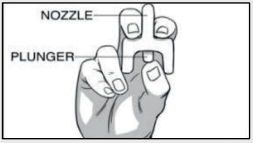](https://kb.astate.edu/uploads/images/gallery/2025-12/narcan-p1.png)
4. Tilt the person’s head back and provide support under the neck with your hand. Gently insert the tip of the nozzle into one nostril until your fingers on either side of the nozzle are against the bottom of the person’s nose.
1. [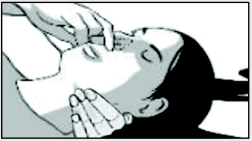](https://kb.astate.edu/uploads/images/gallery/2025-12/narcan-p2.png)
5. Press the plunger firmly to administer the dose.
1. [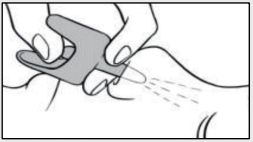](https://kb.astate.edu/uploads/images/gallery/2025-12/narcan-p3.png)
6. Move the person on their side (recovery position) after giving the dose.
1. [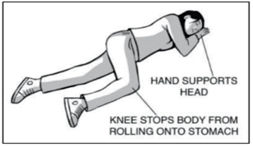](https://kb.astate.edu/uploads/images/gallery/2025-12/narcan-p4.png)
5. If the patient is not breathing, give rescue breaths:
1. Clear the airway.
1. Make sure nothing is inside the mouth or throat blocking the airway.
2. Place one hand on the person’s chin, tilt the head back, and pinch the nose closed.
3. Place your mouth over the person’s mouth to make a seal and give two slow breaths.
4. Watch for the person’s chest (not stomach) to rise.
5. Give one breath every five (5) seconds.
6. Stay with the individual and try to provide support and comfort until help arrives.