Research Development Handbooks & Policies
Designed to support A-State faculty and staff in the grant proposal and development process, this book houses essential documentation managed by the Office of Research and Technology Transfer. In preparation for upcoming institutional accessibility standards (WCAG 2.1/2.2), our proprietary handbooks and guides have been converted into accessible, dynamic webpages (where possible).
For streamlined navigation, please access these materials via the Investigator's Toolbox (https://kb.astate.edu/books/research-development/page/investigators-toolbox-542) , which provides a comprehensive index of these internal guides alongside current external federal resources.
- ➡️ Return to "Investigator's Toolbox"
- A-State Faculty Research Incentive Plan
- Governing Principles of Externally Sponsored Programs
- Governing Principles for the Responsible Conduct of Research
- Standard Operating Procedures
- Cost Share
- For Researchers Interacting with RTT (Pre-Award)
- Limited Submission
- Participant Support Costs
- Combined Fellowship and Off-Campus Duty Assignment Support
- Stipends
- Subrecipient vs. Contractor
- Facilities and Administrative Costs
- Governing Principles for Recovery of Facilities and Administrative Costs
- Requesting Facility and Administrative (Indirect) Cost Reductions
- Communication
- Internal Forms
- Governing Principles and Procedures for Centers and Institutes
➡️ Return to "Investigator's Toolbox"
https://kb.astate.edu/books/research-development/page/investigators-toolbox-542/
A-State Faculty Research Incentive Plan
Approved March 20, 2026. To go into effect July 1, 2026, with first incentive payments eligible in Fall 2027.
Purpose
To support a thriving research culture and recognize faculty who secure external funding, Arkansas State University (A-State) is launching a new initiative called the Faculty Research Incentive Plan. This program is designed to reward faculty who contribute to university research growth by generating external grant support that offsets a portion of their university-funded salary.
Why a Faculty Research Incentive?
External research funding plays a vital role in advancing the university’s mission and priorities. Faculty Research Incentive recognizes that attracting grant support often requires extraordinary time, leadership, and scholarly excellence. This incentive plan aims to:
- Provide recognition and financial reward for faculty who drive research forward
- Increase grant submissions and awards
- Expand A-State’s research enterprise and external funding portfolio
- Reinforce sustainable salary recovery practices that benefit both faculty and the institution
Who Is Eligible?
Faculty must meet all the following criteria to be eligible for a Faculty Research Incentive payment:
- Appointment Type: Full-time faculty members with base salary supported by E&G (Education & General) funds.
- Role: Must be listed as a Principal Investigator (PI) or Co-Principal Investigator (Co-PI) on an externally sponsored project.
- Salary Recovery: The external grant must fund at least 10% of the faculty member’s E&G-supported base salary. The PI or Co-PI must also budget at least one month of summer support to be eligible for the Faculty Research Incentive.
- F&A (Indirect Costs): The grant must include either the full federally negotiated indirect cost rate or the maximum allowable rate, with a minimum of 8% F&A. Projects with waived or significantly reduced indirect costs are not eligible.
- Student Engagement: If the funding sponsor permits, the project should support graduate or undergraduate students meaningfully involved in the scope of work.
- Buyout Limit: Faculty members whose entire (100%) academic-year salary is charged to grants are not eligible for this program.
What Is the Incentive?
Eligible faculty will receive a supplemental payment equal to 40% of their recovered salary, subject to the following limits:
- Individual Cap: Each eligible faculty member may receive up to $15,000 annually in total incentive payments.
- Grant Cap: No more than $15,000 per grant may be distributed through this program, even if multiple investigators are involved. In such cases, funds are distributed proportionally based on each investigator’s salary recovery.
- Multiple Grants: Faculty may participate in multiple qualifying projects during the year, provided their total incentive payment does not exceed the individual cap.
All payments will be made as one-time, lump-sum supplements in the fall semester following the end of the fiscal year (i.e., after June 30). These payments are taxable and subject to standard withholdings, but they will not be added to retirement base salary or affect merit increases, promotion, or summer teaching eligibility.
How It Works: Step-by-Step
- Process is Automatic: RTT will conduct an annual audit of all faculty grant buyout. RTT will notify colleges with names of those earning the research incentive and the amount to pay.
- Payment Approval and Distribution: Approved participants will receive their incentive during the fall semester following their buyout from the previous fiscal year. College fiscal administrators will issue payments from Education and General (E&G) or carryforward accounts.
Specific Examples
Example 1: Single Faculty Salary Recovery
Professor A has an $82,000 university-funded base salary. She has a research grant that covers 30% of her salary.
- Salary charged to grant: 30% × $82,000 = $24,600
- Minimum university-funded portion to qualify: 10% × $82,000 = $8,200 (she qualifies)
- Incentive: 40% × $24,600 = $9,840
Final payment: Professor A will receive a $9,840 incentive.
Example 2: Salary Recovery Split Between PI and Co-PI
Professor B is the PI on a grant, charging 25% of his $82,000 salary to the grant.
- Salary charged: 25% × $82,000 = $20,500
- Minimum university-funded portion qualify: 10% × $82,000 = $8,200 (he qualifies)
- Incentive: 40% × $20,500 = $8,200
Professor A (from example 1) is the Co-PI, also charging 25% of her $82,000 salary to the same grant. - Salary charged: 25% × $82,000 = $20,500
- Incentive: 40% × $20,500 = $8,200
Potential incentives: Professor B: $8,200 and Professor A: $8,200 = $16,400, which exceeds grant cap of $15,000. Since Professor A has already received $9,840 from another grant, she can only receive an additional $5,160 to stay within her $15,000 individual cap. Therefore, she will receive her maximum of $15,000 in incentive total across these two awards.
Final payments: Professor B receives $8,200 and Professor A receives $5,160 from this grant = $13,360 from this grant, which is below the grant cap and below the individual cap for both Professors.
Example 3: Proportional Incentive Distribution for PI and Co-PI
Professor C and Professor D are PI and Co-PI on an industry grant. Both have $80,000 salaries.
- Professor C charges 50% of salary: 50% × $80,000 = $40,000
- Professor D charges 30% of salary: 30% × $80,000 = $24,000
Total salary charged: $40,000 + $24,000 = $64,000 - Minimum university-funded portion qualify: 10% × $80,000 = $8,000 (both professors qualify)
- Incentives: Professor C: 40% × $40,000 = $16,000; Professor D: 40% x $24,000 = $9,600; Combined incentive = $25,600, which exceeds the grant cap.
-
Proportional shares:
Professor C: $40,000 ÷ $64,000 = 62.5% and Professor D: $24,000 ÷ $64,000 = 37.5%
-
Total incentive pool following grant cap: $15,000
Professor C’s incentive: 62.5% × $15,000 = $9,375
Professor D’s incentive: 37.5% × $15,000 = $5,625
Final payments: Professor C receives $9,375 and Professor D receives $5,625
Additional Guidelines
- Payments are made from university funds. Grant funds may not be used to pay faculty incentive bonuses.
- Faculty must remain employed at A-State at the time of disbursement to receive payment.
- Participation in Faculty Research Incentive does not impact eligibility for summer teaching, future merit raises, or promotion.
- Program eligibility and terms are subject to annual review and potential revision.
- At A-State, 20% of faculty buyout stays in the Academic Affairs and Research office, and 80% of the buyout goes to the College where the PI holds the tenure-track appointment. It is the College’s responsibility to cover the teaching load through temporary, adjunct, or overload pay and then use remaining recovered buyout funds or carryforward funds to support the Faculty Research Incentive pay.
Need Help or Have Questions?
Please contact Research & Technology Transfer at research@astate.edu for clarification or questions about eligibility.
Approved March 20, 2026. To go into effect July 1, 2026, with first incentive payments eligible in Fall 2027.
Governing Principles of Externally Sponsored Programs
1.0 INTRODUCTION
Arkansas State University (A-State) is committed to the pursuit of discovery and innovation that enhances understanding of the universe and improves the lives of people, particularly Arkansans. In pursuing this goal, the University has designated the Office of Research and Technology Transfer (RTT) to assist its personnel in securing and managing external funding to support research and other scholarly activities.
In the pursuit of its research mission, A-State affirms that it does not discriminate against prospective or current students, prospective or current employees, or against individuals in affiliated organizations. A-State likewise affirms its commitment to an open research environment whenever practical, supporting the principle of freedom of access to data, processes, and results of research and preserves the faculty’s right to select the best qualified employees and students to participate in sponsored research.
2.0 PURPOSE
The purpose of these principles is to: 1) affirm A-State’s commitment to maintaining an open and non-discriminatory research environment; 2) identify RTT as the office designated to manage the institution’s research effort; 3) establish eligibility standards for principal investigators, co-principal investigators, and project directors; 4) to facilitate preparation and submission of grants and contracts to external sponsors; and 5) ensure compliance with regulations prior to submission.
3.0 DEFINITIONS
4.0 APPLICABILITY
This policy applies to all A-State faculty, staff, and administrators who seek external support for research grants, contracts, and agreements from external sponsors. It does not govern the receipt of philanthropic contributions or clinical trial agreements.
5.0 APPLICABLE REGULATIONS
University Conflict of Interest/Commitment Policy
Governing Principles for University Effort Reporting
6.0 GOVERNING PRINCIPLES
6.1 Non-Discrimination and Openness in Research
A-State does not discriminate against students, employees, or individuals in affiliated organizations on the basis of race, religious creed, color, national origin, ancestry, physical or mental disability, medical condition, marital status, sex, age, sexual orientation, gender identity, veteran status, or any other characteristic protected by law. The University is likewise committed to an open, non-discriminatory research environment that supports freedom of access by all interested persons to data, processes, and results of research whenever practical.
6.2 Project Submission
Proposals for extramural support of research, training, or public service projects may be submitted on behalf of A-State employees who:
A. have primary responsibility for design, execution, and management of the project,
B. will be involved in the project in a significant manner, and
C. will serve as the Principal Investigator, Co-Principal Investigator, or Project Director for a research, training, or public service project.
All requests for support and award acceptance from external sponsors must be submitted to and approved by one of the Authorized Organizational Representatives (AOR), which includes the Vice Provost for Research, Innovation, and Discovery and the Executive Director for Research Development. Deans, Department Chairs, and individual faculty or staff members are not authorized to submit applications, pre-applications, or letters of intent or their equivalent for grants or contracts, nor accept awards, contracts, subcontracts, or agreements on behalf of the University. All proposals must be submitted in accordance with the following timelines.
| Category | Deadline for Submission to RTT |
|
Matching Fund Requests |
Minimum fifteen (15) business days prior to sponsor deadline. This extended timeline allows RTT staff to navigate the financial obligations of the sponsor’s requirement for matching funds. This includes working with the PI to identify possible sources of funding and liaising with university leadership to make the request where necessary. |
|
|
Proposals must be provided to RTT for submission no later than ten (10) business days before the sponsor deadline for full review and compliance check. Once provided to RTT, proposals typically will be submitted in the order they are received. RTT staff need time to review the proposal for necessary files, provide suggested or required edits, repair corrupted files, and overcome other problems that may preclude timely submission.
|
6.3 Eligibility Criteria for Principal Investigators
Individuals recommended for principal investigator or co-principal investigator status on a research, training, or public service project must possess qualifications that satisfy the general standards of research competence. Individuals recommended as project directors must be competent in the project area.
Individuals with faculty rank or other qualified A-State employees may serve as principal investigators, co-principal investigators, or project directors on proposals submitted to any outside funding agency in support of research, training, or other sponsored activities. Candidates for these leadership roles must have appropriate academic or experiential credentials and must have primary responsibility for the design, execution, and management of the project.
Candidates for principal investigator must obtain the approval of the Department Chair and the Dean or equivalent administrators to serve in a leadership capacity during the grant or contract submission process. Candidates are strongly encouraged to talk to their chairs or comparable administrators well in advance of grant submission. Chairs should encourage their faculty to submit grant proposals. When discussing proposal ideas with faculty members, chairs should include consideration of the overall merits of the proposed project and whether it: 1) assists the department and the University to achieve their educational, research, or public service goals; and 2) makes use of University resources in a manner that is consistent with departmental goals and objectives.
6.4 Delegation of Principal Investigator Responsibilities
Primary responsibility for a project is vested in principal investigators, co-principal investigators, and project directors and may not be relinquished nor delegated explicitly or implicitly without the support and direction of the Vice Provost for Research, Innovation, and Discovery and the sponsoring agency.
6.5 Cost Sharing/Matching
A-State recognizes that certain grant, contract, and cooperative agreement awards may require cost sharing, either through the use of internal funds, in-kind resources, or other external sources.
Including cost sharing in a proposal may increase the likelihood that a project will be funded and demonstrates the University's commitment to the project. However, cost sharing implies at least some redistribution of department or college resources to support a specific sponsored agreement. Because these resources are often scarce, it is important not to over-commit funds when the sponsor does not require them and when the project can be completed without them. It should also be noted that cost sharing commitments have an effect on calculation of the A-State’s Facilities and Administration rate, since they are included in the research base and excluded from F&A recovery.
To be included as cost share, proposed expenses must be:
- allowable and allocable under the federal regulations and the terms of the sponsoring agency;
- necessary, reasonable, and directly related to the project objectives;
- verified and recorded in the University's accounting records.
Commitment of University funds or in-kind resources for cost-sharing purposes must be approved, in writing, by the department chair, dean, or official in charge of the funding source before submission. Waived F&A requests must be approved in writing by the Vice Provost for Research, Innovation, and Discovery before a proposal is submitted.
6.6 Research Expenditure Classifications
A-State is classified as a Research 2 "R2": High Spending and Doctorate Production institution, designated by the Carnegie Classification of Institutions of Higher Education. There are two significant benchmarks that universities must meet to attain this status; one of which is research expenditures over a three-year period, determined by reports made to the National Science Foundation's Higher Education Research and Development (HERD) survey. There are five categories of expenditures in this report:
- Basic research: Experimental or theoretical work undertaken primarily to acquire new knowledge of the underlying foundations of phenomena and observable facts, without any specific application or use in view.
- Applied research: Original investigation undertaken to acquire new knowledge. It is directed primarily towards a specific, practical aim or objective.
- Experimental development: Systematic work, drawing on knowledge gained from research and practical experience and producing additional knowledge, which is directed to producing new products or processes or to improving existing products or processes.
- Capital improvements: Activities related to the construction or renovation of research facilities.
- Public service: Activities including community engagement or outreach programs, non-research training grants, routine work or “fee-for-service” activities done to support communities or external companies.
When an award is made, Research and Technology Transfer will email the principal investigator to confirm receipt of the award and confirm how this award's activities should be classified. This email will be kept on file in the PI's award documents folder. A percentage of the award's activity can be distributed across multiple areas listed above. If more than 50% of the activities are classified in one of the three research categories (basic, applied, or experimental), then all of the award's expenditures will be classified as research. If some smaller percentage of the award's activities are classified as research, then that percentage will be used in calculating the expenditures that can be included in these categories on the HERD survey.
Example 1:
PI Smith has categorized Project ABC as:
Basic research: 20%
Capital improvement: 80%
Therefore, 20% of the project's expenditures are categorized as research on the HERD survey.
Example 2:
PI Jones has categorized Project XYZ as:
Applied research: 30%
Experimental development: 30%
Public service: 40%
Therefore, all of the project's expenditures are categorized as research on the HERD survey.
7.0 RESPONSIBLITIES
7.1 Proposal Preparation and Grant/Contract Administration
7.1.1 Research and Technology Transfer (RTT) responsibilities include:
- Reviewing all proposals for external support to ensure compliance with University policies and sponsor regulations,
- Obtaining all necessary institutional approvals for submission of a proposal (e.g., Chair, Dean, RTT, Finance, and any other required approvals);
- Authorizing proposal submissions, as long as their submission is consistent with the timelines set forth in this document,
- If paper submissions are required by the sponsor, assuming responsibility for submitting the correct number of copies to the agency and mailing/delivering the application by the agency deadline.
- Negotiating award conditions with external sponsor representatives, and
- Accepting awards on behalf of A-State.
7.1.2 Principal Investigator Responsibilities
The Principal Investigator’s pre-award responsibilities include:
- Notifying the appropriate personnel in RTT as early as possible prior to submission of proposals to external agencies by utilizing the Proposal Notice form found on the RTT website;
- Completing proposal/application in compliance with sponsor’s guidelines and requirements;
- Developing project design;
- Attending to all compliance issues including, but not limited to transportation limitations and export controls; protection of human research subjects; animal care and use; all safety concerns (e.g., radiation, biohazards, laser; and general laboratory); and disclosure of potential or real conflicts of interest in research;
- Submitting annual conflict of interest in research disclosure materials and update any apparent or actual conflict of interest in research issues that may arise between annual disclosures;
- Developing accurate proposal budgets containing only allowable, allocable, and essential expense items;
- Determining effort for key personnel;
- Notifying the Chair and Dean of any released time or absences that will result if the proposal is funded, and obtain appropriate approvals for this time;
- Coordinating required cost sharing or matching funds (including tuition waivers) with RTT, and obtain appropriate approvals;
- Obtaining scope of work, budget, and institutional approval from any external subcontractors fifteen (15) business days in advance of the sponsor’s deadline date;
- Submitting proposals and subcontract documentation to RTT for review and approval in accordance with the timelines specified in Section 6.2 of this document; and
The Principal Investigator’s post-award responsibilities include:
- Supervising and maintaining progress of the technical aspects of the project to ensure the responsible and ethical conduct of activities according to award document and in compliance with University, sponsor, and local, state, and federal government requirements;
- Devoting effort to the project at the level agreed to with the sponsor;
- Ensuring all compliance issues are met for all key personnel including, but not limited to, conflict of interest in research reporting; effort reporting, and training in the protection of human subjects, animal care and use, and environmental safety;
- Maintaining high-quality, accurate records of research for a period not less than the period of time that the sponsor requires;
- Maintaining research integrity, including the management of activities of project personnel;
- Ensuring responsible management of expenditures in accordance with awarded budget that are allowable, allocable, and essential, and ensuring that any budget changes or alterations are consistent with sponsor and University guidelines (expenditures that exceed the sponsored project budget are the responsibility of the PI/PD and will be charged to a departmental account);
- Selecting, training, and evaluating project staff and providing necessary input and guidance to all students, post-doctoral fellows, staff, and research assistants to ensure the integrity of the project and compliance with sponsor and federal guidelines;
- Informing staff of all University and sponsor guidelines and regulations;
- Ensuring that project staff have the knowledge, resources, and tools necessary for the responsible conduct of research and the technical needs of the project;
- Managing acquisition of equipment, supplies, and personnel according to sponsor guidelines and University policies and procedures;
- Disclosing and managing intellectual property in collaboration with Research and Technology Transfer;
- Fulfilling all reporting requirements, both University and sponsor, in a timely manner, including:
- Certifying time and effort on quarterly basis,
- Approving expenditures,
- Submitting annual conflict of interest disclosures,
- Monitoring conflicts of interest in research and immediately disclosing changes in actual or apparent conflicts,
- Fulfilling sponsor reporting requirements, including technical progress and final reports,
- Working with the Office of Sponsored Programs to close the project at the end of the grant period; and
- Analyzing and publishing findings.
7.1.3 Departmental Chair and School/College Dean Responsibilities
The Department Chair and College Dean, or other appropriate unit head, review and approve the proposal in a timely manner, paying particular attention to any cost sharing that is included in the proposed budget, especially as it relates to the percentage of effort that a faculty member is devoting to the project. By approving in Cayuse, unit heads certify that they approve of the project, the involvement of the PI, other investigators, and students (including release time), the budget, cost sharing, and any other considerations described in the proposal and the project summary in Cayuse.
7.2 Awards Not Reviewed Prior to Submission
Awards for proposals that have not undergone proper review may encounter compliance problems with University or sponsor policies. The University reserves the right to decline an award that is not compliant with institutional, sponsor, or government regulations.
7.3 Authorized Organizational Representative (AOR) Signatory
The Vice Provost for Research, Innovation, and Discovery and designees are the official University signatories. Deans, Department Chairs, and individual faculty and staff are not authorized to sign application forms on behalf of the University.
8.0 PROCEDURES
8.1 Proposal Submission
8.1.1 Contact Research and Technology Transfer (RTT)
PIs should contact RTT as early as possible prior to submission of proposals to external agencies. RTT staff review proposals to ensure compliance with University policy and sponsor regulations.
PIs must fill out the proposal notice form available on RTT’s website to provide the following information:
- A summary of the proposed project
- The name of the funding agency and program
- Copies of program guidelines (RFPs, RFAs, etc.)
- The deadline for submission
- Special needs such as matching funds, tuition waivers, or use of institutional resources
- The need for protection of human subjects, animal care and use, biohazards, or other safety approval, and a plan for obtaining that approval
PIs must develop budgets that are accurate, reasonable, and adequate for the proposed project. The budget must follow A-State and sponsor budget guidelines, and where applicable, all federal and state regulations. Investigators should work closely with RTT staff in this process. RTT must approve budgets to both federal and private sources of research support.
8.1.2 Obtain Institutional Review and Approvals
PIs and Co-Investigators for both paper and electronic proposal submissions must work with RTT to upload their submissions and all appropriate documentation to the electronic repository, Cayuse, and submit the package to their chair or equivalent administrator for approval. Once the chair or equivalent administrator has approved, the package will be transmitted to the Dean or equivalent, and then to RTT for final approval and submission.
8.1.3 Submit the Proposal to the Agency
8.2 Award Acceptance
Usually, notification of an award is sent to the University. However, if an award notice is sent directly to the PI, a copy must be sent immediately to RTT for processing. PIs cannot incur expenses without a University-assigned fund number and budget for a grant or contract. All external funds within the scope of this policy must be set up in a sponsored program account.
In most cases, a grant or contract award is made to the University on behalf of the researcher. An authorized organizational representative must sign a contract to accept the award. Deans, Department Chairs, and individual faculty or staff members are not authorized to sign award documents.
RTT will work with Sponsored Programs Accounting to establish a new fund number for a newly awarded grant or contract. The fund will include a line-item budget in accordance with the award budget, funding agency requirements, and University guidelines.
To fulfill audit requirements, all official correspondence or contact with the sponsor normally will be made through RTT or Sponsored Programs Accounting.
Any significant changes to awarded grants need to be brought to the attention of RTT and Sponsored Programs Accounting. Significant changes include but are not limited to:
- Changes in PI or PD
- Changes in effort devoted to the project
- Budget revisions
- Extension of grant period
- Change in scope of the project
Any questions regarding this policy or the procedures mentioned herein should be directed to RTT personnel (research@astate.edu; 870-972-2694).
Governing Principles for the Responsible Conduct of Research
1.0 INTRODUCTION
Arkansas State University is committed to ethical conduct and provides training to its investigators
in the responsible conduct of research.
2.0 PURPOSE
The purpose of these governing principles is to provide training in the responsible conduct of
research to University employees and students who participate in University or externally-funded
research programs.. It is also designed to ensure compliance with Section 7009 of the America
Creating Opportunities to Meaningfully Promote Excellence in Technology, Education and Science
(America COMPETES) Act which requires that undergraduates, graduate students, and
postdoctoral researchers who participate in National Science Foundation (NSF) projects receive
training in the responsible and ethical conduct of research.
3.0 DEFINITIONS
Co-Principal Investigator. The co-principal investigator is a faculty member or administrator who has
secondary responsibility for directing work on sponsored program projects.
Principal Investigator. The principal investigator is a faculty member or administrator responsible for
directing work on sponsored program projects.
Responsible Conduct of Research (RCR). Responsible conduct in research, at minimum, is research
that is built on commitment to:
- Acquiring and managing data using accepted practices;
- conveying information truthfully and honoring commitments;
- reporting findings precisely and taking care to avoid errors;
- appropriately crediting research colleagues for their participation in research projects and any
publications or presentations that emanate from such research projects; - using resources wisely and avoiding waste;
- letting the facts speak for themselves and avoiding improper bias;
- treating human subjects with respect and minimizing risk to their participation in Universitysponsored
research programs; - caring for animals appropriately and minimizing their pain and suffering;
- providing students, post-doctoral fellows, and junior faculty members with mentoring and training
opportunities; and - aggressively pursuing alleged cases of research misconduct.
4.0 REGULATIONS
Section 7009 of the America Creating Opportunities to Meaningfully Promote Excellence in
Technology, Education and Science (America COMPETES).
5.0 APPLICABILITY
These governing principles apply to all undergraduates, graduate students, and postdoctoral fellows, to
principal, and co-principal investigators who apply for or participate in externally-funded sponsored
programs.
6.0 GOVERNING PRINCIPLES
All individuals who apply for or participate in externally-funded research programs at Arkansas
State University after July 1, 2010 are required to enroll in Responsible Conduct of Research (RCR)
training before the onset of work. Core instructional areas (modules) of the Responsible Conduct of
Research as indicated by the U.S. Office of Research Integrity include:
- Data Acquisition, Management, Sharing, and Ownership: Accepted practices for acquiring
and maintaining research data. Proper methods for record keeping and electronic data collection
and storage in scientific research. Includes defining what constitutes data; keeping data
notebooks or electronic files; data privacy and confidentiality; data selection, retention, sharing,
ownership, and analysis; data as legal documents and intellectual property, including copyright
laws. - Conflicts of Interest and Commitment: The definition of conflicts of interest and how to
handle conflicts of interest. Types of conflicts encountered by researchers and institutions.
Includes topics such as conflicts associated with collaborators, publication, financial conflicts,
obligations to other constituencies, and other types of conflicts. - Human Subjects: Issues important in conducting research involving human subjects. Includes
topics such as the definition of human subjects research, ethical principles for conducting
human subjects research, informed consent, confidentiality and privacy of data and patient
records, risks and benefits, preparation of a research protocol, institutional review boards,
adherence to study protocol, proper conduct of the study, and special protections for targeted
populations, e.g., children, minorities, and the elderly. - Animal Welfare: Issues important to conducting research involving animals. Includes topics
such as definition of research involving animals, ethical principles for conducting research on
animals, Federal regulations governing animal research, institutional animal care and use
committees, and treatment of animals. - Research Misconduct (fabrication or falsification of data including image manipulation,
plagiarism). The meaning of research misconduct and the regulations, policies, and guidelines
that govern research misconduct in PHS-funded institutions. Includes topics such as fabrication,
falsification, and plagiarism; error vs. intentional misconduct; institutional misconduct policies;
identifying misconduct; procedures for reporting misconduct; protection of whistleblowers; and
outcomes of investigations, including institutional and Federal actions. - Publication Practices and Responsible Authorship: the purpose and importance of scientific
publication, and the responsibilities of the authors. Includes topics such as collaborative work
and assigning appropriate credit, acknowledgments, appropriate citations, repetitive
publications, fragmentary publication, sufficient description of methods, corrections and
retractions, conventions for deciding upon authors, author responsibilities, and the pressure to
publish. - Mentor / Trainee Responsibilities: the responsibilities of mentors and trainees in predoctoral
and postdoctoral research programs. Includes the role of a mentor, responsibilities of a mentor,
conflicts between mentor and trainee, collaboration and competition, selection of a mentor, and
abusing the mentor/trainee relationship. - Peer Review: The purpose of peer review in determining merit for research funding and
publications. Includes topics such as, the definition of peer review, impartiality, how peer
review works, editorial boards and ad hoc reviewers, responsibilities of the reviewers,
privileged information and confidentiality. - Collaborative Science: Research collaborations and issues that may arise from such
collaborations. Includes topics such as setting ground rules early in the collaboration, avoiding
authorship disputes, and the sharing of materials and information with internal and external
collaborating scientists.
Only those instructional areas applicable to the grant funded research project are required to be
covered. For example, a chemistry project might not involve the use of human subjects, thus the
human subjects module would not be required as part of the training.
7.0 RESPONSIBILITIES
Principal and Co-Principal Investigators
Principal and Co-Principal Investigators who are conducting externally-funded research projects are
responsible for assuring that undergraduates, graduate students, and post doctoral fellows
participate in appropriate Responsible Conduct in Research training (depending upon discipline)
offered by the CITI Program. Faculty investigators who have received, or are about to
receive external funding are also required to complete the CITI Program Responsible Conduct in
Research Program before a grant account will be activated.
Undergraduates, Graduates Students, and Postdoctoral Fellows
Undergraduates, Graduates Students, and Postdoctoral Fellows are responsible for successfully
completing appropriate CITI Program training.
Associate Vice Chancellor for Research
Dissemination and administration of these regulations will be the responsibility of the Associate
Vice Chancellor for Research.
Standard Operating Procedures
Cost Share
Updated January 11, 2024
Overview
Cost sharing is the portion of the total costs of a sponsored project that is borne by Arkansas State University rather than the sponsor. Cost sharing (sometimes called match) can take the form of salary support for project personnel or other material contributions such as funds to purchase supplies or equipment. It can also include in-kind contributions from a third party (not A-State) in support of the sponsored project objectives.
A specific and quantifiable offer of cost sharing in a proposal becomes an obligation that the university must fulfill. Generally, the university seeks to minimize these obligations because a voluntary commitment to cost share:
- Increases the requirements for auditable record-keeping by imposing a substantial tracking, monitoring, recording, and documenting burden on the PI and university administrators.
- Redirects departmental, school, college, or central resources from other mission-critical uses to support sponsored agreements.
- Has an adverse effect on the university’s Facilities and Administration (F&A; also known as Indirect Cost or IDC) In the calculation of the F&A rate, the denominator is the university’s organized research base – the direct costs associated with sponsored projects and non-sponsored research. The numerator is the university’s research pool expenses, or the facilities and administrative costs associated with supporting organized research. The total amount of the university’s cost-sharing must be included in the denominator. The increase in the denominator serves to decrease the university’s overall F&A rate.
- Increases the university’s exposure to audit liability. Cost sharing commitments are subject to audit, and a failure to provide the level of cost sharing reflected in the approved award budget may result in a disallowance of award costs, refund of award funds to the sponsor, and possible termination of the award.
Cost sharing must comply with federal, university, and sponsor requirements. Cost sharing should only be engaged in when mandated by the sponsor, if needed to reflect the required effort to complete the project, or when the funding announcement emphasizes cost share as a competitive advantage.
Mandatory – Mandatory cost sharing is required by the sponsor as a condition for proposal submission and award acceptance. A mandatory cost sharing requirement will be specified in the sponsor’s published request for proposals. If the mandatory level of cost sharing is not included in the submitted proposal, the sponsor will return the proposal without review.
Voluntary Committed – Voluntary committed cost sharing is cost sharing that is offered in the proposal but not required by the sponsor as a condition of proposal submission. Once offered by the institution in the proposal budget and agreed to by the sponsor, it becomes an obligation the university must fulfill.
Voluntary Uncommitted – Voluntary uncommitted cost sharing is cost share that is over and above an amount that was committed and budgeted for in a sponsored research agreement. It is neither pledged explicitly in the proposal nor stated in the award documents but occurs in the course of executing a project. This is not required to be documented or tracked by the university.
Procedure
- For federal awards, they must be allowable under 2 CFR 200
- Verifiable from recipient’s records
- Not used as match for another project
- Not paid by the federal government
- Provided for in the approved budget
- Necessary and reasonable for accomplishment of the project
Principal Investigators (PIs) must obtain prior approval from their Chair or Dean, in writing, to commit cost-share on behalf of the University.
Research and Technology Transfer will aid in determining if the cost share meets the above cost share eligibility guidelines, and obtain appropriate documentation of approval from the PI's chair/dean before submitting the proposal.
All proposals with cost share must include the Director of Sponsored Programs Accounting in the approval chain in Cayuse for review. This must be added manually before the approval of Research and Technology Transfer and Authorized Organizational Representative (AOR).
Any deviation from this above procedure must be approved by the Executive Director of Research or the Vice Provost of Research, Innovation, and Discovery.
Preferred Methods of Cost Share
- Salary/Fringe Benefits
- F&A costs associated with any cost shared direct cost
- Unrecovered F&A when F&A rate is waived or reduced by the sponsor
- Third-Party In-Kind contributions
For Researchers Interacting with RTT (Pre-Award)
Updated March 14, 2024
NOTE: RTT needs proposal documents from PIs 10 business days or more in advance of the sponsor’s deadline.
Overview
The staff in Research and Technology Transfer (RTT) are your campus collaborators for preparing proposals for submission to federal and state agencies and other sponsors that provide external funding for research, creative endeavors, public service projects, contractual agreements, and fixed-fee agreements. Our expertise allows you to focus on the specific project, and we will assist to ensure all submitted applications are complete and all documents are prepared to the sponsor’s specifications and in compliance with university policy and state and federal law. RTT’s pre-award team wants the highest-quality, most competitive proposals to be submitted, and we will work with each scholar to ensure the development and submission of the best proposals.
Proposal Development Tools: The proposal development process requires access to various types of information to prepare the required proposal documentation. Assistance can be found at the RTT website under the Investigator's Toolbox & Institutional Profile.
Proposal Submission Portal: Cayuse is the official submission portal used by Arkansas State University for proposal preparation, proposal approval, sign-off by the Vice Provost for Research, Innovation, and Discovery and submission to the sponsored agencies’ systems for electronic submission of sponsored funding proposals.
What RTT will provide:
- Thorough review of the grant solicitation (aka the request for proposals or RFP) to understand the specific sponsor requirements
- Assistance with the development of certain aspects of the proposal, including the budget (with an eye toward allowable and unallowable costs, cost share [aka match], and other budget complexities), the budget justification, boilerplate language about the institution and region (NOTE: If you have any questions, reach out directly to 870-972-2694 or research@astate.edu.)
- Review of all application materials
- Feedback to the investigator(s) on required additional elements or edits before submission
- Feedback on optional elements and best practices before proposal submission
- Regular communication with the investigator(s) throughout the proposal preparation process
- Upload to our internal approval system (Cayuse), which is required in advance of proposal submission
- Submission of the proposal to the sponsor (NOTE: This is not the responsibility of the investigator, as only RTT has the authority to enter into an agreement with the sponsor.)
- Communication about recommendation for funding or resubmission from a sponsor
What the Principal Investigator (PI) will provide to RTT:
- As much notice as possible (preferably 3 months – 1 year) regarding intent to submit a proposal (NOTE: The longer the lead time, the more RTT can assist with proposal development.)
- Completing the Proposal Notice Form on the RTT Research Development website (https://www.astate.edu/a/ortt/index.dot): https://app.smartsheet.com/b/form/5dcc5d258518469683b30a9c10b7abe1
- Regular communication with RTT staff well in advance of the submission deadline if plans change or if the PI needs assistance in proposal development
- All required documents for proposal submission to RTT at least 10 business days in advance of the sponsor’s deadline
- All PIs must use the A-State Budget Template for all proposals. When another format is required for a submission, RTT will handle entering or transferring the budget for PIs into the sponsor-required format
- Timely responses to RTT requests for additional information in the lead up to a proposal submission
Other important elements of the proposal development process
- Approvals for submission must be documented in Cayuse by the investigator, chair, dean, and RTT prior to proposal submission.
- RTT will complete the proposal submission no later than 24 hours in advance of the sponsored agency’s deadline date and specified time to ensure agency’s receipt of proposal in acceptable form.
- Award receipt to the University, including review and negotiation of terms and conditions when necessary, is conducted by RTT. Investigators are not allowed to receive awards or sign agreements and contracts on behalf of the University. Funds are awarded to the University and the signature of the Vice Provost for Research, Innovation, and Discovery is required for legally binding purposes.
Important Reminders and Final Points
RTT needs proposal documents from PIs 10 business days or more in advance of the sponsor’s deadline. This is a firm requirement, and investigators may be denied grant submission and asked to wait for the next funding cycle if the internal deadline is not met. This requirement necessitates a lot of planning and coordination with collaborators in advance of a proposal submission. Please review the sponsor’s proposal solicitation, determine the sponsor’s deadline, and calculate and use the RTT deadline of 10 business days in advance of submission as your firm deadline.
Starting in FY24, RTT’s revised goals were to grow the number of submissions, increase the proportion of high dollar-value submissions, and increase interdisciplinary submissions. We have already been successful in this goal, which is a result of creative and innovative faculty members and their hard work. Thank you! It also means that the complexity of the requests and the sheer number of submissions has increased, and to collaborate with you effectively, we need your cooperation in the external funding pipeline.
Again, our mission is to submit the highest quality proposals possible. This requires time to prioritize, review, edit, load, receive internal approvals, and submit proposals.
Limited Submission
Updated November 21, 2025
Purpose
This procedure applied to all faculty and staff at Arkansas State University eligible to submit proposals to funding mechanisms with limited submission requirements. This document outlines Arkansas State University’s process for managing limited submission opportunities, where the number of proposals an institution can submit is restricted by the funding agency. This ensures the strongest proposals move forward for submission.
Procedure
1. Call for Applications
The Research and Technology Transfer (RTT) office announces an internal competition via email to identify proposals for submission to the funding agency. The announcement includes details about the funding opportunity, submission limits, and internal deadlines. The announcement will be shared with the college deans, carbon copying the members of the Faculty Research Awards Committee, so they are aware of their upcoming responsibility in the process. The deans are responsible for broader dissemination to the departments. RTT will also provide a 3-day Daily Digest notification of the limited submission opportunity for direct, campus-wide dissemination.
2. Submission
Interested applicants must submit a one-page project summary via email to research@astate.edu. The summary should include the elements below, as they pertain to the solicitation:
- Description of the proposed project and its
- An estimate of the cost, including any plans for academic year buy-
- Faculty research activities that will be enabled by the
- Student research training
- Preparatory activities completed for the
- Intellectual merit and broader impacts of the proposed research
- A letter of commitment from the relevant dean or department chair, indicating support for the project based on the RTT-provided template, must be included.
3. Internal Review Process
The internal review process consists of two steps:
- Eligibility Review: RTT will review the project summaries to ensure they meet the funding agency's program requirements and that the applicant is eligible to apply.
- Committee Review: The Faculty Research Awards Committee (FRAC) will review eligible project summaries to select the strongest proposal(s) for submission.
- FRAC will use a 1 (strongest) – 10 (weakest) scoring system to evaluate the The mean of the scores will be used to determine the top scoring proposal.
4. Notification of Selected Proposals
RTT will notify applicants of the outcome of the internal competition. This notification will include next steps for the selected applicant to prepare the full proposal.
Timeline
An example timeline is provided below for the Limited Submission process. This may be modified depending upon the time between original notice and sponsor deadline for full submission.
- Announcement of Internal Competition: As soon as RTT is notified of the opportunity
- Submission Deadline for Project Summaries: Two weeks after initial notification
- Internal Review Period: Two RTT will send a reminder to FRAC members who have not completed their scores one week before the deadline and one day before the deadline.
- Notification of Selected Proposals: One business day after the deadline for internal review
- Finalized Proposal Documents: Must be sent from the PI to RTT 10 business days before the sponsor deadline
- Submission Deadline to Funding Agency: One business day before sponsor deadline
Participant Support Costs
Updated January 11, 2024
Overview
Participant Support Costs are defined in Uniform Guidance 2 CFR 200.I as direct costs for items such as stipends, or subsistence allowance, travel allowances, and registration fees paid to or on behalf of participants or trainees (but not employees) in connection with conferences or training projects.
Definition of Participant
A participant is defined as a non A-State employee who is the recipient, not the provider, of a service or training associated with a workshop, conference, seminar, symposium, other short-term instructional or information sharing activity, or are the training beneficiary of a sponsored project. Participants do not perform work or services for the project or program unless it is for their own benefit. Participants may include: students, scholars, scientists from other institutions, teachers, state or local government personnel, or representatives from private-sector organizations. Employees of Arkansas State University are not eligible to receive participant support.
Unallowable Costs
The intent of participant support is solely to provide financial assistance for participants to attend conferences or defray the cost of participating in training programs.
Unallowable Costs Include:
- Honoraria for guest speakers
- Expenses for the PI, project staff, or collaborators
- Incentive payments for recruitment or participation of research subjects
- Costs associated with housing the training or conference
- F&A on participant support expense
Procedure
Participant support funding is typically restricted and exempt from F&A, requiring separate accountability from the rest of the award.
Participant support costs should be accounted for in a separate sub-budget as indicated on the Research and Technology Transfer budget spreadsheet, and will be issued a separate fund for expenditures upon award set up.
RTT will monitor proposal budgets to ensure that participant support costs are identified clearly and are appropriate and allowable.
Re-budgeting of participant support costs requires the prior approval of the sponsor. Re-budgeted costs may be subject to F&A if moved into the main grant fund.
Additional Information
See RTT SOP regarding Stipends for questions about stipend payments to participants/students
Sponsored Programs Accounting Participant Support Costs Guidelines: https://www.astate.edu/a/controller/spa/files/participant-support-costs-ug-edition.pdf
Combined Fellowship and Off-Campus Duty Assignment Support
Updated June 17, 2025
Arkansas State University encourages its faculty to apply for prestigious fellowships to further their research efforts. This procedure outlines the circumstances in which a faculty member can apply for off-campus duty assignment (currently referred to as compensated leave in the Faculty Handbook) while also accepting a prestigious fellowship that requires their leave of absence from their academic appointment.
The purpose of off-campus duty assignment is to provide opportunities for eligible faculty members to engage in professional activities that enhance their tenure at A-State while receiving regular salary. Such activities, in turn, also enhance the faculty members’ service to the university. In accordance with the stated purpose, off-campus duty assignment may be granted for research, writing, other professional creative activities, graduate study leading to advanced degrees, travel for student/research, retraining tenured faculty members who teach in programs being phased out, or for further study to upgrade specific program(s). Eligible faculty are encouraged to apply for off-campus duty assignment to initiate, continue, or complete research or creative activities. For more information, please visit the Faculty Research Awards Committee website or the Faculty Handbook.
Timeline for University Off-Campus Duty Assignment Requests:
August: Off-Campus Duty Assignment solicitation is announced
October: Faculty Research Awards Committee (“FRAC”) deadline
Late October/early November: FRAC meeting, discussion of expectations
November: FRAC application review
December – January: Decisions announced
August or the following January: Off-Campus Duty Assignment begins. See below for more information.
Off-Campus Duty Assignment Cycle:
October – Applications received in October should be made for the next Fall semester (August, 10 months in advance) or Spring semester (January, 15 months in advance).
Approved requests provide salary support to faculty at a rate of half-pay for an academic year or full-pay for a semester.
Combined Fellowship and Off-Campus Duty Assignment Principles:
- The expectations of faculty member’s off-campus duty assignment request must align with the fellowship sponsor guidelines.
- The purpose is to promote professional development and success of faculty and to raise the research profile of the institution.
- All fellowships with an anticipated external funding source or commitment outside of faculty contractual obligations must go through FRAC for approval as an off-campus duty assignment request.
- Off-Campus Duty Assignment requests can be reviewed and considered by FRAC outside of the standard annual review cycle when a sponsored fellowship is awarded that provides support for the faculty member’s research or creative endeavors. External funding of a fellowship with fixed dates will be considered by FRAC when they are notified of the award. Faculty members should work with Research and Technology Transfer (“RTT”) staff to load fellowship applications into Cayuse so there is a record of internal approvals for fellowships awarded to individuals.
- All requests, questions, and consideration for off-campus duty assignment should go through the RTT office. If appropriate, RTT will delegate the request to Advancement for further assistance.
- If a faculty member is approved for off-campus duty assignment in conjunction with a sponsored fellowship, there are several circumstances for which flexibility can be granted with approval from the chair, dean, and RTT:
- Proposed start and end dates. If the fellowship is awarded on a timeline that does not align with university fiscal year, the period of off-campus duty assignment can be adjusted to align with the fellowship.
- If the off-campus duty assignment request will be dependent upon the faculty member acceptance of a sponsored fellowship, this request can be deferred for up to two annual review cycles while a faculty member awaits a response from the fellowship sponsor.
- Scope of work. The scope of work for the off-campus duty assignment request can be adjusted if there are discrepancies with the expectations of the sponsored fellowship program.
o These requests should be initiated with RTT to facilitate the process.
- Proposed start and end dates. If the fellowship is awarded on a timeline that does not align with university fiscal year, the period of off-campus duty assignment can be adjusted to align with the fellowship.
- Teaching reassignments are made at the department and college level and are not reviewed as part of the FRAC process.
Stipends
Updated January 11, 2024
Overview
Participant Support Costs are defined in Uniform Guidance 2 CFR 200.I as direct costs for items such as stipends, or subsistence allowance, travel allowances, and registration fees paid to or on behalf of participants or trainees (but not employees) in connection with conferences or training projects.
Definition of Participant
A participant is defined as a non A-State employee who is the recipient, not the provider, of a service or training associated with a workshop, conference, seminar, symposium, other short-term instructional or information sharing activity, or are the training beneficiary of a sponsored project. Participants do not perform work or services for the project or program unless it is for their own benefit. Participants may include: students, scholars, scientists from other institutions, teachers, state or local government personnel, or representatives from private-sector organizations. Employees of Arkansas State University are not eligible to receive participant support.
Unallowable Costs
The intent of participant support is solely to provide financial assistance for participants to attend conferences or defray the cost of participating in training programs.
Unallowable Costs Include:
- Honoraria for guest speakers
- Expenses for the PI, project staff, or collaborators
- Incentive payments for recruitment or participation of research subjects
- Costs associated with housing the training or conference
- F&A on participant support expenses
Procedure
Participant support funding is typically restricted and exempt from F&A, requiring separate accountability from the rest of the award.
Participant support costs should be accounted for in a separate sub-budget as indicated on the Research and Technology Transfer budget spreadsheet, and will be issued a separate fund for expenditures upon award set up.
RTT will monitor proposal budgets to ensure that participant support costs are identified clearly and are appropriate and allowable.
Re-budgeting of participant support costs requires the prior approval of the sponsor. Re-budgeted costs may be subject to F&A if moved into the main grant fund.
Additional Information
See RTT SOP regarding Stipends for questions about stipend payments to participants/students
Sponsored Programs Accounting Participant Support Costs Guidelines: https://www.astate.edu/a/controller/spa/files/participant-support-costs-ug-edition.pdf
Subrecipient vs. Contractor
Updated January 11, 2024
Overview
Arkansas State University faculty, staff, or students on the premises of the University conduct most of the work on sponsored agreements. However, it may be necessary to collaborate, partner, or outsource portions of the work to other entities, individual consultants, or others outside of the University.
In these cases, a legal agreement outlining the relationship between the parties and the University is required and may take the form of either a subaward or an agreement with a contractor for purchase of services.
The determination between Subrecipient and Contractor should be made early in the proposal preparation stage to ensure compliance with sponsor guidelines and to minimize impacts to the budget, F&A determination, and grant narrative.
Before entering into a relationship with another entity under a sponsored award in which the other entity will provide goods or services of substantive, programmatic work to Arkansas State University as the prime recipient of funding, a determination must be made as to the nature of the legal relationship between A-State and the other entity.
This decision is significant in determining the legal agreement required to establish the relationship, the allocation of responsibilities and influences of the third party, and the application of indirect cost rates.
A-State Responsibility
In the case of a subaward, A-State is responsible, as the prime institution, to ensure that the Subrecipient(s) conduct their portion of the research projects in compliance with all applicable terms and conditions of the externally sponsored agreement, and that the project costs incurred by the Subrecipient(s) are reasonable and allowable.
Agreements with contractors for the purchase of services typically do not bind vendors to the full set of sponsor terms and conditions, and are subject to competitive bidding procurement practices, to assure that funds paid to vendors do not exceed fair market value.
Both agreements should have a clear purpose and cost.
Uniform Guidance
200.331 Subrecipient and Contractor Determinations
200.22 Contractor and 200.92 Subaward
Determination Guidelines
Subrecipient
- Substantive, programmatic work or an important or significant portion of the research program or project is being undertaken by the other entity.
- The research program or project is within the research objectives of the entity.
- The entity retains some element of programmatic control and discretion over how the work is carried out.
- The entity commits to a good faith effort to complete the design and conduct the research.
- The entity participates in a creative way in designing and/or conducting the research.
- The entity makes independent decisions regarding how to implement the requested activities.
- A principal investigator has been identified at the entity and functions as a coinvestigator.
- There is the expectation that the entity will retain ownership rights in potentially patentable or copyrightable technology or products that it produces in the course of fulfilling the scope of work.
- Publications may be created or co-authored at the entity.
- The entity provides cost sharing or matching funds for which it is not reimbursed by A-State. (if applicable)
- The entity regards itself, and/or is regarded by A-State as “engaged in research” involving human subjects under the Common Rule and therefore requires approval for its interactions with human subjects.
Subawards should have a detailed scope of work and a budget that specifies salary, fringe, supplies, equipment, and other direct costs, as well as appropriate F&A costs consistent with the subrecipient’s indirect cost rate. Terms and conditions from the prime agreement are typically imposed on the subrecipient to the same degree that they are imposed on A-State as the prime recipient.
Subrecipient Approval and Negotiation
To establish a subaward with an outside institution, the following must be received by Research and Technology Transfer via the appropriate institutional official at the subrecipient Institution 10 business days before the submission of a proposal:
- A letter of intent from the collaborating institution from the appropriate institutional official.
- The signed Subrecipient Questionnaire form (to be issued by A-State to the collaborating Institution).
- Scope of work
- Approved budget
- Approved budget justification
- Other documents as required by the sponsoring agency
Subawards must be reviewed and negotiated by Research and Technology Transfer.
Contractor
- The entity is providing specified services in support of the research program.
- The entity has not significantly participated in the design of the research itself, but is implementing the research plan of the A-State PI
- The entity is not directly responsible to the sponsor for the research or determining research results.
- The entity markets its services to a range of customers, including those in non-academic fields.
- Little or no independent decision-making is involved in the design and conduct of the research work being completed.
- The agreement only specifies the type of goods/services provided and the associated costs.
- The entity commits to deliverable goods or services, which if not satisfactorily completed will result in nonpayment or requirement to supply
- The entity does not expect to have its employees or executives credited as co-authors on papers that emerge from the research.
- The expectation is that the work will not result in patentable or copyrightable technology or products that would be owned by the entity.
- In the case of an individual vendor of consulting services, the person has no employment relationship with A-State, either academic or administrative in nature, and has not in the previous 12 months.
It is the responsibility of the PI to determine whether the price is competitive and reasonable for agreements with both subrecipients and contractors. In either case, however, the agreed-upon cost is not relevant in determining whether the relationship is that of a Subrecipient or Contractor. It is required by federal grant terms and conditions and by good business practices that competitive bids are sought for goods and services from multiple vendors, whenever possible and when the cost exceeds $10,000. Sole-source contractor relationships may be prohibited by the conditions of the prime award, and if allowed, are typically subject to specific conditions and procedural requirements. Procurement Services guidelines can be found here: https://www.astate.edu/a/procurement/index.dot
Contractor Agreement Approval
Once it is determined that the nature of the relationship between A-State, as the prime award recipient, and the entity involved in providing goods or services is a true contractor agreement, the relationship should be treated as that of purchaser and contractor. A-State Procurement Services is the sole purchasing authority of the University. Please consult with Procurement Services before entering into any agreement with a Contractor.
The office of Sponsored Programs Accounting ensures compliance with all procurement practices on externally sponsored agreements, and monitors the reasonability, allocability, and allowability of the contractor costs.
Responsibilities
PIs and RTT work together to determine the appropriate determination of Subrecipient or Contractor during the pre-award stage. Should A-State be awarded, the Director of Contracts and Agreements within Research and Technology Transfer will work with General Counsel to draft an agreement with the subrecipient. PIs are not authorized to issue agreements between the University and other entities.
After an agreement has been awarded and handed off from RTT, if modifications are needed, the Office of Sponsored Programs Accounting will aid in the determination of Subrecipient or Contractor, as well as the allowability to establish these relationships in the post-award phase of the agreement.
Definitions
Contractor: an entity that receives a contract. A contract is a legal instrument by which a non-federal entity purchase property or services needed to carry out the project or program under a federal award (UG 200.22, 200.23)
Subrecipient: a non-federal entity that receives a subaward from a pass-through entity to carry out a part of a federal program; but does not include an individual that is a beneficiary of such program. A Subrecipient may also be a recipient of other federal awards directly from a federal awarding agency (UG 200.93)
RTT Proposal Stage Process
- Once receiving notification from the PI that a subaward/contractor will be utilized in the proposal, the proposal specialist will issue a checklist to the PI r to make an appropriate determination of Subrecipient vs Contractor.
- Once determination has been made, the proposal specialist will read through the RFP and appropriate Federal and Agency guidelines to determine the allowability of the Subrecipient or Contractor.
- If it is determined that a contractor will be used, the proposal specialist will request a justification in writing from the PI as to the appropriateness and reasonability of the contractor's services.
- If it is determined that a Subrecipient relationship will be established, the proposal specialist will request the contact information of the outside entity’s sponsored programs office to request/issue the following information:
- A letter of intent from the collaborating institution from the appropriate institutional official.
- The signed Subrecipient Questionnaire form (to be issued by A-State to the collaborating Institution).
- Scope of work
- Approved budget
- Approved budget justification
- Other documents as required by the sponsoring agency
- All information must be received by the appropriate institutional official and must not be accepted from the collaborating institution’s Co-PI to ensure all work has been reviewed and approved by the appropriate officials
- Once all documents have been received, the proposal specialist will review the contents for compliance with the RFP, Agency Guidelines, and Federal regulations.
- As appropriate, the proposal specialist will submit all approved award documents of the Subrecipient with the prime proposal.
- Deviations from these procedures should be approved in writing by the Executive Director for Research or the Vice Provost of Research, Innovation, and Discovery.
Facilities and Administrative Costs
Governing Principles for Recovery of Facilities and Administrative Costs
1.0 INTRODUCTION
It is the policy of Arkansas State University (A-State) to request and recover the full indirect (F&A) costs to which it is entitled. Indirect costs reimburse the University for legitimate and real expenses that cannot easily be charged as direct costs on external grants and contracts. Recovered indirect costs in no sense represent a “profit” or otherwise discretionary disposable general revenue. Rather, indirect-cost recovery offsets expenses attributable to externally sponsored projects. These expenses include use of space and equipment, depreciation on equipment and facilities, utility costs, financial accounting, departmental administrative costs, and numerous other support services.
2.0 PURPOSE
The purpose of this statement is to clarify and reaffirm the University’s policy concerning Facilities and Administration (indirect) costs.
3.0 DEFINITIONS
Facilities and Administration Costs (F&A). For major institutions of higher education, F&A (indirect) costs must be classified within two broad categories: “Facilities” and “Administration.” “Facilities” are defined as depreciation on buildings, equipment and capital improvements, interest on debt associated with certain buildings, and operations and maintenance expenses. “Administration” is defined as general administration and general expenses such as the research and technology transfer office, accounting, university-supported grant award management, personnel and all other types of expenditures not listed specifically under one of the subcategories of “Facilities” (including cross allocations from other pools, where applicable). 1
Principal Investigator. The individual(s) who has (have) primary responsibility for management of a grant or contract.
4.0 APPLICABILITY
This policy applies to all external grant and contract proposals, external grants, and externally-funded contracts.
5.0 REGULATIONS
OMB 2 CFR 200
1 OMB 2 CFR 200.414
6.0 GOVERNING PRINCIPLES
6.1 Overview
Federal regulations require institutions of higher education to charge uniform F&A for federal and non-federal awards when permitted and when such charges are not governed by organizational rules or regulations. All proposals submitted by A-State employees therefore must recover full F&A costs, except under the conditions identified below.
Any variation from the full rate, including the exceptions noted below, must be approved by the College Dean or designee and the Vice Provost for Research, Innovation, and Discovery or designee.
6.2 Exceptions and Conditions
- Agency Limitations. The University will accept the maximum allowed by agencies that have a written policy limiting indirect costs to a specific percentage of the grant.
- Waiving F&A. When an agency requires significant in-kind contributions, the Vice Provost for Research, Innovation, and Discovery and University research administrators may choose to reduce the amount of F&A collection, but only in cases in which the agency allows F&As to be used in lieu of other cost sharing or matching funds. This waiver is at the University’s discretion, and principal investigators must understand that such an agreement is granted only in unusual circumstances.
- Contracts of Less than $20,000. The University will consider a waiver of F&A for any fixed-price contract or agreement that is less than $20,000 in total direct costs.
- When F&As are Waived. Provided F&As are allowed by the funding agency, any F&As that are waived must be identified in the proposal as matching or cost-sharing contributions.
7.0 RESPONSIBILITIES
Principal Investigators
Principal Investigators are responsible for including all F&A that A-State is eligible to collect in their grant proposals and/or contracts. Deviations from this principle must be approved by the Chair, Dean, Institute Directors, and the Vice Provost for Research, Innovation, and Discovery.
Chairs, Deans, Institute Directors or Designees
The Chairs, Deans, Institute Directors or designees are responsible for ensuring adherence to these governing principles and for approving any deviations, as articulated in Section 6.2 above.
Vice Provost for Research, Innovation, and Discovery
The Vice Provost for Research, Innovation, and Discovery is responsible for approving any deviations from these governing principles, as articulated in Section 6.2 above.
Requesting Facility and Administrative (Indirect) Cost Reductions
Overview
A facilities & administrative (F&A) cost waiver/reduction is an institutional agreement that the University will charge F&A costs at a lower rate than what is federally negotiated and published by the Vice Provost of Research, Innovation, and Discovery. Unless a project falls into a limited number of pre-established exceptions (see below), Principal investigators (PIs) must petition for such a waiver/reduction on a case-by-case basis. Waivers/reductions are not granted for an entire type or class of project.
It is the policy of Arkansas State University (A-State) to request and recover the full indirect (F&A) costs to which it is entitled. Indirect costs reimburse the University for legitimate and real expenses that cannot easily be charged as direct costs on external grants and contracts. Recovered indirect costs in no sense represent a “profit” or otherwise discretionary disposable general revenue. Rather, indirect-cost recovery offsets expenses attributable to externally sponsored projects. These expenses include use of space and equipment, depreciation on equipment and facilities, utility costs, financial accounting, departmental administrative costs, and numerous other support services required for research.
Principal Investigators are responsible for including all F&A that A-State is eligible to collect in their grant proposals and/or contracts. F&A cannot be waived simply to increase competitiveness of proposals.
Exceptions
Exceptions to the published F&A rates are allowable when
- A reduced rate is required by the funding agency as stated in the Request for Proposal or other written authority
- The sponsoring agency has a written pre-established F&A (Indirect) costs cap (g.,. USDA NIFA, Department of Education)
- A-State has a pre-established agreement with the sponsoring agency to reduce F&A costs for proposed funding
- Project falls under the “off campus” threshold and the off campus F&A rate is applied. A project is considered off campus when no A-State laboratories, facilities, or administrative staff, outside of the pre and post award offices, will be used to perform the work on the award.
Appropriate Reasons to Request F&A Waiver
PIs may request a waiver or reduction in F&A rates when
- The PI is engaging in a fixed-price contract or agreement that is less than $10,000 in total direct costs
- The granting agency requires significant cost-share contributions, and allows F&A waivers to be used as cost-share. Principal Investigators must understand that such an agreement is granted only in unusual circumstances.
Procedure
PIs must provide Research and Technology Transfer with a formal written request to reduce F&A costs in their proposal. Written approval from the Vice Provost of Research, Innovation, and Discovery to reduce F&A costs must accompany proposals before F&A costs will be reduced.
The Vice Provost for Research, Innovation, and Discovery (VPR) has the overall authority to approve F&A waivers. Any deviation to this procedure must be approved by the VPR.
Communication
Contacting a Program Officer
PREPARING AN OUTREACH EMAIL
- Email Subject Line. Carefully choose the email's subject line, giving the Program Officer some context to your message.
- Program Note what program you are applying to (be as specific as possible, i.e., grant number, opportunity number, mechanism, or other available details).
- Title. Include the title of your proposal if you have identified
- Request: Construct 1-3 sentences for your request, g., “I would like to inquire as to the suitability of the proposed research to meeting your program’s objectives,” or “I believe my proposed research addresses Objective 1 of the program in that … I would like to confirm my understanding of the program objective.” In addition, describe the hypothesis you are proposing to test, so the PO has easy access to the context of your work.
- Proposed Project Summary. Write 4-6 sentences summarizing your proposed project, including project objectives, approach, expected results, and how your research will contribute to the field.
- Your Background & Research Program. Write 2-3 sentences providing your background and introducing your research program.
- Closing. End with 1-2 closing sentences acknowledging the PO’s time and efforts and you’re looking forward to the PO’s Let the PO know you are available for follow-up and invite the PO to request any additional information.
- Contact Information. Make sure your full contact information is provided in the
SAMPLE EMAIL TEXT
Dear [add Program Officer/Contact name],
My team will be seeking funding from the [Add specific program name and solicitation number] project [Add project title]. While our proposed research seems to meet the requirements listed in the program solicitation to be responsive, I would like to confirm that my project is a good fit for your program.
Our proposed research will [Add summary of hypothesis(es), objectives, and NSF review criteria – intellectual merit and broader impacts].
[Add 2-3 sentences providing your background (and co-I’s background] and introducing your research program [this is your career program, five-year goal, etc.)].
Thank you for taking the time to address my inquiry as to the suitability of my proposed research to meeting your program’s objectives. I look forward to your response and can provide any additional information you may need.
Regards,
You should get a response within a day or two – study it for tone and nuance as well as its direct message. You might get a recommendation to contact a completely different program office. There might be hints about how to strengthen the proposal. Some Program Officers will ask to see a longer description of your project – usually a positive sign. If there is encouragement of any kind, go to the next step.
NEXT STEPS
PHONE MEETING
Once you receive a response to your email, say you would like to discuss some issues the Program Officer raised in the email. Ask if you can schedule a call within the next couple of weeks. If the Program Officer agrees to a meeting (and many will), you should prepare a short (1–2 pages) white paper and send it first.
Remember you are using this as an opportunity to obtain “between the lines” information to decide: a) whether to write a proposal for this program; and b) how to shape it in such a way to get a favorable review. In the course of the conversation, seek answers to the following:
- Does my project fall within your current priorities? If it does not, explore different objectives that might yield a better fit or ask for suggestions of other programs that might be interested in your project.
- What would you recommend to improve my chances for a favorable review?
- What is the anticipated proposal success ratio?
- Success ratios are your statistical odds for success. Rates are highly variable a mong grant programs, ranging from 5% to 40%, with most in the 10–20% range. First- time submissions have lower rates; resubmissions are
- What are some of the common reasons for proposal rejections? This will help you understand ikes and dislikes of review panels that do not show up in the program’s written
- Throughout the discussion, listen carefully for helpful hints about proposal structure and content. Do you hear any “buying signals,” e., signs that the Program Officer is intrigued by your idea? Conversely, be on the lookout for hints that the Program Officer does not think you have much of a chance.
FOLLOW UP
A short “thank you” note is more than good manners—it is a way to keep the line of communication open and fresh for both parties, especially if you summarize the key points you heard in the conversation. It is also a good idea to note your desire to serve as a reviewer, and attach a one-page CV. Sponsor agencies seek to enhance the diversity of their panels, and some, will engage investigators before they write their first proposals.
RESOURCES
What to Say – and Not Say to Program Officers
Advice for Contacting your Program Officer
A View from the NIH Bridge: Perspectives of a Program Officer
Get a Speedy Response from your Program Officers (NIH)
Communicating with Program Officers
We don’t bite! Communicating with your Program Officers (NIH)
Reframing a Proposal's Language
DEI Words to Avoid in Funding Proposals — And What to Say Instead
 by Ray’Chel Wilson

05/19/2025
The Cleveland Observer --> See original publication here: https://cleobserver.com/dei-words-to-avoid-funding-proposals/
The world of grant writing is not one-size-fits-all, but recent diversity, equity, and inclusion (DEI) shifts have created a newly complex landscape for businesses, social enterprises, and nonprofits alike. What once resonated with funders may now raise eyebrows, requiring a more strategic and informed approach.
As national development professional Razelle E. Townsend observed, “Many foundations are shifting their focus from identity-based funding to cause-driven strategies,” a trend that necessitates a critical reevaluation of how we frame our proposals.
What to Avoid
The challenge for grant writers today is clear: How do you communicate the real needs of your community without using language that may unintentionally jeopardize your funding chances? The key is balance. Below are some words that have increasingly been flagged in funding reviews:
A recent report in The Washington Post noted how certain keywords related to DEI have come under increased scrutiny, particularly within federal funding streams like the National Science Foundation.
This shift appears linked, in part, to the Biden administration’s executive orders concerning diversity initiatives, such as the one addressing women’s issues by the U.S. Office of Personnel Management (OPM). These orders, while aimed at preventing discrimination, have inadvertently created a climate where overly emphasizing certain terms can trigger a side-eye.
A Path Forward
So, how do you craft a winning grant proposal that addresses critical needs without falling into these potential traps? Here are some key strategies to update the messaging of your solution:
Shift #1: Focus on the Problem, Not Just the Population
Funders are increasingly looking for proposals that emphasize broad challenges rather than identity-specific language. Instead of centering a project on a particular demographic, frame it around the industry-based issue being addressed and how your solution provides a measurable impact.
-
- ✗ “Improving educational outcomes for Black and Latinx ”
- ✓ “Closing the achievement gap in science, technology, engineering, and math (STEM) fields by expanding access to hands-on learning programs.”
Shift #2: Quantifiable Impact Matters.
Funders want to see measurable results. Highlight specific outcomes like increased graduation rates, job placements, or health improvements.
-
- ✗ “Creating an inclusive workplace where underrepresented employees feel valued.”
- ✓ “Implementing mentorship programs that increase employee retention and leadership promotions by 25%.”
Shift #3: Data-Driven Justifications
Use solid research and statistics to back up your claims. Instead of relying on emotional appeals, present hard data that underscores the need and effectiveness of your project.
-
- ✗ “Many marginalized communities lack access to quality ”
- ✓ “In [X region], 40% of residents live more than 20 miles from the nearest healthcare provider, increasing preventable hospitalizations by 30%.”
Shift #4: Community Engagement Over Identity-Based Framing
Show how your project is co-created with the community rather than framed as a solution for a particular group. Demonstrate active participation and leadership from those directly impacted.
-
- ✗ “Empowering BIPOC entrepreneurs to overcome systemic barriers to ”
- ✓ “Providing first-time business owners with financial literacy training and direct access to capital.”
Shift #5: Sustainability and Long-Term Viability
Funders prefer projects that have longevity beyond the grant period. Explain how your initiative will continue through additional funding streams, strategic partnerships, or self- sustaining models.
- ✗ “Addressing gender disparities in STEM through a summer coding boot camp for girls.”
- ✓ “Launching a STEM workforce pipeline by integrating coding education into K-12 curricula, ensuring ongoing skills development.”
Shift #6: Thoughtful, Strategic Language Use
While inclusive language is still important, it must be used strategically. Instead of broadly stating your organization is “committed to diversity,” describe how your programs ensure accessibility and equitable participation.
-
- ✗ “Our organization is committed to diversity, equity, and ”
- ✓ “We implement hiring practices that expand candidate outreach and create leadership pathways for all employees.”
Final Thoughts
The world of grant writing is evolving. What worked a few years ago may not be as effective today, but that doesn’t mean you have to water down your mission. By shifting how you frame your impact—focusing on solutions, outcomes, and sustainability—you can continue to secure funding while staying true to your values.
Writer’s BioRay’Chel Wilson is the author of the internationally selling “Black Wealth Freedom” workbook series and CEO of ForOurLastNames, a technology turning financial trauma into financial action for first-generation wealth builders. She is currently a graduate student at Duke Divinity School. Ray’Chel is CEO of the ForOurLastNames app, a “ready, set, go” environment for first-generation wealth builders. Through her books & articles, she increases human flourishing. More by Ray’Chel Wilson |
Internal Forms
A-State Budget Template (CY26)
A-State Budget Template_CY26.xlsx
Time Conversion Chart
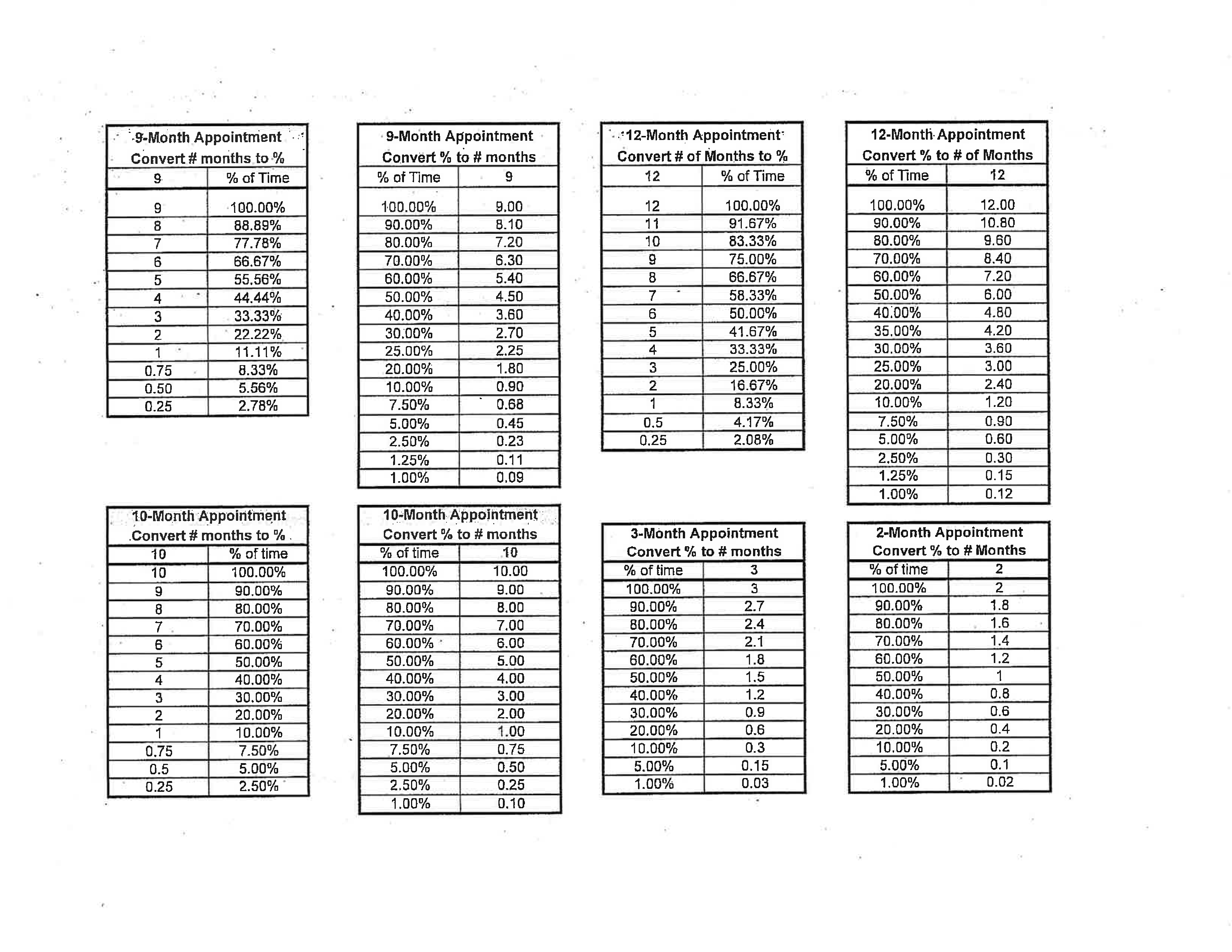
9 Month Appointment Conversions
| Months | Convert # Months to % | % of Time | Convert % to # Months |
| 9 | 100.00% | 100.00% | 9.00 |
| 8 | 88.89% | 90.00% | 8.10 |
| 7 | 77.78% | 80.00% | 7.20 |
| 6 | 66.67% | 70.00% | 6.30 |
| 5 | 55.56% | 60.00% | 5.40 |
| 4 | 44.44% | 50.00% | 4.50 |
| 3 | 33.33% | 40.00% | 3.60 |
| 2 | 22.22% | 30.00% | 2.70 |
| 1 | 11.11% | 25.00% | 2.25 |
| 0.75 | 8.33% | 20.00% | 1.80 |
| 0.50 | 5.56% | 10.00% | 0.90 |
| 0.25 | 2.78% | 7.50% | 0.68 |
| 5.00% | 0.45 | ||
| 2.50% | 0.23 | ||
| 1.25% | 0.11 | ||
| 1.00% | 0.09 |
12 Month Appointment Conversions
| Months | Convert # Months to % | % of Time | Convert % to # Months |
| 12 | 100.00% | 100.00% | 12.00 |
| 11 | 91.67% | 90.00% | 10.80 |
| 10 | 83.33% | 80.00% | 9.60 |
| 9 | 75.00% | 70.00% | 8.40 |
| 8 | 66.67% | 60.00% | 7.20 |
| 7 | 58.33% | 50.00% | 6.00 |
| 6 | 50.00% | 40.00% | 4.80 |
| 5 | 41.67% | 35.00% | 4.20 |
| 4 | 33.33% | 30.00% | 3.60 |
| 3 | 25.00% | 25.00% | 3.00 |
| 2 | 16.67% | 20.00% | 2.40 |
| 1 | 8.33% | 10.00% | 1.20 |
| 0.5 | 4.17% | 7.50% | 0.90 |
| 0.25 | 2.08% | 5.00% | 0.60 |
| 2.50% | 0.30 | ||
| 1.25% | 0.15 | ||
| 1.00% | 0.12 |
10 Month Appointment
| Months | Convert # Months to % | % of Time | Convert % to # Months |
| 10 | 100.00% | 100.00% | 10.00 |
| 9 | 90.00% | 90.00% | 9.00 |
| 8 | 80.00% | 80.00% | 8.00 |
| 7 | 70.00% | 70.00% | 7.00 |
| 6 | 60.00% | 60.00% | 6.00 |
| 5 | 50.00% | 50.00% | 5.00 |
| 4 | 40.00% | 40.00% | 4.00 |
| 3 | 30.00% | 30.00% | 3.00 |
| 2 | 20.00% | 20.00% | 2.00 |
| 1 | 10.00% | 10.00% | 1.00 |
| 0.75 | 7.50% | 7.50% | 0.75 |
| 0.5 | 5.00% | 5.00% | 0.50 |
| 0.25 | 2.50% | 2.50% | 0.25 |
| 1.00% | 0.10 |
3 Month Appointment Conversion
| Month | Convert # Months to % |
| 3 | 100.00% |
| 2.7 | 90.00% |
| 2.4 | 80.00% |
| 2.1 | 70.00% |
| 1.8 | 60.00% |
| 1.5 | 50.00% |
| 1.2 | 40.00% |
| 0.9 | 30.00% |
| 0.6 | 20.00% |
| 0.3 | 10.00% |
| 0.15 | 5.00% |
| 0.03 | 1.00% |
2 Month Appointment Conversion
| Month | Convert # Months to % |
| 2 | 100.00% |
| 1.8 | 90.00% |
| 1.6 | 80.00% |
| 1.4 | 70.00% |
| 1.2 | 60.00% |
| 1 | 50.00% |
| 0.8 | 40.00% |
| 0.6 | 30.00% |
| 0.4 | 20.00% |
| 0.2 | 10.00% |
| 0.1 | 5.00% |
| 0.02 | 1.00% |
Governing Principles and Procedures for Centers and Institutes
1.0 INTRODUCTION
Centers and institutes play an increasingly important role in fulfilling the teaching, research, and service mission of Arkansas State University (A-State). This document establishes guidelines for the creation, operation, and review of new and existing centers and institutes at A-State. These guidelines will affect currently existing centers and institutes by encouraging their participation in the guidelines for operation and evaluation contained herein.
Both flexible and entrepreneurial, a center or an institute contributes to the academic life of the University by fostering collaboration among faculty, departments, and colleges, and by facilitating relationships with other research enterprises, community stakeholders, and grant- making agencies. They help facilitate the University’s mission by providing alternative opportunities for teaching, scholarship, and service, while simultaneously enhancing the University’s reputation as a leader in scholarship and research.
2.0 PURPOSE
When academic centers, support centers, and institutes are appropriately designed, ably led, regularly reviewed, and carefully integrated with the University’s core mission, they make essential and powerful contributions to the University’s academic life. They are distinct entities that may be interdisciplinary or affiliated with departments and colleges. They have any or all of the following attributes:
-
- provide clear intellectual focus that define their essential programs and research activities;
- advance the scholarly missions of departments, colleges, and the University
- serve as the nucleus for research programs in established and emerging fields of strength;
- offer students and community stakeholders educational programs, training, and services that otherwise would not be available; and
- enhance the visibility and reputation of the University.
3.0 DEFINITIONS
- Academic Centers. Academic centers are teaching/research/service entities organized within departments or colleges that have focused missions and clearly defined objectives. They may stem from a single discipline or involve collaboration among disciplines. Academic centers typically will report to a dean and should attract the intellectual and professional participation of a critical mass of faculty members, visiting scholars, senior scientists, and/or leading professionals.
- Support Centers. Support centers are entities organized within colleges or executive-level offices. Their reporting structure typically is to a dean or executive official. Their purpose is to serve the academic community, supporting the University’s mission of teaching, research, and service.
- Institutes. Institutes, like academic centers, are grounded in the teaching/research/service mission of the University. They typically have broader missions and multidisciplinary foci than academic centers and will most commonly report to the Provost or designee, such as the Vice Provost for Research, Innovation, and Discovery for research institutes. They should enhance the intellectual and professional participation of a critical mass of faculty members, visiting scholars, senior scientists, and/or leading professionals. It is expected that most institutes would also include significant interaction with community stakeholders and be totally self-sufficient within a specified period.
- Center or Institute Affiliates. The University’s faculty and staff, community participants, or other external stakeholders may receive “affiliate” designations when appropriate. An affiliate’s designation indicates an individual’s key role in a center or an institute.
- Designation as a Center or Institute. Designation as a center or an institute is a competitive process that is administered by the Office of the Provost and Vice Provost for Research, Innovation, and Discovery in consultation with the Office of the Chancellor.
4.0 APPLICABILITY
This policy applies to all faculty and staff at A-State
5.0 GOVERNING PRINCIPLES
5.1 Establishment
Designation as a center or institute is a singular honor reserved for those entities that are a) central to the mission of the University, b) interdisciplinary, c) entrepreneurial in approach, d) research intensive, e) venues for student learning, and f) linked to the community and to other external stakeholders. Additionally, centers and institutes must build upon faculty strengths; facilitate the creation of a multidisciplinary community of scholars; be linked to at least one academic program in order to provide research, service, and experiential learning opportunities for faculty and students; demonstrate the potential for attracting external support and/or demonstrably enhancing the University’s reputation; and demonstrate linkages to the community (desirable for centers, mandatory for institutes).
Academic centers and institutes require thoughtful analysis before they are established. Proposals for their establishment should include a statement of need, mission statement, goals and objectives, proposed name, benefits, a communications plan, relationships, affiliations, and a business plan. Please see Section 7.0 for more detailed instructions.
5.2 Management of Centers and Institutes
5.2.1 Role of the Director.
The directors of centers and institutes are responsible for ensuring that their units contribute to the academic vitality and visibility of the University. Directors of the academic centers and institutes are appointed by the Provost and Vice Provost for Research, Innovation, and Discovery with the advice and approval of the relevant Deans and Chairs. They must be members of the faculty, unless otherwise approved by the Provost and Vice Provost for Research, Innovation, and Discovery. The appointment of a director must include a written enumeration of any additional compensation, change in workload, other alterations of the faculty member’s responsibilities, and any conditions of employment. The Director’s faculty contract will be modified or redrawn as necessary to reflect new levels of responsibilities and/or compensation.
5.2.2 Faculty/Constituent Affiliations.
The leaders of centers and institutes are encouraged to develop relationships with the faculty and other stakeholders within and outside of the University. The Director has responsibility for recommending any affiliate positions to his/her supervisor.
Center or Institute affiliates should receive letters of appointment that contain the specified periods of service, position descriptions, compensation terms (if any), and descriptions of alterations in workload. Before agreeing to participate, any members of the faculty who anticipate serving in an affiliate’s role should seek advice from their chairs and/or deans concerning the impact that his/her involvement will have upon tenure and/or promotion. Faculty affiliates likewise should report any center or institute activities in their annual performance reports.
5.2.3 Policy and Procedure Compliance.
All center and institute employees and affiliates are responsible for understanding and adhering to the University’s policies and procedures, including but not limited to financial and human resources policies and procedures, the gift acceptance policy, sponsored research policies and procedures, procurement policy, capital projects planning procedures, and all other relevant policies and procedures.
5.2.4 Establishment of Advisory Boards.
If deemed appropriate by the Chancellor, Provost, and Vice Provost for Research, Innovation, and Discovery, an external advisory board may be created for a center or institute to provide the unit with support and advice. Its responsibilities may include advising the director about activities that are consistent with the unit’s mission, reviewing the unit’s accomplishments considering its goals, providing long-range guidance for the unit’s major direction and strategies, and contributing to and/or promoting the financial viability of the center.
The external advisory board may include qualified representatives from academic communities, professional organizations, corporations, governmental agencies, or other suitable entities that are relevant to the center or institute. Members of an external advisory board are appointed by the Chancellor upon the recommendation of the Provost, and the Vice Provost for Research, Innovation, and Discovery. The Director or a nominating committee may recommend prospective board members but cannot invite or appoint new members to the board independently.
If an advisory board is established, the expectations of membership should be clearly articulated. Terms should be for specific durations (no more than three years) and should expire on a rotating basis to ensure continuity.
5.3.5 Evaluation of Centers and Institutes.
All centers and institutes will be fully evaluated every five years using the methodology described in Section 7, Procedures.
6.0 RESPONSIBILITIES
It is the responsibility of the Vice Provost for Research, Innovation, and Discovery to participate in the establishment of centers and institutes, to work with them on an ongoing basis to enhance research productivity, and to participate in periodic evaluations (every 5 years, see section 5.3.5).
It is the responsibility of Deans and Chairs to sponsor development of the centers and institutes, monitor their ongoing activities when appropriate, and participate in periodic evaluations. It is likewise their responsibility to assure faculty release time when appropriate.
It is the responsibility of center and institute directors to:
- create strategic plans and goals in the context of the University’s academic mission;
- ensure that the units’ activities are consistent with their missions, goals, and objectives;
- interact with university faculty and administrators, as well as with external constituents;
- garner faculty, visiting scholar, and community stakeholder participation in the unit and secure affiliate appointments as appropriate via the chair, dean, or Provost;
- secure financial resources to support the center or institute and oversee fiscal matters and submitting financial reports as required;
- ensure that resources are used appropriately;
- employ and manage staff within the unit;
- ensure that terms contained in any grant and donor agreements are met;
- develop and implement annual and self-study reports; and
- ensure that all employees (faculty and staff) perform according to the ethical and moral standards of the University, and comply with all University, federal, state, local and University regulations and policies.
7.0 PROCEDURES
7.1 Establishment
Program requests must include the following elements.
- Statement of Need: How the entity will advance the University’s mission and what opportunities that currently do not exist will be possible if the center or institute is established.
- Mission Statement, Goals, and Objectives: A mission statement should be developed that clearly describes the center’s purpose, goals, and objectives. The statement should link to the University’s mission statement and should provide clear indication of desired outcomes.
- Naming the Center or Institute: The proposed name for the center and the rationale for the name. The Provost will evaluate the proposal and recommend its approval or disapproval. The Provost reserves the right to modify the proposal as appropriate.
- Benefits: The benefits garnered for faculty, students, staff and the community.
- Communication Plans: How the new unit will be communicated to the University community and to external stakeholders.
- Relationships: The relationship of the proposed unit to the faculty and to other educational programs, centers, institutes, the community, or other external constituencies
- Consultations: The entities that have been consulted within and outside the University. Copies of any letters of support must be included with the proposal.
- Business Plan: The business plan should contain the following components:
- A budget that includes anticipated revenues and expenses for the first five years of operation.
- Current external funding, if any, and the duration of that funding. NOTE: A proposal must be submitted to and approved by the Provost prior to the initiation or acceptance of external funds. In some cases, a grant proposal may be used to justify establishment of the center or institute. In such circumstances, the principal investigator must provide sufficient time for the Chair, Dean, and the Provost to evaluate the proposal.
- Potential sources of internal funding and amounts.
- Analysis of the anticipated true cost of the unit including any in-kind donations (e.g., personnel, operating supplies, travel, equipment, space, etc.)
- A long-term methodology and plan to sustain the unit.
- Listing of faculty and staff who will be involved in the proposed unit, what their roles will be, and the impact the new unit will have on their current responsibilities (if any). CVs for current faculty and staff should be included.
- The unit’s proposed administrative structure and organizational chart.
- The space, equipment, or other physical requirements. Explain how existing facilities and resources will be used, or what facilities and resources must be added.
7.2 Annual Reports
All centers and institutes, whether new or existing, are required to submit annual reports to Research and Technology Transfer of their activities from the previous fiscal year by August 1. These reports must contain the following elements:
- contribution to the visibility and stature of the university;
- contribution to scholarship in the areas in which the Center/Institute is positioned;
- involvement of faculty and students, including the names and disciplines of those who participate;
- ability to garner the resources necessary to effectively address the goals and objectives articulated in the unit’s proposal;
- Number, dollar amount, and source of all competitive, extramural funding proposals
- Number, dollar amount, and source of all competitive proposals funded
- financial statement that provides the unit’s operating costs;
- financial statement that provides the unit’s true costs (including all in-kind contributions from the University or other sources);
- ability to utilize the advisory board (if applicable) to enhance and expand the units’ activities;
- reports of any obstacles encountered and the actions taken to overcome these obstacles, or the reason they were not solved
7.3 Evaluation of New and Existing Centers and Institutes
Every five years, Centers and Institutes will provide evaluation materials to Research and Technology Transfer that must include:
- a copy of the document that established the unit;
- evidence of the unit’s ability to enhance the academic mission of the university;
- extent of the unit’s contribution to the visibility and stature of the university;
- a statement of the progress made in fulfilling the unit’s goals and objectives;
- an evaluation of the impact the unit has had upon scholarship including publications, patents, creative activities, invited presentations, keynote addresses, service on federal panels, and awards or other special acknowledgements;
- an evaluation of the impact the unit has had upon teaching at both the graduate and undergraduate levels;
- an evaluation of the impact the unit has had on linkages with community stakeholders;
- an assessment of the external funding that has been garnered during the review period;
- an evaluation of the unit’s long-term fiscal viability;
- an evaluation of the quality of the management of the unit;
- a listing of all visiting scholars and postdoctoral fellows who have worked or are working with the unit (if applicable);
- the efficacy of the unit’s advisory board (if applicable);
- a financial statement of expenses incurred within the unit for the previous five years; a financial statement that articulates the unit’s true costs (including all in-kind contributions from the University or from other sources for the previous five years).
The review process will include the following elements:
- The Faculty Research Awards Committee (FRAC) will serve as the evaluation committee for Centers and Institutes.
- The Vice Provost for Research, Innovation, and Discovery will serve as an ex-officio member of the Committee and Research and Technology Transfer will be responsible for administering the reviews.
- The Vice Provost for Research, Innovation, and Discovery will develop a schedule identifying the year when each unit will be reviewed. Each unit will be given at least one semester to prepare for the review.
- The center will prepare a self-study that addresses the evaluation criteria listed above.
- The center/institute director will have an opportunity to meet with the Committee and to answer any questions that may arise from the self-study.
After evaluating the self-study document and any external input, the FRAC will report its findings to the Provost. The report shall articulate the unit’s strengths and weaknesses and shall contain recommendations to 1) continue the center for an additional five-year period; 2) conditionally continue the center for a prescribed period until improvements are met; 3) merge the unit with another unit on campus; or 4) dissolve the unit. In the latter case, the Committee should make recommendations to the Provost about an orderly transition of any personnel or assets contained within the unit.