Volume 53, Issue 3 (December 2022)
- The Amusement Center in Tallulah
- Star-like
- A Brief, Random Check-In with the Milky Way
- Reviews
- Three Poems
- Delta Sources and Resources
- After Ida
- Table of Contents
The Amusement Center in Tallulah
by Anthony Bukoski
Abe and Mertie Bloom had a vision. They’re the ones that built Bloom’s Arcade, also known as The Amusement Center. Inside of it, we don’t worry about the traffic on Depot Street or the wind or rain. Look at the sun stream through the translucent glass skylight. Three hundred feet of skylight running over the corridor up to Max Levy’s Department Store, W. A. Dozier’s Jewelry, the barbershop, Bloom’s Drugs with the soda fountains and luncheonette, the post office, pool hall, and other businesses. Notice what the archi- tects call “piers,” “pediments,” and “pilasters.” Notice the marble terrazzo floor of alternating black-and-white squares and the figures in relief above the front entrance canopy. This is the “moderne” style of architecture. We’re moderne and have been since Bloom’s Arcade opened in 1930.
Now to Lem Finster, my husband, a good man. Though strong of arm and chest, he has soft, white, piano player’s hands and legs like a cattle egret. You’d think he’d be the other way around after lugging cannisters of movie film up so many stairs. When he changes for work, I avert my eyes from the area between the bottom of his drawers and the garters holding up his socks. The body with the puny legs is mismatched. And so I focus on the upper parts, the wavy hair, the green eyes glinting in the sun, the way he pouts his lower lip when he sings to me like Maurice Che- valier. He’ll end the song by saying “Oh, Gigi.” Holding my hand in his moist palm, he’ll kiss it and say again, “Gigi,” as though I’m Leslie Caron in that beautiful picture.
Lem and I run the movie theater. Country people call them “pitcher shows.” The building’s attached to the front of the arcade and is owned by Mr. Bailey, who has theaters in northeast Lou- isiana and around Mississippi. Ours has the BAI- LEY sign in front that you can’t miss.
With all the troubles in the world, you’ll find peace in our Bailey Theater. A double feature viewed in the comfort of the Nu-Air Cooling Sys- tem is just the ticket. In fact, Lem will sell you the ticket. Starting at 3:30 p.m., he’s in the win- dow out front, while I’m at the popcorn ma- chine. The projectionist is, well, Lem Finster again. Everyone in town knows that once he’s gone up to start the movie you just stop at the concession stand and buy a ticket from Pearl Fin- ster.
I represent entertainment. On the other side of the concession stand are Americans hungry for dreams and candy; on this side in the person of me, Pearl, is the glamor of Hollywood. I’ve gone to Vicksburg to buy the type a horn-rim
A lot of this business is make-believe. The music arouses human sentiment, the previews promise great excitement, the actors probably don’t look so good without makeup. At four, we open the curtain. When Lem switches on the projector, the adventure begins. Sometimes I think Lem and I are make-believe like we’re in a B-movie. Why can’t we be celebrities? I guess Hol- lywood wants them young and beautiful. In the movie of our lives, he doesn’t love me too much.
On this summer day, we study the lobby cards Lem and I put up last week. The ones for Sweet Bird of Youth read, “HE USED LOVE LIKE MOST MEN USE MONEY” and “The big dif- ference between people is not between the rich an’ the poor. The big difference is between those who have ecstasy in love an’ those who haven’t.”
“You have ecstasy, right, Lem?” I ask as he heads up to the projection booth.
“I’ll show you. The special night I promised you in Eros, Louisiana—we’re going to spend it together very soon.”
He’s kidding. Eros is seventy-eight miles away. What’s in Eros? Both of us approaching late middle age, we’ve lived our lives in the Bailey. I’ve missed out on so much. I have neither chil- dren nor ecstasy, but I have stacks of Photoplay. Peeking in at the feature attractions over the years, I’ve seen Grace Kelly, Deborah Kerr, Burt Lancaster, Liz Taylor. After cleaning the popcorn machine and wiping the candy counter, after Lem comes down to shut off the marquee lights, I ache for Audie Murphy to hold me, and instead there’s my projectionist in his wide, flowery ties, sleeves rolled up on wrinkled dress shirts—Lem Finster in his drawers and garters when we get home. This was how things were for fifteen years, for twenty years. Now Pillow Talk and Sweet Bird of Youth play at the Bailey.
In the mall, nothing harms you except a lonely heart. Thank heavens I married a kind, if unexciting, husband to help me through the troubles that come to some women in middle age. Lem does what he can. That’s how we are in Tallulah, helpful. For Highway 80 travelers, a gas- oline filling station stands at the opposite end of Bloom’s from us. Everything’s been planned and thought out, everything taken care of here. At the luncheonette, the key lime pie is excellent. In the movie house seating 680, we have a first-rate balcony.
Last year, protected like this from everything, I had a surprise concerning love. I’d read that be- fore they have their Caesars—their seizures—the epileptic sees an aura and senses things are off. Sometimes just thinking of the aura I had makes me scramble words. I’m no epileptic, but I had a vision and aura in the movie house when we were showing Susan Hayward and James Mason in The Marriage-Go-Round. No, it was the second half of the double feature, come to think of it, that brought on the aura—By Love Possessed star- ring Lana Turner, Jason Robards, and George Hamilton. “THE BOLD BEST-SELLER THAT SENT A FEVER THROUGH AMERICA NOW FIRES THE SCREEN.”
The show’d begun. Coming out of the ladies’ room, relieved that I hadn’t spilled pop- corn oil on my new blouse and that my makeup
We’ll see about this, I thought. “Where’s your ticket?” I asked the early bird. When I rec- ognized an important old lady from our First Baptist sitting with the box of popcorn she’d gotten herself, I was embarrassed. “Oh, Mrs. San- difer. I didn’t know it was you, the head of the Ladies’ Guild.”
“I couldn’t wait. The show was starting,” she said, opening her pocketbook to pay me.
“I took so long checking to see how I looked that you just keep the money and enjoy the show.” Remembering how Mrs. Sandifer, by love possessed, used to come to the movies with her husband, I figured today might be their anniver- sary or another special day. She was crying when I came back with a Royal Crown Cola for her. Forgetting I’d seen her husband’s photo one hundred times, she showed me the picture of him before he got sick.
Where was the aura in this, the aura-vision I hoped would lift me out of my predicament of wanting to be loved more than Lem could love me? Maybe thinking I’d caught someone sneak- ing into the theater had pumped a chemical into my head. An aura being “a subjective sensation (as of lights),” some a what I saw was in techni- color. In the center of the aura sat a customer who’d adored her husband and loved going to movies with him. I saw popcorn husks sprinkled down her tear-stained bosom. I saw melted butter from the popcorn on her lower lip. Everything was clear in this vision of longing I had. In the coming years, maybe I’d be alone like Mrs. San- difer. At least she’d been deeply, truly loved.
This was the first aura or premonition of something that couldn’t really have been a pre- monition because I had no idea what would happen next. Once it did, then what’d happened before might be considered the premonition. Sometimes, everything’s a dream and life is hard to figure.
A year after we showed By Love Possessed, Pil- low Talk is playing. When I spend too long in the ladies’ convenience, I come out to see the sun hat again. No one’s in the theater but Mrs. Sandifer. “Sufferin’ Succotash,” I think. “She’s a widow and a churchgoer. Don’t bother her,” I say to my- self. “Let her enjoy her Rock Hudson and Doris Day.”
When the sports reel ends, I don’t know whether to laugh or cry when this tall boy, “Bubsy” Watson, real name Johnny Lee Watson, walks down the other aisle carefree as ever and sits beside her, kissing the old lady’s buttery lips. A church-going lady with an eighteen-year-old! Mrs. Sandifer’s finally gotten over her husband.
Is this the aura I’ve expected since last year: The Nu-Air Cooling System kicking in, Porky Pig saying “That’s all, folks!”, the popcorn machine’s racket when I step into the lobby? Has the aura come to Pearl on a hot afternoon to show me the many forms of love? The money for their tickets lies on the concession stand. A moment later, I come to my senses. It might be Mrs. Sandifer’s sun hat, but it isn’t Mrs. Sandifer.
Not wanting to embarrass myself, I stand in
the rear of the theater to eye the lovers. Appar-
ently, they don’t care what Tallulah thinks.
When I crack the door a quarter inch to check
on the popcorn, I see the lobby card for our first
feature which reads, “PILLOW TALK—IT’S
WHAT GOES ON WHEN THE LIGHTS GO
OFF!” Rock Hudson’s so handsome. Bubsy isn’t
bad himself, except for his sunburn and unruly
hair. A hard worker, he does chores for our mer-
chants. Good-looking, strong, he has the girls
after him. At his age, he deserves anyone fifty
years younger than Mrs. Sandifer. Exactly whose
On weekdays, I don’t wear high heels. If I have to run see Lem or get items from the store- room, flats are fine. With the lovebirds busy, I can spy on them from nine seats back, even six back. I sit in a row over to the side of them. They don’t notice, wouldn’t care if they did see me snooping. She’s putting her head on his shoulder. How can they do these next things in a public place?
I blame the technicolor reflections from the screen, the pillow talk of movie stars, the sun hat she’s got on, all of it, blame all of it for not saying to myself earlier, That’s Mrs. Sandifer’s cleaning lady! She don’t belong downstairs when there’s balcony seating. When Bubsy whispers in her ear, she whispers back. Just because she removes his hand when it travels down the front of her blouse doesn’t mean I’m naming this dirty be- cause it’s no more dirty than what Lem did to me when we were young.
Lem, how do I tell you what’s going on? Ex- cited, I climb the stairs. Through the little aper- tures where the movie projector sends out its images, Lem can’t see me in the balcony, but he knows I’m here watching something because I hear him step out of the booth. Rock Hudson and Bubsy Watson. Doris Day and the mystery girl. Everywhere I look, people hold others as I sit alone in the balcony.
Oh, Rock Hudson, love is what I feel for you up on that screen. Every night when I leave the concession for a moment, leave the view of the street outside, the streetlights coming on, I whisper to you, “I’m in love, madly in love. I love all of you, Rita Hayworth, Gilbert Roland, Jane Russell.”
“Go mind the concession, Pearl,” Lem says. “I’ll take care a whatever bothers you. Bring me back some Jujubes.”
I can’t stay with him when we have such “ac- tivity” in the theater. If anyone sees Verneta down in front, we’ll be in trouble. I get the Bissell carpet sweeper, a noiseless appliance needing no electricity. I give a quick back-and-forth to clean the carpets. With me standing almost on top of them, they still pay no attention.
When I clear my throat and say, “Downstairs is for the white folks,” that beautiful Verneta doesn’t pull the sun hat down to disguise herself. Nor does she understand Lem and I are separate entities. She combines our first names. When she looks at me, surprised I’d interrupt her, she says, “We busy right now, Miz Lemonpearl.”
“What!” I say, almost choking over being spoken to like this. “I’m cleaning here,” I tell them, knowing right away it makes no sense.
“Yes’m,” they answer, but nothing changes. Mrs. Sandifer’s girl isn’t as shy as she’s made out to be. If anything, the old lady’s straw hat with the wide, round brim brings the attention to her that she wants. I called her a cleaning “lady” but she’s Bubsy’s age. Here I stand resting my arms on the Bissell sweeper, a middle-aged woman, successful operator with Lem Finster of a Bailey theater, and I have been put in my place by two teens.
Though inconvenient to answer the phone in the ticket window, Lem will do so if it rings too long. When I go up to ask who it is, he says, “Hilyard at the pool hall wanting to know if something funny’s going on. There’s reports that Vernetta and that kid who works around the mall were looking at things in the department store. They’ve been parading all over as if to teach their hometown a lesson. They examined the muslin curtains on sale at Max Levy’s. They talked about cups and saucers, all kinds of domestic things. Hilyard says they were heading here. He’s worked
“I guess so,” I say, trying to steady him as I walk Lem into the theater.
When he recognizes Verneta, it’s like he’s been punched by Mr. Big in Kansas City Confi- dential. “The picture that hits with BULLET FORCE and BLACKJACK FURY.” “This is what Hilyard meant about trouble,” Lem says, trying to control his anger. “You aren’t to be here, not together—and you, Verneta, not downstairs.” Then the phone starts.
“You can’t stay,” I tell them.
“We ain’t climbing no stairs, Miz Lemon- pearl,” Verneta says.
“He’s Lem. I’m Pearl. It’s two names.”
“Yes’m,” Bubsy says, “but we like these seats and have paid to see Sweet Bird of Youth, which is on after Pillow Talk. Who cares about Rock Hud- son and Doris Day? We have pillow talk evra night under the stars with the pillow from Mrs. Sandifer’s spare bedroom.”
“This her hat,” Verneta says.
Lem rests his hand on the back of a seat. I fear his legs will give out and he’ll collapse from being nervous. I love when he needs me. Dear Lem, I want to say, Who could foresee a problem like this in our middle-age years? But we’ll help each other.
“If anyone believes we’re running a love-nest, there’ll be trouble,” Lem says. “Hilyard pokes his nose into everything. Those no-goods that hang around him—their grandpas lynched five Sicilians in 1899 for no reason other than their goats were chewing up the doctor’s garden. I’m not worried about myself, Lem Finster. I’m worried about you two and Pearl if there’s a window broken in the theater. If they storm in to look around, I can’t be responsible unless you help me now.”
“This her hat,” Verneta says again. Then they stop talking to put on another show for us. Such touches and tenderness are never seen openly in Tallulah.
“Never mind the kissing. Just for once do something. Help me. There can be plenty of meanness when something starts. They’ll ruin me,” Lem says, bribing Verneta with the box of Jujubes. “It’s never been right for your people to sit upstairs, I know that, but you’ve gotta help. Take the candy. Go sit in the middle of the bal- cony with your sun hat off. If anyone comes up there, you say, ‘Verneta hasn’t seen a soul.’ We won’t mention Bubsy in the projection booth. There’ll be lots more candy for you and him af- terward.”
I wouldn’t want Bubsy angry, especially if it concerns his black pearl. Bubsy has a bull neck. From April to October, it’s sunburned. I saw it turn red with fury one winter day when a mer- chant said the wrong thing to him. He has a broad chest. This and his arms are rock hard.
The phone ringing like crazy, the two kids taking their time getting up to leave, Lem starts explaining cue marks on a movie screen. On the way upstairs, he tells Bubsy the motor cue ap- pears eight seconds before a reel of film ends. The changeover cue comes with about one sec- ond left on the reel. “If I’m downstairs reassuring Hilyard, he won’t be thinking about what goes on up here. No one watching a movie thinks about the projectionist, but you have to watch for cues. When you see the changeover cue on the screen, start the reel on the other projector.”
A minute later, Verneta’s sitting upstairs where today I sat for the first time. When she waves, I don’t acknowledge her. The more she waves the more I know I’d feel lost without Lem. Finally, I wave but I don’t know why.
“How are your legs?” I ask when my husband comes from teaching Bubsy.
“Maybe I’m weak-kneed. But I’m sure of this: We should never have made people sit where they didn’t want to. There’s Bubsy’s motor cue. Eight seconds more and he’ll practice his first changeover.”
“Anyone wants in, they buy a ticket,” Lem says. Then I’m left looking my best on a Wednes- day at five. Now Hilyard from the pool hall is in charge, Hilyard opening the door to the Bailey, Hilyard saying, “We need to look around.”
“Six adults will be three dollars. Midweek, things are slow. There’s one person in the bal- cony.”
T. P. Hilyard in his gabardine pants and white shirt is the best dressed of them. The hangers-on from Bloom’s Arcade wear soiled blue work shirts, overalls. “I finished my carpet sweeping. You stay here if you have mud on your shoes.”
“It’s not mud. It’s likely somethin’ you find in a pasture,” they say when I let Hilyard pass. I think him and his men, ten of them now, are tired of being taken for fools, tired of the heat. Such things as trouble them I don’t want to know. In addition to the axe handle he uses to rule over the pool hall, Hilyard has a thick belt from a uniform, a Sam Browne belt, it’s called. With three daubs of pink nail polish, Hilyard or his wife has painted a smiling face near the buckle.
“Oh, Tony Randall! Oh, Paul Newman and Geraldine Page in the second show,” I whisper as I watch Hilyard walking toward Verneta up- stairs. Even from down here, I see him unbuckle his belt, hear him over the movie. “Where’d you get that hat? Where’d you get that lipstick on your face?” Verneta answering, “Don’t know.” “You too dumb to know? You Miss Sandifer’s girl?” “Yes, sir.” “I have a notion to whip you—”
The movie screen behind me, the projector light streaming through the aperture in front, I’m caught between life and dreams. Lem gave me a Photoplay magazine from the drugstore, Lem in his red Buick twenty years ago with a box of Mike and Ike and the movie star magazines, Lem motivated by love. I think Hilyard will hurt Verneta. Then someone comes out of the booth. It can’t be Lem. Lem would be afraid of what’s going on. Everything’s confusing. Hilyard’s swinging his fists. The projector light is flickering. A cue nears.
I think the arcade’s handyman will beat the hell out of Hilyard. Johnny Lee, Bubsy, is pos- sessed by love the way Mrs. Sandifer is, the way Lem Finster was or is. Lem kept the red Buick run- ning. He kept Modern Screen magazine in the back- seat.
“Don’t hit him,” I say to myself as if Hilyard could hear. When Bubsy takes a punch, Verneta hits Hilyard with her small, black fists. Hilyard looks like he’s reaching for the axe handle he for- got to bring from the pool hall when Verneta hits him again. When he swings the belt at her, he misses. Bubsy’s all over him now twisting his lousy neck. I watch them loop the belt around Hilyard’s chest and under his arms.
In the last moments of Edge of Eternity, Cor- nel Wilde fights a murderer named Bill Ward, played by Jack Elam. The mining company’s tramcar they’re in rocks over a deep canyon. The downstairs theater is the canyon, Bubsy being Cornel Wilde. Next, Verneta and him do the strangest thing, as though they don’t care what trouble they get into. Holding Hilyard by the belt, they hoist him over the canyon rim feet first. Who’d believe two kids could do this? As Hilyard dangles above the seats, kicking out his legs, grab- bing the air, he looks like the trapeze artist in The Greatest Show on Earth. My word, if his beltless pants don’t fall down around his shoes. What kind of underpants are those? “Cover your per- sonals,” I yell to him.
When he stops thrashing, they pull him up. Thankfully for him, his trousers, still bunched and riding atop his shoes, make it to safety.
Hilyard won’t be permitted in here again. Why should he be? Hilyard is a man without dreams. Bubsy and Verneta have dreams. Mrs.
When the men ask him, “Did you see them in there?” Hilyard says, “Looks like someone was sitting in a couple of downstairs seats.”
“It was me and Lem resting in the seats be- fore we opened up. We like to look at the curtain and dream.”
“You’ll have to move out of the way,” Lem tells Hilyard’s followers. “After supper, people will be coming in to enjoy the Nu-Air Cooling and a good show.”
“You sure there’s no white boy in here?” Hil- yard asks when he looks in the theater. All of it is a pretense in front of his men.
“Verneta’s in the balcony,” Lem says. “I don’t know about anything more.”
On the screen, the eight-second cue comes on.
Now this changeover from reel to reel.
You know how word gets out in small towns. In ours, a poor man named Sparks, who sweeps the pool hall and shines shoes, tells a cleaning woman that Hilyard’s men have gone to the Bai- ley. She tells the neighbors. They spread it around about two lovers.
A lot of people this night seem to have gotten interested in hearing Lenny Welch sing “Ebb Tide” in Sweet Bird of Youth. By 6:45, mov- iegoers fill half the balcony. “Enjoy the show,” I say.
“Thank you,” they say as they buy a ticket. Then they say, “You’re a good lady. You earned your name. You’re a pearl and your husband a sweet bird of youth.”
On a Wednesday, the downstairs fills too. Everyone wants to see where news has been made. We love Sweet Bird of Youth and will see if Mr. Bailey won’t let us hold it over.
When the show ends, the empty theater stays filled with dreams for a few minutes. All the music and color, all the life being slow to leave. Lem is figuring how to sneak the young people out of town.
Before Verneta and her date come down to find the marquee lights dark, the place empty, I ask my husband, the projectionist, “Is there such a thing as a lemon pearl?’
“Yes.”
Finally, the aura forms.
“Where, Lem? Where is the lemonpearl?”
“Here?” he says, pointing to his heart.
When he whistles “Ebb Tide,” preoccupied with getting our car around to the side of the Bai- ley, I think that Lem and I, Lem Finster and I, Lem and Pearl, understand what we have to- gether.
“It’s love,” he says, as though it’s been this way all along. “It’s the love we see around us too, everywhere around us, Mrs. Sandifer and her husband, Bubsy and Verneta.”
“It is. It is,” I say.
Lem and Pearl. Twenty years in the making. I think of young lovers and others devoted to love in this town.
Lem will drive Bubsy and Verneta from Tal- lulah. After tonight, it’s up to them what happens, for Lem will return to me in the morn- ing. I know that nothing’s going to stop two lov- ers in their first movie. Nothing!
“Oh, Lord,” I think, and the thought frightens and pleases me, “they’re going to Eros.”
Then I remember the scene in Picnic where, from high above, the camera shows a freight train on the Kansas plains and the whole world open- ing for William Holden and Kim Novack.
Star-like
by Abby Geni
In the distance, a brook babbles unseen. I move with caution, peering through the gloom for fallen logs and mud slicks. I am forty, too old to be trailblazing at midnight. But I needed a break—from my husband’s brothers, and from my husband.
There is a pale beech stump, roughly the size of a man, that I have passed at least five times, scaring the life out of me on each reappearance. I have gone beyond concern, beyond panic, into a kind of quiet resignation. My body will be found days from now, tumbled in the ivy, scav- enged by black vultures, and pearled with mush- rooms.
I am a planetary geologist, which seems like it should be helpful in this situation. I know about the helium rain, laced with neon, that falls on Jupiter. I know that a day on Venus lasts longer than a year. I know about the alluvial plains of Tennessee and the loess-covered river terraces that surround the city of Dyersburg. But I do not know the way back to my brother-in-law’s house.
At the crest of a slope, the ground tips be- neath me. I skid helplessly downward, grabbing a tree branch to steady myself and wrenching my wrist. It might be sprained. When I get my bear- ings, the brook has grown louder. There is a flash of silver in the gloom and a damp, earthy musk. I have reached the water’s edge.
And there, in the distance, is the house, the porch light glinting between the leaves. I break into an ecstatic jog, stumbling through the un- derbrush. Deep in the woods, the owl shrieks like a murder victim. Clutching the stitch in my side, almost sobbing with relief, I tug open the front door.
There is a body on the couch, still and silent. Another curled in a basket chair in the corner. They are all here, of course—all four of my hus- band’s brothers, out cold, one in the armchair, another laid out on the floor, filling the air with their snoring and the collective fume of alcohol leaching from their pores.
Baylor and I have been in Dyersburg for fifty- six hours. In that time, we have never been alone. His brothers have occupied every minute, rough- housing, fishing, singing the fight song from high school, playing darts, eating fried things, and swimming in an ocean of liquor.
I creep down the hall to the guest bedroom. Baylor is tumbled in a heap of sheets, his breath a sour vapor. I climb into bed beside him. It seems like years since we left Boston. The journey here might as well have been our final passage to hell: taxi and plane and taxi again, ill-fitting chairs, enclosed spaces, no privacy, canned air, noise and bustle, waiting and waiting to end up somewhere I did not want to be.
* * *
When I first met Baylor, fifteen years ago, he was not an alcoholic. We were both in grad school then, and he rarely drank at all. Some-
Sometimes it was speed instead. Diet pills, ADD medication, even cocaine. Baylor would binge for week, eschewing sleep, studying with supernatural vibrancy. He would snort a line in the men’s bathroom with his fellow MBA stu- dents, all of them glimmering like dragonflies. He would keep me up at night talking and talk- ing and talking. My head would spin as I tried to follow his theories on climate change, and the south after the civil war, and the male libido—all of which were connected, in that moment, in his mind. Then he would quit, just before I began to worry.
At that time, I did not perceive the pattern. Baylor had a thousand justifications for his ac- tions. The diet pills kept him alert. The pain- killers helped him relax after a tough exam. The cocaine intensified our lovemaking. The mari- juana helped him cope with the dead air in be- tween semesters. He would be sober for a month, even two or three. He would take up a new sub- stance and put it down again, treating each as an isolated incident.
I believed him every time he quit. I did not know any better.
* * *
I wake up and have no idea where I am. A blazing window. Cork paneling. A deer head hangs on the wall, glaring at me in an accusatory manner. Beside me, Baylor is flung across the mattress, every limb akimbo. He looks like a man dropped from a great height, falling not to his death but into sleep. I decide not to wake him. I will let the liquor simmer in his blood, boiling away like stock in a stew.
My morning routine has a clockwork consis- tency. A control freak, Baylor says, but I prefer to think of myself as precise, like a fine Swiss watch. A series of stretches. Twelve-step skin care. A brief meditation, aided by an app on my phone.
Down the hall, a clamor indicates that Bay- lor’s brothers are awake too. I have no desire for conversation. Clutching a blanket around my shoulders, I step onto the side porch. The air is soupy and cold. Moss coats the trees. The sun is not yet visible between the branches, though the eastern sky is soaked with glow.
Baylor grew up in a trailer park on the out- skirts of Dyersburg. His brothers all settled within a few miles of the double-wide where his parents still live—except Baylor, the outlier, who moved to the mysterious north with me. The father is a shy mumbler, the mother a wine-ad- dled cipher, but somehow they managed to gen- erate five huge, loud, charismatic sons. Tall and barrel-chested, Baylor and his brothers all have the same raucous, head-thrown-back laugh. The same galloping stride. The same broad, capable hands. All of them, like Baylor, have begun to manifest the telltale gut of an alcoholic in middle age. The differences between them (a beard, a tat- too, a limp left over from a motorcycle accident) are minor compared to their astonishing similar- ities. The oldest is Emil, then Jimmy Lee, then the “Irish twins,” Cade and Hank, and finally Baylor, the baby.
They do not, however, go by their given names. The monikers that fly around when they get together are impossible to track. Baylor is both Lil Boy and Big Daddy. When he has done something annoying, he is Baylor Richard Mur-
Over the years, I have given up trying to keep the brothers’ lives straight. I am aware that one of them recently had a cancer scare that turned out to be nothing. One of them breeds hunting dogs. One of them can’t hold down a job. Two of them own an auto repair shop together. None of them have kids, though a few are married and might be on the verge. Baylor tries to keep me updated on their lives, but it’s hard to parse the family code. “Hankie thinks that Jujube is doing better,” Baylor might tell me, or, “You’ll never be- lieve it—E-dog says that Sammy Boy has been hid- ing money from his wife.” By the time I figure out who Hankie, Jujube, E-dog, and Sammy Boy are (Hank, Cade, Emil, and Jimmy Lee, respec- tively), the point of the story is lost.
Now the door bangs open behind me, and a figure strides onto the porch—Cade, our current host, dressed in boxer shorts and an undershirt, a cup of coffee in hand. He nods to me. I settle on the porch swing, leaving room for him, but he elects to remain standing. On closer inspec- tion, his boxers are covered with cartoon bunnies having sex in a trillion different positions. The odor of cigarettes hangs about his person.
“Good morning,” I say.
“Is Bebop still sleeping?”
“What?”
His grin fades. “Baylor. Is Baylor still sleep- ing?”
Mentally I add Bebop to the list of my hus- band’s nicknames. In the distance, a group of wild turkeys begins to sing, hooting and burbling. The sun is rising behind the trees. Cade lives on forty acres of thick forest that blocks any view of the neighbors. He shifts his weight, the boards creaking. I wish he would put on some pants.
“Are you having a rough time?” he says.
“I beg your pardon?” I say, startled. I was not prepared for emotional honesty. Not now. Not here.
He takes a step toward me. “Is it hard being with us? Being in Tennessee?”
“Yes,” I say. “It really is.”
“I know you ran away last night. I saw you heading into the woods after Baylor and the others passed out. I wondered if you were plan- ning to hitchhike home to Boston.”
I manage a laugh, which comes out shaky.
“Glad you found your way back,” he says. “Poor thing! We try our best with you. We do try.”
For a moment, I see my husband in Cade’s eyes. There is Baylor’s solidity, a touchstone of frank openness. An instant later, however, the spell is broken.
“Come inside and have a bloody Mary,” Cade says, flashing me a mischievous grin.
“Oh, I don’t drink.”
“Just this once. Have two. Have ten.”
“You know—” I begin, but he interrupts me.
“Pretty please,” he says. “E-dog and I made a bet a while back. I’m still hoping to win. Fifty bucks if either one of us could get you wasted. Man, I’d give a lot more than fifty bucks to see that. Little Miss Priss on a tear!”
He throws back his head and guffaws. It is my husband’s laugh, note for note.
* * *
Even now, I am not sure exactly when Baylor became an alcoholic. It was hard to see the pat- tern unfolding in real time. At some point, he turned to drink as though he’d been dating around for too long and was ready to settle down. He’d tried those other girls—cocaine, marijuana, pills—but this was love. This was the real thing.
Ten years ago, newly married, we moved to a cozy apartment on the west side of Boston. Bay-
I did not notice the change as it was happen- ing. It was slow. Gradual. Baylor would stop by sports bars on weekends to catch up on “the game.” (I never knew what game it was, or even what sport; I was content for him to share this interest with other people, likeminded people.) He would go out after work with “the boys”—his co-workers, always referred to that way, though many of them were female. He came home wasted and amorous, kissing my neck and ex- pounding on my beauty, never an angry drunk, only affectionate and even more boisterous, the life of the party and a dynamo between the sheets. He took up wine as a hobby, buying ex- cellent vintages to share with me over dinner, then drinking a few more glasses once I went to bed. A beer with lunch. A shot of whiskey to set- tle his nerves. His career did not suffer; he even got a promotion, due in part to his boozy social- izing with the top brass.
There was no benchmark, no line in the sand, no moment when I could have pinpointed his descent in action. Maybe addiction is always like that—only discernible in hindsight, with the clarity offered by distance and retrospection.
* * *
In the afternoon, we visit the local swim- ming hole—all five brothers, both parents, and three wives, including me. The day is steamy, hung with shimmering curtains of humidity. I set up a beach chair and apply sun screen and bug spray. Baylor’s parents have aged significantly in the past year, shuffling cautiously across the grass to place their lawn chairs. The mother immedi- ately falls asleep, but the father engages me in smalltalk, though his voice is so low and his southern drawl so thick that I cannot catch a word. I just smile brightly, nodding along, until he dozes off too.
The brothers take turns hurling themselves off a rope swing into the water. Jimmy Lee belly- flops, earning jeers and hollers. Further down the beach, Cade crashes through the shallows, at- tempting to catch a minnow in his hands. They have a thousand inside jokes, almost their own language, like twin-speak expanded to include five. Whenever one of them salutes, the other four strike body builder poses. Jimmy Lee and Emil appear to communicate exclusively in quotes from Calvin & Hobbes. Baylor and Hank keep karate-chopping one another. At one point, Jimmy Lee screams, “Fire in the hole!” and at once, in unison, all five of them drop to the ground as though felled by bullets.
In truth, it is difficult for me to keep the brothers straight today, dazed as I am by the sun- light and the heat, overstimulated by voices and movement, hulking bodies, unkempt brown curls, jiggling beer guts, identical booming laughs, now tossing a frisbee, now leaping off the rope swing again. The other two wives are no help. One of them has been texting since the mo- ment we got here, thumbs flying, long plastic nails clacking against the screen. The other slath- ered herself with baby oil and stretched out on a towel. I can almost hear the sizzle of her skin broiling.
Baylor keeps shooting glances back at me, shading his eyes with a hand. Tennessee has al-
In Tennessee, however, our system invariably begins to break down. During previous visits, Baylor and I have found ourselves fighting over everything under the sun. My use of five-dollar words. His dirty socks. The way I pick at my food. The way he flirts with waitresses. We have squab- bled over our finances. We have quarreled over our decision—made long ago, and only revisited here in Dyersburg—never to have children. We have fought over his drinking. His drinking, his drinking, his drinking. More than once, Tennes- see has nearly detonated our relationship.
Now Jimmy Lee hefts a cooler from the back of his pickup. The brothers swarm around it, and the air resounds with the crackle and hiss of beer cans opening. Baylor flops down on the grass be- side me, pressing an ice cold can against his neck.
“Tell me something about Jupiter,” he says.
“It’s big,” I say shortly.
“Oh yeah? How many moons does it have?”
“Seventy-nine.”
Baylor runs a hand through his damp curls. “Jupiter is near the asteroid belt, right?”
“Right.”
“And how did the asteroid belt form again? I know you’ve told me, but I forget.”
Against my will, I smile a little. This is Bay- lor’s usual peacemaking strategy—drawing me out on my favorite topic. The annoying thing is that it works.
“Gravity makes things circular,” I tell him. “Gas and dust swirl around until they settle into a ball. That’s how the planets formed. But not the asteroid belt. It’s too close to Jupiter, and Ju- piter is almost big enough to be a star. Its gravity is so intense that a rocky planet couldn’t form near it. So instead, there are millions of asteroids orbiting the sun in a wide cloud.”
Baylor stares up at me. The sun has brought out his freckles, a dusting across his nose and forehead. “Millions?” he asks. “Really?”
“Some of them are the size of pebbles. Most are around a kilometer across.”
“What does the word asteroid mean?” Baylor asks, his voice soft.
“Star-like. They look like stars to us, espe- cially when they fall out of the belt. When they hit our atmosphere. Shooting stars.”
“Star-like. I never knew that.” Baylor runs a finger down the length of my arm, leaving goose- bumps in his wake.
“Bo!” Jimmy Lee yells. “We need you to be tie-breaker over here.”
My husband bounds to his feet and joins his brothers.
* * *
There was an afternoon in autumn, perhaps ten years ago, when I caught a glint of light where none should be. I was at my desk, working on a lesson plan, when I saw something shining in the soil of my fiddle leaf fig tree. On closer inspec- tion, the gleam was coming from the tiny gap in between the plastic pot and the pretty basket I’d
Baylor had taken to hiding stashes of liquor around our home. I knew he was drinking, and he knew that I knew, but he still hid the evidence from me. Addiction is furtive by nature. In that moment, I felt compelled to discover exactly where each bottle might be.
And so I set aside my papers and scoured the apartment. I got down on my hands and knees to examine the underside of the couch. I peered into the tank of the toilet, where Baylor had stashed a quart of vodka a few months back. In the kitchen, I disarranged the cans and spice jars. In the mud room, I groped inside each of the boots.
Our apartment was not infinite in scope. In less than an hour, I had located a bottle on top of the refrigerator and another under the bed, swathed in a bin of Baylor’s winter sweaters. Two more bottles were hidden in the bathroom, standing incognito among Baylor’s toiletries.
I set all five in a row on the mantel—biggest to smallest, like children in a class photo. The bottles gleamed in the light. I weighed my op- tions. I could leave them in pride of place where they were, a silent accusation for Baylor when he came home. I could tuck each one back where I had found it and say nothing. I could pour the bottles down the drain, rinsing each one care- fully, patting it dry, and carrying it out to the re- cycling bin, as I did with my yogurt cups and milk jugs. I could smash the five bottles on the floor, leaving a glorious mess of congealed liquor and glittering shards to greet Baylor on his arrival.
All at once, a great weariness fell across my shoulders. The situation was as well-choreo- graphed as the orbit of planets around the sun. I had done all these things before, every single one. I had pitched a fit, screaming and sobbing. I had begged Baylor to think of his health. Once I printed out photographs of diseased livers and taped them up all around the apartment. Once I got hold of a list of surgical patients waiting for liver donations and hand-wrote my husband’s name on top, pinning it to the fridge. (The fight that followed was epic. Baylor accused me of being a drama queen, which may have been ac- curate.) Once or twice, I drank myself blind along with him, getting sloppy on purpose to make a point. I’d dragged him to AA meetings (“too much God talk”). I’d made appointments for him with a therapist (“too much jawing about feelings”). I’d coddled him, cooking his favorite meals and behaving as though the latest relapse was nothing more serious than a bout of flu.
But nothing I did could shift Baylor from his path. I could see that now. He was caught in the gravity well of alcohol. I pictured the void of space like a blanket, strewn with orbs of different shapes and sizes. As each planet settles into the cloth, nearby objects roll toward the ensuing de- pression, pulled by gravity. The largest objects— like Jupiter, like the sun—create a hollow as deep and unforgiving as a hole dug straight down through solid earth to locate water underground.
Sometimes the Earth carves a perfect circle through space as it spins around the sun, circum- scribing the rim of our star’s gravity well. Some- times Jupiter or Saturn reaches out grasping fingers and warps our orbit slightly, pulling our world a few degrees outward, changing our path from circle to oval. But the modification is minor, and the primacy of the sun’s gravity re- mains, keeping us close.
If I made enough of a fuss, Baylor might pre- tend to change his ways for a short while. He might promise to cut back or stick to wine, but eventually, inexorably, he would return to the status quo. Every option before me—to pour the liquor out, to drink the stuff myself—was, at its core, a minute variation in the orbital rotation,
* * *
My last morning in Tennessee is cool and sweet. The air smells as though it has been scrubbed clean. I reach for Baylor and find his side of the bed empty. Then I remember. The brothers dropped me, their parents, and the other wives off after the swimming hole and went out together to “raise a little hell,” in Cade’s words. I did not ask what this meant; I did not want to know. I spent the evening reading in si- lence. Very late, Baylor called to stay that he’d be sleeping over at Jimmy Lee’s place. He did not add that he was too drunk to drive back to me; I gathered that much from the slurring of his speech. He told me he loved me. He told me again and again.
Dragging my suitcase onto the bed, I begin folding my clothes. Jeans, headbands, and lacy underwear—soon these things, like me, will be back in Boston where they belong. In ten hours, I will board a plane and leave this place in my dust. Like a loving wife, I pack for Baylor, too. In filling his suitcase, I exercise far less care—wrin- kling his slacks, incorrectly matching his socks into pairs, and shoving his toothbrush among the T-shirts without sleeving it in a plastic bag. I doubt he will even notice, but these gestures re- lieve my spirit anyway, petty revenges for my bruised heart.
As the sun climbs the sky, I get out my laptop and work on a lesson plan about asteroids. My conversation with Baylor sparked an idea. Next semester, I will give a lecture on asteroid families. I have done research on the subject: a whirling cluster of rocks that all share common orbits and spectra. Their coloration is identical: black for carbon or red for nickel-iron. Asteroids in the same family were once a single organism, but something broke them apart—an impact with another body in space or the tempestuous gravi- tational pull of nearby Jupiter, cratering a larger asteroid into many smaller ones. There are more than 120 such families in the belt, and they even have their own surnames: Nysa, Flora, Hungaria. Excellent fodder for a lecture.
I am waiting for my cell phone to chime. Whenever he wakes up, Baylor will text me. I pick up the phone, making sure it isn’t silenced. Surely he will reach out soon. It’s almost noon, and even the most hungover of the brothers must be awake by now.
Baylor and I always check in regularly. When he’s at work, when I’m on campus, scarcely an hour goes by without one of us making contact. He might photograph the pile of paperwork on his desk and send it to me with a sad emoticon. I might send him a passive-aggressive text about the laundry. These moments matter—me sharing a snapshot of my newly-pedicured toes, him in- forming me that he has just discovered his hair is thinning. The sensation of my phone vibrating in my pocket, containing a note from my hus- band, a note that tells me nothing important, nothing romantic, can be as intimate as a caress.
Today, however, there has been no word. One of us is giving the other the silent treatment, but I am not sure who is the perpetrator and who is the victim.
* * *
Fourteen months ago, Baylor got sober. He did it himself, without the benefit of AA or rehab. He did it the “dude way”—which, to my untrained eye, looked excruciating.
First he went on a tear, drinking all the liq- uor in our apartment and vomiting it back up over the course of a gruesome twenty-four hours.
There followed a few difficult months. Bay- lor was not drinking. When I asked him how he was, he would say, “I’m not drinking.” When I asked him what he was thinking about, he would say, “I’m not drinking.” Everything in front of him—the TV, his dinner, his wife—was clearly being compared to the attractions of a good bot- tle of bourbon and found wanting.
I kept track of his sobriety in my calendar. A circle marked each dry day—the image, in my mind, of an empty glass. He passed four months, the longest stretch he’d ever done. Five. Six. Seven. I was not sure what was motivating him. He had been wanting to quit for years—forever, really. Every addict always wants to quit. Maybe something had shifted in him physically, his liver crying foul. Maybe it was simply time, as though he had been saving up his willpower in some in- ternal vault for years, and now, at last, there was enough accumulated to see him through.
He stopped going to bars. He avoided his weekly poker game. He let “the boys” go out after work without him. In the past, he had stayed up late to drink after I went to bed. Now his secret behaviors included watching infomercials, reading spy novels, and eating all the Popsicles in the freezer.
I was different too. In a word, I was happy. After ten months passed—a nice round number— I stopped waiting for the other shoe to drop. I no longer sniffed Baylor’s breath every morning as a reflex. I stopped wincing, in restaurants, when the waiter set down the wine list. I stopped reach- ing convulsively for my husband’s arm as we strolled past a liquor store, a metaphorical leash, keeping him from bolting.
There is nothing worse than hope. It is an il- lusion, ephemeral, like the light emitted by a far- away star that has since reached the end of its life cycle, exploding or contracting into nothingness, even as it appears to twinkle on in our night sky.
* * *
Hours later, I wake for a second time, cov- ered in sweat. The quality of light pouring through the window suggests mid-afternoon. I am prone on the couch, my neck bent at an un- comfortable angle, a sour taste in my mouth. I push myself upright, brushing sweat-dampened hair from my brow. I am not usually a napper, but the Tennessee heat is as powerful a soporific as ether.
There is another person in the room, planted in the armchair, staring at me. I jump halfway out of my skin. Brown curls. A barrel chest. Clasped hands.
“Baylor!” I cry.
The man rises to his feet. “No, sorry. It’s Hank,” he says.
I blink, clearing my head. “Where’s Baylor?”
“You know, that’s a funny thing,” he says.
“Funny how?”
“Here.” Hank smacks his hands on his thighs. “I’m going to get you some water. That’s what I’m going to do.”
“I don’t need—” I begin, but he is already on his feet, clattering in the kitchen. As he hands me a glass, I notice that he is avoiding my gaze.
“Okay,” I say. “I’m awake now. What time is it? We have to leave for our flight.”
Hank sits down in the armchair again.
“What?”
“I said, he had—”
“What?”
“It happened last night. I guess you’d call it alcohol poisoning.”
A sound escapes me, somewhere between a gasp and a groan.
“We took him to the E.R. All of us went to- gether.” Hank raises a hand, tapping thoughtfully at his temple. “You know, maybe they didn’t pump his stomach. Maybe they just gave him that stuff that makes you puke. What’s that stuff? I’ve had it. Man, it tastes terrible.”
“Is he all right?” I say. Glancing down, I real- ize that I am still holding the glass of water. With a bang, I set it on the coffee table. “Where is he? I should be— Let me get my purse, and I’ll be ready to go.”
Hank holds up his palms. “Whoa, whoa. Baylor’s just fine.”
“He had his stomach pumped.”
“Happens to the best of us.”
“Not to Baylor,” I fire back. “It’s never been that bad. He’s never been hospitalized before.”
Hank nods solemnly, taking this in. “It just got away from him, I think. We hit Joe’s Bar. Stayed up late. Headed over to Big E’s place. We noticed that Baylor seemed—well. He had blacked out. We couldn’t wake him.”
“Why the hell didn’t anyone call me?”
“We didn’t want to bug you until we knew how serious it was.” He darts his eyes sheepishly to the side. “And then, in the hospital, Baylor told us not to.”
All the fight goes out of me, and I sink back against the couch. A hot wind gusts through the screen, carrying humidity and the chime of crickets.
“He’s doing good,” Hank says. “Really.”
“Cross your heart?”
“Hope to die. Stick a needle in my eye.”
I nod. The full weight of his news is still sink- ing in. There is a strange sensation in my chest, as though my heart has become dislodged, slip- ping to the side. A silence descends. Hank has my husband’s calm composure, the ability to weather an uncomfortable pause with equanim- ity.
“We’re not leaving today, are we?” I ask. “We were supposed to leave today.”
“Well,” Hank says. “That’s a funny thing too.”
“I bet.”
“The doctors seemed to think that it might be hard for him to fly the same day he—he—”
Hank trails off, looking at me as though I might suddenly go for his throat. I hear the wind scraping against the wall outside. I hear the tur- keys in the distance, warbling their dissonant song. The peace of the countryside is a myth.
“He’s never had to go to the hospital before,” I say again. “We’ve been through a lot, but never that.”
Hank blushes. “There’s one more thing. Bay- lor wanted me to tell you—I told him I didn’t feel quite right about it, but—”
“Spit it out,” I say coldly.
He is crimson now, all the way up to the tips of his ears. “He’s going to stay at Emil’s place once he’s discharged. He doesn’t want to see you.” Quickly, he corrects himself, “I mean, he doesn’t want you to see him. Not like this.”
“Fine by me,” I say.
“Right.” At once, Hank is on his feet, mov- ing toward the door. “Well, it’s been real nice talking with you.”
This little pleasantry almost makes me laugh aloud. He offers it automatically, as a penance, perhaps, for having shoved himself so awkwardly into the middle of my marriage. He fumbles for
* * *
Three weeks ago, Baylor told me that he wanted to come to Tennessee. Almost before the words were out of his mouth, I heard alarm bells ringing. He had been sober for fourteen months, he said, as though I hadn’t been keeping my own count. He told me that he could not bear to go any longer without seeing his brothers. I was on my summer break, and he had vacation days ac- crued. It was time, he said.
On the morning of our trip, I woke to a sink- ing feeling—a crumbling, as of hope deflating. We spent the ride to the airport sniping at each other. The highway was a mass of angry red tail lights, winking and flashing like morse code. Horns blared. There was a musical precision to it; one would shrill, another would answer, and a conversation would ensue, back and forth, each side trying to get in the last word. Our driver bawled ceaselessly into his radio. Baylor’s shoulders hunched together. My knuckles went white. A quarrel about our respective packing styles carried us all the way to the airport, through the security checkpoint, and onto the plane.
But the real war didn’t start until we were airborne. It was a gorgeous sunset, all watercolor hues and smoky clouds. In the window seat, I watched the ground fall away. Down below, Bos- ton was in darkness, the roads a network of glit- tering lines, reminiscent of the lava rivers on Io, one of Jupiter’s moons, the most volcanic world in our solar system. When we reached the cloud layer, my view was swallowed up by gray.
I glanced over and saw that Baylor had or- dered himself a glass of wine.
Before I could open my mouth, he snapped, “I don’t like flying. You know that.”
When he ordered his second glass, he said, “I’m going to drink this week. No choice, once my brothers get involved. Might as well start now.”
By the third glass, he had his headphones on and was humming along to the music. I would nudge him to be quiet, and he would pause mo- mentarily as I gritted my teeth, counting. Seven, eight, nine, ten—and he would be humming again.
The plane climbed above the clouds. Through the window, a milky landscape emerged, pale peaks and ghostly valleys. Bulbous puffs drifted eerily above the plateau. The upper atmosphere appeared to be a wild place, judging by the shapes carved out of the cloud layer by the wind—whorls and loops, towers and hillsides.
Baylor ordered another glass of wine, and I wiped the tears from my eyes.
* * *
That night, the silence in Cade’s house is oppressive, the guest bed too wide. The television is full of nothing but love stories. I do not want to think about my husband. I do not want to pic- ture him nestled, ashen and shaky, in Emil’s blankets. I do not want to wonder whether anyone is taking care of him as I have so often done—bringing him tea, aspirin, a cool cloth for his brow. I do not want to think at all.
My cell phone rings. I fumble for my purse and answer without bothering to check the screen. I know who it is. I’m sure Baylor has been picking up his phone all day, almost dialing, and putting it away again.
“Hi.” He clears his throat and tries again. “Hey, babe.”
“You sound terrible.”
“Been better.”
“This is a new low, huh?” I ask, unable to keep the rancor out of my voice. “I thought you hit bottom last time, but I guess not.”
I get to my feet and walk to the window. The woods are a silvery mesh. A flowering tree re- leases a cloud of white petals, floating on the air like snow.
“Our flight is at four,” Baylor says. “Tomor- row afternoon.”
“Fine.”
“I’ll pick you up. Hank will drive us out.”
“Okay.”
“You know I love you,” he says.
“I know.”
He waits for reciprocation. I do not offer it.
“I can’t talk much,” he says. “They put a tube down my throat. I’m pretty sore. Listen, honey—”
I interrupt him. “I’m not going to take care of you this time.”
“I’m quitting,” he says pleadingly. “For real. For good. I mean it.”
I breathe steadily, my eyes closed.
“I’ve learned my lesson,” he says. “This whole thing has shown me the light. I’m on the wagon now. Forever. I promise.”
“If you ever drink again, I’ll kill you,” I say.
“What?”
“I’ll kill you.”
The words come out in a rush, as though someone else is saying them. Baylor takes in an astonished breath. I hang up and turn off my phone.
* * *
At midnight, sleepless, anguished, I step outside. The night is full of wind, a chaotic breeze swelling this way and that. I walk into the grass. In the distance, an owl shrieks, shrill and grating.
My own words to Baylor ring through my mind. I hear my voice, hardened by emotion into a rough tenor: I will kill you. In this moment, ho- wever, the words come back to me differently. I hear myself saying, I will leave you.
Because that’s what I meant, what I should have told him, what I will tell him once we’re back home and somewhat recovered. If you ever drink again, I will leave you. That is the truth I have come to understand during my final trip to Ten- nessee.
Saturn glimmers overhead, the ringed planet, first spotted by Galileo Galilei’s telescope. Venus is visible too, a fiery hellscape of ochre-col- ored sulfuric acid that looks serene from this dis- tance. Light pollution usually obscures the Milky Way in Boston, but here I can see it clearly, a beaded quilt thrown over the treetops.
Before my eyes, a pinpoint of light detaches itself from the sky and falls. I would make a wish, but I know it is not a star. It is star-like, an aster- oid wrenched from its family, untethered from Jupiter’s thrall, achieving escape velocity, plung- ing through miles of inky void to enter our at- mosphere. Maybe it will burn up in the air, charring and crumbling into harmless ash. But I hope it survives the terrible descent. I hope it beats the ground hollow when it lands on the other side of the world.
A Brief, Random Check-In with the Milky Way
by Alton R. Stone
A young blergic in a northern region of a planet orbiting Proxima Centauri is first trying to extend its liquipods into the lergic for bloqwat but instead, with repeated efforts, only succeeds in releasing her own bodily fluids. Her mlergic clacks her distenders and turns her body to check the plergic’s reaction, but he has gone qwah. After the next failed attempt, the mlergic glubs to her mleen to stroke its grmmf with one dis- tender as she rests upon the other six dozen or so. The blergic has closely observed her mler over the past many days lergicking so often with such easy precision that her determination seems boundless, even though she has only four not fully developed liquipods. The young blergic col- lapses with a low moan onto her mler and lies quietly upon her as the mler zstrwks her gently with her forefront distender until the blergic
A middle-aged man stands in the checkout line at a neighborhood chain retail store in a large eastern Arkansas town. The Rupert Holmes cover playing over the store speakers ends, and a Captain and Tennille one begins as the man in- spects with rapid eyes the brightly colored items, mostly candy, on the shelf positioned next to the counter. His arms are full, but he cannot resist the impulse to add a packet of gummy snacks to his load. An older man and woman are in line in front of him. She is buying two reduced-price Christmas decorations, and he is holding a skil- let. She hands three five-dollar bills to the cashier, who says, “You got a nickel?” The old woman replies, “Maybe” and opens her purse, removes her wallet, and digs through its zippered coin compartment. “I thought I had at least a few in here. Let me see.” Meanwhile, the younger man wishes he had taken a shopping cart through the aisles, because he senses that the products—eight glass bottled drinks, a large container of dish- washing detergent, cotton balls for his wife, and the gummies—are positioned insecurely in his folded arms. “There,” the woman says. “But no, that’s an old quarter. Ha ha ha ha ha.” She takes the coin back from the cashier, reopens her purse, and unzips her wallet coin compartment, where she replaces the quarter. Two of the younger man’s bottled drinks are slipping, seem- ing to call for the floor. Were there even a foot of counter space, he could sit some of the pro- ducts down, but the old man stands a foot away, smiling and motionless as a statue, the skillet now hanging to his side. “Paw, do you have a nickel?” she says. He places the skillet on the counter, searches thoroughly through each front pants pocket, and says, “No, mother. I’m fresh out. Huh huh huh huh huh.” Feeling a bottle more definitely beginning to slip, the younger man lowers his shoulder slightly and begins to thrust himself gently into the space between the counter and the old man, saying, “Excuse me, sir. May I sit a few of these things on the counter? I’m about to drop some stuff.” Motionless, unre- sponsive, after a few seconds the old man twitches his head as if shooing away a mosquito. He turns, cranes his face into the younger man’s, and whispers something nonsensical: “It’s a qua- drillion to one that a truly random check-in would have two from here!” A bottle, followed by all the rest, lunges for the shiny, white linoleum floor.
Reviews
The Dog Years of Reeducation. By Jianqing Zheng. (Lake Dallas, Texas: Madville Publishing, 2023. Pp. 84, $19.95, paperback)
When Jianqing Zheng mentions Li Po in his
poem “One Winter Night” at the halfway point
in his lyrically stunning and moving collection,
The Dog Years of Reeduca-
 tion, the kinship of line-
age harkening back to
ancient Chinese poets
like Li Po and Du Fu is
complete. Zheng’s
poems have a similar
light touch, imagery,
poignancy, and affinity
with the seasons. As an
introduction, he ex-
plains that in the Chinese Cultural Revolution
in the 1960s and ’70s, to answer Mao Zedong’s
call, millions of middle school and high school
graduates, called zhiqing, or educated youth, were
sent to the countryside to receive “reeducation”
from poor peasants and to work and live along-
side them.
tion, the kinship of line-
age harkening back to
ancient Chinese poets
like Li Po and Du Fu is
complete. Zheng’s
poems have a similar
light touch, imagery,
poignancy, and affinity
with the seasons. As an
introduction, he ex-
plains that in the Chinese Cultural Revolution
in the 1960s and ’70s, to answer Mao Zedong’s
call, millions of middle school and high school
graduates, called zhiqing, or educated youth, were
sent to the countryside to receive “reeducation”
from poor peasants and to work and live along-
side them.
Zheng was a zhiqing for three years in his youth and writes from memories five decades hence, still vivid and startling, those days “dog- eared” in memory. As he sweats, barehanded and barefooted, in the fields planting rice and cotton, we follow his journey from boyhood to shoulder- ing a man’s load, both physically and psycholog- ically. Despite the separation from his family and former comforts, the arduous hours and hunger, dragging himself to and from the fields—he’s a boy after all—the humor of interacting with his comrades Pigsy, Pearl, Yi, Wang, and Horse shines through. Most beautiful are his observa- tions of nature, how he feels a part of it—the moon, the stars, the autumn night—perhaps for the first time in his life, now that it’s stripped to the bare essentials, as in: “The moon peeps through broken clouds: / a marble tombstone in gray weeds.”
In “After Rain,” he writes, “Now on the wind, thousands of gray horses / roll away the fe- vered air” and “I sit on the threshold / dabbing tobacco and dusk / into the cupped paper.” Sim- ple, yet powerful, immediate images and longing for home. Though he labors long days, the world’s beauty seems heightened as he observes girls picking lotus: “her lotus-picking song skim- ming and flapping like a great egret over the dark green lake and then soaring, hovering, flitting and swooping overhead” and catching but- terflies: “It dances in pitch and yaw over the girl’s head.”
Especially admirable is the variation of work
in Reeducation: imagistic and narrative poems,
prose poems, and haiku, the latter two often
combined as haibuns. Each is like a watercolor
in time and season. At one point, Zheng con-
tracts malaria and is taken to a hospital near his
family home. Embedded in the prose poem
“Sick” is this haiku of metaphoric mastery:
mom’s tears
flow into the soil
of my heart
the sickbed throbs
with life
Zheng begins to see “reeducation as a coat / altered to wear, / a fate to face and / a life to
Although set fifty years ago in a time and place foreign to many American readers of con- temporary poetry, this collection remains timely in its historical value and perspective, in its hum- bleness of surrendering to a subsistence life and to hard knowledge gained and carried as lessons into adulthood, and in the beauty and longing captured in his spare writing. One has the feeling that Zheng has been coming to this work all of his life, and we are richer for having glimpsed these years of toil, dreams, and realizations through a poet’s generous heart and eyes.
--Linda Parsons
A History of the Ozarks, Volume 3, The Ozarkers. By Brooks Blevins. (Urbana: University of Illinois Press, 2021 Pp. 328, 24 b/w photographs, 18 maps, $34.95, cloth)
In this last volume of his three-part series, A
History of the Ozarks, the author provides a cul-
tural and economic history of the region begin-
ning at the turn of the
 nineteenth century
through the present
and focuses on two
main themes: the dual-
ity of the region and the
region’s evolving cul-
ture and economy.
Brooks Blevins is the
author of nine books,
including Ghost of the
Ozarks: Murder and Memory in the Upland South;
and Arkansas/ Arkansaw: How Bear Hunters, Hill-
billies, and Good Ol' Boys Defined a State and is the
Noel Boyd Professor of Ozarks Studies at Mis-
souri State University.
nineteenth century
through the present
and focuses on two
main themes: the dual-
ity of the region and the
region’s evolving cul-
ture and economy.
Brooks Blevins is the
author of nine books,
including Ghost of the
Ozarks: Murder and Memory in the Upland South;
and Arkansas/ Arkansaw: How Bear Hunters, Hill-
billies, and Good Ol' Boys Defined a State and is the
Noel Boyd Professor of Ozarks Studies at Mis-
souri State University.
Blevins writes history in a way that is com- pelling and readable, and this work is no excep- tion. He begins and ends the book and each chapter with a story. The chapters are organized chronologically around a theme, allowing Blevins to focus on many different individuals and loca- tions within the region. As in his other works, he frames the story of the Ozarks as a smaller part of the larger American story, explaining how the Ozarks region fits this narrative and at times also breaks away from it. Blevins notes early on that the modernization of the Ozarks coincides with the cultural push to “mythologize” the region (11). As Blevins shows readers, while the Ozarks sees railroads come and go, improved roads, the out-migration of a generation, the creation of state parks, and new immigrant populations, the public image of the region remains largely static. Blevins is able to capture how and why this image
Blevins’s first few chapters focus mostly on the late 1800s and explain the diversity of trades and farming that could be found in the Ozarks during that time; everything from cash crops like cotton and tobacco were grown as well as toma- toes, strawberries, and even grapes. He continues to explore the history of the region and its spirit of “experimentation and entrepreneurship” as he tells the story of the early roads and railroads in his third chapter (p. 59). Here he also includes some local folklore when he shares the story of John Henson, a railroad tie hacker who is com- pared to the legendary John Henry (p. 69).
In the latter portion of the book, Blevins fo- cuses mostly on the history of the early 1900s, be- ginning with important details about the Jim Crow era and race relations, drawing from works by authors such as Kimberly Harper and Kather- ine Lederer, to tell the story of the expulsion of many African-American communities from the region, particularly during the early years of the Jim Crow era. Blevins also explains the impact of the Klu Klux Klan, noting that “Anti-Catholicism and nativism” were as much a part of the 1920s era Klan as was “racism” (p. 113). Blevins also notes the importance of education among the more elite Ozarkers, some of whom founded mis- sion schools and private colleges prior to the Great Depression. This juxtaposition of attitudes and people is one example of the duality present throughout the region and how it is portrayed in the book.
Blevins continues to explore the modern his- tory of the Ozarks, explaining how tourism be- came a mainstay of the economy, especially following World War II. This led to a continu- ation of the idealization of the region, with tour- ism dedicated on pastoral landscapes and a romanticized hillbilly distinctiveness that at- tracted many different groups to the region from midwestern retirees to back-to-the-landers. Ble- vins closes out his book with the corporatization of the region as companies like Tyson and Wal- Mart founded businesses and then became pow- erhouses at a national level. As Blevins reports, the Waltons not only control a major portion of the economy in the region but also have consid- erable influence on the region’s cultural offer- ings, noting the story of Alice Walton’s efforts to create Crystal Brides. Blevins also depicts the story of contemporary immigration to the region, using the growth in the region’s Hispanic and Marshallese populations as two examples. In doing so, he draws readers back to one of his main themes: change. And by placing these stories together, readers are also forced once again to reckon with the dualities of the area, which Blevins shows us in many ways throughout the work: have vs. have-not, tradition vs. progress, religious conservatism vs. live-and-let-live mental- ity, among others. Blevins has once again man- aged to deliver an important, intriguing, and relevant work about the history of the Ozark re- gion.
--Lauren Adams Willette
Black Bodies in the River: Searching for Freedom Summer. By Davis W. Houck. (Jackson: University Press of Mississippi, 2022. Pp. xiii + 155, $25.00, paperback)
In his 2012 book, Trauma: A Social Theory, sociologist Jeffrey C. Alexander defines trauma
 a nation has located the
source of current griev-
ances in allegations of
older wrongs, in contra-
diction to the best work
of historians, as with
Germans after World
War I assigning blame
for their losses not
upon their own leaders
but, instead, upon the devious victor nations,
and most consequentially upon the Jews who al-
legedly stabbed Germany in the back.
a nation has located the
source of current griev-
ances in allegations of
older wrongs, in contra-
diction to the best work
of historians, as with
Germans after World
War I assigning blame
for their losses not
upon their own leaders
but, instead, upon the devious victor nations,
and most consequentially upon the Jews who al-
legedly stabbed Germany in the back.
Most narratives of trauma are not at such de- liberate variance with the prevailing historiogra- phy but, instead, slightly conflate, misremember, or misinterpret events, often to make those events accord with a more subjective experience. One such narrative lay at the heart of Davis W. Houck’s Black Bodies in the River. Anchoring his book is the July 12, 1964, discovery, by a couple fishing in the Old River along the Mississippi- Louisiana state line, of the body of one Charles Moore, badly decomposed and missing its head. When this find was reported, authorities rushed to the site, believing that this might be the body of either Andrew Goodman, Mickey Schwerner, or James Chaney, three civil rights workers who had famously gone missing in Mississippi not long before, and who were at that point already presumed dead. The following day, divers re- trieved the body of Henry Hezekiah Dee. Neither of these men were in any way connected to the Freedom Summer in Mississippi—or to any civil rights movement at all—and the case would linger unsolved for years before investigators finally de- termined that local Klansmen had targeted Dee specifically because his occasional travels to Chi- cago, combined with his frequent bandana wea- ring, had sparked paranoid fears that he was in league with Black Muslims to run guns to Missis- sippi (Moore, meanwhile, was just in the wrong place at the wrong time). After the bodies of the three Freedom Summer workers were found later that summer, national attention would swiftly focus upon them, reducing the murders of Moore and Dee largely to an historical footnote.
Except in memory, where the discovery of Moore and Dee’s tortured and murdered bodies became transmuted into the claim that federal authorities had found any number of black bodies while searching for those three Freedom Summer workers. As Houck observes, “the his- toricity of the unnamed Black bodies in question is perhaps less the point than the critique of how the Freedom Summer has been written, filmed, and even memorialized,” especially how the dom- inant depiction “remains largely white-on-white violence and death,” given that Goodman and Schwerner were white (p. 8). And in this, mem- ory offers a continuation of some of the resent- ment directed at the time toward those “elite white undergraduates from Yale and Stanford” whose “collective well-being mattered intrinsi- cally to the federal government” and who “also had a hand in shaping the government’s new- found interest in Mississippi” (p. 25)—in contrast to local black activists, who could be threatened, kidnapped, beaten, and even murdered at a whim, it seemed, without a peep from Uncle Sam. The disappearance of Moore and Dee, for example, “did not rate so much as a mention in the Franklin Advocate,” the local newspaper, and neither “did it rate as a missing persons case to
The rhetorical transformation of the mur- ders of Moore and Dee into the existence of any number of “black bodies in the river” happened early, as with the song “Here’s to the State of Mis- sissippi,” penned by Phil Ochs of the SNCC Freedom Singers, a song that includes the line: “For underneath her borders, the devil draws no lines / If you drag her muddy river, nameless bodies you will find” (quoted on page 71). So while the deaths of Goodman, Schwerner, and Chaney began to achieve some hagiographic status, the deaths of Moore and Dee tended to be reduced, through the years, to vague claims of “nameless bodies,” as Houck discovers when he tries to chase the origin of the claim in the broader historiography, both scholarly and pop- ular. Various histories and documentaries make an array of claims, so that, “as the fiftieth anni- versary of Freedom Summer was celebrated, the claim that nine, eight, or five nameless Black bodies were discovered during the search for the missing civil rights workers seemed to have be- come legion among journalists, a taken-for- granted fact of Mississippi terrorism” (p. 89). The locations of these discoveries vary, too, with most centering upon the Mississippi River, while others cite the Pearl River or even the non-exis- tent Natchez River. Some of these dubious claims have been memorialized in museum displays and even school curricula.
More than mere pedantry motivates Houck to dredge these rivers of history and memory—he is, instead, genuinely disturbed by the reduction of Moore and Dee’s death to the anonymous and eponymous “Black Bodies in the River.” Their lives have much to teach us about the times in which they lived, and their murders reveal much about the paranoiac mindset that drove (and still drives) opposition to equal rights for all people. Too, and this is something that Houck hints at but never develops, the story of the anonymous black bodies makes their killers seem not only competent but nigh omnipotent, while the fact remains that these murderers in Mississippi, al- though most often free to act with impunity, were anything but, their deeds born out of fan- tastical misconceptions and executed with such incompetence that prosecutors decades later could yet reconstruct events and put many of these killers behind bars. This story, too, needs to be told.
“By refusing to tell those stories,” Houck writes, “by simply repeating the number—five, eight, a dozen, or bodies too numerous to count—we tacitly acknowledge that yes, nameless Black bodies—then and now—are disposable” (p. 127). If, as Martin Luther King Jr. claimed, “hate cannot drive out hate; only love can do that,” then it might also be true that myth cannot drive out myth. That is, the myth of countless black bodies in the river cannot drive out the myth of white supremacy—only an engagement with real- ity can do that. Houck’s book refuses to be satis- fied with the symbolic representations that, for a sociologist like Jeffrey C. Alexander, constituted the nature of trauma; instead, he goes to the heart of the events themselves. Our society needs
--Guy Lancaster
A Weary Land: Slavery on the Ground in Arkansas. By Kelly Houston Jones. (Athens, Georgia: The University of Georgia Press, 2021 Pp. 268, $34.95, paperback)
The story of how slavery came to Arkansas has often been ignored by scholars who have fo- cused instead on more established and long- standing hubs of bondage. Kelly Houston Jones’s A Weary Land: Slavery on the Ground in Arkansas offers a welcome corrective to this neglect, tracing slavery’s development in the natural state, updat- ing and expanding our understanding of how the slave system not only impacted peoples’ lives, economies, and politics, but also labor, land use, and the environment. As Jones demonstrates, slaves painstakingly cleared trees, planted crops, and remade the landscape. In the process, they connected the western edge of the South—pre- viously a comparatively fallow hinterland—with the broader antebellum world. Slaves became the instrument of the planter class’s efforts to control an unwieldy terrain, which in turn helped bind slaves to their surroundings.
A Weary Land skillfully merges environmen-
tal history with contemporary historical concepts
of space, and place, and offers a nuanced depic-
tion of slave agency and the prevailing notions of
freedom in this period. Weaving analysis with
personalized accounts of slaves’ struggles to navi-
gate the harsh chattel system, Jones’s engrossing
narrative reveals how cruel Arkansas slavery
could be. Indeed, the state stood at the center of
a “second slave system,” in which the outer edges
of the South underwent Indian removal, lands
were cleared and cultivated, and slaves were
forced into these areas (p. 19). The labor could
could be exceedingly harsh compared to the
more settled and rigid
 slave societies of Vir-
ginia and the Carolina
Piedmont. In Arkansas,
slaves toiled in these dif-
ficult conditions, but
the newness and fluid-
ity of Arkansas slavery
compared to the older
slave regions afforded
bondspeople a surpris-
ing amount of agency and opportunity. Arkansas
was a verdant environment for slave escapes and
truancy, and the state’s river systems provided a
highway of escape and intrigue. As Arkansas slav-
ery developed, the constant influx and outflow
of slaves disrupted black family life and forced
them to improvise new relationships and hierar-
chies within their communities. According to
Jones, multi-generational slave families living to-
gether in one place were uncommon, and slaves
grew accustomed to reforming kinship networks.
This phenomenon was true elsewhere in the an-
tebellum South, but Jones convincingly argues
that the hinterland nature of Arkansas uniquely
required slaves there to forge a sense of home and
community in the “wild spaces between farms
and fields” (p. 205). The forests and brush served
as conduits for news and gossip, and the inherent
challenges of living in bondage on a frontier gave
slaves’ lives meaning despite their misery.
slave societies of Vir-
ginia and the Carolina
Piedmont. In Arkansas,
slaves toiled in these dif-
ficult conditions, but
the newness and fluid-
ity of Arkansas slavery
compared to the older
slave regions afforded
bondspeople a surpris-
ing amount of agency and opportunity. Arkansas
was a verdant environment for slave escapes and
truancy, and the state’s river systems provided a
highway of escape and intrigue. As Arkansas slav-
ery developed, the constant influx and outflow
of slaves disrupted black family life and forced
them to improvise new relationships and hierar-
chies within their communities. According to
Jones, multi-generational slave families living to-
gether in one place were uncommon, and slaves
grew accustomed to reforming kinship networks.
This phenomenon was true elsewhere in the an-
tebellum South, but Jones convincingly argues
that the hinterland nature of Arkansas uniquely
required slaves there to forge a sense of home and
community in the “wild spaces between farms
and fields” (p. 205). The forests and brush served
as conduits for news and gossip, and the inherent
challenges of living in bondage on a frontier gave
slaves’ lives meaning despite their misery.
Prior to the publication of A Weary Land, Orville Taylor’s formative, but often overlooked monograph, Negro Slavery in Arkansas, marked the
As Jones notes, recovering the individual stories of slaves’ lives not only adds depth to our knowledge of slavery’s burdens, but it also adds to the growing body of research on the autonomy of slaves. By portraying the experiences of slaves from their own perspectives, A Weary Land rep- resents precisely the kind of “from-the-ground- up” history Arkansas studies have sorely needed. Again, much work has been undertaken in this area in shorter form (including work by Jones herself), but this book will serve as an important building block for newcomers to Arkansas his- tory, and a reference point for scholars of the Old South, especially its margins.
A Weary Land also reveals how slavery in Ar- kansas differed from how it was practiced in other regions. The state was “a speculator’s dream and a trafficker’s paradise,” as its un- tapped soil, and remote location essentially out- side the reach of federal oversight, attracted opportunists seeking to capitalize on a region whose soil had not yet been depleted by years of cotton cultivation (p. 204). The experiences of nineteenth century slaves in the state in some ways mirrored that of seventeenth century bond- speople in the eastern slave territories, where planters relied on slaves to cultivate existing farm- land while simultaneously clearing new ground. Arkansas slaves in the antebellum era were al- most always brought there from another part of the South, and Jones is particularly adept at ex- posing the constant mobility and uncertainty they were forced to endure. Slaves were contin- ually pushed further into the fringes of the re- gion well into the Civil War, wrecking family life and health. According to Jones, after emancipa- tion black Arkansans were often quite capable of picking up and making new lives for themselves, in part because so many had already done so due to the constant movement of slaves into the area.
A Weary Land concludes with evocative ac- counts of how, in the postbellum era, former slaves managed to establish new roots, establish families, and construct livelihoods. However, the end of Reconstruction and the onset of Jim Crow restrictions made this exceedingly difficult, and ultimately led many to join the Great Migra- tion out of the South altogether. In fact, many former slaves in Arkansas fared poorly in the post-Civil War period, preyed upon by debt peon- age and predatory landowners who sought to bilk freed people of what little land and autonomy they could carve out for themselves. Despite these challenges, Arkansas was portrayed by boosters as an ideal locale in which black farmers might resettle, especially those frustrated with the restrictions imposed in other areas. Ironically, over 250,000 black farmers came to the state be- tween the end of the Civil War and the outbreak of World War I, many making the journey on foot, undoubtedly in search of the relative free- dom they were told Arkansas could provide. As
--Brenton E. Riffel
My Back Pages: The Teresa Poems. By Floyd Collins. (Nacogdoches, Texas: Stephen F. Austin State University Press, 2022. Pp. 80, author’s note, about the author, $18.00, paperback)
Brooding and nostalgic, My Back Pages: The Teresa Poems offers a view at the imperfect render- ing of memory and the grief that spills out from recounting it. Reading the collection is like walk- ing through a gallery of an artist’s personal work: obsessions are mined, loves are fantastically illu- minated, all the while the artist himself admit- ting that this is a conjuring.
A graduate of the University of Arkansas’s MFA and Doctoral programs, Collins alludes to his time in Fayetteville throughout the collection, and the influence of classical Greek and Roman mythology flavors the recounting of the speaker’s life.
Opening on an apparition, the speaker of Collins’s poem “Expiation” depicts Teresa as an “almost nightly visitation / that frequents trou- bled sleep, defying / All wakeful attempts to ex- orcise the memories / Of what receded so long ago. It remains, / That brief season that tran- spired in another age” (p. 1). Yet, she is not the one who won’t leave the speaker’s mind be. Again and again, Collins alludes to the speaker conjuring her image, her symbolic meaning, how she has shaped the speaker’s life.
In an almost stream-of-conscious conception
of images, Collins’s poems blend into one
another the way the shading of one memory
brings out the color in another. The speaker’s life
is colored not only by his love for Teresa, but love
of youth, family, Memphis, the search for creative
greatness. The emerald grass of ball diamonds in
“Narcissus To The
 Muse” blends into the
broken glass of beer bot-
tles in “Two Parables.”
The colors of oak leaves
and tree lines burst py-
rotechnic in “Farewell”
and “December, 1978,”
each calling back to
Teresa’s aneurysm and
the pain of a that place
to which we can never return. This blending of
images resembles a speaker’s mind wandering
through his life, grasping at memory only to lose
the thread and be drawn to another image recov-
ered from oblivion.
Muse” blends into the
broken glass of beer bot-
tles in “Two Parables.”
The colors of oak leaves
and tree lines burst py-
rotechnic in “Farewell”
and “December, 1978,”
each calling back to
Teresa’s aneurysm and
the pain of a that place
to which we can never return. This blending of
images resembles a speaker’s mind wandering
through his life, grasping at memory only to lose
the thread and be drawn to another image recov-
ered from oblivion.
These are not only love poems to Teresa, but poems about the grief of losing her and the speaker losing himself. Images of a girl in pleated skirts and gypsy shag haircuts give way to an older man drinking heavily as the night winds down: “Slings of Grand Marnier, and, the blue pilot light / In my brain turned low, I mounted the stairs to / Dark chambers where you still wait for all I know” (p. 25).
And at the close of the collection, there isn’t any real sense that the speaker is done digging up the bones of lost love and youth. “Lyrics had more to do with a potter’s wheel—‘Truth is /
Pretty as a picture and painful as a mirror, these poems are a reflection of the stories we tell ourselves as the years going by become decades. The sweet haze of these memories reveals a greater vulnerability of a speaker living alone, drinking often, and caught in the grasp of should have, could have been. If you are a reader who has ever found yourself conjuring up memories like a DJ who won’t let go of fifty-year-old hits, you’ll find yourself in these poems. You might even find that these poems act like a sad country song or singing the blues, where embracing the pain helps heal the wound.
--D.C. Eichelberger
Three Poems
by Casie Dodd
Our Lady of the Ozarks
Mary surprises where the byways wind
Along the Boston Mountains in the blind.
Such things are new to me. I don’t know how
To act as I drive by: a cross? A bow?
Across from Sky-Vue Lodge, she gazes long
Past grassy trails of tears and war gone wrong.
I thought I saw old Pound a few miles back;
He’d given up his front of pure attack.
He drove a tractor, bent beneath the crows,
Away from shrines and anything that glows.
It seems he’d given up the ancient arts
To see why his friend Bill preferred red carts.
I tried to stop and say, “You saved me, Ez—
Like how that canto with the grass blade says.”
But then, he just pretended not to hear
And let the wind speak as he paused mid-gear.
His denim shirt revealed a weathered chest;
He muttered low, “Oh let an old man rest.”
One has to ask sometimes, in thrusts of pain:
When will the world take up its course again?
Still stands Our Lady—beauty at what cost?
Ceramic ash: one touch, and all is lost.
Three Sisters
after Cisneros
Mangoes never grow in Bella Vista.
That place where caves crack down
the middle for highway loops
is where they settled down for good.
Katherine wagged a finger.
Marie blinked in code.
June was always smiling.
They knew, they knew:
life becomes a circle.
Then they left.
Now I want them, more than ever,
to hold me all at once—once more—
before they send me out the back
door into that little forest
in the middle of a cul-de-sac,
running ‘round in lazy
eights all day before
my uncle calls me home.
A True Grit Sonnet
She never meant to end up at the Fort.
It left her feeling cold and lifeless there.
But love and thirst for vengeance drew her where
Her father lost his life in idle sport.
She was too young to grasp the last resort
That those who live in desperation dare
To take upon themselves—a gasp for air
Before the stifling grip of Parker’s court.
So when she stood near Belle Point, fresh with grief,
And watched the gallows holding tight its breath,
She didn’t know where to direct her eyes
Until they caught the edge of a belief
In something not quite permanent as death
But no less true than her faith could devise.
Delta Sources and Resources
Delta Gateway Museum
210 W Main St.
Blytheville, Arkansas
by Gregory Hansen
Vacant stores transformed into local history museums are prevalent in many communities. Blytheville’s Delta Gateway Museum is one such cultural resource that is a lively model for this type of adaptive reuse. The building, itself, is a heritage resource as the Kress Building was listed on the National Register of Historic Places in 1997 S. H. Kress & Company constructed the building in 1938 as part of a chain of five-and- dime department stores that extended through- out the United States. The business closed in 1974, and the building came to be used by a number of organizations, including the United Way and Main Street Blytheville. Shared interests in preserving the region’s history and using cul- tural resources for economic development in- spired the Delta Gateway Commission to open the museum in 2011. The building’s exterior ar- chitecture is well preserved by the museum’s staff and board, and the interior space is filled with attractive permanent and changing exhibits that preserve, present, and interpret heritage re- sources within northeastern Arkansas’s Delta re- gion. The museum is one of the major attractions in Blytheville, and it serves as a com- munity center for local residents as well as visitors
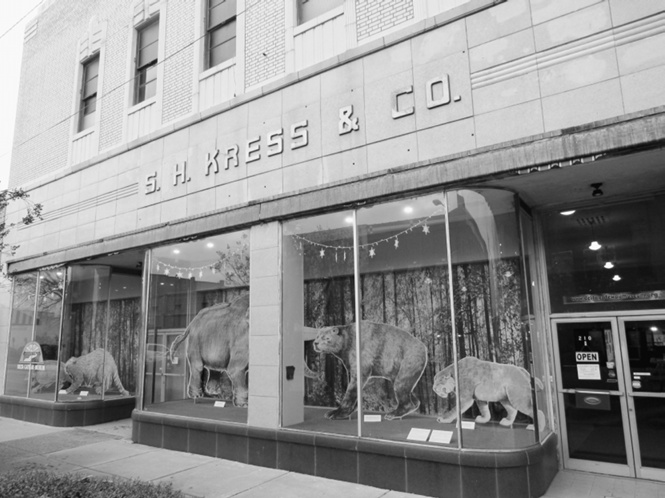
Photograph by Gregory Hansen
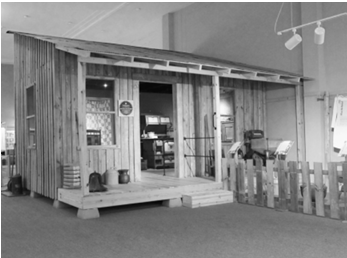
Photograph by Gregory Hansen
who take an exit off of I-55 to explore a number of attractions in Blytheville. The museum excels in using resources from a range of organizations, including the Arkansas Main Street Program and the Smithsonian Insti- tution. In 2017 the museum’s director, Leslie Hester, worked with the Smithsonian’s Museum on Main Street Program to host the exhibit “Home- town Teams: How Sports Shape America.” The Smithsonian provided technical support for cu- rating its traveling exhibit, and the staff, in turn, created an attractive, permanent exhibit of arti- facts connected with the vibrant history of sports teams in northeastern Arkansas. Technical assis- tance from the Smithsonian has continued throughout the years. Its latest manifestation is a newly opened permanent exhibit that provides an attractive representation of a common style of houses within the region. Hester explained that when the museum was closed during the Covid- 19 pandemic, she was able to use her time and the museum’s resources to construct a replica of a boxed house. This installation represents a typi- cal vernacular architecture home used by share- croppers and tenant farmers in the region. A boxed house features vertical-plank construction rather than the more complex framing systems found in more elaborate structures. Boxed houses were commonly built in Appalachia. By the early 20th century, their abbreviated and ex- pedient framing method was readily adopted as an economical building style in eastern Arkansas and throughout the wider region. The museum’s replica can be entered through its porch, and Hester worked with local residents to furnish the house with artifacts and museum replicas com- mon to Arkansas. Whereas the museum display offers visitors a compact version of the front room of the house, those who wish to see a boxed house can visit Marvell, Arkansas and tour the Levon Helm Boyhood Home, a newly opened house museum built from boxed-house construction techniques. As visitors circulate through the museum to other exhibit areas, they can take in another re- cently curated permanent exhibit, one devoted to Mississippi Period Native Cultures. This attrac- tive exhibit is centered around the reconstruction of a dwelling place with a fine display of museum artifacts. It works as a close-up to some of the more extensive displays of Mississippian culture that can be found in archeological sites such as Arkansas’s Parkin Archeological State Park and
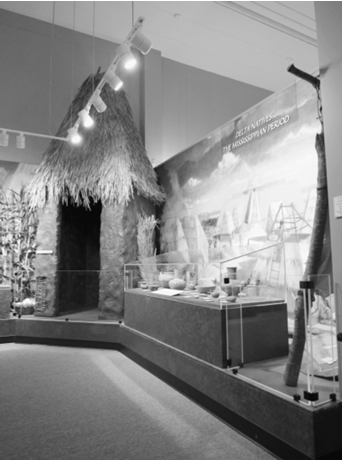
Photograph by Gregory Hansen
The museum also includes other permanent exhibits. There are excellent displays of objects and photographs that portray salient elements of the agricultural, commercial, educational, and military history of Blytheville. The museum has also opened exhibit space for temporary exhibits on a range of topics. One notable display in- cluded photographs and text that interpreted ele- ments of segregation and the Civil Rights movement in the city, a project that was con- nected to Hester’s completion of a masters degree within Arkansas State University’s Heritage Studies Program as well as the social history re- search of Charles Baclawski, who spent time doing local history research in the Arkansas Delta while completing his doctorate in Heritage Studies from A-State in 2015. The museum has continued to support the work of various re- searchers and community members. Its board of directors provides important connections to a wide range of constituents, and the museum has strong potential for continuing to support col- laborative activities, including presentations of children’s artwork and educational activities sup- ported by local schools.
It is challenging to turn an abandoned busi- ness into a museum. Although shelving space, sales counters, tables, and other features of old stores can easily be repurposed as fixtures for mu- seum display, there are major challenges in cre-
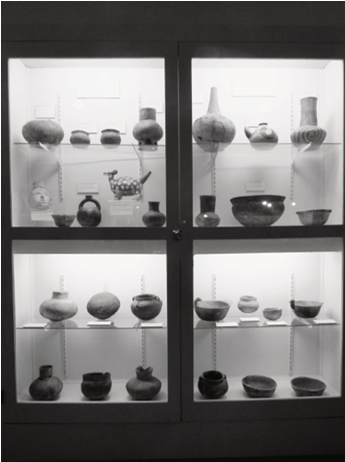
Photograph by Gregory Hansen
ating these local museums. Many of these organ- izations have limited financial resources and must rely on limited, or even all volunteer, staff for their operations. Another common problem is that despite the availability of grants and other financial and technical support to initiate adap- tive reuse projects, there are limited resources to sustain the projects after the museum is opened. Consequently, many of these museums have miniscule collections, somewhat predictable— even bland—exhibits, and limited personnel who can utilize current ideas within the field of mu- seum practices. It is admirable that the Delta Gateway Museum has found creative and com- munity-responsive ways to work with the many challenges of adapting a vacant store into a vital historical and cultural center. The museum is well worth a visit, and it has built a strong basis for future research and representations that ac- curately and engagingly present the region’s his- tory and culture.
After Ida
by JC Reilly
Today Grand Isle’s candy-colored houses look like faces
with their noses and eyes smashed in. Boats are overturned.
So many buildings smashed in. Boats overturned,
ripped in half as if made from paper, take on standing water.
As if made from paper, armoires, doors, and tables wilt in standing water,
a child’s swing set is shorn in three places, chains tangled
like kelp. A child has lost her swing set. Chains tangle
like telephone wires. Someone’s RV is missing
its wall. Telephone poles lie on their sides. Someone is missing.
Send help. Crabs scamper across the main road, don’t notice the damage.
When an old woman returns to survey the damage,
the sobbing rivals Ida’s howl. My home, she wails, my home.
The men are stoic for their wives who wail, My home, my home.
Grand Isle’s candy-colored houses look like their owner’s faces today.
Table of Contents
(formerly Kansas Quarterly)
Promoting Blues Tourism on Both Sides of the Mississippi River
by Stephen A. King and Roger Davis Gatchet163
by Abby Geni183
Mississippi Morning
Long Time No See
by Jianqing Zheng
194
An Interview with Sterling Plumpp
by Olga Ponomareva196
by Catharine Savage Brosman202
by Anthony Bukoski203
by JC Reilly210
by CL Bledsoe211
by Judith Skillman215
by Nick Bertelson216
Our Lady of the Ozarks
Three Sisters
A True Grit Sonnet
by Casie Dodd
219
by Larry D. Thomas222
by Brooke Harries224
by Alton R. Stone225
Delta Gateway Museum
210 W Main St.
Blytheville, AR
by Gregory Hansen
227
Zheng, The Dog Years of Reeducation, reviewed by Linda Parsons
Blevins, A History of the Ozarks, Volume 3, The Ozarkers, reviewed by Lauren Adams Willette
Houck, Black Bodies in the River: Searching for Freedom Summer, reviewed by Guy Lancaster
Jones, A Weary Land: Slavery on the Ground in Arkansas, reviewed by Brenton E. Riffel
Collins, My Back Pages: The Teresa Poems, reviewed by D.C. Eichelberger
Cover Photo credit:
Bonnie Matthews Brock is a Florida-based photographer and a school psychologist. She enjoys capturing a wide variety of scenes and learning and experimenting with shooting and editing techniques. Her images have been featured on the covers of magazines such as Ibbetson Street, Wild Roof Journal, Poesy Magazine, and Humana Obscura; as well as on the pages of publications such as Ember Chasm Review, Oddball Magazine, Beyond Words Literary Magazine, Beaver Magazine, and Lateral. Her works are archived at institutions such as Poets House NYC, Brown University, University of Buffalo, and Harvard University. View more of Bonnie’s images on Instagram @bonniematthewsbrock.
Nick Bertelson is a farmer from southwestern Iowa. His work has appeared in numerous journals. He is a James Hearst Poetry Prize finalist and author of Har- vest Widows (North Dakota State UP, 2019). He cur- rently screens fiction for New England Review.
CL Bledsoe is the author of more than thirty books, including the poetry collections Riceland, The Bottle Episode, and his newest, Having a Baby to Save a Mar- riage, as well as his latest novel The Saviors and story collection Nobody’s Darlings. Raised on a rice and cat- fish farm in eastern Arkansas, Bledsoe lives in north- ern Virginia with his daughter.
Anthony Bukoski is the author of several short-story collections, including most recently The Blondes of Wis- consin (2021, The U of Wisconsin P). His stories have appeared in South Carolina Review, New Orleans Review, Louisiana Literature, and elsewhere. He frequently re- views fiction for the Minneapolis Star Tribune.
Casie Dodd lives in Fort Smith, Arkansas, with her husband and two children. Her writing has appeared in The Windhover, Oxford American, Front Porch Republic, and other journals. She is the Book Review Editor for Psaltery & Lyre and the Founder/Publisher of Belle Point Press, a regional small press celebrating the lit- erary culture and community of the American Mid- South.
D.C. Eichelberger is an MFA candidate at the Univer- sity of Arkansas.
Roger Davis Gatchet is Associate Professor in the De- partment of Communication and Media at West Chester University in West Chester, Pennsylvania. His work primarily centers on rhetorics of public memory, tourism, and popular culture. As an active oral histo- rian and musician himself, Gatchet has worked on projects interviewing blues musicians in Austin, Texas. His work appears in journals such as Communi- cation and Critical/Cultural Studies, Western Journal of Communication, and Oral History Review.
Abby Geni is the author of The Wildlands, The Light- keepers, The Last Animal, and a forthcoming short story collection, The Body Farm, which will be published in the spring of 2024. Her books have been translated into seven languages and have won the Barnes & Noble Discover Award and the Chicago Review of Books Awards, among other honors. Geni is a faculty member at StoryStudio Chicago and frequently serves as Visiting Associate Professor of Fiction at the Uni- versity of Iowa Writers’ Workshop.
Gregory Hansen is Professor of Folklore and English at Arkansas State University where he also teaches in the Heritage Studies Doctoral Program. He is the au- thor of A Florida Fiddler: The Life and Times of Richard Seaman, and his publications focus on roots music, folklore and language, and public folklore.
Brooke Harries is currently pursuing a PhD at the University of Southern Mississippi. Her work has ap- peared in Salamander, Sixth Finch, Laurel Review, and elsewhere.
Stephen A. King is Professor and Chairperson of Communication at St. Edward’s University in Austin, Texas. He has published his work in several commu- nication and interdisciplinary journals including the Southern Communication Journal, Communication and Critical/Cultural Studies, Howard Journal of Communica- tions, Journal of Popular Culture, and Popular Music and Society. He is the author of Reggae, Rastafari, and the
Guy Lancaster serves as the editor of the online Ency- clopedia of Arkansas, a project of the Central Arkansas Library System, and is the author, co-author, or editor of several books on race and violence, including Amer- ican Atrocity: The Types of Violence in Lynching (U of Ar- kansas P, 2021) and The Murder of Oscar Chitwood in Hot Springs, Arkansas (co-authored with Christopher Thrasher and forthcoming from The History Press).
Linda Parsons, a poet, playwright, essayist, and editor, is the poetry editor for Madville Publishing and the copy editor for Chapter 16, the literary website of Hu- manities Tennessee. She is published in such journals as The Georgia Review, Iowa Review, Prairie Schooner, Southern Poetry Review, Terrain, The Chattahoochee Re- view, Baltimore Review, and Shenandoah. Her sixth po- etry collection, Valediction, is forthcoming in 2023. Five of her plays have been produced by Flying Anvil Theatre in Knoxville, Tennessee.
Olga Ponomareva teaches Russian and English at Mis- sissippi Valley State University. She comes from St Pe- tersburg, Russia. She is a Fulbright scholar, and her review of John Han’s book Whispers from the Rice Fields and her interview with Lenard Moore have appeared or are forthcoming in Valley Voices and Conversations with Lenard D. Moore respectively.
JC Reilly is the author of What Magick May Not Alter, a Southern Gothic novel-in-verse set in Shreveport, Louisiana, and Amo e Canto, winner of the Sow’s Ear Poetry Chapbook contest. She has work published or forthcoming from a number of journals, including Peregrine, Isotrope, Louisiana Literature, and Rougarou, and she serves as the Managing Editor of Atlanta Re- view. When she’s not writing, she crochets, plays ten- nis, or practices her Italian. Follow her @Aishatonu.
Brenton E. Riffel holds a doctorate in American His- tory from the University of Arkansas-Fayetteville. He currently is a member of the faculty at College of the Canyons in Valencia, California. He has published a number of articles on the civil rights movement in, among other publications, the Arkansas Historical Quarterly and Arsnick: The Student Nonviolent Coordi- nating Committee in Arkansas, edited by John Kirk.
Judith Skillman’s poems have appeared in Common- weal, Poetry, Threepenny Review, Zyzzyva, and other lit- erary journals. She has received awards from Academy of American Poets and Artist Trust. Oscar the Misan- thropist won the 2021 Floating Bridge Press Chapbook Award. Her new collection is Subterranean Address, New & Selected Poems, Deerbrook Editions 2023. Visit www.judithskillman.com
Alton R. Stone lives on a small farm near Wolf Bayou, Arkansas, and writes in his spare time.
Larry D. Thomas, a longtime contributor to Arkansas Review, is a member of the Texas Institute of Letters and served as the 2008 Texas Poet Laureate. His po- etry and prose have appeared in a number of national journals, including Arkansas Review, Texas Review, Concho River Review, Louisiana Literature, Delta Poetry Review, Deep South Magazine, Valley Voices: A Literary Review, and Red Dirt Forum. Of Southern heritage, he now resides in the Chihuahuan Desert of southwest- ern New Mexico.
Lauren Adams Willette is a Heritage Studies PhD can- didate at Arkansas State University; she serves as the Folk Survey Coordinator for Arkansas Folk and Tra- ditional Arts, the state folk arts program. Lauren’s re- search interests include the history and culture of Arkansas and the Ozarks region, folklore, intangible cultural heritage, and popular culture. She resides in Jonesboro, Arkansas, with her family.
Jianqing (John) Zheng is author of The Dog Years of Re- education (forthcoming), Enforced Rustication in the Chi- nese Cultural Revolution, Delta Sun, and The Landscape of Mind and editor of African American Haiku, The Other World of Richard Wright, and Sonia Sanchez’s Poetic Spirit through Haiku. He is a two-time recipient of the literary arts fellowship from Mississippi Arts Commis- sion and edits Valley Voices: A Literary Review and Jour- nal of Ethnic American Literature.