Volume 54, Issue 1 (April 2023)
- Table of Contents
- Reviews
- Car Lot Cowboy
- For Whom the Writing Goes
- Refuge
- Delta Sources and Resources
- We Lost Bill Harrison
- Abecedarian for a Hometown Tornado
- “A Tainted House of Prayer”: Artist V. L. Cox on White Supremacy, Southern Culture, and Her Persisting Love of the Delta
- excavation
Table of Contents
Arkansas Review: A Journal of Delta Studies
(formerly Kansas Quarterly)
“A Tainted House of Prayer”: Artist V. L. Cox on White Supremacy, Southern Culture, and Her Persisting Love of the Delta
3by Guy Lancaster
excavation (poetry)
15by laura vogt
Car Lot Cowboy (fiction)
16by Addison Griffis
Even Small Things (poetry)
22by Mary Ann Larkin
We Lost Bill Harrison (memoir)
23by M J Melneck
Roads and Bridges (fiction)
25by Robin Kozak
A Cordial Letter to Kaylee Muthart (poetry)
34by John Wall Barger
Refuge (fiction)
36by Kenneth Gulotta
Summer (poetry)
42by Leslie Hodge
The Early History of Streetcar Transportation in Little Rock, Arkansas, 1870–1948
44by Zuzana Chovanec and Timothy S. Dodson
Abecedarian for a Hometown Tornado (poetry)
59by Andrew Alexander Mobbs
For Whom the Writing Goes (creative non-fiction)
60by Damon Guinn
Delta Sources and Resources
67 The Hemingway-Pfeiffer Summer Writer’s Retreat
Hemingway-Pfeiffer Museum and Educational Center
Piggott, Arkansas
by Marcus Charles Tribbett
Reviews
68 Pierce and White Jr., eds., Race, Labor, and Violence in the Delta: Essays to Mark the Centennial
of the Elaine Massacre, reviewed by Michael K. Rosenow
Imahara and Meltzer, eds., Jerome and Rohwer: Memories of Japanese American Internment in
World War II Arkansas, reviewed by Ali Welky
Kirk, Winthrop Rockefeller: From New Yorker to Arkansawyer, 1912-1956, reviewed by Melanie K. Welch
Wegmann, An American Color: Race and Identity in New Orleans and the Atlantic World,
reviewed by Travis C. Perusich
Horowitz, Katrina: A History, 1915-2015, reviewed by Jon Carvell
Erikson and Peek, The Continuing Storm: Learning from Katrina, reviewed by Stan Weeber
Contributors
79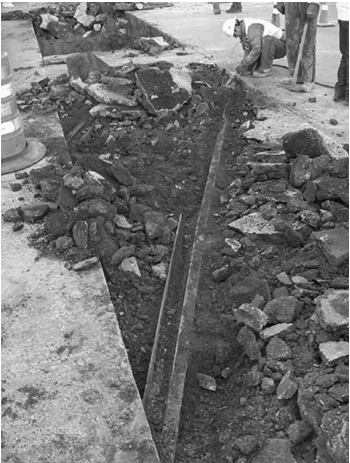
Editor’s note: In the image to the left, modern day construction workers uncover intact rails on East 3rd Street, Little Rock, remnants of the city’s streetcar railway system, permanently shut- tered about seventy-five years ago in 1948. See the fascinating article in this issue, pages 44-58, on this unique part of the city’s heritage.
Contributors
Jon Carvell is Clinical Assistant Professor of Disaster Preparedness & Emergency Management at Arkansas State University and served as the university’s emer- gency manager during the Covid-19 pandemic. He holds a BA in English and an MPA from Arkansas State University and got his start in emergency man- agement by volunteering for recovery efforts during the aftermath of various natural disasters in Northeast Arkansas.
Zuzana Chovanec, PhD, RPA works as an archaeolo- gist with the US Army Corps of Engineers and is af- filiated with the Department of Anthropology at the State University of New York at Albany as a Volunteer Research Associate. Her areas of interest include his- toric preservation, cultural resource management, human-environment relationships, and the archaeol- ogy of Cyprus and North America.
Timothy S. Dodson MA, RPA is currently the Regu- latory Archaeologist for the Nashville and Mobile Dis- tricts of the US Army Corps of Engineers. He has published several peer reviewed articles focusing on archaeology and baseball.
Addison Griffis is a Mississippi writer and finance manager at a car dealership. His work is found in Appalachian Review and Roanoke Review. Addison is currently querying literary Western and magical Southern manuscripts for representation. Instagram is @addisongriffis
Damon Guinn is a writer and nonprofit professional who grew up in Jonesboro, Arkansas. He spent years writing for a humanitarian organization, traveling to remote communities around the world to gather and share stories about families battling extreme poverty. He now resides in Minneapolis, Minnesota, within eyeshot of George Floyd Square, where he works with Twin Cities Habitat for Humanity to advance racial equity in housing. Samples of his work are available at damonguinn.com.
Kenneth Gulotta writes fiction and poetry. He has an MA in creative writing from the University of Texas at Austin and a PhD in English from Tulane Univer- sity. A technical writer by trade, he spends his days solving puzzles that involve communication, design, and coding. Kenneth was born and raised in south Louisiana, but he has also lived in Austin, TX, Wash- ington, DC, and Baltimore, MD. He now lives in New Orleans with his wife and stepson.
Leslie Hodge has poems published or forthcoming in journals including Pigeon Pages, South Florida Poetry Journal, Spank the Carp (where she was featured in The Mind of the Poet), and The Main Street Rag. Leslie lives in San Diego and has deep family roots in central Missouri.
Robin Kozak’s writing has appeared most recently in Arkansas Review, Drunk Monkeys, Pleiades, The Rappa- hannock Review, and Sequestrum. An authority on antique and estate jewelry, she currently is at work on her second novel.
Guy Lancaster serves as the editor of the online Ency- clopedia of Arkansas, a project of the Central Arkansas Library System, and is the author, co-author, or editor of several books on race and violence, including Amer- ican Atrocity: The Types of Violence in Lynching (U of Ar- kansas P, 2021) and The Murder of Oscar Chitwood in Hot Springs, Arkansas (co-authored with Christopher Thrasher and forthcoming from The History Press).
Mary Ann Larkin is the author of That Deep and Steady
M J Melneck earned the MFA degree from the Uni- versity of Arkansas in May 1980. His catalog includes the novel Old Music and many features, reviews, film scripts and short stories. He and his wife Pat and their spoiled rotten dog Max live in western Colorado where he writes about and photographs the nearby desert and mountains.
Andrew Alexander Mobbs (he/him/his), a native Arkansan, is the author of the chapbook, Strangers and Pilgrims (Six Gallery Press, 2013). A Pushcart Prize no- minee, his poems have appeared in Crab Creek Review, Frontier Poetry, New Delta Review, Ghost Ocean Maga- zine, and elsewhere. He co-founded the online lit mag Nude Bruce Review and will soon earn his MFA at Ore- gon State University.
Travis C. Perusich: Travis is a PhD candidate at the University of Arkansas, studying African American soldiers in the American Revolution. He earned his Bachelor’s degree at the University of the Ozarks and his Master’s degree at the University of Central Ar- kansas. He is a former member of the United States Air Force and a former public school teacher.
Michael K. Rosenow is Associate Professor of History at the University of Central Arkansas and is the au- thor of Death and Dying in the Working Class, 1865-1920 and articles about labor and working-class history.
Marcus Charles Tribbett is General Editor of Arkansas Review: A Journal of Delta Studies and Associate Profes- sor of English at Arkansas State University, where he also teaches for the interdisciplinary Heritage Studies doctoral program. He has published scholarly work on blues performers, on a nineteenth-century slave narrative, and most recently on contemporary novels by Jessmyn Ward and Tupelo Hassman.
Stan Weeber is Professor of Sociology at McNeese State University. He has written several papers about natural disasters, and wrote Post-Rita Reflections (2009), a professorial memoir of the Katrina-Rita era.
Melanie K. Welch was born in Little Rock in 1976 and graduated from the University of Central Arkansas in 1999, receiving a baccalaureate degree in history. In 1999, she received the Lucille Westbrook Local His- tory Award from the Arkansas Historical Association. In 2009, she earned a PhD in modern American his- tory from Auburn University. An independent histo- rian, her work has appeared in Arkansas Review, the Arkansas Historical Quarterly, and the Encyclopedia of Arkansas History and Culture.
Ali Welky is Associate Editor of the online Encyclope- dia of Arkansas, a project of the Central Arkansas Li- brary System, as well as a freelance editor for books and magazines, including the Oxford American. She holds a BA in English from Truman State University in Kirksville, MO, and an MA in English from the University of Central Arkansas in Conway. She co- edited the Encyclopedia of Arkansas Music (Butler Center Books, 2013) and edited A Captive Audience: Voices of Japanese American Youth in World War II Arkan- sas (Butler Center Books, 2015). She lives in Conway with her husband and two children.
Laura Vogt studied literature and history in undergrad and grad school, focusing on Shakespeare, folk tales, and the History of Mentalities. She also attended the University of Iowa Writers’ Workshop writing pro- gram in Dublin, Ireland. Her poetry is published in several journals, her prose has placed in a few contests, and her novelette Blue Beyond the Sea is available as a chapbook with Bottlecap Press. Her forthcoming debut novel In the Great Quiet is a historical fiction and fabulism blend based on her ancestor.
Reviews
Race, Labor, and Violence in the Delta: Essays to Mark the Centennial of the Elaine Massacre. Editedby Michael Pierce and Calvin WhiteJr. (Fayetteville, Arkansas: Universityof Arkansas Press, 2022. Pp. ix + 248, acknowledgments, introduction,notes, contributors, index. $29.95, paperback)
In Black Reconstruction, scholar and activist
W.E.B. Du Bois argued that emancipation pro-
duced a dramatic reversal of fortunes for African
Americans: “The slave went free; stood for a brief
moment in the sun, then moved back again to-
ward slavery” (New York: Russell and Russell,
1935, p. 30). Du Bois’s idea of freedpeople being
pulled “back toward slavery”—the title of the pen-
ultimate chapter of his book—is more than a
haunting diagnosis of the failed possibility of Re-
construction. Rather, it provides a way to under-
stand much of Black history for the rest of the
nineteenth and twentieth centuries. Every time
Black Americans organized, countervailing forces
attempted to thwart their efforts at improvement.
Such was the case in Elaine, Arkansas, when in
1919 whites murdered hundreds of Black share-
croppers who had begun to unionize, thereby
temporarily crushing hope for Black freedom in
the Delta.
In 2019, scholars and community members
commemorated the centennial of the Elaine
Massacre, which resulted in Race, Labor, and Vio-
lence in the Delta. Nine essays make a convincing
case that labor relations,
 techniques of oppression, and the incessant striving for better lives fundamentally shaped the Delta’s history. The first three essays examine aspects of labor and race relations from the 1870s to World War I, while the next three probe the interwar period with an emphasis on the 1920s. The final three essays address discrete topics that span the second half of the twentieth century. Some of the historians draw on previously
published research to produce new insights related to the Elaine Massacre. From his prior examinations of nineteenth-century labor
organizations in Arkansas, such as the Agricul-
tural Wheel and the Knights of Labor, Matthew
Hild finds patterns of interracial organizing and
violent white backlash demonstrated in both the
Cotton Pickers’ Strike of 1891 and the Elaine
Massacre. Jeannie Whayne taps her extensive
body of scholarship to situate the 1921 lynching
of Henry Lowery within the community net-
works of power rooted in the plantation econ-
omy of Mississippi County. Whayne interprets
Lowery’s murder as proof that whites had no tol-
erance for collective or individual acts that ques-
tioned their authority—whether that was
organizing a union in Elaine or requesting a
written statement of accounts from a planter as
Lowery did. Greta de Jong offers wisdom col-
lected from aspects of her three previous books
on struggles for social justice in the South, par-
--Michael K. Rosenow
Jerome and Rohwer: Memories of Japanese American Internment in World War II Arkansas. Edited by Walter M. Imahara and David E. Meltzer. (Fayetteville, Arkansas: The University of Arkansas Press, 2022. Pp. xxii + 228, foreword, preface, acknowledgments, introduction, appendix, index. $29.95, hardcover)
 the country to get to
camps (including the
two in Arkansas), attempting to make a
home in tiny barracks—
but they each experienced it in their own
way. The accounts in
the book are full of details, big things and
small things remembered all these decades later. Taken together, they
reveal the personal struggles of all the people af-
fected—from realizing that, despite the fact that
they had been told they were being held mostly
to protect them from the surrounding populace,
the guards’ guns were pointed at them, not away
from them, to the daily humiliation of having to
bathe and use the toilet without privacy. Histori-
cal accounts can paint with a broad brush, but
seeing these finer brushstrokes has real value in
seeing the effects of conflicts and policies on real
people living their daily lives.
Living in Arkansas myself and having done my own delving into the history of the Rohwer and Jerome camps, I appreciated the vivid de- scriptions by these Californians. James Ichinaga’s account of Jerome is as follows: “If I were ever in charge of punishing a group of people, this is the place I would send them. The environmental ele- ments were very hostile. It was hot and humid in the summer, freezing in winter. . . . I remember seeing those odd creatures called flying squirrels, bats, many species of birds, those wonderful in- sects called fireflies, and hearing the noisy croak- ing of the frogs at night. To this day I have never seen mosquitoes as huge as those in Arkansas” (p. 38). Captured also in the book are the diverse de- tails of what happened to people and families after they left the camps as the war was drawing to a close. Some returned to their homes and farms in California—although not without care- ful forethought. As Fran Inouye Imahara said, “My father wanted us to go to Japan to live after our release and applied for Japanese citizenship. Relatives advised us there would be nothing for us there. They canceled our request and we re- turned to Fresno in 1946. We were very fortunate to have a place to return to since a dear family friend, a policeman with the Fresno Police De- partment, looked after our home” (p. 54). Many were not so lucky and had nothing to return to; they made other plans, such as the Imaharas’ move to New Orleans, where they developed a thriving landscaping business (p. xviii). A few accounts have details that astounded me. Clover Johnson said, “While [his friend] Harry [Nagata] was in the service in the Midwest or on [the] East Coast, he encountered fellow sol- diers who had never seen anyone of Japanese an- cestry before. Someone in command decided it would be hard for the men to fight an enemy they’d never seen. Harry Nagata was ordered to dress up in the uniform of a Japanese soldier and parade in front of the troops so they could see and hate ‘the face of the enemy.’ Needless to say, that was a horrible thing to do to a loyal Ameri- can soldier and it breaks my heart every time I think about it” (p. 70). Another account, by Joh Sekiguchi, recalled a Boy Scout jamboree that in- cluded boys from Jerome and Rohwer as well as
--Ali Welky
Winthrop Rockefeller: From New Yorker to Arkansawyer, 1912-1956. By John A. Kirk. (Fayetteville, Arkansas: University of Arkansas Press, 2022. Pp. xi + 267, acknowledgments, notes, bibliography, index. $24.95, hardcover)
In 1953, Winthrop “Win” Rockefeller, a
 member of one of
America’s wealthiest
and most powerful fam-
ilies, moved to Petit
Jean Mountain in Con-
way County. He built a
showplace Santa Ger-
trudis cattle-farming op-
eration, which he
named Winrock farms.
In 1991’s Agenda for Reform: Winthrop Rockefeller
as Governor of Arkansas, 1967-71, historian Cathy
Kunzinger Urwin analyzed his service as Arkan-
sas’s Republican governor from 1967 to 1971, but
his New York life has received little scholarly at-
tention. Until now. John A. Kirk, who is George
## Washington Donaghey Distinguished Professor
of History at the University of Arkansas at Little
Rock (UALR), examines his formative earlier life
experiences to develop a more complete and nu-
anced portrait of the man. Based upon the Win-
throp Rockefeller Collection, which is housed at
the UALR Center for Arkansas History and Cul-
ture, the Winthrop Rockefeller Papers at the
Rockefeller Archive Center (RAC), interviews
and other sources, Kirk argues convincingly that
his life in New York shaped his later career in
Arkansas.
Following a well-crafted introductory first
chapter, the author devotes Chapters Two
through Six to describing his childhood, educa-
tion, and earlier career in the oil industry. Born
on May 1, 1912 in Manhattan, Winthrop Rocke-
feller was educated at the Lincoln School, a prac-
tical learning-oriented institution, and the
Loomis School, which was a traditional, college
preparatory school. A poor student, he preferred
the kind of “hands-on” learning, such as the les-
sons in cattle-raising, he engaged in at Lincoln.
Notably, he and his brothers Nelson and David
received diagnoses of dyslexia much later in their
lives. Much to his family’s disappointment, Win-
throp’s poor academic performance resulted in
his resignation from Yale University in 1934.
Kirk refutes some Rockefeller family historians’
previous claims that an on-campus liaison led to
his dismissal from Yale.
To his family, his choice to enter the oil busi-
ness helped make up for his lack of academic suc-
cess. In 1934, he began learning each stage of the
business by starting work as a roustabout laborer
in Texas. He loved the experience—working in
the field, the adventure, and the people.
He inherited his family’s commitment to im-
proving race relations. During his time in Hous-
ton, Texas during the 1930s, he tried and failed
to interest white leaders in establishing a com-
munity health program for African Americans.
Through the experience he gained “valuable in-
sight into the difficulties in dealing with south-
ern race relations” (p. 80).
His oil career did not quite live up to his fam-
ily’s expectations. Returning from the oil fields
in 1937, he joined his father John D. Rockefeller
Jr. and his brothers in the family’s New York City
offices. In 1939, he began working in the foreign
trade department of Socony Vacuum, a deriva-
tive of his grandfather John D. Rockefeller Sr.’s
Standard Oil Company. As someone who dis-
liked working behind a desk, he struggled to find
his place in an office.
In Chapters Seven through Ten, Kirk details
Winthrop’s army career during World War II, in-
cluding his service in Guam, Leyte, and Oki-
nawa. He distinguished himself in the field of
battle, returning from the war a decorated com-
bat veteran. While in the army, he became
friends with Frank Newell. In the early 1950s,
Newell, an insurance broker from Little Rock,
showed him the property that became Winrock.
For this reviewer, who was less familiar with the
--Melanie K. Welch
An American Color: Race and Identity in New Orleans and the Atlantic World. By Andrew N. Wegmann. (Athens, Georgia: University of Georgia Press, 2022. Pp. xvi + 238, acknowledgments, note on language, introduction, notes, bibliography, index. $29.95, paperback)
In the final chapter of his work, An American
Color: Race and Identity in New Orleans and the At-
lantic World, Andrew N. Wegmann references the
prevalent eighteenth- and nineteenth-century no-
tion that American society could not be shared
between white and non-white Americans. De-
spite this supposed incompatibility between the
white and black com-
 munities, the New Or-
leans mixed-race Creole
people forged a path
and identity for them-
selves, embracing the
ambiguous line between
white and black, and in
turn defining and rede-
fining themselves as
uniquely Creole within
the changing American
landscape. These are the people Wegman brings
to the fore as he analyzes the origins and devel-
opment of mixed-race middle-class Creoles in
New Orleans—from their French origins in the
1730s through to their embrace of their Ameri-
can home in the 1860s. For Wegmann, these
Creoles underwent a process of Americanization
in which they carefully crafted their cultural iden-
tity over more than a century to promote eco-
nomic and social uplift, as well as lay claim to a
place uniquely theirs within New Orleans and
greater American society. They were proud, edu-
cated, ambitious middle-class people who con-
stantly endeavored to promote their
community’s growth and claim to status in a con-
stantly shifting Atlantic World. In doing this,
they understood race, race science, and racial am-
biguity—manipulating these elements to their ad-
vantage while also forming a sense of identity
--Travis C. Perusich
Katrina: A History, 1915-2015. By Andy Horowitz. (Cambridge, Massachusetts: Harvard University Press, 2020 Pp. 281, introduction, notes, acknowledgments, index. $36.00, hardcover)
Whether the author of this Barcraft Award winner intended to create irrefutable justification for the paradigm shift toward prioritizing vulnerable

--Jon Carvell
The Continuing Storm: Learning from Katrina. By Kai Erikson and Lori Peek. (Austin, Texas: University of Texas Press, 2022. Pp. xv + 142, prelude, postlude, acknowledgments, notes, index. $32.14, paperback)
Sociologist Kai T. Erickson observed in 2014 that Hurricane Katrina would be the most telling storm of our era, not just because of the damage it inflicted upon people and property, but be- cause of what it revealed about our culture and ourselves. Social scientists were eager to learn more about the human costs of the disaster and went to work soon after the storm passed, sifting through reams of data, striving to make sense of it. Among this group were some of America’s best disaster researchers, their colleagues, and stu- dents who lent support. The best of this work ap- peared on The Katrina Bookshelf, the most comprehensive social science coverage of a dis- aster found anywhere in the literature. The Con- tinuing Storm is the capstone of this series. This book is a somber reflection, thoughtful, with a measured academic tone. Yet, simulta- neously, it is a brutally honest story of the abuse suffered by some of New Orleans’ most vulner- able citizens. It is a short, powerful read, essential for those who want to deeply understand what happened before, during, and after Hurricane Katrina. At the center of the narrative are the poor, mostly Black residents of New Orleans, some eld- erly, handicapped, and medicine-dependent, stuck in Katrina’s path and unable to escape the storm’s wrath. They died in floodwaters that reached as high as their attics; they died swim- ming through toxic sludge, trying to find some- thing to hold on to as the water inched higher; they died on bridges and overpasses, waiting for help that was late in coming; some died in the filthy squalor of the Superdome and the Conven- tion Center, dehydrated, hungry and without medication. Those that survived were hastily loaded on buses or planes, headed for unknown destinations, separated from some of their family, and after a while living in a new place, feeling like utter outcasts in their new environment. For these souls, the hurricane is not over; it is a con- tinuing trauma. Wherever these survivors go, so goes Katrina. The book succeeds in reorienting our percep- tions of time and space as it relates to the hurri- cane. As humans, we like to corral nature into
 timeframes. For exam-
ple, as a meteorological
event, Katrina was
short-lived; it began on
August 25 near south-
east Florida and ended
on August 29 over east
Mississippi. The storm
surge abated. The flood-
waters in the geo-
graphic bowl that is
central New Orleans eventually receded. But
human suffering will last a lifetime. Coastal
towns like Venice, Buras, and Waveland were
completely destroyed, having to build back from
scratch. Memories of what was lost and the grief
about those things have no official time stamp or
expiration date.
Regarding space, we like clear geographic
boundaries that we can identify and point to on
the map to remember those who suffered in that
part of New Orleans, such as the Lower Ninth
Ward and St. Bernard Parish. But in the travels
of those displaced from those places, Katrina
lives on. Wrenched from their homes and made
to feel unwelcome to return, Katrina followed
them wherever their diaspora took them.
Meanwhile, among New Orleans’ elite busi-
ness crowd, there was jubilation as they witnessed
the storm’s devastation. As affluent people living
on higher ground, they suffered less damage and
had the resources to get out of town as the storm
passed. Surveying the flooding in the poorer, pri-
marily Black district of New Orleans, some ex-
pressed thanks to God for the “gift.” The storm
did what they always wanted to do but could not.
Their town’s “criminal element” had just
boarded buses and was now gone. The city would
gentrify and do all possible to make it nearly im-
possible for the displaced to return. Possibly this
slight was the lowest depth of humiliation for
those in the diaspora, to be unwanted by their
city. They were uprooted from their homes,
treated like garbage, shuttled away, and barred
from returning. The New Orleans business
crowd wanted a smaller, taller, and whiter post-
Katrina city, and they got all that. It may be true
that no one reads Herbert Spencer anymore, as
Talcott Parsons once wrote. But these business
types wore their Social Darwinism on the sleeves
of their freshly pressed suits. The “unfit” of their
town had just been expelled. We learned from
Katrina that Social Darwinism was stitched into
the fabric of New Orleans and much of white
America, which stood by silently watching.
The Continuing Storm reveals the limits of a
neo-liberal democratic state in the current age to
protect its citizens after a disaster. In this pro-free
market, pro-business way of governing, the re-
sponsibility for disaster preparedness lies squarely
on the shoulders of the individual family unit
and local communities. Individual responsibility
rules the day. The fittest will survive and the rest
will fail. The federal government and state gov-
ernments can help with infrastructure projects or
resiliency initiatives and some limited forms of
aid. Still, it is not their job to replace your home
or to make you whole again. The political system
insists that to receive substantial assistance, your
local representatives must continually approach
the halls of Congress, hat in hand, to beg for
more relief money and prove that your district
needs it—an exhausting, years-long process.
Louisiana now encourages families to have
an action plan before the next storm arrives in
the Gulf. That plan involves adequate insurance,
savings, a roadworthy car, a “go” kit to save time,
and a place to meet family members during an
evacuation. Unfortunately, many of the vulner-
able poor in New Orleans lack access to these re-
sources today just as they did in 2005.
--Stan Weeber
Car Lot Cowboy
by Addison Griffis
For Whom the Writing Goes
by Damon Guinn
It’s 1:30 p.m. on the first day of a writing re- treat at the Hemingway-Pfeiffer Museum and Educational Center in Piggott, Arkansas, and I’m camped out in a bathroom between the mu- seum/house and gift shop. I’m supposed to be working on “my art,” but the gastric remains of junk food, coffee, and energy drinks—fuel from a two-day road trip—have just erupted in my lower GI.
Earlier, seven attendees and I kicked off the retreat with introductions and an overview from the instructor and writer-in-residence, Mary Miller. Miller, a storyteller whose prose chron- icles the tension and tedium of everyday life, has published two novels, two collections of short stories, and several pieces of flash fiction. She’s shrewd with a sharp wit, and after reading her story collection, Big World, I was convinced that she would have something to teach me.
Arkansas State University Heritage Sites has been hosting the retreat at the Hemingway- Pfeiffer Museum annually since 2002. Every year, the visiting author signs a quilt square that is framed and placed on a wall in the Educational Center. The earliest square is from July 7, 2002. It’s signed by author Lorian Hemingway, the daughter of Gregory Hemingway, Ernest’s young- est son with Pauline. Both she and her father— who later identified as Gloria and underwent gender reassignment surgery—each have fascinat- ing stories all their own.
Following our morning discussion and an awkward lunch, we are given an hour and a half of independent writing time. The director, Shan- non Williams, tells us that we are free to write wherever we like—at the Educational Center, in the Pfeiffer house, or at the studio above the barn where Hemingway did most of his work while vis- iting. I decide to follow Dr. Adam Long, who is the executive director of Arkansas State Univer- sity’s Heritage Sites, and a sixty-something man named Bill from Kentucky.
Adam leads us to the house and gives us a cursory tour of the rooms, pointing out choice spots. I pick an open room on the second floor with conference chairs arranged around the peri- meter.
Adam explains that there probably won’t be any tours, but if people do come through, I can just close the door and continue working. That will be interesting, I think, imagining myself springing to my feet and slamming the door on a family who planned months in advance to visit this historic home once graced by Hemingway. He adds that he will lock the front door to the house because it tends to blow open. Then he and Bill head off to see the rest of the house.
I start working on a story about rivalry be- tween childhood friends, something I’ve been playing around with for years, but I’m too unset- tled to focus.
Before traveling to Piggott, I watched Ken Burns’ PBS documentary on Hemingway, so I’m curious to explore the house and see remnants of the writer’s experience in Arkansas. As I wander from room to room looking at the mem- orabilia, the downstairs door opens and closes. I hear shuffling and banging. Bill must have re- turned, and it sounds like he’s burglarizing the place. I want to investigate, but my gut starts to rumble, and I’m forced to bolt down the stairs of the museum three at a time and make a clench-cheeked beeline for the bathroom.
My first day and I already can’t stomach it.
Fathers and Sons (with a Mother in the Mix)
My trip to Piggott had taken a surprise turn when my traveling companion, my eleven-year-
At the first sight of the teepee, Oliver was thoroughly nonplussed. “Do we have to stay there tonight,” he whined. He wanted AC and TV, not BS. He wanted to be back home playing Fortnite or Minecraft on his PC, not hanging out in a tee- pee with faux-Native American décor, listening to his old man snore.
“It’ll be an adventure!” I enthused.
“Yeah, right,” was his dejected reply.
Situated off a deteriorating highway flanked by abandoned storefronts, our teepee was tucked in the backyard of a modest suburban home and right next to a murky pond that belched with bull frogs. I went to “test” the outhouse and told Oliver we would have the distinct privilege of pooping in a sawdust-filled five-gallon bucket. He dropped his head in defeat and sulked to the teepee.
It was muggy outside, and Oliver complained that he felt sticky and gross, so he stripped off his shirt and settled in to watch YouTube videos on his phone. That’s when the bull frogs kicked up their croaks a notch and started doing call-and- response with a chorus of crickets.
“How am I supposed to sleep tonight with all this noise?!” Oliver demanded, storming over to a chair and announcing that he would be lis- tening to Yo-Yo Ma until he fell asleep.
“Good call,” I replied, returning to my place in Hemingway’s A Moveable Feast. A short chap- ter later, I glanced over my shoulder to see Oliver soundly sleeping while the frogs and crickets competed for swamp cred.
The teepee was illuminated inside by solar- powered patio lights that were brighter than a sin- gle table lamp but dim enough to be ignored by heavy sleepers. Oliver always slept with a lamp on; I customarily slept in darkness that rivaled Vantablack. By 2:00 a.m., Oliver’s phone was dead, and I was wide awake. Oliver started to toss and turn while I thought through the logistics of Plan B. I would simply book a hotel the next day, and we could spend the afternoon in Kansas City with friends before driving to Jonesboro on Sunday.
Plan B changed to Plan C the moment Oliver woke up.
Bolting upright, he screamed, “I can’t sleep!” before springing to his feet and frantically pacing back and forth in the teepee.
“Do you want to pack up and drive to Jones- boro?” I asked him, hoping he would say no to the six-and-a-half-hour overnight drive.
“Oh, Dada, I know!” he beamed. “We can get some gum and energy drinks and listen to loud music to stay awake! You can get a coffee and an energy drink, so you’ll have a back-up after you finish the first.”
We were back on the highway in less than 15 minutes. At 2:30 in the morning.
By the time we made it to Jonesboro, the car, my son, and I were all cruising on fumes. Oliver slept soundly for hours after our arrival, while I struggled to catch any rest whatsoever.
My eyes eventually dimmed as I reread lines from Hemingway’s story, “Fathers and Sons”:
Like all men with a faculty that surpasses human requirements, his father was very nervous. Then, too, he was sentimental, and, like most sentimental people, he was both cruel and abused. Also, he had much bad luck, and it was not all of it his own. I, too, had been cursed with much bad luck, bad luck that had left me feeling suicidal at times. Fortunately, I had a loving son to accompany me on my journey.
When Monday morning rolled around, I packed the car for the short drive northeast from Jonesboro to Piggott. I’m nearly fifty, but my mom nevertheless insisted on loading me up with a pantry’s worth of snacks before taking my picture in front of the car. I felt like an overgrown kid heading to summer camp.
The drive through rural Arkansas, through towns named Marmaduke and Rector, made me
I decided to attend the retreat based on my favorable impression of Miller’s writing and my mom’s recommendation. My mom has been at- tending the retreat for years, reading occasional poems about the childhood exploits of my brothers and me . . . like setting fire to the kudzu in the ravine behind our old home, “running away from home” to a fort in said ravine, and stealing money from an envelope reserved for church tithing.
Recalling her descriptions of past retreats, I had serious doubts about attending. I envisioned a writing group at a retirement home—a bunch of old biddies and geezers sharing stories about their grandkids and sciatica. I had never attended a writing retreat, and I didn’t relish the idea of having my writing critiqued by a group of geria- tric strangers. And, honestly, I’m not even a big Hemingway fan; I enjoy his writing, but I wasn't convinced it was worth the thirteen-hour drive to visit the place he occasionally visited while writing A Farewell to Arms.
Despite all of that, my mom somehow con- vinced me that I would benefit from the collegial atmosphere and discussions about craft. Plus, it was a good excuse to visit my parents and try something different after a grueling year of COVID quarantine. That and I was unemployed after a year and a half of job rejections.
When I finally pulled into the drive of the Pfeiffer home, I took a moment to sit in my car and examine the large but plain Victorian façade. It wasn’t as stately as I anticipated. It didn’t look grandiose enough to temporarily house Heming- way’s larger-than-life persona or the fortunes of his in-laws’ pharmaceutical empire, even as it dwarfed the ’70s-style brick rambler that served as the Hemingway-Pfeiffer Educational Center, where our writing classes would be held.
As I entered the center and angled my way toward a seat, an older woman at the conference table blurted out, “I bet I know who you are! You’re Fay’s son.” She introduced herself as Charlotte. Another woman in the room chimed in, “Oh, yeah. Fay with no E. She’s a regular.” That was Talya, the only published novelist in the group besides the instructor.
Oh, great, I thought. Every expletive and lurid phrase I read aloud is going to find its way back to my mom.
A Clean, Well-Lighted Place
We kick off the first class with a great con- versation about the humor and wisdom of Anne Lamott’s Bird by Bird, a book all novice writers are encouraged to read, and then dive into a reading of Joe Brainard’s I Remember. Miller, our instructor, reading the crowd, skims over Brai- nard’s more titillating memories about his sexual experiences.
We break for independent writing time after lunch. That’s when I wind up alone in the Pfeiffer house. Returning to the Educational Center, Karen, an assistant with ASU Heritage Sites, announces to the room, in what could easily be confused as a conspiratorial tone, that I selected Max’s room. Max was the Pfeiffer’s fourth child who died from the 1918 flu epi- demic at age eleven. I had chosen the dead kid’s room, who died from the flu no less!
Once the entire group reconvenes, two at- tendees volunteer to share what they wrote dur- ing the break. Tonia, a retired attorney from Little Rock, details her discovery that the man she adored as her maternal grandfather wasn’t her real grandfather. Next, Bill, whose occupa- tion escapes me, launches into a sprawling, bor- derline-metaphysical account of his life and the universe. We’re dumbfounded. It’s a prolix solil- oquy that sounds like free verse. (The next day, Bill transforms the first chapter of prose into a poem per the group’s recommendation, and we all agree that it’s much better.)
With that, we’re dismissed for the day, and I jump in my car and make a run for the Missouri border. Piggott is in a dry county, and I need booze to help me sleep and process my first
Back in my room at the Inn at Piggott, I pour myself some scotch, fire up Spotify for back- ground music, and set to work on a story. But again, I’m too distracted and it’s only the first day, so I step outside my room to inventory the inn’s lounge and dining room. As I do, the door clicks shut, and I immediately realize I’m locked out. Shit! My cell phone is in the room, and there’s no phone in the lobby. I ring the front bell, but no one responds, so I head back to the second floor and nervously knock on the guest’s door across from mine. No answer. I cross the hall and knock on another door.
“Is someone out there?” a woman yells. She peeks through the curtain in the door’s window, and I recognize Charlotte’s face. “Who is that?!”
“It’s Damon, Charlotte. I’m sorry to bother you, but I’ve locked myself out of my room, and I need to call someone to let me in.”
“I’m not dressed, Damon,” she adds before quickly cracking open the door and thrusting her phone at me.
“I’m very sorry. This should only take a mi- nute,” I reassure her.
“It’s okay,” she tells me. “I’m your mother’s friend.”
Sleep comes easier that evening with the help of scotch. Like the old man who stays too late drinking at a café in Hemingway’s story, “A Clean, Well-Lighted Place,” I feel like the loneli- est man in the world, the drink in hand my only companion. But I am settling in. I don’t even mind the rumble of trains outside the inn.
A Way You’ll Never Be
We open the conversation on the second day with a discussion about Jo Ann Beard’s essay “Now,” which I love for the vivid description of Alaska, the author’s channeling of her father’s World War II experience, and references to Neil Young and Denis Johnson. There is dissent over the essay’s value. Some of us like the imagery and the free-form style; others are frustrated by the lack of structure and focus.
We learn that the piece was originally a speech Beard presented and later printed in AGNI magazine. Beth, a writing instructor at the University of Tennessee-Martin, is not cool with this. “Do you think we could get away with some- thing like that?”
Mary adds that Beard wrote a celebrated essay for The New Yorker called “The Fourth State of Matter” about a mass shooting at the Univer- sity of Iowa that won her a loyal audience. Mary promises to hunt it down.
Next up is Cheever’s story, Reunion. This one is about an estranged father and son on a day- drinking excursion. It promptly brings out the psychoanalysts among us. Bill, for the first of what will be many times to follow, opens the Pan- dora’s Box of his personal life and shares an ac- count of his time in a psychiatric hospital. As he veers farther off topic and into the murkier re- cesses of his mind, the rest of us, intrigued and unnerved, collectively pull back a little from the table, acknowledging that a boundary has been crossed.
Charlotte, a former school librarian, soon mollifies us with a piece about her childhood in the ’50s. Then Beth shares a story about meeting William Stafford during her stint as a graduate student, recalling how she smugly treated the an- thologized poet. Her story is full of subtle refer- ences to Stafford’s “Traveling Through the Dark.” The references are lost on our group. It’s been more than twenty years since I’ve read the poem, and the others haven’t read it at all. But it’s a clever story, and a beautiful reminder to wake up every morning and get to work on what you love.
That evening after dinner, I grab some scotch, my portable speaker, and a copy of Beard’s “The Fourth State of Matter” and head to the rear deck of the inn to read and scribble some thoughts. The sun sets in time with Yo-Yo Ma’s cello. The deck shakes as a train blows by in the background. Birds dart by, surfing the breeze and skirting past a waxing gibbous moon that has just begun to peak around the corner of the inn’s roof. A text from my wife says she’ll call soon. The phone remains silent.
Back in my room, I pull up Elia Kazan’s A Face in the Crowd on my laptop. The movie is Pig- gott’s other major claim to fame. Part of the film is set in the town.
The movie had a resurgence after the 2016 election. Several political commentators noted the similarities between Donald Trump and the film’s main character, Larry “Lonesome” Rhodes. Lonesome is a drifter who uses his good- ole-boy schtick to rise to celebrity status on TV before wedging his way into politics. He’s even referred to as an “influencer,” just like today’s tech-savvy promoters. And, like Trump, he em- bellishes a populist persona to pitch false claims to “real Americans” over the airwaves.
Piggott is smack dab in Trump country. I could walk a few blocks from the main square and spot at least two or three “Trump 2020” banners and even a crudely written “Stop the Steal” yard sign.
The irony isn’t lost on me, but, judging by the political placards lingering long past the elec- tion, the locals didn’t get the memo.
A Day’s Wait
On Wednesday morning, Mary is excited to ask us about “The Fourth State of Matter.” We dig into Beard’s description of the degeneration of her dog, her husband’s abandonment of their marriage, and the mass shooting that kills her colleagues in the Department of Physics and As- tronomy at the University of Iowa. It’s a riveting essay with an eloquence that forces us to question our abilities as writers. If it takes a topic as horri- fic as mass murder to be a noteworthy writer, what hope do we have?
“I guess I can’t be a writer, then,” Charlotte says. “Nothing that interesting happens to me. My life is too normal.”
We take turns offering her hollow words of encouragement, but each of us seems to realize the reality of the situation. A devastatingly sad essay has left us sadder still.
Fortunately, Karen turns our thoughts and stomachs away from despair. A veteran violist with the Memphis Symphony Orchestra, Karen shares a short piece about a subject that is near and dear to our hearts and stomachs: pork. She strings together a comparative history of pork dishes in the Mid-South with their native dishes in Austria, Germany, and France, singing its praises by way of allusions to great composers. It’s the perfect transition to lunch.
I head back to the inn for a phone interview for a job in Minneapolis then set about revising my unfinished short story. It’s my turn to read my work during the afternoon session, and I’m not relishing the potential criticism.
Back in the classroom, I read the first part of my story, summoning the speed and tone of the story’s insecure, adolescent narrator. Even though I emphasize words like “piss” and “dick,” the overall response is positive. A couple of the attendees say they can relate to the narrator’s plight. Some want to know what happens in the second part since I accidentally include a page and a half of it. I’m reworking the second part, I explain, describing some of the potential plot scenarios.
Talya reads a flash fiction story next. It’s about an aging woman inspecting her garden in the morning. I can easily imagine the piece in the “Readings” section of Harper’s magazine.
Before we break for the day, I invite the group to join me for dinner at the pizza place on the square and note that the deck behind the inn has a great view of the sunset. I’m in need of some company. Tonia and Talya are the only takers.
We are the only customers, too, so we ask the teenage waitress holding down the fort if it’s okay to bring our own wine into the restaurant. “I don’t know, but I doubt anyone will be here to- night, so I really don’t care,” she replies noncha- lantly before returning a few minutes later with three large Styrofoam cups. Without missing a beat, Tonia hands me the key to her room and
Tonia, Talya, and I wash down our pizza with glassfuls of contraband, rehashing the day’s dis- cussions and basking in the moment.
One Reader Writes
We dive into some flash fiction samples on the following day, starting with George Saunders’ story “Sticks.” One of my favorite living writers, Saunders captures my attention by creating ab- surd and surrealistic settings that are navigated by characters struggling with their humanity. “Sticks” is about Saunders’ father’s tradition of decorating a pole for the holidays.
The story inspires me to search for quotes from Saunders while the group reviews our other samples for the day. Saunders has a reputation for producing quotes like this: “What I regret most in my life are failures of kindness. Those moments when another human being was there, in front of me, suffering and I responded . . . sensibly. Reservedly. Mildly.”
I will soon discover that this is the universe, via Saunders, preparing me for the afternoon session.
One o’clock rolls around, and I meet with Mary for my one-on-one review session. I had de- cided to share the first ten pages of a memoir I began writing during the pandemic because it felt like the most earnest writing I’ve done to date. The book opens with a recollection of a near-fatal night in December 2020 before shifting to the year I spent in Bulgaria after graduating from col- lege. Mary points out that the sections about Bul- garia come across more naturally than the rest. She encourages me to keep working on the ma- terial and share the draft with her once I have two hundred pages.
I leave the review session feeling optimistic about my writing for the first time in as long as I can remember. I’ve always considered myself more of a reader than a writer, so the validation gives me a boost.
The confidence doesn’t last long. Back in the class, I read a couple of my poems, foolishly fol- lowing Beth, the real poet in the room. I first read a poem called “Old Man Winter.” At the end of the first page, I freeze. I haven’t printed the second page. The room is silent. Embar- rassed, I quickly print copies of the second page, pass them around the table, and resume my reading. When I finish, I get an obligatory “That’s nice” from someone before the others start lobbing questions and comments my way.
“What do you mean by ‘latent snow’?” one woman asks.
“I was thinking of the dormant quality of a pending snowstorm,” I argue. “You know, when you can feel it coming? The expectancy. The nearness.”
“Maybe you should change this to a flash fiction piece,” another recommends.
“Yeah, I can see that” is my lame reply.
“Do you really need the adjective ‘dusty’ to describe the smell of radiator heat or ‘musty’ for the warmth of an afghan?” the instructor asks.
“Well, younger readers might not have a clue what radiators smell like and might not even know what an afghan is.” It was a weak defense, but it makes sense to me.
The next poem I read is about my daughter— her search for knowledge and answers and my fear of losing her too soon to a cruel world. I choke up as I read a stanza about wanting to shield her from pain as she grows increasingly distant. “But you’re leaving me at thirteen,” I read. “/ Too soon, it seems, / To fully protect you or to fully grieve.”
The tears flow without warning. My strained relationship with my daughter has been lingering in the back of my mind for months now, and I’m finally processing it. I apologize and explain it’s the first time I’ve read the poem aloud. The others smile as I finish the piece. My pathetic display is met with positive reception, and for the first time all week, I’m glad to be here.
That evening, after a catfish dinner with the
The End of Something
Boobs. That’s the topic that provides some much-needed levity during Friday’s discussion. It’s inspired by the reading of Lucille Clifton’s poem, “homage to my hips.” The attendees wonder if any poets have written about boobs in the same way, prompting Charlotte to search the web. She comes across a book about Asian breasts. I jokingly tell her to proceed with caution. Scrolling down a webpage, she gasps, “Oh, my!” and we all start laughing.
The conversation takes a more serious tone when we discuss the story “Envy” by Kathryn Chetkovich. It’s about her relationship with Jo- nathan Franzen, and her jealousy over his suc- cess. She doesn’t mention him by name in the story, but everyone looks it up.
It’s an appropriate choice for one of our final readings during the retreat. Envy could be con- sidered a central theme of Hemingway’s work. His characters envy bullfighters, wild game hunters, other men’s women. To an extent, Hem- ingway envied the writers in Paris who helped him get recognized for fiction: Sherwood Ander- son, Gertrude Stein, Ezra Pound, and F. Scott Fitzgerald. Some of those writers ultimately en- vied him in return—or, at least, Fitzgerald did if Hemingway’s own egotistical account in A Movable Feast is any indication.
I’m certainly envious of the other writers in the group who appear confident and at ease with their writing, something I had hoped to achieve by attending the retreat.
As the final day progresses, Talya shares a story about the deterioration of her long-vacant high school and the disappearance of time. We take turns sharing memories of our old schools, enchanted by nostalgia.
Karen captures our attention with a trave- logue about visiting Key West during the Cuban Missile Crisis in 1962. We all want to hear more about the mermaids of Weeki Wachee and Karen’s mother’s nucleomituphobia (a term that’s new to all of us). I don’t think to ask Karen if she knew about Hemingway when she was a little girl traveling through his former place of residence a year and a half after he blew his brains out in Idaho. And what would the author have made of the Bay of Pigs and the missile crisis? Hemingway didn’t have much interest in Castro and Guevara or their fight against Batista. He just wanted to fish and drink and salvage his reputation as a writer with The Old Man and the Sea.
The reading that most intrigues me is a final poem from Beth called Trail. She asks us to con- sider two possible endings. I opt for the first ver- sion but think she should stop short with the lines: “Listen to the bell ring. / It does not have to be / the devil declaring / he’s come to call again.”
I recognize it as a nod to Hawthorne’s “Young Goodman Brown,” but I don’t probe Beth about the allusion, and I gloss over the pos- sible connection to For Whom the Bells Tolls. It’s only after the retreat that I review the ending of Hemingway’s highly regarded novel. The book ends with the main character, Robert Jordan, lying in a forest with a broken leg as he prepares to blow up a bridge to thwart the enemy’s ad- vance. Jordan faces a dilemma: He can carry out the mission and wait for the enemy to find him and kill him while his fellow soldiers escape, or he can try to flee with his comrades and possibly live out his days with his lover, Maria. He chooses to stay, the smell of the pine needles on the forest floor flooding him with nostalgia.
The novel reminds us of nature’s maxim: All things must come to an end; we are simply part of the cycle. Life can seem futile, but does it re- main so if we get to choose how to live it?
I came to the retreat with a sense of dread. I thought I would be bored, that I wouldn’t have anything in common with the attendees. I would realize my efforts to write were hopeless, and it would drive me deeper into the depression that
Instead, I left the retreat with a sense of pur- pose. Impressed with the insight of my fellow writers and their confidence to examine mem- ories both beautiful and hideous. I want that. I don’t want to succumb to despair and cut my life short like Hemingway.
The devil might very well come calling again, but hopefully I’ll be too busy writing to pay him any attention.
Delta Sources and Resources
The Hemingway-Pfeiffer Summer Writer’s Retreat
Hemingway-Pfeiffer Museum and Educational Center
Piggott, Arkansas
by Marcus Charles Tribbett
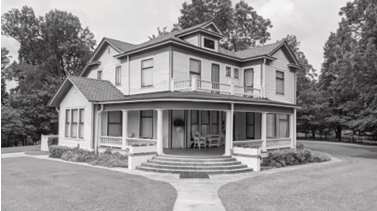
Photo courtesy of Damon Guinn.
Hosted annually since 2002 (as 2021 at- tendee Damon Guinn notes in his essay in this issue), the Summer Writer’s Retreat at the Hem- ingway-Pfeiffer Museum in Piggot, Arkansas, has attracted a wealth of talent for decades—both among participants and teachers. Recent past writers-in-residence have included Matt Gal- lagher, author of two novels and a collection of short fiction; Mary Miller, who has two novels and two short story-collections; Hugh Martin with three book credits; C.D. Albin, journal ed- itor, poet, and short story author; and Pat Carr with sixteen published books.
An interactive experience for aspiring and published writers alike, the retreat strives to be a place where the craft of writing is sharpened, cre- ativity is strengthened, and camaraderie and friendships are fostered. The teachers have dec- ades of experience among them as creative writ- ing instructors and workshop leaders.
This year’s writer-in-residence is Matthew Pitt, Associate Professor of Creative Writing at Texas Christian University. Pitt has worked in tel- evision and as an editor, has published two short- story collections, These Are Our Demands and Attention Please Now, with a third underway and a forthcoming novella, The Be-Everything Brothers.
Additional information about the retreat, held this year from June 19th to the 23rd, and a downloadable registration form can be found on the museum’s website at hemingway.astate.edu. As the site notes, “participants come from all backgrounds and experience levels.” Seize your chance to be mentored and work in a construc- tive and collaborative atmosphere in a beautiful, historic setting. Registration fee is $325.
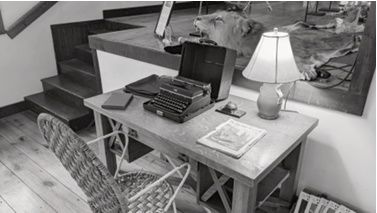
Photo courtesy of Damon Guinn.
Refuge
by Kenneth Gulotta
Roberta scraped her chair across the boards of the little back porch off the kitchen, moving closer to her coffee cup on the table. Back at the old house she would have had a nice ceramic ash- tray, something green and leaf-shaped, maybe, for the outdoors feel, just something small for her morning cigarette. But not here: no ashtray, be- cause no morning cigarette. That was one of the first things they put an end to when they moved her in here with them, her grandson Paulie and that wife of his, Robin. Paulie kept making jokes about her getting along with Robin because their names were so similar. Like three letters were enough for two grown women to talk about.
They had moved her to this place and sold her old house out from under her—sold it and used the money to buy the new wood paneling and carpets and plumbing and what-have-you to fix up their house. They did let her have the bigger bedroom, but she knew, just knew they were making plans for it after she died. She knew they were doing that—thinking about their To Do list for the day after.
Roberta picked up her coffee cup, took a sip, and winced: she had left it sitting there too long, and it wasn’t coffee anymore. It was whatever cof- fee turned into after it stopped being hot. Dead coffee, maybe.
The screen door yawned open, its spring pro- testing.
“Getting you some sun, Grandma?” Paulie asked.
“A tolerable amount,” Roberta said. “Not too much. People with sense step out in the morning when it’s easy.”
“I know, Grandma. That’s how you always liked to do.”
“Stay out in the hot sun too long, without a hat or nothing, and you’ll fall out. And you two, with your beach tans, you’re just crazy. Look like you’re farmers, but you don’t even grow any- thing.”
“Well, it’s just the style these days, I suppose. Anyway, I’m heading off to get boards for the windows. I get back, and put them up, and then we’ll be hitting the road.”
“Never had to evacuate from my house.”
“Yeah, but down this way, we’ve got to ske- daddle for anything category two or up.”
“Don’t know why you’d move down here, then.”
“You know why. You know. We’ve gone—for my work. I’ve got to be in New Orleans for work.”
“Oh, stores can be anywhere.”
“Stores can be. That’s true. But galleries can’t—they’ve got to be where people who buy art will be.”
“Art. Nobody painted it. They’re just camera pictures.”
“I’m going, Grandma. We’ll be leaving in two, three hours.”
The screen door hung for a moment, inched a bit, and then plunged, slamming against the jamb. Thumps sounded and faded as Paulie walked through rooms. The house took a breath as the front door opened and huffed some air back out as it slammed.
Then the screen door creaked, creeping open. Robin came slowly into view, pressing a hand against her lower back. She stepped a foot or two outside, holding the door open with her free hand.
“Grandma, I thought you were looking for- ward to this,” she said. “To spending some time with Carl, in his house, I mean.”
“I am looking forward to going to Carl’s house. But I can’t say it makes sense to have to pick up and leave your house every time it’s a threat of rain.”
“I just—I wish you would take it easier on Paul. About his work and all.”
“Missy, I’ve known him a lot longer than you, and it’ll be a cold day when I have to hold my breath around him. So you’ll just have to live with it. Just like I do with all the . . . improvements you’ve made around here.”
The screen door trembled in the sunlight.
“You better shut that,” Roberta said, “before you let all the skeeters in.”
“There aren’t—it’s—”
The girl shook her head and shuffled right back in, the screen door letting out a series of lit- tle creaks as it dipped slowly shut behind her.
Roberta turned her chair an inch or two to the left, away from the little table with her cold coffee. Across the street, at the house one corner over, a woman moved about on a high porch, bringing potted plants inside one by one. A sta- tion wagon stopped in front of the house, and a bald-headed man stepped out. He stood with one foot on the road and the other inside the still- running car.
“Miss Emily, how you doing?” he called.
The woman on the porch peered at the street under her hand. “Who’s that? Oh, Peter. I had a real fun time at that party.”
“Did you have a good time at the party? What are you up to?”
“I did. I had a real good time. I’m just getting ready for the hurricane.”
“You getting ready for the storm?”
Roberta levered herself up from her chair. “Good God,” she muttered as she limped to the door to go inside. Across the street, the woman was calling, “I am. I’m getting my plants in before the weather hits.”
“Going to stretch out a bit,” Roberta grunted as she passed Robin, who was sitting on the sofa watching the weather station.
She slid her right foot against the polished wood floor with each step to her bedroom, refus- ing to wince at the creaking and twinging of her right knee. Years back, when she was twenty-two, so . . . fifty-six years back, her son Jimmy, Paulie and Carl’s father, started screaming in the back yard like he was dying, and she ran to the back door and leapt down the steps and the knee just popped and crunched as she went down. It was never the same. After a time it strengthened enough that she didn’t have to limp, though it sometimes let out a single pop, like a knot of pinewood exploding in a bonfire, which her left knee never did. Now, though, she seemed to have crossed over some hill in the healing process, and her knee was returning to its former state: each day she limped a bit more; each day it took her a bit longer to make sure that her leg would sup- port her after she woke in the morning.
And after all that, Jimmy’s screaming had turned out to be part of some fit because he had buried some marbles and forgotten where. Play- ing treasure hunt and then crying over it.
She made her way to the bed and lay on her back. The morning sun fell through one of the bedroom windows in a cluster of slanted, defec- tive squares across the bottom half of her bed. Her knee lay under the patches of light; it warmed slowly as they crept across it.
She watched the ceiling for a while, and then she closed her eyes. The television mumbled about storm tracks and wind speeds through the closed bedroom door. A door slammed outside, and a few minutes later there were bangs and grinding on the other side of the house.
She breathed more slowly. She imagined the sunlight moving like molasses over her knee, dripping down the bed and across the floor. Then, with two muted, casual cracks, the joints of her leg seemed to release and let the blood flow through, bringing pinpricks to the sole of her foot.
The light disappeared with a thud. She opened her eyes and dimly saw the plywood ac- ross the window. The wood scuffed from side to side, and then the grinding, louder now, began again, as Paulie, outside, drove the screws to hold
“House looks the same,” she said to Carl as he closed the front door.
“Yeah, well, I haven’t been doing any remod- eling, like these two,” he said. He tugged on the doorknob as he twisted the deadbolt key. “How’s it coming over there, anyway?” he asked as he turned into the living room.
“Pretty much done,” Paulie said. “You’ll have to come down and see it soon.”
“Well, if I can get away. And it’d have to be during the daylight. I don’t like going down there at night. Just the other night in the news they were talking about those carjackings down there?”
“Come on, Carl, it’s safe. You know it is. Long as you lock your doors. It’s just like any other place—you just have to use your basic sense.”
“Well, I don’t know.” He sat in an easy chair next to the sofa; the vinyl cushions hissed.
“I wouldn’t bother coming right over, any- way,” Roberta snorted. “They always got some- thing else they want to do to that house—you’re liable to come and see it, and then it’ll just be dif- ferent a week later and you’ll have to come again.”
Robin put her hand on Paulie’s, lacing her fingers through his and digging them into the top of his leg.
“Y’all made good time,” Carl said. “I was sure it’d take you till midnight to get here.”
“It would have, but Paul knows all the alter- nate routes,” Robin said. “All the back roads and side streets and everything. From when he worked for the antique store.”
“Which makes a better living?” Carl asked. “Are you making more running that gallery than you did for the antique shop?”
“Usually, yes,” Paulie said. “It just depends on business. I was driving for the antique store, so I didn’t make much money, but it was always the same amount. At the gallery, my pay can go up and down depending on how many prints I sell and what kind of commission I’m getting and so forth.”
“It’s that old story—you can go for the steady money or you can take a risk and maybe get you a bigger payday.”
“What I don’t know,” Roberta said, “is how either of those places make any money. One place they’re just selling other people’s old junk. The other they’re selling snapshot pictures. I mean, I had a houseful of old furniture, and I can snap a Polaroid. Seems like I should be rich.”
They all stared at the spaces before them. Robin’s hand tightened slightly over Paulie’s.
“Anyway,” Carl said. “Let me get you folks settled in your places for the night.”
The power went out, and branches scrab- bled as the wind whipped through the trees, but otherwise the night seemed as quiet as any other.
“This far back from the city,” Carl said—he called the four-stoplight town six miles from his house a city—“a night like this can actually be kind of pleasant. The wind takes some of the heat off, and we’re far enough up from the creek we don’t have to worry about the water. As long as you stay out from under big tree limbs—which side of the shed did you park on?”
“This side,” Paulie said.
“Well, then, we’re all okay, then. All we got to do is wait for the power to come back on.”
So they settled into their various beds, lying on top of the sheets in the warmish but not un- bearable air—Carl had run the air conditioner at sixty for the last two hours before the power went out—and they all ended up sleeping through the night, waking to the clear skies and light breezes that follow hurricanes, as if the storms scrub the paths they lumber through.
“That didn’t seem like nothing at all,” Rob- erta said at the breakfast table. “Seems like we could’ve set still.”
“Up here is one thing,” Carl said. “Could’ve been a lot worse down there, down in that New Orleans bowl.”
“You got a radio?” Robin asked.
“Forgot to buy batteries,” Carl said.
“When we finish eating, I’ll go turn on the car radio,” Paulie said.
“What’s the hurry?” Paulie asked. “You’ve been saying for months you wanted to visit Carl.”
“Yeah, Grandma, you sick of me already?” Carl asked.
“I just don’t want us to overstay our wel- come, is all.”
“Anyway, it doesn’t make sense to load up yet,” Paulie said. “Let me listen to the radio and make sure the roads are open first.”
They chewed the pastries that Paulie had bought on the way out of the city the afternoon before—two jelly doughnuts for Roberta and chocolate croissants for everyone else. The kitchen door rattled as someone rapped on the other side of it.
“Tell whoever that is to knock softer,” Rob- erta said. “My heart pretty near stopped.”
Carl got up and peeked through the window over the sink. “It’s just Chick,” he said. “He didn’t mean nothing—that’s just how he knocks.” He went to the door and opened it. A roundish man with a brown beard stood on the other side.
“Y'all know about the road?” he asked.
“Which road?” Carl asked. “You mean our road to the big road?”
“Yep. Blocked. Trees’re in it—damn near the whole woods, looks like. Tornadoes, they saying, Bull and Pearl and them. We’re trapped. Every- body’s meeting up there where it starts, just a hundred feet or so up.”
Carl turned back to the table. “Paulie, you better come on with me so we can see what this old guy is talking about.”
Paulie got up and walked to the door.
“Have you heard anything about the rest of the roads?” he asked as he and Carl stepped out- side. “Back to New Orleans?”
“New Orleans is gone, man,” Chick said as Carl closed the door. As the three men walked away, his voice came faintly through the kitchen window. “They’re saying it’s completely under water, or washed away. Saying different things. No one’s going back, anyhow.”
Gravel crunched softly into silence. Roberta wiped some jelly from her lips. Robin looked at her and then looked away. She pressed a hand against her swollen stomach and shifted slightly in her chair.
“Man’s real name is Chick—that’s what he said, anyway,” Paulie said. “And get this—his best friend is named Bull.”
“Now that can’t be his real name,” Robin said.
“That I do not know. I didn’t ask him.”
Paulie was back at the kitchen table with Robin and Roberta, telling them about the people he’d met that morning, some of Carl’s neighbors who had gathered to talk about the blocked road. Carl was still out there with them.
“There’s more,” Paulie said. “These two guys have dogs—I mean, each one has a dog—and guess what they named their dogs.” He waited while Robin lifted an eyebrow, and then he chortled, “Bull and Chick!”
“Wait . . . they named their dogs with their own names?”
“Yep.” He swiped at the sweat on his fore- head, leaving a streak of dirt just below his hair- line. He got up and pulled a paper towel from the roll on the kitchen counter and mopped at his face. “Uhh,” he grunted, wadding the paper towel. He looked around, found the trashcan, and pitched the wet lump at it. Then he bent over the sink to open the kitchen window. “Cold air is all gone,” he said. “We may as well start opening these to get some breeze, at least.”
“Are you rhyming on purpose?” Robin asked.
“No. Was I? I’m worn out.” He sat back down at the table.
“So which dog belongs to who?” Robin asked. “Whom, I mean.”
“What?”
“I mean, did Bull name his dog Bull and Chick name his dog Chick, or did Bull name his dog Chick and Chick name his dog Bull?”
“I don’t know. It didn’t come up.”
“Because that seems like a big difference. Either they’re full of themselves or they truly are the best friends ever. I mean, maybe they’re
Paulie and Robin laughed.
“This is all so interesting,” Roberta said. “But what I want to know is what’s being done to clear the road.”
“Well, Grandma, we spent most of the morning digging, but we didn’t make much headway with crowbars and chainsaws.” He turned to Robin. “Chick, at one point, he had me use a crowbar as a lever to lift a tree and get a block under it, so could get at it with the chain- saw, and afterward the crowbar was bent.”
“So you just came on in while your brother stayed out there working?” Roberta sneered. “Just like always—old Carl sticks with the hard work while Paulie hightails it inside.”
Paulie turned and looked at her for a mo- ment. Then he said:
“Let me ask you something, Grandma. Why am I always Paulie, but he’s Carl? You know I want to be called Paul. Why isn’t Carl ever Car- lie?”
“Oh, you’ve always been Paulie,” she said. “And Carlie isn’t a man’s name, even. It’s no name at all!”
“What about Carly Simon?” Robin asked. “That’s someone named Carly.”
“A woman, though, right?”
“Yes.”
“So. So that’s why.”
“It doesn’t matter,” Paul said. “What matters is I want to be called Paul. I’ve been wanting to be called Paul since I was thirteen, but you’ve al- ways just refused. I would think you could just call me by my real name when that’s what I want.”
She didn’t speak.
“Anyway, Grandma, Carl isn’t still out there working. He and his friends are having beers on Chick’s porch, and I came back here instead to check on you two.” He turned again to Robin. “I told them there was no way we were digging our- selves out of here, not with the tools we’ve got. I started climbing through, and the fallen trees were so thick I couldn’t even make it. I just hope I didn’t get into any poison ivy or anything. But I bet I didn’t even make it a tenth of the way through. Who knows? I maybe did hear engines, though, just at one point. So I think the town, the municipal workers or whatever, must be dig- ging us out. The others say there’s no way the town would have anyone out here, down this back road, this quick, but, I don’t know, someone was moving stuff out there.”
“What about home?” Robin asked. Then, she said in a lower voice: “Was there any more about how bad it is? Like, word on which neigh- borhoods got it the worst?”
He shook his head. “They’re saying all kinds of things. I think we just have to wait until we can get out somewhere we can get some real news, some real information, before we let our- selves get worked up about anything.” He glanced over at Roberta, and then he looked back at Robin. “I didn’t feel much like hanging out with those guys for beers. One of them—young guy, too, this—started going on about”—he altered his voice, injecting a twang into it, and crooked the index and middle fingers of both his hands into mid-air quotation marks—“jigaboos in the city going around looting everybody’s houses.”
“Really?” Robin scoffed. “Psh.”
“Well, maybe they are!” Roberta glowered. “Maybe there are looters down there right now in that city, just doing whatever they want—wha- tever they’re always wanting to do.” She jabbed a finger at Paulie. “This is what you’ve done. You moved down into that city and you brung me with you. I would’ve been happy still in my own house, but you went and sold it away, and you used that money for your own place, and your own place probably just got washed away!”
“Enough!” Robin shouted, slapping the table. “Just stop it! Stop acting like we stole from you and forced you into something.” She shook her head. “You asked to move in with us. You begged us. And your house was barely standing. There were rats in the walls—they were rotting, the walls were rotting and the roof, the inspector said, the roof was about to collapse in four places.” She waved her hands above her head at
“I don’t have to just take getting yelled at,” Roberta said, shoving her chair back from the table. “Not from my grandson’s wife, I don’t!” She pressed down on the tabletop, hauling her- self up. “I’m going to find Carl and see what he has to say about the road getting cleared.”
She walked to the door, her knee ratcheting. She went out, leaving the door open behind her, and walked up the driveway. Her knee made less noise with each step; by the time she was on the dirt-and-gravel road, it was quiet and seemed to be back in some kind of working order.
She trudged around the bend in the road and came upon the wall of fallen trees. Chick had been right: it seemed like the whole forest was there, pressed all together in one clotted tan- gle. The strange thing was, the rest of the forest was still there. There was a forest’s worth of trees where the road had been, but they didn’t seem to have come from anywhere else in the forest— the standing trees looked just as thick as when they had driven past them the evening before.
She heard voices and laughter off to the right. She peered into the trees and bushes and saw another driveway going down from the dirt road. Carl's snorting laughter rose. The leaves seemed to shake with it. She could walk down that driveway, probably, and find him and his friends.
She looked around; there was a sawed-off sec- tion of log on the side of the road, standing up- right—someone had been using it as a stool, most likely. She trudged over to it and sat down.
She looked at the wall of fallen trees, won- dering what would happen. Who was right? Was that grumbling in the ground the township dig- ging them out, like Paulie (Paul) thought? Or were Carl’s friends right? Would they have to dig their way out on their own, over days, weeks, or months, living in the meantime like pioneers back in this sopping little valley, no electricity, catching fish and drinking creek water? Living worse than pioneers, probably, because she doubted any of them had any pioneer know-how. Is that what was going to happen? Was she going to die out here in circumstances more pathetic than those of an old pioneer woman?
The grumbling in the ground grew louder and became coughing and snarling in the air. Cracks and pops began echoing in the trees. The coughing settled into a roaring that rose and fell, again and again, until the branches at the edge of the wall of fallen trees trembled and parted. A log spun slowly backward, and a pair of black metal beams pushed through the opening, fol- lowed by a set of orange metal boxes.
Some sort of backhoe worked its way through the trees and pushed into the clear por- tion of the road. A boy with blond hair was driv- ing the machine. He couldn’t have been older than twelve or thirteen. He looked around and saw Roberta, and then he reached down and turned the machine off.
“Do you work for the town, young man?” she called to him.
“No, ma’am,” he responded. “My grandpa and my cousins and I are trying to dig as many people as we can out today. Lots of these dirt roads have got trees down, but this is the worst, seems like.” He thumped the machine’s side with his heel. “This here’s my grampa’s Kubota.” He glanced at her again, and then he twisted around, looking for other people. “Do you live back on this road, ma’am? I’m sorry, I guess I don’t rec- ognize you. Do you need help back to your house or something?”
“No,” she said. She bent forward to push up from the section of log, but then she let herself fall the few inches back onto it. It had been sawed unevenly, and a ridge near the edge dug through her dress, gnawing at the underside of her leg. “No,” she said again. “I don’t live back here. I don’t live anyplace at all.”
Delta Sources and Resources
Instead, I left the retreat with a sense of pur- pose. Impressed with the insight of my fellow writers and their confidence to examine mem- ories both beautiful and hideous. I want that. I don’t want to succumb to despair and cut my life short like Hemingway.
The devil might very well come calling again, but hopefully I’ll be too busy writing to pay him any attention.
Delta Sources and Resources
The Hemingway-Pfeiffer Summer Writer’s Retreat
Hemingway-Pfeiffer Museum and Educational Center
Piggott, Arkansas
by Marcus Charles Tribbett
Photo courtesy of Damon Guinn.
Hosted annually since 2002 (as 2021 at- tendee Damon Guinn notes in his essay in this issue), the Summer Writer’s Retreat at the Hem- ingway-Pfeiffer Museum in Piggot, Arkansas, has attracted a wealth of talent for decades—both among participants and teachers. Recent past writers-in-residence have included Matt Gal- lagher, author of two novels and a collection of short fiction; Mary Miller, who has two novels and two short story-collections; Hugh Martin with three book credits; C.D. Albin, journal ed- itor, poet, and short story author; and Pat Carr with sixteen published books.
An interactive experience for aspiring and published writers alike, the retreat strives to be a place where the craft of writing is sharpened, cre- ativity is strengthened, and camaraderie and friendships are fostered. The teachers have dec- ades of experience among them as creative writ- ing instructors and workshop leaders.
This year’s writer-in-residence is Matthew Pitt, Associate Professor of Creative Writing at Texas Christian University. Pitt has worked in tel- evision and as an editor, has published two short- story collections, These Are Our Demands and Attention Please Now, with a third underway and a forthcoming novella, The Be-Everything Brothers.
Additional information about the retreat, held this year from June 19th to the 23rd, and a downloadable registration form can be found on the museum’s website at hemingway.astate.edu. As the site notes, “participants come from all backgrounds and experience levels.” Seize your chance to be mentored and work in a construc- tive and collaborative atmosphere in a beautiful, historic setting. Registration fee is $325.
Photo courtesy of Damon Guinn.
We Lost Bill Harrison
by M J Melneck
The workshops began, and the first thing I learned from Bill was that there are only eight colors in the Crayola box, “And f*%$#ng ‘Burnt Sienna’ isn’t one of them,” he said one after- noon. I don’t remember who tried to use that color; I was just glad it wasn’t me. We were “al- lowed” two adjectives per fifty pages. Nouns and verbs, verbs and nouns. “Understatement is the particularization of art.” The workshops went on; we newbies took and taught Faulkner Grammar, staying only a couple of pages ahead of the stu- dents. At a gathering one night Paul Williams’s wife complained to Bill that Paul wanted to write fifteen hours a week. Bill looked her in the eye and said, “Dina, I erase fifteen hours a week.”
My assistantship paid $144 a month, and September’s $75 rent degraded to my one-fourth part of a cinderblock hovel down the hill from the student union—$30. I was miserable, took In- completes, and drove back to Montana without looking in the rear-view mirror because I knew too well what I’d left behind.
Bill published Lessons in Paradise in ’71, the Rollerball book of stories in ’75, and in the summer of ’76 I got married while Bill published Africana. The first paragraphs of that novel are still, to me, one of the greatest “Oh, shit, here it
Photograph courtesy of the author.
comes” openings I’ve ever known. I fell in love with Val too, but of course she was too beautiful for ordinary men. I had a finished manuscript of my own Old Music, though it would take three agents and twenty plus years to get it published. I sent Bill fifty or so pages and he invited Pat and me to come back to finish my MFA. Hello, Fay- etteville, 1978. Make up the Incompletes, teach, write, adopt three Special Needs kids, and watch Bill put out Savannah Blue, then Burton and Speke. In the midst of that came A Shining Season, for which he won a prize. I took the MFA in two years, got a three-year no-tenure teaching gig, then went to work for President Martin as Direc- tor of University Information. Bill was writing Three Hunters.
I did this; Bill published The Buddha in Mal- ibu. I did that; Bill gave us The Blood Latitudes. I
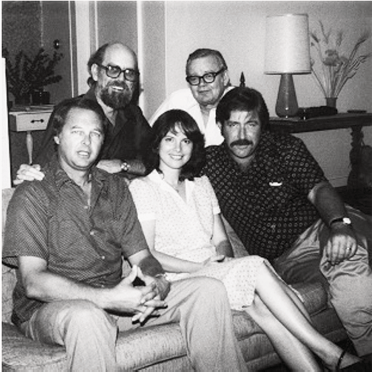
had a “necktie life.” Bill gave us Texas Heat, and Black August, the Rollerball and Mountains of the Moon scripts.
You’ll notice that the constant in these past decades—isn’t me. It’s Bill Harrison. The writer. The guy who got it done. Again and again. He told us one day, in a workshop that hadn’t gone all that well, “You people don’t want to write— you want to have written.” The gap is something like the distance between the near side of this Universe, and the far side of another one. Bill knew the gap like none of us could, then or per- haps now.
Bill made me—makes me—a better writer, per- haps more by inspiration than by instruction. And if there’s a better angel somewhere inside me, Bill still makes me trust it and leaves me a great deal to strive toward. Our visits grew farther apart, as did our phone calls, but I’ve known no stronger bond. I lost it the day he told me he was “losing” nouns.
Bill Harrison changed me, quite for the better. And if he hasn’t changed you, you aren’t paying attention. Bill’s beacon will shine for me all of my own days, and if I can pay it forward as he did so beautifully, long past my time. Because of Bill Harrison I am blessed far beyond my de- serving.
Rest, my friend—you will always be much loved.
Photograph courtesy of the Pryor Center for Arkan- sas Oral and Visual History, University of Arkansas.
Abecedarian for a Hometown Tornado
by Andrew Alexander Mobbs
Cabot, Arkansas, March 29, 1976, 3:18 PM
Antagonized by charcoal skies, townsfolk
bowed their heads in prayer, beelined for Polaroid
cameras to document southern springtime
destruction bleeding out in the electric air.
Elementary schoolkids curled under wooden desks,
fearful of the sky tearing its seams, sirens
going off at the drop of a drugstore dime,
hallways left hollow in metallic hiss and creak.
I imagine my parents, twenty-something and
just out of college, exchange a fleeting
kiss goodbye before dad got in his gold Nova,
lead foot gunning for his folks’ during
midday darkness, drifting in brick-splitting wind.
Not much back then but your family farms,
open land to gobble and shred, those five
poor souls laid flat beneath white sheets in the
quiet aftermath of pine sap sizzling.
Remember, just weeks before, several
science teachers at the local schools had
taught lessons on twisters—how spiraling
updrafts and downdrafts can waltz inside
violent velocities of daggered rain. How
when the storm cellars finally open up to a
xanthic haze of debris, each living throat
yells out their drawled grief, a soft
zephyr spreads the scent of honeysuckle.
“A Tainted House of Prayer”: Artist V. L. Cox on White Supremacy, Southern Culture, and Her Persisting Love of the Delta
by Guy Lancaster
The interview occurred over a shared electronic document during November and December 2022 and has been lightly edited, with occasional editorial inser- tions placed in brackets.
Guy Lancaster: I grew up in eastern Arkan-
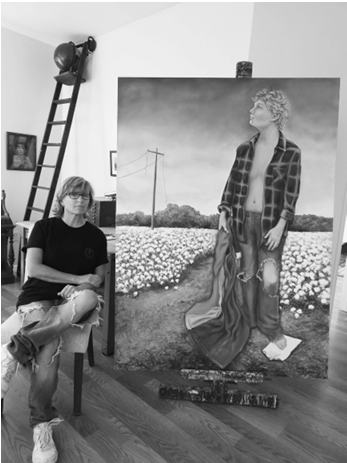
Photograph courtesy of V.L. Cox
sas, amid the flat land of the Delta, and as a con- sequence I was always fascinated by places that possessed “actual geography,” hills and whatnot. But you grew up in the hilly country around Ar- kadelphia. What attraction does the Delta have for you?
V. L. Cox: I was briefly introduced to the Delta when I moved to Memphis, Tennessee in the early ’80s to sow the wild oats of my youth. I
It was during these numerous explorations that I would stop and talk to the locals if they looked interesting. One guy was named Moon- pie, and after visiting with him about his life, he politely asked if I would help him cut a tree down on his property if I was going to stick around long enough. Another was a store owner who told me gruffly an inch from my face to “get out of town before sunset or [you] could be knocked in the head by the locals” (I backed out of that place slowly towards the door). I always kept my eyes out for the Arts though, which I feel has been shunned in the Arkansas Delta and not ac- knowledged or explored fully due to its rural lo- cation and socioeconomic status.
On my last trip, I stopped to photograph an old church that caught my eye and, while looking down, saw a molted snakeskin laying at my feet. I picked it up, photographed it and found it rep-
Photograph courtesy of V.L. Cox
resentational of my journey. The Delta is a cal- ling. And if you answer it, you shed your outer self and become something entirely different. You never leave the same person after experienc- ing it. I still have that photo. It’s framed in my studio to this day.
GL: What does the Delta do for you or to you as an artist? Do you find that the art you pro- duce in response to experiencing the Delta is of a different quality or theme than your other work?
VLC: The Delta has been a life changing ex- perience for me, yet I think it goes hand in hand as far as my Civil Rights and Social Justice work goes. The secrets and the stories that have longed to be told are finally beginning to surface in the Delta. The Art World, however, can be full of it- self at times with pretentious economic exclu- sion, closed-door academic exclusion, and retail
GL: There’s this big region in America we call “the South,” that draws together Delta flat- lands, Ozark and Appalachian uplands, coastal communities, rivertowns, the staggering wealth of Miami and Atlanta, and the poverty of so many other places. Do you see anything that ac- tually unifies all of this? And if there is some re- ality that unifies this Southern experience, does it then still make sense to call the Delta, as it has been popularly dubbed, “the most Southern place on earth”?
VLC: Yes. Food and Art. Those two things alone can bring about unity and world peace. Why do you think one of the first things authori- tarian governments try to crush is the Arts? It’s because they know the extent of its true power. The Arts are a different, yet universal language. One that cuts through the constant onslaught of blather, documents historical events and visually crosses religious, political, and socioeconomic boundaries with ease. Its unification and educa- tional qualities are embraced yet feared by many, and in all my travels I still stand by my belief that some of the most talented people I have ever known and some of the best art I have ever seen, are from the South. And I have seen a lot of art. The South is where the magical, cherished oral history of storytelling evolves to a different level and creatively begins to take another form.
The food of the South is known worldwide, and God bless ’em, Brooklyn doesn’t know real BBQ to save their life, but they’re trying. I have also known of divorce proceedings being consid- ered in the South over someone putting a cast iron skillet in the dishwasher, and I would wager that crime runs the full social economic spec- trum. Art and food, especially in the South, are what I consider the most basic, cherished tools of survival and the secret to knowledge, unity, and peace. The history of the rich, fertile land, the people from old indigenous communities to now, the deadly, hidden secrets of the past that have long needed to surface so they can begin to heal, the mysterious beauty of the swamps, the life-giving rivers, the incredible home-grown food, the art, the relentless blistering heat, the beauti- ful sunsets and the sounds of the cicada at dusk singing their ancestral song as they welcome the
GL: Well, you’ll have to leave the Delta to find a hill to die on!
VLC: Ha!
GL: Thinking about the Delta as the most southern place on earth brings to mind your work “Delta Mercantile,” which strikes me as one of the most southern artworks you’ve done. If you’ve driven through the Delta, you’ve seen those long-abandoned places covered over in rusted signs. Where did you get the materials for this? It looks like you’ve converted some old shutters into the walls.
VLC: “Delta Mercantile” is created from an original old copula salvaged from the top of an old structure that had been located somewhere in the Delta. The rest are pieces I’ve collected on my travels and explorations through the South. I try to use original materials with provenance when I can find them, but these pieces are be- coming as scarce as hen’s teeth as many structures of the Delta fall into disrepair or decay.
I’ve always had a special place in my heart for those old mercantile stores. I have driven by nu- merous skeletal remains of them in the Delta and remember the ones I frequented fondly in the hills as a child. The creaking, wooden floors, the smell of smoked bacon and lunchmeat being trimmed and sliced in the back, the cast-iron wood burning stove with mismatched chairs in the corner, the obligatory gallon jar of pickled eggs (that I never saw anyone eat) that sat not far from the cash register or the butcher counter and the rack of comic books that changed my life and turned me into a creative, fanatical book collec- tor for over 40 years. The old Vacation Bible School bus I found myself on every summer, de- spite my pleas and protests, would careen on two wheels to a stop in front of Thompson’s mercan- tile store on Highway 8, announcing our arrival in a hot cloud of dust. The sweltering bus was
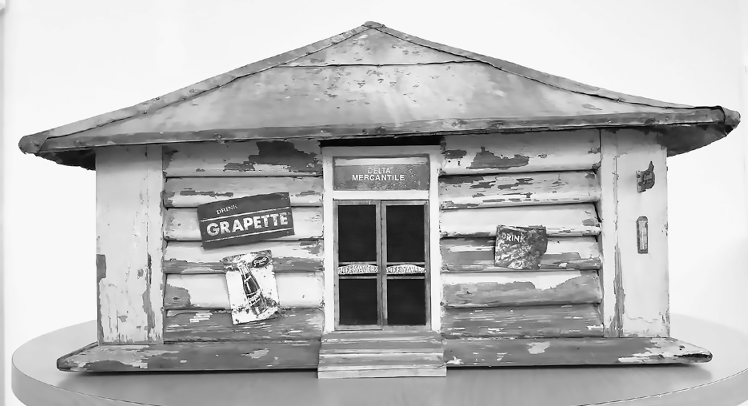
Photograph courtesy of V.L. Cox
GL: There seems to be some conscious irony whereby we think of these mercantiles as places that were so intensely local, and yet their local importance depended greatly upon their offering of products from so far away.
VLC: That’s true. From food variety, to fancy bolts of fabric, pantyhose and homemaker supplies to farming supplies, pocket knives and hardware. Loyalty came with variety. My father was a staunch Case Knife man, which originated in 1889 and was sold out of the back of a wagon in upstate New York yet was found in every mer- cantile store throughout the South. My father loved those “northern” knives so much, he was buried with one in his pocket in a southern rural family cemetery.
The importance of these old stores had many different levels. They also served and took care of the most vulnerable in their community. One of my main memories after my grandfather passed, was when my grandmother and I went to Welch’s Grocery in Arkadelphia in the late ’60s early ’70s. She would always hand Mr. Welch her list, and he would help gather her sundries then carry them to the car. This day, however, was dif- ferent. It was during desegregation, and his store had a direct view to the courthouse in downtown Arkadelphia. As we walked through the squeak-
Photograph courtesy of V.L. Cox
ing wooden door, hearing the little tinkling of the bell announcing our arrival, Mr. Welch met us with a look of concern on his face. He took my grandmother’s list, put his hand on her shoulder and quietly told her, “Now Mrs. Hard- man, you take that grandbaby, turn right around and go on home. It’s not safe here today. I’ll de- liver your groceries here shortly.” As we got back in the car and were leaving, I glanced across the road towards the courthouse and saw a surging white crowd in turmoil sprinkled with men in white helmets. I didn’t realize the national impli- cations of desegregation due to my youth at the time, but my hometown wasn’t immune to it.
GL: You’ve got two “self-portraits” that seem to be having a conversation with one another. The first, “Reflection,” is mostly taken up with a wardrobe slightly open, showing a Confederate flag hanging up inside, with the self-portrait com-
VLC: Those are two of the most personal pieces I have ever painted. “Reflection” is an ac- tual moment where I caught my reflection in the mirror of an old Civil War–era wardrobe I had acquired from Tennessee. I had been storing flags inside of it for some of my future art projects (Pride, American, and Confederate), and one af- ternoon I heard the creaking of the wardrobe door open behind me. As I turned around, I saw that my cat had jumped on top of the wardrobe
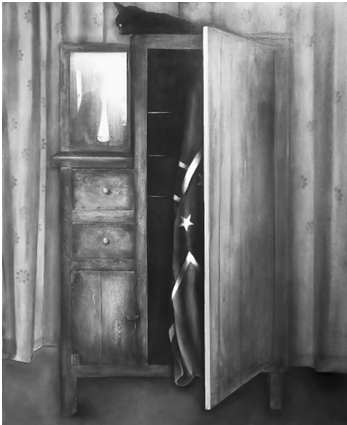
Photograph courtesy of V.L. Cox
and jarred the door open, exposing the lone Confederate flag, which was ominously peeking out from the shadows. It sent a shiver up my spine.
I am a bonafide Southerner, but the South has not been truthful about its evil past. I was taught in public school that the war was fought over “States Rights” (bottom line, the right to own other men), Northern Aggressors or “Yan- kees” coming down to take our rich farmlands and resources (it’s easy to flourish financially when you have free labor), and higher taxes on our cotton. I was also taught that slaves had de- cent, stable lives on plantations and floundered so much after being given their freedom, they were given 40 acres and a mule by the U.S. gov- ernment. But as we all know, during Reconstruc- tion almost all land allocated during the war was restored to its pre-war white owners, yet I’ve heard this bitterly mentioned by disgruntled white, male southerners my entire life, of “why they can’t get ahead?” I was never taught about the brutal, deadly depths of slavery, didn’t learn about the Elaine Massacre or Black Wall Street and the Tulsa Race Riots until I was in my 50s, and still to this day often hear the n-word fall out of ignorant mouths in south Arkansas more often than a prayer. This brief visual moment of reality when that wardrobe door opened was a stark reminder that no matter how much you try to educate yourself and pull yourself out of the ignorance, myths, and whitewashed history that you were exposed to your entire life, parts of that racist, close-minded environment will always re- main in your background trying to overpower you and claim you as its own. The struggle at family reunions, the painful conversations with your elders or the youth in your family due to perpetuated disinformation of hatred and dis- crimination, believing in the preservation of “heritage” and “southern pride” in a twisted form of religious white supremacy, that never goes away. Acknowledging that ominous and ever-present struggle, however, is part of what has
As far as “Escape Velocity” goes, I am a firm believer that there are only two emotions in life. Fear and Love. Every other emotion stems off of these. I painted this piece after leaving the South. The cotton field, a worn, vast, battleground of in- justice, shows snapped antiquated telephone wires and a twisted telephone pole in the form of a cross representing the isolating lines of truth and communication in the Bible Belt that have been intentionally severed and broken over gen- erations never meaning to be repaired. The self- portrait conveys strength, exhaustion, the raw vulnerability of feeling you have nothing left to lose (hence the open flannel shirt with no bra or undershirt), while firmly grasping and refusing to drop the colorful, beautiful, symbol in my hand of who I truly am. Gazing North, through ever-present tumultuous southern storm clouds, with hope and determination to survive and start a new life.
The historical cruelty crafted during the 2021 Arkansas Legislative Session [with the pas- sage of anti-transgender legislation], indistin- guishable from a backwoods snake-handling Tent Revival, influenced this painting and my deci- sion to finally leave the home I’ve always known. Arkansas lost all the progress and anti-discrim- inatory ground that they gained in 2015 [when previous such legislation was voted down], and the timing during a deadly global pandemic was wickedly plotted and executed. Civil Rights were ripped away from decent, hard-working Ameri- can citizens and modern-day Jim Crow bigotry rammed through by laughing lawmakers as Ar- kansans struggled with limited supply chains, ac- cess to food, medicine, and basic staples, not knowing which loved one would be the next taken by the mysterious angel of death to suffo- cate and die. This painting, despite political at- tempts to once again whitewash history, will continue to tell a Southern story of life, pain, hope, resilience, diversity, survival and the truth.
GL: Your mention of a snake-handling tent revival provides a nice segway to talk about the next piece, “Tent Revival.” You’ve written online that it was inspired by a picture of a revival held by the Ku Klux Klan and that it is crafted from the robe of a Grand Wizard. I spent some time pondering the piece and wondering why you used a real Klansman’s robe to make it when you could have used anything. And then I realized that, though the art piece is empty of people, should we imagine an actual revival taking place there, then all those Christians would literally be “under the hood.” It speaks to how they are not only implicated in these evils but being revived spiritually in the context of evil. It speaks to that Protestant doctrine of total depravity, how every person born cannot help but to act in service to sin without the grace of God, but here the taber- nacle of God’s grace is constructed out of a relic of that sin. And I remember, too, how a professor of mine in Japan remarked that while snow in Western cultures is often viewed as a symbol of purity, in Buddhist traditions a white blanket of snow serves the symbolic function of that which obscures sin, smooths out the contours of sin so that you can’t see it anymore. The more I thought about it, the more there was going on in this piece.
VLC: There is a lot going on in this piece, yet it’s a pretty simple message. The concept orig- inated one day after talking on the phone to an antique dealer out of Atlanta, Georgia. I had no- ticed on his website a tiny old vintage photo- graph of what I thought appeared to be a Revival Tent with a “Knights of the Ku Klux Klan” sign in front of it. Now, I have gone to (or was dragged to) plenty of church revivals in my youth under
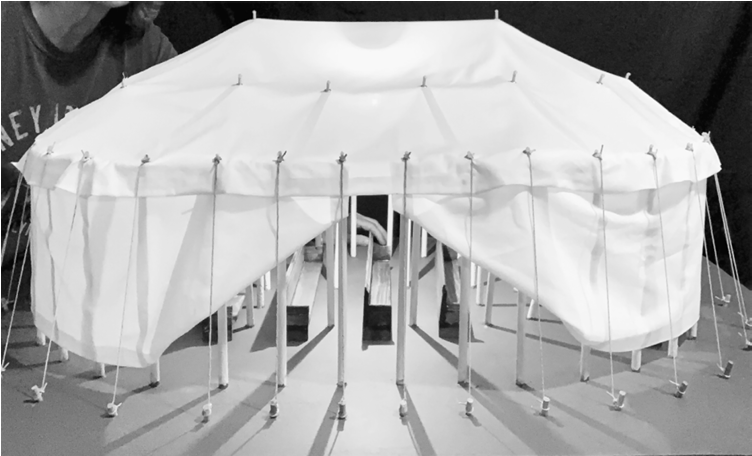
Photograph courtesy of V.L. Cox
This Revival Tent is made out of an original Cyclops Klan robe that belonged to Roy Frank- houser Jr. in Pennsylvania. Boy, he was some- thing else. [Frankhouser was a Grand Dragon of the Ku Klux Klan, a member of the American Nazi Party, and later a leader in the Christian Identity movement.] And Roy had a following.
After reading the history of this robe along with historical and current events, I realize that a large population of Christians have, and con- tinue, to congregate “under the hood.” I’ve done extensive research of the history of the Klan, drove over 2,000 miles cross country a few years ago to be the first to see and read rare discovered doctrine and minutes of secret klavern meetings from 1922 and was shocked to see the blatant similarities from the past to today. “Are you a gen- tile or Jew?” “Were your parents born in the United States of America?” “What is your reli- gious faith?” were some of the initiation ques- tions asked. Documented images from the Library of Congress show Ku Klux Klan members marching in the street by the thousands only two generations ago under the banners “One God, One Country, One Flag,” “Jesus Saves,” or “For God, One Country and Each Other.” (Sound familiar?) As a business owner in the past, you were expected to be a member of the Klan, and if you weren’t or you rejected their doctrine, you were shunned politically, econom- ically and socially. It was like a bastardized ver- sion of a freak Chamber of Commerce of sorts.
“Being revived spiritually in the context of evil” is what we are seeing take place today. I never realized until now the depths that insecure people will go to to achieve a desperate sense of belonging and how spiritually fragile, scared, and lost people are to where they will instantly sell their soul, family and friends out to embrace the first so called religious “Savior” that walks through the door, even though the Bible specifi- cally warns us over and over against this.
I use a lot of historical relics in my work with this being constructed into a deadly symbol of a tainted house of prayer, cloaking the congrega- tion in white supremacy deceit while promising spiritual superiority and a false hope of salvation. And the primitive wooden church pews under the cloak of white supremacy are visually worn for a reason. They continue to be heavily used. White Supremacy, ferociously claiming the white pages of the Bible as its own, brutally twists and moves the black letters around at will but the last time I checked, and I’m pretty sure I’m accurate on this, the robe Jesus wore didn’t come with a hood.
GL: Let’s wrap up with “No Vacancy.” It’s made in large part from the steeple of a Delta church, but I’ll be honest—after thinking about “Tent Revival,” I can’t see that white cone shape as anything but a Klansman’s hood. Is that some- what intentional?
VLC: Good catch. That’s exactly what it’s supposed to represent. I try not to be too literal in my creations, but I don’t think a lot of people grasped that visual. “No Vacancy” is created from an old 9-foot-tall church steeple from the Delta after reading the story the Arkansas Times did on a young man in northern Arkansas who received a letter in the mail from his church telling him he was immediately being removed from their membership records because he was gay, and then another story about a man who had to ac- tually move his deceased partner’s grave due to the threats in Baxter County. The worker for the monument company who was moving the tomb- stone was even approached and threatened by a man with a Bowie knife in a Wal-Mart parking lot, who asked “why he had that faggot’s head- stone in the back of the truck.”
The neon letters on the handmade cross ominously flicker off and on like a cheap, sketchy Motel sign on the side of the road, leaving the viewer wondering if there are any vacancies or not. And if there are? Is that really a place that you would feel clean and safe and where you would spend your time and money?
While creating “No Vacancy,” I was reminisc- ing upon a piece I did several years ago called “30 Pieces of Silver,” which was based on an experi- ence I had after being invited to visit a small rural country church in South Arkansas. I had briefly met and befriended a few of the younger members that attended there so I agreed to join them that next Sunday. Everything was going pretty much the way it normally does when I visit church, I was lip syncing through a few of the old hymns since I can’t carry a tune in a bucket, squirming while trying to get comfortable on the hard wooden pew since us Presbyterians are used to a little bit of cushion and padding, and won- dering where to politely position myself as a guest in the potluck line afterwards.
As we finished “Onward Christian Soldiers Marching Off To War” (which I always found to be an odd song for a church), the old white haired preacher in a shaky, shrill voice stood up behind the podium and began to preach. He hadn’t been three minutes into his sermon be- fore all of a sudden, he lunged forward on the
White Supremacy and bigotry that reside under steeples know no bounds. I don’t think this is what Christ had in mind when he told people to “love thy neighbor.”
GL: Attached to this steeple is a hotel sign you’ve fashioned into a cross, with the words “No Vacancy” running the horizontal, intersected by the vertical of “Acceptance.” And I can’t help thinking how that “no vacancy” both has and hasn’t been the rule in the Delta in a long time. You probably got this church steeple because the church itself was vacant. Chances are, whatever town was there or nearest had plenty of va-
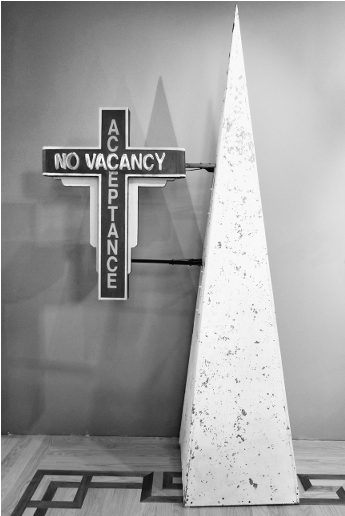
Photograph courtesy of V.L. Cox
cancies. And while a good part of this vacancy is predicated upon economic factors, there’s more than enough also thanks to the very attitude of “no vacancy,” no room for people who are differ- ent. The “no vacancy” axis is like the flat of the Delta horizon, but it’s the “acceptance” axis that rises above.
VLC: I agree with this analogy. It’s not just the Delta though. Churches everywhere are strug- gling with numbers. That is, except for the reli- gious-political Mega churches who fleece their congregation to the tune of private jets, Man- sions, and Ferraris in exchange for smooth-talk- ing comradery and false superiority with “please vote for my tax break” sermons.
A little background: I am an ordained Pres- byterian Elder who has spent most of my life in a pew. Calling out greed, hypocrisy, and question-
The world changes. Progress happens. We learn and become more intelligent, Economic challenges come and go, leaving the past behind while issuing a new day of efficiency, new tech- nology, and hope. Being defiant and obstinate to “outsiders” or any type of progress, especially dur- ing extreme economic, climate, and environmen- tal changes in these Delta River towns and farming communities, will take a heavy toll. Water is literally drying up in some river areas due to heat or geographically rising in others due to melting polar ice caps, drastically impacting populated shorelines and economies. If not ad- dressed quickly, the reluctance towards diversity and change will leave endless communities be- hind, churches, and businesses abandoned and continue to create poverty and a sparse, mi- gratory population.
GL: Much of your art is constructed from the found objects of the Delta’s past. But do you think much about the future of the Delta? If so, how does that look to you?
VLC: I think about it all the time. I’m a vi- sionary. I see the value the Delta still has. I also know as I mentioned above, that with the scarcity of water from California through the panhandle and the Midwest breadbasket predicted to shift due to environmental change, the Delta could play a major role in future food production with education and the implantation of new technol- ogy, new crops, unification and modern distribu- tion and management despite changing water levels and flood zones. I may be naive, but with New Orleans surviving as long as they have below sea level (at least for now) with the right tools and structural ingenuity, I believe the Delta can not only survive but thrive.
These changes do not come cheap, however, and electing politicians who lazily do the back- float in hard earned American tax dollars, while arrogantly poking their fingers toward others, in- tentionally stirring the dangerous division of an- tiquated, time-consuming culture wars, has not helped the Delta with growth. Because the truth is they really don’t care. Stirring antiquated divi- sion is easy, lucrative work, but only for them. They know they are going to be just fine with all their political perks, bloated contributions, family privilege to skirt deadly discriminatory state laws if needed, and could not truly care less about the backbone of their working community, the hardworking poor or their minority neigh- bors struggling down the road.
Have you seen the billions of dollars spent on political campaigns alone? Can you imagine even half of that hard-earned contribution money that politicians literally beg you for being donated back into struggling communities in- stead? Real change will begin when the people put vengeful, media-driven, sport voting aside
Change will happen when we hold these re- ligious community anchors accountable when they are given the opportunity to welcome new residents from different backgrounds and tal- ented skillsets bringing fresh ideas and business into their community. Communities will flour- ish by encouraging these diverse communities to work together for a common goal of success and growth for the entire region instead of being sup- pressed and played like pawns on an antiquated chess board for cruel political folly and selfish fi- nancial and political gain.
I believe the Delta, due to its rich culture, hard-working people, and fertile resources can be one of the most influential places in the country if not the world if allowed, but only when people who have been intentionally misguided to be angry and fearful of change are encouraged to open their hearts and minds towards new people, fresh ideas, and new beginnings. Because as we all know historically, progress and change are in- evitable and we only have two choices: You either learn, adapt, become a part of it, and thrive, or you shut the world out, become angry and bitter and left behind.
If the rigid religious and political obstinance which is targeted and intentional, wary of any- thing new due to fear of losing control, con- tinues, then the rich, beautiful Delta will eventually become a vast ghost town with aban- doned buildings and empty communities. We see this with our own eyes as we drive down the Delta back roads as a hot, life-giving sun sets over what once were fertile crops and communities. Empty, dilapidated buildings, hand-painted wooden crosses, some with angry, judgmental messages, sprinkle the landscape, complimenting arrogant political billboards that continue to spew a message of fear, division and hatred. That transition, if not reversed, is already underway.
excavation
magic doesn’t need to be defined, play
doesn’t need a purpose, you don’t even
know what’s real
in the sunlight, the trees shimmering in the
wind, that first physical warmth of spring, i
hope for everything
i hear robins, the distant weed whackers,
and the children as they build a new
world in the forest
slate-brown bark, new green leaves, far off
the sun lighting along the edge of your body,
a line of light enclosing you, like you’re
traced by liquid magic
it’s like we’re here, but not. sunlines reminding
me of illusion, of transference. where would i
go, but here?
what would i dig down to, flee towards? i
like it here, just fine. if only i was not too
tired to enjoy
if only i could pause, sleep a year, then come
back to today. you’re so startlingly beautiful. unique
in your own way
no, i’d go nowhere but here, over and again,
once more
excavation, digging into the dirt. whatever
you are, you are your own hope. time is
lost in you
whatever this is, childhood, a
moment, i wish we could stay here
forever