I left Missoula and drove into Fayetteville on
Labor Day weekend, 1969, in a 1956 Ford Crown
Victoria that I’d bought from Jim Crumley for
$325 that I didn’t have. Pretty much everything
I owned fit in the car, including my wide carriage
Olympia SM-9, a wad of bad poetry and a couple
of mediocre short stories. I had that, and a dog
(Spanky Benchmark) in Montana. Bill had Mer-
lee, three kids, two golden retrievers, The Theolo-
gian and In a Wild Sanctuary.
The workshops began, and the first thing I
learned from Bill was that there are only eight
colors in the Crayola box, “And f*%$#ng ‘Burnt
Sienna’ isn’t one of them,” he said one after-
noon. I don’t remember who tried to use that
color; I was just glad it wasn’t me. We were “al-
lowed” two adjectives per fifty pages. Nouns and
verbs, verbs and nouns. “Understatement is the
particularization of art.” The workshops went on;
we newbies took and taught Faulkner Grammar,
staying only a couple of pages ahead of the stu-
dents. At a gathering one night Paul Williams’s
wife complained to Bill that Paul wanted to write
fifteen hours a week. Bill looked her in the eye
and said, “Dina, I erase fifteen hours a week.”
My assistantship paid $144 a month, and
September’s $75 rent degraded to my one-fourth
part of a cinderblock hovel down the hill from
the student union—$30. I was miserable, took In-
completes, and drove back to Montana without
looking in the rear-view mirror because I knew
too well what I’d left behind.
Bill published Lessons in Paradise in ’71, the
Rollerball book of stories in ’75, and in the
summer of ’76 I got married while Bill published
Africana. The first paragraphs of that novel are
still, to me, one of the greatest “Oh, shit, here it
[](https://kb.astate.edu/uploads/images/gallery/2026-08/image-1787062554702.png)
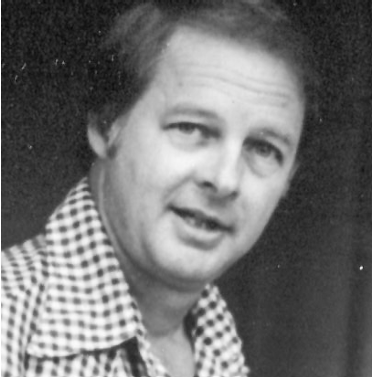
Bill Harrison.
Photograph courtesy of the author.
comes” openings I’ve ever known. I fell in love
with Val too, but of course she was too beautiful
for ordinary men. I had a finished manuscript of
my own Old Music, though it would take three
agents and twenty plus years to get it published.
I sent Bill fifty or so pages and he invited Pat and
me to come back to finish my MFA. Hello, Fay-
etteville, 1978. Make up the Incompletes, teach,
write, adopt three Special Needs kids, and watch
Bill put out Savannah Blue, then Burton and Speke.
In the midst of that came A Shining Season, for
which he won a prize. I took the MFA in two
years, got a three-year no-tenure teaching gig,
then went to work for President Martin as Direc-
tor of University Information. Bill was writing
Three Hunters.
I did this; Bill published The Buddha in Mal-
ibu. I did that; Bill gave us The Blood Latitudes. I
[](https://kb.astate.edu/uploads/images/gallery/2026-08/image-1787063102734.png)
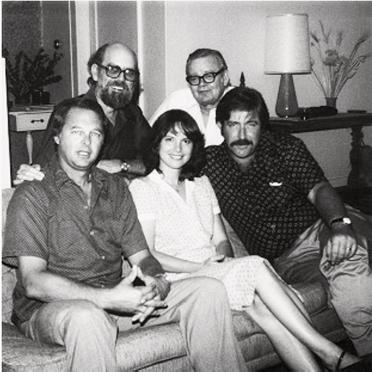
Members of the University of Arkansas Creative Writing
program: (front row) Bill Harrison, Carolyn Forche, and
Jim Whitehead; (back row) Miller Williams and John
Clellon Holmes.
Photograph courtesy of the Pryor Center for Arkansas
Oral and Visual History, University of Arkansas.
had a “necktie life.” Bill gave us Texas Heat, and
Black August, the Rollerball and Mountains of the
Moon scripts.
You’ll notice that the constant in these past
decades—isn’t me. It’s Bill Harrison. The writer.
The guy who got it done. Again and again. He
told us one day, in a workshop that hadn’t gone
all that well, “You people don’t want to write—
you want to have written.” The gap is something
like the distance between the near side of this
Universe, and the far side of another one. Bill
knew the gap like none of us could, then or per-
haps now.
Bill made me—makes me—a better writer, per-
haps more by inspiration than by instruction.
And if there’s a better angel somewhere inside
me, Bill still makes me trust it and leaves me a
great deal to strive toward. Our visits grew farther
apart, as did our phone calls, but I’ve known no
stronger bond. I lost it the day he told me he was
“losing” nouns.
Bill Harrison changed me, quite for the
better. And if he hasn’t changed you, you aren’t
paying attention. Bill’s beacon will shine for me
all of my own days, and if I can pay it forward as
he did so beautifully, long past my time. Because
of Bill Harrison I am blessed far beyond my de-
serving.
Rest, my friend—you will always be much
loved.
[](https://kb.astate.edu/uploads/images/gallery/2026-08/image-1787063354671.png)
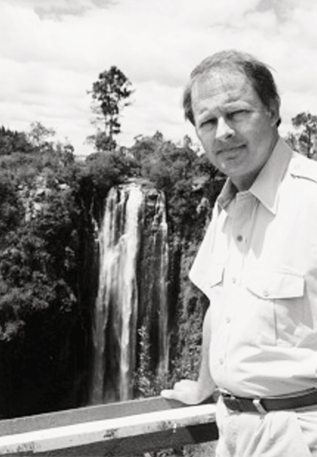
Bill Harrison in Africa
Photograph courtesy of the Pryor Center for Arkan-
sas Oral and Visual History, University of Arkansas.