Volume 55, Issue #3 (December 2024)
- Table of Contents
- The California Story
- Aftermath
- Lucky
- The Communion
- Carey
- Delta Sources and Resources
- The Cali Story 2.0
- Reviews
Table of Contents
Arkansas Review: A Journal of Delta Studies
(formerly Kansas Quarterly)
Arkansas Review, Vol. 55, No. 3 (December 2024)
The California Story (fiction) ...................................................... 163
by Mary Troy
The Big Piney (poetry) ............................................................ 172
by Darren Morris
A Brief Autumn Hunt (fiction) .................................................... 174
by Brad Cobb
Aftermath (poetry) ............................................................... 178
by Michele Parker Randall
The Understudy (fiction) ......................................................... 179
by Ian Woollen
Star Dimmed: A Boomer Elegy (or where the Whiteness went) (poetry) ......... 184
by LC Gutierrez
Envisioning a Storyworld at the Crowley’s Ridge Raceway (photo essay) ....... 186
by Gregory Hansen
Four Poems (poetry) .............................................................. 206
Unnaming the River
Country Music
Bass Rising at Dusk
Worm-Digging, Early Autumn
by Jordan Escobar
Lucky (creative non-fiction) ..................................................... 209
by Stephanie Vanderslice
Female Mayfly of the Delta (poetry) ............................................. 213
by Farah Art Griffin
The Communion (poetry) .......................................................... 214
by Floyd Collins
Carey (fiction) ................................................................ 216
by Mary McAlister Randlett
Two Poems (poetry) ............................................................... 222
Cricket and the Cosmos
Telephone
by Clay Matthews
Delta Sources and Resources ...................................................... 224
The Miss-Lou Military Museum and Veterans Welcome/Information Center
107 Jefferson Davis Boulevard
Natchez, Mississippi, 39120
by Roscoe Barnes III
Reviews ........................................................................ 232
Thurmond, Lottie Deno: A Novel of the Civil War & the American Southwest, reviewed by
Khem Aryal
Hendrix, Peep Light: Stories of a Mississippi River Boat Captain, reviewed by Gregory Hansen
Madden, A pooka in Arkansas, reviewed by Bryan L. Moore
Contributors ................................................................... 239
Contributors
Khem Aryal is a writer, editor, and a teacher of writing. His fiction has appeared in such journals as The Pinch, Isthmus, Reed, South Carolina Review, and Pangyrus. He is the author of The In-Betweeners: Stories (2023 Braddock Avenue Books) and the chapbook His Grandma Blues (2022 Belle Point P), as well as the editor of South to South: Writing South Asia in the American South, a collection of stories and essays by authors of South Asian descent in the U.S. (2023 Texas Review P). He is Associate Professor of Creative Writing at Arkansas State University, where he also serves as creative materials editor of Arkansas Review.
Roscoe Barnes III is a native of Indianola, Mississippi, and is the cultural heritage tourism manager for Visit Natchez. Barnes’s articles have appeared in scores of newspapers, magazines, and academic journals, and he is the author of several books, including F.F. Bosworth: The Man Behind ‘Christ the Healer’ (Cambridge Scholars Publishing, 2009); and Off to War: Franklin Countians in World War II (White Mane Publishing, 1996). In addition to being an independent scholar and award-winning journalist, Barnes is vice president of the Mississippi Historical Society and a trustee of the Natchez Historical Society. Barnes holds a PhD in Church History and Church Polity from the University of Pretoria, South Africa, and an MA in Religion from the Lutheran Theological Seminary at Gettysburg.
Brad Cobb is a native of the Arkansas Delta. He currently resides in England, Arkansas. This is his fourth story to be published by Arkansas Review.
Floyd Collins holds an MFA in Creative Writing and a PhD in Twentieth-Century Literature from the University of Arkansas. He has authored several volumes of poetry, including My Back Pages: The Teresa Poems (2022). The Living Artifact, a selection of his essay-reviews, appeared in 2021. Most recently Waking Past Midnight: Selected Poems, a career retrospective, was published by Stephen F. Austin State UP in 2023.
Jordan Escobar is a professor and Lecturer in the Warren College Writing Program at University of California, San Diego. He is the author of the chapbook Men With the Throats of Birds (CutBank Books). He is a 2023 winner of the St. Botolph Emerging Artist Award and a 2022 Djanikian Scholar in Poetry with the Adroit Journal. He has received scholarships from the Community of Writers and the Fine Arts Work Center. His poetry has been recently published in The Common, Ninth Letter, and Prairie Schooner. His poetry has been publicly displayed at the Albright-Knox Art Museum, Mosesian Center for the Arts, Boston City Hall, and Watertown City Hall.
Farah Art Griffin’s poetry is forthcoming or has appeared in Pleiades, The American Journal of Poetry, Constellations, Storm Cellar, Iron Horse Literary Review, Tipton Poetry Journal, Poetry South, The Perch, Plexus, The New Verse News, Vancouver Cherry Blossom Festival Haiku Invitational, and elsewhere, and was featured in exhibition in the North Dakota Human Rights Arts Festival. She holds an EdM in Arts in Education from Harvard University and is a recipient of the Altman Writers of Color Scholarship from the Hudson Valley Writers Center and a grant from the Writers Happiness Movement.
LC Gutierrez is a product of many places in the Southern USA and the Caribbean. An erstwhile academic, he now writes, teaches and plays trombone in Madrid, Spain. His work is recently published or forthcoming in Notre Dame Review, Sugar House Review, Trampoline Journal, New York Quarterly, Ponder Review, Delta Poetry Review and Ballast Journal. He is a poetry reader for West Trade Review.
Gregory Hansen is Professor of Folklore and English at Arkansas State University where he also teaches in the Heritage Studies PhD Program. He recently co-edited Sustaining Support for Intangible Cultural Heritage and he has published on roots music, public folklore, and a range of topics. He recently was inducted as a Fellow of the American Folklore Society.
Clay Matthews has published poetry in journals such as American Poetry Review, Image, Kenyon Review, Appalachian Review, The Southern Review, and elsewhere. He is the author of several collections of poetry, and his next collection, Birds Sing, Anyway, is forthcoming from Cornerstone Press. He currently lives in Elizabethtown, Kentucky, and teaches at Elizabethtown Community & Technical College.
Bryan L. Moore is Assistant Chair of the Department of English, Philosophy, and World Languages; Professor of English at Arkansas State University; and Poetry Editor for Arkansas Review. He is the author of Ecology and Literature: Ecocentric Personification from Antiquity to the Twenty-first Century (2008) and Ecological Literature and the Critique of Anthropocentrism (2017), as well as numerous scholarly articles.
Darren Morris is an artist who has lost much of his sight to retinitis pigmentosa. He is the recipient of a fellowship from the Virginia Commission for the Arts. His poems are forthcoming at the American Poetry Review, the Yale Review, Southern Indiana Review, and Connecticut River Review as the winner of the Connecticut Poetry Society’s 2024 Experimental Poetry Contest. He lives in Richmond, Virginia.
Michele Parker Randall is the author of Museum of Everyday Life and A Future Unmappable. Her works can also be found in Atlanta Review, Bellevue Literary Review, Tar River Poetry, Tampa Review, and elsewhere.
Mary McAlister Randlett’s first published short fiction appeared in Calyx Journal in the Summer/Fall, 2023 issue. Her work was nominated for a 2024 Pen/RJ Dau Short Story Prize for Emerging Writers. She has lived much of her life beside the Mississippi River and makes her home in St. Louis. Her work as a psychologist and couple therapist brought her to write stories and essays about families. Her poetry appeared in literary magazines at an earlier time.
Mary Troy is the author of six books of fiction–four collections of short stories and two novels: In The Sky Lord, the latest one, a collection of connected stories, is just out from Braddock Avenue Books. Her other books are Swimming on Hwy N, Beauties, Cookie Lily, The Alibi Cafe and other stories, and Joe Baker Is Dead. She has won the USA Book award for literary fiction, the Devil’s Kitchen Reading Award, a Nelson Algren award, a William Rockhill Nelson award, and more. Mary has published dozens and dozens of short stories in Boulevard, Story Magazine, New Letters, Moon City Review, River Styx, and more. Her books have been reviewed widely and well, including in the New York Times Sunday Book Review.
Stephanie Vanderslice, Director of the Arkansas Writers MFA Workshop at the University of Central Arkansas and Professor of Creative Writing, has published eight books, most recently Teaching Creative Writing: The Essential Guide (Bloomsbury) and The Lost Son (Regal House). She lives in Conway, Arkansas, and Quillan, France.
Ian Woollen lives to write in Bloomington, Indiana. His recent short fiction has appeared in Panorama, OxMag, and Millennial Pulp.
Arkansas Review 55.3 (December 2024)
The California Story
(Chapter one of a novel in progress)
By Mary Troy
An hour at the most, I tell myself and watch the ice melt in my glass that is soon as wet on the outside as the inside. “What’s new, Joy?”
“Mom. I’d like it if you called me Mom.”
I shrug, and then probably because the new is mundane, she launches into the old, her California story, one I know but haven’t heard for a while. I managed an escape from Wolf Pass for more than a decade, but a promotion in the National Parks System brought me to St. Louis, a mere hour’s drive from Wolf Pass where all three of my mothers live. I put off visiting for as long as I could, feeling their needs and wants like hot breath on my neck, like small electric shocks, and finally chose to start with Joy. Joy’s story is also about escape, hers from Lee and Eisenhower and fascism and having been dropped on her head. If someone had just painted over the hot pink, if Lee had done it instead of moaning about the fool lost to time who’d slathered thick hot pink over the natural red bricks of the three-story, hundred-year-old house in the South side of St. Louis, Joy would’ve had a different life. But she claims she’d change little of the experience, the good or the bad. She has her Jeff and her memories of Kevin who will love her always and whose face surprises her still in background scenes of old television shows, a face with those perfect comma-like dimples on either side of his mouth, the right side deeper and just a smidge farther from his lips.
It began, she always says, with her suspension from Angus Dei High for two weeks in her senior year, an over reaction to a bit of plagiarism that meant she was alone in the hot pink house that Monday in early April, trying to read about Eisenhower and the cold war as her social studies teacher and Lee, my granny, had ordered. But instead, she went out to the concrete stoop, sat in the weak April sunlight, and soon one of the water company workers tearing up the street sat beside her to eat his bratwurst. Whoever lived in the hot pink house must be odd, he joked. He and his fellow ditch diggers all assumed so. He
For the next three days she fed him priced-for-quick-sale cold cuts and cheese, gave him a few of Lee’s Budweisers. Kevin was on his way to Hollywood to be discovered. He knew all he had to do was hang around the sets and be chosen for crowd scenes and then his good looks would make him stand out and he’d be given a line or two and the rest, fame and money, would follow without much effort. The hardest part was driving there, and he wondered if she could drive a stick shift. Two drivers pushing his old VW Beetle across the desert and mountains would be better than one.
Because on the fourth day he kissed her right on the front stoop in full view of all the South City busybodies, his lips like down filled pillows over rocks, she knew they’d have to go the next day, and they did, leaving at mid-morning on a Friday while Granny was sitting behind her mahogany-veneered desk at the downtown Mercantile bank denying yet another small business loan, something she loved doing because it proved her view of life: If you needed a loan, you probably didn’t deserve one.
Joy is one of my three mothers, and I’ve heard all their stories. As I sit in Joy’s stifling kitchen, the window air conditioner behind her rattling and pushing about stale air smelling of burnt bacon, I think that of my many mothers, Joy may not be the most fascinating, interesting, or complicated. On certain days when I am in a self-pitying mood, she seems the worst. Other times, like Mother’s Day or Christmas, I think not one of them is fascinating or interesting, and the complicated part is only that they’ve turned their own minds inside out trying not to seem what they are, trying to be what they pretend. Joy and the others say they do not pretend. We’re not a fanciful people, Sammie says. We live the lives we’ve been given, Kay Baby says. Everyone here is against me, Joy says, adding it’s the rock-bottom truth.
What do I say? Leave me alone, or I don’t blame you, a statement often a lie. I was passed from sister to sister with seeming little thought, as if I were a casserole dish they shared, so of course I have blamed them, the sisters who want me to call them Mom, for all my shortcomings. Not one of their other children got passed about. And if I ever take the high road and say my failures are my fault, I mean the opposite. No one who lays out grievances and then says “I don’t really blame them,” means it. No one.
Joy says driving out to the unknown with Kevin all those years ago was like flinging herself into cartwheels or backflips on the asphalt playground. Acts that begin with delicious fears mixed up with trust in herself.
Just great, Lee said when Joy phoned that first night, said she was headed to California with one of the water workers. Your decision making continues to amaze.
Kevin’s mother, Honey Mama, on the other hand, said hooray, he was on his way to fame, and she called him Sweetie, and once he got to Hollywood, she wired him money so he wouldn’t have to suffer much while waiting for stardom.
During the four-day drive, Joy told Kevin that Lee counted calories for herself and her three daughters, marked them on a chart she kept on the refrigerator. No one was allowed more than 1300 a day. Lee told her girls they’d find better mates if they looked good because girls got to choose only from among those who chose them. Kevin’s response was Lee had an eating disorder, and also some guys didn’t like boney women.
Joy told Kevin the first sentence of the plagiarized paper, copied from an old textbook her father had left behind, was about the rise of fas-
Joy told Kevin her family had not funny jokes about themselves, like that Kay Baby looked better in the dark and would have her best shot at finding a man in blackouts, that Sammie had a lazy streak and that if left to her own devices would sit in front of the tv all her life, and that Joy was stupid because she’d been dropped on her head as a baby, dropped on the concrete front porch at only six months old and lived, sustaining a concussion and what Lee said must have been brain damage. Kevin thought none of those were funny and said hers was a family of sadists.
Joy says surely I can see from that how wise Kevin was. The more he talked the more convinced she was that he could guide her through life. She tosses her frizzy head and giggles. And as always when Kevin’s name is invoked, she glows, not exactly blushing, but as if she’s wrapped in a shiny veil of happiness.
For the California Story, Joy does all that he said and she said, seldom varying the dialogue.
On the cross-country trip, she first told Kevin the story she often told me about the old priest who tried to frighten his congregation with talk of the end of the world, lingering over descriptions of the horrors of floods and fires and killings and people bleeding from their eyes. That old priest’s voice was wavery with age, and he stood high in the pulpit so that mostly his wattle was visible and said no one would get up after and say let’s roll up our sleeves, recover, get over it, for there would be no next day, an idea that gave Joy strength. Whatever was not the end of the world could be survived, gotten over, sadists and school suspensions included.
And she told Kevin part of Lee’s trouble was that her husband, a father Joy had not met, was not MIA in Vietnam, no matter that Lee flew the black and white flag. He was missing only from their lives. The truth was he’d decided to stay in a war-ravaged country and be part of a new family, this one gentle and kind.
Once in Hollywood, Joy learned few others were as good at getting over the bad stuff as she was, and Kevin explained that they clung to pain, believed their past hurts made them better actors. She also learned that having a part of another’s body inside hers was nearly miraculous, spiritual, she called it. She does blush when she says that, though she says it every time. That miraculous act proved that she was fertile and Kevin potent, for within a month she was pregnant. Cool, Kevin said. Welcome to the world, Little Dude, he said to her stomach.
After nearly a year of hoping and waiting, Kevin was offered a part in an experimental movie to be filmed in one of the Dakotas and told Joy he would be driven up to whichever one it was by a woman whose name he couldn’t say, but one Joy would recognize. He said Jeff was for sure a lovely baby and he loved him and Joy to bits, always would, but after the Dakota thing, he would leave them and live with the woman whose name he would not say because she played poker with directors and producers and had a large home in the hills. He looked sad to go, and his dimples were dark commas beside his frown. He left behind his black Beetle and an unfinished treatment for a movie about aliens living in water pipes. And us, Joy says. He left us.
She tells me that was when she first felt her heart beat in her stomach so hard she couldn’t stand up. For hours, she says. No, more like days. Something had been lost inside her, something important, like an organ. But then she could and did stand, and she rolled up her sleeves. It had not been the end of the world.
The wart woman said her mother had been like Joy, had fallen for a bit of good looking, and had been abandoned to raise a child on her own. Of course, her mother was poor and hungry. Hunger’s not a bad excuse for stupidity, she said, adding Joy looked as if she’d never been hungry. But Joy had been hungry back in the pink house where Lee forbade second helpings. She remembers hiding in the pantry, stuffing pieces of bread into her mouth as fast as possible.
After Kevin left, Joy depended on Honey Mama for news about him—he had indeed had a small but not speaking part in that Dakota movie not even Honey Mama had seen. Honey Mama said Kevin wanted to come back to Joy, but movie business, chances at roles, always got in the way. He’d been offered a major part once, but for some reason having to do with nepotism had been cheated out of it before shooting began. Joy sent photos of Jeff to Honey Mama, a few of which Honey Mama varnished onto wood and sent back as gifts that still hung on the walls wherever Joy lived.
If I turn my head, I’ll see Jeff in a sailor suit as he hangs over the stove, cooking oils and old varnish having turned his skin yellow.
She sent photos of Jeff to Lee, too, but Lee did not respond.
As Jeff grew into the loveliness of Kevin with dimples in his fat cheeks and round, sparkling eyes, people, even strangers, said Jeff was meant for the large screen or at least should be in commercials for baby food. But Joy said no. All the tabloids called baby stardom a sad life, and she wouldn’t take a chance with her Jeff, with Kevin’s child. Instead, she protected him, vowed never to teach him about getting over it, never hinted the world would end, never called him stupid.
That black and white thinking about the end of the world is childish, I say to Joy, even the decision not to talk about it. The world can not end but go so awry it is hard to find hope in it, and we can do things that make us feel wrong. Get over it is the wrong response unless you know what you are getting over. Joy seems never to have wondered what pain or regrets I have had in my thirty-eight years. Instead, she waves my words into the sour smelling kitchen, talks over me.
Get over it was what she first told herself that long ago evening Jeff whined that the food was too hot and then too cold, and finally resorted to the all-purpose yuck. He didn’t want to sit on her lap, but each time she put him down, he climbed on her, even stepping on her face, and she noticed, not too late she hoped, he was hot. Burning she thought. He will die. He will die at thirty months. He will be brain damaged. She emptied ice trays into the tub while he hung on her, his whining growing faint. When she had all five trays in the tub, all of them making little difference, she ran cold water in, then lowered Jeff into it. He cried, he screamed. She carried him to the phone and called 911, then dragged the phone with the long cord into the bathroom and lowered him into the cold bath again. Her stomach flipped, her heart in it beat out doom,
When Jeff was three, Joy gave him me, a girl she had all by herself in an empty campground in the Angeles National Forest, Jeff sitting quietly in the back seat of Kevin’s Beetle. She hadn’t wanted this one, me, and Jeff often said “no no sister,” which she found adorable. She’d considered getting rid of me early on, had had to restrain herself from walking through the protestors in front of the clinic who carried tiny coffins and played dirges on keyboards, called women baby killers. But the father of the mass of cells that would end up being me was in love with her. The father was Gerald, the owner of the art gallery and an artist himself who did installation pieces made of chicken wire and paper mâché and car windshields and pieces of rusted rebar. Their titles were Hope and Sunrise and Peace in a rotation of sorts that led to a Hope III and a Peace V, but they looked to Joy like end of the world warnings. Gerald explained it to her once as they lay on the hide-a-bed that came with her apartment. Art must be disturbing. It should create an emotion, make the viewer uneasy, maybe even a bit blue.
Gerald and his wife owned the gallery, and for more than a year he’d been saying he would get a divorce and marry Joy. She liked that Gerald loved her, but he would never replace Kevin in her life. He was not a beautiful man like Kevin, his face long and thin, his arms too long for most sleeves, the wrists sticking out red and bruised. On the plus side, he kissed like time had no meaning, and laughed at what he called her middle of the country innocence, her not knowing, for example, that no one wore socks with boat shoes. He taught her to like wine and raw fish. He smiled when he saw her. If he’d noticed her expanding middle, he’d not said. One evening, as they lay on her hide-a-bed, the bottom bar hard through the thin mattress, his juices dripping from her onto the beige sheets and the mattress, each of them getting their breath back, he said Joy, joy, joy. Did she know she was his joy? He promised it would be just a few more months, maybe six, certainly by the end of summer, until he asked for a divorce, just after the next big show his wife had planned. As usual he’d come by at nap time when Jeff slept in a playpen in the kitchen area. As Joy laughed at him going on about her name, she heard Jeff awake, and knew reality couldn’t be ignored. She may have four months but not six, so she told Gerald the good news. I was on the way.
He rolled away and sat up, rubbed his hands together as if wiping dust from them. Then he said a funny thing. His saying he would divorce his wife was merely talk encouraged by his therapist, a way of mentioning the unmentionable, just pretend. It was how Gerald gained strength in his marriage.
His voice grew thin, higher pitched. Here in L.A. girls were given birth control pills with their raisin bran. What did they do in Missouri, cross their fingers, pray to Mary? She’d been on the pill, free ones from the clinic where she’d had Jeff, but as Gerald talked, she thought maybe free ones weren’t as good. Each time Joy tells this part she says she’s still mystified by my conception. She didn’t cry about Gerald, though. His ranting was not the end of the world. Lee would call her stupid. The wart woman would call her stupid. She wanted to provoke more reaction, so she said her high school teachers called birth control a sin. Missouri Catholics, he said, were like peasants from the Middle Ages. A joke she says that
Often after telling the Gerald story, she shrugs, says she must’ve been afraid of Gerald’s reaction. She can’t remember fear, but why else hadn’t she announced me right away. Then she laughs again and says the reason is lost to time. It couldn’t have been fear, she says now. Surely I know she’s never been afraid. So many, like her two sneaky sisters, pretend toughness, but Joy is the real thing. She’s never pretended one thing, not in her whole life. I don’t contradict her.
In some versions of her past, there is no Gerald. Kevin is my father. In other versions, Joy left California nearly a year earlier than she did in the Gerald version, and my father became some guy who raped her at a rest stop, some guy who chewed tobacco and is the reason she cannot stand the smell of chaw. In that version she lived in a New Mexico town for a while, a town she forgets the name of. In another version, two men, Gerald and someone called either Reggie or Tucker, loved her and she never was sure which was my father. Sometimes Gerald was not an artist, but the owner of a string of carwashes, but then sometimes Reggie owned the carwashes. The most consistent version is the one in which Gerald was an artist and is my father and she had no doubt. Gerald Stiffel, or Striker as she sometimes says. I’ve searched in vain for an artist with those names, for a gallery or carwash owned by him.
Kay Baby and Sammie say no one ever believes a thing Joy says. Accept the unknown. The past is no more valid than the vivid dreams you have after too much wine.
Joy spent the months after Gerald left and before I showed up driving about the L.A. area, watching spring arrive, then summer. Fields of poppies and sunflowers added to her strength. She and Jeff hit the playgrounds and then the beaches and played in the waves. His courage in rushing into the surf and getting knocked down astonished her. He laughed after being tossed. Even his eyelashes would be coated with sand when he surfaced. They ate burgers and fries for lunch and dinner on the beaches and in parks, and she drove the Beetle up into the hills and along the coast where they stopped at diners for root beer floats and sushi. The Beetle was black with red interior and no air conditioning, and as summer came, she and Jeff sweated, but laughed. She was Joy the strong, driving all day, and out into the nights, radio blasting, Jeff in the back seat cooing along and talking nonstop. Except for missing Kevin, it was the happiest time of her life, one she relives on nights she can’t sleep, her love for Jeff overwhelming.
Is he still in prison? I ask it only when I know the answer is yes.
She nods.
Stealing?
She says they persecute him. She cannot understand why.
Stealing, I say.
On one ride in mid-July, she drove seventy miles north and east into the Angeles National Forest to see the birds and maybe climb a few hills. Jeff slept better after climbs. Just before sunset, though, the contractions that meant birth came a few weeks early but fast, and she found a grassy spot in a campground. She told Jeff to stay in the car and used the grungy floor mats to cushion her back as she lay in the dirt and grass. Kevin, she called out as she pushed me from her body. Oh Kevin. After, she drove to a Mobile station and cleaned up. She christened me in the restroom, named me Blue O’Malley, then wrapped me in paper towels.
Guess you wish you’d had a soft blanket for me, I say, the heat in this stifling kitchen making me needy.
Wish I had a million dollars, too, she says.
It was a slow journey because she hit rain and the Beetle’s wipers didn’t work when she accelerated, because by the second day, the clutch stuck, and for whatever reason reverse disappeared. And I needed to eat often, my hunger cries the shrill kind that went right through Joy’s brain and landed in her eyes. Jeff got cranky sitting too long and spent his bored time hitting me and making me cry more. That horrid cry, she says, shaking her head and staring at me as if I could remember it, the one that went right through her brain. We spent nights in inexpensive motels, napped at rest stops. She forced herself to eat.
We arrived at the hot pink house on an early evening, the air hot enough to choke the petunias, the west wind hotter than the air. No one answered the bell or the knocks, so Joy and Jeff and I rested on the hot concrete stoop in the shade of the sugar maple, and she wished she’d at least carved one of those silly hearts with Joy and Kevin into its trunk. The heat in St. Louis and the sunlight were different than that in L.A., harsher, angrier. Two children seemed like ten. Joy looked to her side and saw the hot pink house, wavery but whole, reflected in the neighbor’s front window, and wondered how that was possible. The hot pink house should’ve been reflected in the windows across the street, not next door. She wished she’d gone to her science classes more often and remembers thinking what an odd wish that was. She saw curtains move behind the reflection, saw a face that seemed superimposed on an upstairs casement window. The face belonged to a neighbor who eventually opened her door, called out. “If you’re looking for the Morgans, they’re gone.” Joy knew by the voice it was Susy Williams. Like her vocal cords are made of barbed wire, Lee used to say. Susy remained in her doorway and shouted across the tiny yard. She shouted that Kay Baby had been married a few months earlier, had married a man who owned a restaurant in Wolf Pass, Illinois, and lived in a fancy house up on the bluffs above town. Lee had moved to Wolf Pass, too, and was managing the restaurant.
That Lee would move without even a postcard didn’t hurt Joy. She wants me to know that. It was merely the surprise that made her gasp, that briefly opened a hole in her. Others more important than Lee had left her already.
Are you Joy? Susy finally asked and came closer.
Susy described Kay Baby’s wedding that included a carriage pulled by a white horse, a champagne fountain, napkins at every plate with Kay Baby’s new monogram. Susy Williams was just a bit older than Sammie, but she had babysat for the three girls. She looked down at Jeff and me crowded on Joy’s lap. She said no one spoke of Joy at the wedding. She then offered to ride with Joy to Wolf Pass, show her where to go, clearly wanting to be in on the reunion. Come to think of it, she added, she wasn’t surprised to see Joy was the mother of two bastards, for Joy never had been known for her intelligence. Oh well. It was almost the new millennium after all, and everyone knew it was possible to be too smart, to think too much. Something to be said for acting without thinking, she said. She knew Joy agreed. And no one cared about those old traditions; no one said bastard anymore.
Joy asked if people still said busy body. Joy is so proud of that line, we’re all sure she didn’t say it.
Susy sniffed but got in the car. The church says we’re supposed to help the least of our brethren, and you seem to be one of those least. See, Joy says. She just couldn’t help being mean.
As Joy drove the forty-something miles north to Wolf Pass, her heart beat wildly in her stomach.
Joy knew neither Susy nor Kay Baby would ever be loved by anyone as beautiful as Kevin. She said my husband is in the movies. He’ll be famous someday.
You don’t have a ring, Susy said.
It’s where Jeff gets his good looks, Joy said. And we had two white horses for our wedding.
Susy turned around, said he’s not that cute. I mean, all kids are cute, but he’s nothing special. Sorry to break it to you.
Joy was twenty-three but felt ancient. Isolated. Would her life have been different if Angus Dei hadn’t reacted so vigorously to that fascism copying stuff? And what kind of silly topic had that been for high school girls in the middle of the US? Could she blame Europe for its political upheavals, or her father for not coming back? Or should she blame the sweet Vietnamese girl and her kind family? Or could she blame the water company for having pipes that needed so much work? Or that she could drive a stick shift? She laughed at herself then, laughed out loud and interrupted Susy who was saying sit-down dinners were not as much fun as many tables of different kinds of hors d’oeuvres.
Her stomach heart beat out run, run. She crossed the Missouri River, wanting to turn around. She’s blessed that way, she explains to me, like ESP or something, premonitions.
She’d decided on my name, Blue, even before Gerald’s desertion, not only because Kevin used to sing that Dylan song about Baby Blue, but also because she knew this one would make her blue. Perhaps, she jokes, she should’ve called gutless Gerald to say his daughter was like art.
Lee dropped me on my head, Joy said out loud to Susy as they crossed the Mississippi. At least I haven’t done that with either of mine.
Susy shook her head and said the value of the past is it lets you see where you took a wrong turn. Like reading a map backwards. Now you just must shape up. But first, find your fault lines.
Joy’s stomach heart pounded.
Susy kept talking. Fault lines. That’s a metaphor from a book I’ve been reading. The book’s called Creating Your Best Life. Joy stops here, says she doesn’t remember the real name of the book, but it was silly like that.
Whatever its name, Susy’s fault line book calmed Joy. Her heart went back to her chest where it belonged. Imagine taking life lessons rom Susy Williams. She remembered Susy as a babysitter, remembered Susy locking them outside so she could raid the refrigerator in peace. Once, the three sisters had looked in through the kitchen window and watched Susy eat an entire frozen pepperoni pizza that had been meant for all of them.
Joy knew Lee and the others would see her with two children and at first, like the wart woman, would think she’d not been wise enough. Soon though, she believed, they’d see she was the same Joy. Strong as always. Let’s see Kay Baby drive a junker across the country with two children, she said to Susy. Let’s see her smack her soft baby head on concrete and keep living. Let’s see her or Sammie clean a building to get enough money to feed her child, or give birth in the wilds all alone. Let’s see them empty ice cubes in a tub with a two-and-a-half-year-old hot as a
Aftermath
By Michele Parker Randall
What else can my eyes unsee? No
signs, no tells, no warnings. What more
can my ears unhear? Cries for mama.
Your voice no longer peals *wake up*,
and your pulse once iambic skip-stopped.
All amiss, gone. A leaving, as in a state of. Today,
I’m half-dead remembering
when the Gulf left its body to come for ours.
Lucky
By Stephanie Vanderslice
How to be writers, both of us, people who troll always for the exact right word, and still at such a loss to describe what happened. To tell a stranger in an elevator why you’re still wearing a mask. Or to explain this unwieldly, important thing when you meet someone new who, chances are, will confuse it with a heart attack, which it was distinctly not. It is, for now anyway, a part of a ghostly context, the corridor of air that follows us everywhere: The event. The SCA. Shorthand for the time my husband almost died a year and a half ago and no one really knows why and we’ll probably never know but he’s doing better, yes thanks, so much better and there are a million other things I could tell you about this but I will stop there.”
Isn’t that the way with any story? How to tell it. How much to tell and where to stop. How to make the characters come to life, without telling too much.
You cannot walk past a cat without stopping to talk to it and pet it. You feed each of our three, Lucky, Chairman, and Marie, their own tiny dish of milk every morning even though you know I don’t approve, believing the common wisdom that milk is bad for cats’ digestion.
“It’s fine,” you tell me. “If it made them sick, I would stop. But they love it.”
No wonder whenever you sit still, on the sofa or at your desk, you are soon draped in our pets. They just want to be near you.
You have always liked to feed people. You devoted yourself to feeding our children in ways even I couldn’t completely comprehend. Maybe it was the fact that I breastfed them as infants, something you couldn’t do. Or maybe it was your lifelong passion for food, for nourishment. As soon as they could eat anything that didn’t have to come from me, you were the one eagerly preparing it and spooning it into their mouths. Rice cereal the day they turned four months, on the dot. Later broccoli and squash and peas you pureed yourself and painstakingly poured into ice cube trays to freeze. Because of you, commercial baby food never touched our children’s lips unless we were on a trip. And still you were always fretting they weren’t eating enough. As a nursing mother, I was more intuitive. If they were hungry, they would let me know. Our sons learned at a young age that one way to get me in trouble when I was home alone with them was to go the whole time not asking for anything and then complain the minute you walked in the door that, “Mom didn’t feed us anything. Can you get us a snack?”
You poured them their cereal every morning long after they could do it themselves, something I didn’t find necessary once they could reach the bowls and the cereal. I did their laundry until we were able to teach them to do it themselves as pre-teens—but even after that I might find you throwing in a load for them or painstakingly folding their clothes, explaining, “they’re really busy.”
Both of us rode the school bus during our own elementary years, but for a long list of reasons, this was “not done” in Conway, so we traded off joining the drop off and pick up lines like everyone else. You were much better at picking the boys up for 3:15 dismissal. I found the whole “no riding the school bus” thing disruptive, so I made it a point to find out the latest I could pick them up without getting either me or them in trouble (3:45 if you want to know) and arranged my schedule never to miss the later deadline. I probably shouldn’t admit that. But I was never late and the boys avoided the “dreaded” bus ride. One day, though, I found Wil sitting in the pick up line beside another friend who was in tears.
“What’s wrong with Justin?” I asked as Wil got into the car.
“Oh, his mother can’t pick him up any more and his babysitter is late.” He shrugged. “I’m used to it.”
I was the nighttime parent, which included existential crises in the teen years and, more often, “can you quiz me on this?” duties at ten or eleven pm. I was also the one on eternal vomit patrol—something that can’t really be appreciated until your child has puked off the top bunk all over his shared bedroom in the middle of the night. Otherwise, like most other aspects of parenthood—doctors appointments, soccer practices, teacher conferences—unless we had to divide and conquer, we did them together. Still, you were probably more solicitous with all of us. You still are.
Solicitous. Yes. If I had to pick from a handful of words to best describe you, that would be the one.
Solicitous. The opposite of my father, who would just as soon let someone else do anything as do it himself. How he loved to be attended to, waited on. At first I thought it was just my mother whom he left to shoulder the burden of nearly every task in our home. Years later, though, during a vacation in the Adirondacks, I watched in disbelief as his second wife, a tiny woman, wrestled a huge canoe into the water for our boys to paddle even though my father was right nearby. You would never have let me do that by myself; probably we would have struggled together and eventually, that’s what the three of us did until we got it in the water while my dad watched. Just like my mother had, my father’s second wife made him sandwiches, brought him his snacks and drinks on a tray. He was pleasant about it, grateful even this second time around, but he still expected it. It was just who he was.
I reassure myself, at least that I clean up after every meal, handle all the finances, try to carry my share. At least I offer to help and sometimes you let me. But maybe I don’t mind being attended to, either, sometimes. Growing up I raked the leaves, mowed the lawn, shoveled the driveway, walked the dogs in sub-freezing temperatures. I understood that was what kids were supposed to do, especially back then, and I didn’t have siblings to share the burden.
And so I appreciate that you are solicitous of all of us. I appreciate it not because I can’t do most of these things for myself but because I know, I can.
My paternal grandfather was seven years older than my grandmother, which is also
A few years shy of their fiftieth wedding anniversary, my grandfather was diagnosed with multiple myeloma, a blood cancer whose survival rate has since gotten better but which was low at the time, often a matter of months. My grandfather lived another three years though, in part because as one of the original health food nuts he was in otherwise great condition and in part because my uncle was also a physician. As soon as my grandfather was diagnosed, he moved my grandparents into his own home, overseeing every aspect of my grandfather’s care. He lived to attend our wedding during a period of remission and was later able to die at home, surrounded by family. Still, considerably weakened in his last months, he often sat in one of the two wing chairs in my uncle’s garage turned in-law apartment watching people and cars come and go through the bay window that looked out onto the street, unable to do much. My grandmother sat beside him in the other chair in companionable silence. Never a man of many words, he was even less so now, wearied by this disease, a shell of the person who used to walk miles every day. Once, my grandmother told me, he turned to her and sighed. “Well, Marge,” he said, “It looks like this is going to be one of those times I go on ahead of you, to get everything ready, like I always do.”
My grandparents were religious Christians, my grandmother especially so. Raised a Lutheran, my grandfather converted to Catholicism for her. He loved her and he knew what was good for him. The story of going ahead would have been a familiar one for them, John: 14: 2-3 a common New Testament reading, “My Father’s house has many rooms; if that were not so, would I have told you that I am going there to prepare a place for you? 3 And if I go and prepare a place for you, I will come back and take you to be with me, that you also may be where I am.”
My grandmother had a long wait. Sixteen more years. My mother-in-law outlived my father-in-law by eighteen years. And yet. And yet. My great-grandparents both died in their eighties, within one month of each other. Professor Pierre and Madame Alix Deguise, who met in the French Resistance and were legendary French teachers at my undergraduate college, spent their last days side by side in a Connecticut hospital, holding hands.
We are sitting on the sofa on a Sunday morning, drinking coffee and reading. “Roslyn Carter died last night,” I inform you. She’d gone into hospice just two days before.
“How old was she?” you ask.
“Ninety-six.”
“And how old is he?” you say, referring of course, to her husband, Former President Jimmy Carter.
“Ninety-nine,” I answer, after a quick phone search. “He’s in hospice too. I don’t suppose it will be long for him.” I pause. “I hope that’s us some day.”
You shrug. “We can hope.”
It goes unsaid that I don’t necessarily think we will live that long. What I mean is that I hope the time between our deaths will be short.
After Rosalyn Carter died, a popular quote from the former President made the rounds, “As long as Rosalynn was in the world, I always knew somebody loved and supported me.”
It is New Year’s Day 1976. I am almost nine years old. My father is watching an interview with Jimmy Carter’s mother, Lillian, snowy haired and sassy at age seventy-eight. Carter will be inaugurated in a few weeks, Amy Carter, who is the same age I am, holding her parents’ hands and walking down Pennsylvania Avenue in cowboy boots and a velvet-collared coat.
“Why is his mother alive,” my father weeps, waving angrily at the television through gulps and muffled sobs from the Early-American style rocking chair in our living room. “And mine isn’t?”
I watch from the sofa, unsure what to say. Last summer, his mother, my grandmother, Gladys, died of lung cancer at the age of fifty-seven. The dress I wore to her funeral, an itchy peau de soie the color of bricks, was the same dress I would wear a month later, with matching knee socks and Buster Brown shoes, on the first day of third grade.
My father hasn’t spoken of my grandmother in several months, can’t seem to do it without breaking down, which wouldn’t have been such a bad thing but seemed to be something he wanted, needed, to avoid. She would disappear so quickly in the months after her death because we weren’t allowed to mention her unless my father did.
Even so, at eight, I have no words of comfort, don’t even think to say, “I miss her too,” which probably would have helped. But my father’s emotions have always taken up a lot of air and space, and my own grief seems flat by comparison, a punctured balloon. After all, I had only known her for eight years to his thirty-two, although it had been, for both of us, the span of our lives.
I wonder now, if I had lost you two years ago, if I would also shake my fists at the television now and sob and wonder why the Carters had been given seventy-five years and we only twenty-eight.
Only twenty-eight? What about the people who only get five or ten or even twenty years? Perhaps I am more like my father than I realize. Nothing is ever enough for me. I always want more.
My parents were married for twenty-seven years before their divorce and so I suppose that was the star I steered by, consciously or unconsciously, until I understood, that October day, that there were plenty of other reasons we might not make it to thirty other than abandonment and bitterness.
Two days later there will be clips from Roslyn Carter’s funeral running on CNN, Amy at fifty-six, her face lined and fuller now but still betraying flashes of the bespectacled eight-year-old on Pennsylvania Avenue. The former President is wheeled in to the front row, apparently insistent on being at the service even as he has so clearly deteriorated that he seems barely conscious.
She’s making a place for him. It won’t be long now.
I still think how lucky they are. How lucky.
The Communion
By Floyd Collins
I remember still the lakes of our eighteenth year.
Each stream seemed a running aisle without altar,
Teeming with blue channel cat and trout at an age
When all mystery arises from the commonplace.
A young man’s breath would catch in his beard
To hear a horned owl’s mournful nocturnal cry
Or glimpse a winsome blonde’s short gypsy shag
As she strolled by the barber’s red, white, and blue
Striped pole. We’d pick her name to a forgetful air,
Then imagine her bathing naked in Banjo Creek.
Rick, you’d raised your own pyramid in Memphis,
Briquette by briquette of incandescent charcoal
Glowing in a barbeque pit where you basted a rack
Of beef ribs. We’d tipple tumblers of iced bourbon
And Coke while an insect zapper lured white-bellied
Mosquitoes swollen with the West Nile virus. We’d
Listen to their vital saps spit and crackle in the ultra
Violet lantern’s glow. How we loved to hear them fry.
Inside the foursquare den a stereo would slot and spin
A vinyl 33 r.p.m., The Rolling Stones’ “Honky Tonk
Women,” Charlie Watts’s copper cowbell tinkling
Before he began to pound his pagan skins, Keith
Richards joining in with his immortal six-string riff.
There was nothing like Mick Jagger’s down-home
Grit to flavor a midsummer night’s drunken debauch.
All along Briscoe Road, livestock trod the sodden turf
And bellowed. Next morning, our hearts muscled dull
Blood into our temples and a felicitous dolor revived
Our wonted world view. Still, we shunned all pulpits
And splintery pews. We opted instead to pop a cork.
And savor a fierce brown vintage that poured smoky
And crackling into a glass. But the move to Red Banks
Mellowed us both. Cornbread sliced in thick wedges
And cold buttermilk became our daily fare. We chose
Apple cider over cherry vodka. Watching plum trees
Ripen and drop their dark fruit like bruises enhanced
Our gentle pleasure. Evenings we’d pay heed to Walt’s
Redbones and blueticks baying at a treed raccoon.
We watched radio towers pulsing like the old RKO
Logo feeding its feeble signal, the weather forecast
Warbled from fork tines. You’d already observed,
Rick, how our persimmons had been bitten by frost.
A half-century passed before you were consigned
By blood relations to a crematorium and reduced
To heat-flaked bone. But I still set a place for you
At this table and carve the roast and break the fresh-
Baked bread. My knife unlocks the smooth aroma
Of rum cake. I breathe in and this poem begins.
Carey
By Mary McAlister Randlett
“Not so close, Carey. Look at these cute jumpsuits. Only $23.99, but your Daddy wouldn’t like me spending more on clothes right now.”
The noise of a car engine cut suddenly toward their house from the alley behind. Carey rushed to look out the window of the back door into their yard and Mama jumped up, saying, “What in the world?”
There in the backyard between the swing-set and the garage, an old blue Chevy was parked with two wheels on the concrete walk that ran from the alley to the house, and the other two wheels on the grass. Muddy streaks stretched behind the car across the yard. Carey was glad it didn’t hit the swings.
A woman popped out of the driver’s door, her graying hair wild, the sun bright on her glasses. She looked like a cartoon lady.
“What is Laverne doing 900 miles from home? Showin up with no notice. Your Daddy better not know about this.” Mama pulled her robe together and opened the back door slightly, even though it was cold out.
Carey hoped there might be somebody fun coming.
Standing beside her car, the woman said loudly, “Hello, sistah-in-law, we come for a visit. We needed time away from the old house after losin Grandma!”
Carey remembered this Laverne was Daddy’s big sister who Carey didn’t know. Maybe that’s why Mama wasn’t telling her to get her damn car off the grass.
Then Laverne hollered toward her car, “Now, Mardy, get up before you get a stiff neck and help me bring in the bags!”
Maybe she didn’t see her car was in the wrong place. Carey wondered if Mama would correct the woman. The woman needed a comb. She was tall and skinny in her striped blue dress, not plump like Daddy. Another almost grown woman got out of the car, but no kids.
Mama called to them, “I’m surprised to see you here Laverne, Ya’ll come in.” Mama didn’t look mad like Carey expected. Mama brushed her dark hair away from her face and moved quickly back inside the kitchen door, like she realized she wasn’t dressed.
“I wonder what your Daddy will say when he sees these muddy tracks through his grass.” Then Mama smiled.
Aunt Laverne made her way up the back steps and gave Carey’s Mama a hug, but not like she meant it. She didn’t even look at Carey.
“Mardy, you can bring the bags in one at a time so they aren’t too much for you. Here we are after our long ride up from Lafahyette, Charlyn.”
“Thank you, Aunt Char for letting us visit.”
Mardy’s breasts were just above Carey’s head as her cousin carried a suitcase past her. It was hard not to stare at them on the way to looking at her
Mama gave Mardy a sideways hug, “Look how you’ve grown up, Mardy, you were straight up and down the last time I saw you. Now you’re grown and traveling around the country.”
Mardy smiled and moved closer to Mama. “I don’t know if I could do what you did, Aunt Char, movin here where it’s so cold, but I’d like to do something besides run around the country with my mother.”
Laverne beamed, “All right now, enough complaints about coming to see our precious relatives.”
Laverne took Daddy’s seat at the kitchen table, her eyes traveled over the dirty dishes and Mama’s robe, and she said, “Were you sleepin in, honey? You must be wore out with takin care of these chilren. You have to let us help. Mardy’s a good little housekeeper, she’d be glad to help you.
“Now, I wouldn’t want your girls growin up in Chicago without knowin our family ways. We can’t leave it up to Dick to show them. Look how much work he’s left you with, and you jus all wore out. So hard back home with Grandma sufferin through those strokes.”
Laverne put both hands to her face and pressed her fingers on her closed eyelids, “Ooo, I think I bettah lay down for a rest.”
Mama showed them the way to the basement rec room. Carey wondered how both of them would sleep on the sofa down there. Would they come upstairs looking for more beds?
When Mama came back, she headed to her bedroom to put on her clothes. “She’s probably going to complain we’re becoming Yankees just because we live in Chicago now. You’d think no one ever left Lafahyette before.”
Carey had asked to see the Christmas windows downtown for weeks, so she was very happy when her Aunt said she wanted to take her sister Virginia and her. She hoped Aunt Laverne could drive them there like she said, although she could tell Mama was worried about it. After he came home from work, Daddy told Aunt Laverne it would be better if she took the El downtown, since none of us knew the way to the Loop. Aunt Laverne would not listen. Mama had a wrinkle between her eyebrows and Daddy kept talking to convince Aunt Laverne, but he finally gave up and told us to have a good time.
Cousin Mardy assured Mama they could follow the map Daddy gave them. They would call when they got to the dinner restaurant—after looking at the store windows.
Their breath made little clouds in the cold, as they watched the elves in the department store window, traffic whizzing behind them. Virginia said the dolls were cute and made a funny face at the elves like she didn’t like them. Aunt Laverne didn’t want to stay long looking at the elves on account of her thin coat, so they went right to the restaurant. Carey was kind of mad they were already leaving, but she was also hungry. Maybe Daddy would feel sorry for her not getting to stay very long and bring her again soon.
“Hennessey’s” it said on the window; Mardy told Carey when she asked. Inside, restaurant people rushed around in white shirts and black pants, and customers sat in dark wood booths. Everyone was talking. Some people were wearing outside coats and others wore blue jeans and heavy sweaters, but there were not many kids. Maybe it was too late, since it was already dark outside.
Carey rocked her head back and forth in time to the restaurant music, feeling the effects of the soda she didn’t even have to beg for. Aunt Laverne said Doctah Peppah was better than
A man about her Daddy’s age was sitting next to Aunt Laverne. Carey saw Laverne speak to him when they walked in the restaurant where he was sitting at a table by himself. Now he was next to Aunt Laverne in their booth, so she must know him. The guy was looking right at Carey, so she stopped moving around. Maybe he thought she was acting up.
“You like to dance around, don’t you?” the man said, smiling, his teeth white. Carey felt confused. The strange man was sitting next to Aunt Laverne and acting like he knew all of them. Carey didn’t know what to do, so she just nodded.
“Answer Bill, Carey, he just wants to get to know you.” Aunt Laverne’s hand rested on top of his arm on the big table.
“Laverne, you didn’t say how cute your nieces were. So, Carey, I bet you go to kindergarten. I have a niece in kindergarten and she likes to dance and play games. Do you like to play games?” he asked real friendly with a voice like on the radio. Carey nodded again.
Before Carey could answer, Virginia faced Bill and looked interested for the first time since they got in the restaurant. “Does your niece have a big sister?”
Carey liked the way he talked to them and thought this guy Bill was pretty cute. Seemed like Virginia liked him, so he must be cute.
“We should make a date to go and see my nieces. You’re right, I have another niece who’s about your age, Virginia. I bet you’re about eight.” The open collar of his blue shirt showed a few strands of black and gray hair on his chest, which Carey thought was creepy, even though he was more friendly than most of the dads she knew.
Virginia looked happy and nodded—“Eight, I’m eight.”
“I like to play games,” Carey said, pushing her voice loud, “I like Sorry and Crazy Eights. I’d like to meet your niece and I’d like to meet your other niece, too.”
Carey stood next to Cousin Mardy in the booth, so she could be right across from Bill while she spoke, so he would be sure to hear her. She knew Virginia would think the eight-year-old niece was only for her to play with.
Bill and Aunt Laverne both nodded and said “okay, okay,” like she was being a pain. They went on talking, looking at one another and didn’t say more to Carey.
Virginia looked at her kind of mad, “We heard you, Carey.”
Mardy hovered over Carey’s head. “I grew up with girl cousins, Mary Lee and Jenny who lived right down the street in Lafahyette. You would like havin cousins.”
Now, Carey felt confused again, since Mardy was called her cousin, but she was mostly grown-up.
“Will Mary Lee and Jenny visit Chicago?”
“It’s too far, honey, it takes hours and hours in the car.”
“They’re too old for us to play with now,” Virginia added, “They’re like Mardy.”
Carey looked at Mardy’s face to see if she agreed with Virginia, wondering if there were girl cousins to play with, if she could only meet them. She couldn’t tell what Mardy thought.
Cousin Mardy held her fist out toward Virginia and said, “Sizzehrs, papah, stone?”
And Virginia smiled slowly and raised her hand flat in “paper”—so she won. They played again and again, and Virginia started making her fist “stone” every time. Carey didn’t know why she did that.
“Maybe too much, Vahginia, I was just trying to make our own fun, since my mama is occupied with her company.”
Carey sang jingle bells quietly, stood up, and slid over to her sister’s place in the booth and patted her on the head. Carey was bigger, since she was walking around on the seat and Virginia was sitting down.
Carey puffed toward Virginia. “Look, Virginia, I’m making clouds again like we did outside Marsha Fields.”
Virginia looked up at Carey with a twisted mouth and said firmly, “Marshall Fields, Carey, not Marsha. You can’t make clouds inside, only out in the cold.”
“Isn’t it tahm to go, Mama?”
Aunt Laverne waved Mardy away with her hand, like she was swatting at a bug. Aunt Laverne and Bill were talking fast to one another and Laverne seemed more excited the longer they talked. They had tall glasses in front of them. Carey wondered if they’d start arguing or get real tired all of a sudden and want to leave. They still had to drive home.
“Bill says he’ll come with us to Dick and Char’s, so we can maybe play some of those games.”
“Ma, I’m worn out from all that drivin up here. Besides, how do you know Uncle Dick and Aunt Char want you bringin company back to their house? Haven’t we been through this before?”
“The only thing we’ve been through before is you tellin me what not to do,” Aunt Laverne shot back.
Carey looked back and forth from her Aunt and Bill to her cousin, trying to figure out what was going on. She scooted closer to Virginia. Was anyone even paying attention? Was this Bill guy coming with them and where would he sleep? Carey was tired now and she wished Virginia didn’t look like she was going to cry. She knew it was late, maybe close to bedtime. What would Mama and Daddy be thinking? She sat down in front of her plate, but she wasn’t sure she could eat more fried chicken. Carey hoped leaving food on her plate wouldn’t make Aunt Laverne mad.
Bill winked at her, and then, he acted like he was taking a picture of her with an imaginary camera. Carey noticed whiskers growing on his cheek and he didn’t look so handsome.
She thought of Mama’s college friend, Uncle Brad, who liked to tell her jokes and kid around. But last summer at the lake, he had picked her up in her wet suit and squeezed hard around the middle until she could hardly breathe and grizzled her face with his whiskers. Carey couldn’t stand it and wiggled and squirmed. He threw her into the water, even though she couldn’t swim. She had screamed for her Mama and Daddy, but later they called her a baby.
Then, Bill took a pretend picture of Virginia and of Mardy.
Carey hiccupped and turned around and faced the high back of the booth. It sounded fun to meet his nieces, but she didn’t want them to see her now. It was dark inside her hands, her breath was warm on her fingers. Someone whimpered. Maybe it was her. She didn’t want them to call her a baby.
“What’s goin on with you, Carey, are you hidin out? I hope you’re not cryin.” Mardy leaned close and her breath was warm on Carey’s neck. Carey scooted down even lower on the seat.
Aunt Laverne dropped her purse on the table and said, “Well children, Bill is ridin with us, since he took the El to get here and we’ll bring him back in the mornin.”
“Oh, we weren’t that close to Cousin Suzie anyway and these girls aren’t scared, just wore out.”
Carey didn’t want to look at them. Virginia said she wanted to go home.
“Mama, we need to take these girls home now.”
Carey looked up in time to see Mardy stare right in her Mama’s eyes. Then Laverne shushed her and said they were leaving.
Carey woke the next morning in her bed, not remembering much of being carried in asleep, late at night, except how cold the car was after they left the restaurant. She wondered if that Bill was in the house and held her breath. She crept downstairs, but everything looked normal.
While she ate corn flakes, she talked with Mama about elves making toys in the Marshall Fields’ windows and how they had to leave early, on account of Aunt Laverne’s coat. And she told about the Dr. Pepper, and that she’d had two glasses.
“Ya’ll were out late.” Mama looked steadily at Carey.
“We weren’t lost or anything. Aunt Laverne and Bill were talking a long time.”
Carey looked into her Mama’s face.
“Bill said he would take us Saturday to see his niece in kindergarten and his other niece who is eight.” Carey looked through the kitchen door to the dining room, checking if anyone else was there, but there was no one.
“Who is Bill?” Mama laid her arms on the table.
“Just Aunt Laverne’s friend at the restaurant. He was going to come over and spend the night last night, but Mardy said no. Bill said we could visit this Saturday. He said you would think it was all right, because his sister is a teacher in Wilmette. He’s going to call us, so we can come over and play games with him and his nieces.”
“What do you mean he was going to spend the night?”
“Cousin Mardy said you and Daddy wouldn’t like it. Aunt Laverne acts like she really likes Bill. Can we go, Mama?”
Mama got that look on her face like a storm was crossing over, like she was going to get really mad. “Ah don’t think so, Carey, we have othah plans Saturday.”
Then, Mama got up from the table and started cleaning the kitchen, frowning, and it was time for Carey to go to school.
When Carey got home from kindergarten that day, everything was clean and picked up in the dining room, where Aunt Laverne and Mardy had left their stuff earlier. There was no blue Chevy in the back of the garage when she looked. The house was quiet.
“Mama,” Carey called, when she was inside the back door.
Her Mama was sitting at the kitchen table dressed in her bright white shirt and blue skirt.
“They were so sorry they had to go and couldn’t say goodbye, Carey.” Mama smoothed Carey’s hair, like she did when Carey was sick.
Carey wiggled in her chair and twirled her hair between her fingers and told Mama about the funny show-and-tell her friend Sally brought. She smiled big at Mama—she could tell Mama didn’t want her to be upset. When she got up from the table, Carey danced around until Mama said stop and sent her out to play.
Carey scooped dirt into one hand and let it sift through her fingers into a pile, squatting beside the tire tracks in the backyard, where there used to be little hills of leftover snow. Her
“Here we are, come this long way and we hope you’re happy to see us.”
She sifted more dirt onto the pretend driveway, in front of the blue car, and made a pretend house. Carey moved the car up and down the dirt space in front of her.
Carey used her fingers to show the people getting out of the car and walking up to the pretend house, which was now a bigger pile of dirt.
“We hope you liked those Christmas windows we took you to see. We know we were out kinda late.”
Then she walked her fingers into the house and back out again.
“Bill, Bill, Bill, that’s all you talk about, Mama.”
“I didn’t want the girls disappointed not to meet Bill’s nieces, but we just had to leave.”
Virginia came out the back door and clomped down the porch stairs, her winter jacket open. She stood over Carey, her brown hair hanging down.
“I see you playing with that blue car, but the real blue Chevy was over there.”
And she pointed to where Aunt Laverne’s car had come to a stop in their backyard.
“What do you think you’re doing?”
“I’m just playing. Do you think we’ll go to Lafayette?”
Virginia scuffed her brown Oxford in the dirt, close to where Carey was playing.
“Don’t mess up my driveway, Virginia. Here’s how Aunt Laverne woulda said goodbye.”
And then Carey took her forefinger and waved it close to the pile of dirt house and said, “We got to go, bah-bah, girls, Bah Bah, little brother Dick and his sweet wife, so wore out and skinny. She’s got so much on her. You come see us in Lafahyette, so ya’ll can learn our family ways. We know you aren’t really Yankees.”
Carey liked how she was talking, talking as much like Aunt Laverne as she could.
Virginia turned back toward the house, saying, “Don’t be silly, Carey, Mama says come in for dinner. You’re getting dirty. Aunt Laverne doesn’t know what she’s talking about. Mama says it will be a long time before she goes to Lafahyette again.”
Virginia scuffed her foot in the dirt again near Carey’s driveway, almost covering it, and turned back to go inside.
Carey watched her big sister leave. Then, she moved the little blue car back down the driveway in the dirt, farther and farther away, as if it was leaving the house. She stood up and brushed off her knees. Then she scooped up the car, knocked the loose dirt off the tires, and threw it into the bushes by their garage, where Mama and Daddy found toys when the snow melted in the spring. She kicked dirt over her pretend house and driveway. She knew she better go and wash her hands before Mama called her for dinner herself.
At the dinner table she told Mama and Daddy that Aunt Laverne was a terrible driver and almost got them in a wreck with a red pickup truck. Mardy and Aunt Laverne couldn’t stop arguing about which way to turn to get to the restaurant: “Raght, no left, no raght.”
When she imitated Aunt Laverne fussing at Mardy, Mama and Daddy laughed. Carey knew without knowing this was how they acted like family.
“Go get that old bologna sandwich before it smells up the Chevy.”
Mama and Daddy gave one another a look. Carey laughed and laughed, until they told her to go to bed.
Delta Sources and Resources
By Roscoe Barns III
The Miss-Lou Military Museum and
Veterans Welcome/Information Center
107 Jefferson Davis Boulevard
Natchez, Mississippi, 39120
by Roscoe Barnes III, PhD
Cultural Heritage Tourism Manager
Visit Natchez
The Miss-Lou Military Museum and Veterans Welcome/Information Center exists as a vital resource to inspire communities of young people and pay tribute to the men and women who served in the United States military. Located in the southern part of Natchez, Mississippi, the museum aims to educate the public about the contributions of military personnel by giving local residents and visitors immersive experiences that are interactive, memorable, and visually stimulating. These experiences are made possible by the use of military artifacts, carefully crafted GI Joe figures, well-designed ship and aircraft

The Miss-Lou Military Museum and Veterans Welcome/Information Center.
107 Jefferson Davis Boulevard in Natchez, Mississippi.
Photograph courtesy of Roscoe Barnes III.
History and Mission
The Miss-Lou Military Museum and Veterans Welcome/Information Center is a nonprofit organization with 501-C3 status. It first opened in 2018 at the VFW Post 9573 building at 318 Sgt. Prentiss Drive in Natchez. The VFW provided a room for the museum on its second floor. However, on Nov. 12, 2023, the museum celebrated its grand opening at its current location at 107 Jefferson Davis Blvd., where it now has better access and visibility. The museum occupies a storefront between Highway 61 South and the Grand Village of the Natchez Indians.
The museum is operated by the Home with Heroes Foundation Inc. The foundation is a private non-profit organization that works to help and honor veterans, as well as their loved ones. Its founding president, G. Mark LaFrancis, passed in June 2024 following a long battle with cancer. In August 2023, LaFrancis said the museum fulfills a dream he had with the Home with Heroes Foundation. Among other things, he said, “It’s a gift to the community, especially the veterans' community.” LaFrancis said his aim was to display many donated and loaned items from local residents and veterans. He created a “Try Me On” section to allow young visitors and others to dress up as military personnel.
LaFrancis was a retired veteran of the military. He served a total of twenty-three years in the Air Force, Air National Guard and Air Force Reserve. In addition to being a veteran, LaFrancis was an author, poet, journalist, and filmmaker. He authored several books for young readers and co-authored The Parchman Ordeal: 1965 Natchez Civil Rights Injustice (The History Press, 2018).
“He is also well-known throughout the Miss-Lou (Mississippi-Louisiana) as a champion of veteran’s affairs,” The Natchez Democrat reported after his passing. Natchez Mayor Dan Gibson described him as a treasure to southwest Mississippi. In an interview with The Natchez Democrat, Gibson said, “Mark’s love for others, including all he did for our veterans, made such an impact on Natchez. He contributed in so many ways.”
The foundation’s current president is retired Army Lt. Col. Larry Smith. According to Smith, the museum is a community arm of the foundation that was created “as a tribute to veterans who have served the nation in war and in peace.” The museum focuses on the United States military history beginning with World War I. Its mission is centered around five terms that summarize the overall thrust of the museum. Those terms are:
* Tribute: The museum is a way to honor the men and women who served in the Armed Forces, many of whom lived in the Miss-Lou area.
* Preservation: It is a way to preserve artifacts (i.e. uniforms, medals, collectibles, and more), some of which are priceless.
* Inspiration: It is a way to inspire visitors to be proud of those who served in the United States military.
* Friendship: It is a way to cultivate friendship among visitors, especially veterans.
Audience and Operations
According to Smith and his team of volunteers, the people who visit the museum are quite diverse. Visitors include people of all ages, races, and backgrounds. Some of them are working adults and some are retired. Although many are military veterans, some are students from local schools. No matter their backgrounds, however, all are welcome, said Smith.

In regard to operations, a total of twenty people, including board members of the Home with Heroes Foundation, help run the museum. Support also comes from Boy Scout Troop 168, Natchez High School’s Air Force JROTC, as well as the VFW, the American Legion Post 4, and the Natchez Chapter of the National Society Daughters of the American Revolution. In May 2024, the museum hosted a ceremony in which the Natchez Chapter NSDAR presented Smith with the Quilt of Valor awarded in partnership with the Quilts of Valor Foundation. In addition to individuals and local businesses, two of the museum’s biggest supporters include the City of Natchez and the City of Vidalia in Louisiana. Vidalia is located just across the Mississippi River from Natchez.
Along with greeting visitors and helping with the exhibits, volunteers also engage in fundraising to keep the museum afloat. “We are grateful for our local donors, and we rely on them for their community-wide display of support,” Smith explained. Home Bank, Atmos Energy, and Entergy are among the foundation’s largest sources of grant aid. Private fundraising efforts are also critical. In late April 2024, volunteers with the museum hosted a Patriotic Poker Run fundraiser to benefit Home with Heroes. The event featured motorcycle riders and motorists in other vehicles traveling to veteran and military-related venues throughout Adams County, including the Natchez National Cemetery. Participants also toured the museum.
As with its fundraising, the museum’s work to increase its visibility is ongoing. Since its grand opening, it has appeared in several newspapers and a regional magazine, including The Natchez Democrat, Concordia Sentinel, The Bluff City Post, and Miss-Lou Life & Style Magazine. Presentations about the museum are given at the Friday Forum, a public program hosted by the Natchez-Adams County Chamber of Com-

The GI Joe collection.
Created and donated by Robert Foley, former Green Beret and museum volunteer.
Photograph courtesy of Roscoe Barnes III.
Museum Tours
The museum allows for “self-guided tours” that are enhanced by signage that explains each of its exhibits. Visitors are presented aspects of military history in several categories, all of which have strong appeal with its audience. One of its popular features is a collection of GI Joe combat figures, which Smith described as “one of the most accurate and exquisite collections around.” The collection, which consists of sixty GI Joes dressed in uniforms, is a tribute to veterans who served during foreign wars. Smith noted all of the figures were created and donated by Robert Foley, a former Green Beret who volunteers as one of the museum’s greeters.
A favorite of children is the “Try Me On” section where they can actually try on military uniforms. This includes the wearing of military caps, helmets, and jackets, among other items. The experience is for people of all ages, but it is especially enjoyed by young visitors. According to volunteers, the “Try Me On” section is the perfect place for visitors to experience the moment and take a few selfies in the process. The mu-

volunteer, pictured here in the Try Me On section.
Photograph courtesy of Roscoe Barnes III.
seum also offers a “fold-a-flag” segment in which visitors are shown how to properly fold an American Flag.
Artifacts like the Rosie the Riveter welder mask, shed light on World War II history and the impact it had on American women in the workplace. The Rosie exhibit includes the actual work suit and welder’s hood worn by Mary Baroni Warren, a young woman who worked in the Naval shipyards during World War II. She reportedly became a nationally ranked first-class welder.
Military service items are also displayed. They include uniforms, a patriotic quilt, maps, military decoration medals and awards, patches, field equipment, eating utensils, and challenge coins.
The display that stops people in their tracks—and causes them to reflect—is the Gulf War Tribute section, a somber part of the museum that honors the men and women from Mississippi who died serving in the Global War on Terrorism. Presented as “The Wall of Remembrance,” the section features photographs of 75 military service members who were killed in action in Iraq or Afghanistan. Their sacrifice, said Smith, is something that should never be forgotten.
Museum programs
In addition to providing the community with artifacts, images, and important stories on military history, the museum engages the community by hosting or participating in several programs related to veterans. For example, each year volunteers with the museum and Home with Heroes participate in the nationally-observed

Mary Baroni Warren.
Photograph courtesy of Roscoe Barnes III.
 A section of the Wall of Remembrance, honoring the men and women
from Mississippi who died serving in the Global War on Terrorism.
Photograph courtesy of Roscoe Barnes III
Wreaths Across America program in which wreaths are laid on the graves of American fallen service members. This event occurs on the second Saturday in December. The volunteers also raise funds each year in order to purchase the wreaths that they place on the graves.
On Veterans Day in 2023, Smith visited the Natchez National Cemetery where he joined Mayor Dan Gibson and other volunteers in placing flowers on the grave of Landsman Wilson Brown (1841-1900), the only Naval Medal of Honor recipient buried among the 8,000 patriots who lay at rest in the cemetery.
For Veterans Week in 2023, the museum collaborated with the Natchez Museum of African American History and Culture to co-host the public showing of the film Six Triple Eight (2023), which was directed and produced by James William Theres. The film tells the story of the 855 women in the first and only predominantly black female battalion who served in Europe during World War II. Among other achievements, the battalion cleared a two-year backlog of mail and helped process for delivery more than seventeen million pieces of mail near the end of the war. Two local veterans of that storied unit were Louise Bruce and Gwendolyn Freeman Johnson who are among those buried at the Natchez
 Veterans’ Welcome and Information Center.
Photograph courtesy of Roscoe Barnes III.
Veterans’ Welcome and Information Center.
Photograph courtesy of Roscoe Barnes III.National Military Cemetery.
Volunteers with the museum also participate each year in the local Veterans Day parade. They have organized bus trips to the World War II museum in New Orleans, Louisiana, as well.
Unlike typical museums, the Miss-Lou Military Museum includes an Information Center for veterans in need. Among other things, its purpose is to assist veterans by seeking to answer their questions and provide them with information on veteran benefits and other issues of concern. A computer is available for their use.
“This is a center where veterans can mingle, have free coffee, read, relax, and gain information about benefits, activities, and more,” according to a brochure published by the museum. “Occasionally, professional advisors will visit the center to meet with veterans.”
With regard to the museum’s future, Smith said that it is bright and promising. That view is shared by the foundation and the volunteers.
“Home with Heroes plans to continue to operate the museum and information center as its primary interface with veterans, their families, and the community the foundation supports,” Smith said. “It seeks to raise its local profile and attract more tourists to Natchez while increasing awareness of the foundation among the veterans in need that it serves.”
For More Information:
Tours at the Miss-Lou Military Museum and Veterans Welcome/Information Center are free to the public. Donations are accepted. The museum is located at 107 Jefferson Davis Blvd., Natchez, Mississippi 39120. Hours of operation are Tuesday through Friday from 9 a.m. to 12:30 p.m. On the first and third Saturday, it is open from 9 a.m. to 12:30 p.m. Other hours are available for groups by appointment. The museum is wheelchair accessible. Parking is available in front of the building. For more information, call Executive Director Larry Smith at 253-970-2090. Send email to Smithlaiii@gmail.com or homewithheroes@live.com
Information is also available at homewithheroes.org or through the Home with Heroes Facebook page.

period military helmets and aircraft models.
Photograph courtesy of Roscoe Barnes III.
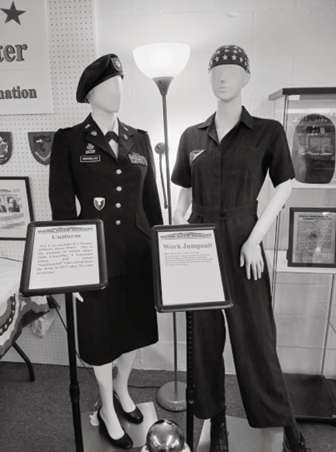
On the left is a female Army officer’s dress blues,
a uniform once worn by Home with Heroes Vice
President Gabi Crousillac. The uniform on the right
is an actual women’s work jumpsuit at Bell Aircraft
in Atlanta, Georgia, from 1942 to 1943. It was
donated by Patricia Jamison, whose mother, Bertie
Torgerson, was an original “Rosie the Riveter” who
worked at Bell Aircraft during World War II.
Photograph courtesy of Roscoe Barnes III.
The Cali Story 2.0
Reviews
Lottie Deno: A Novel of the Civil War & the American Southwest. By Frank Thurmond. (Marion, MI: Parkhurst Brothers Publishers, 2024. Pp. 240, $17.95, paperback)
“I was later accused of ‘running a disorderly house,’ but that is of course nonsense, the kind of thing men always want to say about a woman who happens to be suc- cessful in her own right,” says Lottie Deno about her thriving busi- ness enterprise as she reflects on her life in Frank Thurmond’s novel Lottie Deno. Now in her 80s, as she re- counts her story, Lottie appears a remarkable character, brilliantly de- veloped from the historical figure who led an ad- venturous life during the Civil War and the turbulent decades that followed. The novel, sub- titled A Novel of the Civil War and the American Southwest, chronicles the Civil War’s impact on a young girl’s growth and the life-altering choices she makes in its aftermath. The novel vividly cap- tures her evolution from an innocent girl in Ken- tucky into a formidable and unconventional woman, while also capturing socio-cultural up- heavals of the post-Civil War South.

Charlotte J. Tomkins, known as Carlotta and later as Mysterious Maud and Lottie Deno, grew up in Gallatin County, Kentucky, where her family home became a Confederate recruitment hub when the Civil War began. After her father’s death in the war, she is sent to Detroit, partly to separate her from Johnny, a Jewish boy she loves. Despite their separation, Johnny manages to meet her and they plan to move West. As things don’t go as planned for Johnny, Carlotta falls for Frank Thurmond, an outlaw who changes the course of her life, again. Carlotta’s journey across the chaotic post-war frontier is one of adventure and resilience. She defies societal expectations, survives kidnappings, befriends saloon owners, and makes her own money and way in a lawless world, finally settling in New Mexico. Lottie speaks as a highly transformed and so- cially aware woman, critical of slavery and unen- thusiastic of the forces in play that fueled the Civil War. Her inclination toward equality and freedom for all is evident in her character from an early age. As her story opens, she reflects on her upbringing, recounting how her parents owned “a large number of enslaved people,” and here she adds in parenthesis “though I am now terribly ashamed to admit it.” She calls the “talk of the constitutional right to freedom” of the Confederate sympathizers, like her father, “hyp- ocritical,” as freedom “in their minds clearly ap- plied only to wealthy, white (and male) landowners like themselves. Despite being the heiress of a slave-owning landowner from the South, and taken by her father to many of his business trips—from Detroit to European cities— she develops a liberal worldview, and in fact, learns to become someone the society would not expect of a girl. Her Nanny, a black woman, becomes her confidant, and later she helps her secure free- dom. Carlotta understands the price she may
--Khem Aryal
Peep Light: Stories of a Mississippi River Boat Captain. By Lee Hen-drix. (Jackson, MS: University of Mis-sissippi Press, 2024. Pp. xviii + 196,
As you have driven over a Mississippi River bridge, you have seen towboats pushing their barges up and down the Gathering of Waters. You might mistakenly refer to both the towboat and the tow as a large barge. A river boat captain will set you straight. A barge is one of the main vessels attached to a tow. The towboat pushes the barges, and the crew members eat and sleep on the towboat, not the barge. Captain Lee Hendrix sets these kinds of misconceptions straight in his witty and vibrant collection of reflections, essays, short stories, and reminiscences of half a century of life on riverboats. Rather than imagining what life is like on a towboat, Hendrix brings you down from your car into his wheelhouse where he seats you on the liar’s bench and relates won- derful stories. The book blends genres as many of the chapters work as memoirs, but he also in- cludes short fiction, eulogies, essays, and other forms of writing. The peep light refers to blue steering light that pilots use for navigation. It is an excellent metaphor for the book’s content, and Hendrix’s personable style of writing gives readers luminous experiences with stories and ac- counts of captains and crews who work the river.
After college, Hendrix began working on the barge lines in 1972 as a deckhand. Personal ex- perience narratives relate the challenges of work- ing on a barge as well as the excitement of learning the occupational practices and folklore within this working community. Some of the most fascinating writing gives readers a great ap- preciation for the skills of deckhands. Hendrix and other crew members worked six hours on and six hours off in all kinds of weather, and the work is often dan- gerous. Lines can break and cables can break free. A loose barge is dangerous, and a snapped cable or line can be deadly. Hendrix conveys his apprecia- tion for the deckhands’ skill, and his prose illustrates the respect and camaraderie between captains, mates, and deck- hands. Stories of events that he experienced as well as the accounts of others include original text that is new to this book as well as entries published in Big River Magazine and other publications.

Within a few years, Hendrix began training to become a river boat pilot. His description of learning the requisite skills evokes the writing of Samuel Clemens and other cub pilots. He gives readers an understanding of both the direct con- tinuity to time-honored ways of training pilots as well as new developments within the past half century that have influenced the education and certification of river boat captains. His own work is diverse and fascinating. He piloted towboats for the barge lines on the Mississippi and other rivers. He worked as an outdoor educator who taught students about the importance of water- way ecosystems. He piloted excursion boats, in- cluding the steamers the Mississippi Queen and the Delta Queen. His accounts of serving as a cap- tain on a casino boat in Davenport, Iowa, during the 1993 flood offer a unique insider’s view of one of the worst floods in American history. As he gives us accounts of his range of experiences, readers gain a microcosm of the history and cul- ture of those working on river boats, with an ex- cellent blending of vivid descriptions with
--Gregory Hansen
A pooka in Arkansas. By Ed Madden. (Washington, DC: The Word Works, 2023. Pp. 81, $19.00, paper-back)
The pooka of the title is a borrowing from an Irish folktale work by Yeats, according to whom, quoted in the front matter, the creature “seems essentially an animal spirit” and a sort of shapeshifter. (The Irish variant is púca.) Madden appropriates the term to signify queerness while growing up in a home and community hostile to a healthy self-awareness of it. The volume is roughly chronological, from boyhood to college and later, suggesting a verse memoir, though all poetry is by its nature fictive. The poems mine experiences and bravely reveal aspects of them to readers. Although they may be especially helpful to those living in similar situations—there is more than one pooka in Arkansas—they have a com- mon humanity for anyone interested, as the poems adeptly place readers in the speaker’s shoes. In the tradition of such poets as Jo McDou- gall, most of these poems are set in the Arkansas Delta, where Madden was born and raised. They lend credence to the famous Flannery O’Connor idea that anyone surviving childhood has enough experience to fuel a writing career. Scattered poems take readers elsewhere, including Ireland and Brazil, the setting of the beautiful ode “Horses,” but the Delta poems hit hardest. The opener, “When I was a young animal,” both links the shapeshifting pooka with the speaker and es- tablishes the family rice farm as the main setting. The speaker as a young animal learned, as we all do, from watching others. There is no guar- antee the things any of us learn when we are young will be positive, humane, or true, and throughout the volume the speaker reflects on rejection by community and, most painfully, by family. The persona slides back and forth easily between past and present to reveal consciousness in operation, the mind trying to understand itself.

Madden also follows a long tradition of po- etry about farm work extending back at least to Hesiod, who was raised to be a shepherd, and Seamus Heaney, in whose “Digging” the nar- rator-son concludes he will not follow his farmer father but dig instead with his pen. This collec- tion is a tribute to Madden’s father, whose final days and death are central to Ark (2016). The title poem represents the speaker’s merged identity as he pauses in caring for his father by walking alone near his family’s house to speak with his partner on the phone. Some of the poems are set in a deepening dusk as fires of various sorts, as large as an entire field and as small as his father’s cigarette, blaze in the dark and evoke a vividness with which the reader can almost smell the smoke. The poems expose wounds but also, as a book-length narrative, reconcile the past with the present. The volume suggests that some wounds have healed or scarred over, while others remain tender. The therapy session of “Eclipse” draws this idea forward by employing a snippet from poet Mary Oliver: “this, too, was a gift.” These poems show how familial wounds cut the deepest and remain the longest. Some of the complexities of familial relationships unfold sequentially. For example, while the father in
--Bryan L. Moore