# Volume 56, Issue #1 (April 2025)
# Table of Contents
### **Arkansas Review: A Journal of Delta Studies**
##### (formerly Kansas Quarterly)
*Arkansas Review*, Vol. 56, No. 1 (April 2025)
[**The Pear Orchard (fiction)** ](https://kb.astate.edu/books/volume-56-issue-1-april-2025/page/the-pear-orchard)............................................................. **3**
by Cary Holladay
[**Jail, No Bail (poetry)**](https://kb.astate.edu/books/volume-56-issue-1-april-2025/page/jail-no-bail) ............................................................... **15**
by William Heath
**Survival of the Baddest: Etheridge Knight’s Hard Rock Aesthetic** ................. **16**
by Claude Wilkinson
**The Planter’s Wife: Five Poems (poetry)** ........................................... **20**
The Lord giveth and the Lord taketh away
Mary’s Wish
Marrying Mr. Hunt
Cyrus
Judgment Day
by Anne Bucey
**“It had turned them all into voyeurs”: Celebrity as the Antithesis**
**of Community in Molly O’Keefe’s Wild Child** ...................................... **25**
by Guy Lancaster
[**Trust is a Tick (poetry)**](https://kb.astate.edu/books/volume-56-issue-1-april-2025/page/trust-is-a-tick) ............................................................ **37**
by Scott T. Hutchison
**A Certain Number of Kills (fiction)** ............................................... **38**
by Catherine Niolet
[**Train Ride (creative non-fiction)**](https://kb.astate.edu/books/volume-56-issue-1-april-2025/page/train-ride) ................................................. **44**
by Jacqueline Guidry
**Bacchanalia (French Quarter, New Orleans) (poetry)** .............................. **49**
by Larry D. Thomas
**Lake Pontchartrain (fiction)** ...................................................... **50**
by Pier Roberts
**Two Poems (poetry)** ................................................................. **57**
French Quarter and Beyond
Pornography
by Allan Johnston
**Water Belly (fiction)** .............................................................. **59**
by Austin Price
**Still Life with a Dead Pond (poetry)** .............................................. **68**
by Terry Belew
**Wasteland Survivors (fiction)** ..................................................... **70**
by Kevin Novalina
**The Turning Seasons (poetry)** ...................................................... **74**
by Floyd Collins
**Delta Sources and Resources** ....................................................... **76**
Historic Arkansas Newspapers available for free as part of Chronicling America
The Library of Congress’s Historic American Newspapers collection (online)
by Katie Adkins and Darren Bell, Arkansas State Archives
**Contributors** ..................................................................... **77**
---
## **Contributors**
**Katie Adkins** is the project director for the Arkansas Digital Newspaper Project at the Arkansas State Archives and works with the Library of Congress on the National Digital Newspaper Program.
**Terry Belew** lives in rural Missouri with his wife and two sons. His debut poetry collection, *The Deep Blue of Neptune*, was selected as the winner of the 2024 Stan and Tom Wick Poetry Prize by Alison Hawthorne Deming and is forthcoming from Kent State UP. He earned his MFA from the University of Nebraska-Omaha and his MA from Missouri State University. His work has appeared in recent issues of *Southern Humanities Review, Meridian, Tar River Poetry, The Pinch,* and *Storm Cellar*, among many others.
**Darren Bell** is an Archival Assistant specializing in microphotography at the Arkansas State Archives, digitally preserving newspapers from across Arkansas. For questions related to newspaper digitization and other Arkansas State Archives resources, contact state.archives@arkansas.gov
**Anne Bucey** is a writer living in Atlanta, GA. She earned an undergraduate degree in history from Kenyon College, an MEd from Georgia State University, and an MFA in writing from Spalding University. Bucey’s work has appeared in various regional and national journals, including *The Healing Muse* and *Tipton Poetry Journal*. A chapbook collection of her poems, *A Shade Pulled Just Barely*, will be published this year by Finishing Line P. Research into two antebellum plantations in Mississippi led to poems comprising a longer unpublished manuscript titled, *Canebrake*. The poem “Canebrake,” from that collection, was a 2023 finalist for the Ron Rash Award and was published by *Broad River Review* last year.
**Floyd Collins** holds an MFA in Creative Writing and a PhD in Twentieth-Century Literature from the University of Arkansas. He has authored several volumes of poetry, including *My Back Pages: The Teresa Poems* (2022). *The Living Artifact*, a selection of his essay-reviews, appeared in 2021. Most recently *Waking Past Midnight: Selected Poems*, a career retrospective, was published by Stephen F. Austin State UP in 2023.
**Jacqueline Guidry’s** first collection, *Visions, Stories*, is forthcoming from Lamar U Literary P. *What We Carry* was selected as one of nine novels long-listed for Regal House’s Petrichor Prize. The first chapter of that novel appears in *Embark*. Jacqueline hopes to include “Train Ride” in a hybrid collection centered on Cajun life, past and present. Other works from the collection-in-progress appear in *Rosebud* and *storySouth*.
**William Heath** has published four poetry books: *The Walking Man, Steel Valley Elegy, Going Places,* and *Alms for Oblivion*; three chapbooks: *Night Moves in Ohio, Leaving Seville,* and *Inventing the Americas*; an award-winning novel about the civil rights movement in Mississippi, *The Children Bob Moses Led*; a history, *William Wells and the Struggle for the Old Northwest* (winner of two Spur Awards and the Oliver Hazard Perry Award); and a book of interviews, *Conversations with Robert Stone*. He received a Lifetime Achievement Award from Hiram College. He lives in Annapolis, MD. www.william-heathbooks.com
**Cary Holladay** has published eight volumes of fiction, most recently *Brides in the Sky* (Swallow P, Ohio UP). Over one hundred of her stories and essays have appeared in journals and anthologies. Her awards include an O. Henry Prize for “Merry-Go-Sorry,” based on the case of the West Memphis Three, and a fellowship from the National Endowment for the Arts. She is Professor Emeritus at the University of Memphis, where she directed the creative writing program and was named a First Tennessee Professor. She is a core faculty member in the low-residency MFA program at Converse University. She lives on a farm in her native Virginia with her husband, the writer John Bensko.
**Scott T. Hutchison** is the author of two books of poetry, *Reining In* (BlackBird P) and *Moonshine Narratives* (Main Street Rag Publishing). Previous work has appeared in *Arkansas Review, Louisiana Literature, The Georgia Review,* and *The Southern Review*. New work is forthcoming in *Atlanta Review, Kestrel, The Opiate,* and *Trampset*.
**Allan Johnston** earned his MA in Creative Writing and his PhD in English from the University of California, Davis. An award winning poet, his work has appeared in over sixty journals, and he has published three full-length poetry collections (*Tasks of Survival*, 1996; *In a Window*, 2018; *Sable and Selected Poems*, 2022) and three chapbooks. His scholarly articles, as well as his translations and co-translations with Guillemette Johnston, have appeared in multiple journals. Johnston has taught most recently at Columbia College and DePaul University in Chicago. He is co-editor of *JPSE: Journal for the Philosophical Study of Education*.
**Guy Lancaster** is currently the editor of the online *Encyclopedia of Arkansas*, a project of the Central Arkansas Library System (CALS), and the author of a number of books on race and violence, including *American Atrocity: The Types of Violence in Lynching* (U of Arkansas P, 2021).
**Catherine Niolet** is a writer from Mississippi. Her work has previously been featured in *Ninth Letter*, and she is currently at work on her first novel. A graduate of Mississippi State University and Brooklyn Law School, she currently lives in Birmingham, AL, with her family.
**Kevin Novalina** has had fiction and poetry published in numerous literary journals and anthologies. He has won multiple writing fellowships and awards and has been nominated for four Pushcart Prizes.
**Austin Price** is a literary critic and journalist whose interviews, reviews, and essays have appeared in publications such as *The Hopkins Review, The Los Angeles Review of Books,* and *The Comics Journal*. Alongside the cartoonish Matthew Rainwater, he is the creator of the webcomic *Batmonster*. He is currently at work on his first novel.
**Pier Roberts** is from California but spent most of her childhood summers in Louisiana where her mother was from. She is a teacher, reader, writer, hiker, amateur chef, and avid swimmer and paddleboarder. Her work has appeared in *The Atlantic Unbound, Spotlong Review, Clackamas Literary Review,* and *Travelers’ Tales, Turkey*, among others. She lives with her teenage twins and two rescue cats.
**Larry D. Thomas,** a previous contributor to *Arkansas Review*, served as the 2008 Texas Poet Laureate and is a member of the Texas Institute of Letters. Of deep Southern heritage, he has published poetry in a number of Southern journals, including *Valley Voices, Deep South Magazine, Delta Poetry Review, Louisiana Literature,* and *Green Hills Literary Lantern*. Buttonhook P recently brought out his online chapbook, *Letting the Light Work (Poems of Mexico)* and two poetry pamphlets, *Gems* and *Bestiary: Far West Texas*.
**Claude Wilkinson** has been Provost Scholar and also John and Renée Grisham Visiting Southern Writer in Residence at the University of Mississippi. His poems have appeared recently in *Alabama Literary Review, Arkansas Review, Chronicles, Poetry South,* and *Southern Quarterly*, and his recent poetry collections include *Marvelous Light, World without End,* and *Soon Done with the Crosses*.
Arkansas Review 56.1 (April 2025)
# The Pear Orchard
##### By Cary Holladay
Twenty-eight years had passed since Elvis Presley died, but people could still point to his room at Baptist Memorial Hospital. The now-dilapidated building was scheduled for demolition on Sunday, November 6, 2005. Vince Johnson, interim director of Memphis’s personnel department, doubted it was truly empty. Surely a gurney was rattling down one of its hundreds of corridors. From his top-floor downtown office, Vince had a clear view of BMH and its weedy lot. His house was two miles away, in midtown, close enough he might feel the vibrations or even hear the implosion. If he wanted to, he could watch the whole thing from his office.
Now it was summertime, but he felt the clock ticking toward November.
He was forty-four, single, and childless, a city employee for nineteen years. Memphis’s government had been fully integrated for a long time, but his mother remembered when the entire administration was white; in fact, well into her adulthood, Blacks were allowed to go to Memphis’s parks, zoo, and swimming pools only on certain days. As a child, she had stood in the street to observe May Day celebrations in Overton Park, where young white girls wearing long gowns danced around a lake.
Never mind all that now, she said, with a lift of her eyebrows that indicated the dance was silly. Every time you look back, make sure you look ahead.
She and Mr. Allen, Vince’s recently deceased boss, who was one of the first Blacks to hold a top position in Memphis government, had encouraged Vince in his career.
Vince loved the vista from his office—the clotted traffic, the ballpark. He’d been born at Baptist; was that why his heart ached? He took to favoring the window that faced the Mississippi River. Barges loaded with coal and freight crawled south to New Orleans and north to Minnesota, where the headlands were said to be a trickle. He imagined ships beached in snowy fields. From a distance, a barge was a slow-moving stick of gum pulled by a toy tugboat, yet when he grew busy with his work and looked again later, they’d be gone. He was overcome by the fear that barge and tug had sunk and the crews were drowning in floating debris—trees, buoys ripped from moorings. This grief was new, taking him unawares. His forty-fifth birthday would coincide with the hospital’s demolition.
One August evening, he found himself aboard a riverboat, its sidewheel spinning, its deck full of merrymakers. His secretary, June Bradshaw, had chartered it for her wedding reception. Late sun scorched his head, his voice felt wild and hoarse, and his brain spun from the sticky drinks.
“Cash bar, June?” he said, annoyed.
She shrugged. A band called Break Up Dan—her kind of humor—played dance music. A starry-eyed mermaid shimmied into his arms, and, startled, he felt his spirits soar. He introduced himself and asked for her name.
“Ronnie,” she said.
“Where’d you come from? My dreams?”
After a few turns around the dance floor, she slipped away. He sought out June.
“Who was that woman?”
“Veronica Sapelo,” June said. “Ronnie Sapelo, a dispatcher at Fire. I didn’t think she could make it. She works nights.”
“She looks like the Ronnie in the Ronettes. Ronnie Specter.”
“I know. The hairstyle, the eyeliner, but without the sass. Sweet, though.”
June cocked a hip and bobbed a knee.
“Be my...” she belted out, “be my baby,” motioning him to join in.
Until now, Sapelo, Veronica had been only a name on the employee rosters in Vince’s office: eight thousand names. Veronica Sapelo, of Fire. Vince mopped his brow.
June grinned in a way she had.
“More than a mote, Chief?” She’d seen him infatuated before, seen him suffer and recover as if the feeling were no more than a speck in his eye. “Go talk to her,” she said. “Meek is weak.”
“Is she married?” he said, recalling a Sapelo, Joseph E. on the rosters, in Engineering.
“Separated. She kicked ol’ Joe to the curb.”
A commotion arose at starboard. The bridegroom, a hotshot in Legal, was making a show of trying to jump off the boat. His buddies grabbed his arms and held him back. June ignored them. Generosity moved Vince to write a large check to the new husband and wife, but the groom’s antics irked him. He tore it up and made out another check for the same amount, but only to June, and handed it to her. Yawning, she slipped it into a beaded purse.
“Thank you. Now it’s your turn to give a party,” she said. “You’ve got your pool.”
“I never have time.”
“You have time.”
Vince’s mother, Marie Morton Johnson, was sitting on deckchairs with other women her age. June had sent a limo to her retirement home. Marie waved June over. They were great friends. Vince sought out Ronnie Sapelo and danced with her again. This was one of the things he loved about Memphis, that you could slow-dance with somebody you’d just met. Ronnie’s hair smelled like incense. They dipped and swayed, and she closed her eyes and tipped her chin. Was this really happening? Head whirling, he leaned down for a kiss. Her mouth tasted of sugar and limes.
“May I see you again? May I take you home?” he said when he caught his breath.
“Oh, that’s all right. I have my car.”
A smile, and she was gone. By the time the boat returned to the dock and he stumbled ashore, he was a lost man, the evening breeze burning his cheeks. He’d bitten his lip while chewing shrimp on a skewer. His heart felt skewered: that was the major symptom of his new and urgent condition, Ronnie Sapelo beating through his veins. A couple hours on fresh water was hardly a voyage, yet he swayed on sea legs, treading waves.
While June honeymooned in the Virgin Islands, Vince was caught in the brooding that had gripped him since the wedding. He looked up Veronica Sapelo’s address and tried to forget it. He pored over her social media. She’d been with the city for three years. Ronnie Sapelo, night shift. If they got together, how often would he see her? Could the sun abide with the moon?
He met with labor union reps and breakfasted with the mayor and division directors, never mind the pounding heart that felt like part of a permanent hangover. Always, there were complaints from employees, mostly women reporting misconduct by men. If they were distraught, he recommended professional counseling. He informed them of the procedures they would need to follow, and he explained the rights that would be extended to those they accused. The offenders weren’t always coworkers or
bosses. They could be subordinates or third-party vendors.
He came up behind me and...
Backed me up against the wall and...
Vince held an MBA and a master’s degree in psychology. For nineteen years, he had worked under the former director, Mr. Louis Allen.
Sometimes people lie, mm-hmm, Mr. Allen had said.
He had only an associate’s degree from a community college, but he possessed the accumulated wisdom of fifty years’ service to the city. When a police secretary had accused a high-ranking detective of raping her, Mr. Allen insisted on an investigation. Mr. Allen suffered the mayor’s skepticism and a personal lawsuit filed by the detective, but he prevailed.
I take no pleasure in it, Mr. Allen said when the detective was convicted in court and sent to prison.
Mr. Johnson, Mr. Allen had said, can you tell when a person is lying?
And Vince said, No, I believe everything people tell me, and Mr. Allen laughed till he cough-choked. Always, cigarettes in his pocket. He’d smoked outside, but even now, six months after he’d left, his office still smelled of his Newports.
If a gal says a guy done something, Mr. Allen said, I generally believe he done it.
Vince had not automatically become director when Mr. Allen retired. That post was currently open. Another year might pass before the mayor would decide whether or not to promote Vince; change at the top came slowly, and there was no seeking out Mr. Allen for advice: lung cancer had killed him mere weeks into retirement. He was survived by his beautiful white wife, Charlotte, and their fragile, disabled son, Charley, who was a year or two older than Vince. Charlotte’s famous blonde hair had silvered. When she and Mr. Allen had wed, long ago, interracial marriages were rare.
They can’t stand each other, June had whispered when Mr. Allen was alive, and Vince understood that a once-great passion had cooled to ice.
He rang the bell of Charlotte’s townhouse, and when she answered, he handed her a bouquet of carnations.
“Just checking on you,” he said. “I miss him.”
She accepted the flowers.
“Louis was proud of you.”
Yet her tone was frosty-like. Maybe she thought he’d had it too easy. Mr. Allen had had to battle so hard, whereas Vince must seem like one spoiled, lucky pup.
Behind her, Charley was coming toward him.
“Vince, hi! Want to watch TV? There’s lions on TV.”
“Sure,” he said over Charlotte’s shoulder.
“We’re busy, Vince,” she said and closed the door.
---
One of the least congenial aspects of Vince’s job was informing victims of intimidation that bullying per se was not illegal. A pattern of bullying and harassment was a different story, and was prohibited if the recipient were in a protected category.
Document the incidents, Vince advised.
He emphasized he was not a lawyer. He had to protect the city, although he never said so to the unhappy employees who sought his help. He had to keep the city out of lawsuits; the city signed his paycheck.
Poker face, Mr. Allen had advised.
Sometimes there were no consequences.
Know when to let sleeping dogs lie, Mr. Allen said.
“You have to write something down,” Vince told complainants, but often they didn’t want to, and instead simply left, their names disappearing from the employment rosters.
A hurricane struck the Virgin Islands, and he worried that June would be blown out to sea. On Sunday, he picked up his mother at her re-
tirement community and took her to church, and afterwards, to lunch at a cafeteria she liked. As they carried their trays to a table, she spoke to other diners. She knew hundreds of people, having clerked at the Park Commission for over thirty years, from the time he was in kindergarten, which was when his father had died of a heart attack, until she’d retired at sixty-five. Vince remembered his father, an insurance salesman, as a coppery, heavy-cheeked man, quiet as a shadow. His parents had separated when he very young, but they’d stayed married; he didn’t know why. They were of another generation. Old courtesies were observed at town hall meetings, where the head of Public Works would begin a report on rats and mosquitoes with an apology for the unpleasantness of the subject. There were prayers at town hall meetings, led by a minister of one or another denomination, and a blessing before the breaking of bread that followed. While citizens feasted on ribs and spaghetti, paid for by a council member’s budget, that official would circulate among the tables, finding out what was going on in homes and schools and streets, asking for support and granting favors. Vince’s mother had urged Vince to run for city council.
He demurred, but he was aware of himself as part of a century-old bureaucracy, going back to the days when the city’s architects drew maps on linen.
Now, at the cafeteria, he followed his mother to her favorite table.
“Any news?” she said, meaning his promotion. “I’ll call Eddie.” The mayor.
“Mama, no.”
She pressed a napkin to her lips and made a characteristic trill, a faint hum that prefaced her remarks.
“You need to be out there shaking hands and making friends. And?”
She waited until he looked up from his steak.
“They’d rather have a married person. Shows stability.”
“Mama...” When he was younger, finding girlfriends was easy. Now there was nobody, hadn’t been for a long time, and he couldn’t exactly count Ronnie Sapelo.
“June would have been perfect.”
She stabbed her fork into her banana cream pie.
---
A clerk named Gina Traylor seated herself gingerly beside his desk, glanced around the glass walls of his office, and rolled up her sleeves to reveal bruises so distinct, it was as if ghostly hands still gripped her arms.
“He said come to a meeting,” she said, “but when I got there, it was just him.”
She named her director, a silver-haired dandy from Chicago whose major concern at the time of his hiring, Vince recalled, was his clothing allowance, much to Mr. Allen’s private scorn.
“Now what?” Gina Traylor said, her eyes as wide as if she hadn’t blinked since the incident.
“I’m sorry this happened to you. I can’t do anything unless you write it down.”
Vince handed her a form.
“I advise you to file a police report.”
Her eyes implored him.
“I’ll talk to him,” he said.
---
But he didn’t. His brief connection with Ronnie Sapelo had left him overwrought and feeling wronged. The feeling was wrong in itself, but it had taken up residence in his heart, like the New Madrid Fault crouching in west Tennessee’s seismic earth.
Let a little time go by had been another of Mr. Allen’s maxims.
Yet Mr. Allen always pursued a meanwhile. It might seem that he was doing nothing, yet he was only waiting for the right moment to lower the boom on an errant employee. Day after day, Mr. Allen might stand on the back steps, smoking with a custo-
dian who was his friend, and then, when he was ready, he’d come inside and pick up the phone. When the wrongdoer appeared, Mr. Allen delivered a blistering reprimand. Afterwards, when the person had departed, having accepted Mr. Allen’s terms, or had quit or been fired, Mr. Allen would turn to Vince and say:
Temporize, temporize. That is my role.
Half a century earlier, at age eighteen, Mr. Allen had been valedictorian at Booker T. Washington High School.
But Memphis State didn’t let me in, he said.
The color barrier at MSU wasn’t broken until 1959. By then, Mr. Allen had landed a job with the city’s recreation services. He won the much-bigger position, in Personnel, in the 1970s. Years later, he’d shown Vince a newspaper article announcing his appointment. In the picture, he had a big ’fro. He laughed and said:
Being light probably helped.
Back from her honeymoon, June said, “You call Ronnie yet, Chief? Here, I brought you something.”
A coconut packed with whiskey-filled chocolates: he gobbled the candies, the liquor spurting into his mouth. Two weeks and a day had passed since he’d met Ronnie Sapelo, yet her kiss still burned his lips. She seemed a creature of river and ocean; surely her sweat would turn to pearls, she’d wear a crown of coral.
June clapped the coconut halves over her breasts.
“They sell coconut bras to tourists.”
She laughed and clunked them into the trash can.
---
The city’s old linen maps hung in the office of the silver-haired dandy—director of one of the largest divisions—who had allegedly bruised Gina Traylor’s arms.
“Can you find your house on the map, Vince?” he said.
Vince pointed to a mass of trees on one of the drawings.
“Aha. Midtown,” the director said. “Back in 1900, it was a distant suburb.”
Big-boned and suntanned, a former athlete, he exuded a costly aftershave that made Vince think of yachts and tuxedos.
“Your neighborhood used to be...”
“A pear orchard.”
“You read the caption.”
PEAR ORCHARD was neatly lettered below the trees, but Vince had already known.
“Mr. Allen told me.”
“That old know-it-all. He thought he was Wile E. Coyote.”
“I need to talk with you about a serious matter. Let’s sit down.”
“I’d rather stand. My knee is acting up. Basketball, thirty years ago.”
“All right.”
Vince summed up the accusation without identifying Gina Traylor. She still hadn’t written a complaint, but he couldn’t forget her bruises.
“Totally false. I have no interest in harming my staff,” the director said. “No romantic interest in them, either. I have all the girlfriends I need. Women show up at my house.”
“This could mean criminal charges.”
“Is there a written statement?”
Vince hesitated.
“No.”
“Well. Thanks for the heads up.”
The director bounced on his good leg.
“I didn’t say I’m on your side.”
“You better be. I haven’t done anything wrong.”
Mr. Allen would have known how to read that flat hazel gaze, would have punctured this perfumed pomposity. But Mr. Allen wouldn’t have been there with nothing written down.
---
PEAR ORCHARD, the caption said. The mapmaker must have been a god, skimming above the alluvial plains. It was 1900—as Vince imagined it—and warblers sang among flowering branches. When the fruit was ripe, birds pierced the skin with their beaks, and wasps crawled into the sticky holes and ate their fill. At dusk, deer moved in from the shadows and turned fallen pears over with their hooves. Pickers climbed ladders and harvested all day, and at night, when they closed their eyes, they saw their own hands reaching for ripe fruit. The middle of the orchard had eventually become Vincent’s street, and the orchard’s distant edge, Ronnie Sapelo’s. Vince pictured Ronnie as an orchardist’s wife—his wife, making pear sauce, her apron heavy with splatter, their kitchen a broiling September.
He pictured all of this with pleasure, though it didn’t wipe out the meeting. On his way out of the director’s office, he glimpsed Gina Traylor at her desk, gripping her arms. Was it merely an idle pose? Was she feeling the tender places, reliving the attack, or had she herself caused those bruises? Vince could almost hear Mr. Allen’s cough-choking laugh.
Nothing is too strange to have happened, Mr. Allen would say, quoting Mark Twain, but much is too strange to be believed.
Gina’s eyes found Vince’s, and he nodded, but she looked away.
That evening, he visited his mother and said, “Tell me about the old times.”
She laughed.
“Born in 1927 is not that old.”
She was seventy-eight and knew a lot. During the early nineteen-teens, the pear trees in his neighborhood had been cut down and these houses were constructed, not mansions like those on Belvedere and Central where the city fathers lived, but solid dwellings all, airy and cool even on summer nights. By the end of 1918, the war was over, and Memphians found themselves in a modern world. They’d enjoyed fine municipal water since 1887, when an ice company drilled a well and discovered an underground river, supremely clean and pure. People covered their backyard wells and forgot about the muddy foulness that had clogged their throats. Even then, Memphis was barely past the yellow fever epidemics, when sickness caught people so fast, their knees buckled as they crossed a street.
“My grandfather picked up the bodies,” his mother said. “He was a wagon driver. When I was a little girl, he was about eighty, telling his stories.”
Her grandfather was Samuel Morton, born in the 1850s. As a child, he had seen massive flocks of passenger pigeons migrating from Texas and Louisiana to the great forests of Illinois and Canada, had felt the wind created by millions of beating wings. For hours and days, the swift, elegant birds passed overhead.
“They made the sky so dark, his mama lit the lanterns,” Vince’s mother said.
As a young man, Samuel Morton had worked as a stevedore, unloading barges at the docks along the river. He saved enough money to buy a wagon and horses and open a livery stable, an impressive rise for a man born into slavery.
Although Samuel Morton had died long before Vince was born, Vince thought about him whenever he saw horses, the mounted police taming rowdy Beale Street, their tall steeds nudging through the crowds and calming them into respect without the officers having to say a word. He thought about Samuel whenever he passed the Cinderella-style coaches that vied for tourists, the carriages draped with twinkle lights, the horses wearing collars of plastic flowers. The young drivers sported vests and top hats, and little dogs dozed beside them. Not so long ago, draymen had clattered through downtown streets, their world a place of shouts, burlap, and
heavy loads.
Now and then, when Vince weeded his yard, he found a green sprig and wondered if it was a pear seedling. Every January, incredibly, the pale pink petals of his camellia bush unfurled, luring insects from God knew where.
“This is very old,” his mother would say, touching the blossoms.
He sensed the ancient seeds of fruit trees just beneath his feet. In crazy late-summer heat, digging at crabgrass, he unearthed a big wide horseshoe like a draft horse would wear. He set it atop his front door, the ends pointing upward for luck.
Weekends felt long.
Ronnie, Ronnie.
What if he called her? Sent an email? No, he’d wait, be patient. June would no doubt tell him when Ronnie was free. He swam in his pool and stretched out in a lounge chair, but the burning sun made his heart pound. He felt puny in comparison with Great-Grandfather Morton, who had never known air conditioning, who’d sat atop a jolting wagon, gripping the reins in callused palms.
Baptist Hospital’s implosion was growing closer. In the dim chill of his den, Vince turned on his laptop and watched demolition videos from all over the world. Skyscrapers and parking garages collapsed in Seattle and Tokyo. A Richmond office tower looked almost new, but you couldn’t see inside, where the concrete was surely stained and foul, with roaches scuttling through tangled wires.
A voice came on:
Three, two, one.
And ka-lamm, ka-lamm, ka-lamm went the explosions—rhythmic, percussive, almost leisurely—ka-lamm, with brilliant bursts of light, lower floors first. The building shuddered, slumped as if struck on the shoulder, and fell so fast the top floors hung in the air while the rest plummeted. Dust and dirt and gases spewed up from the ground and boiled sky-high. In the corner of Vince’s screen, onlookers watched from a safe distance, shrieking and cheering. By the end, Vince believed, they had changed, somehow. It wasn’t just the few seconds of drama, it was a sense of indefinable loss that drove each spectator into some shaken-hearted place. The person who posted the video had included a reverse that was even better. Amid blasts and sparks, the building reassembled itself. With a final leap, it shook off the haze, and every piece flew back into place.
The more Vince watched, the more he noticed about the events. Sobs were mixed in with spectators’ cheers.
Destruction and regeneration: people needed both.
Just after Labor Day, his mother announced that her retirement community was boring and restrictive. She wanted to move in with him.
“Let’s think about it for a while,” Vince said, panicked.
“I’m too big a fish for that poky old place,” she said. “Nothing but card games and exercises where people sit in their chairs. You’ve got a pool. A daily swim would feel so good. Besides, I can help you.”
“You can come over and swim whenever you want. And you don’t have to help me, Mama.”
“You mean you want to keep living on your own.”
“I’m used to it.”
“Mm-hmm.”
For a moment, he thought it was settled, but she said, “Let’s give it three months. If it doesn’t work out, I’ll get an apartment.”
Next thing he knew, a van arrived with her furniture and boxes of antique china. She brought her cat, Lightfoot. Soon it seemed as if her King James Bible had always been on the coffee table, and Lightfoot’s litter box in the laundry room.
Every morning, in bathing suit, cap, and
goggles, she jumped into the pool and swam laps. As a finale, she held her breath and jetted underwater, trying to reach the far end, but surfaced midway, panting, and paddled to the side.
“It scares me when you do that,” Vince said.
“One day it’ll be easy,” she said.
He’d thought she would cook, and he’d looked forward to the meals he’d enjoyed in childhood, but she ordered delivery and takeout. She hired a cleaning service, and suddenly there were people vacuuming the carpets and scrubbing baseboard while she cradled Lightfoot in her arms and pointed out spots they’d missed.
“The way I intend to help you, Vince,” she said, “is with your social life.”
She gave a pool party, a big bash. She hosted luncheons, dinners, cocktail hours. On his staircase, he bumped into women in flip-flops, trailing the fumes of nail enamel: a mani-pedi party. He hadn’t wanted this. Didn’t want to be a man who lived with his mother. Reading his mind, she emitted her soft verbal trill.
“Yes, you live with me,” she said, “and I live with you.”
She pointed to the horseshoe over the front door.
“Your luck has changed.”
If the women at her parties were too old, or already married, doesn’t matter, you’re gonna be nice, because they had friends or nieces, and you don’t want to be a single old goat forever. The house and patio overflowed with guests, musicians, and bartenders.
“We can afford it,” she said, when he balked at the bills from caterers and florists. “Isn’t there somebody you’d like to invite?”
Had June spilled the beans about Ronnie? Resolutely, he shook his head.
“You could be married to some nice young lady in time for Mardi Gras,” his mother said. “A honeymoon in New Orleans, how about that?”
“Mama...”
“You could have kids, a family. Don’t wait!”
He felt lonely and awkward at the parties, even with people he knew. At June’s wedding, he’d danced and mingled, but now his mother cast him in a new role—a fuddy-duddy—and he was dismayed by how well it fit.
At a poolside barbecue, he overheard a woman say, “He’s not very friendly.”
“Leave him to me,” his mother said. “He’s a barge, and I’m a tugboat,” and they laughed.
June winked at him over her glass of wine; she was his mother’s guest, not his.
His mother made a show of crossing a room to greet snowy-haired dignitaries, shaky on their pronged canes. She knew educators, business leaders, artists. They brought their families, and she remembered their children’s names. And yet, search as he might, Vince never saw Mr. Allen’s widow.
“Have you invited Charlotte?” he asked.
“She’s a very private person.”
His mother stood at the sink, polishing a silver tray.
“She may see you as a bit too much the heir apparent.”
“But do you invite her? And Charley?”
He had the strangest feeling as she turned toward him. The tension in her hands and in the corners of her mouth—
“No,” she said.
“But Louis Allen was my friend and mentor.”
She turned back to the sink.
“Some people expect their life to have a certain kind of shape. And when they lose the one they love or have some—disappointment...”
She stopped, and he waited, but she didn’t say any more.
“Is that how you felt when Daddy died?”
He searched his mind for some recollection of the sorrow she must have felt, but it was long ago; he’d been five and they’d been separated.
“Well,” was all she said.
“Mama, what are we talking about? What do you mean?”
“I mean Charlotte is waiting for something she’ll never get.”
---
Heavy autumn rains came. The river leaped up the cobblestones and poured into a grassy park. Picnickers and dog-walkers fled. Floodwaters made a shining swath, gunmetal beneath the clouds. He stood at his window when he should have been working.
“Don’t you want me to organize your desk?” June said.
“No, I know where everything is.”
Let sleeping dogs lie.
Not until now had he seen the doubleness. Was that what Mr. Allen meant? Gina Traylor would never file a complaint. She would leave, or eke out the years to claim the humble pension of a city clerk. Vince gazed at the thick body of the river, its banks shaggy with weeds, and at the green Arkansas forests a mile across the water. If things got to be too much, he could wait for a storm, open the windows, and let the wind lift the documents from his desk and carry them away in the high, spinning currents of air. The papers would transform into grit from cottonseed factories and glitter from the horse-carriages lined up at The Peabody. Ronnie Sapelo would be part of the great wind; she would be there in his office weeping and telling him of hardships. He would sweep her up in his arms, and the gusts would ring the bells in downtown spires.
---
When his mother wasn’t entertaining, she scooped up Lightfoot, holed up in the den, and watched old Westerns, *Rawhide, Gunsmoke, Wagon Train*. She loved fights—the uppercuts, fisticuffs, flying tackles—and cowboys, sheriffs, and bushwhackers. Lightfoot nibbled morsels from the snack tray on her lap.
*Laramie’s* theme music was loud, but the song in Vince’s heart was louder.
Ronnie Sapelo, Ronnie Sapelo, Ronnie Sapelo.
It was October, two months since he’d kissed her on the boat. She was a dazzling memory that didn’t fade.
May I take you home?
No, I have my car.
Early one morning, when he knew the night shift was ending, he parked outside her office. Finally she came out. The fact that she was wearing big new glasses seemed significant. She didn’t seem to notice him, just went to her car and wheeled away. He replayed her stride in his mind, the way her purse strap slid off her shoulder. He vowed not to be that kind of man. Yet after a few minutes’ wait, he drove to her street and idled within view of her house, a brick four-square with a modest yard.
He required all employees to complete anti-harassment tutorials. He wanted to believe the training worked. The heavy-handed acting in the videos amused him—the villains’ gall. But that weekend, he cruised by Ronnie’s house a dozen times.
November 6th was coming, unstoppably. He would turn forty-five, and the hospital would fall. He was balanced on time’s hinge.
“Forty-five, a milestone,” his mother said.
“No party, Mama.”
She held up her palm.
“I’ve already ordered the cake. Be gracious.”
Today, an October Saturday, eight days before the birthday and implosion, she was hosting a beauty club. Her friends were arriving at the house. Hairstylists set up a special shampoo chair in the bathroom. In the kitchen, caterers unpacked sandwiches, fruit salad, Halloween cupcakes, sparkling water.
“Vamoose, son,” his mother said. “Girls only.”
As he backed his car out of the garage, he fought the urge to drive by Ronnie’s house, but moments later, he reached her now-familiar street. A Jeep was parked behind her car, and a man Vince didn’t recognize was mowing the grass. Sweat darkened the man’s T-shirt. Vince drove slowly around the block. When he returned, the man was finished. The front door opened, Ronnie stepped out and looked at the lawn, and she and the man went inside. Vince waited, but the man didn’t come out. Most likely, he was Sapelo, Joseph E. He’d had the settled, Saturday look of a husband; now he might be showering or having a beer or embracing Ronnie, his thoughts far from Engineering and hers far from Fire, man and wife, reconciled, and whatever had riven them didn’t matter anymore.
Through inexplicable tears—Vince’s eyes were just watering, it was the sun—he checked his watch. His mother’s event would be in full swing. He wanted to visit someone, but he’d forgotten his phone, and he couldn’t think of anybody to drop in on, a buddy or an old girlfriend whose kitchen chair he could plop into. Eventually he found himself at the hospital site. He parked and joined the people milling around. The sun was gone, the day edgy, clouds streaming overhead, and he felt like a ghost. The empty building loomed.
“That’s where Elvis died,” people said, pointing out which floor, which window.
The oldest part of the hospital dated to 1912. Vince calculated: it was ninety-three, closed for five years now. Hardhat crews had been prepping it for weeks. A strident man in a Redbirds ballcap was explaining this, and people were paying attention. Holes had been drilled into the support columns, the man said, and three thousand pounds of explosives loaded inside.
“A million square feet, collapsing inward.”
The man squinted over his glasses, surveying his audience. Vince felt a surge of irritation.
“At 6:45 a.m.,” the man said, “part of the skyline will disappear. The sound will be colossal. You’ll smell gunpowder. It’ll take about twenty seconds.”
“Like a firing squad, but with TNT,” said a woman with green-tipped hair.
The man rounded on her with a delighted frown.
“The dynamite just weakens the building. It’s gravity that does the work.”
“My friend is giving a party,” the woman said. “We’re going to stay up all night.”
She and the man began an exclusive conversation. Vince wondered if years from now, they would say, *That was how we met.*
He felt washed-out, slain. He went to a meat-and-three and ate lunch, but the food didn’t help.
*Mardi Gras,* his mother had said, *married in time for Mardi Gras.*
Parades, jazz, bright strands of beads raining down on his shoulders. Instead, he’d been wired, his knees packed with dynamite, and the Sapelos had pushed the button.
---
When he turned his car onto his street, he saw emergency vehicles parked in front of his house, an ambulance peeling away, neighbors clustered on their porches. Alarm flashed through his stomach like a cold knife. Women stood in his driveway, weeping. He jumped out of his car, and they ran to him, saying something about a shampoo:
“Her head, she couldn’t lift her head.”
One of the women ran past him into the house, yelling, “He’s back, here he is,” and he followed her, his legs gone to jelly.
The beauticians were packing up, the caterers were gone. The living room smelled of tea tree oil. Two police officers came up and asked to speak with him, and he led them to the den. The TV was off, and the carpet made the room very
quiet. He brushed cat fur from the sofa, wanting to say it was time for his mother’s shows and they should let her have the room.
She had been seated in the shampoo chair, the officers said, with her head bent backward into the wash basin, and something had happened. Possibly because of the weight of her wet hair and the unnatural position of her neck, something had happened.
Vince’s head was roaring, his brain on fire. Maybe he hadn’t really heard *deceased*, or *unfortunately*, or the first thing they’d said, as soon as he sat down, which was:
“Mr. Johnson, there’s no easy way to say this.”
They said they were sorry.
---
“Beauty parlor syndrome,” June said. “There oughta be warning signs in every salon.”
She’d brought lasagna, and they ate at his kitchen table. He’d taken the week off to make arrangements. She snapped off a length of plastic wrap and covered the rest of the lasagna.
“There’s no room,” she said, peering into the refrigerator.
People had brought hams, casseroles, and pies.
“Take some home,” he said.
“There’ll be a million people at the funeral. You’ll need it.”
She wedged the dish into the fridge, cleared the table, refilled their glasses of iced tea, and sat down again. The roots of her hair were gray, the faintest rim at her scalp. He’d never realized she colored it.
“My niece was having a baby shower that day,” she said. “Otherwise, I’d have been here, and maybe I could have saved her.”
They looked at each other. It was so easy to be with her.
“This is how it would’ve been if we were married,” she said. “Like she wanted.”
“She told you that?”
“We talked about all kinds of things.”
June’s eyes welled.
“She was my best friend. I might not have been hers, but she was mine.”
She laid her head on the table and cried.
He reached over to pat her arm and knocked over the salt shaker. Bad luck, his mother used to say. She would throw the spilled salt over her shoulder, to blind the devil.
“I was lucky to have her so long,” he said, a consolation the preacher had offered.
June sat up and wiped her cheeks.
“Now you’ve lost them both.”
“My father died when I was little. I hardly remember him.”
“Oh, Vince.”
She held his gaze, and he had the same odd feeling he’d had when his mother had stood at the sink and talked about the shape of a life. June was waiting, pushing him in some direction where he didn’t want to go. Her words were what people said when you lost the second parent.
*Now you’ve lost them both,* but it was something about her tone.
“My father,” he said, “died so long ago.”
June swept salt into her palm.
“She told me about her and Mr. Allen, but I’d already figured it out.”
He’d intended to go to the implosion. He’d wanted to be able to say, *I was there.* But the overflowing church—three hundred, five hundred mourners?—the solos and tributes and prayers, his mother’s body in the satin-lined casket, her face with its sealed expression, the white bouquet in her motionless fingers, and afterward, the repast that went on and on, people eating and grieving—it all created an exhaustion so deep that when the house was finally empty, when at last he could go to his room and lie down, he fell into a drowse that only made him wearier, as if he were marching and wasn’t allowed to stop. He reached for one of the glasses of stale dusty water
on his night table, took a sip, and sank back.
Something jumped up on the bed—the cat, Lightfoot. It turned around in a circle and curled into a hot ball against his stomach.
He opened his eyes. He must have slept. A realization swam up from his fatigue:
*It’s my birthday. Forty-five.*
He blinked, letting it sink in. A sound registered on his ears or in his brain, faint but commanding. Puzzled and alert, he lay very still, his head on the pillow. The air felt electric, even prickly. The sound he detected was softer than a whisper, but it stood out from the stuffy quiet of the house, and as his ears became attuned, he recognized his mother’s timbre, her charming, evasive cadences. He felt her energy in the room. Whether or not he was dreaming, and he didn’t think he was, the voice invited his response. This was his chance, and he’d thought he would never have it. He need only shape his words in his mind, and listen.
—So the whole city knew, Mama, everybody but me? And they are knowing now. The people at the parties. At your funeral. At my office, at meetings—
There came a soft, trilling hum, her light vocal preface, and her reply took form.
*As long as Charlotte was alive, there was nothing Louis and I could do. Their son, handicapped. He couldn’t just leave them, and I never asked him to. Finally we gave each other up. But you, well, you rankled her. You’re mine and his too. Happy birthday, son.*
—But sometimes he called me Mr. Johnson! Like I was just anybody. I can’t believe this.
She laughed, a little tendril of sound in a corner of the ceiling.
*He was so much younger than I was, ten years. We couldn’t believe how we felt. But we were married to other people, and he had just become a father. Charley was a newborn when we met.*
—Why didn’t you tell me, Mama?
*You were the flower of our love. That was enough. And we were too proud for scandal. Let sleeping dogs lie.*
—But you had a secret life. You should have told me while he was alive. He could’ve told me. Did people think I knew? That it was old hat? Me and my father working together, formal-like all those years, an open secret? My name-father, did he know? When I say my father, who do I even mean?
*Vince, listen to me. You won’t get the promotion. It’s nothing against you. They want a woman in your job. It’s time. They’ll hire from within, transfer a woman from another department. One day, it’ll be that girl in Fire.*
—You mean Ronnie Sapelo? Will have my job?
*Eventually, yes. You’ll come to think it’s kind of funny.*
—All right. Fair enough. But Mama, we were talking about the other thing.
*There will always be a place for you, maybe in another division, like Public Works or General Services.*
—Mama, enough about work. Tell me—
*Shh. Hear me now.*
The tumblers of water on his nightstand started tinkling, a light, glassy, insistent zing. Every fragile thing throughout the house hummed and trembled. Lightfoot growled and sprang off the bed. The floor, the windows, the whole house shook, and far away, something rumbled. The rumbling went on and on, and then it stopped, and there was silence.
# Jail, No Bail
##### By William Heath
At Parchman, we’re stripped and searched, issued a towel, a bar of soap, a toothbrush, sheets and pillow cases, a striped prison outfit. Filthy cells are full of bugs.
A jail is just another house, less comfortable than most, I admit, room service leaves something to be desired, if you like three squares of rice and beans you can’t
complain, a mattress thick as a poor man’s wallet and twice as hard, no seat on the toilet, rusty water seeps from the tap, a view through iron bars of a guy
in another cell staring back, one visitor asked us to say something in “commonist.” Entertainment is not out of the question, cigarettes smoked down to the filter
serve as chess pieces, singing freedom songs always lifts our spirits, drives the guards crazy. They took our sheets, then our mattresses,
and when we wouldn’t stop singing, our soap, towels, and toothbrushes, but we raise our voices, “Keep your eyes on the prize, hold on.”
# Trust is a Tick
##### By Scott T. Hutchison
Trust has altered herself with excess, she’s become engorged— a dark-legged tick, filled to bursting after long-feeding at the blood trough of steady-pumping veins.
Her narrow mouth could release—but it loves the stabbing kiss, the future of her children nurtured in the lifeblood image of parasitic advancement, siphoning other essences.
Depletion means: find another. And another. Palp and pulp alert her to the potential of additional hosts. Brain and abdominal cord intertwine: heart and gut operating as one.
Her hardened dorsal shield shifts as her stout body gives way, its colorless thin skin stretched to scars.
But Trust herself is victimized by greedy diseases driving through the streams: with bullseye rashness, bold invasions of red cells and white, with the infections of already-compromised prey. Miniscule stormings of defenses attack and stroke fever-rivers into lymph nodes, toss grenades into the joints, spread dysfunction down to the kidneys. We are naturally
disgusted by what she has become. But we are fowl-perplexed—standing still in the courtyard, as nature’s turkeys and guinea hens noisily gambol forward to supposedly help us, clucking and clacking, hungry for the slow, the fat, the infinite bounty.
# Train Ride
##### By Jacqueline Guidry
Even at four, I’d eavesdropped on enough conversations to know all Texans considered themselves superior to everyone else. Especially superior to everyone in Louisiana. Especially, according to my mother, superior to us. But those Texas relatives were the only people my grandmother and I could think to visit, so they had to do.
Mom-Mom packed egg salad sandwiches, apples, and sugar cookies and bought our tickets. A neighbor who worked for a railroad company chauffeured us to the station. He was a cheerful man, a disposition he shared with his wife; the ride would’ve been even jollier if she’d joined us. Still, good cheer ushered us away from home and into the station.
Mom-Mom and I crossed the platform, our train looming over us, much larger than any I’d witnessed barreling down a track. Puffs drifted from the engine as it took mighty breaths to marshal its strength, readying itself for the engineer’s command to start pulling.
We walked through two cars and down the aisle of a third before reaching seats Mom-Mom deemed satisfactory. These, identical to the others she’d rejected, were red leather and wide enough to accommodate two or three of me. Why were we sitting here instead of on seats we’d passed earlier? My grandmother knew what she was doing, knew exactly where we belonged, and there was nothing to be gained from questioning her decision.
She gave me the window seat, and I stared outside. A few stragglers on the platform paced. Others stood rooted in place. Were they struggling to make up their minds, deciding whether to board? Unlike them, I had no choice on most matters, momentous or not, my days laid out by others in a pattern this journey was disrupting, a prospect that stirred me with both exhilaration and trepidation.
I felt suspended in a world gone strange.
There was a woman wearing the same style hat my mother favored, but she wasn’t my mother. Over there was a man with his hands clasped behind his back. Wasn’t that exactly how my father stood when he warmed himself at the gas heater in our kitchen? But he wasn’t my father.
When I turned back to Mom-Mom, her lips were moving in silent prayer. Two fingers massaged each rosary bead only long enough for a cursory Hail Mary or Our Father. She was blessing our trip so talking wasn’t allowed.
I knelt for a better view and pressed a cheek against the glass to see the train extending far beyond our car, then switched cheeks to get a glimpse in the other direction. Out front was the engine, still puffing away. Out back, too far for me to see, was the caboose. Friendly caboose men waved back when I stretched out of our Oldsmobile window, waiting with my mother at the edge of tracks for a train to speed past. Now I was the one on a train, the one who would speed past.
The door at the front of our car opened. A conductor appeared. I knew about conductors. I knew about caboose men. The conductor stopped at the first row of seats and punched a passenger’s ticket. He said something then grinned. A joke, I thought, and wondered what it was. He made his slow way towards us, pausing
at each row and extending a hand for tickets.
Was Mom-Mom nearly done with her rosary? She often refused to respond to interruptions when praying, liked to pretend she’d been transported to a holy realm. Really, I thought, she was reminding the world who was boss. She decided what merited attention and what didn’t. I wasn’t foolish enough to ask whether I was right, but like Mom-Mom, I knew what I knew.
What I didn’t know was what I should do if she didn’t answer when the conductor demanded our tickets. What then? Was I expected to scavenge through her purse and overnight case and larger bag too? Would he glower over us until I produced tickets or, instead, quickly lose patience and escort us down the aisle with everyone staring? Would he march us to the exit and throw us off his train, forcing us to stand, humiliated, on the platform until my annoyed mother fetched us? She was supposed to be rid of us for a couple of days, and now this?
I fixed my eyes on Mom-Mom and refused to be distracted by the approaching conductor, willed her to finish that rosary while there was still time. Then, with the conductor nearly upon us, she slipped her pearl beads into their velvet, drawstring bag, pulled our tickets from her purse, and presented them.
“Bonjour, Madam. Comment ca va?”
We relaxed. He wasn’t some Texan with an exotic accent, not even another sort of American spitting English faster and faster until meaning was camouflaged by the onrush of too many syllables. Mom-Mom’s prayers had saved us again. We were safe on this train carrying us from Louisiana to Texas. The good cheer of our neighbor had proved prophetic.
They exchanged pleasantries as he punched our tickets. She told him of the relatives, her son and his family, we were visiting in Orange, Texas. This was my first train ride, she said. At that, he gave a broad smile, as if it were the most delightful news he’d heard in days. Leaving the place you knew to explore a place you didn’t know? Nothing more gratifying.
As the train jerked to life, he swayed. “We’ll have a good ride today.” He gave me a friendly nod and a two-fingered salute. “Perfect day for a train ride.” The brass buttons on his jacket sparkled with their own good cheer. Then he was gone, off to promise someone else a good ride, a perfect day.
Outside my window, the station disappeared, mainly replaced by stores and offices. Almost immediately, those were followed by open country with scattered houses and fields of cotton, sugar cane, and corn. An occasional herd of cows munched grass. I’d chewed blades myself and knew how sweet they tasted. Here and there, I spied people going about their business. Two boys played catch. A girl swung on the rope her daddy must’ve hung across the high branch of their live oak. She looked about my age. Did she also have a baby sister in the house? A mother whose time was now devoted to someone else? Did the girl yearn to be on one of the trains speeding past her house each day? Or was she content with the rope swing, her sister too young to claim that, at least for now?
The train braked as it approached a town, larger than Carencro where we worshipped on Sundays, smaller than Lafayette where we’d boarded. As we neared the center of this unfamiliar place, we slowed even more, barely creeping forward. Ahead, a line of vehicles marked time behind the lowered crossing gate. Was a girl sitting in one of those cars, eager for the chance to announce her presence? I strained to see but didn’t spot a girl stretching out of her window. Still, if anyone looked at my window, they’d see me waving. Here I am. It’s me.
No answering wave and I decided if a girl was watching, she watched only for the caboose. Did she guess how little I’d seen compared to those
men who traveled the rails daily and witnessed many sights? Maybe. And maybe that was reason enough to keep her hands at her sides, to save her greetings for the caboose men who’d seen so much, who probably held clues to what lay past her town’s narrow borders.
As we left that crossing behind, we picked up speed again. When I glanced at my grandmother, who hadn’t spoken since the conductor left us, she was as mesmerized as me by everything flashing past our window. “Where are we?” I asked.
She shrugged. “Je ne sais pas.”
If Mom-Mom didn’t know where we were, no one knew. We might be anywhere, some place very special or a place not special at all. I didn’t think we were in Texas yet because we hadn’t traveled long enough to unpack our sandwiches and, though I’d never ridden a train before, I knew Texas was far away. “We’re not in Texas,” I said out loud to see whether she agreed.
“Non,” she said.
I turned back to the window, satisfied. We weren’t in Texas, which meant we must be in Louisiana. Louisiana, the only place I’d ever lived. Texas, the only place I’d ever imagined.
Just as my stomach started growling and I was about to complain, Mom-Mom pulled out the sandwiches—egg salad with chopped onions for her, plain for me. While I ate my first bites, she peeled, cored, and sliced an apple. The train glided smoothly, food balancing easily on our laps. I chewed and thought about how you could eat anything on a train without worrying about spilling. Next time, we might bring fried chicken and potato salad, two of my favorites. More work for Mom-Mom, though. I’d probably have to settle for another egg sandwich.
“We’ll be in Texas soon,” I said, after awhile. “Before supper.”
“Yes, before supper.” Already, I considered myself an expert in such matters.
She handed me a cookie. “You miss your mama and daddy, you?”
I considered before shaking my head. I’d seen them, my sister too, that morning when those of us old enough to eat regular food had shared a pot of couche-couche poured into individual bowls, soaked in milk, and sprinkled with sugar. I could almost taste breakfast. Milk warmed by the hot couche-couche. The couche-couche softened by that milk. All of it sweetened by the sugar. Why would I miss my family this soon, the flavors of home still with me?
“They be missing you.”
Again I considered before replying. “Not yet.” Truly, I didn’t know whether they’d ever miss me. But this much I did know: Right now, my departure only hours old, they didn’t miss me.
“They miss you, them.” She was insistent. “Soon, you miss them too.”
I turned back to the window. Mom-Mom didn’t want me forgetting I was tightly bound to the family I left behind. Even when I crossed into Texas, my rightful place remained with my parents and sister. This train was a temporary interlude and nothing more. I wasn’t to forget this central fact of my life.
Hadn’t she noticed my mother’s farewell that morning? Forgotten, if she noticed? Mom-Mom missed little, forgot even less.
Instead of a tearful hug, expected from any properly sad mother bidding her firstborn farewell, my mother had smiled almost as cheerfully as our neighbor. While I was only leaving for a few nights, didn’t that absence call for an inkling of regret or apprehension? Apparently not. Already, my place in her arms was filled by my baby sister, too small, you might think, to take anybody’s place. Perhaps our futures were laid out that day—who would eventually leave, who would stay—but I didn’t recognize the omen, if that’s what it was.
I pictured my family as they’d be that even-
ing, supper finished but bedtime not yet arrived. After putting my little sister down for the night, Mama and Daddy would tune to a radio program—the Grand Ole Opry, one of my best shows, if it was the right night. Old Minnie Pearl, her high-pitched cackle of a greeting making us all laugh before she shared her first story about Brother or someone else from Grinder’s Switch, her hometown where excitement crackled every minute of every day. I’d never heard of anyone like Brother or Minnie and as much as I liked to open my ears to every conversation, surely I would’ve heard if anyone like those two lived nearby. Some towns got all the entertaining citizens. Other towns, like mine, were stuck with the plain and commonplace.
Minnie was a crazy one, my father said. So were all those Opry stars up in Tennessee. Even the singers weren’t quite normal underneath it all. Could you be on the radio, if you were all the way normal like us? Never let yourself get put on a radio show or live in Nashville where many strange people congregate. Or Texas, for that matter. My tante, who would greet us at the station alongside my uncle, was fond of reminding us that their state was huge. No telling what lurked in all that space.
Maybe later tonight, after the radio was turned off and my father crossed one leg over the other to make a foot horsey, he’d miss me. Just as that girl I’d spied might have a sister too young to play on the rope swing, so was my sister too young to bounce on a foot horsey. When she was awake and watching, my sister whimpered when I squealed too loudly at another toss into the air—giddy-yap, giddy-yap. She wasn’t ready to be a rider. Maybe tonight when my mother wanted a big girl to bathe in the big tub, she’d miss me. But for now, I was certain, my absence remained unmarked.
By the time I looked to Mom-Mom to ask what she thought of these ideas playing in my head, she was reading devotions from her missal. She was devout but also believed in getting a head start on required prayers to give herself time for other activities, to enjoy more visiting when we arrived.
I spent the rest of that trip watching whole mysterious worlds appear then disappear. We crossed a body of water sprinkled with ships larger than I’d known possible. “Lake Charles,” Mom-Mom announced, and I nodded as if this was the very place I’d been waiting to see. Cotton fields gave way to rice paddies. Towns, then country, then towns again. Scenes changed so rapidly, I could not discern more than fleeting details here and there, sometimes not even that much. I saw acres of sugar cane, but couldn’t describe a single individual stalk. A farmer rode a red tractor, but was his shirt striped or plaid? By the time we crossed the border, I’d seen so much yet still knew so little.
In Texas, I played with my youngest cousin, a boy six months my junior and not yet fully Texan. I listened in on adults’ conversations and ate strange foods, tamales you had to unwrap being my favorite. But the whole time, I waited impatiently to reboard. I wasn’t homesick, never missed my father or mother or sister despite Mom-Mom’s prediction. What I did miss was being on the train and seeing so much even if I saw all of it for the briefest of moments.
Though the tracks we rode only swept across Louisiana and into the easternmost tip of Texas, they revealed enough to provide a glimpse of the size of the country, much larger than I’d imagined. If a girl was swinging on a rope in the middle of an unknown part of our state, what might girls and boys be doing all across Louisiana and Texas and elsewhere? Trains went everywhere, saw everything. I wished we had relatives in other states so Mom-Mom would buy us tickets, then pack food— chicken and potato salad if I was very lucky. My mother, for her part, would merrily
send us on our way.
I knew all about Tennessee with its unfair burden of abnormal residents. But what about New York where other radio programs broadcast? Or California where still other shows originated? What were they like? Tree swings or more exotic playthings? Washington, D.C.? What did the capitol of an entire nation hold? Forty-eight states, according to my older cousin, a fourth grader who took great pleasure in doling out bits of knowledge to me and her younger sister. Forty-eight and who knew what any of them held?
Until this journey, I’d assumed leaving Louisiana was a leap into the completely foreign. Wasn’t that what my mother meant when she complained of swellheaded Texans? Wasn’t my father’s message the same when he described the Nashville misfortunates? Now I’d seen some of this country for myself and knew leaving my state only required stepping onto a train to discover what the next station and the vast spaces between offered. With Mom-Mom guarding over me, I was ready to see more, some of it startling, some of it familiar, all of it compelling. But because our relatives never managed to move beyond Texas, she and I never saw another part of the world in swift, ever-changing tableaus.
Back home, I expected my parents to bombard me with questions. Who were the conductors? Where did I sit? What did the other passengers look like and what did they do? Most important of all, what did I see streaming past my window? To my surprise, they only wanted to hear about my tante, uncle, and cousins and turned to Mom-Mom for those reports. Nothing else piqued their interest.
When I whispered stories of the train ride to my sister, she swatted at my breath tickling her ear and laughed at everything I said. I wouldn’t have minded, if I’d been telling a funny part.
Because my parents weren’t interested and because my sister was too young to distinguish the serious from the silly, I kept the treasure of this trip to myself. For days and weeks afterwards, when I closed my eyes, I saw the country, huge and varied, racing past a train window. “Look here,” the vista cried. “No, there. Don’t miss that,” came tumbling after. And, finally, “There is so much to see in this world.” I listened and tried, as I had on the train, to see it all and to remember it all.
# Wasteland Survivors
by Kevin Novalina
The daddy spits on the whetstone and
grinds the blade up its surface. He flips the Buck
knife over and scrapes it back down, the steel
over silicon carbide rasping like slow-peeled duct
tape.
Sitting at the kitchen table, he thumbs the
blade’s edge and sets it down. He twists his whis-
key glass back and forth in the water lipped
around the bottom, then drains it to the ice and
pours another.
The son sits beside him eating a butter and
syrup sandwich. Whenever the daddy nudges the
glass of rye toward him, he takes a sip to wash it
down, his face contorting as he swallows back the
gag. He’s buzzing, though he doesn’t know what
buzzing is.
The small wastebasket on the table is still
smoldering, the room shrouded in a dark haze
that smells of burnt hair and old cigarettes. Out-
side, lightning fractures the night sky as wind
rocks the trailer on its blocks and rain begins
clicking on the tin roof.
The daddy grabs the knife and grates the
edge over the grit again, his eyes bubbled slits.
“Don’t go repeating this,” he says, “but your
mother sure cunted us over.”
Spread over the wall behind him is a large
map of the United States thumbtacked to the
faux wood paneling. On it, the geography’s been
reduced to rubble: different cities and states de-
molished by deep gashes and wide gapes. Cross-
cuts in bridges and highways. Mountain
topography sheared away, paper rippled over var-
ious waterways.
There’s a big tear through Texas.
A break in the Mississippi River.
Every time the daddy wipes a new location
off the map, he has the son repeat the name
aloud.
There’s Manhattan laid to waste, Michigan
in ruins.
California’s broken away from the mainland.
The daddy finishes honing the knife and
shaves a smooth strip down his hairy forearm.
“She’s keen enough to carve a heart out,” he says,
then slams it on the table and spins it blade—han-
dle, blade—handle, blade—handle, the light and
their reflections slashing in the steel with each
rotation.
The daddy downs another glass and moves
before the kitchen sink, each heavy step shifting
the single-wide and tinkling the dishware. His
back to the son, he stabs the blade into the coun-
tertop beside the mommy’s crumpled note.
The son sees the daddy’s reflection in the
window over the faucet. Since he can remember,
he’s seen his reverse face in that same pane, but
the mommy’s had always been beside it. Eating
butter and syrup sandwiches at the table, he’d
watch them wash dishes, splashing water and
blowing soap bubbles in each other’s hair. Then
their images would pause and smile, their mir-
rored eyes closing as they smeared in a kiss.
“Takes a real bitch to do this,” he says, thick
raindrops popping the glass and sliding down his
replica cheeks in clear streaks. Lightning whitens
the window, erasing his face, and when it re-
appears, the backward daddy’s head is down.
The son speaks his name with no voice. Swal-
lows and says: “She’s really gone?”
The daddy looks up at the low ceiling and
chuffs a long breath. Swiping a cheek with his
forearm, he nods, drinks. “But it’s none of it
your fault,” he says. “Remember that.”
At length, he turns to the map and studies
the mess of a land. Pops his jaw and rolls his
neck. Prying the knife from the counter, he flips
it in the air and catches it by the bolster. He flicks
it up again, snagging it by the handle.
The son rises, backing hard as he can against
the refrigerator door, turning his head with
clenched eyes and seized breath.
Rearing the knife like a tomahawk, the
daddy steps forward firing, and the son jumps
when it slams into the wall. After a second, one
eye unfolds, then the other.
“We stripped Vegas,” the daddy says, head
cocked at the map.
The son traces his gaze to where the blade’s
buried to the hilt. “Vegas.”
“Las Vegas,” the daddy says, and the son re-
peats it.
In the Mojave Desert, the daddy tells him.
Sounding it out, the son steps before the
map. Wrapping hand over hand over handle, he
braces a foot against the baseboard, tugs, and
torques. The knife whines, lifting the paneling
with it before ripping free, splintered dust swirl-
ing around the new hole in the Mojave Desert.
Snapping his fingers, the daddy says, “Let’s
go.”
The son hands him the knife and backs
against the fridge again. Looks away tensed as the
daddy throws, growling: “Heartless—”
It was a day ago the mommy left, and though
he hadn’t realized it, the son had been watching
her leave for months. Starting back when the
mommy and daddy stopped smiling, then speak-
ing. When their reflections no longer smeared
together in the glass. When they stopped being
in the window at the same time altogether.
After the silence came the yelling, and it
never stopped. One night, she slapped his head
and clawed at his face. Another morning, he
dragged her down the hall, throwing her on the
couch. Both screaming curses and curse words as
they broke furniture and lamps. The TV and fish
tank.
Then yesterday, the son came home from
school to find the mommy gone and the daddy
at the kitchen table with his head in his hands.
Propped against his whiskey bottle, a note and
her ring.
The note said: I TRIED.
The ring engraved: Ever & Ever . . .
The son jumps at the knife’s impact.
“Just murdered Mickey Mouse,” the daddy
says. “Disney World, Florida.”
The son repeats him, digging the blade from
the large chunk of Florida sunk into the insula-
tion.
Eyes crazed with raw blood vessels, the daddy
squats on his haunches. “Think it’s your turn,”
he says, passing the knife. “Bitch left you too.”
The son closes his fingers around the warm
handle as the daddy faces him toward the target,
saying this distance is perfect for non-instinctive
full spin throwing. Since the edge is sharp, he
says to hold it by the spine, and that the key
here’s optimal balance, grip, and wrist-flick.
“Then any rage you have,” he says, nods at the
map. “Just take it out on the world.”
The son rolls his wrist, frail as a wren’s wing.
He wants to make the daddy proud, but he’s al-
most certain that drink’s making him sick.
Leaning against the counter, the daddy
downs a shot and says: “Now flip it.”
The son’s arm jellies, the knife going tons
heavier. “I can’t.”
“Try,” the daddy says. “Can’t never could
kick ass.”
“Please, you do it.”
The daddy shakes his head. “This is your
anger.”
His insides light as helium balloons, the son
sees his eyes in the blade, bleared by his quaking
grip.
“Flip the fucking thing,” the daddy says.
“Get pissed!”
The son bites his jaw square and hefts its
weight a couple times, then lobs the knife in the
air. Dropping tip-first, he shies away, and it hits
the floor as he hops astride its carom.
The daddy toes it toward him and says:
“Catch it.”
Jouncing it in his grip, the son captures his
breath and slings the knife high, wheeling blade—
handle, blade—handle, in what seems like slow-
motion. It drops and he catches it along the edge,
flailing his hand back as if burned, the tip lodg-
ing in the floor at his feet. He stares cross-eyed at
the rent meat along his thumbpad going white
to pink to crimson, then veining down his wrist.
“Had worse than that in my eye,” the daddy
says, wets a paper towel, and presses it to the
son’s thumb, blood soaking through in a puck-
ered bloom. He pulls it away and the cut goes
white, then pink, then crimson again and he lifts
the wound to the son’s mouth and says, “Taste.”
Swallowing the nausea, the son tries to back
away but he’s stopped. “To take pain,” the daddy
tells him, “you gotta beat it.”
The son looks at the gash, closes his eyes,
slides his thumb in his mouth. It tastes how the
blade looks, and pulling it out, blood strings like
stretched Hubba Bubba from his lips.
“Now, back to my fury,” the daddy says, twist-
ing the knife-tip from the floorboard. “You still
got a lot more hate to grow.”
Though she’s gone, the mommy left pieces
of herself all around the trailer. Just small rem-
nants of the whole her, scattered and lifeless. Her
smell and long strands of flaxen hair in the fur-
niture. Fingernail parings and lipstick-stained
Virginia Slims in the ashtrays.
A bra in the dryer. An earring in the carpet.
A two-word goodbye letter and her wedding
ring on the counter.
The only real proof she was ever there.
Swilling hooch and weeping, the daddy went
around gathering up every piece he could find,
then threw it in a tin wastebasket and tossed a lit
match inside. He hit it with a spit of lighter fluid,
and they stood watching as all the mommy’s
abandoned waste went up in flames, dark smoke
curling across the ceiling.
Everything save the note and several strands
of her hair the son’d snuck and bound with
string.
Now, his wrapped thumb touches the frizzy
lock in the shirt pocket over his heart.
The daddy chunks the whiskey tumbler in
the sink, bubbles straight from the bottle several
times, and lowers it with teeth bared, hissing. He
smooths the note flat on the counter, shakes his
head. “Know she’s your mother and all,” he says,
sniffling. “But I pray she gets cancer of the fuck-
ing face.” He runs the blade through the center
of the page, then winds up and fires, snarling:
“Tried my ass!” The momentum hops him for-
ward, the whole trailer shunting as the paneling
explodes leaving the note pinned over a razed Oregon.
I TRIED.
He snaps his fingers. “Again,” he says, and
keeps throwing.
There’s a gorge in the Grand Canyon.
The Atlantic curled back from the Eastern Seaboard.
Grunting harder with each throw, he takes
snaps of whiskey while the son retrieves the knife
one-handed, the walls shuddering with thunder
the while.
Then Yellowstone’s cratered.
The Mexican Border’s obliterated to the tan-
gled white and green electrical wiring.
The daddy chokes the bottle and stumbles to
the map. Large sleevings of paper coiled on the
floor, dusted with shredded kindling. “All’s left,”
he says, voiced croaked. The son takes his side,
and both study the one state still untouched. A
bullseye somehow clinging to the laminate panel
marred around it. “Toto,” the daddy says, “we
ain’t in Kansas anymore.”
“Kansas,” the son says, tranced on Dorothy’s
home.
The daddy staggers toward the sink singing
“Over the Rainbow” before slurring into “This
Land Is Your Land.” His image forming in the
window, he spins and hurls the knife, the son
dropping from danger just before the burst of
shrapnel.
“Good instinct,” the daddy says, resumes
singing. “Again.”
Still cowering on the floor, the son looks up.
“Now goddammit.”
The son rises on newborn foal’s legs.
Shimmies the blade free, hands it over.
Another throw misses high. Another, a hair
to the right.
He fires again.
And again.
Then again.
Overhand, sidearm, before he even takes a
firm grip. Kansas never grazed as each throw
grows wilder and harder, the son trying to re-
trieve the knife, then clear its path quick as he
can.
A shot misses low, then wide left.
Another clips the baseboard molding.
Eight throws. Fifteen, twenty.
“Motherfuck!” he yells, and shatters the whis-
key bottle over the floor as the son scampers
away. He swats a chair across the kitchen, then
flings the knife blind and the butt ricochets off
an exposed wall stud, the spine cracking the son
over one eye. He drops limp and balls fetal as the
daddy flips the table, the wastebasket spilling
smoke and the mommy’s charred remnants along
the dry-rotted linoleum. He slips kicking the ice-
box and crashes down, the trailer wrenching
under the violence, picture frames flipping from
the shelves. The daddy pushes against the cabinet
beneath the sink. Wrists draping his knees, his
forearms flakked with bloody glass. “Why’d she?”
he slurs, shoulders tremoring. “Tell me.”
Outside, the storm sweeps hard over the cor-
rugated tin.
Heart booming in his wounds, the son
crawls and hugs the daddy’s arm at the muscle.
He kisses his raw knuckles, his dropped head.
Then he rises.
With the ridge over his socket knotting the
shape of a chimp’s brow, he wants to cry but
doesn’t. To take pain, he thinks, you gotta beat it.
He stands before what’s left of the map, the
country, the world. A ravaged wasteland from
Redwood Forest to Gulfstream Waters, Sea to
Shining Sea. All save one place. “Kansas,” he
whispers, and peels it from the mangled flinders,
the paper foxed and delicate as goldfish flakes.
He eases it into the pocket with the mommy’s
lock of hair and presses a hand over his heart.
Protecting the only survivors left to brave the new
world.
# Delta Sources and Resources
##### Historic Arkansas Newspapers available for free as part of Chronicling America The Library of Congress’s Historic American Newspapers collection (online) by Katie Adkins and Darren Bell, Arkansas State Archives
Since 1905, the Arkansas State Archives
(ASA) has collected and preserved official records
and historical materials for the State of Arkansas.
It has amassed a vast collection of state, county,
and federal records, manuscripts, military
records, newspapers, family histories, and genea-
logical resources. Newspapers, however, are at the
heart of the Arkansas State Archives and are the
most requested resource in the collection.
[](https://kb.astate.edu/uploads/images/gallery/2026-08/image-1786384476313.png)
The Arkansas State Archives has operated its
newspaper microfilming program since 1957. Its
archives contain the largest existing collection of
Arkansas journalism, curating approximately
22,000 rolls of microfilm containing nearly 1800
titles and representing all 75 of the state’s
counties, with an estimated page count exceeding
22 million. The Arkansas State Archives is the
only institution in Arkansas that still microfilms
historic and current Arkansas newspapers.
In 2017 the Arkansas State Archives joined
the Library of Congress’s (LoC) National Digital
Newspaper Program (NDNP) and began to digi-
tize its historic newspapers of record. Today,
more than 300,000 pages of curated Arkansas
newspapers are digitized with an additional
100,000 to be completed by the end of August
2025. Dates of these digitized newspapers range
from 1819 (with the recent addition of the
Arkansas Gazette) to 1959 with the Arkansas State
Press, owned and operated by Daisy and Lucious
Bates. These digitized newspapers are part of the
Library of Congress’s (LoC) Historic American
Newspapers collection and can be accessed for
free at Chronicling America:
https://www.loc.gov/collections/chronicling-
america/.
The digitized titles include several from Ar-
kansas’s Delta region. Most chronicle the late
nineteenth and early twentieth centuries and
cover a range of topics and readership from the
following communities: Arkansas Post, Brinkley,
Carlisle, Dermott, Des Arc, DeWitt, Dyess, For-
rest City, Gillett, Helena, Marianna, McCrory,
McGehee, Napoleon, Newport, Osceola, Para-
gould, Pine Bluff, and Stuttgart.
The largest amount of content submitted
from a single title comes from the Pine Bluff Daily
Graphic, with daily and semi-weekly issues from
1893-1920. The Graphic chronicles an era of pros-
perity in Pine Bluff, then the third largest city in
Arkansas. During this time the city was a
transportation hub and agricultural center for Southeast Arkansas.
Many Delta newspapers selected for digitiza-
tion showed their support for the Democratic
party but there were exceptions to this. The
Southern Shield from Helena, for instance, was
published by Quincy K. Underwood, a nationally
prominent member of the Whig Party. The title
suspended publication during the Civil War after
secessionists burned its building in response to
its support of the Union cause. Published
between November 1860 and April 1861, Consti-
tutional Union from Des Arc contained argu-
ments for remaining in the United States as a
counter to the Citizen (1854-1869) which sup-
ported secession. The Citizen was known for
printing news transmitted via telegraph from
Memphis. Both newspapers are available on
## Chronicling America.
The Delta region contributes newspapers
published for African American and immigrant
communities such as the Forrest City Herald. Af-
filiated with the African Methodist Episcopal
Church, the Herald promoted African American
communities as well as church objectives. Seven
issues from 1896 (the only remaining issues) have
been digitized. Issues of the Negro Spokesman,
from Pine Bluff, representing African American
interests rather than any one political party, were
published from 1938 to circa 1958; the two sur-
viving issues are included. The Stuttgart Ger-
mania, a German language newspaper, was
published from 1895-1913 and served the immi-
grant population that founded the town,
Stuttgart, as a colony in the 1870s; nine issues
exist from 1908.
Most recently, titles were selected that dem-
onstrate the environmental impacts of economic
development particularly from communities in
which agriculture, timber, mining, and oil pro-
duction were significant, from 1819-1942. Issues
of the Forrest City Times and Herald 1920-1928,
and the Courier-Index, Marianna, 1921-1930 were
included as a result of their role as central hubs
[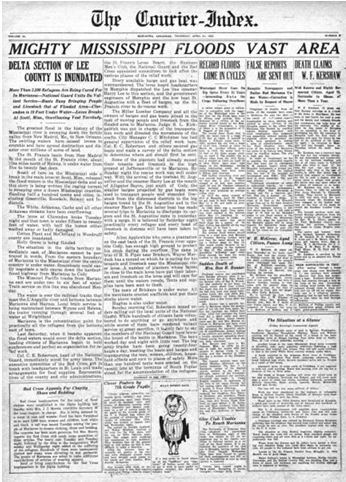](https://kb.astate.edu/uploads/images/gallery/2026-08/image-1786384567624.png)
The front page story of the Mariana Courier-Index:
April 21, 1927 (The Great Flood).
Image courtesy of the authors.
for refugees displaced from the 1927 Mississippi
River flood. The Arkansas Gazette, founded in
1819 at Arkansas Post and at Little Rock since
1820, consistently promoted immigration and
land sales, while documenting life in Arkansas
settlements and early “agribusiness.”
Collaborating with the Butler Center at the
Central Arkansas Library System, Historic Dyess
Colony Heritage Site managed by Arkansas State
University, and Special Collections at the Uni-
versity of Arkansas in Fayetteville, the Arkansas
State Archives has assembled a nearly complete
run of the Colony Herald, 1936-1937, from the
Dyess Colony in Mississippi County. The colony
offered relocatees modest houses with electricity
and water and the opportunity to support them-
selves by farming during the Depression. The
Herald contained community news and farming
techniques. The paper was suspended from mid-
January to mid-May 1937 as the colony was evac-
uated because of the 1937 flood. Singer Johnny
Cash, the most famous resident of the Dyess col-
ony, reflects on the rise of flood waters in his
childhood home in his 1959 song, “Five Feet
High and Rising.”
Newspapers relevant to the Delta region but
not originating from the area include the Arkan-
sas Homestead, Arkansas Farmer & Homestead, and
Arkansas Farmer (Little Rock). These titles focus
on agriculture statewide, dating from 1906-1930.
Another group of papers related but not originat-
ing in the Delta include a collection of populist-
related titles published in Faulkner, Pulaski, and
White counties from 1895-1938. The populist
movement originated in part with farmers’ frus-
tration with low crop prices, lack of access to
credit, and monopolies in transportation and
marketing. Issues of the Union Label Bulletin and
Union Labor Bulletin from Little Rock, 1903-1931
address concerns from various agricultural organ-
izations in the early twentieth century and are
now included on Chronicling America.
Since its migration to the Library of Con-
gress’s collections website, Chronicling America
now contains several Arkansas-specific titles not
submitted by the Arkansas State Archives. A col-
lection of miscellaneous African American titles
from the LoC were added in 2022. Included in
this collection were two titles from the Delta,
each single issues from 1900, the Pine Bluff Weekly
Herald, and the Reporter from Helena. Further ad-
ditions were made in 2023 when the LoC began
to reorganize their various online newspaper col-
lections under the Chronicling America name.
Two titles published in Japanese, by Japanese
Americans detained at the Rohwer Relocation
Center in Desha County, the Rohwer Outpost,
1942-1945, and Rohwer Relocator, 1945, are now
available as part of Chronicling America.
For a full list of Arkansas newspapers
currently digitized on the LoC’s Chronicling
America website, visit https://www.loc.gov/col-
lections/chronicling-america/dynamic-list-of-ti-
tles/ and search “Arkansas.”
The National Digital Newspaper Program is
a partnership between the National Endowment
for the Humanities (NEH) and the Library of
Congress. One cultural institution from each
state works alongside the Library of Congress to
digitize newspapers for that state, in grant cycles
of 100,000 pages at a time. The Arkansas State
Archives joined the project in 2017 and has digi-
tized Arkansas’s newspapers of record, papers
from underrepresented communities, and papers
that demonstrate the relationship between the
economy and the environment. All fifty US
states along with Puerto Rico and the Virgin Is-
lands have participated (or are currently partici-
pating) in this project.
To learn more about the National Digital News-
paper Program, visit https://www.loc.gov/ndnp/.
For more Arkansas State Archives resources in-
cluding search guides, lesson plans, topic guides,
recipe booklets and activities for kids, visit https://ar-
digital.contentdm.oclc.org/digital/collection/adnp.
[](https://kb.astate.edu/uploads/images/gallery/2026-08/image-1786384631671.png)