Volume 56, Issue #2 (August 2025)
Table of Contents
Arkansas Review: A Journal of Delta Studies
(formerly Kansas Quarterly)
Arkansas Review, Vol. 56, No. 2 (August 2025)
Video games, Blackness, and the South:
The Procedural Antiracist Praxis of Mafia III...................................................... 83
by Taylor Orgeron
The Ozark Flutist (poetry) ............................................................................................ 98
by Glenda S. Pliler
Fixed Match (fiction) ...................................................................................................... 102
by Joseph Thomas
Four Poems (poetry) ....................................................................................................... 112
Off 8th Street
Nest
Audrey’s House
American Flag Chest Piece
by Katherine Kallas
No Longer Silent: Marguerite and Margaret, Two Arkansan
Women Writers and their Shared Stories of the South ............................... 114
by Kerri L. Bennett.
Sparrow Wings (Tala) (fiction) .................................................................................. 125
by Michael Copperman
Two Poems (poetry) ........................................................................................................ 130
At a Rural Valero
Invisible Rift
by Tim DeJong
Grading Don Quixote (fiction) ................................................................................... 132
by R.M. Kinder
Three Poems (poetry) ...................................................................................................... 140
Getting in the Cows
Rice Farming
How To Dream the Delta
by CL Bledsoe
The Unknown Immigrant (fiction) ............................................................................ 143
by Murali Kamma
Delta Sources and Resources ....................................................................................... 154
The University of Arkansas Virtual Museum
Online Resource
by Marcus Charles Tribbett
Reviews .................................................................................................................................... 155
Zheng and Touchet, Still Motion: Poems and Photographs,
reviewed by Michael A. Antonucci
Bearden, Mississippi Hippie, A Life in 49 Pieces,
reviewed by William V. (Bill) Davidson
Contributors .......................................................................................................................... 159
Correction: This year, the Spring/April 2025 issue (Arkansas Review Volume 56, Issue 1) was mailed with
an incorrect issue number misprinted on the front cover (incorrectly printed as Issue 3). Although the
correct issue number is listed on the table of contents page, we sincerely regret the error! The correct
version of the front cover appears below and has been updated on our website at arkreview.org.

Contributors
Michael A. Antonucci is Professor Emeritus at Keene State College, where he taught courses on Black literature and culture. His monograph Understanding Michael S. Harper is available from U of South Carolina P. He is coeditor of the collection of interviews with Michael Harper forthcoming from UP of Mississippi.
Kerri L. Bennett, PhD, is an Instructor of English at Arkansas State University, where she teaches Freshman Composition, World Literature, and Heritage Studies Research Seminar. She has co-edited the last four editions of A-State’s first-year writing textbook, the newest of which is First-Year Composition@Arkansas State University: Writing with the Pack. She holds an MA in English from Arkansas State, an MAT from the University of Arkansas at Monticello, and a PhD from Arkansas State. Her research interests are in Nineteenth-Century British Literature, Women Writers, First-Year Writing, and Multimodal Composition.
CL Bledsoe is the author of more than thirty books, including Riceland and Having a Baby to Save a Marriage. Raised on a rice and catfish farm in eastern Arkansas, Bledsoe lives in northern Virginia with his daughter.
Michael Copperman’s work has appeared in The Oxford-American, Guernica, The Sun, Creative Nonfiction, Boston Review, Salon, Gulf Coast, Triquarterly, Kenyon Review, and Copper Nickel, among others, and has won awards and garnered fellowships from the Munster Literature Center, Breadloaf Writers Conference, Oregon Literary Arts, and the Oregon Arts Commission. His memoir Teacher: Two Years in the Mississippi Delta (UP of Mississippi, 2017), about the rural black public schools of the Mississippi Delta, was a finalist for the 2018 Oregon Book Award in CNF. His next book, Seeking Eden, about the extremes of the American subculture of wrestling as seen through the story of five-time national champion Kenny Cox’s pilgrimage into the Na Pali jungle, is forthcoming in the Fall of 2026 from U of Iowa P.
William Van (Bill) Davidson holds degrees from Rhodes College (BA Political Science 1962), the University of Memphis (MA Geography 1967), and the University of Wisconsin-Milwaukee (PhD Geography 1972). Since 1965 he has conducted field research as a historical-cultural geographer among the minority cultures of Yucatán and Central America, especially in Honduras. He has served as geography editor of the Handbook of Latin American Studies at the Library of Congress and is the author of numerous works on the ethnogeography and ethnohistory of Central America and the Caribbean. Retired from the faculty of the Department of Geography and Anthropology at Louisiana State University in Baton Rouge, he and wife Sharon Solomito live in Memphis, Tennessee.
Tim DeJong currently lives in central Texas but is originally from Hamilton, Ontario, Canada. He has poems published or forthcoming in Waxwing, Image, Rattle, The Penn Review, Modern Language Studies, and other journals. His poetry has been nominated for two Pushcart Prizes. His website is timothydejong.com
Katherine Kallas is a writer and artist based in Kansas City, Missouri. Her work investigates how memories are constructed and reimagined, exploring themes of nostalgia and home-coming. Her writing has recently been published in Spires Journal and Contemporary Verse 2. She is currently pursuing an MFA in Creative Writing at the University of Missouri, Kansas City.
Murali Kamma is the author of Not Native: Short Stories of Immigrant Life in an In-Between World (Wising Up P), which won an Independent Publisher Book Award. A graduate of the University at Buffalo and Loyola College, India, he's the managing editor of Khabar, an Atlanta-based magazine in English. His fiction has appeared in Havik, Evening Street Review, Rosebud, BigCityLit, Apple Valley Review, and other journals. He has interviewed, among others, Salman Rushdie, Anita Desai, William Dalrymple, Amitav Ghosh, and Pico Iyer. His fiction has also been published in anthologies like The Best Asian Short Stories.
R.M. Kinder is the author of three collections of short fiction and two novels: A Common Person and Other Stories (Richard Sullivan Award U of Notre Dame 2021); A Near Perfect Gift (U of Michigan Literary Fiction Award 2005); Sweet Angel Band (Helicon Nine Willa Cather Award 1991); An Absolute Gentleman (Counterpoint 2007); and The Universe Playing Strings (U of N Mexico P 2016). Her stories and poems have appeared in numerous literary magazines, including Descant, Southern Humanity Review, Arts and Letters, most recently in Green Hills Literary Lantern, and is forthcoming in Main Street Rag.
Taylor Orgeron is a native of Louisiana who resides in Oklahoma as Associate Professor of English in the Department of Language & Literature at Southwestern Oklahoma State University. Her research and teaching interests include first-year composition, digital/multimedia writing, and game studies. Her other work can be found in The Ethics of Playing, Researching, and Teaching Games in the Writing Classroom and Emerging Genres: New Formations of Games.
Glenda S. Pliler is a poet, essayist, and author whose work has appeared in The Iowa Review, The Christian Science Monitor, The Wittenberg Door, and elsewhere. Her poetry collection The Agony of Intimacy explores the evolution of love and human connection. Originally from Missouri, she now lives and writes in Florida.
Joseph Thomas is a graduate student studying creative writing at the University of Louisville. His work has appeared in the Equinox Literary Magazine, The Laurel Review, Necessary Fiction, and Nebo: A Literary Journal. He holds a BA in English—Creative Writing from the University of Arkansas at Little Rock, and he is currently working on a short story collection taking place in Hot Springs, Arkansas.
Marcus Charles Tribbett is General Editor of Arkansas Review: A Journal of Delta Studies and Associate Professor of English at Arkansas State University, where he also teaches for the interdisciplinary Heritage Studies doctoral program. He has published scholarly work on classic and contemporary blues performers, on a nineteenth-century slave narrative, and on contemporary novels by Jessmyn Ward and Tupelo Hassman. His most recent work, an essay on New Orleans bluesman Mem Shannon, appeared in Voices and Visions: Essays on New Orleans’s Literary History, edited by Nancy Dixon and Leslie Petty (UP of Mississippi, 2025).
Arkansas Review 56.2 (August 2025)
Four Poems
By Katherine Kallas
Off 8th Street
Memory is a place shattered by wind
Its pieces swept up into god’s dustpan
and dumped in the Mississippi River
The water is murky here, on the tilted shore off 8th street
Frogs with full lungs, as bulbous as onions
Cicadas scream in high-pitched static
Dragonflies hitch on the water’s surface
wisps of neon blue thread stitch a map
of someone with hair as long as tallgrass
With eyes that hang low
as the branches of a live oak
My boots sink in the mud bruising earth
I pack purple into the collarbones of the bank
Cast my line into the mouth of my reflection
and fish for something fat and familiar
Nest
Memory: something orange, like the glass beads in Jenna’s kitchen windows that separate me from a cloud-coated sky. My therapist tells me: settle into your body, try to find it again. How to find home in something lanky and unending? Burrow in a stomach made of silk and a head stuffed with steel wool.
I wish I could build myself a nest like the sandhill cranes on the shores of the Missouri River. With hearths full of blooming milkweed, burgundy flickering through the sedges. Beds cushioned with ferns and cattails, a muscular roof – a mother’s copper wingspan.
Instead, I hoard loose fibers and margarita straws, trying to construct safety in this body. To pack it full of lace and optimism, and fly to a lighter place.
Audrey’s House
Cicadas are Audrey’s birthday month bug
and sometimes if I close my eyes and believe too much
I can hear them way down in December
I watch girls drive dirt bikes through wiry grass
Churning up dust – all the dead things are alive again
resurrecting the dusty parts of me that July sun dried out
I fear the world spins too fast for me and that I’ll be left
floating on my back in an above-ground pool
somewhere Arkansas
So tonight,
I toast to imperfections
and with grapefruit on my tongue
I raise a glass to late August bitterness
American Flag Chest Piece
Points of contact at the ankle and nose, hook onto each other for stability.
It’s Tornado Alley outside.
I am patriotic when it comes to him.
Light roman candles, we watch the birth of several large stars.
I crawl under his skin, like an American flag chest piece.
Anita says I need to – Grow and learn to yell.
Louder than the static which hovers above fields of tall grass.
Balls of anxiety, mosquitos dart through the air looking for someone sweeter.
“Never settle.”
Red freckled shoulders, houses he constructs in the air, “when we . . .”
Talk of mountains, and toddlers, and porch swings, and balding.
Anita calls me for dinner. Her voice pierces the air, like the sharp salutes from paper bombs exploding on the driveway.
I march in blue boots all the way home
Delta Sources and Resources
The University of Arkansas
Virtual Museum
Online Resource
http://sdc.cast.uark.edu
by Marcus Charles Tribbett
The University of Arkansas Virtual Museum is an online project jointly created and main- tained by the Center for Advanced Spatial Tech- nologies (CAST) that features a number of 3D models of artifacts from the collections of the Ar- kansas Archaeological Survey (ARAS) and the University of Arkansas Museum. Some 210 arti- facts, cataloged by year of acquisition and number (Accession Number), have been digitized and are viewable and manipulable in the Gallery section of the website. The virtual museum is of interest mainly to archaeology researchers, teachers, and aficiona- dos who wish to virtually examine clay pots, tools, and artwork of the indigenous cultures of the region, particularly the Mississippian (with representative samples of Carden Bottoms Phase pottery and other Caddoan finds, for example). However, there are also some artifacts that repre- sent paleo-historical cultures as well as some much more recent material culture. The object viewer allows users to adjust light- ing, fully rotate the object to observe from all an- gles, zoom in and out, and find measurements. The surface layer of the digital scan can also be removed so that details emerge that may be ob- scured by the original coloration and decoration or the discoloration and degradation caused by time and damage: incised and carved marks on some objects are thus more easily seen. One drawback to the site is the minimal description of the artifacts. However, multiple searchable fields from a pulldown menu for each entry do provide some historical and cultural context. Following a brief descriptive name, each entry has a field for “Cultural Affiliation,” “Geo- graphical Region,” Time Range,” and “Reposi- tory.” For instance, item number 1927-5-37 is a “Bottle, teapot, Ceramic” from the Carden Bot- toms Phase in the Arkansas River Valley circa AD 1500-1700 and held by the UA museum. The col- lection can be filtered by these fields as well. One caveat: not all fields are complete for every arti- fact. Still, there is enough summary information for most entries for the feature to be useful. An advantage of the virtual museum is that many of the indigenous artifacts included have been repatriated to descendant communities and are displayed on the website by permission of these descendant groups. By making them avail- able virtually, professional and amateur research- ers may centrally view objects of initial interest that otherwise could be difficult to examine with- out travel and permission to see them. In times of shrinking research and travel budgets, this benefit is especially important. While the project is in its early stages, the website briefly discusses planned expansions to the virtual museum, such as adding additional pages with more contextual information and linking newly scanned objects to specific projects and educational initiatives. While by no means a vast database at this point, the Virtual Museum shows great promise for future growth. Even at its current modest size, researchers and teachers will find value in the resource. Let us hope it con- tinues to expand.
Reviews
Still Motion: Poems and Photo-graphs. By Jianqing Zheng & Leo Touchet. Photo Circle Press, 2025. Pp. 62, $15, paperback)
John Berger opens Ways of Seeing by asserting that “Seeing comes before words.” Explaining his claim, he writes, “The child looks and recognizes before it can speak.” Continuing his influential collection of exploratory essays on sight, recep- tion, and visual art, Berger identifies “another sense in which seeing comes before words,” stat- ing that “it is seeing which establishes our place in the surrounding world; we explain that world with words, but words can never undo the fact that we are surrounded by it. The relation be- tween what we see and what we know is never settled.” Written with clarity, strength, and direction, throughout its fifty-plus years in print, Ways o f Seeing has remained relevent for changing au- diences, over time. For example, Berger cites René Magritte’s painting The Key of Dreams to il- lustrate what he describes as the “always-present gap between words and seeing.” To establish the foundations of his volume’s argument at the end of chapter one, he declares, “our vision is contin- ually moving, continually holding things in a cir- cle around itself, constituting what is present to us as we are” (www.ways-of- seeing.com/ch1). In Still Motion Jianqing Zheng and Leo Touchet assemble ekphrastic poetry and photo- graphic images that speak back to the dialogue that emerges from Ways of Seeing. With the inter- play between Zheng’s poems and Touchet’s pho- tographs bridging the “gap between words and
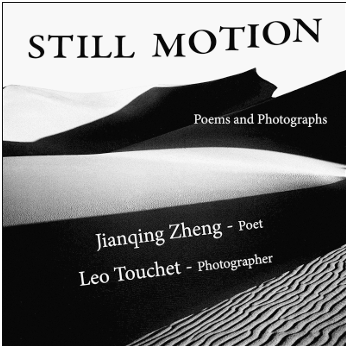
seeing,” this collaborative, interdisciplinary vol- ume arrives as a contemporary conversational partner for Berger’s celebrated study, delivering a collection of stark images and stunning imag- ery. At the outset of Still Motion, Zheng provides a description of the poetic project his contrib- utions to the collection pursue by writing, “I was fascinated with Leo’s black-and-white dune pho- tographs when I received Duet, a collection of photos and poems by Leo and his wife Liz.” Con- tinuing, the poet praises Touchet’s work with sand dunes in Chasing Shadows. He explains that the images in this collection have not only shaped Still Motion but informed his own sense of how ekphrasis works. Zheng writes “ekphratic writing is not a retelling of what we see in art- work,” before suggesting that, instead, “it con- cerns an interaction of the senses,” and arrives as “a creation from the original art.” Outlining these perspectives, Zheng explores the writing process he pursues in the twenty-five poems that he’s prepared for the volume.
--Michael A. Antonucci
Mississippi Hippie, A Life in 49 Pieces. By Willy Bearden. (Deep Delta Publishing, 2024. Pp. 286, $34.95, hardcover)
In the rural South, boys named “William” at birth are normally called “Billy” shortly there- after. A few of them, later on, become labeled “Willie/Willy.” By high school, almost all of these people have outgrown “Billy/Willy” and have become “just plain Bill.” Not many adults remain “Willy.” Of course, there is the obvious exception of the famous Willie Nelson . . . and our author here. This memoir is by a well-known Memphis personality who has proven himself quite success- ful in his chosen enterprises. He has focused mostly on historical Memphis, in his publica- tions and photographs, in several heavily-viewed documentary films, in organizing the University of Memphis symposia on the Delta, and general public relations. His accomplishments might be surprising given the life he describes in 49 non-chronologi- cal vignettes. He grew up in Rolling Fork, a village in the lower part of the so-called “Mississippi Delta.” The portrait he paints of the place, and his life there, is not pretty, but perhaps insightful of small town life in the American South, and espe- cially the Mississippi Delta, during the last half of the twentieth century. His father participated in the local “society of alcoholism,” (“a beautiful pack of alcoholics”), his mother toiled hours daily “on her feet” in a beauty shop, he was a poor student who learned to read late and who, embarrassingly, had to re- peat the seventh grade. At a young age, around the pool hall, roadhouses, and juke joints he learned all of the raw, crude clichés of Southern dialect. Growing up, his victories were few, but he did manage to tackle Archie Manning in a high school football game. Bearden especially likes storytelling and Mississippi Hippie is his story, “his truth,” that he hopes might enlighten and inspire others. His prose shines when he talks about some of the “characters” in Rolling Fork. These include his uncle “Doc,” Sheriff Tarleton, and the longtime jailer. Following his mother’s guidance to become

Along the way, Willy found that he could not accept the stereotypical attitudes of his town folk. On race: Probably because of his early friendships with black kids, he wasn’t racist. On war: The anti-Vietnam protester of the 1970s finds that “I am more anti-war now than I was in my 20s.” On religion: By his fourteenth year, Willy had shed his Episcopal/Baptist upbring- ings and found that he “had little use for church.” His philosophical summation is simple: “be nice, or leave.” Like many from the Delta, after high school he made his way to Memphis. He saw in Rolling Fork, as in other Delta towns, “the slow and pain- ful death that has lasted more than fifty years” and realized that he had to leave. At the end of his senior year in high school he drove to the mental institution outside of Jackson to see his father and left Rolling Fork. He tried a junior college and Ole Miss for less than a semester, be- fore returning to Memphis and a few odd jobs: wholesale liquor deliveries, sold old tires (at least tried to), became an ordained “minister,” and eventually got a job with Motion Picture Labo- ratory where he, after years, learned the film-mak- ing trade. One clear intent of this collection of recol- lections is to thank all the people who played a role in his life. In his first chapter, “The Book of the Dead,” he writes that since his eleventh birth- day he “kept a list of everyone I knew who had died.” In his last chapter (“Memorial Day”), he explains that “a person doesn’t die, for the sec- ond and final time, until their name is last said.” Then follows a radically-innovative ending to a book: he writes the names of 370 deceased people who he remembers. He wants dearly to credit others for his successes. But while I do not know the author, I see it differently. I am more inclined to believe that he is one of those few who succeed on their own, from their own inner strength. Bearden reeks of “tha Delta,” and loves the notion of that “place.” Fifty years after high school, he returned to buy a house in Rolling Fork where he penned this memoir. Perhaps he still wants to be called “Willy” because it keeps him attached to his Delta deep roots. For those interested in “Delta studies” this book is a valuable contribution—to understand life at both personal and community scales.
--William V. (Bill) Davidson