MS in Nutrition & Dietetics - RD Track Preceptor Handbook
PROGRAM TheINFORMATION
Welcome to the Arkansas State University Coordinated Program in Dietetics
Welcome Message
The faculty and staff of the DieteticsCoordinated Program extendin ourDietetics wish to offer sincere appreciationthanks to you for the significant contributions you make to our students, our program,program and the profession of dietetics. Without dedicatedyou, the preceptors, there would be no dietetic education wouldprograms notto betrain possible.
professionals. We recognize that you takeperform onyour thispreceptor roleroles in addition to your manyother professional responsibilities,duties without extra pay or tangible rewards. ServingPerforming asthe arole of preceptor requirestakes significantvaluable time andaway commitment,from demanding jobs and weschedules. deeplyWe respectapplaud theyour dedicationprofessional youcommitment bring to supporting the next generation of dietitians.
Please know that weand are here to support you.your Ifefforts.
havePlease questions,contact needs,us with any question, need, or concerns,issue, as we are only a phone call or email away. We alsoencourage welcomeyou to share your feedbackthoughts and provide valuable ideas for program improvement, as your perspective is essential to strengthening the learning experience for our students.improvement.
Program Contact
Dr. Tiffany Sterling, EdD, RD, LD, FAND
Director, Coordinated Program in Dietetics
College of Nursing and Health Professions
PO Box 910
State University, AR 72467
Office:Office 870-680-8598
Email: dietetics@astate.edu
Dietetics Program
The Coordinated Program in Dietetics at Arkansas State University is administered by the Department of Health Sciences & Risk Management within the College of Nursing and Health Professions. The program provides for the achievement of knowledge and performance requirements for entry-level dietitians through integration of active online learning with a minimum of 1,080 supervised practice hours. Supervised practice experiences occur in food service, community, and clinical settings, with half of hours occurring in the clinical setting. This allows students to build upon foundation knowledge and competencies for future proficiency in the clinical area of dietetics.
Students earn a Master’s of Science degree in Nutrition and Dietetics upon completion of the required 53 hours. The master’s program is delivered 100% online. Upon successful completion of the Master of Science in Nutrition and Dietetics (MSND) and all supervised practice requirements, graduates receive a Verification Statement and are eligible to take the Commission on Dietetic Registration (CDR) credentialing examination for Registered Dietitians/Registered Dietitian Nutritionists (RD/RDNs). After passing the examination, they become registered dietitians.
In addition to registered dietitian credentialing, many states have regulatory laws for dietitians and nutrition practitioners. Frequently, these state requirements are met through the same education and training required to become and maintain status as a registered dietitian.
Program Mission
The Dietetics Program at Arkansas State University is committedseeks to meetingmeet the need for registered dietitians in the Deltadelta region and beyond.beyond Weby provideproviding high-quality, equitable, and inclusive education and supervised practice experiences that preparefor all students for professional success in nutrition and dietetics.students.
Program Goals and Objectives
The successful graduate of the Arkansas State University Coordinated Program in Dietetics will:
1.
- Perform as a knowledgeable, competent entry-level
dietitian
dietitian.
- At least 80% of program students complete program/degree requirements within 3 years (150% of the program length).
OfAtgraduatesleast 80% of graduate survey respondents whoseekreportemployment,seeking80%employment are employed in nutrition and dietetics or related fields within 12 months of graduation.- Graduate Performance on Registration Exam:
- At least 80% of program graduates take the CDR credentialing exam for dietitian nutritionists within 12 months of program completion.
- The program’s one-year pass rate (graduates who pass the registration exam within one year of first attempt) on the CDR credentialing exam for dietitian nutritionists is at least 80%.
80% of graduates working in dietetics receive a score of “average or higher” for professional conduct when rated by employers on satisfaction surveys.
2. Pursue service to the profession of nutrition and dietetics
dietetics.
- At least 70% of program graduates will pursue service to the profession of dietetics as a preceptor, leader, through civic engagement, or through active participation in professional organizations within 3 years post-graduation..
Outcomes data are available upon request.
Program of Study
Degree: Master of Science
*AccreditationMajor: CouncilNutrition & Dietetics
|
Core Courses: |
Sem. Hours |
|---|---|
|
NUTR 66143, Health Care Delivery in the U. S. |
3 |
|
HSRM 64413, Research in HSRM |
3 |
|
NUTR 66303, Nutritional Epidemiology |
3 |
|
NUTR 66043, Data Analysis in the Health Professions |
3 |
|
Sub-total |
12 |
|
Major Requirements: |
< strong>Sem. Hours |
|
HSRM 64423, Leadership in HSRM |
3 |
|
NUTR 66243, Metabolic Nutrition |
3 |
|
NUTR 66253 Nutrition in Critical Illness |
3 |
|
NUTR 66263, Advanced Medical Nutrition Therapy |
3 |
|
NUTR 66843 Ethics of Health Care |
3 |
|
Sub-total |
15 |
|
Support Courses: |
Sem. Hours |
|
NUTR 66033, Topics in Food Service |
3 |
|
NUTR 66003, Management of Nutrition Services |
3 |
|
NUTR 66133, Food and Nutrition Public Policy |
3 |
|
Sub-total |
9 |
|
Supervised Practice Courses: |
Sem. Hours |
|
NUTR 61223, Practicum 1 |
3 |
|
NUTR 62223, Practicum 2 |
3 |
|
NUTR 63223, Practicum 3 |
3 |
|
NUTR 64224, Practicum 4 |
4 |
|
NUTR 65224, Practicum 5 |
4 |
|
Sub-total |
17 |
|
Total Degree Hours: |
53 |
PRECEPTOR ROLE IN SUPERVISED PRACTICE
Responsibilities of Preceptors
- Conduct a thorough orientation to the supervised practice setting.
- Meet with the student you precept on a regular basis.
- Permit students to shadow and learn from you
- Facilitate a positive professional learning environment.
- Provide opportunities for the student to practice what he/she has learned.
- Provide assistance and supervision as needed.
- Evaluate the student’s progress through verbal and written evaluations.
Let the student and the practicum instructor know early in the rotation if the student is not meeting expectations so he/she can learn and adjust. Evaluation results should not be a surprise at the end of a rotation.
- Complete required supervised practice documentation in a timely manner.
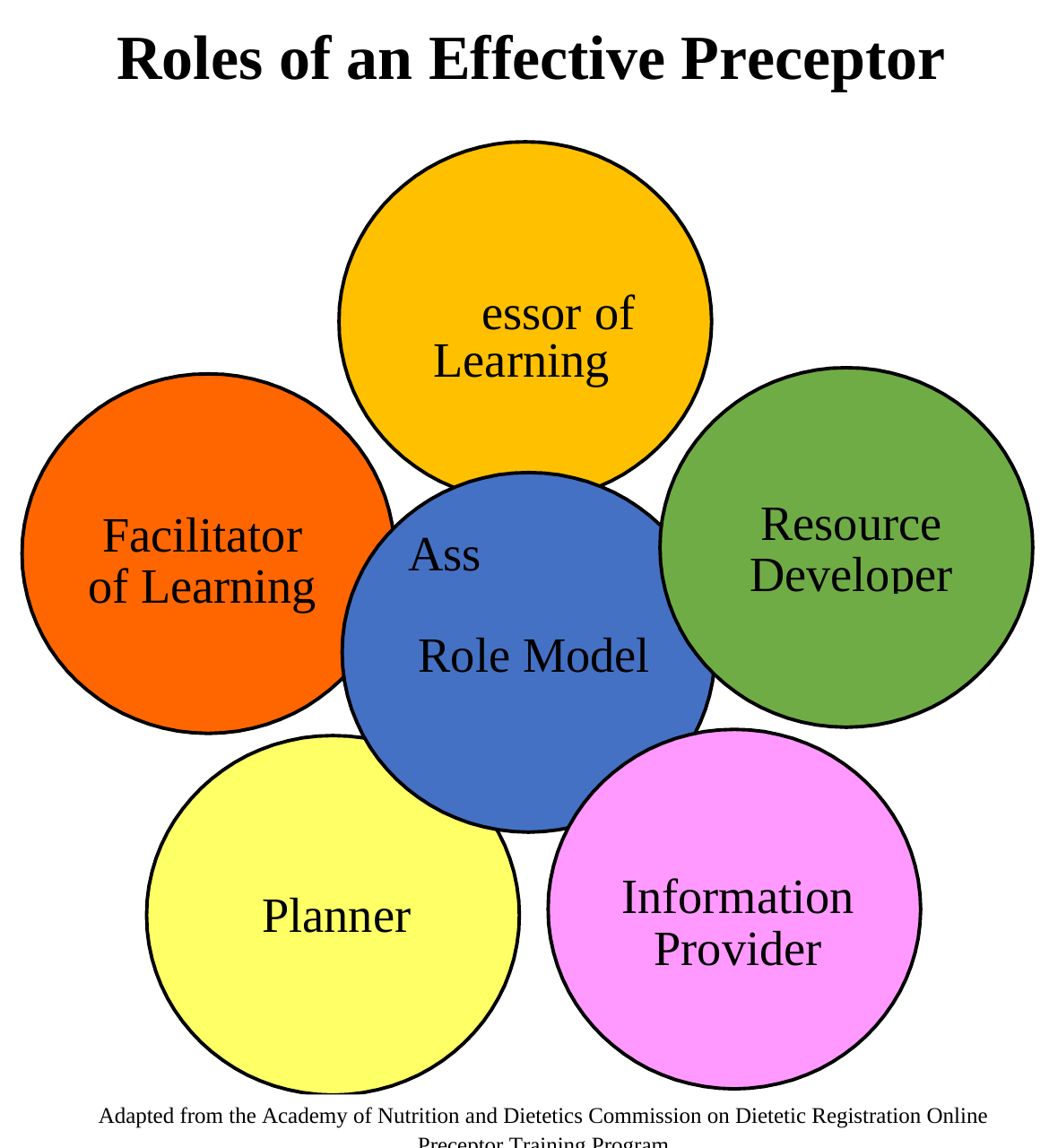
- Be a positive role model.
- Participate in preceptor training: read preceptor handbook; complete preceptor online training (Appendix B), including self-assessment tool (Appendix C); attend university training sessions. Preceptor online training provides 8 CPEUs at no cost; visit the dietetics preceptor training program. *This training was updated by ACEND in 2023. If you have previously completed it before 2023, you may complete it again and earn CEUs.*
- Privacy of student information: Preceptors must adhere to the Family Educational Right and Privacy Act (FERPA) which affords students certain rights in regard to their educational records. Consult the graduate bulletin for the complete policy.
Responsibilities of Practicum Instructors
- Communicate any changes in procedures, curriculum, rotation descriptions or competencies/learning outcomes to preceptors and students.
- Monitor progress of students through the competency evaluation forms.
- Address any concerns raised by either preceptors or students in a timely manner.
- Conduct regular site visits with preceptors and students.
- Incorporate preceptor feedback into the program assessment process.
- Work with preceptors to develop alternatives and solutions to challenges and difficulties as they arise.
Benefits of Precepting: Positive Outcomes of Working with Students
Help with work load: Students need to develop proficiency at gathering assessment data and doing the very things that can be the most time consuming for you. Once students are properly trained and oriented to your facility, they can be very helpful.
A fresh perspective: A second set of eyes looking for the same things you do can provide additional information or a new perspective on a situation or problem. Students have very little prior history influencing their decisions and can often bring fresh creativity to the work place.
Up to Date Information: Nutrition knowledge is constantly evolving and growing with continuous research. Students have access to the most current information in the field. Although they lack experience, their didactic education is fresh and they can be a resource on developing topics as well. Allowing them to share their knowledge makes the student feel valued and builds confidence.
Further Develop Your Management Skills: Precepting requires many management skills, from time and project management to coaching and personnel development. If management is a personal career goal, this can be a very valuable learning experience for you.
Opportunity to get a Special Project Done: Use student case studies and projects to do an analysis or project that you have identified as important to your organization but haven’t had the time or resources to complete. This allows the work to be a win-win situation for you and the student and can be rewarding as well.
Supporting Student Success
Communicate: It is critical to communicate not only with the student, but with the Practicum Instructor and others in your organization regarding the student and their learning experience.
- Communicate regularly with your practicum instructor at Arkansas State University.
- Make sure others in your organization know the student is going to be there and what should and should not be expected of them.
- Communicate on a planned and routine basis w ith the student regarding the specific competencies they must achieve.
Orient: Providing a thorough orientation to the student saves you time and protects the student, the organization, and your clients. As much as possible, make information available in writing so they can refer back to it.
- Provide a tour and maps of the facility, if necessary, along with hints for how to get around. Many organizations have HIPAA training and emergency action plan training. Be sure to pass this along to the student as well, although A-State has provided HIPAA training.
- Many organizations have an orientation that covers the mission and goals of the organization, plus policies and procedures. Providing an organizational chart with names, job titles and working relationships can also be helpful to understanding the function of a department or organization.
- Students must be oriented to security and technology such as phones, computers, copy machines, ID cards, etc.
- Make sure they know what they can use and what they cannot use, as well as where they can and cannot go.
- Finally, orient them to your job, resources to which you have access, office supplies, patient education materials and forms.
Handling Difficult or Problem Situations
It is always preferable to address the student directly with a reminder of clear expectations, before contacting the A-State Practicum Instructor. Remind the student of the expectation, and why it is important. Never ignore a problem and assume the student knows what is expected. If a student ignores a clear expectation that you have reminded them about twice, always contact the Practicum Instructor to describe the situation and share your concerns. The sooner we are aware, the sooner we can work on resolution. This information should never be a surprise to the student.
1. Absence or Tardiness. Absences from the supervised practice facility must be reported to the preceptor and the Practicum Instructor. The preceptor should be notified prior to the time the student is expected to be present; the Practicum Instructor should be notified shortly thereafter. It is not the responsibility of the preceptor to notify the Practicum Instructor that a student was absent. Students understand that they must accumulate a specific number of hours in each supervised experience and that all hours missed must be made up, at your convenience, including emergencies. Options must be acceptable to you and your schedule. Absence and tardiness reflect poorly on the student’s professional behavior and work ethic and may result in corrective/disciplinary action.
2. Emergency Absence. Students are expected to contact both the preceptor and the Practicum Instructor prior to the start time if they have an emergency and will be late or absent.
3. Inappropriate Dress. This may be the first time a student has ever dressed for a professional workplace. While we attempt to be as specific as possible regarding proper attire, some issues may need to be pointed out or reinforced.
4. Making personal phone calls, texting or sending personal email messages while at supervised practice facility. Students are instructed to use cell phones and electronic devices as a student resource (textbook or calculator) or as a phone only in case of family emergency UNLESS specified otherwise by the preceptor and/or individual facility policy. They should get your permission if they need to make a call due to an emergency. Generally, their full attention should be on their learning experience.
5. Negative, disrespectful or unprofessional behavior. Like any other behavior, clear expectations, timely correction and modeling appropriate behavior is the way to correct this behavior. Explain why it is important to behave in specific ways in certain circumstances. If you need help handling this type of behavior, discuss this with the Practicum Instructor.
6. Excessive knowledge gaps. You may wish to discuss the previous coursework and background of the student. They simply may not have been taught certain material yet. However, if they are not recalling information that they have been taught, they will need to develop a plan to augment their knowledge and review material. It is not your job to teach this material; it is a good idea to contact the Practicum Instructor and get their assistance in helping the student with this plan. It is in the student’s personal best interest to address these issues as well, as they will be attempting to pass the RD exam and become a competent entry-level dietitian at the completion of the program.
7. Personality conflicts. This usually is not a matter of the student doing anything wrong. On some RARE occasions, certain personalities simply do not mix. It is best to discuss this with the Practicum Instructor to see if any action is warranted or resolution can be reached.
Continuing Education inHours
The commission on Dietetic Registration allows for continuing education hours to be awarded for precepting students. One to three hours are awarded depending on the amount of contact time with the student. Forms may be found at https://www.cdrnet.org/cpeu-credit-for-preceptors.
STUDENT ROLE IN SUPERVISED PRACTICE
Student Admission and Preparation
- A selective admissions process is used to select the most qualified students for the Coordinated Program. Students apply for admission for either Summer or Fall entry into the program. Application deadlines are established approximately two weeks prior to ACEND notification deadlines. Applicants are notified of their admission status on or before November 1 for Summer admission and on or before March 1 for Fall admission. A grade point average of 3.0 or better on a 4.0 scale is required for admission. Students must have earned an undergraduate degree from an accredited institution including the following courses:
- Required Upper-Level Prerequisites (24 credit hours):
- Lifecycle Nutrition
- Nutritional Biochemistry
- Nutrition Assessment
- Food Science
- Nutrition C ounseling
- Community Nutrition
- Medical Nutrition Therapy
- Applied Statistics - Junior-level or higher
- Foundational Prerequisites (27 credit hours):
- Basic Human Nutrition
- Concepts of Chemistry with Lab
- Concepts of Organic & Biochemistry OR Survey of Organic Chemistry
- Anatomy & Physiology I with Lab
- Anatomy & Physiology II with Lab
- Microbiology with Lab
- Introduction to Sociology
- Introduction to Psychology
- Once accepted, students complete the following requirements upon starting the program:
- CPR certification
- ServSafe certification
- Certified Background Check
- Academy of Nutrition and Dietetics
(ACEND)membership - Required
objectives.immunizations including Hepatitis B and TB skin test - Personal health insurance
- Student professional liability insurance
- HIPAA training
WhatResponsibilities of A-State Students
- Make initial contact with preceptor to determine time, location, dress code and parking for the first day.
- Prepare for and participate in all supervised practice activities. Assume responsibility for your own learning.
- Comply with all policies of the Dietetics Student Handbook.
- Comply with all policies and procedures of the facility.
- Refrain from making personal calls, texts, and emails while at the facility.
- Communicate regularly with preceptors regarding expectations, progress, questions and problem areas.
- Plan and organize assignments for the day and week. Take responsibility for accomplishing the learning objectives for the experience.
- Present necessary paperwork and evaluations to preceptor ahead of the deadline, to allow adequate time for review and signatures.
- Be willing to take some risks and stretch outside of personal comfort zone in order to grow and learn.
- Be respectful of knowledge and experience gained through professional practice.
- Realize that preceptors receive no extra pay or tangible rewards for working with students. They are simply volunteers who want to pay back to the profession.
- Be grateful for and receptive to both positive feedback and suggestions for improvement, as both can be helpful.
- Manage health and personal lives in order to be able to give the supervised practice experience your full focus and energy.
Supervised Practice from a Student’s Perspective
I am not an intern. As a student in a Coordinated Program supervised practice experiences, I can be anywhere in my professional program, from an entry-level student to my final semester. However, I am not done with my didactic program, as an intern would be. Thus, I may have gaps in my knowledge, and I hope that you will be understanding. I am here to learn. Supervised practice experiences are an extension of classroom learning. Feel free to provide supplemental learning material to facilitate my ability to function in your setting.
I am not like your last student. Students come from a wide range of backgrounds. Some of us are very young and inexperienced and have rarely worked before while others are pursuing second careers, are more mature and have a great deal of work experience. I might be very comfortable with patients or could need more exposure to develop confidence with patients. We come from a wide range of cultural and experience backgrounds that are sure to enrich your workplace.
No matter who I am, this is all new to me. Please be patient and encourage me to take risks in order to develop confidence. For the most part, every experience that I enter is a Coordinatedforeign Program?environment. It is similar to starting a new job every couple of months! Please take the time to orient me to the physical environment and policies, and even to describe the culture at your particular facility.
ArkansasShare Statewith University’sme Coordinatedyour Program“tips and tricks.” Please let me learn from your experiences by sharing the “tricks of the trade” and techniques you have developed along the way. How do you manage time and work load? How do you handle difficulty situations? If a particularly good learning opportunity arises, please include me in Dieteticsit.
Please beganremember that I am still in 2012school. asWe thestudents only program of its kindare in Arkansas. Originally offered at the undergraduate level, it has since transitioned into a fully online graduate program, awarding the Master of Science in Nutrition and Dietetics (MSND).
A coordinated program integrates graduate-level coursework with 1,080 hours of supervised practice. Students complete both components simultaneously, allowing them to immediately apply classroom learning in professional settings. This highly structured approach ensures that supervised practice experiences reinforceand academicalso contenthave a full load of coursework to attend to during evenings and prepareweekends. graduatesWe are expected to be flexible and give you our full attention for entry-levelthe dieteticshours practice.we have committed to, but additional hours beyond our experience requirements may be impractical given our course load.
Excerpts from Dietetics Student ReadinessHandbook &Related Complianceto RequirementsSupervised Practice
Insurance Requirements
All students mustare carryrequired to have health, automobile,automobile and professional liability insurance and provide documentation to the program director before beginning supervised practice rotations.
Travel
While the program makes reasonable efforts to assist students in identifying appropriate supervised practice experiences, placement at a specific site or geographic location cannot be guaranteed. Students should anticipate that travel may be required to complete supervised practice experiences. The availability of qualified sites and preceptors varies by geographic location. In some cases, students may need to travel, temporarily relocate, or complete rotations outside their local area to meet program requirements and required competencies. Students are responsible for transportation, travel-related expenses, and liability associated with travel to sites within a 75–90 mile radius of their home. They must furnish their own reliable transportation and assumefrom allsupervised costspractice and liability.sites. Travel time does not count toward supervised practice hours.
Injury or Illness at Supervised Practice Sites
Students who are injured or become ill or sustain an injury during a supervised practice willexperience may be sentreferred to thean Emergencyemergency Roomdepartment, urgent care facility, or private physicianhealthcare asprovider appropriate.for evaluation and treatment. Students are responsible for anyall financialcosts expensesassociated incurred,with asmedical wellcare asand must maintain health insurance tocoverage coverthroughout suchenrollment emergenciesin the program. Arkansas State University and follow-upsupervised care.practice facilities are not responsible for medical expenses incurred as a result of illness or injury during supervised practice experiences.
Drug Testing and Criminal Background Checks
StudentsAll arestudents requiredadmitted to undergothe Coordinated Program must successfully complete a drug test and criminal background check ifprior requiredto bybeginning the program. The criminal background check must have been completed within six months of the first day of classes. Some supervised practice site.facilities may require additional criminal background checks, drug testing, fingerprinting, or other screening procedures as a condition of placement. Students are responsible for anyall feescosts associated with theserequired screening procedures. Failure to satisfy program or supervised practice facility requirements may prevent participation in supervised practice experiences and may delay progression or completion of the program.
Student Replacement of Employees
Students completing supervised practice experiences will not be used to replace employees or perform routine staffing functions. Planned staff-relief experiences may occur when educationally appropriate and necessary to achieve program competencies. Such experiences are designed to enhance learning and are supervised in accordance with program requirements. Students are not compensated for supervised practice hours completed as part of program requirements.
Professional Dress Code
Students are expected to dress inmaintain a clean, neat, and professional mannerappearance at allduring supervised practice sites.experiences. ImproperFailure attireto willcomply with dress requirements may result in dismissal from the site until appropriate attire is obtained. Time missed is counted as an absence.
Students must wear:
- Program name badge
- Arkansas State University identification badge
Clinical Rotations
Students are expected to changewear clothes,professional attire appropriate to the practice setting.
Acceptable attire includes:
- White lab coat
- Scrubs
- Business-casual professional attire approved by the facility
Attire must be clean, neat, in good repair, and timeappropriate lostfor patient care and professional interactions.
Not permitted:
- Jeans unless specifically approved by the site
- Shorts
- T-shirts unless specifically approved by the site
- Exercise clothing
- Clothing that is
consideredexcessivelyabsencetight,time.revealing, torn, or otherwise inappropriate for a professional healthcare environment
Shoes
- Closed-toe
- Closed-heel
- Low-heeled when appropriate for the setting
- Clean and in good condition
Tennis shoes or athletic shoes may be worn only when approved by the supervised practice site.
SpecificHair
- Hair net must be worn in foodservice areas
- Facial hair must be neat and trimmed
Food Service Rotations
Requirements include:
- Slip-resistant shoes
- Minimal jewelry
- No gum chewing
- No candy while working
Community Rotations
Dress requirements vary by rotationsite.
When labapproved, coatstudents requiredmay inwear:
- A-State T-shirt
- Plain red, black, or white T-shirt
- Jeans without holes
- Knee-length shorts
- Closed-toe shoes
Additional A‑StateAppearance t‑shirtStandards
- Name badge visible at
Farmer’sallMarket).times - Nails
fullkepthandbooktrimmed - Nail
detailedenhancementsattiremayguidelines.be prohibited - Excessive makeup is discouraged
- Strong perfumes, lotions, or colognes should not be worn
- Students should maintain good personal hygiene
Students must comply with appearance standards established by supervised practice facilities, including requirements regarding tattoos, facial piercings, jewelry, hair, nails, fragrances, and other grooming practices. Students must comply with any additional appearance, dress, grooming, safety, and identification requirements established by supervised practice facilities. Facility requirements supersede program dress code requirements.
Professional Behaviors
StudentsProfessional behavior is expected in all academic and supervised practice settings.
Examples include:
- Following the Code of Ethics for the Profession of Dietetics
- Regular attendance and punctuality
- Timely completion of assignments
- Respectful interactions with faculty, peers, patients, and staff
- Compliance with dress code expectations
- Acceptance of constructive feedback
- Adherence to university, college, and program policies
- Professional and ethical conduct at all times
Professional behaviors are expectedevaluated throughout coursework and supervised practice experiences. Areas evaluated may include critical thinking, interpersonal skills, communication skills, use of constructive feedback, problem-solving, professionalism, responsibility, and stress management. Students demonstrating deficiencies in professional behavior may be subject to remediation and disciplinary procedures as outlined in this handbook.
Failure to demonstrate ethical performance, punctuality, completion of assignments, positive relationships, compliance with dress code, and responsiveness to feedback. Unprofessional or disruptiveprofessional behavior may resultlead in corrective orto disciplinary action.
Cell Phones and Electronic Devices
Cell phones and electronicElectronic devices may be used onlywhen asapproved professionalby resourcesfaculty or supervised practice sites.
Students may not:
- Take unauthorized photographs in
emergencies, at the discretion of the faculty member orclinicalsite.settings. - Store
photography or storage ofprotected patient informationisonstrictlypersonalprohibited under HIPAA.Program of Study – Master of Science in Nutrition & DieteticsCore Courses (12 hours)NUTR 66143 – Health Care Delivery in the U.S. (3 hrs)devices.HSRMUse6413devices–forResearchacademicin HSRM (3 hrs)NUTR 66303 – Nutritional Epidemiology (3 hrs)NUTR 66043 – Data Analysis in the Health Professions (3 hrs)dishonesty.
Subtotal: 12 hoursMajor Requirements (15 hours)HSRM 6423 – Leadership in HSRM (3 hrs)NUTR 66243 – Metabolic Nutrition (3 hrs)NUTR 66253 – Nutrition in Critical Illness (3 hrs)NUTR 66263 – Advanced Medical Nutrition Therapy (3 hrs)NUTR 66843 – Ethics of Health Care (3 hrs)
Subtotal: 15 hoursSupport Courses (9 hours)NUTR 66033 – Topics in Food Service (3 hrs)NUTR 66003 – Management of Nutrition Services (3 hrs)NUTR 66133 – Food and Nutrition Public Policy (3 hrs)
Subtotal: 9 hoursSupervised Practice Courses (17 hours)NSP 6123 – Practicum 1 (3 hrs)NSP 6223 – Practicum 2 (3 hrs)NSP 6323 – Practicum 3 (3 hrs)NSP 6424 – Practicum 4 (4 hrs)NSP 6524 – Practicum 5 (4 hrs)
Subtotal: 17 hoursTotal Degree Hours: 53Admissions and PrerequisitesStudent Admission and Preparation – PrerequisitesA selective admissions process is used to identify the most qualified students for the Coordinated Program. Students may apply throughout the year. To be considered, applicants must have completed:Undergraduate degree from an accredited institution, including courses in:Lifecycle NutritionNutritional BiochemistryNutrition AssessmentFood ScienceNutrition CounselingCommunity NutritionMedical Nutrition TherapyApplied Statistics (junior level or higher)
ServSafe CertificationUndergraduate GPA of 3.0 or higher (on a 4.0 scale)
Requirements Upon Program StartOnce accepted, students must complete the following before beginning supervised practice:CPR certificationCertified background checkAcademy of Nutrition and Dietetics membershipRequired immunizations (including Hepatitis B and TB skin test)Personal health insuranceStudent professional liability insuranceHIPAA training
Additional Compliance RequirementsInsurance:maintaincomplyhealth,withautomobile,all university, facility, HIPAA, FERPA, andprofessionalinformationliabilitysecurityinsurancerequirementsandwhenprovideusingdocumentationelectronicbeforedevicessupervisedfor academic or supe rvised practicebegins.activities.
DrugHIPAA
Testing & Background Checks:Students are required to undergo a drug test and criminal background check if required by the supervised practice site. Students are responsible for any fees associated with these procedures.Travel:Students may be required to travel up to 75–90 miles to rotation sites. Reliable transportation and vehicle insurance are required. Travel time does not count toward supervised practice hours.Injuryviolations orIllness:academicStudentsmisconductwho are injured or become ill during supervised practice will be sent to the Emergency Room or private physician as appropriate. Students are responsible for any expenses incurred.
Supervised Practice Responsibilities & TimelineResponsibilities of A‑State Students in Supervised PracticeExpectations for Student ConductInitiate contact with your preceptor prior to the first day to confirm time, location, dress code, and parking.Prepare for and actively participate in all supervised practice activities, taking responsibility for your own learning.Follow all policies outlined in the Dietetics Student Handbook.Adhere to the policies and procedures of the assigned facility.Avoid personal calls, texts, and emails while at the facility.Communicate regularly with preceptors about expectations, progress, questions, and challenges.Plan and organize daily and weekly assignments, ensuring that learning objectives are met.Submit required paperwork and evaluations to preceptors well before deadlines to allow time for review and signatures.Be willing to step outside your comfort zone to grow and learn.Show respect for the knowledge and experience gained through professional practice.Recognize that preceptors volunteer their time without additional pay or tangible rewards, giving back to the profession.Accept both positive feedback and constructive suggestions with gratitude, recognizing their value to your growth.Manage personal health and responsibilities to ensure you can devote full focus and energy to supervised practice.
Policies During Supervised PracticeStudent Replacement of Employees:Students do not replace employees for routine work responsibilities unless staff relief is planned as part of the CP supervised practice experience to meet specific competencies.Professional Dress Code:Students must follow the dress code outlined in the handbook. Improper attire willmay result indismissaldisciplinarytoaction,change clothes, and time lost is considered absence time.Professional Behaviors:Ethical performance, punctuality, completion of assignments, positive relationships, compliance with dress code, responsiveness to feedback.Cell Phones & Electronic Devices:Restricted to professional purposesfailure, oremergencies. Unauthorized photography or storage of patient information is strictly prohibited under HIPAA.
Responsibilities of Preceptors in Supervised PracticeProvide a thorough orientation to the supervised practice setting.Meet regularly with the student you are precepting.Allow students to shadow and learn from your professional practice.Foster a positive and supportive learning environment.Offer opportunities for students to apply what they have learned.Provide assistance and supervision as needed.Evaluate student progress through verbal and written feedback.Notify the student and practicum instructor early in the rotation if expectations are not being met. Evaluation results should never come as a surprise at the end of a rotation.
Complete required supervised practice documentation in a timely manner.Serve as a positive role model.Participate in preceptor training (handbook, online modules, university sessions).Protect student privacy by adhering to FERPA.
Responsibilities of Practicum Instructors in Supervised PracticeCommunicate curriculum/rotation updates promptly to preceptors and students.Monitor student progress using competency evaluation forms.Address concerns raised by preceptors or students in a timely and professional manner.Conduct regular site visits.Incorporate preceptor feedback into ongoing program assessment and improvement.Collaborate with preceptors to develop solutions when challenges arise.
Practicum Rotation Timeline➡️Practicum I (NSP 6123)– 3 credit hoursSchool and long-term care food serviceOnsite Hours:180➡️Practicum II (NSP 6223)– 3 credit hoursHospital food serviceOnsite Hours:180➡️Practicum III (NSP 6323)– 3 credit hoursCommunity nutrition practiceOnsite Hours:180➡️Practicum IV (NSP 6424)– 4 credit hoursClinical practice in long-term care and hospital settingsOnsite Hours:270➡️Practicum V (NSP 6524)– 4 credit hoursClinical practice in hospital and outpatient settingsOnsite Hours:270
Total Supervised Practice: 17 credit hours (1,080 onsite hours)Coordinated Program Core Knowledge and Competencies for the RD
During the CP, students will meet the competencies expected of dietetics students who progress to entry-level professionals. Students must successfully complete both the academic course requirements and supervised practice experiences in order to receive a Master of Science degree.
Domain 1. Scientific and Evidence Base of
Practice:PracticeIntegration of scientific information and research into practice.
Knowledge
KnowledgeUpon completion of the program, graduates are able to:KRDN 1.1 Demonstrate how to locate, interpret, evaluate and use professional literature to make ethical, evidence-based decisions.
KRDN 1.2 Select and use appropriate current information technologies to locate and apply evidence-based guidelines and protocols.
KRDN 1.3 Apply critical thinking skills.
Competencies
- completion of the program, graduates are able to:
CRDN 1.1 Select indicators of program quality and/or customer service and measure achievement of objectives.
CRDN 1.2 Evaluate research and apply evidence-based guidelines, systematic reviews and scientific literature in nutrition and dietetics practice.
CRDN 1.3 Justify programs, products, services and care using appropriate evidence or data.
CRDN 1.4 Conduct projects using appropriate research or quality improvement methods, ethical procedures and data analysis utilizing current and/or new technologies.
CRDN 1.5 Incorporate critical-thinking skills in overall practice.
Upon
Domain 2. Professional Practice
Expectations:ExpectationsBeliefs, values, attitudes and behaviors for the professional dietitian nutritionist level of practice.
Knowledge
Upon completion of the program, graduates will be able to:
KRDN 2.1 Demonstrate effective and professional oral and written communication and documentation.
KRDN 2.2 Describe the governance of nutrition and dietetics practice, such as the Scope of Practice for the Registered Dietitian Nutritionist and the Code of Ethics for the Profession of Nutrition and Dietetics.
KRDN 2.3 Assess the impact of a public policy position on nutrition and dietetics practice.
KRDN 2.4 Discuss the impact of health care policy and different health care delivery systems on food and nutrition services.
KRDN 2.5 Identify and describe the work of interprofessional teams and the roles of others with whom the registered dietitian nutritionist collaborates.
KRDN 2.6 Demonstrate cultural
humility…humility, - awareness of personal biases and an understanding of cultural differences as they contribute to diversity, equity, and inclusion.
KRDN 2.7 Describe contributing factors to health
inequity…inequity - in nutrition and dietetics including structural bias, social inequities, health disparities and discrimination.
KRDN 2.8 Participate in a nutrition and dietetics professional
organization…organization - and explain the significant role of the organization.
KRDN 2.9 Defend a position on issues impacting the nutrition and dietetics profession.
Competencies
Upon completion of the program, graduates will be able to:
CRDN 2.1 Practice in compliance with current federal
regulations…regulations - and state statutes and rules, as applicable, and in accordance with accreditation standards and the Scope of Practice for the Registered Dietitian Nutritionist, Standards of Practice, Standards of Professional Performance, and Code of Ethics for the Profession of Nutrition and Dietetics.
CRDN 2.2 Demonstrate professional writing
skills…skills - in preparing professional communications.
CRDN 2.3 Demonstrate active participation,
teamwork…teamwork - and contributions in group settings.
CRDN 2.4 Function as a member of interprofessional teams.
CRDN 2.5 Work collaboratively with
NDTRs…NDTRs - and/or support personnel in other disciplines.
CRDN 2.6 Refer clients and patients to other
professionals…professionals - and services when needs are beyond individual scope of practice.
CRDN 2.7 Apply change management
strategies…strategies - to achieve desired outcomes.
CRDN 2.8 Demonstrate negotiation skills.
CRDN 2.9 Actively contribute to
professional/nutrition and dietetics professional and community organizations.CRDN 2.10 Demonstrate professional
attributes…attributes - in all areas of practice.
CRDN 2.11 Show cultural
humility…humility - in interactions with colleagues, staff, clients, patients and the public.
CRDN 2.12 Implement culturally sensitive
strategies…strategies - to address cultural biases and differences.
CRDN 2.13 Advocate for
legislative/local, state or national legislative and regulatoryissues…issues or policies impacting the nutrition and dietetics profession.
Domain 3. Clinical and Customer Services: Development and delivery of information, products and services to individuals, groups, and populations.
Knowledge
Upon completion of the program, graduates will be able to:
KRDN 3.1 Use the Nutrition Care Process and clinical workflow elements to assess nutritional parameters, diagnose nutrition related problems, determine appropriate nutrition interventions, and develop plans to monitor the effectiveness of these interventions.
KRDN 3.2 Develop an educational session or program/educational strategy for a target population.
K RDN 3.3 Demonstrate counseling and education methods to facilitate behavior change and enhance wellness for diverse individuals and groups.
KRDN 3.4 Practice routine health screening assessments, including measuring blood pressure and conducting waived point-of-care laboratory testing (such as blood glucose or cholesterol).
KRDN 3.5 Describe concepts of nutritional genomics and how they relate to medical nutrition therapy, health and disease.
KRDN 3.6 Develop nutritionally sound meals, menus, and meal plans that promote health and disease management and meet client’s /patient’s needs.
Competencies
Upon completion of the program, graduates will be able to:
CRDN 3.1 Perform Medical Nutrition Therapy by utilizing the Nutrition Care Process including use of standardized nutrition terminology as a part of the clinical workflow elements for individuals, groups and populations of differing ages and health status, in a variety of settings.
CRDN 3.2 Conduct nutrition focused physical exams.
CRDN 3.3 Perform routine health screening assessments including measuring blood pressure, conducting waived point-of-care laboratory testing (such as blood glucose or cholesterol), recommending and/or initiating nutrition-related pharmacotherapy plans (such as modifications to bowel regimens, carbohydrate to insulin ration, B12 or iron supplementation).
CRDN 3.4 Provide instruction to clients/patients for self-monitoring blood glucose considering diabetes medication and medical nutrition therapy plan.
CRDN 3.5 Explain the steps involved and observe the placement of nasogastric or nasoenteric feeding tubes; if available, assist in the process of placing nasogastric or nasoenteric feeding tubes.
CRDN 3.6 Conduct a swallow screen and refer to the appropriate health care professional for full swallow evaluation when needed.
CRDN 3.7 Demonstrate effective communication and documentation skills for clinical and client services in a variety of formats and settings, which include telehealth and other information technologies and digital media.
CRDN 3.8 Design, implement and evaluate presentations to a target audience.
CRDN 3.9 Develop nutrition education materials that are culturally and age appropriate and designed for the literacy level of the audience.
CRDN 3.10 Use effective education and counseling skills to facilitate behavior change.
CRDN 3.11 Develop and deliver products, programs or services that promote consumer health, wellness and lifestyle management.
CRDN 3.12 Deliver respectful, science-based answers to client/patient questions concerning emerging trends.
CRDN 3.13 Coordinate procurement, production, distribution and service of goods and services, demonstrating and promoting responsible use of resources.
CRDN 3.14 Develop and evaluate recipes, formulas and menus for acceptability and affordability that accommodate the cultural diversity and health needs of various populations, groups and individuals.
Domain 4. Practice Management and Use of Resources: Strategic application of principles of management and systems in the provision of services to individuals and organizations.
Knowledge
Upon completion of the program, graduates will be able to:
KRDN 4.1 Apply management theories to the development of programs or services.
KRDN 4.2 Evaluate a budget/financial management plan and interpret financial data.
KRDN 4.3 Demonstrate an understanding of the regulation system related to billing and coding, what services are reimbursable by third party payers and how reimbursement may be obtained.
KRDN 4.4 Apply the principles of human resource management to different situations.
KRDN 4.5 Apply safety and sanitation principles related to food, personnel and consumers.
KRDN 4.6 Explain the processes involved in delivering quality food and nutrition services.
KRDN 4.7 Evaluate data to be used in decision-making for continuous quality improvement.
Competencies
Upon completion of the program, graduates will be able to:
CRDN 4.1 Participate in management functions of human resources (such as training and scheduling).
CRDN 4.2 Perform management functions related to safety, security and sanitation that affect employees, clients, patients, facilities and food.
CRDN 4.3 Conduct clinical and client service quality management activities (such as quality improvement or quality assurance projects).
CRDN 4.4 Apply current information technologies to develop, manage and disseminate nutrition information and data.
CRDN 4.5 Analyze quality, financial and productivity data for use in planning.
CRDN 4.6 Propose and use procedures as appropriate to the practice setting to promote sustainability, reduce waste and protect the environment.
CRDN 4.7 Conduct feasibility studies for products, programs, or services with consideration of costs and benefits.
CRDN 4.8 Develop a plan to provide or develop a product, program or service that includes a budget, staffing needs, equipment and supplies.
CRDN 4.9 Explain the process for coding and billing for nutrition and dietetics services to obtain reimbursement from public or private payers, fee-for-service and value-based payment systems.
CRDN 4.10 Analyze risk in nutrition and dietetics practice (such as risks to achieving set goals and objectives, risk management plan, or risk due to clinical liability or foodborne illness).
Domain 5. Leadership and Career Management: Skills, strengths, knowledge and experience relevant to leadership potential and professional growth for the nutrition and dietetics practitioner.
Knowledge
Upon completion of the program, graduates will be a ble to:
KRDN 5.1 Perform self-assessment that includes awareness in terms of learning and leadership styles and cultural orientation and develop goals for self-improvement.
KRDN 5.2 Identify and articulate one’s skills, strengths, knowledge and experiences relevant to the position desired and career goals.
KRDN 5.3 Practice how to self-advocate for opportunities in a variety of settings (such as asking for support, presenting an elevator pitch).
KRDN 5.4 Practice resolving differences or dealing with conflict.
KRDN 5.5 Demonstrate the ability to resolve conflict.
KRDN 5.6 Demonstrate an understanding of the importance and expectations of a professional in mentoring and precepting others.
Competencies
CRDN 5.1 Perform self-assessment that includes awareness in terms of learning and leadership styles and cultural orientation and develop goals of self-improvement.
CRDN 5.2 Identify and articulate one’s skills, strengths, knowledge, and experiences relevant to the position desired and career goals.
CRDN 5.3 Prepare a plan for professional development according to Commission on Dietetic Registration guidelines.
CRDN 5.4 Advocate for opportunities in the professional settings (such as asking for additional responsibility, practicing negotiating a salary or wage or asking for a promotion).
CRDN 5.5 Demonstrate the ability to resolve conflict.
CRDN 5.6 Promote team involvement and recognize the skills of each member.
CRDN 5.7 Mentor others.
CRDN 5.8 Identify and articulate the value of precepting.
Dietetics Preceptor Training Program
- The Accreditation Council for Education in Nutrition and Dietetics preceptor training web site is https://acend-s-school.thinkific.com/courses/preceptor-training-course
- Enrollment is free.
- You do not have to be a DTR or RD to use this training program.
- This is a FREE course with eight (8) CPEUs.
- There are eight modules that include:
- Preparing for your role as a preceptor
- Planning for student learning
- Facilitating student learning
- Assessing student learning
- Students like feedback, and they often identify it as
PreceptoroneGuidanceof the most important qualities of a good preceptor.- Students who receive regular feedback about their
performance are likely to perform significantly better,
develop better judgment, and learn faster than students who do not.
- Communicating effectively
- Managing your time
- Keeping current
- Discussions and preceptor advice on rotation activities
- You may download or print a certificate for your records.
OrientationCharacteristicsChecklistof Effective Preceptors Self-AssessmentInstructions: First, read and rate yourself on each characteristic listed below by placing an “x” in one of the four rating boxes. Then, for
Preceptorseach characteristic rated at sometimes or never, develop an action plan for how you will practice in these areas.UseCharacteristicthischecklistAlways
Usually
Sometimes
Never
Is Organized and Focused
Is Organized and Focused
Is Organized and Focused
Is Organized and Focused
Is Organized and Focused
I pre-plan precepting learning activities
I am prepared for precepting activities
I am on time for precepting activities
I take the time to
guideexplainstudentconceptsorientationfully and clearlyI am careful and precise in answering questions
I summarize major learning points
I focus on the
first day of supervised practice. Initial each item as completed.Welcome & IntroductionsIntroduce student to staff and team members.Provide tour of the facility (work areas, break rooms, restrooms, emergency exits).
Administrative DetailsConfirm student schedule (start/end times, rotation length).Review dress code and professional appearance expectations.Explain parking, building access, and security procedures.
Policies & ProceduresReview facility policies (confidentiality, HIPAA/FERPA, safety, sanitation).Discuss communication expectations (reporting absences, contacting preceptor).Clarify use of phones, email, and personal devices during practice.
Learning ObjectivesReview rotation-specificidentified learning objectives
I identify what I consider most important
Values Student-Preceptor Interactions
Values Student-Preceptor Interactions
Values Student-Preceptor Interactions
Values Student-Preceptor Interactions
Values Student-Preceptor Interactions
I encourage discussion
I invite students to share knowledge, experiences, and
competencies.opinionsExplainevaluationmethodsI welcome and
timelinesencourage(verbalquestionsfeedback,writtenevaluations).DiscussstudentresponsibilitiesI use eye-contact with my students
I clarify thinking by identifying my reasons for
assignmentsquestionsandpaperwork.WorkEnvironmentExplaindailyworkflowandexpectationsforI
participation.canIdentifytellkey resources (manuals, policies, reference materials).Outline opportunities for observation, shadowing, and hands-on practice.Safety & Emergency ProceduresReview emergency exits, fire alarms, and evacuation routes.Explain procedures for reporting accidents or incidents.Discuss infection control and food safety protocols.
ClosingAnswer student questions.Set expectations forif thenext day/week.Confirmstudent understandsorientationmematerials.or not
I have interest and concern in the quality of my precepting
Characteristic
Always
Usually
Sometimes
Never
I encourage active learning, that is, the students are involved and engaged rather than simply observing
Is Dynamic and Enthusiastic
Is Dynamic and Enthusiastic
Is Dynamic and Enthusiastic
Is Dynamic and Enthusiastic
Is Dynamic and Enthusiastic
I am enthusiastic about my professional responsibilities, including precepting
I vary the speed and tone of my voice
I use humor appropriately with students
I have an interesting style of presentation/ teaching
Relates Well to Students
Relates Well to Students
Relates Well to Students
Relates Well to Students
Relates Well to Students
I have a genuine interest in students
I respect students as persons
I attempt to relate to students as individuals
I adapt to the differences in individual students
I am valued for advice beyond that directly related to the supervised practice experience
I am accessible to students
I am approachable and friendly
Uses an Analytical Approach
Uses an Analytical Approach
Uses an Analytical Approach
Uses an Analytical Approach
Uses an Analytical Approach
I discuss recent developments in the field
I discuss points of view other than my own
I share the origins of my ideas and concepts
I provide references for interesting and involved points
I explain why the student’s work is correct or incorrect
Characteristic
Always
Usually
Sometimes
Never
I have students apply concepts to demonstrate understanding
I provide constructive and timely feedback
Is Competent and Confident
Is Competent and Confident
Is Competent and Confident
Is Competent and Confident
Is Competent and Confident
I demonstrate mastery in the area in which I am precepting
I keep up-to-date in the area in which I am precepting
I am confident in my expertise in the area in which I am precepting
I am confident in my skill as preceptor
Models Professional Behavior
Models Professional Behavior
Models Professional Behavior
Models Professional Behavior
Models Professional Behavior
I show respect for others
I demonstrate empathy for others
I take responsibility for my actions
I recognize my own limitations
Sources:
- MH Oermann, A Study of Preceptor Roles in Clinical Teaching. Nursing Connections (1996 Winter) 9(4): 57-64.
- An extended summary of Association for Medical Education in Europe Medical Education Guide No 20 R M Harden and J R Crosby Published in Medical Teacher (2000) 22, 4, pp 334-347 Tay Park House, 484 Perth Road, Dundee DD2 1 LR (www.amee.org)
- Irby, David M. Clinical Teacher Effectiveness in Medicine. (October 1978). Journal of Medication Education, 53: (October 1978): 18-24.
From the Academy of Nutrition and Dietetics Accreditation Council for Education in Nutrition and Dietetics: preceptor training web site is https://acend-s-school.thinkific.com/courses/preceptor-training-course