Theatre Student Handbook
FACULTY AND STAFF
- Claire Abernathy
- Professor - Design and Technology
- Costume Shop Supervisor
- Office 158F
- cgarrard@astate.edu
- 870.972.2485
- Lisa Bohn
- Instructor of Fine Arts
- lbohn@astate.edu
- Jay Burt
- Instructor of Fine Arts
- Jburt@astate.edu
- Dr. Marika Kyriakos - Interim-Chair
- Professor of Voice
- Office 158H
- mkyriakos@astate.edu
- 870.972.2037
- Brianna Larson
- Associate Professor - Acting and Dance
- Office 158C
- blarson@astate.edu
- 870.972.2355
- Dallas Martinez
- Assistant Professor - Musical Theatre, Artistic Producing Director, Director of Fowler Center
- Office 158A
- dalmartinez@astate.edu
- 870.972.3315
- Jeff McLaughlin
- Associate Professor - Design and Technology, Production Manager and Technical Director
- Office 158B
- jmclaughlin@astate.edu
- 870.972.2373
- Jarrett Robinett
- Instructor of Sound Design
- Office Fine Arts 239
- jrobinett@astate.edu
- 870.972.2094
- DayDay Robinson
- Assistant Professor - Acting, Playwriting
- Office 158D
- drobinson@astate.edu
- 870.972.3627
- Dr. Kristen Sullivan
- Collaborative Voice Instructor in Music and Theatre
- Office Fine Arts 132
- ksullivan@astate.edu
- 870.972.3037
- Brandie Tibbs
- Administration Specialist
- Office 158
- bltibbs@astate.edu
- 870.972.2037
- Eli Webb
- Lighting Designer, Assistant Technical Director
- ewebb@astate.edu
MISSION STATEMENT
The Arkansas State University Theatre Department places students at the center of a demanding and supportive training culture that prepares them to shape the future of theatre. Through classroom study, rehearsal, performance, and professional engagement, we ground students in disciplined craft, creative exploration, and collaborative practice. Interpersonal and professional competencies, including communication, teamwork, self-awareness, and ethical responsibility, are emphasized, recognizing that theatre is created through human connection as much as artistic skill. Our mission is to graduate artists and citizens who adapt to evolving forms and audiences while creating work with clarity, empathy, and integrity.
VISION STATEMENT
The Arkansas State University Theatre Department envisions a program recognized for cultivating thoughtful, skilled, and adaptable theatre artists who are prepared to contribute meaningfully to an evolving artistic landscape. We aspire to be a place where students are challenged and supported as whole individuals, where tradition and innovation coexist, and where theatre is practiced as both an artistic discipline and a human endeavor grounded in collaboration, empathy, and purpose.
EDUCATIONAL PHILOSOPHY
Core Values:
The following values guide the work of the Arkansas State University Theatre Department:
- Student Centered Education
We place student learning, mentorship, and development at the core of all curricular, production, and programmatic decisions. - Artistic Rigor and Craft
We uphold high standards of discipline, preparation, and excellence in performance, design, scholarship, and production practice. - Collaboration and Interpersonal Competence
We affirm that theatre is a collaborative art form and prioritize communication, teamwork, accountability, and mutual respect as essential professional skills. - Human Growth and Ethical Practice
We foster an environment that supports personal development, self-awareness, and ethical responsibility, recognizing that artistic growth is inseparable from human growth. - Adaptability and Professional Readiness
We prepare students to engage with changing artistic forms, technologies, and audiences, equipping them with transferable skills for sustainable professional and creative lives.
CONCERNS & GRIEVANCES
Introduction
In theatre, we spend an extraordinary amount of time together—in classrooms, labs, rehearsals, and productions. The nature of our craft requires close collaboration, and with it come both the rewards and the challenges of constant interaction. College life can be demanding, and the pressures of academics, personal responsibilities, and daily living may sometimes lead us to speak or act in ways that unintentionally cause misunderstanding, offense, or harm. This goes for faculty, staff, and students. We are all people.
As a department, we are dedicated to fostering a respectful, professional, and supportive environment. We acknowledge that each individual brings unique perspectives and life experiences to our collective work, and we aim to approach one another with understanding and grace. When concerns arise, our objective is to address them promptly, constructively, and with empathy, ensuring that every voice is heard.
The first step in resolving any concern, whether in the classroom, rehearsal, or production, is always to speak directly with the faculty or staff member most closely involved. This might be your professor, director, choreographer, or another member of the production team. Most issues can be resolved at this stage through open and respectful dialogue.
In our productions, we also designate a Company Representative to serve as an additional channel for communication. The representative’s role is to bring forward production-related concerns raised by all company members. However, we ask that the director be approached first so that they have an opportunity to address the matter directly. If the concern remains unresolved, the company representative may assist in escalating the issue.
If, after speaking with the appropriate faculty or staff member, your concern is not resolved to your satisfaction, you may proceed through the formal grievance process, beginning with the Department Chair and continuing through the established chain of command. This process is designed to ensure fairness, transparency, and timely resolution.
In addition to the concern and grievance procedures, the university provides further resources for addressing more serious matters, such as violations of the Student Conduct Code, discrimination, or harassment. These resources ensure that you have options and support at every stage.
Definitions
Concern – An issue, question, or difficulty related to a classroom, rehearsal, or production activity that affects a student’s experience, performance, or well-being. Concerns are generally best addressed through informal, direct conversation with the individual most closely involved.
Grievance – A formal, documented complaint that follows the university’s established chain of command and grievance procedures. Grievances are used when a concern remains unresolved after initial discussion or when the matter involves serious or ongoing issues that require official review.
Procedures for Navigating a Concern or Grievance
1. Start with Direct Communication
Begin by speaking with the instructor, director, choreographer, or relevant production team member. In most cases, open conversation will resolve the matter.
2. Company Representative (Production Concerns Only) If you are part of a production, you may bring your concern to the Company Representative after first speaking with the director. The representative can help facilitate communication and determine if the issue should be elevated.
3. Follow the Chain of Command
If the matter remains unresolved, proceed in the following order:
Instructor/Professor
Department Chair
Dean of the College
Academic Affairs
4. University-Level Support For guidance or if you are unsure where to begin, contact Pack Support: ? PackSupport@AState.edu ? 870-680-8888
5. Student Conduct and Appeals If your concern involves misconduct, academic or non-academic, submit an Incident Report to the Office of Student Conduct within 10 business days of the incident. Outcomes may be resolved informally or through a formal hearing. Appeals are available through the university process.
6. Title IX and Discrimination Complaints Concerns involving discrimination or harassment should be directed to the Office of Title IX or through the Other Sex-Based Discrimination Grievance Procedure. These must generally be filed within 60 days of the incident.
HEALTH AND SAFETY
It is necessary that theatre artists take care in their daily activities to preserve their health. Faculty prioritize safety measures throughout all theatre classes and activities. Students are advised to exercise caution. Faculty encourages consultation for any questions and strongly advises consulting a physician for any health issues. Careers could be at stake if problems persist and are not appropriately addressed.
Automated External Defibrillator
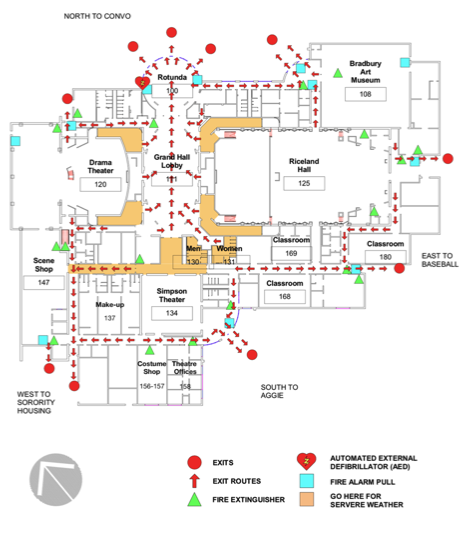
An AED is mounted in the Rotunda.
COVID-19 and other Diseases
The Department of Theatre is taking the threat of communicable diseases seriously to ensure that artists and audiences are safe; therefore, productions and classes may be modified to reduce risk. Protocols will continue to evolve with guidance from the Arkansas Department of Health and the Centers for Disease Control.
Ear Protection
The Department of Theatre provides hearing protection to students in classes such as Stagecraft and Theatre Lab.
Decibels & Hearing Loss
How to Wear Earplugs
Eye Protection
Students must provide their own eye protection for safety reasons. Welding helmets are available when welding.
Eye Protection Training
Emergency Action Plan
Fowler Center has adopted an Emergency Action Plan in case of a tornado, flood, earthquake, or active shooter, which can be found in the Theatre Student Handbook or in the rack outside the Theatre Offices, FC 168.
First Aid Kits
First-aid kits are available in the:
-
- Costume Shop FC 156,
- Scene Shop FC 147,
- and in the Grand Hall Closet FC 113.
Fowler Safety Orientation
Opioid Rescue Kit
An Opioid is mounted in the Rotunda
General Safety Precautions
- Safety procedures for theatre activities are established and posted in the Department of Theatre handbook. Classroom safety policies are in course syllabi.
- Students working in theatre production lab courses must complete required coursework in costume construction and stagecraft before enrolling in Lab courses. These prerequisite courses include safety policies and procedures.
- Students are not to work in the labs without training or supervision.
- Safety protocols and devices are to be used at all times.
- The Department of Theatre adheres to the safety procedures as outlined by the Environmental Health, Safety, and Risk Management Office.
- All incoming students and staff undergo active shooter training.
Inspections
- Theatre facilities are inspected annually by a representative from the university Emergency, Health, Safety, and Risk Management office to ensure a safe learning environment.
- The Fire Marshal also conducts routine inspections each year.
- Rigging undergoes regular inspections by trained personnel.
Security
- A theatre faculty member must supervise student events and rehearsals held outside of regular business hours.
Stage Management locks the stage door once everyone is present for evening rehearsals. - An Emergency Phone is located outside the academic entrance.
Vocal Health
- Considering the musical aspects of theatre, the following information is provided to students regarding musician health. It is a draft publication from the National Association of Schools of Music specially written to address student questions and concerns. Musician Health from the National Association of Schools of Music.
- Vocalists should understand the anatomy of the voice and avoid using the voice in ways that could endanger their health. The following resource is utilized for general vocal care: Protecting Your Vocal Health
FACILITIES
Keycard Access to Fowler
Keycard access to the Fowler Center at the Stage Door is near the scene shop on the building's Southwest side. Students involved in production will be granted access to rehearsals after regular business hours. In addition, the Theatre faculty may grant keycard privileges if deemed necessary for successful course completion.
Times:
- Keycard access will work from 7 am to 11 pm. Students must leave the building by midnight.
Keys:
- To gain access to the Simpson Black Box or room 168, a key can be checked out from Administrative Assistant Brandie Tibbs. bltibbs@astate.edu
- Checking out a key carries significant responsibility.
- Fowler is only to be used for academic activities.
Key check-out duration:
- A key can be checked out for 24 hours.
- For example, if you check out a key at 4 pm on Thursday, it is due back by 4 pm on Friday.
- Weekends
- If a Key is checked out at 2 pm on Friday, then it is due back by 2 pm on Monday.
Students utilizing classrooms in Fowler must:
- Restoring any chairs, rehearsal furniture, etc.
- Turn off the lights
- Lock anything you unlocked.
- Pick up after yourself.
In case of an emergency, contact University Police at 870.972.2093 or call 911.
Late keys may result in the loss of privileges. In addition, lost keys will result in the student having to pay for the lock and key replacement.
Classroom Check out Protocols
Rooms available for theatre students to check out include Simpson Theatre and Studio 168. Spaces are available Monday through Friday from 8 am to 5 pm, except during class periods. At this time, additional measures are being taken with shared spaces; please abide by the following guidelines:
- Rooms may be checked out for up to 1 hour at a time.
- There must be 30 minutes of buffer time between any groups using the room; this includes classes that meet in the space.
- Restore the room when you are done.
Box Office
The A-State Central Box Office is on the lower level of First National Bank Arena near the red entrance. It is open from 8:30 a.m. to 5:00 p.m. Monday through Friday. The Fowler Center Box Office generally opens one hour before each performance.
Bulletin Boards
The call board is a bulletin board located on the hallway wall across from the departmental office, FC 158. The call board is used to post vital information concerning the Department of Theatre productions. The call board is maintained by the production manager and stage managers. The information board is located directly across from room 158, next to the call board. The information board is primarily for academic and student activities. Students may post announcements with faculty permission. The job board is located across the hallway from the call board and is maintained by theatre faculty to help students identify employment and professional development opportunities in the field. Theatre students should check the call board and information board daily.
Costume Shop - FC 157
The Costume Shop is typically open Monday – Thursday, 2:00 – 5:00 pm. The Costume Shop is a work environment, and all safety rules must be followed at all times.
- No food or drink is permitted in the costume shop.
- Students are expected to clean up after themselves when working in the shop.
- Turn off and cover the sewing machine(s) when you are finished, and return any supplies to the correct location, including scissors, tracing paper/wheels, hand sewing needles, thread, etc.
- Scrap fabric should be placed in the fabric recycling bin, not the trash can. This includes thread, elastic, interfacing, and other materials.
- Those working in the shop are in class or working on homework; be respectful of their time and do not distract them.
- Students are not permitted to hang out in the shop unless they are working.
- Students may not be in the Costume Shop unsupervised without permission from the Costume Shop Supervisor.
Design Lab - FC 169
The Design Lab is primarily a classroom space and should be treated as such; however, it also houses 11 computer terminals for theatre students' use. The computers are equipped with basic software applicable to theatre design/tech classes. Please be respectful of the needs of all theatre students by storing your materials and supplies neatly in the provided flat files. Students may request access to the design lab from a faculty member.
- Never impersonate another user by using their login name and/or password or sharing your login name and/or password with another individual.
- Do not access files, accounts or other systems you are not authorized to use.
- There is to be absolutely no eating or drinking in the labs.
- Non-academic software is not to be installed on campus computers.
- Software may only be installed with authorization from the Department of Theatre Faculty.
- Students may not engage in harmful or illegal acts using campus property. This includes but is not limited to: using campus computers for pornography of any type, threatening other people, or using campus equipment for destructive purposes.
- Students should not rely on saving files directly to the computer. Each lab has the ability to allow a student to save their work to a Personal Cloud or USB Flash drive.
- During class time, the computers may only be used for tasks approved by the instructor. Do not use the computers for personal use or to do homework for other classes
Drama Theatre - FC 119-122
Drama Theatre is used for A-State Theatre production rehearsals and performances. Additionally, the space is used by various campus and community organizations. All use of this theatre must be approved by the department chair or production manager.
Dressing Rooms - FC 136-138
The Dressing Rooms are used exclusively for classroom and production related activities. Any additional use of the Dressing Rooms must be approved by the Costume Shop Supervisor. When the dressing rooms are in use, please observe the following:
- No food or drink is permitted in the dressing rooms.
- Only students involved in production should access the dressing rooms. This includes: actors, wardrobe crew, stage management, and those working in the costume shop.
- Once actors are called, no one except the actors and wardrobe crew should be in the dressing rooms.
- Please do not enter the dressing rooms without knocking. This is an act of respect. Remember that everyone has different needs and should feel safe when dressing.
- Treat costume pieces with care and respect. This includes hanging garments up and not leaving things wadded up in your ditty bag, chair, locker, or on the floor. Place shoes in the bottom of your locker.
- Dressing rooms are not locked during performances. If you wish to leave items of value in your locker, please bring a combination lock to secure them in your cubby. Items left in the dressing rooms are your responsibility.
Grand Hall - FC 111
The Grand Hall is a multi-use space that serves as a shared lobby for Riceland Hall, Simpson Theatre, and Drama Theatre. The Grand Hall is frequently used for banquets, conferences, and other events; faculty, staff, and students should be respectful of these events.
Green Room - FC 140
The Green Room is utilized during Department of Theatre productions as an offstage holding area for actors during rehearsal and performance calls. Secondarily, the Green Room serves as the venue for design and production meetings. When the Green Room is not used for meetings, rehearsals, and performances, it can be used as a lounge and gathering space for students, faculty, and staff.
Those who use the Green Room are responsible for its cleanliness. Unlabeled food items will be discarded. Dishes should be washed and stored in cabinets immediately after use. The Green Room is not a sleeping room—please do not lie down or place your feet on the furniture. The Green Room is not a rehearsal space and furniture should not be rearranged. The Green Room remains unlocked throughout the day and typically during rehearsals and performances as well. Valuables should not be left unattended in the Green Room.
Library/Conference- FC 139
The department conference room is a multi-purpose space. It is used for meetings, classes, and houses the department’s library of reference books, scripts, scores, videos and musicals on CD. Computers are available during posted library hours. Books and scripts may be checked out by students for two weeks at a time and only with a valid A-State ID. Late fees are assigned on a per day, per book fee. Please note that musical scores, videos, CD’s and senior project documents do not circulate. The library is designed to be a place of research and exploration with an atmosphere conducive to learning. For more information on library policies, see the appendix.
Lobby - FC 159
The lobby is located immediately inside Fowler Center’s academic entrance. Seating is provided for all students to use during the hours of 8:00am to 5:00pm. The lobby is not a sleeping room—please do not lie down or place your feet on the furniture. The lobby is not a rehearsal space—please do not rearrange the furniture. During classes and rehearsals in the adjacent Simpson Theatre, the lobby should remain quiet.
Lockers
Lockers and locks located near the scene shop are available to all theatre students. Locks may be checked out in the theatre office with the administrative specialist for free. Please use departmental locks only. All locks are to be returned to the departmental office at the end of the spring semester.
Lounge - FC 164
The lounge, located near the lobby, is available from 8:00am until 5:00pm. Please do not rearrange or remove furniture from the lounge for any purpose. The lounge is not a rehearsal space. Vending machines are available for students, faculty and staff. Problems with the vending machines should be reported to the cashier’s window in the student center.
Makeup Room - FC 137
The makeup room is used exclusively for classroom and production related activities. Any additional use of the makeup room must be approved by the Costume Shop Supervisor.
General Guidelines:
- No food or drink is permitted in the makeup room.
- Make-up should not be shared at any time due to health and hygiene reasons.
- Always clean up after yourself and turn off the lights before leaving this room. Makeup kits may be placed on the shelf above your work station.
- Do not borrow, use, or take items that do not belong to you.
- Student should not access the makeup cabinet. If you need something from the cabinet ask a member of the wardrobe crew, the Costume Shop Supervisor, or your Instructor.
- Production Guidelines:
- Only students involved in production should access the dressing rooms. This includes: actors, wardrobe crew, stage management, and those working in the costume shop. Students in the makeup room are getting ready mentally and physically; often there is a lot going on and focus is required. The makeup room is a not a place to socialize and those who are not assisting in preparations should not linger. Please be respectful of those around you.
Office - FC 158
The department office is typically open Monday – Friday 8:00 am – 5:00 pm. The office suite houses the department administrative specialist, faculty offices, and faculty mailboxes. Student use of the copier/printer is not permitted.
Scene Shop - FC 147
The scene shop is typically open for set construction Monday - Thursday, 2:00-5:00 pm. The scene shop is a work environment and all safety rules must be followed at all times. Please see the appendices for scene shop rules and regulations.
Simpson Theatre - FC 134
Simpson Theatre is a blackbox theatre used for A-State Theatre production rehearsals, performances, and classes. Additionally, students and faculty may reserve Simpson for rehearsal by signing up for available times on the schedule posted on the information board. The space should be returned to its original condition before leaving. (i.e.: put away rehearsal furniture, stack chairs, etc.) This space can be reserved up to one hour at a time, for no more than two hours a day. For more information on Room Checkout Protocols, see appendix.
Studio 168 - FC 168
FC 168 is a multi-purpose space and is very actively used. Students and faculty may reserve FC 168 for rehearsal or use of the lab equipment by signing up for available times on the schedule posted on the information board. The space should be returned to its original condition before leaving. (i.e.: put away rehearsal furniture, stack chairs, etc.) This space can be reserved up to one hour at a time, for no more than two hours a day. For more information on Room Checkout Protocols, see appendix.
STUDENT EMPLOYMENT
Carpenter
Carpenters report to the technical director and generally work Monday through Thursday from 2:00-5:00 pm, with occasional Friday hours. Carpenters are responsible for the realization of scenic elements as directed by the scenic designer and technical director. Applications are accepted each fall and positions are for one semester with possible renewal in the spring.
Digital Communication Assistant
The digital communication assistant reports to the department chair and manages social media accounts and other messaging to enhance engagement with the university and regional community. Creates content for digital platforms. Coordinates digital marketing campaigns with the marketing assistant. Applications are accepted at the end of each semester.
Lighting and Sound Technician
The lighting and sound technician reports to the lighting and sound supervisor and generally works Monday through Friday, and hours are determined by the lighting and sound supervisor. Lighting and sound technicians are responsible for implementing lighting and sound elements as directed by the lighting designer, sound designer, and lighting and sound supervisor. Applications are accepted each fall, and positions are for one semester with possible renewal in the spring.
Marketing Assistant
The marketing assistant reports to the department chair and provides marketing support for the Department of Theatre productions. The marketing assistant prepares news releases and calendar listings, maintains departmental and production archives and library holdings, and coordinates digital marketing campaigns with the digital communication assistant. Applications are accepted at the end of each spring semester.
Recruiting Assistant
The recruiting assistant reports to the department chair and facilitates communication with prospective students. Attends recruiting events, maintains database, develops social media content, and performs other duties as assigned. Applications are accepted at the end of each spring semester.
Stitcher
Stitchers report to the costume shop manager and generally work Monday through Thursday from 2:00-5:00 pm, with occasional Friday hours. Stitchers are responsible for producing costume elements for each production, as directed by the costume designer and costume shop manager. Applications are accepted each fall, and positions are for one semester with possible renewal in the spring.
PRACTICUM
Practicums are faculty-supervised, independent study projects that require a high degree of discipline and responsibility. There are several design, performance, production, and front-of-house assignments a student may undertake for practicum credit. Assignments to practicum are made by the production manager and are based on the application as well as the needs of the production and the student.
THEA 2020 Production Practicum 1
Non-credit course. Practical application of introductory design, technical, or other techniques for a Department of Theatre production. No prior experience necessary.
THEA 2021 Production Practicum 1
Practical application of introductory design, technical, or other techniques for a Department of Theatre production. No prior experience necessary.
45 hours of work (9 hours of work x 5 weeks)
Assistant to the Costume Designer
Reports to the costume designer. Assists with research, fittings, and paperwork. Promptly read and respond as necessary to rehearsal/performance reports. Attends all design meetings, production meetings, designer run-thru, dress rehearsals, and strike. Usher at least two performances.
Assistant to the Lighting Designer
Reports to the lighting designer. Assists in producing and updating lighting paperwork, which includes the light plot, cue sheets, follow spot cue sheets, magic/cheat sheet, instrument schedule, and hookup sheet. Assist with hang, focus, and programming. Promptly read and respond as necessary to rehearsal/performance reports. Attends all design meetings, production meetings, designer run-thru, technical rehearsals, dress rehearsals, and strike. Usher at least two performances.
Assistant to the Scenic Designer
Reports to the scenic designer. Assist with analysis, research, drafting, elevations, models, and other paperwork. Promptly read and respond as necessary to rehearsal/performance reports. Attends all design and production meetings, designer run, dress rehearsals, and strike. Usher at least two performances.
Assistant to the Sound Designer
Reports to the sound designer. Responsible for assisting the sound designer in analysis, research, cue lists, block diagrams, and speaker plots. Assist with programming, sound system, and intercom system setup and operation. Promptly read and respond as necessary to rehearsal/performance reports. Attends design and production meetings, designer run, paper tech, dry tech, all subsequent rehearsals, and strike. Usher at least two performances.
A3/Audio Technician
Reports to the lighting and sound supervisor. Responsibilities include monitor mixes, back line technician, maintains wireless transmitters and possibly guitar-technician responsibilities. Required to attend crew view and all subsequent rehearsals, performances, and strike.
Deck Engineer (A2)
Reports to the lighting and sound supervisor. Responsible for wireless microphone rigging and maintenance. Other duties including assist cast into mics (in coordination with wardrobe and hair/makeup departments), battery management, and on deck (or in pit) troubleshooting during the performance. Often tasked with the care and repair of intercom systems. Attends designer run-thru, crew view, dry tech and all subsequent rehearsals and performances as well as strike.
Documentarian
Reports to the Production Manager. Attends and photographs designer presentations, designer run, crew view, dress rehearsals and other notable production related events. Helps serve as historian for the production as well as assists in generating social media content with the publicist. Usher at least two performances.
Dresser
Reports to the costume shop manager. Assist with laundry, repairs, check-in/out of garments and accessories, help actors get ready, and facilitate quick changes. Communicates with the Wardrobe Crew Head regarding any concerns. Attends all dress rehearsals, performances, and strike.
House Manager
Reports to the Production Manager. Prepares the Grand Hall for performances and minimizes potential disruptions to the performance in the lobby areas. Creates and assembles program. Recruits, supervises, and trains ushers.
Reports attendance numbers to stage management at each performance. Attends dress rehearsals and post-dress rehearsal production meetings, all performances, and strike. During strike, the house manager is responsible for restoring the Grand Hall, lobby, and other public areas. Unused production programs should be gathered and delivered to the administrative specialist. Other strike-related duties will be assigned by the production manager. See House Manager Appendix.
Light Board Operator
Reports to the lighting and sound supervisor. Assists with programming during technical and dress rehearsals. Run the light board. dimmer check. Replaces burnt out lamps. Work with SM in execution of show. Start regularly attending rehearsals at crew view. Runs lights at all performances and attends strike.
Sound Board Operator
Reports to the lighting and sound supervisor. Execute speaker check and microphone checks. Prepares sound system and headsets for the performance. Executes the designs of the sound designer. Attends crew view and all subsequent rehearsals, performances, and strike.
Spotlight Operator
Reports to the lighting and sound supervisor. Assists with programming during technical and dress rehearsals. Run the spot light. Work with SM in execution of show. Start regularly attending rehearsals at crew view. Runs lights at all performances and attends strike.
Makeup Crew
Reports to the costume shop supervisor. Attends all dress rehearsals, hair and makeup workshops, performances, and strike. Assists actors with hair, wigs and makeup, including preparing supplies, helping with quick changes, and cleaning the makeup room. Attends crew view, dress rehearsals, and other meetings and rehearsals as assigned. Attends strike.
Publicist
Reports to the Production Manager. Responsibilities include attending production meetings, creating social media content, hanging posters, distributing marketing materials, and other duties as assigned. Works closely with marketing assistant. Attends strike. Usher at least two performances.
Run Crew
Reports to the technical director. Maintains safety and order backstage. Execute scene changes. Attends crew view and all subsequent rehearsals, performances, and strike. (A-State Theatre Student Handbook, 19.)
Wardrobe Crew Head
Reports to the costume shop manager. Attend all dress rehearsals, performances, and strike. Coordinate and assist with laundry, repairs, check-in/out of garments and accessories, help actors get ready, and facilitate quick changes. Promptly read and respond as necessary to performance reports. Oversees members of the wardrobe and makeup crew, and communicate directly with the costume shop manager regarding any concerns. Attends strike.
Dramaturg
Assist the director by providing textual analysis, history of the text, biographical information on the playwright or any real-life persons of interest, sociopolitical-historical context, etc. Usher at least two performances.
THEA 3022 Production Practicum 2
Practical application of design, technical, or other techniques for a Department of Theatre production. Requires critical thinking, independent preparation, and some familiarity with the production process for your assigned role. Fall, Spring. Prerequisite: instructor permission. 85-120 hours of work (17-20 hours of work x 5-6 weeks)
Assistant Costume Designer
Reports to the costume designer. Assists with and manages aspects of research, fittings, and paperwork. Promptly read and respond as necessary to rehearsal/performance reports. Attends all design meetings, production meetings, designer run-thru, dress rehearsals, and strike. Usher at least two performances.
Assistant Lighting Designer
Reports to the lighting designer. Responsible for producing and updating lighting paperwork, which includes the light plot, cue sheets, follow spot cue sheets, magic/cheat sheet, instrument schedule, and hookup sheet. The assistant lighting designer may also assist with hang, focus, and programming. Promptly read and respond as necessary to rehearsal/performance reports. Attends all design meetings, production meetings, designer run-thru, technical rehearsals, dress rehearsals, and strike. Usher at least two performances.
Assistant Scenic Designer
Reports to the scenic designer. Assist with and are responsible for aspects of analysis, research, drafting, elevations, models, and other paperwork. Promptly read and respond as necessary to rehearsal/performance reports. Attends all design and production meetings, designer run, dress rehearsals, and strike. Usher at least two performances.
Assistant Sound Designer
Reports to the sound designer. Responsible for assisting the sound designer in analysis, research, cue lists, block diagrams, and speaker plots. Assist with programming, sound system, and intercom system setup and operation. Promptly read and respond as necessary to rehearsal/performance reports. Attends design and production meetings, designer run, paper tech, dry tech, all subsequent rehearsals, and strike. Usher at least two performances.
Assistant Stage Manager
Reports to the faculty director of the production. Prepping stage for rehearsal/performance, assist with administrative tasks, help maintain prompt book, help the stage manager communicate, fill in for absent actors, assist the stage manager and director, and other duties as assigned. Attends design and production meetings, rehearsals, performances, and strike.
Captions Supervisor
Manage the generation and playback of at least 2 tracks of captioning for the production. This should include English captioning and might include Spanish translation, director commentary, playwright commentary, or other insightful information. Attends production meetings, designer runs, crew views, technical rehearsals, performances, and strike.
Dramaturg
Assist the director by providing textual analysis, history of the text, biographical information on the playwright or any real-life persons of interest, sociopolitical-historical context, etc. Present relevant information to the production team and cast. Public presentation of notable information. (poster presentation in lobby, web presentation, page in program, etc.) Usher at least two performances.
Master Electrician
Reports to the lighting and sound supervisor. The master electrician implements the lighting design. Directly responsible for the acquisition, installation, and maintenance of all lighting equipment and the supervision of the crews who hang, focus, and run the lighting equipment. Attends hang and focus. Promptly reads and responds as necessary to technical rehearsal/performance reports. The master electrician is on call during tech rehearsals/performances to repair problems as necessary. Attends strike. Usher at least two performances.
Mix Engineer
Reports to the lighting and sound supervisor. Responsible for overall front of house audio mix, digital console programming, and triggering playback cues. Attends designer run, crew view, all technical rehearsals, sitzprobe/wandelprobe, performances, and strike.
Properties Master
Reports to the technical director. Responsible for props analysis of the script, research, creating and maintaining a props list. Designs, builds, or acquires rehearsal and final props for the production. Promptly reads and responds as necessary to rehearsal/performance reports. Attends design/production meetings, designer run-thru, crew view, technical rehearsals, and strike. Usher at least two performances.
THEA 4023 Production Practicum 3
Practical application of advanced design, technical, or other techniques for a Department of Theatre production. Requires critical thinking, independent preparation, strong collaboration skills, and prior experience. Fall, Spring. Prerequisite, instructor permission. 120-138 hours of work (20-23 hours of work x week for 5-6 weeks)
Costume Designer
Reports to the costume shop manager. Provide analysis, research, renderings in a timely manner and in collaboration with the rest of the design team. Promptly read and respond as necessary to rehearsal/performance reports. Attends all design meetings, production meetings, designer run-thru, dress rehearsals, and strike. Usher at least two performances.
Lighting Designer
Reports to the lighting and sound supervisor. The lighting designer is responsible for the artistic and practical design of the lighting and special electrical effects used in the production. Responsible for analysis and research of the lighting needs of the production. Produces a light plot, sectional, cue sheets, follow spot cue sheets, magic/cheat sheet, instrument schedule, and hookup sheet. The lighting designer is active at hang, focus, and programming calls. Promptly reads and responds as necessary to rehearsal/performance reports. Attends all design meetings, production meetings, designer run-thru, technical rehearsals, dress rehearsals, and strike. Usher at least two performances.
Scenic Designer
Reports to the production manager. Provides analysis, research, renderings, draftings, paint elevations, scale model, etc. in a timely manner and in collaboration with the rest of the design team. Promptly reads and responds as necessary to rehearsal/performance reports. Attends all design meetings, production meetings and technical/dress rehearsals, and strike. Usher at least two performances.
Sound Designer
Reports to the lighting and sound supervisor. Responsible for script analysis, research, cue lists, block diagrams, speaker plots, building and programming of sound cues, sound system setup and intercom setup. Promptly reads and responds as necessary to rehearsal/performance reports. Attends design and production meetings, designer run-through, paper tech, dry tech, all subsequent rehearsals and strike. Usher at least two performances.
Performance Practicum
Actor practicums are determined by their year in school. Underclassmen are beginning their study of the performing arts. Upperclassmen have a general grasp on their craft and are seeking to further develop it. Acting roles are available by audition only.
THEA 2010 Performance Practicum 1
Non-credit course. Practical application of performance techniques in a Department of Theatre production. This course is for underclassmen who are beginning their study of the performing arts.
Underclassman Actor
Reports to the director. Responsibilities include reading and analyzing the script and score, research and other rehearsal preparation, publicity, and performing the role(s) as rehearsed. Attends all costume measurements and fittings, rehearsals, performances, rehearsals, publicity calls, and strike. Refer to the “Actor’s Etiquette” guidelines in the appendices for more information.”
THEA 2012 Performance Practicum 1
Practical application of performance techniques in a Department of Theatre production. This course is for underclassmen who are beginning their study of the performing arts.
Underclassman Actor
Reports to the director. Responsibilities include reading and analyzing the script and score, research and other rehearsal preparation, publicity, and performing the role(s) as rehearsed. Attends all costume measurements and fittings, rehearsals, performances, rehearsals, publicity calls, and strike. Refer to the “Actor’s Etiquette” guidelines in the appendices for more information.”
THEA 3012 Performance Practicum 2
Practical application of performance techniques for a Department of Theatre production. Requires critical thinking, independent preparation, and an understanding of the process for building a performance. This course is for upperclassmen who have a grasp on the general knowledge of performance and are seeking to further develop their professional craft.
Upperclassman Actor
Reports to the director. Responsibilities include reading and analyzing the script and score, research and other rehearsal preparation, publicity, and performing the role(s) as rehearsed. Attends all costume measurements and fittings, rehearsals, performances, rehearsals, publicity calls, and strike. Refer to the “Actor’s Etiquette” guidelines in the appendices for more information.”
THEA 4013 Rehearsal & Production Practicum
Practical application of (stage management, directing, choreography, or music direction techniques) for a Department of Theatre production. Requires critical thinking, independent preparation, strong collaboration and leadership skills, and prior experience. This is a more rigorous course in which the students will be required to attend all production aspects of the show, as well as rehearsals in their given roles. Fall, Spring. Prerequisite, instructor permission.
Assistant Choreographer
Reports to the choreographer. Responsibilities include reading and analyzing the script and score, research and rehearsal preparation, publicity, and other duties as assigned. Promptly read and respond as necessary to rehearsal reports. Attends all design meetings, production meetings, rehearsals, publicity calls, and strike. Usher at least two performances.
Assistant Director
Reports to the director. Responsibilities include reading and analyzing the script and score, research and rehearsal preparation, publicity, and other duties as assigned. Promptly read and respond as necessary to rehearsal/performance reports. Attends all design meetings, production meetings, rehearsals, publicity calls, and strike. Usher at least two performances.
Stage Manager
Reports to the director. Set up rehearsal space. Communicate call times. Call rehearsals to action. Determine breaks. Records actors blocking. Manages meetings. Maintains prompt book. Manages paperwork such as rehearsal/performance reports, production meeting minutes, contact sheets, master cue lists, etc. Calls the necessary light, sound, special effect, fly cues. Attends design/production meetings, rehearsals, performances, and strike. Please See Appendix on Protocol on Emergency Protocols during productions.
PRODUCTION PROCESS
Crew View
Crew view will take place approximately one week prior to opening and will provide crew members with an opportunity to see the production prior to taking on their responsibilities. All members of the crew are expected to attend.
Cell Phones
Technology is a tool that can be used for the benefit of the production, but it can also be a distraction or even harmful. Inappropriate use of technology will not be tolerated. Excessive or distracting use of technology (such as online shopping, listening to music, or browsing social media) is not permitted. Cell phones should be turned to silent. Headphones should be removed and put away. A student using technology in a distracting or unhelpful way may be asked to put the device away or leave class.
Designer Run
Designer run is an opportunity for the designers to see a full run through of the production and generally occurs approximately two weeks prior to opening. All designers, assistant designers, and properties crew are expected to attend.
Design Meetings
Design meetings will be established by the creative team and posted on the call board. The stage manager is responsible for running design meetings and everyone on the team is invited to participate.
Dry Tech
Dry tech takes place approximately one week prior to opening. This is a technical rehearsal without entire cast being called. A few actors may be asked to stand in as lighting models.
Final Dress
Final dress rehearsal will take place the rehearsal prior to opening.
First Dress
First dress will occur three to four days prior to opening and will afford the actors an opportunity to wear their costumes and practice any quick changes. This gives the costume designer a chance to see the costumes on stage, in action, and all together. Have patience with the designer, wardrobe crew, and other actors as this can require repeating scenes numerous times as problems are solved.
Paper Tech
Paper tech usually takes place on Friday, two weeks prior to opening. This involves the stage manager, assistant stage manager, lighting designer, sound designer, scene designer, and director.
Performance Report
Created by the stage manager with the help of the house manager. A detailed report on the performance. Includes sales numbers, start/stop times, problems or successes. Distributed to costumes, choreography, department chair, dialect coach, director, fight director, lighting, properties, scenery, and sound.
Photo Call
Photo call usually takes place during the week prior to dress rehearsals and is intended to provide images to publicity and marketing teams in order to promote awareness of the production and to encourage ticket sales.
Production Meetings
Production meetings typically occur on Mondays at 12:15 pm in the Green Room. The stage manager is responsible for running production meetings and everyone on the team is invited to participate. Attendance is required for the props master, designers, stage manager, technical director, director, and publicist. Production meetings are also held at the end of each dress rehearsal. House managers must attend production meetings during the week of dress rehearsals.
Rehearsal
The rehearsal schedule will be set by the director and posted on the call board before rehearsals begin. More specific schedules for each day may also be posted the day before each rehearsal. Please check the call board daily. Rehearsals might involve script discussion, blocking, choreography, stage combat, character exploration, dialect work, working or running scenes. Later rehearsals may involve introducing properties, costumes, some scenic elements, but the majority of technical elements will be introduced in technical rehearsals.
Rehearsal Report
A daily record of what happened at each rehearsal, prepared and distributed by the stage manager. The report communicates rehearsal needs and requests to the design and production departments. Department heads are expected to respond to these needs and requests through the stage manager before the next scheduled rehearsal.
Sitzprobe
A musical rehearsal focused on the integration of singers and the orchestra. Sometimes referred to as a “sit-and-sing,” because the actors do not perform their blocking.
Strike
This is the process of putting everything away after the production. It involves putting props in the props room, laundering costumes, cleaning the makeup and dressing rooms, taking down scenery, painting the floor black again, restoring lighting and sound equipment. Audience areas including the house and lobby must be clear of any tables or displays. Strike generally takes place immediately after the final performance. All are invited, but students enrolled in practicums are required to participate in strike. Work clothes are required for strike (no open toe shoes). Please check in with costume shop supervisor, lighting and sound supervisor, or technical director to receive show tasks. Publicists and house managers should discuss strike responsibilities with the Production Manager in advance of strike.
Table-Read
Early in the rehearsal process, this is a customary reading of the entire play by the actors. The table-read typically involves sitting in a circle or around tables. Designers and other invited guests may be invited to attend. Some rehearsal processes may not include a table read.
Wandelprobe
A rehearsal integrating the orchestra and singers, where the singers perform a loose version of the blocking. It gives performers a chance to gain a better understanding of how the orchestra will sound in relation to where they are on on stage and what they are doing.
Wet Tech
Wet tech is the first technical rehearsal after dry tech. It is the first technical rehearsal with all the actors called. It usually takes place on the weekend prior to opening.
ACADEMIC POLICIES
Academic Standards
All theatre majors must abide by the Arkansas State University Student Handbook and all policies contained therein. At the end of each semester, all theatre majors are required to complete a self-assessment and attend a student progress interview.
Class Attendance
The Department of Theatre faculty believes attendance and discipline are vital to the success of each student; therefore, all theatre classes will adhere to the following attendance policy:
- Each student may have two absences per class during the semester. Each absence beyond two will result in a one-letter grade reduction per absence.
- Tardiness will not be tolerated and may result in the lowering of your grade at the instructor’s discretion.
Please note: For classes meeting within a non-traditional schedule (e.g., summer classes, one class meeting per week, etc.), it is at the instructor’s discretion to set the attendance policy appropriately.
Credit Hour Formula
A successful student should expect to spend approximately 3 hours per credit hour per week, including instruction time. Use the formulas below to determine the expected workload for a class, as well as how many hours a student is expected to complete outside of class.
- Course Credits x 3 = Weekly Workload
- Weekly Workload – Weekly Class Time = Hours a successful student should expect to spend studying, rehearsing, practicing, drawing, etc. outside of class
Lecture Classes
- (e.g. Fine Arts Theatre, Theatre History, Playwriting)
- Courses are generally 2-3 credit hours, which directly coincide with class contact hours
- Student workload expectation is 6-9 hours per week
Studio Classes
- (e.g. Dance, Acting, Directing, Stage Combat)
- Courses are generally 2-3 credit hours
- For classes in which course credit coincides with the contact hours, the weekly workload is 6-9 hours (e.g., Acting, Directing)
- For classes which meet for a longer period than reflected by the course credit, the same formula applies; however, less is required outside of class (e.g., Jazz Dance, Voice & Movement I)
Theatre Laboratories
- Courses are generally one credit hour
- Class time is 3.5 hours per week
- Student workload is 3.5 hours per week
Performance/Production Practicums
- Courses are 0-3 credit-hour
- Class time varies
- Student workload ranges from 5 to 25 hours per week
Mandatory Reporting
The university holds the faculty and staff accountable for mandatory reporting of sexual misconduct or any crime that may involve Arkansas State University students, faculty, or staff.
Students may speak to someone confidentially by contacting NEARK’s Family Crisis Center’s 24-hour Sexual Assault Line: (870) 933-9449.
Registration and Advising
Each theatre major will be assigned a full time faculty member as their academic mentor as well as a professional advisor. Each semester, the schedule of classes is published for the upcoming semester. Students may obtain a copy of this schedule on-line. They should check the schedule of classes for registration dates and times and use it to prepare a tentative schedule. They must then schedule an appointment to meet with their advisor prior to registering for classes. The advisor will make recommendations, review the schedule, and assist the student with the completion of their registration. Advisors are also available to discuss academic matters during non-registration times. Students should notify their advisors of any schedule changes.
Sexual Misconduct
Arkansas State University works to provide a safe, productive learning environment. Title IX and university policy prohibit sexual discrimination, which regards sexual misconduct — including harassment, domestic and dating violence, sexual assault, and stalking. If you have been sexually assaulted, you can immediately speak with someone at NEARK’s Family Crisis Center’s 24-hour Sexual Assault Line: (870) 933-9449. Reports to law enforcement can be made to the University Police Department: (870) 972-2093
If you or someone you know has been harassed or assaulted, receive support from the Counseling Center and Pack Support. The Student Health Center provides Sexual Assault resources. Alleged violations can be reported non-confidentially to the Title IX and Institutional Equity office.
Title IX Office
title9@astate.edu
Phone: 870-972-2015
Administration Building, Room 218A
Student Evaluations of Course/Instructor
Students have the opportunity to evaluate each course and instructor via an online survey administered near the end of the semester. Surveys are confidential; instructors cannot link a survey response to the student who provided that response. The evaluation survey is a valuable tool for improving and maintaining a high level of teaching quality in the department. Faculty and administration are especially interested in each course's strengths and areas for improvement.
Juries
At the end of each spring semester, each theatre major is required to meet with the faculty to discuss the student’s progress in the program. In preparation for the annual student progress interview, students are required to:
- Schedule an appointment on the sign-up sheet posted on the information board.
- Submit the self-evaluation form made available at the time of scheduling your appointment and carefully complete all sections, and return by the posted deadline.
- Dress in a professional manner appropriate for an interview.
- Arrive for the appointment 10 minutes early.
- Participate in the interview process with a professional demeanor.
- More information is coming
Syllabi
Instructors will provide students with a course syllabus within the first week of classes for every theatre course. This syllabus will clearly state course requirements, expectations, grading criteria, and course policies. The syllabus outlines what is expected of students and the instructor for that course. It is the student’s responsibility to resolve any questions about the course at the beginning of the semester. For courses without a regular meeting time, it is the student’s responsibility to contact the instructor to obtain the syllabus.
SEASON SELECTION
The A-State Theatre faculty is committed to providing high-quality production opportunities for our students. In considering the selection of our season titles, there are many determining factors, and we strive to balance the following holistically:
- Academic Needs: Provide students opportunities to work on productions of varying periods, genres, and styles while choosing plays that reflect our department’s population
- Diversity: Give voice to underrepresented voices by including plays written by women, persons of color, and other differing perspectives
- Community Enrichment: Choose plays that our audience will appreciate and enjoy while also including titles that challenge them
- Quality: Maintain high standards and produce quality productions
- Collaboration: Work with other departments on campus to enrich the experience of those involved as well as the community
- Musical Theatre: Fulfill our commitment to select at least one musical for production each year
We also accept student submissions and take them seriously; several of our recent productions were student suggestions. Submissions are solicited each fall and can be submitted using the provided form. If a proposed play/musical script is not available in the department library, the student must provide a copy in order for consideration.
When submitting a script for consideration, please keep the points above in mind.
SCHOLARSHIPS
The Department of Theatre offers a variety of scholarships for new and returning theatre majors. Monetary values of individual scholarships can vary from year to year. Scholarships are awarded for one academic year with half of the funds applied to the fall semester, and half to the spring semester. They must be reapplied for annually. The deadline to apply for a theatre scholarship is February 1 and the application can be found on our webpage. For questions relating to scholarships contact Claire Abernathy, cgarrard@astate.edu. Students should contact the University Office of Financial Aid for information concerning additional scholarship opportunities.
Production Scholarships
Three to six $2000 scholarships awarded in production, including costume, scenery, lighting/sound. Half of the scholarship will be awarded during the fall semester and half during the Spring semester.
Qualifications for Receiving the Scholarship:
- Returning, full time student
- Theatre major with cumulative GPA of 3.0
- Consideration given to production participation, classroom performance, and need
Qualifications for Receiving the Scholarship:
- Scholarship awarded annually. Recipients are eligible to reapply provided they continue meeting the necessary criteria.
Expectations
- Remain a full time student in good standing
- Maintain cumulative GPA of 3.0 and status as Theatre Major with an academic mentor in the Department of Theatre
- Attend any workshops provided by A-State Theatre
- Attend end-of-semester juries
- Serve 6 hours weekly in designated production area (Costume, Scenery, Lighting, Sound)
General Scholarships
Six or more $1000-$1400 scholarships awarded to students with any emphasis. Half of the scholarship will be awarded during the fall semester and half during the Spring semester.
Qualifications for Receiving the Scholarship:
- Returning, full-time student
- Theatre major with cumulative GPA of 3.0
- Consideration given to production participation, classroom performance, and need
- Qualifications for Maintaining the Scholarship:
- Scholarship awarded annually. Recipients are eligible to reapply provided they continue meeting the necessary criteria.
Expectations
Remain a full-time student in good standing
Maintain a cumulative GPA of 3.0 and status as a Theatre Major with an academic mentor in the Department of Theatre
Attend any workshops provided by A-State Theatre
Attend end-of-semester juries
Serve 3-4 hours weekly in a designated area, as determined by the needs of the department (hours dependent on amount of scholarship funding received; $1000 = 3 hours, $1400 = 4 hours)
Audition for all A-State Theatre productions; it is not required that you accept a role.
Audition for SETC
Sophomores and Juniors - Participate in one additional professional audition of your choice; examples include but are not limited to: Disney college auditions, cruise ship auditions, etc.
Graduating Seniors - Audition for UPTAs
Outstanding student award
One $2000 scholarship awarded to an outstanding student. Half of the scholarship will be awarded during the fall semester and half during the Spring semester.
Qualifications for Receiving the Scholarship:
- Returning, full-time student
- Maintain a cumulative GPA of 3.0
- Exceptional leadership, attitude, and participation within the department
- Consideration given to production participation, classroom performance, and need
Qualifications for Maintaining the Scholarship:
Scholarship awarded annually. Recipients are eligible to reapply provided they continue meeting necessary criteria.
Expectations
Remain a full-time student in good standing
Maintain a cumulative GPA of 3.0 and status as a Theatre Major with an academic mentor in the Department of Theatre
Attend any workshops provided by A-State Theatre
Attend end-of-semester juries
Serve 4 hours weekly in designated area, as determined by the needs of the department
Incoming Freshmen
Scholarships typically range between $500-$2500 per academic year. Half of the scholarship will be awarded during the fall semester and half during the Spring semester.
Qualifications for Receiving the Scholarship:
New, full-time student at Arkansas State University
Audition or Interview with A-State Theatre
Apply to Arkansas State University
Qualifications for Maintaining the Scholarship:
Scholarship is awarded to new students only. Returning students are eligible to apply for the following: Production Scholarships, Performance Scholarships, Generalist Scholarship.
Expectations
Remain a full time student in good standing
Maintain cumulative GPA of 3.0 and status as a Theatre Major with an academic advisor in the Department of Theatre
Attend any workshops provided by A-State Theatre
Attend end of semester reviews
Enroll in at least one section of Performance Practicum OR Production Practicum 8each semester
Audition for all productions (this applies only to students with a Musical Theatre or Acting concentration)
Transfer Students
Scholarships typically range between $500-$2500 per academic year. Half of the scholarship will be awarded during the fall semester and half during the Spring semester.
Qualifications for Receiving the Scholarship:
- New, full time transfer student
- Audition or Interview with A-State Theatre
- Apply to Arkansas State University
Qualifications for Maintaining the Scholarship:
- Scholarship is awarded to new transfer students only. Returning students are eligible to apply for the following: Production Scholarships, Performance Scholarships, Generalist Scholarship.
Expectations
- Remain a full time student in good standing
- Maintain cumulative GPA of 3.0 and status as a Theatre Major with an academic advisor in the Department of Theatre
- Attend any workshops provided by A-State Theatre
- Attend end of semester reviews
- Enroll in at least one section of Performance Practicum OR Production Practicum
- Audition for all productions (this applies only to students with a Musical Theatre or Acting concentration)
Additional Expectations for Semester 2
- Serve 4 hours weekly in designated area, as determined by the needs of the department.
Endowed Scholarships
The following endowed scholarships are also available and do not require an application. These are awarded at the discretion of the scholarship committee. Awards range between $1500-$2800, and qualifications prioritize leadership, community involvement, departmental involvement, GPA, and classification.
- A-State Theatre Arts Alumni Scholarship
- Brackett-Krennerich Associates Scholarship for Endowment of Theatre
- Jake West Memorial Scholarship
- Lorena J. “Rockie” Smith Endowment
- Theatre Guild Scholarship
Need-Based Scholarships
In addition to the specific scholarships outlined above, if funds are available, scholarships based solely on student need may be awarded. If you have an acute financial need, please reach out to your faculty advisor or contact Claire Abernathy.
Grants for Continuing Education
Sometimes money remains in our scholarship account at the end of the spring semester. In these cases, we may make it available to students as a continuing education grant. These are one-time funding opportunities, independent from other funds you may receive from A-State Theatre, and thus have different requirements.
Suggestions for using this money include, but are not limited to:
- Broadway Stage Management Symposium (virtual or face to face)
- Theatrical Intimacy Education Workshops (virtual)
- Dialect Certifications (virtual)
- Great Lakes Michael Chekov Consortium (face to face)
- The Michael Chekov Association (face to face)
- USITT Costume Symposium
- Kentucky Dance Institute
- Entertainment Technician Certification Program
- Sun King Dance LLC
PRODUCTION POLICIES
Casting
- Student actors must audition in order to be cast in Department of Theatre productions.
- Auditions are generally held in the first week of the fall semester and in the last two weeks of the fall semester.
- Students are encouraged to talk to directors after auditions to receive feedback.
- Directors make every effort to cast productions entirely from current A-State students. In some rare cases, guest artists may be invited to play a role.
- All student actors in Department of Theatre productions must enroll in THEA 2010 Performance Practicum.
- When deemed appropriate by the production’s director and artistic team, actors may be cast without regard to ethnicity, gender, or physical capability.
Complimentary Tickets
Complimentary tickets must be requested at least two weeks before the opening performance. Requests made after this date are not guaranteed. The online form should be distributed by the stage manager and is also available by contacting the administrative specialist. Complimentary tickets cannot be granted once a performance is sold out. Complimentary tickets are held at will call. Seating preferences will be honored only at the box office manager’s discretion.
- Any student enrolled in either Performance Practicum or Production Practicum receives one complimentary ticket for that production. This complimentary ticket may be used by the student or the ticket may be requested for another person’s use.
- Students who volunteer to usher may attend the final dress rehearsal free of charge. Ushers are often able to use a house seat to attend the performance for which they usher but this seating is not guaranteed.
- Theatre faculty and staff may request complimentary tickets for themselves or, with the chair’s consent, their professional guests.
- Students serving on the production’s artistic team may request additional complimentary tickets to enable them to attend the performance multiple nights.
- A guest artist who provides contract or consulting services to the production receives two complimentary tickets.
- Additional complimentary tickets requests should be directed to the department chair.
Control Booths
- Food and drink are not permitted in the control booth.
- Control boards are to be covered when not in use.
- The equipment in the booth is not to be used without explicit permission from a faculty/staff member.
- Doors must be locked when finished.
Costumes
- No eating or drinking in costume pieces. Water is permitted if kept in a container with a lid.
- Once actors begin getting in costume, all food and drink in work spaces must be put away. Water is permitted if kept in a container with a lid.
- Washable costume pieces that need to be laundered should be placed in the clothes basket available in each dressing room and not on the floor.
- Rehearsal garments are requested only by the costume designer, director, or stage manager, and provided at the discretion of the costume shop manager.
- There will be a repair list in the makeup room each dress rehearsal and performance.
- Costumes should be placed on the rack in the costume shop in the following order; name tag, costume pieces and then the ditty bag.
- Actors are responsible for placing and striking their costumes during a dress rehearsal or performance.
Costume Fittings
Costume fittings are scheduled for a specific time and date through the Stage Manager of a production. It is the actor’s responsibility to meet all scheduled fittings, be punctual, wear appropriate undergarments, and practice good hygiene prior to arrival. Should an actor be unable to make a scheduled fitting, it is his/her responsibility to contact the Costume Shop Supervisor to reschedule.
General Rehearsal Guidelines
- Cell phones should be powered completely off and kept out of sight during rehearsals. Cell phones may be used only during designated breaks and may only be used outside of work spaces. During performances, technical and dress rehearsals, the Green Room is considered a work space.
- Please arrive at least fifteen minutes early to scheduled call time.
- Once cast and crew members are signed in, they may not leave the building until excused by either the stage manager or the director.
- Have a pencil and notebook prepared for notes.
- Dress appropriate for rehearsal. Pin bangs back; do not wear hats that shadow your face or large earrings. Wear appropriate shoes—No flip-flops or sandals.
- Enter and exit through the stage door. The main doors are locked past five o’clock.
- Do not touch or move another person’s props, costumes, or other objects.
- Please park close to the stage door for safety reasons.
- Anytime you leave the theatre, have a buddy.
- No food in the rehearsal/performance space. Only bring bottled water to drink.
- No smoking/vaping on campus.
- Actors and crew are expected to go to classes.
- Please inform the stage manager if you are going to be late or absent as soon as possible.
- Check the call-board daily for rehearsal information.
Main Stage Rehearsals
Main stage productions typically rehearse in the evenings, five days a week, four hours per day, between the hours of 6:00 p.m. and 10:00 p.m.. Some productions may require additional rehearsals due to the demands of the project, which will be announced prior to auditions for that production. It is the department’s policy that rehearsals will not be scheduled to end after 10:00 p.m. excepting the week of technical rehearsals. Productions typically rehearse 100 hours before technical rehearsals begin; plays with less demanding needs might rehearse 80-100 hours and plays/musicals with more complex needs might rehearse 100-120 hours before technical rehearsals begin. A rehearsal schedule will be provided at the beginning of the rehearsal process of each production. Rehearsal dates/times may be adjusted with reasonable notice. It is the director’s responsibility to clearly state rehearsal expectations and procedures. Company members who violate the schedule or other stated expectations may be removed from the production.
Purchasing Tickets
- The A-State Central Box Office in the First National Bank Arena is open from 8:30 a.m. to 5:00 p.m. Monday through Friday. The Central Box Office also accepts telephone orders during these hours at (870) 972-2781.
- Fowler Center Box Office generally opens one hour prior to each performance.
- Tickets can be ordered online at the Box Office.
- Groups of 10 or more should call the Box Office regarding group rates.
EMERGENCY ACTION PLAN
Report all emergencies to 9-911 (911 from your cell phone) and University Police (870) 972-2093.
Report all calls to 911 from Fowler Center to the Dean’s Office at 972-3973.
Active Shooter
- Act only on information received through the official campus emergency alert text or email.
- If the threat is in the Fowler Center and you can evacuate without risk, proceed cautiously.
- Seek shelter in other buildings, putting as much distance between yourself and the danger as possible.
- If law enforcement is on the scene, keep your hands in the air as you evacuate.
- If evacuation is unsafe, secure the area immediately.
- Lock and barricade doors. Turn off the lights and silence phones.
- Seek cover behind concrete walls, thick desks, or filing cabinets.
- While undercover, create an action plan.
- If confronted by the shooter, plan to fight with conviction using any makeshift weapons available.
- Throw objects to distract. Rush to overwhelm.
- If the threat is not in the Fowler Center, secure your room and stay in place.
- Do not attempt to evacuate if danger is nearby.
- Individuals moving on campus during lockdown require law enforcement attention.
- Do not sound the fire alarm. This might put others in danger.
- If unsafe/unable to speak, the QuikTip app immediately routes to UPD Dispatch and other UPD officers.
- Dispatch may be overwhelmed. Email all UPD officers, whether on campus or off, at upd@astate.edu
Earthquake
Pick "safe places” such as a sturdy table or desk, or against an interior wall.
Stay away from windows, bookcases, or tall furniture that could fall on you.
The shorter the distance to move to safety, the less likely you are to be injured.
Assist the injured or disabled.
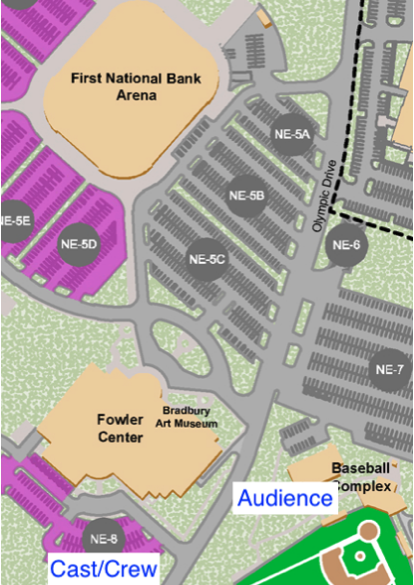
Once shaking stops, evacuate to the grassy area by the baseball complex, maintaining a safe distance from buildings and light/utility poles.
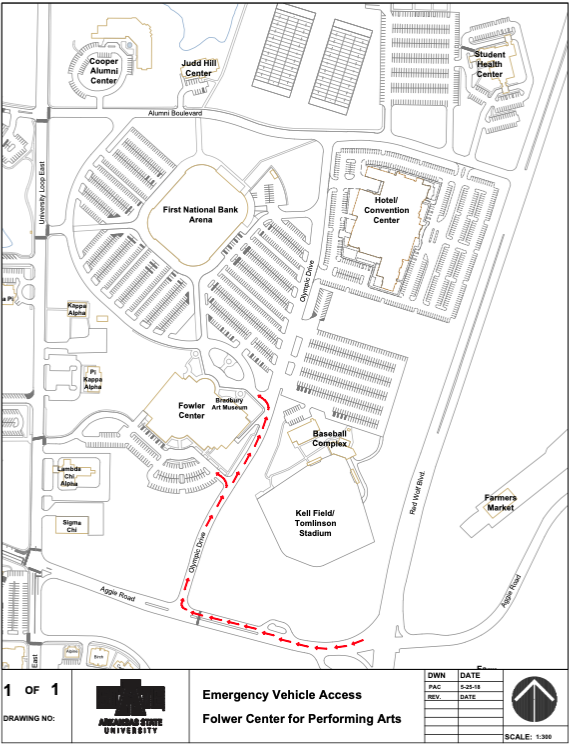
Emergency Vehicle Access
Fire
- Activate the fire alarm and have someone call 9-911.
- If the fire is smaller than a wastebasket and you have been trained to operate a fire extinguisher, attempt to extinguish the fire yourself as you wait for help to arrive.
- If the fire appears uncontrollable, evacuate the building to grassy area across the parking lot on the Southeast side of the building.
- Assist the injured or disabled.
- Close but do not lock the doors.
Fowler Center Emergency Plan Map
Tornado/Severe Weather
- Move to the areas highlighted in tan/gold on Fowler Center Emergency Plan map.
- Safer areas include interior hallways and restrooms. Avoid windows or glass doors.
Appendices
ACTOR ETIQUETTE
Acting can be exhilarating for the actor, but the process demands time and effort. These guidelines help you to understand the minimum expectations set for actors by the Department of Theatre. These guidelines constitute the minimum criteria for evaluating your participation. Read these guidelines carefully; you are responsible for knowing and understanding what is expected of you as an actor.
Be There
Conflicts.
Be sure to write down all the conflicts you are aware of on your audition form. If an emergency or serious conflict arises during rehearsal, notify your stage manager immediately.
Call.
This is the time that you are expected to be at rehearsal or at a performance, ready to work. This should tell you that you should arrive in plenty of time to warm up, change into rehearsal clothing and organize yourself so you are ready to work at the time you are called. The daily schedule is published via email each day. Check the daily schedule for your call time each day and pay particular attention to your "first call" so that you arrive to your first call on time. If you do not receive the schedule via email for any reason, you are responsible for calling your stage manager.
Punctuality.
There is no excuse for being late. Make it your goal to arrive 15 minutes before your scheduled call time. If there is an emergency, call your stage manager immediately. It is inappropriate to contact your stage manager via email, text, or any other nonverbal means to report your lateness.
Costumes
Hair
When you are cast, your appearance becomes the basis of the costume designer’s palette. You cannot change the cut, style, or color of your hair without first obtaining the costume designer's approval. Likewise, you cannot acquire additional piercings or tattoos without prior permission.
Rehearsal Costumes
These are costumes you wear during rehearsal to help you explore the clothing's physicality and movement possibilities. If you are wearing rehearsal costumes, make sure you put them on at the beginning of rehearsal and return them in the same condition after rehearsal.
Fittings
Do not be late. Do not tell the designer how to do their job. If you have a concern, voice it. If you have a preference, keep it to yourself.
Dressing and Makeup Rooms
Your stations in each room will be assigned. Be respectful of your fellow actors and each person’s individual needs when preparing for a performance. After the curtain call, return your costume pieces to the designated racks (notifying the wardrobe crew of anything of which they should be aware). Clean your stations and leave the area tidy before leaving. There is no eating or drinking while in costume, and no food and beverages are allowed in the dressing and makeup rooms.
Performance
Performances
You must arrive at the theatre via the stage door. You must sign in at every performance and scan the call board for any important announcements. Sign in for yourself, and only yourself. Stage Management needs to know that everyone is present; the sign-in sheet serves this purpose. Commit to your personal best for every performance. The people in a small audience paid the same ticket price as the people in a sold-out house. You worked hard during rehearsal so don’t shortchange yourself, your cast or the audience. Challenge yourself to stay fresh.
Post-Performance
Tend to your costumes and station before leaving the theatre. You must remove your makeup before leaving the theatre.
Backstage
Be quiet. Whispers can be heard in our intimate spaces. Be aware of what’s happening onstage and be prepared for your entrances. If you do not have an entrance, stay out of the wings; your presence increases congestion in a very small space.
Backstage Pages
Stage Management will make calls through the paging system in the dressing room area. Always respond to calls with “thank you” so the stage manager knows you have heard and understand the call.
Brush Up
Sometimes a production will schedule brush up rehearsals. You are responsible for keeping your work vital and fresh in the interim. Remember, you are responsible for performing the work as it was directed for every performance of the run.
Properties
Props. Check your props before rehearsals and performances to ensure that they are where you need them. Use the prop during the course of the rehearsal or performance only as it was designed to be used. Never touch any prop that is not assigned to you. Never sit on production furniture when it is backstage. Return your props to the prop table after rehearsals and performances. Check your pockets. Notify the run crew if any of your props need maintenance.
Rehearsal
We spend more time in rehearsal than we do in performance. This is our process; you can learn a great deal by observing the director and other actors. Take full advantage of your rehearsal time by being attentive and respectful. Rehearsals are for exploring the possibilities the text offers; commit to the process and your skills will be strengthened.
Prepare
Come to rehearsal fully prepared to work. Engage in research as soon as you are cast and, outside of rehearsal, develop the history and life of your character. Memorize your lines and review your lines and notes between the end of one rehearsal and the beginning of the next.
Warm-Up
Give yourself plenty of time to warm-up. You are responsible for ensuring that you are physically, vocally and mentally ready to work at the scheduled call time.
Notes
When the director gives you notes, pay attention and write them down. Respond to the note with a “thank you.” If you need clarity, ask for greater detail, but do not argue with the note. Actors are responsible for taking the notes given to them and incorporating them into the work. Notes aren’t just for you; everyone gets them. You can strengthen your own work by listening carefully to the notes given to other actors. Continually review your notes and be sure to incorporate them into your work. If you need to discuss a note, talk with the director in private.
Script
Memorize your lines verbatim. No more, no less. Do not paraphrase your lines. The playwright chose the words for a reason; work to discover the syntax, rhythms and language the playwright provided. You have an ethical responsibility to perform the text as written with no augmentation, deletion, or approximation.
Line Notes
Actors are responsible for performing the work of the playwright verbatim. Stage Management will, on specified rehearsal dates, take note of which lines are dropped, paraphrased, added, skipped, and jumped. They will also note when you call for a line. These notes will either be posted or given to you after rehearsal. Make sure you review these notes and fix the problems they identify.
Actor Notes
NEVER give notes to another actor. It’s rude and not your job.
Working Outside Rehearsal
NEVER rehearse with another actor outside of rehearsal unless you have explicit permission from the director to do so.
Technical Rehearsals
Dark & Quiet Time
This is the beginning of the technical rehearsal process when the lighting and sound designers build cues and set levels. This is not about you. Be attentive, patient and cooperative. You will be asked to stand onstage and move to different locations as the lighting designer creates looks and sets levels. Keep talking to a minimum. Feel free to bring something to read but be aware that you will be asked to keep your head up so your face can be fully seen. The stage manager will tell you what color clothing to wear.
Technical Rehearsals
While you can accomplish work during technical rehearsals, techs are primarily for the designers and technicians. Give them your full attention and patience.
Valuables
Storage. Place your valuables (cell phone, wallet, jewelry, etc) in your valuables bag at your dressing room station. Hand your valuables bag to stage management when they come to collect valuables at 15-minutes to places during tech and performances. You are responsible for your valuables until you hand them to stage management.
Working Together
Stage Management
When a member of the stage management staff tells you something, always reply with “thank you” so they know you have heard and understand the direction.
Respect
Respect yourself by eating properly and getting sleep during rehearsals and performances. Your health is critical to the rest of the cast. Respect others by treating everyone as you wish to be treated. You are all part of the same company whether you are an actor or a member of the crew. If you are disrespectful to others, they lose respect for you.
Read
You are liable and responsible for anything you sign. Read the audition form and practicum agreement carefully and ask your stage manager or director if you have any questions.
Cell Phones
The Department of Theatre adheres to a strict policy of no cell phone use in Drama Theatre, Simpson Theatre, and their ancillary spaces. You may use your cell phone on announced breaks, but only by stepping out of the rehearsal or performance area. Cell phones are to be turned completely off when not in use. If a family emergency requires you to have access to your cell phone, speak with the director for an exception to the policy.
Drama
Keep it on the stage. If you have a personal problem with a fellow actor please leave it at the door. If there is a problem with a fellow cast member that is seriously disrupting your ability to work, talk to the director.
Gossip
Don’t participate in gossip and don’t tolerate gossip from others. It can be hurtful and destructive to the process.
COMPANY CONTRACT
A production’s company consists of everyone who contributes to the realization of the event witnessed by the audience. Members of any theatre company have an ethical obligation to support one another within the company, and promote enthusiasm for the production in public. Some companies sign a compact that verifies each member’s commitment to the company’s obligations. An example compact is seen below.
Creativity thrives in a supportive environment and dies when faced with negative gossip about other company members. I will support all well-prepared endeavors and will not speak ill of the production or individual company members in or out of rehearsal.The rehearsal schedule was distributed at the first rehearsal. Each company member was given an opportunity to identify prior commitments. I will be available at all call times not indicated as prior commitments and will not schedule new appointments during call times without prior consent from the director or stage manager.
Cell phones and other electronic devices cause distractions in rehearsal and performance areas. I agree to keep my phone and other devices out of sight in work spaces, and to only access my devices during designated breaks.
During the course of rehearsal, prompt attendance is mandatory at all calls: rehearsal, costume fittings, makeup workshops, performances, etc. I will be present and ready to work as scheduled.
Company members need to work on the material outside of scheduled call times in order to achieve excellence. I agree to execute the homework needed to make the production a success.
The “company” includes anyone working on the production. While the level of responsibility may vary, all individuals carry equal importance. I will treat all company members with respect and consideration at all times.
I have read the company compact and agree to abide by the guidelines stated above.
Signature Date
These guidelines are adapted from the Actor's Equity Association Code of Conduct.
COSTUME SHOP GUIDELINES
The Costume Shop provides a learning space for Costume Construction and Theatre Laboratory classes as well as creating costumes for A-State Theatre productions. The costume shop is open Tuesday/Thursday from 2pm - 4pm and all persons working in the Costume Shop must have approval from the Costume Shop Manager.
Costume Shop Manager
Claire Abernathy cgarrard@astate.edu 870.972.2037
Risks Include
Punctures from pins and needles, burns from hot surfaces, and cuts from sharp objects.
Guidelines, Rules, and Procedures
- Bare feet are not allowed in the Costume Shop for any reason. The potential for puncture wounds resulting from fallen pins, needles, or dropped scissors is too great.
- Be sure irons, glue guns, hot plates, or other tools are turned off at the end of the day.
- For safety and security reasons, it is suggested no one works alone in the Costume Shop.
- Do not use spray paints or other aerosols in the Costume Shop. Spray all paints, dyes, etc. on the loading dock.
- Anyone working in the costume shop should be aware of the first-aid kit, fire extinguisher, and fire alarm pull box locations. If you are uncertain where to find these items, speak with the Costume Shop Manager.
- All flammables should be stored properly in the approved flammables cabinet. This can be found in the Scene Shop.
- Clean up after yourself.
- Turn off and cover your sewing machine at the end of the day.
- No food or drink is permitted.
- Use the stepladder for items you cannot reach and ask for help if working with something too heavy to move on your own.
Fittings
Fittings are by appointment only and must be schedule by the Stage Manager. Generally, several fittings are scheduled for one afternoon, so arrive on time. Before you come, complete the form provided. Underwear is required attire for all fittings and students should wear an everyday bra rather than a sports bra unless otherwise specified.
Rentals
Costumes rentals are at the discretion of the Costume Shop Manager. Items may not be borrowed for class projects, special events, or independent projects.
INTIMACY
A-State Theatre considers stage action in which the given circumstances of the production require physical and or/or imaginative touch, or sexual violence between actors as a moment of “intimate contact.” These moments are not limited to but may inlace the following:
- Kissing
- Intimate touch
- Imaginative intimate moments (moments where actors are asked to portray moments of romantic chemistry between characters even when physical touch is not needed)
- Violent touch that is interpreted as an abusive physical, sexual, and/or mental act
- Imaginative violent moments without touch (moments where violent mentally abusive behavior is portrayed buy physical touch may not occur)
- Exposure of any performer’s breast, buttocks, pelvic/genital area
Tips For Working on Intimate and Violent Scenes
- Accept that you have to be open and vulnerable with each other. Take a few moments to silently stand in an open neutral position and seek eye contact
- Talk about the scene
- Articulate clear objectives for the scenes
- Articulate clear objectives for the scenes
- Use “Button” the Self-Care Cue, all action should stop. Concerns should be discussed, addressed, and full permission from all parties in the room given before rehearsal can start again.
- Do the boundary establishment exercise.
- Discuss your “Fences.” Be specific and clear about boundaries – especially physical boundaries.
- When it comes to making physical contact always work slowly and ask, “May I touch you.”
- Incorporate boundary practice into your warm-up. Always have a boundary check-in before working.
- When you find complicated physical touch in a scene make sure you repeat it in slow motion until both partners are comfortable with picking up the pace.
- Use derole-ing as a way to close the rehearsal and process what you accomplished. Derole- ing: address each action with the following phrase, “As my character I want to (state the character’s intention), as the actor I (describe in detail how withe technique thsi was accomplished).
- Always keep working towards telling the story, not showing clever .
- Never leave the rehearsal without discussing what you achieved.
- Be honest if you are feeling uncomfortable. If you do not feel you can be open with your partner immediately contact your teacher, director or stage manager to discuss your feelings.
- Make sure you are in agreement about how the scene is working. Never leave the rehearsal with unanswered questions for your partner.
- Document your rehearsal in a journal or a log, and if possible have a third party present.
©Laura Rikard, Theatrical Intimacy Education
POLICY FOR STAGING NUDITY
A-State Theatre strives to employ professional and pedagogically-sound processes when creating theatre productions. We recognize there may be scripts produced in which the playwright states a character’s nudity is a critical element of the story, or, in the case of a devised production, it may be discovered that nudity seems appropriate to the staging. Nudity is defined as the exposure of any person’s chest/breast, buttocks, and pelvic/genital area to the audience, cast members, and any members of the production team. We ask directors to give mindful consideration of other possible means of story-telling before choosing to incorporate nudity in productions. Should the director and production team deem it necessary to ask an actor and/or student actor to consider performing nudity, we asks the following guidelines be incorporated throughout the production process:
- Have the stage manager notify all auditioning actors that nudity may be incorporated into the production.
- Request written consent from the actors in a form provided at the audition. This form will allow the actor to state in their own words their willingness to explore the possibility of nudity in the rehearsal process. It does not obligate the actor to perform in the nude.
- Stage and rehearse all scenes with the stage manager in the room at all times and have the stage manager detail the process in the rehearsal report.
- Once the scene is staged, the actors will complete a form stating what they agree to perform. The director, stage manager, and actor will sign off on this form.
- Have a plan B. Should an actor at any point during the rehearsal process or performance wish to no longer perform in the nude, this wish will be respected and the stage manager will implement the plan B staging.
- The actor will work at their personal comfort level in removing clothing throughout the rehearsal process and will make the stage manager and scene partner/s aware at each rehearsal at what level they wish to work. Once the production moves into dress rehearsals, the actor can be required to perform the scene as it will be staged in performance. Up to that point, it is the actor’s decision as to how much of the body will be exposed in each rehearsal.
Thank you for the respect you show our to our policy and actors by adhering to these guidelines. Read more about Arkansas State University’s policy on Sexual Misconduct here.
©Laura Rikard, Theatrical Intimacy Education
THEATRE LIBRARY POLICIES
Rules and Guidelines
- Absolutely no food or drink in the library, except bottled water.
- Anything checked out of the library, for any duration, must be signed out.
- Books may be checked out for two weeks. Videos, CDs, recordings, dialect material, and sheet music may not be checked out.
- No more than four books may be checked out at a time.
- Students taking certain classes – such as Directing – or those with extenuating circumstances, may have special borrowing privileges at the discretion of the librarian & faculty member in charge.
- You must be a theatre major, taking a theatre class, or cast in a departmental production to check out books.
- You must have a valid A-State ID & email address to check out materials.
- You can only print pages pertaining to theatre academics. If it is over five pages, please use the Dean B. Ellis Library.
Library Fines
- Fines are assessed daily at $0.25 per book. The fine continues to grow on weekends and holidays (including winter break & summer) until the maximum replacement fee is reached.
- Replacement fees:
- Small paperback (Acting Edition) - $9.00
- Large Paperback - $24.00
- Hardback Script - $22.00
- Large Anthology/Textbook/Reference Material - $35.00
- Note: Some of these books will be priced at the replacement value.
- Writing in books or damaging pages will result in a $0.25 per-page fine.
- If you incur fines, your library privileges will be reinstated only after the fines are paid & you are cleared by the librarian.
- Library fines may result in a hold on your account. More information on financial holds is available on the A-State Student Resources site.
ROOM CHECKOUT PROTOCOLS
Rooms which may check out include: Simpson Theatre and Studio 168. Spaces are available for use Monday through Friday from 8 am until 5 pm, except during class periods. Students may not be in the building without a faculty member present. At this time, additional measures are being taken with shared spaces; please abide by the following guidelines:
- Rooms may be checked out for no more than 1 hour at a time.
- There must be 30 minutes of buffer time between any groups using the room; this includes classes which meet in the space.
- Masks must be worn at all times, even if you are the only person in the room.
- Only students actively involved in rehearsal may be in the space.
- Restore the room when you are done.
SCENE SHOP SAFETY GUIDELINES
Proper Attire
- Avoid loose or baggy clothing, long or large jewelry. Long hair must be securely tied back and up. You may consider a hat or tucking ponytails in shirts. These are all things that could get caught in a power tool.
- Do not wear gloves while using power tools.
- No slippers, including Tom’s, sandals, or dress shoes. Wear shoes with good traction and think soles. Steel-toe shoes or boots are a great investment.
- No shorts or skirts. Jeans are best.
- Wear clothing that protects you from dust and similar particles.
- You will get dirty, so bring work clothes. Lockers are available in the hall. Launder your clothing regularly.
- Long sleeves are required for welding. You don't want to get burned.
General Safety Tips
- Be Careful and Alert!
- Know where you are in relation to your environment. For example, when you are on stage, be aware of moving batons.
- Work in the shop is sometimes boring or monotonous. Do your best to stay alert. Most shop accidents occur during a repetitive task.
- Being careful means being careful all the time. You can be careful for years and then get hurt in one moment of inattention. This is entirely under your own control. Being careful is your best defense against injury.
- Use common sense.
- Do not cut corners on safety to try and work faster.
- Recognize that you are vulnerable at all times.
- Keep your work area clean.
- Do not come to work under the influence of alcohol or drugs.
Power Tools
- All power tools pose hazards. Proper use can help avoid injury.
- Training will be done on all the tools before they are used.
- Understanding how the tools work can help avoid injury.
- Most tools have rotating parts that can snag you if your clothing or jewelry comes into contact with them.
- Nearly all power tools throw debris. Injury can be avoided in this instance by wearing eye or face protection.
- It gets loud in the shop. Use earplugs. (Provided by the shop)
- Never remove the safety or guards on a tool. If any of these items are missing, do not use the tool.
Hands
- Hands are most susceptible to injury.
- Keep your eyes on all cutting blades and your hands away from them.
- Use a push stick whenever necessary.
- Do not get distracted and do not distract anyone when they are using any power tool.
- When using pneumatic tools to staple, brad, or nail something together keep your hands out of the way. Use clamps or jigs to hold pieces together if necessary. Oftentimes, nails and staples will blowout the side or go where you do not expect it. Double shots often cause a nail to be airborne.
- When using matte knives and chisels cut away from yourself and keep your other hand out of the way.
House Keeping
- Dirty=Danger
- At the end of your work shift make sure your work area is clean.
- Do not leave tools and supplies out unnecessarily.
- Do not let your work area become too cluttered; this can lead to trip hazards. Clean as you go.
- Flatten nails in used lumber.
- Do not leave long sticks in trash barrels. They can poke others in the eyes.
- Do not block fire extinguishers, doors, or marked tool-safety areas.
- Keep pathways to fire exits and for crossing the shop clear. It can be dangerous having to carry large items while walking over lumber and trash.
Lifting and Carrying Heavy Objects
- Lift with your legs, not your back. Keep the object close to your body.
- Do not try to lift anything over 50 pounds by yourself. Get help or use mechanical advantage.
- Communicate with others and work out a plan.
- Look where you are going, especially through doors and around corners.
- When carrying tall objects always lift with one hand high and one hand low. When two people carry tall objects, alternate the high/low positioning of your hands. The low hand takes the weight and the high hand maintains balance.
- Watch your toes and fingertips. Always check with your co-lifters to make sure everyone is ready to set it down and how it is going to be accomplished.
- When you lean scenery or materials against a wall, be sure that the object is a sufficient distance between its base and the wall so it will not fall back by itself.
Air Quality
- Whenever using any of the tools that are attached to the dust collector, please use them.
- The shop cannot provide respirators, but you may consider purchasing one for yourself and having it properly fitted to your face.
- Any spray painting should be done on the loading dock on a scrap piece of wood to avoid overspray on the floor.
- Please do not paint on the concrete.
Ladders, the Grid or Scaffolding
- Empty your pockets and make sure all tools and equipment are securely attached to your person before you go up.
- You are responsible for letting people know that you are working above their heads and that they should keep their distance.
- If you do drop something, immediately yell “HEADS!” This warning will hopefully give the people listed below enough time to reach safety. Yell this warning even when you think you are alone.
- When working on ladders, ensure all four legs are touching the floor.
- Do not use ladders on raked surfaces.
- Do not leave tools or hardware on the top of a ladder.
- Do not stand on the top step of a ladder.
The Fly System
- When you are the fly person, it is your responsibility to make sure that all people and scenery are safely out of the way, and that everyone on stage knows that you are about to move something in or out (down or up) on stage.
- Whenever any fly lines are used (not during shows) you are to loudly yell “Baton coming in” and make sure you tell us where it is (i.e., “Upstage”)
- You must monitor the line, the baton you are flying, and the stage below.
- Do not use damaged or worn rigging hardware.
Fire Safety
- Know where the fire exits are in the shop.
- Know where the fire extinguishers are and what types we have in the shop.
- No smoking/vaping.
House Management
At least two weeks before opening night
- Post an usher sign-up sheet on the information board. Recruit ushers for each performance.
- 4-5 ushers/night for Simpson Theatre
- 5-6 ushers/night in the Drama Theatre.
- Have ushers collect phone numbers and email addresses when they sign up so you can call/text to remind them and contact them if they are late for the call.
- Notify ushers of dress code. Nice professional, clean clothing. Something a grandmother would like you to wear.
Preshow
- Arrive 1 hour and 15 minutes before the show starts. This is also when the box office will open.
- Turn on the lights in the Foyer. Switches are on the wall near the portraits.
- Velcro doors between the foyer and the grand hall open.
- Unlock front doors.
- Turn on the lights in the Grand Hall—switches in the cleaning closet next to the water fountains closest to the foyer.
- Turn on the lights in the bathrooms.
- Turn on the video monitors on the stands by the theater doors.
- Verify there are enough programs.
Train ushers
- Explain the seating arrangement to ushers
- Find seating locations for the ushers to view the performance
- Give each usher a set of duties (collecting tickets, handing out programs, showing patrons to their seats, keeping patrons off the set, and other duties as required by the production).
- Ushers to assist patrons in finding their seats. At least two on each side is ideal.
- Smile. Ask if you can help patrons find their seats.
- Patrons must sit in the seats they purchased to avoid triggering a chain reaction of patrons not sitting in someone else's seat.
- Seating in the Simpson is General Admission
- Confirm the ticket is for this performance.
- Generally, for Drama Theatre performances, we ask patrons with in seats 1-16 to enter in the doors closest to the box office. Patrons in seats 16 and up enter on the far side. This is designed to avoid burdening ushers on the side closest to the box office and to make it easier to seat everyone.
- Mobility-challenged patrons should be allowed to enter through whichever door is easiest.
Smiles. Offers a program and directs patrons to a theater usher.
Showtime
- Flash lights 2 minutes before curtain if possible. (Not always possible, because you are frequently helping patrons.)
- Once everyone is in the theater.
- Release your ushers to vacant seats, on an aisle if at all possible.
- Let the SM know you are ready.
- If there aren’t vacant seats in the theatre for the ushers, the chairs on the rail by the booth can be used for the ushers.
- Tell the box office they can close and ask how many tickets were sold.
Intermission
- Set an alarm for 8 minutes once intermission begins.
- Ticket takers resume their positions as smiling friendly faces.
- Ushers can direct patrons to the rest rooms and make sure patrons don't walk onto stage.
- At 8 minutes you can flash the lights to encourage patrons to take their seats.
- Once the house is ready let the SM know they can start Act Two.
Post show
- Have Front of house crew walk the aisles picking up trash and programs
- Release FOH crew
- Turn off video monitors by the doors
- Check to make sure bathrooms are empty and then turn out lights
- Close doors to the foyer. Put Velcro in the cleaning closet.
- Lock front doors
- Turn out foyer lights
- Turn out the grand hall lights
In case of an emergency
University Police Department 870.972.2093
They also serve as after-hours dispatch for things like leaking toilets or roofs.
Fire/Earthquake Announcement:
- Alert crew over the headset that you are about to hold the show for an emergency announcement.
- All Actors and Crew Backstage should not go on stage.
- Blackout on stage and bring house lights up.
- Cast and crew must quickly proceed outside and convene on the far side of the South side of the parking lot (Dept. of Theatre lot, not the arena
- The House Manager and Ushers will lead patrons across the street by the baseball field.
SCRIPT
- “Attention, we are currently experiencing an emergency in which we must pause the show.
- In a calm and orderly fashion, please exit Fowler Center and convene by the baseball field.
- Everyone is required to vacate the theatre at this time. No exceptions.
- The ushers will guide you.
- Please take all your belongings.
- Once the emergency has been addressed, we will resume the production if possible.”
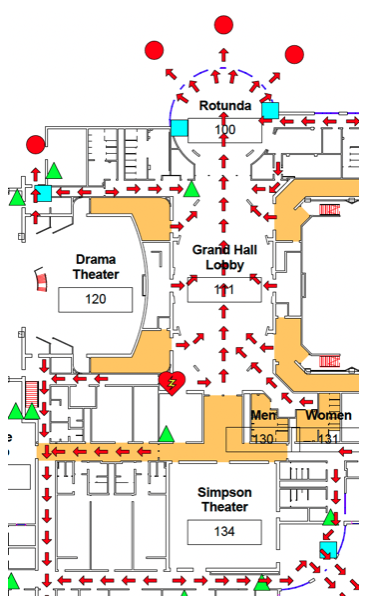
Tornado Announcement
Alert crew over the headset that you are about to hold the show for an emergency announcement.
All Actors and Crew Backstage should not go on stage.
Blackout on stage and bring house lights up.
House manager and ushers will guide patrons to the areas in yellow.
Cast and crew should proceed to the orchestra pit.
SCRIPT
- “Attention, we are currently experiencing an emergency in which we must pause the show.
- In a calm and orderly fashion, please follow the ushers to an interior hallway.
- Everyone is required to vacate the theatre at this time. No exceptions.
- The ushers will guide you. Please take all your belongings. Once the emergency has been addressed, we will resume the production if possible.”