Faculty Senate Constitution (2024 edition)
CONSTITUTION OF THE UNIVERSITY FACULTY AND FACULTY SENATE
OF ARKANSAS STATE UNIVERSITY
This constitution of the University Faculty and Faculty Senate of Arkansas State University is adopted in order to promote the effectiveness of the University in the discharge of its responsibilities and implementation of shared governance, to effect closer coordination among the various colleges and departments of the University, and to provide a means by which the special competencies of the members of the faculty may be utilized more fully in the formulation and execution of the academic programs of the University.
Article I
UNIVERSITY FACULTY AND FACULTY SENATE
Section I: Definition of University Faculty
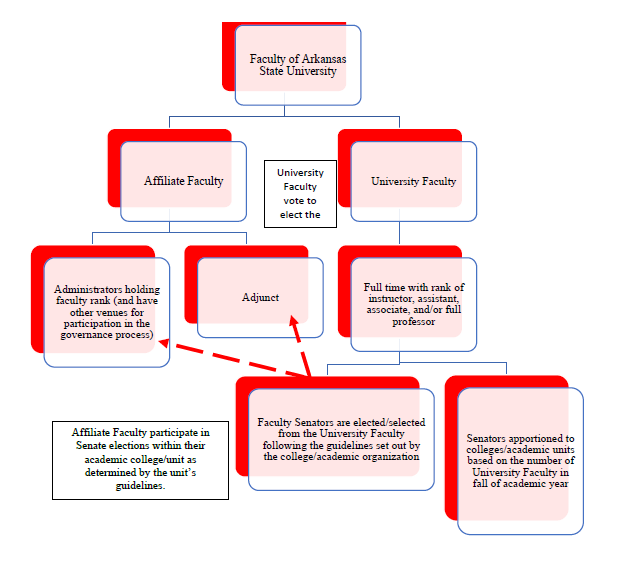
The Faculty of Arkansas State University will include both the University Faculty and also the Affiliate Faculty. The University Faculty shall consist of those employed full-time by Arkansas State University and hold the rank of instructor, assistant professor, associate professor, or professor. The Affiliate Faculty is defined as adjunct faculty and administrators who hold faculty rank.
The Office of the Provost in collaboration with the Officers of the Faculty Senate shall identify the number of both University and affiliate Faculty by the 10th day of classes in the Fall Semester to clarify the sizes of the University and Affiliate Faculty for a given academic year.
The Faculty of Arkansas State University shall meet at any time as deemed necessary by the Chancellor, the Provost and Executive Vice Chancellor for Academic Affairs, the Executive Committee of the Faculty Senate, or by petition of 20 percent (20%) of the members of the Faculty of Arkansas State University.
Section II: Definition of the Faculty Senate
The Faculty Senate is the agency for the articulation and presentation of the views of the Faculty of Arkansas State University. While departments, colleges, schools, and programs are empowered to make decisions in many areas, the need remains for consultation and cooperation on academic and professional matters pertaining to the university. The Faculty Senate shall function as the official representative voice of the Faculty of Arkansas State University in making recommendations to the Chancellor, and to the Provost and Executive Vice Chancellor for Academic Affairs and Research concerning academic requirements and policies, faculty responsibilities, welfare, and any other matters of importance to the faculty.
Section III: Faculty Senator Qualifications and Eligibility
Only University Faculty employed full-time by Arkansas State University; hold the rank of instructor, assistant professor, associate professor, or professor; and have served as a full-time faculty member for at least three years may serve as a Faculty Senator. Affiliate Faculty may not serve as senators or proxies for elected senators.
The term of each senator is fixed at two years. A senator may be elected for an unlimited number of consecutive terms.
Senators are elected or appointed to their positions from the academic organizations they represent.
Section IV: Apportionment and Composition of the Faculty Senate
The officers of the Senate shall reapportion seats on the Faculty Senate among the colleges and the independent academic organizations based on the number of University Faculty members (not Affiliate Faculty) within those units as determined in the fall semester prior to reapportionment (Article I, Section I).
Faculty with dual appointments shall be counted only once and by the college of their primary academic appointment as defined by the budget line or tenure determination.
The professional library staff and the military science faculty shall be represented as an independent academic unit. The creation of additional such academic units outside of colleges will be likewise acknowledged and represented. Representation would begin the academic year following the creation of the unit.
Section V: Officers of the Faculty Senate
The officers of the Faculty Senate shall consist of a president, vice president, secretary, and president-elect or immediate past president. These four officers shall serve as the Faculty Senate Executive Committee. This committee has the responsibility to plan meetings of the Faculty Senate and conduct the business of the Senate. The Faculty Senate Executive Committee shall also plan meetings for the Faculty of Arkansas State University.
Any faculty member eligible for service in the Faculty Senate shall be eligible to hold any elective office of the Faculty Senate (See Article I, Section III). The Faculty Senate officers shall be members of the Faculty Senate with all rights and privileges of such membership.
The president shall preside over the Faculty Senate. The president shall serve for a term of two years. Upon completing the two-year term as president, the retiring president will serve in the Executive Committee for one year as immediate past president. In the absence of the president or vice president, the immediate past president or the president-elect shall preside over the Faculty Senate or the Faculty of Arkansas State University meetings.
The vice president is elected each year from seated Faculty Senators with a maximum of two consecutive years. The role of the vice president is to preside over Senate meetings in the absence of the president. The vice president also serves on the Faculty Senate Executive Committee.
The secretary is elected each year from seated Faculty Senators with a maximum of two consecutive years. The secretary shall keep the records of the faculty proceedings and be responsible for select administrative tasks related to the business of the Faculty Senate
University Faculty. This includes minutes for the Faculty Senate and the Faculty of Arkansas State University meetings.
The University Faculty shall select the president-elect. The president-elect shall be elected every other year and shall serve for one year, whereupon he/she will succeed the president in office. The president and president-elect shall not be from the same college/academic organization. The president-elect serves as a member of the Faculty Senate Executive Committee.
The president and/or vice president of the Faculty Senate, or a member of the faculty so designated by the president of the Faculty Senate, shall attend meetings of the Arkansas State University System Board of Trustees and other shared governance meetings as appropriate and shall submit periodic reports to the Faculty Senate about the discussions of these bodies.
Section VI: Meetings
The Faculty Senate shall meet at least once each month during the academic year and shall be conducted according to Robert's Rules of Order. All meetings of the Faculty Senate shall be open to interested parties. Any member of the faculty or guest who is not a member of the Faculty Senate may participate in the discussion ONLY WHEN recognized by the senate president, but may not vote unless they are a designated proxy. The Faculty Senate president may close the session at any time for a closed Senate discussion with a simple majority vote. A non-senator may be invited to attend a closed Senate discussion only when invited by the Faculty Senate President, and if requested, a majority of Faculty Senators in attendance. Any actions taken during the closed Faculty Senate discussion will be reported in meeting minutes.
Section VII: Duties
The Senate has the authority to look into any subject affecting the well-being of the University, the faculty, or the student body. It must look into any question referred to it by the Faculty of Arkansas State University, the administration, or by petition of 10 percent (10%) of the Faculty of Arkansas State University. It may receive individual requests, but may decide on the validity of the action.
The Senate will hear the reports of all standing, non-standing, and ad hoc Faculty Senate committees. The Senate alone will make recommendations from these committees to the administration. The Senate may request that Shared Governance Committees also to provide reports. Senators serving on University Shared Governance Committees should expect to report on the
work of assigned committees.
The president of the Senate can appoint any number of special committees. These will be chaired by a member of the Senate but may be staffed by non-senate faculty and administrative personnel. These committees will report to the Senate. Further action will be at the discretion of the Senate.
Article II
AMENDMENTS
Amendments to this constitution may be proposed by a two-thirds vote of the Faculty Senate or by a majority vote of the Faculty of Arkansas State University present at general meetings. An amendment must be approved by a two-thirds majority vote of the Faculty of Arkansas State University either in a general meeting or electronically. It shall then be submitted to the Arkansas State University System Board of Trustees through the Chancellor and become effective upon their approval.
Article III
RATIFICATION
Before the constitution shall become effective, it must be approved by a majority of the sitting Faculty Senate, and members of the Faculty of Arkansas State University in attendance at a general faculty meeting called for that purpose or electronically. It shall then be submitted to the Arkansas State University System Board of Trustees through the Chancellor and become effective upon their approval. Following approval of the board, the Faculty Senate president shall immediately take steps to call such elections as will be necessary to put it into operation.
FACULTY SENATE BYLAWS
I. Faculty Senate Composition and Apportionment
A. Each year, members of the Faculty of Arkansas State University in a college/academic organization shall have the right to apportion their seats among the various departments/organizations constituting the college or the elect at-large representatives. The procedures for choosing senators within each college shall be determined (and may be revised as necessary) by a majority vote of all faculty of that college/academic organization.
B. The procedures adopted by academic colleges and units shall be reported to the Faculty Senate each year when the senators are elected. The procedures will be submitted to the secretary of the Senate for documentation.
C. Senate apportionment shall be done annually, by March 1, preceding the election of senators using the roster provided by Human Resources and the Office of the Provost in the Fall of the academic year.
D. Apportionment of the Faculty Senators is based upon the total number of full-time University Faculty with rank at the instructor, assistant professor, associate professor, and professor level, as listed by the official fall faculty roster posted by the Office of the
Provost and Human Resources. Excluded from this tally are University Faculty members on leave and Affiliate Faculty. The ratio is one senator per 15 faculty; an additional 8 to 14 faculty above the ratio allows for an additional senator. A college with up to 22
University Faculty is allotted one senator; a college with 23 – 37 University Faculty is allotted two senators; a college with 38– 52 University Faculty is allotted three senators, and so on).
E. If the size of the faculty increases or decreases significantly to the extent that the size of the Senate is unmanageable, the officers of the Senate may revise the ratio of faculty in an academic organization allotted per senator as identified above to maintain the size of
the Faculty Senate within proper proportions. A majority must approve revisions of the Senate prior to implementation for apportionment.
F. The Faculty Senate president shares apportionment numbers with Deans or other appropriate academic leaders and the current senators from each represented unit by March 1. Units are responsible for selecting the senators within the unit; each academic
unit should have written guidelines for this process (see bylaw 1.B). For the next academic year, senators should be identified by the end of the Spring semester and communicated to the Faculty Senate president.
II. Stipend
An annual stipend is to be provided by Arkansas State University to finance the activities of the Faculty Senate. The Faculty Senate president shall disburse no monies without authorization by the Faculty Senate Executive Committee.
III. Meetings
The Faculty Senate president shall call the meetings specified in the Constitution, Article 1, Section I, and Article I, Section VI, with notice being given to members of the Faculty of Arkansas State University. The president shall schedule regular meetings as deemed
best suited to the University program.
IV. Nomination and Election Procedures
A. Nomination of Officers
i. In accordance with the constitution, every second year or as necessitated by a vacancy in office, the Faculty Senate President shall appoint a Nominations Committee by March 1; the Nominations Committee will present nominations for the office of the president-elect to the Faculty of Arkansas State University by April 1. Faculty members shall be notified electronically of the nominees at least
two weeks before the election. Additional nominations may be made by a petition, signed by twenty (20) members of the Faculty of Arkansas State University, and filed with the president at least one week before the election date.
ii. Secret ballots, either paper or electronic, must be used for the election, with the names of all certified candidates appearing on the ballot. Certified candidates must have met eligibility criteria to be a senator (See Article I, Sections III and V), have been listed either by the Nominations Committee, or met the criteria for the petition.
iii. A majority of the members voting shall be necessary to elect an officer of the Senate. If no candidate for a particular office receives a majority of the votes cast, a run-off election shall be held electronically in two weeks after the initial voting.
iv. Newly elected officers of the Senate begin their duties at the first meeting of the Fall Meeting of the Faculty Senate following their election in the spring. The president and president-elect are expected to work together during the summer months, after the spring election, to ensure a smooth transition.
B. Election of the Members of the Faculty Senate
i. Members of the Faculty Senate shall be elected by members of the faculty in their respective groups (colleges, departments within a college if the faculty of the college so decides, independent departments, professional librarians, or other academic organizations) during the spring of each year to fill vacancies caused by the expiration of the term of a senator, or by any other reason as defined below. Academic organizations will determine the method of selection and voting, and this shall be on record with the Faculty Senate president.
ii. New senators shall assume their duties in the first fall meeting of the Faculty Senate following their election.
iii. Filling Vacancies: Officer and Senate vacancies shall be filled as they occur.
a. Definition of Officer vacancies
Definition of vacancy: Office of president, president-elect, or secretary shall be considered vacant when the incumbent (1) retires, (2) resigns from his/her office or the university, or (3) goes on leave for a semester or more, (4) elected to serve as president-elect, or (5) dies.
b. Procedures for filling vacancies:
i. President. If the office of president becomes vacant, the vice president is appointed to the office of president to serve out the remaining term.
ii. Vice President. If the office of the vice president becomes vacant, the Senate, at the next Senate meeting following the vacancy, shall elect a vice president from the sitting Senators to serve the remaining term.
iii. Secretary. If the office of secretary becomes vacant, the Senate, at the next Senate meeting following the vacancy, shall elect a secretary from the sitting Senators to serve the remaining term.
iv. Immediate Past President. If the office of immediate past president becomes vacant, the Senate, at the next Senate meeting, may, if it wishes, select a person to serve on the Executive Committee until such time as the office is filled under the provisions of these bylaws.
v. President-Elect. A special university election would be held to fill the president-elect position. As outlined in the constitution, the nomination process for the president-elect would be followed. The timeline for this special election will be set by the current Executive Committee and communicated to the Senate and Faculty
of Arkansas State University as soon as feasible.
c. Senate vacancies
i. Definition of vacancy. A Senate vacancy shall be considered to exist when a Senator (1) retires, (2) resigns from the Senate or from the University, (3) goes on leave for a semester or more, (4) is elected to serve as president-elect, or (5) dies.
ii. Procedure for filling vacancies. The president of the Faculty Senate, in consultation with the members of the affected group and with the approval of the Faculty Senate, shall make interim appointments effective until the next annual election. At the next annual election, a senator or senators shall be elected to complete
an unexpired term of the affected membership or memberships.
V. Standing Committees
The Faculty Senate Executive Committee is charged with setting membership for the University Shared Governance Committees as identified in the Book of Committees and for any standing, non-standing, or ad hoc Senate Committees the president may choose to stand.
VI. Amendment of Bylaws
Proposals to amend the bylaws of the Faculty Senate will be sent to the Faculty Senate for consideration. A proposal may come from within the Senate or from any group of at least 20 members of the Faculty of Arkansas State University. If approved by a simple majority of the Faculty Senate, the proposals would be sent out to the Faculty of Arkansas State University electronically for a vote. The proposal must be sent out to the Faculty of Arkansas State University at least five days before the electronic vote.
COMMITTEES APPOINTED BY THE FACULTY SENATE
During the spring semester, the Faculty Senate president circulates to each member of the University Faculty a list of University Shared Governance committees and those University committees to which the Senate has the privilege of appointing some of the members. A brief statement (or reference to the Book of Committees) as to the role of the committee and the number of vacancies is included. Faculty members are requested to return such a list, marking their preferences as to committee(s) on which they would like to serve.
Upon return of such expressions of preferences by the faculty, the Faculty Senate Executive Committee prepares a roster of committees and of faculty members willing to serve on them. The roster is used to select and name faculty for committee service. Faculty named to serve on Faculty Senate standing, non-standing, and ad hoc committees are appointed by the Faculty Senate president. Appointments are made with preference given to faculty volunteering their services. The chairs of senate standing, non-standing, and ad hoc
committees are, normally, senators. Some preference is also given to the reappointment of several previous members of a given committee to ensure continuity.
As part of this process, the Faculty Senate Executive Committee works to (1) solicit the faculty to develop a pool for prospective Faculty Senate committee appointments and Faculty Senate appointments to Shared Governance and University committees each spring; (2) select committee members for the coming year's Faculty Senate committee appointments, and (3) monitor equitable faculty member appointments to Faculty Senate, Shared Governance, and University committees.
Any other Faculty Senate committees will be appointed by the Faculty Senate Executive Committee on an ad hoc basis. These will be convened as deemed necessary by the Executive Committee and Faculty Senate.
Historical Committee: Standing Committee of the Faculty Senate
The committee is charged with overseeing the nomination and approval process for permanently honoring future distinguished faculty who have since retired, and also charged with maintaining the archives/historical records of the faculty and the association. Membership on the committee will consist of one representative who is a tenured faculty member from each academic college. Members will be selected by the Executive Committee of the A-State Faculty Senate. Members selected to serve on the committee should have a long history of employment as A-State Faculty. The committee will elect a chair. The length of the term for each committee member is five
years. Every five years beginning in the fall of 2014, the committee will put forward a call for nominations.
The committee will follow the Criteria for Inclusion and the Procedure for the Nomination Process listed below. The committee and the A-State Faculty Senate Executive Committee will be responsible for having the names of the distinguished faculty honorees, highest degree, title, and years of service engraved on the prefabricated nameplate and permanently attached on display outside of Centennial Hall. The names will be unveiled every five years during the spring meeting of the Faculty of Arkansas State University and Faculty Honors Convocation. Distinguished faculty honorees and their families will be invited to these events.
I. Criteria for Inclusion of Nominee
A. Nominees must be former A-State Faculty members.
B. Other than in exceptional cases, nominees must have a minimum of 10 years of service to A-State.
C. They must have made significant long‐term contributions to A-State.
II. Procedure for the Nomination Process
A. The Historical Committee will notify all A-State Academic Deans of their plans to honor select former faculty and the criteria that nominees must meet, and the procedures for submitting nominations.
B. Academic Deans will be asked to form a faculty nominating committee consisting of current faculty representatives from every department and program within their respective college. Deans will be asked to include as many “seasoned” faculty as possible
on these college nominating committees. Nominating committee members need to have a long history of employment as A-State Faculty.
C. Each college nominating committee will submit the names of faculty members who meet the criteria for inclusion and who should be considered as nominees. Each college nominating committee will rank order these names. These names will be provided to the Chair of the Historical Committee and copied to the college dean by mid-October 15th.
D. Each nomination must include the following in order to be considered:
i. Nominee’s full name and highest degree (e.g., Ph.D., Ed.D., MFA, MSN, etc.)
ii. Nominee’s rank and title (e.g., Professor of Chemistry)
iii. Year of first contract and year of the last contract (e.g., 1991‐2014)
iv. Key contributions to A-State (i.e., why the former faculty member is being nominated)
v. Rank order (see # 3 above) (5) The Historical Committee has the right to select nominations for presentation to the A-State Faculty Senate Executive Committee. The committee should consider approximately 10 nominations every five years.
E. The Historical Committee will vote on a final nominee list and forward the list to the A-State Faculty Senate Executive Committee for final approval.
Potential ad hoc Committees of the Faculty Senate
I. Finance Committee
The role of the Faculty Senate Finance Committee is to monitor faculty financial status both within the University and relative to other universities in the state, region, and nation.
II. Status of the Profession Committee
The role of the Faculty Senate Status of the Profession Committee is to: (1) annually survey the faculty; (2) analyze annual and longitudinal results; (3) summarize at least three major findings from survey results, and (4) prepare a report of the results for
distribution to the faculty and the public.
III. Nominating Committee
The Faculty Senate president appoints the Nominating Committee to secure nominations for the Faculty Senate president to be elected every other year.
Appendix
A-State Faculty Definitions for Faculty Senate