
Doctor of Nursing Practice Graduate Information Guide
ARKANSAS STATE UNIVERSITY
COLLEGE OF NURSING AND HEALTH PROFESSIONS
SCHOOL OF NURSING
DNP POST-MASTER'S PROGRAM OPTION
STUDENT HANDBOOK
ACADEMIC YEAR 2026-2027
A-State University
Doctor of Nursing Program
910 N. Caraway Rd. Nursing Building
State University, AR 72467
WELCOME
Welcome to the Doctor of Nursing Practice (DNP) program. You bring a wealth of academic preparation and experience to serve as a launching board for this advanced level of education and nursing practice. We look forward to helping you achieve your goals and congratulate you on recognizing the opportunities the DNP study will bring you.
This Post Masters DNP Student Handbook has been compiled to provide you with information and the policies relevant to your studies as a DNP student. You are responsible for knowing and understanding the policies and procedures in the Handbook, the University Student Handbook, and the Graduate Information Guide (GIG). Please ask for clarification if you have any questions about the information in this Handbook; we welcome your suggestions for additional information.
The Student Handbook is available online at the School of Nursing Website. The faculty reserves the right to revise policies and procedures found herein at any time deemed advisable and will communicate with you if changes are made. We look forward to working with you during your program of study as you complete the requirements for the DNP degree and assume a leadership role in nursing. We are glad that you are here!
Dr. Lisa Drake
DNP Program Director
School of Nursing, College of Nursing and Health Professions
Arkansas State University
School of Nursing Mission and Philosophy
The Core Values:
The School of Nursing values the following as;
• Access and Engagement: Respect for varied dimensions of individuality among populations. We embrace diversity in all of its dimensions realizing that mutual respect for individuality and the inclusion of all are vital for both personal and institutional success.
• Service: Professional experience in response to the needs of society.
• Learning: Acquisition of knowledge and skills in critical thinking, practical reasoning, and decision making.
• Student Centered: Development of essential skills for lifelong learning, leadership.
School of Nursing Philosophy for Nursing Education
Central to our philosophy for nursing education are four widely accepted metaparadigms of the nursing profession: person, environment, health, and nursing. Each may be defined in many ways. The works of Virginia Henderson (1972), Callista Roy (1991), Betty Neuman (1993), and Madeleine Leininger (1991) among others drive our understanding of these concepts.
A person may be defined as an individual, family, group, or community (Leininger, 1991) comprised of biological, psychological, sociological, cultural, and spiritual constituents (Henderson, 1972; Neuman, 1993). Each person has innate worth, and though each is unique, all possess characteristics of shared basic human needs. We believe that a person’s individual experiences, genetics, culture and existence are dependent on perception of and reaction to change. Inherent in this process is the capacity to make decisions, consider alternatives, and predict and accept possible outcomes.
Environment may be defined as internal, external, and created (Henderson, 1972; Neuman, 1993) conditions, circumstances, influences, events, situations, or experiences (Leininger, 1991; Roy, 1991) that surround the person or are within the person and affect development, behavior, and resources. The environment affects the ability of the person to pursue and achieve a high quality of life. Society and culture drive the need for order, meaning, and affiliations with other humans. These, along with physical and biological forces stimulate a need for adaptation and, potentially, interactions with others in order to survive, develop, grow, and mature.
We understand health to be a continuum of wholeness and integrity defined by culture, values, and practices (Leininger, 1991; Neuman, 1993). Often expressed in terms of wellness and illness or absence of disease or injury, health is based largely upon the person’s ability to function independently in their environment (Henderson, 1972; The Nurse of the Future: Nursing Core Competencies, 2016). The ability of a person to achieve an optimal level of wellness depends on motivation, knowledge, ability to cope, and developmental status. The primary responsibility for one’s health rests on the individual and/or those upon whom the individual is dependent.
Nursing is both an art and science and can be defined as activities aimed to assist, support, and promote adaptation of individuals and groups (Leininger, 1991; Roy, 1991) in performance of activities (Henderson, 1972) by assessing behaviors and factors that alter the ability to adapt (Roy, 1991). Nursing is an altruistic discipline evolved from the study and application of its own interventions as well as application of knowledge from other disciplines. Nursing is focused on provision of care across the health continuum using systematic processes, and practice is refined based on societal needs. Thus, nursing enhances the environment and contributes to health, quality of life, and dying with dignity (Roy, 1991).
Nursing education must prepare professional nurses for traditional and evolving roles. The faculty recognizes the obligation of the nursing curriculum to include leadership, strategies that promote change, professionalism and service. A wide variety of types of nurses are needed to fulfill the needs of our communities. These types include, but are not limited to, registered nurses (RN), RNs certified in their specialty, Nurse Practitioners, Nurse Educators, Nurse Administrators, Nurse Leaders, and Nurse Anesthetists. Therefore, nursing education must be provided at various levels. To acquire the knowledge and judgement necessary for practice, nursing education focuses on critical thinking, decision-making, analysis, inquiry, and research. The faculty also believes that learning is a life-long process, often conducted independently of formal educational settings. Formal educational settings provide opportunities for teacher- student interaction in setting goals, selecting and evaluating learning experiences, and appraising learners’ progress. All levels of nursing education share certain rights, duties, and characteristics, such as the scientific basis of nursing care. Accordingly, we actively support the endeavors of the profession to assist nurses in pursuing professional education from beginning to advanced levels.
The school of nursing provides education at four levels: the Associate of Applied Science in Nursing (AASN); the Bachelor of Science in Nursing (BSN); the Master of Science in Nursing (MSN); and the Doctor of Nursing Practice (DNP).
The purpose of the AASN is to prepare graduates capable of applying the nursing process to provision of direct nursing care for clients with common, well-defined problems. Therefore, the associate curriculum is grounded in the liberal arts and includes professional values, core competencies, core knowledge, and role development. An associate degree graduate is prepared to function as a member of the profession and a manager of care in acute and community-based settings.
The nurse prepared with a BSN is a professional who has acquired a broad, yet well- delineated knowledge base for practice. We believe that the role of a baccalaureate graduate is multifaceted and developed through extensive study in the areas of liberal education, professional values, core competencies, core knowledge, and role development. These prepare the baccalaureate graduate to function as a provider of direct and indirect care to individuals, families, groups, communities and populations. A graduate of the baccalaureate program is a member of the profession and a designer, manager, and coordinator of care.
Master’s level (MSN) education prepares nurses who have already achieved their baccalaureate degree for advanced nursing practice. Preparation for advanced practice emphasizes strategies to intervene in multidimensional situations. The knowledge base is expanded in scope and depth through scientific, theoretical and research components of nursing. Various theories inherent in advanced practice roles and strategies are analyzed and explored to synthesize the interdependence of theory, practice, and scientific inquiry in nursing. This synthesis of knowledge and experience provides the basis for creating, testing, predicting, and utilizing varied and complex interventions for problems of healthcare and healthcare delivery. A graduate of the master’s program is a leader in the profession and is prepared as an independent coordinator of care.
The DNP prepares master’s level nurses with advanced leadership skills, increased knowledge of health policy, and increased clinical skills and expertise with which to provide care, especially in rural and underserved areas. They are prepared to initiate and to lead implementation of changes required by the evolving healthcare system. They are prepared to analyze and expand boundaries in order to become transformational leaders driving innovation and excellence in healthcare for their communities, region, nation, and the world.
The DNP in Nurse Anesthesia prepares baccalaureate nurses with critical care experience and a working knowledge of pathophysiology, pharmacology, and anatomy/physiology to become Certified Registered Nurse Anesthetists (CRNA). They are educated in the roles of advanced leadership, health policy, clinical skills, and expertise to provide care in the full scope of practice in anesthesia care throughout the lifespan. They are prepared to initiate and to lead implementation of changes required by the evolving healthcare system. They are prepared to analyze and expand boundaries in order to become transformational leaders driving innovation and excellence in healthcare for their communities, region, nation, and the world.
Revised 11/2024
SCHOOL OF NURSING ORGANIZING FRAMEWORK
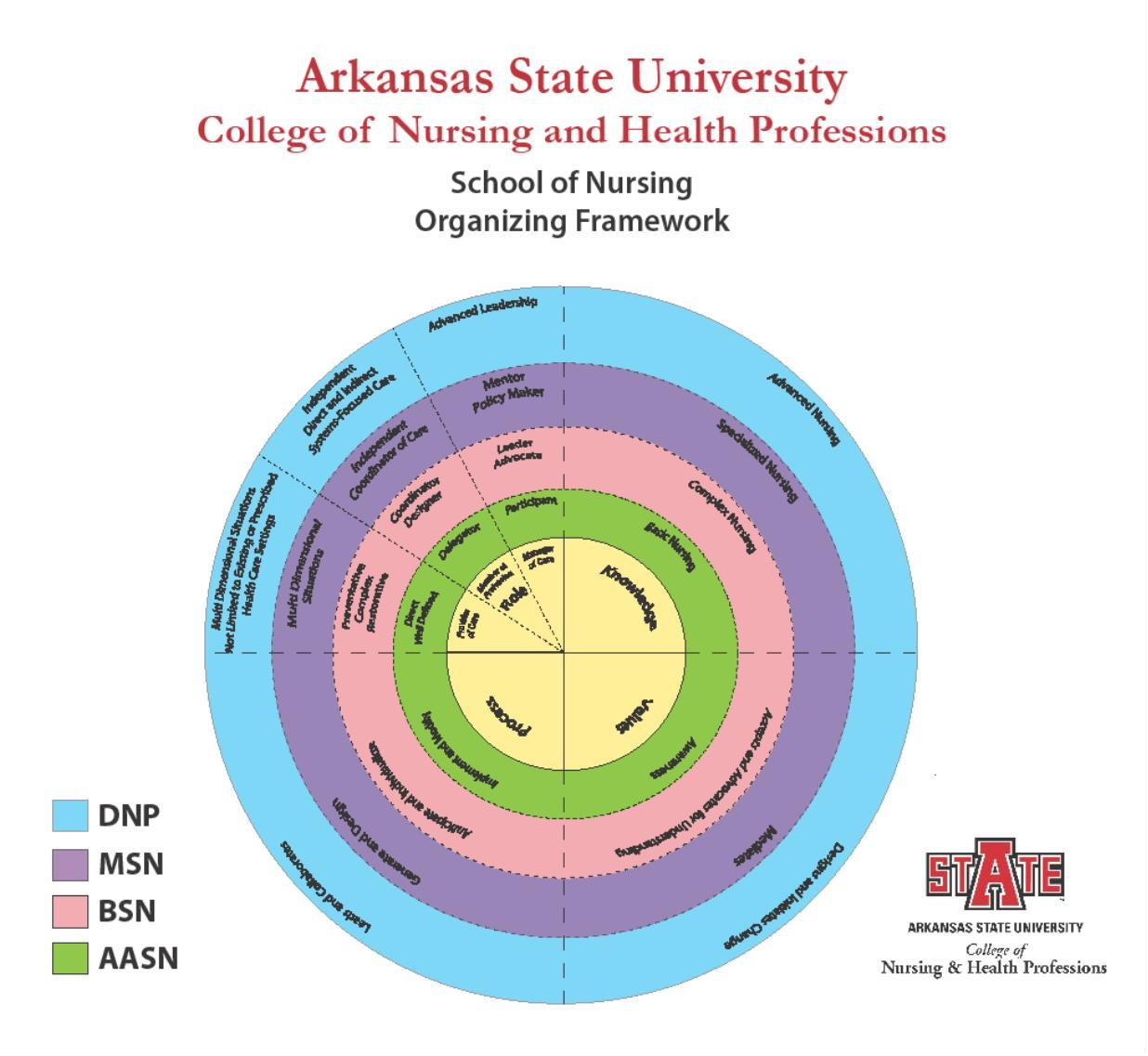
The organizing framework of the nursing department is derived from the philosophy and has four major components. The four components are role, process, values and knowledge. These components are taught at each level of education and provide a construct for development of objectives and outcomes. The framework model clearly shows how each of the components increases in complexity at the three levels of education.
ROLE
The first major component is role. The faculty believe provider of care, manager of care and member of the profession (NLN) are key elements of this component. To clearly explain how these roles develop, each will be examined at all three levels.
At the associate degree level, emphasis is placed on providing and managing direct care to individuals with common well-defined problems. The associate degree graduate functions as a team member using nursing diagnoses and established protocols for individuals in acute care and community-based settings.
Additionally, the graduate participates as a member of the profession in appropriate specialty and politically focused nursing organizations.
The baccalaureate degree nurse provides direct and indirect nursing care to individuals, families, groups and populations. The baccalaureate graduate has the ability to individualize nursing diagnoses and protocols to enhance the design and coordination of preventative, complex and restorative care. As a member of professional organizations, the graduate has the capacity to assume leadership and advocacy roles.
The master’s graduate can function independently in the provision for direct and indirect care. Practice settings for the master’s prepared graduate are multi-dimensional. Inherent is the ability to design, facilitate and coordinate care for individuals in a variety of health care settings.
Graduates have the skills necessary to lead effect policy and mentor as members of specialty and politically focused nursing organizations.
The Post Masters Doctor of Nursing Practice graduate functions independently in the provision of direct and indirect, systems-focused care. The DNP graduate is active in evaluating existing health care systems and initiating changes to meet the needs of individuals, families, groups, and populations. Practice settings for the DNP prepared graduate are multi-dimensional and are not limited to existing or prescribed health care settings. Graduates have the skills to initiate change, lead and serve as mentors for other health care team members at the local, regional, state, national and world levels.
KNOWLEDGE
The second major component is knowledge. The general education curriculum provides a foundation of liberal arts and sciences for the associate and baccalaureate students. These courses help provide the basic psychosocial, spiritual, humanistic, and legal components which assist students in developing an appreciation of each person’s interaction with the environment. The knowledge gained enhances the nurse’s ability to think critically, reason logically, and communicate effectively.
The associate degree core focuses on liberal arts and sciences, which include courses in English, college mathematics, basic biological science, history, and psychology. Content for the associate degree student provides basic nursing knowledge that is applied to common well-defined problems.
The baccalaureate student’s general education core is expanded to provide a more in-depth science basis and global view of society. These courses include physical sciences, sociology, world civilization and humanities. Pathophysiology and statistics are incorporated into the nursing curriculum as the student progresses into complex nursing theory and application.
The master’s program builds on the baccalaureate curriculum. Core graduate courses include theory, research, role, and health policy. These courses prepare the master’s graduate to integrate the other components of role, process, and values. The key support courses for all options include advanced pathophysiology, advanced pharmacology, and advanced health assessment/physical diagnosis. Content in specialty courses reinforces concepts in the core courses as well as preparing the graduate for advanced nursing.
The Post Masters Doctor of Nursing Practice curricula builds on traditional master’s programs with education in evidenced based practice, advanced clinical, organizational, economic, and leadership skills to design and implement programs of care delivery. Translation of research into practice will significantly impact health care outcomes and have the potential to transform health care delivery.
VALUES
Faculty defines the third component, values, as the system of beliefs that guide behaviors, attitudes and moral judgment. Personal values reflect cultural and social influences, relationships and individual needs. Professional values guide nurses’ behavior to act in a manner consistent with nursing responsibilities and standards of practice. We believe professional values can be formed through reasoning, observation and experience. The associate graduate possesses an awareness of personal values and how these values may influence care delivery.
Additionally, the associate graduate incorporates professional values in assisting individuals with the process of value clarification that may impact health care decisions. The baccalaureate graduate has a global perspective and is able to help individuals clarify or re-prioritize personal values, minimize conflict and achieve consistency between values and behaviors related to health. The masters’ prepared graduate applies professional values when designing health care systems in response to societal need. The master’s graduate is able to engage in activities that influence policies and service delivery to diverse populations in a variety of settings. The Doctor graduate is prepared as the nursing terminal degree that encompasses all professional role expectations in nursing. Personal values are applied when evaluating and designing health care systems, as well as leading the change of health care systems in response to research translation, population health, and needed policy development.
The profession of nursing utilizes a systematic process that incorporates the other three components, role, knowledge and values to evaluate the needs of individuals, groups and/or communities. The process involves assessment, planning, implementation, and evaluation on a continual basis. All nurses are prepared to use this process but as one acquires additional knowledge, the nurse begins to use the components of the process in unique and creative ways. As one moves through the educational program, elements such as communicating, educating, supporting, coaching and monitoring are incorporated into the process. Additionally, problem solving, planning, inquiry, and appraisal are used to derive and evaluate the interventions developed.
The associate degree graduate uses a systematic process in nursing care to implement and modify known nursing interventions. The baccalaureate prepared graduate has the capability of anticipating, individualizing, implementing, and evaluating various interventions according to unique situations and cultural responses. The master’s graduate generates and designs nursing interventions. The master’s graduate recognizes interdependence of theory, practice and scientific inquiry when creating, predicting, and evaluating interventions that are complex and varied. The Doctor graduate leads and collaborates change for improved healthcare systems and designs systems for improved population health based on research translation. At all levels relevant research literature is utilized in the application of the nursing process.
DNP Program Outcomes
The following are the DNP Program Outcomes:
1. Incorporate theories and concepts from nursing, the arts, humanities, sciences, and evidence-based practice to guide clinical and professional judgment in nursing practice. (Domain 1 AACN)
2. Enhance person-centered care while respecting diversity and the unique determinants of individuals and populations. (Domain 2,3 AACN)
3. Integrate leadership and collaborative roles in the planning, provision, and management of services to influence policy for individuals, families, and populations. (Domain 3,6 AACN)
4. Facilitate authentic leadership within complex health systems for the improvement of safe, cost-effective, quality health care for diverse populations. (Domain 5 AACN)
5. Model professionalism in nursing practice through accountability to ethical and legal standards. (Domain 9,10 AACN)
6. Cultivate critical inquiry to advance the discipline and profession of nursing. (Domain 4 AACN)
7. Revise programs of care, outcomes of care, and care systems through information systems and technology. (Domain 7,8 AACN)
DNP Essentials
The DNP program outcomes (AACN’s Essentials of Doctoral Education for Advanced Nursing Practice, 2021), constitute the foundation of the program and run throughout all courses. Assessment includes DNP Essentials (AACN, Program and Course Learning Outcomes).
Upon completion of the study for the Doctor of Nursing Practice, the student learner/graduate is expected to be prepared in The Essentials: Core Competencies:
Domain 1: Knowledge for Nursing Practice
Domain 2: Person-Centered Care
Domain 3: Population Health
Domain 4: Scholarship for Nursing Discipline
Domain 5: Quality and Safety
Domain 6: Interprofessional Partnerships
Domain 7: Systems-Based Practice
Domain 8: Informatics and Healthcare Technologies
Domain 9: Professionalism
Domain 10: Personal. Professional and Leadership Development.
DNP Curriculum
The curriculum of 36-43 credit hours is completed in a program of study that is as few as 14 months in length. These credit hours include 27 credits, with 9 of those courses identified as specialty courses. The total clinical hours required for a DNP degree is 1000 hours. However, a gap analysis evaluating the student’s MSN clinical hours may provide credit for up to 460 of these hours. Students will be required to complete an additional clinical course, NURS 881V (8887V)*, if the gap analysis calculation indicates additional clinical hours are needed to complete the 1000-hour requirement. NURS 881V is a variable credit course so students can earn up to 7 credit hours or 60 clinical hours per module and fulfill the clinical hours requirement.
*See the A-State Graduate Bulletin for the current plan of study and course descriptions.
Course Delivery
The DNP courses will be offered online with distance education delivery using the learning management system. Students must have a computer with Internet access that supports video streaming. Please review the additional online student electronic requirements provided on the A-State website, your course syllabus, and the General Orientation tab under the Getting Started Module in each course.
Clinical Attire & Name Tags
● Students may not begin their clinical hours until they are cleared to start by the faculty.
● All students are required to dress professionally. A white lab coat will be worn, which is freshly laundered and ironed. The lab coat may be worn over scrubs, depending on the clinical needs of the day, wear it over business clothing. The appropriate length of the lab coat is not longer than mid-thigh length. A name tag will be worn identifying the student as an A-State DNP student. Name tags can be ordered through the Textbook Brokers.
Order form for name tag:
Examples for an appropriate format for a name include:
Line 1: (If you want, Mr./Mrs./Miss/Ms.) “Your Name, MSN, APRN, (certification: CNP, CNM, CNS, CRNA)” Line 2: “A-State DNP Student”
Clinical Documentation
Students must submit the following clinical documents to their Verified Credential account and obtain approval before enrolling in NURS 8313 (88303) DNP Internship I. Failure to complete these approvals before the NURS 8313 DNP Internship I will result in denied entry. Additional information will be provided in the DNP Orientation.
1. Active license to practice as a registered nurse in the state in which they will complete clinical hours. May use report from https://www.nursys.com/. Expires on the expiration date noted.
2. Professional liability insurance indicating role as a DNP student with a policy limit of
($1,000,000/$3,000,000). Expires on date provided on malpractice and should be updated accordingly.
3. TB skin test, QuantiFERON, or T-spot, or evidence of negative findings from chest x-ray (one time on admission, and test dates should be within one year of admission to the program; 1-step). Does not expire.
4. CPR certification (AHA BLS). Expiration date applies.
5. Hepatitis B full immunization; titer must have positive result.
6. MMR; full immunization; titer must be positive for all three (3) diseases 7. Influenza-yearly; must include date. 1 dose.
8. TDAP- within 10 years. Booster required every 10 years.
DNP Project Documentation
Before enrolling in NURS 8213 (88203)Translational Research I, students must submit the following DNP project documents for review and approval. This is a crucial step for the DNP Project and a necessary component for obtaining IRB approval. Failure to submit and obtain approval will put the student at risk of course failure, as IRB approval is required for the course. ** Once project documentation has been approved, any changes to the project site or practice partner will require the student to resubmit documentation with the new change for approval. This may also require students to resubmit a new feasibility document for the project and IRB approval. Students are to notify the course faculty of any changes throughout the program. Failure to do so can prevent students from moving to the project courses: NURS 8213 (88203)Translational Research I, NURS 8223 (88233)Translational Research II, or NURS 8263 (88263) DNP Project.
Site Permission letter: Document 1 if completing project at workplace or affiliation agreement secured.
1. Affiliation Agreement: Document 2 if completing project outside of workplace. Once the contract is approved and signed, Document 1 must be completed and signed by the project site.
2. Practice Partner Agreement: Document 3 if completing project outside of workplace.
3. Practice Partner Agreement: Document 4 if completing project at workplace.
The DNP (Scholarly Improvement) Project
The DNP Project is a culmination of the knowledge gained in the DNP courses and applied in a specific area of the student's choice (based on needs assessment). The Project provides:
1. An opportunity to demonstrate an analytical approach to clinical problems, programmatic, administrative, or policy issues in a format that supports the synthesis, transfer, and utilization of knowledge.
2. The ability to demonstrate the identification and resolution of a practice problem through the scholarship of application, integration, and translation.
3. A broad and holistic approach to systematic problem-solving.
4. A contribution from DNP expertise in the workplace or the community, and in the academic area.
5. Experiences that are characterized by strategic interactions between and among faculty, students, and the community in which the DNP is enacted.
Criteria for the DNP Project Manuscript
The DNP project is completed during NURS 8263 (88263) DNP Project. The project represents an opportunity for the student to investigate healthcare issues in a clinical situation that needs improvement. The focus is broad, encompassing not only direct care issues but also interventions and programs that indirectly impact clinical outcomes for a defined population or group of professionals.
Indirect clinical care, interventions designed to improve clinical outcomes for a population, administrative interventions to improve clinical outcomes, and policy interventions to improve health conditions and outcomes for populations are included in this definition. The project focuses on the scholarship of practice, with an emphasis on internal (local value) validity rather than external generalizability. The report of the DNP project consists of one scholarly manuscript that describes the nature of the DNP project and a presentation to a learned forum. Student final products are shared in an online repository.
Policy
DNP Manuscript-Final Version (all required components) must be submitted by the student to include all final edits discussed in oral or written format by the project chair and course faculty. This version is graded per the manuscript rubric.
A second attempt for submission of the DNP Manuscript- Through References is what is submitted to the DNP Repository. This manuscript must be approved by the DNP Faculty with a grade of 80% or higher. Failure to do so will result in an F for the course. The faculty has the right not to submit the manuscript to the DNP Repository if the student does not meet the scholarly work requirements.
Types of translational scholarly DNP projects include but are not limited to:
• Quality Improvement-focus on the structure, process, and outcomes of health outcomes. Quality improvement is a continuous monitoring process with its own validated methods and tools for analysis. Interventions should be evidence-based, with input from the local stakeholders, to have the most meaningful impact in this setting.
• Action Research (Translational Research) - directly impacts practice and builds capacity. Translational action research involves a cycle of data gathering, reflection, and problem redefinition. The student takes research already completed and modifies it for use in the local setting.
• A variety of methods may be used to collect data.
Ideas that may fall into one of the above categories:
• Translation of research into practice
• Design and evaluation of new care delivery models
• Design and evaluation of programs for patient or community-based populations
• Implementation and evaluation of evidence-based practice guidelines
• Implementation and evaluation of innovative uses of technology in clinical practice to improve outcomes
• System modification for quality improvement processes
** Substantive deviations from the suggested scholarly projects will require discussion and approval with the Program Director, the project committee, and the project chair.
**All projects should address the purpose, needs for the project, change theory, policy issues, literature review, leadership and change management role competencies, role-specific certification competencies, DNP Essentials, organization/systems implications, educational needs of staff/providers/patients, technological elements, strategic planning, interdisciplinary teamwork, guidelines for data management, IRB review, and financial aspects for implementing the project.
Roles of DNP Project Team
The DNP Project is produced with the advice and guidance of a team.
Role of the DNP Project Chair
1.Support and enhance DNP students in developing inter-professional and intra-professional skills, doctoral writing skills, and leadership skills in conducting the DNP project and its associated project paper. These attributes will be done within the construct of the course guidelines.
2.Maintain rigor of the DNP project by assuring scholarly and doctoral writing, appropriate literature references, and reviews. Ensure the project is multi-dimensional, is education, and/or quality improvement, or safety oriented, all while using APA standards.
3.Mentor the student in developing and applying the principles of business, informatics, finance, evidence-based practices, QI, and/or policy initiatives as they relate to their DNP project topic.
4.Mentor students in developing the critical thinking skills of a doctoral student while they are developing and advancing their skills in translational research and scholarly writing.
5.Mentor student on how to professionally disseminate DNP project results in different venues.
6.Ensure all DNP projects remain evidence-based, incorporating appropriate evidence-based references for support.
7.Mentors in the DNP project process include the critical and systematic method of the AACN Essentials of Doctoral Education for Advanced Nursing Practice.
8.Review and provide feedback on sections of their DNP papers before submission of required coursework.
9.Maintains a Project Chair Workroom.
10.Reviews the feasibility document and project approval. Mentors students through project development.
11.Review and provide feedback on the student’s IRB study before the student’s submission for a grade and submission to the IRB. The Project Chair serves as the Faculty Advisor for the IRB study.
12.The project chair mentors the DNP student throughout the dissemination process.
13.The Project Chair is present during the assigned student’s DNP final presentation (this is the comprehensive final for the project).
14.Maintains open communication with the course instructor and the program director regarding the progress of the students being mentored. Concerns should be addressed in a timely manner.
15.Attend virtual or recorded faculty meetings.
16.Completes required university and/or program training and continued education.
17.Holds a terminal degree in Nursing and maintains an unencumbered nursing license.
Roles of DNP Practice Partner (Outside the department)
1.Provide expertise in the selected area of study for the student.
2.Assist students in the selection and project design most appropriate for their area of expertise.
3.Mentors the DNP student through the Quality Improvement or Policy project at the project site.
4.Communicate concerns to students and the DNP Director as needed.
5.Review the practice partner handbook.
6.The Practice Partner does not grade assignments and does not precept.
Role of the DNP Student
1.Maintain consistent and effective communication with the Project Chair and all team members, using only school email.
2.Collaborate with the DNP Project Chair to schedule team meetings.
3.Generate and submit all required forms (ie, Site permission letters, practice partner agreement, clinical documentation, feasibility document, and IRB study).
4.Submit work to the DNP Project Team that demonstrates a high level of scholarship and interventions.
5.File Certificate of Completion of CITI training, IRB proposal, IRB notification of approval, and final manuscript (Sections I, II, and III as per the template).
6.It is an expectation to make all edits in response to the course faculty's and/or project chair comments in a timely manner.
7.Disseminate the DNP Project and complete the final manuscript in the NURS 8263 DNP Project course.
DNP Project Process
1.Complete DNP Orientation and required tasks.
2.DNP Project proposal is an essential component; however, non-graded. Students will receive faculty feedback during DNP Orientation, providing direction with potential project topics.
3.Project approval is based on previous feedback and the completion of a feasibility document and is approved by the faculty project committee during the NURS 8123 Leadership course (88173).
4.Failure to secure a project site and practice partner can delay entrance to NURS 8213 Translational Research I (TRI). Students must have an approved DNP Project before entry to NURS 8213 TRI.
5.The student will complete Section I in NURS 8213 TRI.
6.Before the start of NURS 8213 Translational Research I, a Project Chair will be assigned to each student by the DNP Program Director.
7.The DNP student will contact the assigned DNP Project Chair to discuss the project that was approved. If the Project Chair leaves A-State, the DNP Director, in consultation with the remaining team members and the student, will either appoint another project chair or assume the position.
8.The student completes CITI training appropriate to the project and uploads the certification to the DNP Workroom, as well as in any courses required through an assignment.
9.The student completes the IRB application appropriate to their project and uploads it to the DNP Workroom as well as in any courses requiring this through an assignment. Students will contact the Project Chair for assistance with filing IRB application forms (See section on IRB below).
10.Students will complete and certify the IRB study for faculty review, allowing 2-3 weeks for a response. It is common for multiple attempts at editing and approval to occur. Failure to submit the IRB study and receive IRB approval in NURS 8213 TRI will put the student at risk of failing the course.
11.Any changes to the project site or practice partner must be communicated to the project chair, the course faculty, and the DNP Director. This will require a change in topic and approval of the project.
12.Notify the Project Chair of IRB status and maintain IRB notification of approval for filing/ portfolio, etc.
13.Once IRB requirements are satisfied, the student, CO-PI, and Faculty Advisor will certify, and the IRB study will enter into Pre-Review status.
14.Project implementation or data collection may not begin until IRB approval is formally obtained.
15.The next project course is NURS 8223 Translational Research II(TRII), in which you will implement your project. The student will be denied entry into NURS 8223 TRII without IRB approval. The student will complete Section II of the DNP Project paper in NURS TRII. You can begin implementation, data collection, and analysis once the course faculty receives confirmation of IRB approval.
16.In the NURS 8263 DNP Project course, students will complete Section III and disseminate the project through a completed manuscript and an oral/ PowerPoint presentation (comprehensive final for the DNP program). You must pass the program requirements to be eligible to graduate.
17.The oral presentation will include all key points of Sections I, II, and III.
18.PowerPoint slides should be used. The DNP student must meet with the Project Chair to practice dissemination and to review PowerPoint slides. All team members and the students must be present for the oral presentation to the DNP Project Team.
19.Completed DNP Presentation - Students must be prepared to present the entire project in the timeframe of 20 minutes. The candidate must present the entire project and demonstrate to the team that they are qualified to receive the Doctor of Nursing Practice degree.
20.The candidate should be prepared to answer any questions from the faculty members.
21.After the public presentation, the course faculty and/or the project chair will meet to discuss the final results.
22.The Project Chair will communicate results to the students.
23.The DNP Director will forward the completed Project form to the Graduate School.
24.The student will submit a written draft of the completed DNP Project Manuscript to the Project Chair. Allow 1-2 weeks for review and to make recommended revisions.
25.The student should prepare the final electronic manuscript and submit it to the NURS 8263 DNP Project course and faculty. Once graded and approved, the manuscript will be sent to the DNP repository. See policy for manuscript.
26.The student must pass with a minimum grade of “B” in all DNP courses, maintain a GPA of 3.25 or higher, and submit a completed and approved manuscript to be eligible for graduation. Additionally, the student must meet all required clinical hours. Lastly, the DNP Presentation must be successfully passed in two attempts.
Oral Presentation Policy
DNP Comprehensive Final (Oral Presentation): Program Requirement
Live/PPT Final Defense Presentation (Comprehensive: Must pass the comprehensive final.)
Mandatory pass/fail.
If a student does not pass the oral presentation, the student will have one more attempt, which will include a Video/PPT Final Presentation. The due date is designated by the course faculty, and the student is notified. If the student does not pass the Video/PPT Comprehensive Presentation, the student is terminated from the program.
Institutional Review Board (IRB) Approval and Forms
Depending on the nature of the investigation, an application for exempt or full review is submitted to the IRB at Arkansas State University. The student will work with the project chair to determine which application is appropriate for the proposed study. Students must also identify and follow the procedures for study review and approval at the site where data will be collected. The clinical site may also have its own IRB and procedures to follow. Students are kept informed about College and University matters, including the review process of the IRB application in the College, via their assigned university email address only. Information will not be sent to personal email addresses. Furthermore, the student may not implement the intervention or collect data until official written approval is obtained from the Institutional Review Board.
If changes are made in the protocol or consent form, or if problems arise in the conduct of the study, the student must report them to their project chair, course faculty, and to the IRB. It is the student’s responsibility to notify the IRB when the study is completed (if it is deemed research).
Advising and Retention
Advising
An Advisor will be assigned to you upon admission to the program. You will receive a degree plan upon admission, and students are expected to follow the sequence of courses in the plan.
Retention
Students must maintain a GPA of 3.25, according to the Graduate School requirements. Admission to clinical courses requires a grade of B or better in all graduate-level courses.
All policies as represented in the -State Graduate Bulletin remain in effect, including requisites and corequisites identified for each course. Effective Fall 2013, all DNP students will be required to earn a minimum grade of “B” in all courses before progression in the curriculum.
Dismissal Policies
Clinical Agency Dismissal Policy
Students dismissed or removed from clinical agencies at the request of the faculty mentor or contracting agency will be placed on probation for no less than one (1) month. Faculty will make every attempt to locate another suitable clinical practice site. Faculty will work with students to produce a plan of action for students to correct the behavior that led to dismissal. By the end of the probationary period students must demonstrate improvement or correction of the behavior that led to dismissal. If the student fails to improve or demonstrate correction of the behavior that led to removal, dismissal from the program can result.
*IF THE STUDENT IS REMOVED FROM A CLINICAL AGENCY A SECOND TIME, HE/ SHE WILL FAIL THE COURSE.
General Dismissal Policy
A student may be asked to leave the nursing program regardless of academic grade if any of the following conditions exist:
1.Demonstrated lack of aptitude for advanced practice in nursing.
2.Failure to exhibit behavior of:
a.)Integrity
b.)Dependability and accountability
c.)Concern for human and societal needs. (See Honor Code)
3. Clinical nursing performance that jeopardizes the safety of patients.
4. Physical or emotional condition of a nature that affects, or is affected by, one's performance in nursing.
5. Failure to conform to the legal and ethical standards of the nursing profession.
6. Having excessive absences or inadequate clinical contact hours obtained throughout clinical rotation (see attendance policy).
Academic Honesty Acknowledgment Statement (found in the course Getting Started Module)
All DNP Students will review and complete the quiz. The following statement is;
I acknowledge that I have received and read the Simple Syllabus. I understand that it is a violation of university academic policies to share my Canvas or BioSig-ID login credentials, disguise my location, mask my IP address, use Virtual Private Networks (VPNs), or engage in any unauthorized collaboration. I also understand that violations of these policies may result in disciplinary action, including possible dismissal from the program.
Policy
1.If PM DNP Director receives an email from IT about a violation of this policy, the Director will provide the student with a first warning email recognizing the violation.
2. If a second occurrence happens, the student will be notified by email, and the violation will be sent to Academic Misconduct, for further investigation and sanction.
Withdrawal from Courses
The option of withdrawing from a course and receiving a grade of "W" is possible within the withdrawal period listed on the academic calendar each semester. Students electing to take a "W" in a nursing course are to understand that re-enrollment in that course is subject to the review of the faculty.
Academic Rights and Appeal Policies
Arkansas State University is a community of scholars whose members include its faculty, students and administrators. It is a forum where ideas are discovered, discussed and tested. The basic purposes of the university are the enlargement, dissemination and application of knowledge. These are achieved through classroom instruction, research, special lectures, concerts, discussion groups, seminars, experimentation, out-of-class activities, and group living and leadership development.
The basic necessity for the achievement of these purposes is freedom of expression and assembly. Without this freedom, effective testing of ideas ceases, and teaching, learning, and research are rendered ineffective. Yet absolute freedom in all aspects of life leads to anarchy, just as absolute order leads to tyranny. Both anarchy and tyranny are antithetical to the purposes and necessities of the university. Therefore, the university must always strive for that balance between maximum freedom and necessary order which best promotes its basic purposes by providing an environment most conducive to many-faceted activities of teaching, learning, and research.
The student, as a member of the academic community, has both rights and responsibilities. The most essential right is the right to learn, and the university has a duty to provide for the student those privileges, opportunities and protections that best promote the learning process. The student has a responsibility to other members of the academic community, the most important being to refrain from interference with the rights of others, which are equally essential to the purposes and processes of the university.
Regulations governing the activities and conduct of student groups and individual students are not comprehensive codes of desirable conduct; rather, they are limited to meeting the practical, routine necessities of a complex community and to the prohibition or limitation of behavior, which cannot be condoned because it interferes with the basic purposes, necessities and processes of the academic community, or with rights essential to other members of that community.
The student is not only a member of the academic community —he/she is also a citizen of the larger society. The university will use every method at its disposal to ensure that the campus environment is conducive to the learning process. It cannot condone those activities designed to disrupt and destroy the basic functions of the university. Each student has an obligation to the larger society, which is the responsibility of the legal and judicial authorities of the city, county, and state. The university cannot be expected to shelter a student from the reality of this obligation.
The university, in its relationship to each student, recognizes the constitutional rights of freedom of speech and due process when the student’s right to continue as a student is in question. A student who feels that his/her constitutional rights have been violated and who has not found satisfactory relief within the university structure has access to the judicial process of the civil courts.
In order to protect student rights, to facilitate the definition of student responsibilities, to preserve necessary order, and to provide avenues through which students may seek to effect change, the guidelines in the following pages are established.
The freedom and effectiveness of the educational process depend upon the provision of satisfactory conditions and opportunities for learning. The responsibility to secure, respect and protect such opportunities and conditions must be shared by all members of the academic community. The faculty has the central role in the educational process and has the primary responsibility for the intellectual content and integrity of the university.
It is the faculty’s role to encourage discussion, inquiry and expression among students and to act as an intellectual guide and counselor. They should foster honest academic conduct and evaluate students fairly and accurately. They should not exploit students for private advantage, and they should respect the faculty-student fiduciary relationship. The establishment and maintenance of the proper faculty and student relationships are basic to the university’s function. This relationship should be founded on mutual respect and understanding and assumes a common dedication to the educational process. If problems arise in this relationship, both student and faculty should attempt to resolve them in informal, direct discussions as between well-intentioned and reasonable persons.
Academic Responsibilities of the Student
The student is responsible for being informed about academic requirements, both general and specific, for completing a degree program as outlined in the Undergraduate or Graduate Bulletin. • The student is responsible for learning the content of a course of study according to standards of performance established by the faculty. • The student’s behavior in the classroom shall be conducive to the learning process for all concerned.
The Academic Rights of the Student
The student shall have the right to an academic environment that is accepting of all students without regard for race, national origin, gender, disability, ethnicity, sexual orientation, age, or religion. • The student shall be free to take reasoned exception to data and views offered in the classroom, and to express differences of opinion without fear of penalty. • The student has a right to protection against improper disclosure of information concerning grades, health, or character that an instructor acquires in the course of his/her professional relationship with the student. • The student has a right to a course grade that represents the instructor’s professional judgment of the student's performance in the course. • The student has a right to be governed by educationally justifiable academic regulations. • The student has a right to competent instruction. • The student has the right to accurate and clear information in order to determine: o The general requirements for establishing and maintaining an acceptable academic standing. o His/her academic relationship with the university and any special conditions that apply. o The graduation requirements for a particular curriculum and major.
Academic Misconduct
Arkansas State University promotes academic integrity and professional ethics among all members of the AState academic community. Violations of this policy are considered as serious misconduct and may result in severe penalties, up to and including expulsion from Arkansas State University. A student deemed to have engaged in academic misconduct may not avoid academic sanctions by withdrawing from a class, a program, or the University. Students that participate in organizations such as Honors College or Athletics program(s) are subject to dismissal from those programs in addition to the penalties set forth below. The respective program(s) will be notified of any offense. Colleges and Departments may add to these prohibitions and standards applicable to all students in order to enforce academic integrity and professional ethics to meet their special needs for a specific degree program. For the purposes of these definitions, an assignment includes any task assigned as a course requirement or program requirement. Assignments include but are not limited to papers, projects, homework, and exams.
Plagiarism
Plagiarism is the act of taking, using, and/or presenting the idea(s), work(s), and/or writing(s) of another person or entity (e.g., artificial intelligence) as one's own. Plagiarism includes, but is not limited to:
Submitting as one’s own any theme, paper, report, computer program, presentation, creative work, or scholarly work of any nature belonging to, or written or created by another, including artificial intelligence, without prior permission of the instructor and proper citations.
a)To avoid plagiarism, give written credit and acknowledgment to the source of thoughts, ideas, and/or words, whether you have used direct quotation, paraphrasing, or just a reference to a general idea.
b)If you directly quote works written by another person(s) or entity (e.g., artificial intelligence), enclose the quotation with quotation marks and provide an appropriate citation (e.g., footnote, endnote, bibliographical reference).
c)Research for an assignment, as well as the complete assignment, must be the work of the person seeking academic credit for the course. Permission of the instructor to use prior work completed for another course or assignment must be obtained in advance.
Discipline
Faculty members may respond to cases of plagiarism in any of the following ways:
• Return the paper or other item for rewriting; the grade may be lowered.
• Give a failing grade on the paper or other item—"F" if a letter grade is used or zero if a numerical grade is used.
• Give the student who plagiarized a failing grade in the course.
• Recommend sanctions, including disciplinary expulsion from the university.
Cheating
Cheating is an act of dishonesty with the intent of obtaining and/or using information in a fraudulent or unauthorized manner. Examples of cheating include, but are not limited to:
1)Observing and/or copying from another student's assignment.
2)Giving or receiving assistance during an examination period. This includes providing specific answers to subsequent examinees and/or dispensing or receiving information that would allow the student to have an unfair advantage in the examination over students who did not possess such information.
3)Using class notes, outlines, and/or other unauthorized information during an examination.
4)Using, buying, selling, stealing, transporting, or soliciting, in part or in whole, the contents of an assignment when such action is not authorized by the instructor of the class.
5)Using for credit in a subsequent class an assignment written for credit in a previous class without the knowledge and permission of the instructor of the subsequent class. This includes when a student is repeating a course for credit.
6)Impersonating or attempting to impersonate another person, or permitting or requesting another person to impersonate you for the purpose of taking an examination or completing other assignments.
7)Unauthorized collaborating during an examination, lab, or any course requirement with any other person by giving or receiving information without specific permission of the instructor.
8)Altering grades or official records.
9)Falsifying or signing another person’s name on any academically‐related University form or document.
10)Sabotaging or interfering with the academic progress of others.
11)Submitting altered, fraudulent, or falsified data, course, degree program requirements, including but not limited to honor’s thesis; doctoral dissertation; qualifying exam; dissertation defense, and University records/forms.
Discipline
Suspected cheating will be turned over to Academic Misconduct.
Sanctions for Academic Misconduct
Course-level sanctions may be imposed prior to a finding of responsibility with the exception of a failing grade for the class or removal from class. These sanctions may only be imposed after a finding of responsibility. Acts of behavioral misconduct are not covered by this section and should be reported to the Office of Student Conduct. Academic Misconduct that occurs in clinical, field, and internship sites is subject to sanctions established by the respective program.
These sanctions may or may not be included in the list below. Course-level sanctions for Academic Misconduct can be imposed by the faculty member or instructor who discovered the Academic Misconduct upon a finding of responsibility (see Procedure for Handling Academic Misconduct Charges).
The following course‐level sanctions may be imposed by the instructor for academic misconduct:
• Completion of Educational Modules;
• A reduction of grade for assignment;
• An alternative assignment;
• A failing grade on the assignment;
• Rewriting or repeat performance of assignment; and, or;
• A failing grade for the class
In addition, the following administrative‐level sanctions may be imposed for Academic Misconduct upon a finding of responsibility based on the seriousness and/or prior acts of academic misconduct of the respective student. Administrative-level sanctions are determined by the student’s academic department in consultation with Academic Affairs:
• Completion of Education Modules;
• A failing grade for the course;
• Removal from the course;
• Dismissal from a particular program;
• Suspension from a particular program for one semester or more;
• Suspension from the University for one semester;
• Expulsion from the University; and/or
• Other appropriate sanctions as warranted by the specific acts of the student.
PROCEDURES FOR HANDLING ACADEMIC MISCONDUCT CHARGES FOR VIOLATIONS OF THE STANDARDS OF STUDENT CONDUCT
A student disagreeing with the sanction issued based on Academic Misconduct should follow the Academic Grievance Procedure located in the The Student Handbook.
Student Academic Grievance Procedure
Under certain circumstances, Arkansas State University students have the right to grieve alleged violations of their academic rights. A grievance is a complaint alleging that one or more of the "academic rights of students" have been violated. The Student Handbook contains the academic grievance procedure.
A-State Online Students and those residing Out-of-State
Students, including A-State Online students and those residing Out-of-State, must follow Arkansas State University's published grievance policy. If any student must report an unresolved grievance, the student may complete the student complaint form for the Arkansas Department of Higher Education (ADHE) found at: Student Complaint Form. Resolution by ADHE are final.
Students must submit a written grievance to ADHE using the form. The grievant must also provide written documentation from Arkansas State University verifying that the A-State appeal process has been followed.
Grievances regarding student grades or conduct violations are governed entirely by institutional policy and Arkansas law and will not be considered by ADHE.
College Hearing Team
The college hearing team shall be organized in the following manner:
At the beginning of each Fall semester, each college dean, independent department chair, and other academic unit supervisors shall identify a "hearing team pool," consisting of nine (9) to eighteen (18) faculty members, five (5) to ten (10) undergraduate students, or five (5) to ten (10) graduate students, depending on the rank of the student making the appeal.
When a hearing team must be convened, the dean shall appoint a college hearing team comprised, to the extent possible, of individuals knowledgeable in the area asserted in the grievance. The hearing shall take place no sooner than five (5) and not later than ten (10) working days after the hearing team is appointed, unless there is a compelling reason why another time must be selected. At a prearranged time prior to the hearing, the members of the hearing team will meet with the dean to receive all relevant background materials and to review the process to be utilized during the hearing. The individual against whom the complaint has been filed and the student may attend this meeting as observers. All non-team members will then withdraw and the hearing team will elect a chair to preside at the subsequent hearing.
The hearing will be conducted in private. Witnesses will be admitted for testimony only and then asked to leave. The testimony will be tape recorded, but the final deliberations of the team will not be recorded.
The student and the individual against whom the complaint has been filed must appear in person and answer questions from members of the hearing team. The student and the individual against whom the complaint has been filed each may have one person present during the hearing to advise them. Those persons may not address the hearing team, speak on behalf of the student or individual against whom the complaint has been filed, question witnesses, or otherwise actively participate in the hearing.
A university attorney may also attend the hearing and may advise the team on procedural issues but may not question witnesses or otherwise actively participate in the hearing. The dean shall attend as an observer only.
The student and the person against whom the complaint has been filed may make an oral statement and/or submit sworn written statements and other exhibits and witnesses on their behalf. The student and the individual against whom the complaint has been filed may hear and question all witnesses testifying before the hearing team. Neither the student nor the individual against whom the complaint has been filed may be present during the deliberations of the hearing team.
The hearing team shall conduct its deliberations based upon the evidence presented at the hearing that is relevant to the issue or issues before the team. The hearing team shall present to the dean a written report detailing its findings and its recommendations relative to the complaint within five (5) working days following the conclusion of the hearing. Member(s) of the hearing team may file a minority opinion, which shall be appended to the team report. Within ten (10) working days following receipt of the hearing team report, the dean will notify the student and individual against whom the complaint was filed whether the recommendations are accepted or rejected. The decision of the dean is final as to the student except in the case of expulsion from the university where the student shall have a final appeal to the Vice Chancellor for Academic Affairs and Research which must be filed in writing within ten (10) working days following receipt of the dean’s decision.
If the individual against whom the complaint was filed refuses to accept a remedy accepted by the dean, the individual may appeal to the Vice Chancellor for Academic Affairs and Research in writing within ten (10) working days following receipt of the dean’s decision. The decision of the Vice Chancellor for Academic Affairs and Research to accept or reject the recommended remedy is final as to the individual against whom the complaint has been filed.
Technology Proficiency
Competency in the use of the computer to access information, communicate by Email, use Excel, Word Processing and PowerPoint is a component of the program. It is to your advantage to have your own computer, modem, and access to the Internet. A detailed technology statement is located in each course in the General Orientation tab under Getting Started.
0
Writing Proficiency
Minimal level expectation for written academic assignments includes use of the 7th edition of the Publication Manual of the American Psychological Association (APA) style format, expression of a logical flow of ideas, and proper grammar, spelling and sentence structure (APA, 2020). The APA manual has information regarding content and organization of a manuscript, expression of ideas, as well as information about editorial style and manuscript preparation. All written academic assignments must be typed and properly referenced. You are encouraged to seek faculty assistance with a draft version of your work prior to the assignment due date. The American Psychological Association (APA) publication guidelines are used in the Nursing Program.
Student Assignments
Student papers/assignments may be displayed as student examples for course files and accreditation purposes. Student work used for any other purpose will require permission from the student(s) prior to faculty use.
Pregnancy and Change in Health Status
Student pregnancy or a change in health status is to be reported to the clinical instructor. A physician's consent is required for students to continue clinical agency experiences. After surgery or other hospitalization, a physician's release to return to clinical is required.
Health Insurance and Health Care Responsibility
Students are expected to have health care insurance while enrolled in the program. The student is responsible for all costs related to their health care, including any costs associated with any type of clinical exposure, while enrolled in the program.
Tuition and Financial Aid Policy
Graduate Assistantships –A-State has a limited number of assistantships available to students in the nursing program. The student must have applied for admission to the graduate school to be eligible for a graduate assistantship position. Assistantships are available to qualified students in fall, spring and summer sessions. Applications are through the program director, or the Graduate School.
Scholarships –DNP students are eligible for one scholarship(s) offered by the College of Nursing and Health Professions. Notification about scholarships is done through the DNP student listserv and announcements to classes. Scholarship applications are usually filed in Spring Semester of each year.
State Scholarship/Loan Funds –A scholarship/loan fund for students residing in Arkansas who, after graduation, practice in a rural area as a NP or teach in an Arkansas school of nursing as a nurse educator. Loan forgiveness is based on fulfilling work obligations as a rural NP or nurse educator. Information and applications are available from the Graduate Chair.
General Information
School Offices
The offices of the Dean of the College of Nursing and Health Professions, the Associate Dean of the College of Nursing and Health Professions, the Student Affairs Coordinator, and Faculty are located in the College of Nursing and Health Professions building. In locating a specific office, inquire at the Receptionist's Desk in room 203D.
Computers
To participate in required course work, you will need access to a computer, the Internet, and an email account. While many students enjoy the convenience of doing their coursework on their home computer, computer access is available on campus for students who do not own a computer. All Arkansas State University computing facilities, equipment, software and reference manuals are for class use only. No use of a commercial nature or use for personal gain or profit will be allowed. Copying of computer software or related reference manuals for commercial or personal use is a violation of federal copyright laws and will not be allowed. Playing games on the computers will not be allowed. Using computers and printers to print banners, posters, term papers, resumes, greeting cards, etc. will not be allowed unless it is for an A-STATE computer or word processing class assignment. Please review the A-State IT Policies and Procedures.
Students get an account in the system upon being admitted to Arkansas State University. Until a student is admitted, individuals cannot be given an A-STATE account. Further information can be obtained at AState IT services. You must have an established email account before your first class meeting. All communication must be conducted through your A-State email account. Please include your Student ID number and a phone contact number in all correspondence.
Parking
All students, faculty and staff who park a vehicle on the A-STATE campus are required to register the vehicle and display a sticker. Students can register their vehicle at Parking Services.
University Policies
All university policies, as published in the Bulletin, extend to all sites where students are engaged in the role of a DNP nursing student.
Library
Extensive library services are available to students at the Dean B. Ellis Library. Services include interlibrary loans, on-line computer searches, personal computers, and photocopiers. Students should contact the library (870-972-3077) for a current listing of library hours.
Licensure
All DNP students must hold an unencumbered license as a Registered Nurse in their state of residence and the state where they will complete clinical hours.
Smoking Policy
Use of tobacco is not permitted on university property. This includes, but is not limited to, the use all lighted tobacco and plant products including cigarettes, cigars, and pipes, smokeless tobacco, and vaping devices including e-cigarettes. Possession of tobacco products by persons under the age of 21 is prohibited.
Student Organizations and Participation
Student Advisory Council
Students in all graduate programs at A-State have an organization of their own. This organization, which works with the Graduate School and the Graduate Dean, is the Graduate Student Advisory Council. A student from one of the graduate programs represents the College of Nursing and Health Professions. If you have concerns about graduate study in general or campus services to graduate students, contact your representative to the Graduate Student Advisory Council. The Constitution and By-Laws of the Graduate Student Advisory Council are on file in the Department of Nursing Office for review.
Sigma Theta Tau
Sigma Theta Tau is the international honor society of nursing with the A-State chapter, Eta Theta. The purpose of this society is: 1) to recognize superior achievement and scholarship; 2) to recognize the development of leadership qualities; 3) to foster high professional standards; 4) to encourage creative work; and 5) to strengthen commitment to the ideals and purposes of the profession. Membership Criteria: Graduate students must have a cumulative grade point average (GPA) of at least 3.5 and have completed at least ¼ of the program of study.
Graduation
STUDENT RESPONSIBILITY FOR MEETING GRADUATION REQUIREMENTS
Each student should study the Undergraduate or Graduate Bulletins and this Student Handbook thoroughly and become completely familiar with the organization, policies, and regulations of the University. Failure to do this may result in serious mistakes for which the student shall be held fully responsible.
Appendix
DNP Project Paper and Presentation Rubrics
Arkansas State University
Post-Masters DNP Program
DNP Final Project Manuscript Rubric
|
Criteria |
|
|
|
|
|
Abstract and TOC |
10 to >9.0 pts Full Marks The abstract (5 Points) and table of contents (5 Points) are included with all revisions completed based on DNP Project Chair and Course Instructor feedback |
9 to >0.0 pts Marginal Abstract (5 Pts) and/or Table of Contents (5 pts) with minor revisions completed based on DNP Project Chair and Course Instructor feedback |
0 pts Unsatisfactory The abstract and/or Table of Contents were either not included or major revisions were not completed based on feedback from the DNP Project Chair and Course Instructor. |
10 Points |
|
Section I |
25 to >24.0 pts Full Marks Section I final version with no editing errors (each worth points) to Introduction (2 pt); Background of Problem (3 pt); Literature Review intro and addressed topic, problem, and intervention (4 pts); Statement of Problem (2 pt); and Purpose of Project (2 pt); Change Theory(5 pt), and Theoretical Framework (5 pt) and Section I summary (2 pt) completed based on the DNP Project Chair and Course Instructor feedback. |
24 to >0.0 pts Partial Completion Section I final version with minor revisions/editing errors to Introduction (2 pt); Background of Problem (3 pt); Literature Review intro and addressed topic, problem, and intervention (4 pts); Statement of Problem (2 pt); and Purpose of Project (2 pt); Change Theory(5 pt), and Theoretical Framework (5 pt) and Section I summary (2 pt) completed based on the DNP Project Chair and Course Instructor feedback. |
0 pts Incomplete Section I final version was either not included or major revisions to Introduction (2 pt); Background of Problem (3 pt); Literature Review intro and addressed topic, problem, and intervention (4 pts); Statement of Problem (2 pt); and Purpose of Project (2 pt); Change Theory(5 pt), and Theoretical Framework (5 pt) and Section I summary (2 pt) completed based on the DNP Project Chair and Course Instructor feedback. |
25 Points |
|
Section II |
25 to >24.0 pts Full Marks Section II final version with no editing errors to include: Introduction (2 pts), Project Design (2 pts), Sample and Setting (2 pts), Instrumentation (4 pts), Data Collection (2 pts), Data Analysis (2 pts), Data Management (2 pts), Ethical Considerations (2 pts), Timeline/Budget-Cost/ Cost Analysis/Resources (4 pts), Sustainability (2 pts), and Summary (1 pts) completed based on the DNP Project Chair and Course Instructor feedback. |
24 to >0.0 pts Partial Completion Section II final version with minor revisions/editing error to Introduction (2 pts), Project Design (2 pts), Sample and Setting (2 pts), Instrumentation (4 pts), Data Collection (2 pts), Data Analysis (2 pts), Data Management (2 pts), Ethical Considerations (2 pts), Timeline/Budget-Cost/ Cost Analysis/Resources (4 pts), Sustainability (2 pts), and Summary (1 pts) completed based on the DNP Project Chair and Course Instructor feedback. |
0 pts Incomplete Section II was either not included, or major revisions to Introduction (2 pts), Project Design (2 pts), Sample and Setting (2 pts), Instrumentation (4 pts), Data Collection (2 pts), Data Analysis (2 pts), Data Management (2 pts), Ethical Considerations (2 pts), Timeline/Budget-Cost/ Cost Analysis/Resources (4 pts), Sustainability (2 pts), and Summary (1 pts) completed based on the DNP Project Chair and Course Instructor feedback. |
25 Points |
|
Section III |
25 to >24.0 pts Full Marks Section III final version with no editing errors to include: Introduction (2 pts); Summary of Methods and Procedures (4 pts); Summary of Sample and Setting Characteristics (3 pts); Major Findings (4 pts); Implications to Nursing Practice(3 pts); Recommendations (3 pts); Discussion (3 pts); and Conclusion and Contributions to Profession of Nursing (3pts), completed based on the DNP Project Chair and Course Instructor feedback. |
24 to >0.0 pts Partial Completion Section III final version with minor editing to Introduction (2 pts); Summary of Methods and Procedures (4 pts); Summary of Sample and Setting Characteristics (3 pts); Major Findings (4 pts); Implications to Nursing Practice(3 pts); Recommendations (3 pts); Discussion (3 pts); and Conclusion and Contributions to Profession of Nursing (3pts), completed based on the DNP Project Chair and Course Instructor feedback. |
0 pts Incomplete Section III final version was either not included or major revisions to Introduction (2 pts); Summary of Methods and Procedures (4 pts); Summary of Sample and Setting Characteristics (3 pts); Major Findings (4 pts); Implications to Nursing Practice(3 pts); Recommendations (3 pts); Discussion (3 pts); and Conclusion and Contributions to Profession of Nursing (3pts), completed based on the DNP Project Chair and Course Instructor feedback. |
25 Points |
|
APA Formatting & Mechanics |
15 to >14.0 pts Full Marks Free of errors in APA formatting, including title page, table of contents, spacing, margins, font, level headings, shout-outs, in-text citations, references, tables, figures, appendices, and free of errors in grammar, indentations, punctuation, and/or spelling. All citations and references must come from real, verifiable academic sources. AI-generated or fabricated citations are not allowed and will result in a zero for the citation portion of the assignment, with possible academic integrity consequences.
|
14 to >0.0 pts Marginal 1-9 errors in APA formatting, title page, table of contents, spacing, margins, font, level headings, shout-outs, in-text citations, references, tables, figures, appendices, and free of errors in grammar, indentations, punctuation, and/or spelling. All citations and references must come from real, verifiable academic sources. AI-generated or fabricated citations are not allowed and will result in a zero for the citation portion of the assignment, with possible academic integrity consequences.
|
0 pts Unsatisfactory 10 or more errors in APA formatting including title page, table of contents, spacing, margins, font, level headings, shout-outs, in-text citations, references, tables, figures, appendices, and free of errors in grammar, indentations, punctuation, and/or spelling. All citations and references must come from real, verifiable academic sources. AI-generated or fabricated citations are not allowed and will result in a zero for the citation portion of the assignment, with possible academic integrity consequences.
|
15 Points |
|
Total Points |
|
|
|
Total: /100 Points |
Arkansas State University
Post-Masters DNP Program
Comprehensive Final (DNP Presentation) Rubric
|
Criteria |
|
|
|
|
|
|
Section I: Introduction |
4 points Excellent Introduces self (1 pt) and thoroughly introduces the topic of interest (1 pt)and title of project (1 pt). Project type, i.e. policy, protocol, or process change(1 pt). |
3-2 Points Proficient Introduces self (1 pt) and thoroughly introduces the topic of interest (1 pt)and title of project (1 pt). Project type, i.e. policy, protocol, or process change(1 pt). |
1point Marginal Introduces self (1 pt) and thoroughly introduces the topic of interest (1 pt)and title of project (1 pt). Project type, i.e. policy, protocol, or process change(1 pt). |
0 pts Unsatisfactory Does not introduce self or address the topic of interest and the title of project and Project type, i.e. policy, protocol, or process change. |
4 Points |
|
Background |
10 Points Excellent Expertly explains a brief summary of the focused evidence related to the problem/issues (4 pts). Include the Needs Assessment (4 pt) and results(2 pt) |
9-5 points Proficient Efficiently explains a brief summary of the focused evidence related to the problem/issues (4 pts). Include the Needs Assessment (4 pt) and results(2 pt) |
4-1 point Marginal Vaguely explains a brief summary of the focused evidence related to the problem/issues (4 pts). Include the Needs Assessment (4 pt) and results(2 pt). |
0 pts Unsatisfactory Does not address explains a brief summary of the focused evidence related to the problem/issues. Include the Needs Assessment and results. |
10 Points |
|
Purpose and Aim |
6 Points Excellent Expertly explains the purpose statement (2 pt) and desired outcome/impact (2 pt). Discussed the aim of project (2 pts) |
5-4 Points Proficient Efficiently explains the purpose statement (2 pt) and desired outcome/impact (2 pt). Discussed the aim of project (2 pts) |
3-1 Points Marginal Vaguely explains the purpose statement (2 pt) and desired outcome/impact (2 pt). Discussed the aim of project (2 pts) |
0 pts Unsatisfactory Does not address the purpose statement outcome or impact. Discussed the aim of project
|
6 Points |
|
Review of Literature |
20 Points Excellent Expertly addresses the significant research available (2 pts), describes peer reviewed articles to cover topic, problem, intervention (6 pts-2 each), describes similarities (2 pts) and differences (2 pts) between research articles and articulates how articles demonstrate EBP (4pts). Includes citations on slide in APA format (4 pts) |
19-16 Points Proficient Efficiently addresses the significant research available (2 pts), describes peer reviewed articles to cover topic, problem, intervention (6 pts-2 each), describes similarities (2 pts) and differences (2 pts) between research articles and articulates how articles demonstrate EBP (4pts). Includes citations on slide in APA format (4 pts) |
15-1 Points Marginal Vaguely addresses the significant research available (2 pts), describes peer reviewed articles to cover topic, problem, intervention (6 pts2 each), describes similarities (2 pts) and differences (2 pts) between research articles and articulates how articles demonstrate EBP (4pts). Includes citations on slide in APA format (4 pts) |
0 pts Unsatisfactory Does not address the significant research available, describes peer reviewed articles to cover topic, problem, intervention, describes similarities and differences between research articles and articulates how articles demonstrate EBP. Includes citations on slide in APA format |
20 Points |
|
Problem Statement |
4 Points Excellent |
3 Points Proficient |
2-1 Points Marginal |
0 pts Unsatisfactory |
4 Points |
|
|
Expertly explains the problem statement, issue, or challenge to be addressed (4 pts) |
Efficiently explains the problem statement, issue, or challenge to be addressed.(4 pts) |
Vaguely explains the purpose statement, issue, or challenge to be addressed.(4 pts)
|
Does not address the problem statement, issue, or challenge to be addressed. |
|
|
Project Question |
4 Points Excellent Expertly explains the problem question/PICOT for their project (2 pts). PICOT is written correctly (2 pts). |
3 Points Proficient Efficiently explains the problem question/PICOT for their project (2 pts). PICOT is written correctly (2 pts).
|
2-1 Points Marginal Vaguely explains the problem question/PICOT for their project (2 pts). PICOT is written correctly (2 pts). |
0 pts Unsatisfactory Does not address the problem question/PICOT for their project. PICOT is written correctly |
4 Points |
|
Change Framework |
20 Points Excellent Expertly describes the alignment of their DNP Project with a Change framework (5 pts). Discussed how they interrelate in project (5 pts). Visual/models provided (5 pts). Key concepts clearly defined relative to project/problem (5 pts). |
19-10 Points Proficient Efficiently describes the alignment of their DNP Project with a Change framework (5 pts). Discussed how they interrelate in project (5 pts). Visual/models provided (5 pts). Key concepts clearly defined relative to project/problem (5 pts). |
9-1 Points Marginal Vaguely describes the alignment of their DNP Project with a Change framework (5 pts). Discussed how they interrelate in project (5 pts). Visual/models provided (5 pts). Key concepts clearly defined relative to project/problem (5 pts).. |
0 pts Unsatisfactory Does not address the alignment of their DNP Project with a Change framework. Discussed how they interrelate in project. Visual/models provided. Key concepts clearly defined relative to project/problem. |
20 Points
|
|
Conceptual/Theoretic al Framework |
20 Points Excellent Expertly describes the alignment of their DNP Project with a conceptual or theoretical framework(5pts). Discussed how they interrelate in the project (5 pts). Visual/models provided (5 pts). Key concepts clearly defined relative to project/problem (5 pts) |
19-10 Points Proficient Efficiently describes the alignment of their DNP Project with a conceptual or theoretical framework(5pts). Discussed how they interrelate in the project (5 pts). Visual/models provided (5 pts). Key concepts clearly defined relative to project/problem (5 pts) |
9-1 Points Marginal Vaguely describes the alignment of their DNP Project with a conceptual or theoretical framework(5pts). Discussed how they interrelate in the project (5 pts). Visual/models provided (5 pts). Key concepts clearly defined relative to project/problem (5 pts) |
0 pts Unsatisfactory Does not address the alignment of their DNP Project with a conceptual model or theoretical framework. How the two interrelate. Visual/models is not provided. |
20 Points |
|
Section II: Project Design |
20 Points Excellent Expertly describes the project design: Methodology: Research Design – such as Quantitative, non-experimental, retrospective (5 |
19-10 Points Proficient Efficiently describes the project design: Methodology: Research Design – such as Quantitative, non-experimental, retrospective (5 |
9-1 Points Marginal Vaguely describes the project design: Methodology: Research Design – such as Quantitative, nonexperimental, |
0 pts Unsatisfactory Does not address the project design or implementation framework or the EBP intervention |
20 Points |
|
|
Points). Clearly describes the implementation framework r/t the project (5 Points). Thoroughly describes the EBP intervention (5 pts) and provides citations (5 pts). |
Points). Clearly describes the implementation framework r/t the project (5 Points). Thoroughly describes the EBP intervention (5 pts) and provides citations (5 pts). |
retrospective (5 Points). Clearly describes the implementation framework r/t the project (5 Points). Thoroughly describes the EBP intervention (5 pts) and provides citations (5 pts). |
|
|
|
Sample and Setting (Include Tables, Figures, Appendice) |
8 Points Excellent Expertly describes the project setting (2 pts), population, inclusion and exclusion criteria in sample selection (2 pts), stakeholder impact (2 pts), and recruitment strategy and copy of flyer/email (2 pts) |
7-6 Points Proficient Efficiently describes the project setting (2 pts), population, inclusion and exclusion criteria in sample selection (2 pts), stakeholder impact (2 pts), and recruitment strategy and copy of flyer/email (2 pts) |
5-1 Points Marginal Vaguely describes the project setting(2 pts), population, inclusion and exclusion criteria in sample selection (2 pts), stakeholder impact (2 pts), and recruitment strategy and copy of flyer/email (2 pts)
|
0 pts Unsatisfactory Does not address the project setting, population, inclusion and exclusion criteria in sample selection, stakeholder impact, and/or recruitment strategy and copy of flyer/email |
8 Points |
|
Instrumentation Process |
10 Points Excellent Expertly describes the project outcome (1 pt), describes instrument (items, levels of measurement)(4 pts-2 pts each), and psychometric properties (valid/reliable) (4 pts- 2 pts each), instrument on a slide (1 pt) |
9-5 Points Proficient Efficiently describes the project outcome(1 pt), describes instrument (items, levels of measurement)(4 pts-2 pts each), and psychometric properties (valid/reliable) (4 pts- 2 pts each), instrument on a slide (1 pt) |
4-1 Points Marginal Vaguely describes the project outcome(1 pt), describes instrument (items, levels of measurement)(4 pts-2 pts each), and psychometric properties (valid/reliable) (4 pts-2 pts each), instrument on a slide (1 pt) |
0 pts Unsatisfactory Does not address the project outcome, describes instrument (items, levels of measurement), and psychometric properties (valid/reliable) and instrument on a slide |
10 Points |
|
Data Collection |
14 Points Excellent Expertly describes the who, what, when, and how of the data collection process (4 pts-1 pt each), justifies data elements for data retrieved (2 pts), project site permission, and protection of data addressed (4 pts). Codebook on slide (1 pt), discussed the variables and level of measurement, |
13-10 Points Proficient Efficiently describes the who, what, when, and how of the data collection process(4 pts-1 pt each), justifies data elements for data retrieved (2 pts), project site permission, and protection of data addressed (4 pts). Codebook on slide (1 pt), discussed the variables and level of measurement, |
9-1 Points Marginal Vaguely describes the who, what, when, and how of the data collection process, justifies data (4 pts-1 pt each), justifies data elements for data retrieved (2 pts), project site permission, and protection of data addressed (4 pts). Codebook on slide (1 pt), discussed the variables and |
0 pts Unsatisfactory Does not address the who, what, when, and how of the data collection process, justifies data elements for data retrieved, project site permission, protection of data. No Codebook on slide, no discussion of the variables and level of measurement, addressed missing data or outliers |
14 Points |
|
|
addressed missing data or outliers (3 pts- 1 pt each). |
addressed missing data or outliers (3 pts- 1 pt each). |
level of measurement, addressed missing data or outliers (3 pts-1 pt each). |
|
|
|
Data Analysis Methods |
10 Points Excellent Expertly explains the level of significance used in project (2 pt), the determination of normality (4 pt), and statistical test used (4 pt) |
9-5 Points Proficient Efficiently explains the level of significance used in project(2 pt), the determination of normality (4 pt), and statistical test used (4 pt) |
4-1 Points Marginal Vaguely explains the level of significance used in project(2 pt), the determination of normality (4 pt), and statistical test used (4 pt) |
0 pts Unsatisfactory Does not address the level of significance used in project, the determination of normality, and statistical test used |
10 Points |
|
Data Management |
6 Points Excellent Expertly explains how the data will be handled from data collection to data destruction (4 pts), and the method of deidentifying PHI (2 pts). |
5-4 Points Proficient Efficiently explains how the data will be handled from data collection to data destruction (4 pts), and the method of deidentifying PHI (2 pts). |
3-1 Points Marginal Vaguely explains how the data will be handled from data collection to data destruction (4 pts), and the method of deidentifying PHI (2 pts). |
0 pts Unsatisfactory Does not address how the data will be handled from data collection to data destruction, and the method of deidentifying PHI. |
6 Points |
|
Ethical Considerations |
4 Points Excellent Expertly describes ethical considerations/minim al risk to participants (4 pts). |
3 Points Proficient Efficiently describes ethical considerations/minim al risk to participants (4 pts) |
2-1 Points Marginal Vaguely describes ethical considerations/mini mal risk to participants (4 pts). |
0 pts Unsatisfactory Does not address ethical considerations/mini mal risk to participants. |
4 Points |
|
Timeline/Budget/Reso urces (use tables and figures) |
15 Points Excellent Expertly describes timeline (2 pts), budget (2 pts), additional resources (2 pts), financial feasibility (2 pts), and economic impact of project (2 pts). Timeline figure/table (2.5 pts) and Budget Table (2.5 pts) on PPT slide |
14-10 Points Proficient Efficiently describes timeline (2 pts), budget (2 pts), additional resources (2 pts), financial feasibility (2 pts), and economic impact of project (2 pts). Timeline figure/table (2.5 pts) and Budget Table (2.5 pts) on PPT slide |
9-0 Points Marginal Vaguely describes timeline (2 pts), budget (2 pts), additional resources(2 pts), financial feasibility (2 pts), and economic impact of project (2 pts). Timeline figure/table (2.5 pts) and Budget Table (2.5 pts) on PPT slide |
0 pts Unsatisfactory Does not address timeline, budget, additional resources, financial feasibility, and economic impact of project. Timeline figure/table and Budget Table on PPT slide |
15 Points |
|
Section III: Major Findings (Include Tables) |
25 Points Excellent Expertly explains interpretation of major findings (5 pts), how findings supported by literature (5 pts), how finding support or expand on theoretical framework (5 pts), and relates all |
24-15 Points Proficient Efficiently explains interpretation of major findings, how findings supported by literature (5 pts), how finding support or expand on theoretical framework (5 pts), and relates all information to |
14-1 Points Marginal Vaguely explains the interpretation of major findings, how findings supported by literature (5 pts), how finding support or expand on theoretical framework (5 pts), |
0 pts Unsatisfactory Does not address the interpretation of major findings are supported by literature, how to find support or expand on the theoretical framework, and relate all |
25 Points |
|
|
information to problem statement and question (5 pts). Must include visuals of major findings such as tables, charts, graphs, etc.(5 pts), visuals must be displayed as you discuss the findings |
problem statement and question (5 pts). Must include visuals of major findings such as tables, charts, graphs, etc.(5 pts), visuals must be displayed as you discuss the findings |
and relates all information to problem statement and question (5 pts). Must include visuals of major findings such as tables, charts, graphs, etc.(5 pts), visuals must be displayed as you discuss the findings |
information to the problem statement and question. Must include visuals of major findings such as tables, charts, graphs, etc., visuals must be displayed as you discuss the findings |
|
|
Implications for Nursing Practice |
15 Points Excellent Expertly describes what findings mean to the nursing profession at the project location (5 pts), defines implications, includes a plan of the project (5 pts) , how the project was designed to provide meaningful change in practice (5 pts). |
14-10 Points Proficient Efficiently describes what findings mean to the nursing profession at the project location(5 pts), defines implications, includes a plan of the project (5 pts) , how the project was designed to provide meaningful change in practice (5 pts). |
9-1 Points Marginal Vaguely describes what findings mean to the nursing profession at the project location, defines (5 pts), defines implications, includes a plan of the project (5 pts) , how the project was designed to provide meaningful change in practice (5 pts). |
0 pts Unsatisfactory Does not address what findings mean to the nursing profession at the project location, defines implications, includes a plan of the project, how the project was designed to provide meaningful change in practice. |
15 Points |
|||||
|
Recommendations/ Systems |
10 Points Excellent Expertly described any unexpected variables in the project (2 pts), facilitators and barriers to the project (4 pts-2 each), systems (2 pts), and recommendations for like settings in project organization (2 pts) |
9-5 Points Proficient Efficiently describes any unexpected variables in the project project (2 pts), facilitators and barriers to the project (4 pts-2 each), systems (2 pts), and recommendations for like settings in project organization (2 pts) |
4-1 Points Marginal Vaguely described any unexpected variables in the projectproject (2 pts), facilitators and barriers to the project (4 pts-2 each), systems (2 pts), and recommendations for like settings in project organization (2 pts) |
0 pts Unsatisfactory Does not describe any unexpected variables in the project, facilitators or barriers to the project, systems, and recommendations for like settings in project organization |
10 Points |
|||||
|
Discussion |
6 Points Excellent Expertly expresses opinion regarding implications and recommendations (2 pts), strengths (2 pts) and limitations of project (2 pts). |
5- 4 Points Proficient Efficiently expresses opinion regarding implications and/or recommendations (2 pts), strengths (2 pts) and limitations of project (2 pts). |
3-1 Points Marginal Vaguely expresses opinion regarding implications and/or recommendations, strengths and limitations of project
|
0 pts Unsatisfactory Does not address opinion regarding implications and recommendations, strengths and limitations of project |
6 Points |
|||||
|
Conclusions (include Sustainability) |
10 Points Excellent Expertly discussed overall conclusions (5 pts) and a |
9-5 Points Proficient Efficiently discussed overall conclusions (5 pts) and a |
4-1 Points Marginal Vaguely discussed overall conclusions (5 pts) and a sustainability plan |
0 pts Unsatisfactory Does not address overall conclusions and a sustainability plan of the project |
10 Points |
|||||
|
|
sustainability plan of the project (5 pts). |
sustainability plan of the project (5 pts). |
of the project (5 pts). |
|
|
|||||
|
Presenter |
4 Points Excellent Student with excellent oral presentation that meets all of the following: • Good Audio technology • Student articulates clearly • Student confident with project • Student engages audience.(4 pts) |
3-2 Points Proficient Student does not meet 1 of the following: • Good Audio technology • Student articulates clearly • Student confident with project • Student engages audience.(4 pts) |
1 Point Marginal Student does not meet 2 of the following: • Good Audio technology • Student articulates clearly • Student confident with project • Student engages audience. |
0 pts Unsatisfactory Student does not meet more than 2 of the following: • Good Audio technology • Student articulates clearly • Student confident with project • Student engages audience. |
4 Points |
|||||
|
APA and Mechanics |
5 Points Excellent Slides free of errors with APA formatting (3 pts), grammar (1 pt), punctuation, and spelling (1 pt). |
4-3 Points Proficient Slides with 1-2 errors with APA formatting (3 pts), grammar (1 pt), punctuation, and spelling (1 pt) |
2-1 Points Marginal Slides with 3-4errors with APA formatting, grammar, punctuation, and spelling. |
0 pts Unsatisfactory 5 or more errors with APA formatting, grammar, punctuation, and spelling. |
5 Points |
|||||
|
Total |
|
|
|
|
Total: /250 |
|||||
**This form is subject to change.
DNP Clinical Log Rubric
|
Criteria |
Excellent |
Adequate |
Marginal |
Not Met |
|
End of Program Learning Outcomes Listed (10 points) |
Included all course EPSLOs as written in syllabus Old Plan-9 EPSLO (1.11 points each) New Plan-7 EPSLO (1.42 points each) (10 points) |
Missing 1-3 EPSLO’s as written in the syllabus (6-9 points) |
Missing 4-8 of the Old EPSLO’s; Missing 4-6 of the New EPSLO’s (1-5 points)
|
Missing EPSLO’s (0 points) |
|
Role Specific Competency (10 points) |
Includes all Role Specific Competencies (Concentration): Leadership-5 competencies (2 points each) Education- 8 competencies (1.25 points each) General: Entered program before summer POT1 2024: AACN 2016 8 Essentials (1.25 points) Entered program after summer POT1 2024:AACN 2021- 10 domains (1 point each) (10 points) |
Includes Role Specific Competencies (Concentration): Leadership-5 competencies (2 points each) Education-8 competencies(1.25 points each) General- Entered program before summer POT1 2024: AACN2016 8Essentials(1.25 points) Entered program after summerPOT1 2024:AACN 2021- 10 domains (1 point each) (6-9 points) |
Includes Role Specific Competencies (Concentration): Leadership-5 competencies (2 points each) Education- 8 competencies (1.25 points each) General- Entered program before summer POT1 2024: AACN 2016 8 Essentials (1.25 points) Entered program after summer POT1 2024:AACN 2021- 10 domains (1 point each) (1-5 points) |
Missing Role Specific Competencies (0 points) |
|
DNP Practice Experience Requirements (Activities) (20 points) |
1. Approved activity (from learning contract) (4 points) 2. Activity supported by documentation (ie. Webinar has certificate, article has citation and reference per APA style) (4 points) 3. Narrative explicitly explains how the activity met the stated EPSLO(4 points) 4. Narrative explicitly explains how the activity met the stated role competency. (2 points each) 5. References written per APA style in back of document (4 points) (20 points)
|
1. Approved activity (from learning contract) (4 points) 2. Activity supported by documentation (ie. Webinar has certificate, article has citation and reference per APA style) (4 points) 3. Narrative explicitly explains how the activity met the stated EPSLO(4 points) 4. Narrative explicitly explains how the activity met the stated role competency. (2 points each) 5. References written per APA style in back of document (4 points)
(10-19 points)
|
1. Approved activity (from learning contract) (4 points) 2. Activity supported by documentation (ie. Webinar has certificate, article has citation and reference per APA style) (4 points) 3. Narrative explicitly explains how the activity met the stated EPSLO(4 points) 4. Narrative explicitly explains how the activity met the stated role competency. (2 points each) 5. References written per APA style in back of document (4 points)
(1-9 points)
|
DNP Practice Experience Activities were not addressed or included on the clinical log. (0 points) |
|
Hours (20 points) |
(20 points) Internship Courses: Student addresses the 80 reasonable or assigned hours per practice requirement document, and hours are aligned with the previously approved Learning Contract.
|
|
|
(0 Points) Post Masters DNP students must complete a minimum of 80 clinical hours in Internship courses. Failure to meet these minimum requirements will prevent the student from achieving the required 1,000 total PM DNP clinical hours (see handbook). Failure to complete the required hours will result in failure of the Internship course. Students are responsible for accurately tracking and ensuring completion of the required minimum hours in their clinical log. There is no partial credit.
(0 points) |
**This form is subject to change.
DNP Portfolio Rubric
DNP Portfolio Rubric 1-7 NEW EPSLOs
|
Introduction |
Fully described; (2 points each) 1. Student's initial interests and plans when entering the program. 2. How interests evolved in the program. 3. Student Chosen Concentration. 4. Impact of chosen concentration to the new DNP Role. (8 points) |
Fully described; (2 points each) 1. Student's initial interests and plans when entering the program. 2. How interests evolved in the program. 3. Student Chosen Concentration. 4. Impact of chosen concentration to the new DNP Role. (6 points) |
Fully described; (2 points each) 1. Student's initial interests and plans when entering the program. 2. How interests evolved in the program. 3. Student Chosen Concentration. 4. Impact of chosen concentration to the new DNP Role. (2-4 points) |
Did not describe introduction.
(0 points) |
|
DNP Role Competencies |
Includes all Role Specific Competencies (Concentration):
Leadership-5 competencies (2 points each)
Education- 8 competencies (1.25 points each)
General: Entered program before summer POT1 2024: AACN 2016 8 Essentials (1.25 points)
Entered program after summer POT1 2024:AACN 2021- 10 domains (1 point each) 1. Identified Competency based on concentration. 2. Exemplar (Assignment Name) and how it met the competency 3. Identified course number and name. (10 points) |
Includes Role Specific Competencies (Concentration):
Leadership-5 competencies (2 points each)
Education- 8 competencies (1.25 points each) General-
Entered program before summer POT1 2024: AACN 2016 8 Essentials (1.25 points)
Entered program after summer POT1 2024:AACN 2021- 10 domains (1 point each) 1. Identified Competency based on concentration. 2. Exemplar (Assignment Name) and how it met the competency 3. Identified course number and name. (6-9 points) |
Includes Role Specific Competencies (Concentration):
Leadership-5 competencies (2 points each)
Education- 8 competencies (1.25 points each)
General- Entered program before summer POT1 2024: AACN 2016 8 Essentials (1.25 points)
Entered program after summer POT1 2024:AACN 2021- 10 domains (1 point each) 1. Identified Competency based on concentration. 2. Exemplar (Assignment Name) and how it met the competency 3. Identified course number and name. (1-5 points) |
Did not describe Essential Components
(0 points) |
|
EPSLO #1 |
Fully Described; (1 point each) 1. Identified EPSLO 2. Exemplar (Assignment Name) and how it met the EPSLO. 3. Identified Course Number and Name (3 points) |
Fully Described; (1 point each) 1. Identified EPSLO 2. Exemplar (Assignment Name) and how it met the EPSLO. 3. Identified Course Number and Name (3 points) |
Fully Described; (1 point each) 1. Identified EPSLO 2. Exemplar (Assignment Name) and how it met the EPSLO. 3. Identified Course Number and Name (3 points) |
Did not describe EPSLO and Components
(0 Points) |
|
EPSLO #2 |
Fully Described; (1 point each) 1. Identified EPSLO 2. Exemplar (Assignment Name) and how it met the EPSLO. 3. Identified Course Number and Name (3 points) |
Fully Described; (1 point each) 1. Identified EPSLO 2. Exemplar (Assignment Name) and how it met the EPSLO. 3. Identified Course Number and Name (3 points) |
Fully Described; (1 point each) 1. Identified EPSLO 2. Exemplar (Assignment Name) and how it met the EPSLO. 3. Identified Course Number and Name (3 points) |
Did not describe EPSLO and Components
(0 Points) |
|
EPSLO #3 |
Fully Described; (1 point each) 1. Identified EPSLO 2. Exemplar (Assignment Name) and how it met the EPSLO. 3. Identified Course Number and Name (3 points) |
Fully Described; (1 point each) 1. Identified EPSLO 2. Exemplar (Assignment Name) and how it met the EPSLO. 3. Identified Course Number and Name (3 points) |
Fully Described; (1 point each) 1. Identified EPSLO 2. Exemplar (Assignment Name) and how it met the EPSLO. 3. Identified Course Number and Name (3 points) |
Did not describe EPSLO and Components
(0 Points) |
|
EPSLO #4 |
Fully Described; (1 point each) 1. Identified EPSLO 2. Exemplar (Assignment Name) and how it met the EPSLO. 3. Identified Course Number and Name (3 points) |
Fully Described; (1 point each) 1. Identified EPSLO 2. Exemplar (Assignment Name) and how it met the EPSLO. 3. Identified Course Number and Name (3 points) |
Fully Described; (1 point each) 1. Identified EPSLO 2. Exemplar (Assignment Name) and how it met the EPSLO. 3. Identified Course Number and Name (3 points) |
Did not describe EPSLO and Components
(0 Points) |
|
EPSLO #5 |
Fully Described; (1 point each) 1. Identified EPSLO 2. Exemplar (Assignment Name) and how it met the EPSLO. 3. Identified Course Number and Name (3 points) |
Fully Described; (1 point each) 1. Identified EPSLO 2. Exemplar (Assignment Name) and how it met the EPSLO. 3. Identified Course Number and Name (3 points) |
Fully Described; (1 point each) 1. Identified EPSLO 2. Exemplar (Assignment Name) and how it met the EPSLO. 3. Identified Course Number and Name (3 points) |
Did not describe EPSLO and Components
(0 Points) |
|
EPSLO #6 |
Fully Described; (1 point each) 1. Identified EPSLO 2. Exemplar (Assignment Name) and how it met the EPSLO. 3. Identified Course Number and Name (3 points) |
Fully Described; (1 point each) 1. Identified EPSLO 2. Exemplar (Assignment Name) and how it met the EPSLO. 3. Identified Course Number and Name (3 points) |
Fully Described; (1 point each) 1. Identified EPSLO 2. Exemplar (Assignment Name) and how it met the EPSLO. 3. Identified Course Number and Name (3 points) |
Did not describe EPSLO and Components
(0 Points) |
|
EPSLO #7 |
Fully Described; (1 point each) 1. Identified EPSLO 2. Exemplar (Assignment Name) and how it met the EPSLO. 3. Identified Course Number and Name (3 points) |
Fully Described; (1 point each) 1. Identified EPSLO 2. Exemplar (Assignment Name) and how it met the EPSLO. 3. Identified Course Number and Name (3 points) |
Fully Described; (1 point each) 1. Identified EPSLO 2. Exemplar (Assignment Name) and how it met the EPSLO. 3. Identified Course Number and Name (3 points) |
Did not describe EPSLO and Components
(0 Points) |
|
APA, Spelling, Grammar |
(10 points)
Free of errors in APA formatting for academic paper, including title page, spacing, margins, headings, analysis findings are written per APA, Free of errors in grammar, punctuation, and/or spelling.
All citations and references must come from real, verifiable academic sources. AI-generated or fabricated citations are not allowed and will result in a zero for the citation portion of the assignment, with possible academic integrity consequences.
The DNP faculty prohibits the use of AI (unless specified by the course faculty) in the Post-Masters DNP Program. The use of Grammarly BASIC, IntelliWriter (found on Canvas), or Microsoft Word is generally accepted in the program. AI-generated or fabricated citations are not allowed and will result in a zero for the citation portion of the assignment. Greater than 80 percent of AI-generated material in the assignment may result in a zero (0) in the APA category of that assignment and may lead to possible academic integrity consequences |
(5-9 points)
1-4 errors in APA formatting for academic paper, including title page, spacing, margins, headings, analysis findings are written per APA, Free of errors in grammar, punctuation, and/or spelling.
All citations and references must come from real, verifiable academic sources. AI-generated or fabricated citations are not allowed and will result in a zero for the citation portion of the assignment, with possible academic integrity consequences.
The DNP faculty prohibits the use of AI (unless specified by the course faculty) in the Post-Masters DNP Program. The use of Grammarly BASIC, IntelliWriter (found on Canvas), or Microsoft Word is generally accepted in the program. AI-generated or fabricated citations are not allowed and will result in a zero for the citation portion of the assignment. Greater than 80 percent of AI-generated material in the assignment may result in a zero (0) in the APA category of that assignment and may lead to possible academic integrity consequences |
(4-1 points)
5-9 errors in APA formatting for academic paper, title page, spacing, margins, headings, analysis findings are written per APA, Free of errors in grammar, punctuation, and/or spelling.
All citations and references must come from real, verifiable academic sources. AI-generated or fabricated citations are not allowed and will result in a zero for the citation portion of the assignment, with possible academic integrity consequences.
The DNP faculty prohibits the use of AI (unless specified by the course faculty) in the Post-Masters DNP Program. The use of Grammarly BASIC, IntelliWriter (found on Canvas), or Microsoft Word is generally accepted in the program. AI-generated or fabricated citations are not allowed and will result in a zero for the citation portion of the assignment. Greater than 80 percent of AI-generated material in the assignment may result in a zero (0) in the APA category of that assignment and may lead to possible academic integrity consequences.
|
(0 points)
10 or more errors in APA formatting for academic papers including; title page, spacing, margins, headings, analysis findings are written per APA, Free of errors in grammar, punctuation, and/or spelling.
All citations and references must come from real, verifiable academic sources. AI-generated or fabricated citations are not allowed and will result in a zero for the citation portion of the assignment, with possible academic integrity consequences.
The DNP faculty prohibits the use of AI (unless specified by the course faculty) in the Post-Masters DNP Program. The use of Grammarly BASIC, IntelliWriter (found on Canvas), or Microsoft Word is generally accepted in the program. AI-generated or fabricated citations are not allowed and will result in a zero for the citation portion of the assignment. Greater than 80 percent of AI-generated material in the assignment may result in a zero (0) in the APA category of that assignment and may lead to possible academic integrity consequences.
|
Total: 49 Points
DNP Portfolio Rubric
DNP Portfolio Rubric 1-9 OLD EPSLOs
|
Introduction |
Fully described; (0.5 points each) 5. Student's initial interests and plans when entering the program. 6. How interests evolved in the program. 7. Student Chosen Concentration. 8. Impact of chosen concentration to the new DNP Role. (2 points) |
Fully described; (0.5 points each) 5. Student's initial interests and plans when entering the program. 6. How interests evolved in the program. 7. Student Chosen Concentration. 8. Impact of chosen concentration to the new DNP Role. (1.5-1 points) |
Fully described; (0.5 points each) 5. Student's initial interests and plans when entering the program. 6. How interests evolved in the program. 7. Student Chosen Concentration. 8. Impact of chosen concentration to the new DNP Role. (0.5points) |
Did not describe introduction.
(0 points) |
|
DNP Role Competencies |
Includes all Role Specific Competencies (Concentration):
Leadership-5 competencies (2 points each)
Education- 8 competencies (1.25 points each)
General: Entered program before summer POT1 2024: AACN 2016 8 Essentials (1.25 points)
Entered program after summer POT1 2024:AACN 2021- 10 domains (1 point each) 4. Identified Competency based on concentration. 5. Exemplar (Assignment Name) and how it met the competency 6. Identified course number and name. (10 points)
|
Includes Role Specific Competencies (Concentration):
Leadership-5 competencies (2 points each)
Education- 8 competencies (1.25 points each) General-
Entered program before summer POT1 2024: AACN 2016 8 Essentials (1.25 points)
Entered program after summer POT1 2024:AACN 2021- 10 domains (1 point each) 1. Identified Competency based on concentration. 2. Exemplar (Assignment Name) and how it met the competency 3. Identified course number and name. (6-9 points) |
Includes Role Specific Competencies (Concentration):
Leadership-5 competencies (2 points each)
Education- 8 competencies (1.25 points each)
General- Entered program before summer POT1 2024: AACN 2016 8 Essentials (1.25 points)
Entered program after summer POT1 2024:AACN 2021- 10 domains (1 point each) 1. Identified Competency based on concentration. 2. Exemplar (Assignment Name) and how it met the competency 3. Identified course number and name.
(1-5 points) |
Did not describe Essential Components
(0 points) |
|
EPSLO #1 |
Fully Described; (1 point each) 4. Identified EPSLO 5. Exemplar (Assignment Name) and how it met the EPSLO. 6. Identified Course Number and Name (3 points) |
Fully Described; (1 point each) 1Identified EPSLO 2. Exemplar (Assignment Name) and how it met the EPSLO. 3. Identified Course Number and Name (2 points) |
Fully Described; (1 point each) 1.Identified EPSLO 2.Exemplar (Assignment Name) and how it met the EPSLO. 3.Identified Course Number and Name (1 points) |
Did not describe EPSLO and Components
(0 Points) |
|
EPSLO #2 |
Fully Described; (1 point each) 1. Identified EPSLO 2. Exemplar (Assignment Name) and how it met the EPSLO. 3. Identified Course Number and Name (3 points) |
Fully Described; (1 point each) 1. Identified EPSLO 2. Exemplar (Assignment Name) and how it met the EPSLO. 3. Identified Course Number and Name (2 points) |
Fully Described; (1 point each) 1. Identified EPSLO 2. Exemplar (Assignment Name) and how it met the EPSLO. 3. Identified Course Number and Name (1 points) |
Did not describe EPSLO and Components
(0 Points) |
|
EPSLO #3 |
Fully Described; (1 point each) 1. Identified EPSLO 2. Exemplar (Assignment Name) and how it met the EPSLO. 3. Identified Course Number and Name (3 points) |
Fully Described; (1 point each) 1. Identified EPSLO 2 Exemplar (Assignment Name) and how it met the EPSLO. 3 Identified Course Number and Name (2 points) |
Fully Described; (1 point each) 1. Identified EPSLO 2. Exemplar (Assignment Name) and how it met the EPSLO. 3. Identified Course Number and Name (1 points) |
Did not describe EPSLO and Components
(0 Points) |
|
EPSLO #4 |
Fully Described; (1 point each) 1. Identified EPSLO 2. Exemplar (Assignment Name) and how it met the EPSLO. 3. Identified Course Number and Name (3 points) |
Fully Described; (1 point each) 1. Identified EPSLO 2. Exemplar (Assignment Name) and how it met the EPSLO. 3. Identified Course Number and Name (2 points) |
Fully Described; (1 point each) 1. Identified EPSLO 2. Exemplar (Assignment Name) and how it met the EPSLO. 3. Identified Course Number and Name (1 points) |
Did not describe EPSLO and Components
(0 Points) |
|
EPSLO #5 |
Fully Described; (1 point each) 1. Identified EPSLO 2. Exemplar (Assignment Name) and how it met the EPSLO. 3. Identified Course Number and Name (3 points) |
Fully Described; (1 point each) 1. Identified EPSLO 2. Exemplar (Assignment Name) and how it met the EPSLO. 3. Identified Course Number and Name (2 points) |
Fully Described; (1 point each) 1. Identified EPSLO 2. Exemplar (Assignment Name) and how it met the EPSLO. 3. Identified Course Number and Name (1 points) |
Did not describe EPSLO and Components
(0 Points) |
|
EPSLO #6 |
Fully Described; (1 point each) 1. Identified EPSLO 2. Exemplar (Assignment Name) and how it met the EPSLO. 3. Identified Course Number and Name (3 points) |
Fully Described; (1 point each) 1. Identified EPSLO 2. Exemplar (Assignment Name) and how it met the EPSLO. 3. Identified Course Number and Name (2 points) |
Fully Described; (1 point each) 1. Identified EPSLO 2. Exemplar (Assignment Name) and how it met the EPSLO. 3. Identified Course Number and Name (1 points) |
Did not describe EPSLO and Components
(0 Points) |
|
EPSLO #7 |
Fully Described; (1 point each) 1. Identified EPSLO 2. Exemplar (Assignment Name) and how it met the EPSLO. 3. Identified Course Number and Name (3 points) |
Fully Described; (1 point each) 1. Identified EPSLO 2. Exemplar (Assignment Name) and how it met the EPSLO. 3. Identified Course Number and Name (2 points) |
Fully Described; (1 point each) 1. Identified EPSLO 2. Exemplar (Assignment Name) and how it met the EPSLO. 3. Identified Course Number and Name (1 points) |
Did not describe EPSLO and Components
(0 Points) |
|
EPSLO #8 |
Fully Described; (1 point each) 1. Identified EPSLO 2. Exemplar (Assignment Name) and how it met the EPSLO. 3. Identified Course Number and Name (3 points) |
Fully Described; (1 point each) 1. Identified EPSLO 2. Exemplar (Assignment Name) and how it met the EPSLO. 3. Identified Course Number and Name (2 points) |
Fully Described; (1 point each) 1. Identified EPSLO 2. Exemplar (Assignment Name) and how it met the EPSLO. 3. Identified Course Number and Name (1 points) |
Did not describe EPSLO and Components
(0 Points) |
|
EPSLO #9 |
Fully Described; (1 point each) 1. Identified EPSLO 2. Exemplar (Assignment Name) and how it met the EPSLO. 3. Identified Course Number and Name (3 points) |
Fully Described; (1 point each) 1. Identified EPSLO 2. Exemplar (Assignment Name) and how it met the EPSLO. 3. Identified Course Number and Name (2 points) |
Fully Described; (1 point each) 1. Identified EPSLO 2. Exemplar (Assignment Name) and how it met the EPSLO. 3. Identified Course Number and Name (1 points) |
Did not describe EPSLO and Components
(0 Points) |
|
APA, Spelling, Grammar |
(10 points)
Free of errors in APA formatting for academic paper, including title page, spacing, margins, headings, analysis findings are written per APA, Free of errors in grammar, punctuation, and/or spelling.
All citations and references must come from real, verifiable academic sources. AI-generated or fabricated citations are not allowed and will result in a zero for the citation portion of the assignment, with possible academic integrity consequences.
The DNP faculty prohibits the use of AI (unless specified by the course faculty) in the Post-Masters DNP Program. The use of Grammarly BASIC, IntelliWriter (found on Canvas), or Microsoft Word is generally accepted in the program. AI-generated or fabricated citations are not allowed and will result in a zero for the citation portion of the assignment. Greater than 80 percent of AI-generated material in the assignment may result in a zero (0) in the APA category of that assignment and may lead to possible academic integrity consequences |
(5-9 points)
1-4 errors in APA formatting for academic paper, including title page, spacing, margins, headings, analysis findings are written per APA, Free of errors in grammar, punctuation, and/or spelling.
All citations and references must come from real, verifiable academic sources. AI-generated or fabricated citations are not allowed and will result in a zero for the citation portion of the assignment, with possible academic integrity consequences.
The DNP faculty prohibits the use of AI (unless specified by the course faculty) in the Post-Masters DNP Program. The use of Grammarly BASIC, IntelliWriter (found on Canvas), or Microsoft Word is generally accepted in the program. AI-generated or fabricated citations are not allowed and will result in a zero for the citation portion of the assignment. Greater than 80 percent of AI-generated material in the assignment may result in a zero (0) in the APA category of that assignment and may lead to possible academic integrity consequences |
(4-1 points)
5-9 errors in APA formatting for academic paper, title page, spacing, margins, headings, analysis findings are written per APA, Free of errors in grammar, punctuation, and/or spelling.
All citations and references must come from real, verifiable academic sources. AI-generated or fabricated citations are not allowed and will result in a zero for the citation portion of the assignment, with possible academic integrity consequences.
The DNP faculty prohibits the use of AI (unless specified by the course faculty) in the Post-Masters DNP Program. The use of Grammarly BASIC, IntelliWriter (found on Canvas), or Microsoft Word is generally accepted in the program. AI-generated or fabricated citations are not allowed and will result in a zero for the citation portion of the assignment. Greater than 80 percent of AI-generated material in the assignment may result in a zero (0) in the APA category of that assignment and may lead to possible academic integrity consequences.
|
(0 points)
10 or more errors in APA formatting for academic papers including; title page, spacing, margins, headings, analysis findings are written per APA, Free of errors in grammar, punctuation, and/or spelling.
All citations and references must come from real, verifiable academic sources. AI-generated or fabricated citations are not allowed and will result in a zero for the citation portion of the assignment, with possible academic integrity consequences.
The DNP faculty prohibits the use of AI (unless specified by the course faculty) in the Post-Masters DNP Program. The use of Grammarly BASIC, IntelliWriter (found on Canvas), or Microsoft Word is generally accepted in the program. AI-generated or fabricated citations are not allowed and will result in a zero for the citation portion of the assignment. Greater than 80 percent of AI-generated material in the assignment may result in a zero (0) in the APA category of that assignment and may lead to possible academic integrity consequences.
|
Total= 49 Points
Document 1. SAMPLE SCHOOL/SITE PERMISSION LETTER
Required by all students
[MUST Place on clinical site’s letterhead]
Date
Arkansas State University – Jonesboro Institutional Review Board
c/o Research and Technology Transfer
Post Office Box 2760
State University, Arkansas 72467
To Whom It May Concern:
A Doctor of Nursing Practice student in the Arkansas State University-Jonesboro
Department of Nursing has requested permission to complete the Doctor of Nursing Practice Project named below at {Insert School/Institution/Clinic Name} during the period of {Insert Start Date} to {Insert End Date}.
This letter notifies you that I/we grant permission to {Insert Student Name}, a student of Arkansas State University-Jonesboro Doctor of Nursing Practice Program, to collect data at the location listed below.
Project Title: {insert your quality improvement project title here}
Principal Investigator(s): {insert your name here – must be student only}
Study Site Location: {insert Institution/Clinic name here}
{Street address}
{City, State, zip code}
Permission granted by:
Print Name and Title
Signature __________________________ Date ___________________________________
Arkansas State University Post Masters DNP Program
DNP Project Completion Site (Affiliation) Request
Document 2 (If you are NOT completing the project at your place of employment)
Please immediately upload the document as directed in your DNP program. Delays in submitting this Site Request may disrupt the original plan of study and delay program completion. PLEASE TYPE INFORMATION.
Name of the desired site for DNP project completion:
____________________________________________________________________________Physical address of the chosen site for DNP project completion:
_____________________________________________________________________________
Name and role of the person at this site authorized to sign clinical affiliation agreements:
_____________________________________________________________________________
Email address and phone number of the person authorized to sign clinical affiliation agreements:
______________________________________________________________________________
Arkansas State University Post Masters DNP Program
Document 3. Clinical Practice Partner Verification Form
(Use if you are NOT completing your project at your place of employment)
Directions: Identify a terminally degreed expert who is willing to coach/mentor you in your efforts to complete your project. Ask them to complete this form. Once completed, electronically upload this document along with the Practice Partner’s CV as directed in your DNP program.
Note: Illegible forms will be returned to the student.
Clinical Practice Partner’s Name & Credentials
(Must have a terminal degree such as DNP, PhD, EdD, PharmD, MD):
_________________________________________________________
Clinical Practice Partner’s Title/position
(Such as Administrator, Educator, Physician, CNO, Dean):
_________________________________________________________
Clinical Practice Partner’s Employer:
_________________________________________________________
Clinical Practice Partner Employer’s Address:
_________________________________________________________
RN and APRN (if applicable) license number/s including state______________________________
Clinical Practice Partner’s Contact information:
Email: ________________________________________________________________
Telephone number: ______________________________________________________
Mailing Address: ________________________________________________________
Terms of Agreement
I agree to be the practice partner for the student listed above during the time needed to complete the DNP project for AState’s School of Nursing and will submit a current CV to the above-listed student. I am aware of the time and responsibility that is required to advance student learning. I understand the student is not allowed patient interaction for this project. I verify that I am employed at the facility where the DNP project will be completed.
Practice Partner Signature Date
Please Print Name
Arkansas State University Post Masters DNP Program
Document 4. Clinical Practice Partner Site Agreement Form
(Use if you ARE completing your project at your place of employment)
Directions: Please upload the completed Clinical Practice Partner Site document and the Practice Partner’s CV as directed in your DNP program. Delays in submitting this Agreement may interrupt the original plan of study and delay the completion of the program.
DNP Student Name _____________________________
Practice Partner Name: _____________________
Preferred Contact: Home Phone Cell Phone: _____________ E-mail _____________
Title/Role: ______________________Credentials: __________________________
|
License #: __________________ State: ____________________ |
Expiration Date: |
|
Project Site (Must Match Site Permission Letter): _____________________________________________
|
|
|
Project Site Address: _____________________________ |
|
Terms of Agreement
I agree to be the practice partner for the student listed above during the time needed to complete the DNP project for A- State’s School of Nursing and I will provide a current CV for the student to submit to the School of Nursing. I am aware of the time and responsibility that is required to advance student learning. I understand the student is not allowed patient interaction for this project. I verify that I am employed at the facility where the DNP project will be completed.
Practice Partner Signature Date
Please Print Name
The DNP student agrees to the following. Please initial each statement and sign and date below:
_______I agree to maintain professional liability insurance coverage as required by the DNP program for the duration of the period of time needed to complete the DNP project.
_______I understand the DNP project does not involve contact with or treatment of any patient.
_______I understand that patient health information cannot be utilized in the DNP project without execution of a clinical affiliation agreement between A-State and the clinical facility.
_______I have spoken to my employer, where I will be completing my DNP project, and they have no objection or restrictions regarding the publication of my DNP project.
Student Signature Date
Printed Name