
Delta Sources and Resources
210 W Main St.
Blytheville, Arkansas***
by Gregory Hansen
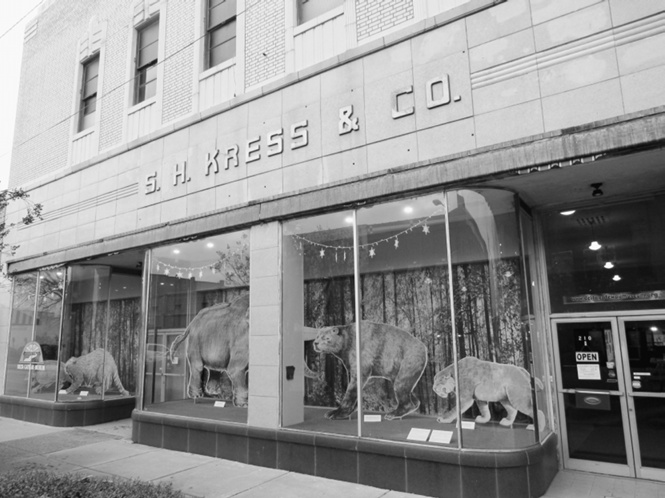
Vacant stores transformed into local history museums are prevalent in many communities. Blytheville’s Delta Gateway Museum is one such cultural resource that is a lively model for this type of adaptive reuse. The building, itself, is a heritage resource as the Kress Building was listed on the National Register of Historic Places in 1997 S. H. Kress & Company constructed the building in 1938 as part of a chain of five-and- dime department stores that extended through- out the United States. The business closed in 1974, and the building came to be used by a number of organizations, including the United Way and Main Street Blytheville. Shared interests in preserving the region’s history and using cul- tural resources for economic development in- spired the Delta Gateway Commission to open the museum in 2011. The building’s exterior ar- chitecture is well preserved by the museum’s staff and board, and the interior space is filled with attractive permanent and changing exhibits that preserve, present, and interpret heritage re- sources within northeastern Arkansas’s Delta re- gion. The museum is one of the major attractions in Blytheville, and it serves as a com- munity center for local residents as well as visitors
Photograph by Gregory Hansen
Photograph by Gregory Hansen
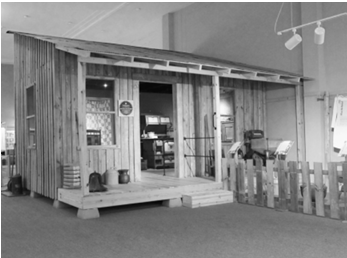
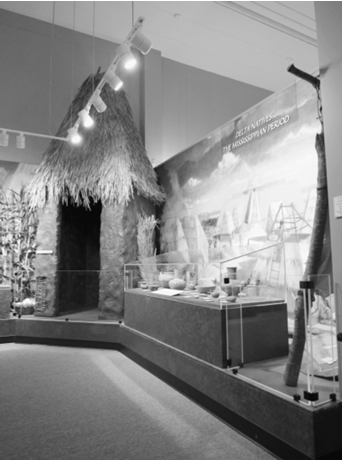
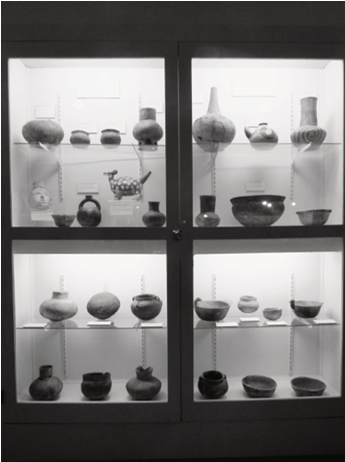
who take an exit off of I-55 to explore a number of attractions in Blytheville. The museum excels in using resources from a range of organizations, including the Arkansas Main Street Program and the Smithsonian Insti- tution. In 2017 the museum’s director, Leslie Hester, worked with the Smithsonian’s Museum on Main Street Program to host the exhibit “Home- town Teams: How Sports Shape America.” The Smithsonian provided technical support for cu- rating its traveling exhibit, and the staff, in turn, created an attractive, permanent exhibit of arti- facts connected with the vibrant history of sports teams in northeastern Arkansas. Technical assis- tance from the Smithsonian has continued throughout the years. Its latest manifestation is a newly opened permanent exhibit that provides an attractive representation of a common style of houses within the region. Hester explained that when the museum was closed during the Covid- 19 pandemic, she was able to use her time and the museum’s resources to construct a replica of a boxed house. This installation represents a typi- cal vernacular architecture home used by share- croppers and tenant farmers in the region. A boxed house features vertical-plank construction rather than the more complex framing systems found in more elaborate structures. Boxed houses were commonly built in Appalachia. By the early 20th century, their abbreviated and ex- pedient framing method was readily adopted as an economical building style in eastern Arkansas and throughout the wider region. The museum’s replica can be entered through its porch, and Hester worked with local residents to furnish the house with artifacts and museum replicas com- mon to Arkansas. Whereas the museum display offers visitors a compact version of the front room of the house, those who wish to see a boxed house can visit Marvell, Arkansas and tour the Levon Helm Boyhood Home, a newly opened house museum built from boxed-house construction techniques. As visitors circulate through the museum to other exhibit areas, they can take in another re- cently curated permanent exhibit, one devoted to Mississippi Period Native Cultures. This attrac- tive exhibit is centered around the reconstruction of a dwelling place with a fine display of museum artifacts. It works as a close-up to some of the more extensive displays of Mississippian culture that can be found in archeological sites such as Arkansas’s Parkin Archeological State Park and
Photograph by Gregory Hansen
The museum also includes other permanent exhibits. There are excellent displays of objects and photographs that portray salient elements of the agricultural, commercial, educational, and military history of Blytheville. The museum has also opened exhibit space for temporary exhibits on a range of topics. One notable display in- cluded photographs and text that interpreted ele- ments of segregation and the Civil Rights movement in the city, a project that was con- nected to Hester’s completion of a masters degree within Arkansas State University’s Heritage Studies Program as well as the social history re- search of Charles Baclawski, who spent time doing local history research in the Arkansas Delta while completing his doctorate in Heritage Studies from A-State in 2015. The museum has continued to support the work of various re- searchers and community members. Its board of directors provides important connections to a wide range of constituents, and the museum has strong potential for continuing to support col- laborative activities, including presentations of children’s artwork and educational activities sup- ported by local schools.
It is challenging to turn an abandoned busi- ness into a museum. Although shelving space, sales counters, tables, and other features of old stores can easily be repurposed as fixtures for mu- seum display, there are major challenges in cre-
Photograph by Gregory Hansen
ating these local museums. Many of these organ- izations have limited financial resources and must rely on limited, or even all volunteer, staff for their operations. Another common problem is that despite the availability of grants and other financial and technical support to initiate adap- tive reuse projects, there are limited resources to sustain the projects after the museum is opened. Consequently, many of these museums have miniscule collections, somewhat predictable— even bland—exhibits, and limited personnel who can utilize current ideas within the field of mu- seum practices. It is admirable that the Delta Gateway Museum has found creative and com- munity-responsive ways to work with the many challenges of adapting a vacant store into a vital historical and cultural center. The museum is well worth a visit, and it has built a strong basis for future research and representations that ac- curately and engagingly present the region’s his- tory and culture.