
Reviews
The Dog Years of Reeducation. By Jianqing Zheng. (Lake Dallas, Texas: Madville Publishing, 2023. Pp. 84, $19.95, paperback)
When Jianqing Zheng mentions Li Po in his
poem “One Winter Night” at the halfway point
in his lyrically stunning and moving collection,
The Dog Years of Reeduca-
 tion, the kinship of line-
age harkening back to
ancient Chinese poets
like Li Po and Du Fu is
complete. Zheng’s
poems have a similar
light touch, imagery,
poignancy, and affinity
with the seasons. As an
introduction, he ex-
plains that in the Chinese Cultural Revolution
in the 1960s and ’70s, to answer Mao Zedong’s
call, millions of middle school and high school
graduates, called zhiqing, or educated youth, were
sent to the countryside to receive “reeducation”
from poor peasants and to work and live along-
side them.
tion, the kinship of line-
age harkening back to
ancient Chinese poets
like Li Po and Du Fu is
complete. Zheng’s
poems have a similar
light touch, imagery,
poignancy, and affinity
with the seasons. As an
introduction, he ex-
plains that in the Chinese Cultural Revolution
in the 1960s and ’70s, to answer Mao Zedong’s
call, millions of middle school and high school
graduates, called zhiqing, or educated youth, were
sent to the countryside to receive “reeducation”
from poor peasants and to work and live along-
side them.
Zheng was a zhiqing for three years in his youth and writes from memories five decades hence, still vivid and startling, those days “dog- eared” in memory. As he sweats, barehanded and barefooted, in the fields planting rice and cotton, we follow his journey from boyhood to shoulder- ing a man’s load, both physically and psycholog- ically. Despite the separation from his family and former comforts, the arduous hours and hunger, dragging himself to and from the fields—he’s a boy after all—the humor of interacting with his comrades Pigsy, Pearl, Yi, Wang, and Horse shines through. Most beautiful are his observa- tions of nature, how he feels a part of it—the moon, the stars, the autumn night—perhaps for the first time in his life, now that it’s stripped to the bare essentials, as in: “The moon peeps through broken clouds: / a marble tombstone in gray weeds.”
In “After Rain,” he writes, “Now on the wind, thousands of gray horses / roll away the fe- vered air” and “I sit on the threshold / dabbing tobacco and dusk / into the cupped paper.” Sim- ple, yet powerful, immediate images and longing for home. Though he labors long days, the world’s beauty seems heightened as he observes girls picking lotus: “her lotus-picking song skim- ming and flapping like a great egret over the dark green lake and then soaring, hovering, flitting and swooping overhead” and catching but- terflies: “It dances in pitch and yaw over the girl’s head.”
Especially admirable is the variation of work
in Reeducation: imagistic and narrative poems,
prose poems, and haiku, the latter two often
combined as haibuns. Each is like a watercolor
in time and season. At one point, Zheng con-
tracts malaria and is taken to a hospital near his
family home. Embedded in the prose poem
“Sick” is this haiku of metaphoric mastery:
mom’s tears
flow into the soil
of my heart
the sickbed throbs
with life
Zheng begins to see “reeducation as a coat / altered to wear, / a fate to face and / a life to
Although set fifty years ago in a time and place foreign to many American readers of con- temporary poetry, this collection remains timely in its historical value and perspective, in its hum- bleness of surrendering to a subsistence life and to hard knowledge gained and carried as lessons into adulthood, and in the beauty and longing captured in his spare writing. One has the feeling that Zheng has been coming to this work all of his life, and we are richer for having glimpsed these years of toil, dreams, and realizations through a poet’s generous heart and eyes.
--Linda Parsons
A History of the Ozarks, Volume 3, The Ozarkers. By Brooks Blevins. (Urbana: University of Illinois Press, 2021 Pp. 328, 24 b/w photographs, 18 maps, $34.95, cloth)
In this last volume of his three-part series, A
History of the Ozarks, the author provides a cul-
tural and economic history of the region begin-
ning at the turn of the
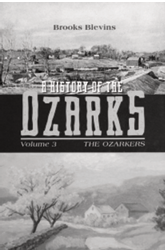 nineteenth century
through the present
and focuses on two
main themes: the dual-
ity of the region and the
region’s evolving cul-
ture and economy.
Brooks Blevins is the
author of nine books,
including Ghost of the
Ozarks: Murder and Memory in the Upland South;
and Arkansas/ Arkansaw: How Bear Hunters, Hill-
billies, and Good Ol' Boys Defined a State and is the
Noel Boyd Professor of Ozarks Studies at Mis-
souri State University.
nineteenth century
through the present
and focuses on two
main themes: the dual-
ity of the region and the
region’s evolving cul-
ture and economy.
Brooks Blevins is the
author of nine books,
including Ghost of the
Ozarks: Murder and Memory in the Upland South;
and Arkansas/ Arkansaw: How Bear Hunters, Hill-
billies, and Good Ol' Boys Defined a State and is the
Noel Boyd Professor of Ozarks Studies at Mis-
souri State University.
Blevins writes history in a way that is com- pelling and readable, and this work is no excep- tion. He begins and ends the book and each chapter with a story. The chapters are organized chronologically around a theme, allowing Blevins to focus on many different individuals and loca- tions within the region. As in his other works, he frames the story of the Ozarks as a smaller part of the larger American story, explaining how the Ozarks region fits this narrative and at times also breaks away from it. Blevins notes early on that the modernization of the Ozarks coincides with the cultural push to “mythologize” the region (11). As Blevins shows readers, while the Ozarks sees railroads come and go, improved roads, the out-migration of a generation, the creation of state parks, and new immigrant populations, the public image of the region remains largely static. Blevins is able to capture how and why this image
Blevins’s first few chapters focus mostly on the late 1800s and explain the diversity of trades and farming that could be found in the Ozarks during that time; everything from cash crops like cotton and tobacco were grown as well as toma- toes, strawberries, and even grapes. He continues to explore the history of the region and its spirit of “experimentation and entrepreneurship” as he tells the story of the early roads and railroads in his third chapter (p. 59). Here he also includes some local folklore when he shares the story of John Henson, a railroad tie hacker who is com- pared to the legendary John Henry (p. 69).
In the latter portion of the book, Blevins fo- cuses mostly on the history of the early 1900s, be- ginning with important details about the Jim Crow era and race relations, drawing from works by authors such as Kimberly Harper and Kather- ine Lederer, to tell the story of the expulsion of many African-American communities from the region, particularly during the early years of the Jim Crow era. Blevins also explains the impact of the Klu Klux Klan, noting that “Anti-Catholicism and nativism” were as much a part of the 1920s era Klan as was “racism” (p. 113). Blevins also notes the importance of education among the more elite Ozarkers, some of whom founded mis- sion schools and private colleges prior to the Great Depression. This juxtaposition of attitudes and people is one example of the duality present throughout the region and how it is portrayed in the book.
Blevins continues to explore the modern his- tory of the Ozarks, explaining how tourism be- came a mainstay of the economy, especially following World War II. This led to a continu- ation of the idealization of the region, with tour- ism dedicated on pastoral landscapes and a romanticized hillbilly distinctiveness that at- tracted many different groups to the region from midwestern retirees to back-to-the-landers. Ble- vins closes out his book with the corporatization of the region as companies like Tyson and Wal- Mart founded businesses and then became pow- erhouses at a national level. As Blevins reports, the Waltons not only control a major portion of the economy in the region but also have consid- erable influence on the region’s cultural offer- ings, noting the story of Alice Walton’s efforts to create Crystal Brides. Blevins also depicts the story of contemporary immigration to the region, using the growth in the region’s Hispanic and Marshallese populations as two examples. In doing so, he draws readers back to one of his main themes: change. And by placing these stories together, readers are also forced once again to reckon with the dualities of the area, which Blevins shows us in many ways throughout the work: have vs. have-not, tradition vs. progress, religious conservatism vs. live-and-let-live mental- ity, among others. Blevins has once again man- aged to deliver an important, intriguing, and relevant work about the history of the Ozark re- gion.
--Lauren Adams Willette
Black Bodies in the River: Searching for Freedom Summer. By Davis W. Houck. (Jackson: University Press of Mississippi, 2022. Pp. xiii + 155, $25.00, paperback)
In his 2012 book, Trauma: A Social Theory, sociologist Jeffrey C. Alexander defines trauma
 a nation has located the
source of current griev-
ances in allegations of
older wrongs, in contra-
diction to the best work
of historians, as with
Germans after World
War I assigning blame
for their losses not
upon their own leaders
but, instead, upon the devious victor nations,
and most consequentially upon the Jews who al-
legedly stabbed Germany in the back.
a nation has located the
source of current griev-
ances in allegations of
older wrongs, in contra-
diction to the best work
of historians, as with
Germans after World
War I assigning blame
for their losses not
upon their own leaders
but, instead, upon the devious victor nations,
and most consequentially upon the Jews who al-
legedly stabbed Germany in the back.
Most narratives of trauma are not at such de- liberate variance with the prevailing historiogra- phy but, instead, slightly conflate, misremember, or misinterpret events, often to make those events accord with a more subjective experience. One such narrative lay at the heart of Davis W. Houck’s Black Bodies in the River. Anchoring his book is the July 12, 1964, discovery, by a couple fishing in the Old River along the Mississippi- Louisiana state line, of the body of one Charles Moore, badly decomposed and missing its head. When this find was reported, authorities rushed to the site, believing that this might be the body of either Andrew Goodman, Mickey Schwerner, or James Chaney, three civil rights workers who had famously gone missing in Mississippi not long before, and who were at that point already presumed dead. The following day, divers re- trieved the body of Henry Hezekiah Dee. Neither of these men were in any way connected to the Freedom Summer in Mississippi—or to any civil rights movement at all—and the case would linger unsolved for years before investigators finally de- termined that local Klansmen had targeted Dee specifically because his occasional travels to Chi- cago, combined with his frequent bandana wea- ring, had sparked paranoid fears that he was in league with Black Muslims to run guns to Missis- sippi (Moore, meanwhile, was just in the wrong place at the wrong time). After the bodies of the three Freedom Summer workers were found later that summer, national attention would swiftly focus upon them, reducing the murders of Moore and Dee largely to an historical footnote.
Except in memory, where the discovery of Moore and Dee’s tortured and murdered bodies became transmuted into the claim that federal authorities had found any number of black bodies while searching for those three Freedom Summer workers. As Houck observes, “the his- toricity of the unnamed Black bodies in question is perhaps less the point than the critique of how the Freedom Summer has been written, filmed, and even memorialized,” especially how the dom- inant depiction “remains largely white-on-white violence and death,” given that Goodman and Schwerner were white (p. 8). And in this, mem- ory offers a continuation of some of the resent- ment directed at the time toward those “elite white undergraduates from Yale and Stanford” whose “collective well-being mattered intrinsi- cally to the federal government” and who “also had a hand in shaping the government’s new- found interest in Mississippi” (p. 25)—in contrast to local black activists, who could be threatened, kidnapped, beaten, and even murdered at a whim, it seemed, without a peep from Uncle Sam. The disappearance of Moore and Dee, for example, “did not rate so much as a mention in the Franklin Advocate,” the local newspaper, and neither “did it rate as a missing persons case to
The rhetorical transformation of the mur- ders of Moore and Dee into the existence of any number of “black bodies in the river” happened early, as with the song “Here’s to the State of Mis- sissippi,” penned by Phil Ochs of the SNCC Freedom Singers, a song that includes the line: “For underneath her borders, the devil draws no lines / If you drag her muddy river, nameless bodies you will find” (quoted on page 71). So while the deaths of Goodman, Schwerner, and Chaney began to achieve some hagiographic status, the deaths of Moore and Dee tended to be reduced, through the years, to vague claims of “nameless bodies,” as Houck discovers when he tries to chase the origin of the claim in the broader historiography, both scholarly and pop- ular. Various histories and documentaries make an array of claims, so that, “as the fiftieth anni- versary of Freedom Summer was celebrated, the claim that nine, eight, or five nameless Black bodies were discovered during the search for the missing civil rights workers seemed to have be- come legion among journalists, a taken-for- granted fact of Mississippi terrorism” (p. 89). The locations of these discoveries vary, too, with most centering upon the Mississippi River, while others cite the Pearl River or even the non-exis- tent Natchez River. Some of these dubious claims have been memorialized in museum displays and even school curricula.
More than mere pedantry motivates Houck to dredge these rivers of history and memory—he is, instead, genuinely disturbed by the reduction of Moore and Dee’s death to the anonymous and eponymous “Black Bodies in the River.” Their lives have much to teach us about the times in which they lived, and their murders reveal much about the paranoiac mindset that drove (and still drives) opposition to equal rights for all people. Too, and this is something that Houck hints at but never develops, the story of the anonymous black bodies makes their killers seem not only competent but nigh omnipotent, while the fact remains that these murderers in Mississippi, al- though most often free to act with impunity, were anything but, their deeds born out of fan- tastical misconceptions and executed with such incompetence that prosecutors decades later could yet reconstruct events and put many of these killers behind bars. This story, too, needs to be told.
“By refusing to tell those stories,” Houck writes, “by simply repeating the number—five, eight, a dozen, or bodies too numerous to count—we tacitly acknowledge that yes, nameless Black bodies—then and now—are disposable” (p. 127). If, as Martin Luther King Jr. claimed, “hate cannot drive out hate; only love can do that,” then it might also be true that myth cannot drive out myth. That is, the myth of countless black bodies in the river cannot drive out the myth of white supremacy—only an engagement with real- ity can do that. Houck’s book refuses to be satis- fied with the symbolic representations that, for a sociologist like Jeffrey C. Alexander, constituted the nature of trauma; instead, he goes to the heart of the events themselves. Our society needs
--Guy Lancaster
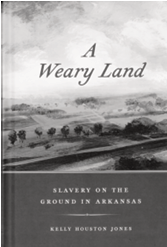
A Weary Land: Slavery on the Ground in Arkansas. By Kelly Houston Jones. (Athens, Georgia: The University of Georgia Press, 2021 Pp. 268, $34.95, paperback)
The story of how slavery came to Arkansas has often been ignored by scholars who have fo- cused instead on more established and long- standing hubs of bondage. Kelly Houston Jones’s A Weary Land: Slavery on the Ground in Arkansas offers a welcome corrective to this neglect, tracing slavery’s development in the natural state, updat- ing and expanding our understanding of how the slave system not only impacted peoples’ lives, economies, and politics, but also labor, land use, and the environment. As Jones demonstrates, slaves painstakingly cleared trees, planted crops, and remade the landscape. In the process, they connected the western edge of the South—pre- viously a comparatively fallow hinterland—with the broader antebellum world. Slaves became the instrument of the planter class’s efforts to control an unwieldy terrain, which in turn helped bind slaves to their surroundings.
A Weary Land skillfully merges environmen-
tal history with contemporary historical concepts
of space, and place, and offers a nuanced depic-
tion of slave agency and the prevailing notions of
freedom in this period. Weaving analysis with
personalized accounts of slaves’ struggles to navi-
gate the harsh chattel system, Jones’s engrossing
narrative reveals how cruel Arkansas slavery
could be. Indeed, the state stood at the center of
a “second slave system,” in which the outer edges
of the South underwent Indian removal, lands
were cleared and cultivated, and slaves were
forced into these areas (p. 19). The labor could
could be exceedingly harsh compared to the
more settled and rigid
 slave societies of Vir-
ginia and the Carolina
Piedmont. In Arkansas,
slaves toiled in these dif-
ficult conditions, but
the newness and fluid-
ity of Arkansas slavery
compared to the older
slave regions afforded
bondspeople a surpris-
ing amount of agency and opportunity. Arkansas
was a verdant environment for slave escapes and
truancy, and the state’s river systems provided a
highway of escape and intrigue. As Arkansas slav-
ery developed, the constant influx and outflow
of slaves disrupted black family life and forced
them to improvise new relationships and hierar-
chies within their communities. According to
Jones, multi-generational slave families living to-
gether in one place were uncommon, and slaves
grew accustomed to reforming kinship networks.
This phenomenon was true elsewhere in the an-
tebellum South, but Jones convincingly argues
that the hinterland nature of Arkansas uniquely
required slaves there to forge a sense of home and
community in the “wild spaces between farms
and fields” (p. 205). The forests and brush served
as conduits for news and gossip, and the inherent
challenges of living in bondage on a frontier gave
slaves’ lives meaning despite their misery.
slave societies of Vir-
ginia and the Carolina
Piedmont. In Arkansas,
slaves toiled in these dif-
ficult conditions, but
the newness and fluid-
ity of Arkansas slavery
compared to the older
slave regions afforded
bondspeople a surpris-
ing amount of agency and opportunity. Arkansas
was a verdant environment for slave escapes and
truancy, and the state’s river systems provided a
highway of escape and intrigue. As Arkansas slav-
ery developed, the constant influx and outflow
of slaves disrupted black family life and forced
them to improvise new relationships and hierar-
chies within their communities. According to
Jones, multi-generational slave families living to-
gether in one place were uncommon, and slaves
grew accustomed to reforming kinship networks.
This phenomenon was true elsewhere in the an-
tebellum South, but Jones convincingly argues
that the hinterland nature of Arkansas uniquely
required slaves there to forge a sense of home and
community in the “wild spaces between farms
and fields” (p. 205). The forests and brush served
as conduits for news and gossip, and the inherent
challenges of living in bondage on a frontier gave
slaves’ lives meaning despite their misery.
Prior to the publication of A Weary Land, Orville Taylor’s formative, but often overlooked monograph, Negro Slavery in Arkansas, marked the
As Jones notes, recovering the individual stories of slaves’ lives not only adds depth to our knowledge of slavery’s burdens, but it also adds to the growing body of research on the autonomy of slaves. By portraying the experiences of slaves from their own perspectives, A Weary Land rep- resents precisely the kind of “from-the-ground- up” history Arkansas studies have sorely needed. Again, much work has been undertaken in this area in shorter form (including work by Jones herself), but this book will serve as an important building block for newcomers to Arkansas his- tory, and a reference point for scholars of the Old South, especially its margins.
A Weary Land also reveals how slavery in Ar- kansas differed from how it was practiced in other regions. The state was “a speculator’s dream and a trafficker’s paradise,” as its un- tapped soil, and remote location essentially out- side the reach of federal oversight, attracted opportunists seeking to capitalize on a region whose soil had not yet been depleted by years of cotton cultivation (p. 204). The experiences of nineteenth century slaves in the state in some ways mirrored that of seventeenth century bond- speople in the eastern slave territories, where planters relied on slaves to cultivate existing farm- land while simultaneously clearing new ground. Arkansas slaves in the antebellum era were al- most always brought there from another part of the South, and Jones is particularly adept at ex- posing the constant mobility and uncertainty they were forced to endure. Slaves were contin- ually pushed further into the fringes of the re- gion well into the Civil War, wrecking family life and health. According to Jones, after emancipa- tion black Arkansans were often quite capable of picking up and making new lives for themselves, in part because so many had already done so due to the constant movement of slaves into the area.
A Weary Land concludes with evocative ac- counts of how, in the postbellum era, former slaves managed to establish new roots, establish families, and construct livelihoods. However, the end of Reconstruction and the onset of Jim Crow restrictions made this exceedingly difficult, and ultimately led many to join the Great Migra- tion out of the South altogether. In fact, many former slaves in Arkansas fared poorly in the post-Civil War period, preyed upon by debt peon- age and predatory landowners who sought to bilk freed people of what little land and autonomy they could carve out for themselves. Despite these challenges, Arkansas was portrayed by boosters as an ideal locale in which black farmers might resettle, especially those frustrated with the restrictions imposed in other areas. Ironically, over 250,000 black farmers came to the state be- tween the end of the Civil War and the outbreak of World War I, many making the journey on foot, undoubtedly in search of the relative free- dom they were told Arkansas could provide. As
--Brenton E. Riffel
My Back Pages: The Teresa Poems. By Floyd Collins. (Nacogdoches, Texas: Stephen F. Austin State University Press, 2022. Pp. 80, author’s note, about the author, $18.00, paperback)
Brooding and nostalgic, My Back Pages: The Teresa Poems offers a view at the imperfect render- ing of memory and the grief that spills out from recounting it. Reading the collection is like walk- ing through a gallery of an artist’s personal work: obsessions are mined, loves are fantastically illu- minated, all the while the artist himself admit- ting that this is a conjuring.
A graduate of the University of Arkansas’s MFA and Doctoral programs, Collins alludes to his time in Fayetteville throughout the collection, and the influence of classical Greek and Roman mythology flavors the recounting of the speaker’s life.
Opening on an apparition, the speaker of Collins’s poem “Expiation” depicts Teresa as an “almost nightly visitation / that frequents trou- bled sleep, defying / All wakeful attempts to ex- orcise the memories / Of what receded so long ago. It remains, / That brief season that tran- spired in another age” (p. 1). Yet, she is not the one who won’t leave the speaker’s mind be. Again and again, Collins alludes to the speaker conjuring her image, her symbolic meaning, how she has shaped the speaker’s life.
In an almost stream-of-conscious conception
of images, Collins’s poems blend into one
another the way the shading of one memory
brings out the color in another. The speaker’s life
is colored not only by his love for Teresa, but love
of youth, family, Memphis, the search for creative
greatness. The emerald grass of ball diamonds in
“Narcissus To The
 Muse” blends into the
broken glass of beer bot-
tles in “Two Parables.”
The colors of oak leaves
and tree lines burst py-
rotechnic in “Farewell”
and “December, 1978,”
each calling back to
Teresa’s aneurysm and
the pain of a that place
to which we can never return. This blending of
images resembles a speaker’s mind wandering
through his life, grasping at memory only to lose
the thread and be drawn to another image recov-
ered from oblivion.
Muse” blends into the
broken glass of beer bot-
tles in “Two Parables.”
The colors of oak leaves
and tree lines burst py-
rotechnic in “Farewell”
and “December, 1978,”
each calling back to
Teresa’s aneurysm and
the pain of a that place
to which we can never return. This blending of
images resembles a speaker’s mind wandering
through his life, grasping at memory only to lose
the thread and be drawn to another image recov-
ered from oblivion.
These are not only love poems to Teresa, but poems about the grief of losing her and the speaker losing himself. Images of a girl in pleated skirts and gypsy shag haircuts give way to an older man drinking heavily as the night winds down: “Slings of Grand Marnier, and, the blue pilot light / In my brain turned low, I mounted the stairs to / Dark chambers where you still wait for all I know” (p. 25).
And at the close of the collection, there isn’t any real sense that the speaker is done digging up the bones of lost love and youth. “Lyrics had more to do with a potter’s wheel—‘Truth is /
Pretty as a picture and painful as a mirror, these poems are a reflection of the stories we tell ourselves as the years going by become decades. The sweet haze of these memories reveals a greater vulnerability of a speaker living alone, drinking often, and caught in the grasp of should have, could have been. If you are a reader who has ever found yourself conjuring up memories like a DJ who won’t let go of fifty-year-old hits, you’ll find yourself in these poems. You might even find that these poems act like a sad country song or singing the blues, where embracing the pain helps heal the wound.
--D.C. Eichelberger