
“A Tainted House of Prayer”: Artist V. L. Cox on White Supremacy, Southern Culture, and Her Persisting Love of the Delta
by Guy Lancaster
The interview occurred over a shared electronic document during November and December 2022 and has been lightly edited, with occasional editorial inser- tions placed in brackets.
Guy Lancaster: I grew up in eastern Arkan-
Photograph courtesy of V.L. Cox
sas, amid the flat land of the Delta, and as a con- sequence I was always fascinated by places that possessed “actual geography,” hills and whatnot. But you grew up in the hilly country around Ar- kadelphia. What attraction does the Delta have for you?
V. L. Cox: I was briefly introduced to the Delta when I moved to Memphis, Tennessee in the early ’80s to sow the wild oats of my youth. I
It was during these numerous explorations that I would stop and talk to the locals if they looked interesting. One guy was named Moon- pie, and after visiting with him about his life, he politely asked if I would help him cut a tree down on his property if I was going to stick around long enough. Another was a store owner who told me gruffly an inch from my face to “get out of town before sunset or [you] could be knocked in the head by the locals” (I backed out of that place slowly towards the door). I always kept my eyes out for the Arts though, which I feel has been shunned in the Arkansas Delta and not ac- knowledged or explored fully due to its rural lo- cation and socioeconomic status.
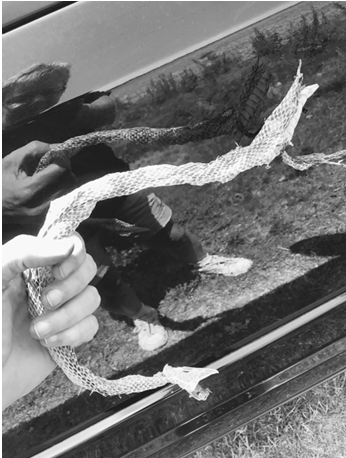
On my last trip, I stopped to photograph an old church that caught my eye and, while looking down, saw a molted snakeskin laying at my feet. I picked it up, photographed it and found it rep-
Photograph courtesy of V.L. Cox
resentational of my journey. The Delta is a cal- ling. And if you answer it, you shed your outer self and become something entirely different. You never leave the same person after experienc- ing it. I still have that photo. It’s framed in my studio to this day.
GL: What does the Delta do for you or to you as an artist? Do you find that the art you pro- duce in response to experiencing the Delta is of a different quality or theme than your other work?
VLC: The Delta has been a life changing ex- perience for me, yet I think it goes hand in hand as far as my Civil Rights and Social Justice work goes. The secrets and the stories that have longed to be told are finally beginning to surface in the Delta. The Art World, however, can be full of it- self at times with pretentious economic exclu- sion, closed-door academic exclusion, and retail
GL: There’s this big region in America we call “the South,” that draws together Delta flat- lands, Ozark and Appalachian uplands, coastal communities, rivertowns, the staggering wealth of Miami and Atlanta, and the poverty of so many other places. Do you see anything that ac- tually unifies all of this? And if there is some re- ality that unifies this Southern experience, does it then still make sense to call the Delta, as it has been popularly dubbed, “the most Southern place on earth”?
VLC: Yes. Food and Art. Those two things alone can bring about unity and world peace. Why do you think one of the first things authori- tarian governments try to crush is the Arts? It’s because they know the extent of its true power. The Arts are a different, yet universal language. One that cuts through the constant onslaught of blather, documents historical events and visually crosses religious, political, and socioeconomic boundaries with ease. Its unification and educa- tional qualities are embraced yet feared by many, and in all my travels I still stand by my belief that some of the most talented people I have ever known and some of the best art I have ever seen, are from the South. And I have seen a lot of art. The South is where the magical, cherished oral history of storytelling evolves to a different level and creatively begins to take another form.
The food of the South is known worldwide, and God bless ’em, Brooklyn doesn’t know real BBQ to save their life, but they’re trying. I have also known of divorce proceedings being consid- ered in the South over someone putting a cast iron skillet in the dishwasher, and I would wager that crime runs the full social economic spec- trum. Art and food, especially in the South, are what I consider the most basic, cherished tools of survival and the secret to knowledge, unity, and peace. The history of the rich, fertile land, the people from old indigenous communities to now, the deadly, hidden secrets of the past that have long needed to surface so they can begin to heal, the mysterious beauty of the swamps, the life-giving rivers, the incredible home-grown food, the art, the relentless blistering heat, the beauti- ful sunsets and the sounds of the cicada at dusk singing their ancestral song as they welcome the
GL: Well, you’ll have to leave the Delta to find a hill to die on!
VLC: Ha!
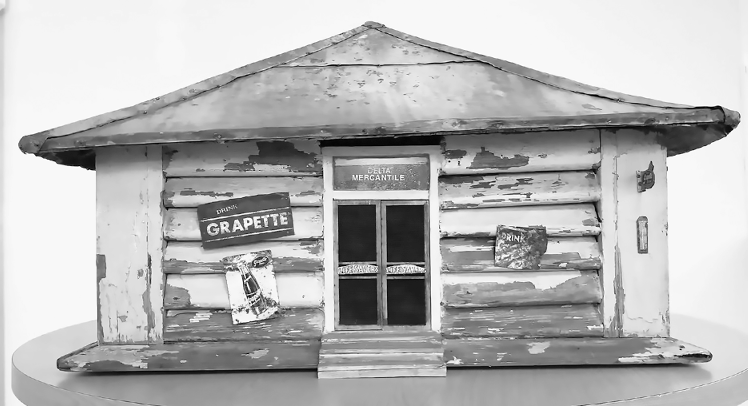
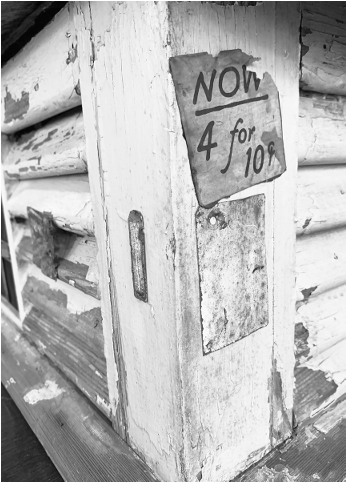
GL: Thinking about the Delta as the most southern place on earth brings to mind your work “Delta Mercantile,” which strikes me as one of the most southern artworks you’ve done. If you’ve driven through the Delta, you’ve seen those long-abandoned places covered over in rusted signs. Where did you get the materials for this? It looks like you’ve converted some old shutters into the walls.
VLC: “Delta Mercantile” is created from an original old copula salvaged from the top of an old structure that had been located somewhere in the Delta. The rest are pieces I’ve collected on my travels and explorations through the South. I try to use original materials with provenance when I can find them, but these pieces are be- coming as scarce as hen’s teeth as many structures of the Delta fall into disrepair or decay.
I’ve always had a special place in my heart for those old mercantile stores. I have driven by nu- merous skeletal remains of them in the Delta and remember the ones I frequented fondly in the hills as a child. The creaking, wooden floors, the smell of smoked bacon and lunchmeat being trimmed and sliced in the back, the cast-iron wood burning stove with mismatched chairs in the corner, the obligatory gallon jar of pickled eggs (that I never saw anyone eat) that sat not far from the cash register or the butcher counter and the rack of comic books that changed my life and turned me into a creative, fanatical book collec- tor for over 40 years. The old Vacation Bible School bus I found myself on every summer, de- spite my pleas and protests, would careen on two wheels to a stop in front of Thompson’s mercan- tile store on Highway 8, announcing our arrival in a hot cloud of dust. The sweltering bus was
Photograph courtesy of V.L. Cox
GL: There seems to be some conscious irony whereby we think of these mercantiles as places that were so intensely local, and yet their local importance depended greatly upon their offering of products from so far away.
VLC: That’s true. From food variety, to fancy bolts of fabric, pantyhose and homemaker supplies to farming supplies, pocket knives and hardware. Loyalty came with variety. My father was a staunch Case Knife man, which originated in 1889 and was sold out of the back of a wagon in upstate New York yet was found in every mer- cantile store throughout the South. My father loved those “northern” knives so much, he was buried with one in his pocket in a southern rural family cemetery.
The importance of these old stores had many different levels. They also served and took care of the most vulnerable in their community. One of my main memories after my grandfather passed, was when my grandmother and I went to Welch’s Grocery in Arkadelphia in the late ’60s early ’70s. She would always hand Mr. Welch her list, and he would help gather her sundries then carry them to the car. This day, however, was dif- ferent. It was during desegregation, and his store had a direct view to the courthouse in downtown Arkadelphia. As we walked through the squeak-
Photograph courtesy of V.L. Cox
ing wooden door, hearing the little tinkling of the bell announcing our arrival, Mr. Welch met us with a look of concern on his face. He took my grandmother’s list, put his hand on her shoulder and quietly told her, “Now Mrs. Hard- man, you take that grandbaby, turn right around and go on home. It’s not safe here today. I’ll de- liver your groceries here shortly.” As we got back in the car and were leaving, I glanced across the road towards the courthouse and saw a surging white crowd in turmoil sprinkled with men in white helmets. I didn’t realize the national impli- cations of desegregation due to my youth at the time, but my hometown wasn’t immune to it.
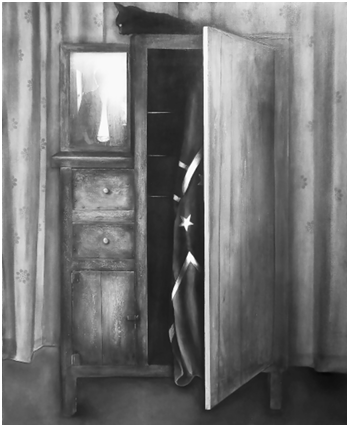
GL: You’ve got two “self-portraits” that seem to be having a conversation with one another. The first, “Reflection,” is mostly taken up with a wardrobe slightly open, showing a Confederate flag hanging up inside, with the self-portrait com-
VLC: Those are two of the most personal pieces I have ever painted. “Reflection” is an ac- tual moment where I caught my reflection in the mirror of an old Civil War–era wardrobe I had acquired from Tennessee. I had been storing flags inside of it for some of my future art projects (Pride, American, and Confederate), and one af- ternoon I heard the creaking of the wardrobe door open behind me. As I turned around, I saw that my cat had jumped on top of the wardrobe
Photograph courtesy of V.L. Cox
and jarred the door open, exposing the lone Confederate flag, which was ominously peeking out from the shadows. It sent a shiver up my spine.
I am a bonafide Southerner, but the South has not been truthful about its evil past. I was taught in public school that the war was fought over “States Rights” (bottom line, the right to own other men), Northern Aggressors or “Yan- kees” coming down to take our rich farmlands and resources (it’s easy to flourish financially when you have free labor), and higher taxes on our cotton. I was also taught that slaves had de- cent, stable lives on plantations and floundered so much after being given their freedom, they were given 40 acres and a mule by the U.S. gov- ernment. But as we all know, during Reconstruc- tion almost all land allocated during the war was restored to its pre-war white owners, yet I’ve heard this bitterly mentioned by disgruntled white, male southerners my entire life, of “why they can’t get ahead?” I was never taught about the brutal, deadly depths of slavery, didn’t learn about the Elaine Massacre or Black Wall Street and the Tulsa Race Riots until I was in my 50s, and still to this day often hear the n-word fall out of ignorant mouths in south Arkansas more often than a prayer. This brief visual moment of reality when that wardrobe door opened was a stark reminder that no matter how much you try to educate yourself and pull yourself out of the ignorance, myths, and whitewashed history that you were exposed to your entire life, parts of that racist, close-minded environment will always re- main in your background trying to overpower you and claim you as its own. The struggle at family reunions, the painful conversations with your elders or the youth in your family due to perpetuated disinformation of hatred and dis- crimination, believing in the preservation of “heritage” and “southern pride” in a twisted form of religious white supremacy, that never goes away. Acknowledging that ominous and ever-present struggle, however, is part of what has
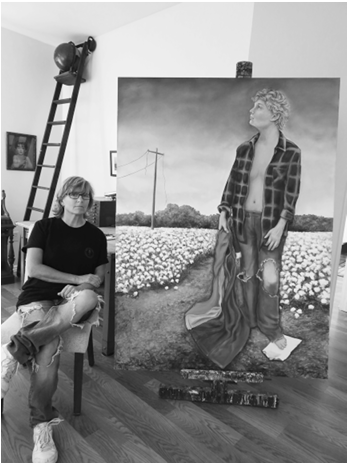
As far as “Escape Velocity” goes, I am a firm believer that there are only two emotions in life. Fear and Love. Every other emotion stems off of these. I painted this piece after leaving the South. The cotton field, a worn, vast, battleground of in- justice, shows snapped antiquated telephone wires and a twisted telephone pole in the form of a cross representing the isolating lines of truth and communication in the Bible Belt that have been intentionally severed and broken over gen- erations never meaning to be repaired. The self- portrait conveys strength, exhaustion, the raw vulnerability of feeling you have nothing left to lose (hence the open flannel shirt with no bra or undershirt), while firmly grasping and refusing to drop the colorful, beautiful, symbol in my hand of who I truly am. Gazing North, through ever-present tumultuous southern storm clouds, with hope and determination to survive and start a new life.
The historical cruelty crafted during the 2021 Arkansas Legislative Session [with the pas- sage of anti-transgender legislation], indistin- guishable from a backwoods snake-handling Tent Revival, influenced this painting and my deci- sion to finally leave the home I’ve always known. Arkansas lost all the progress and anti-discrim- inatory ground that they gained in 2015 [when previous such legislation was voted down], and the timing during a deadly global pandemic was wickedly plotted and executed. Civil Rights were ripped away from decent, hard-working Ameri- can citizens and modern-day Jim Crow bigotry rammed through by laughing lawmakers as Ar- kansans struggled with limited supply chains, ac- cess to food, medicine, and basic staples, not knowing which loved one would be the next taken by the mysterious angel of death to suffo- cate and die. This painting, despite political at- tempts to once again whitewash history, will continue to tell a Southern story of life, pain, hope, resilience, diversity, survival and the truth.
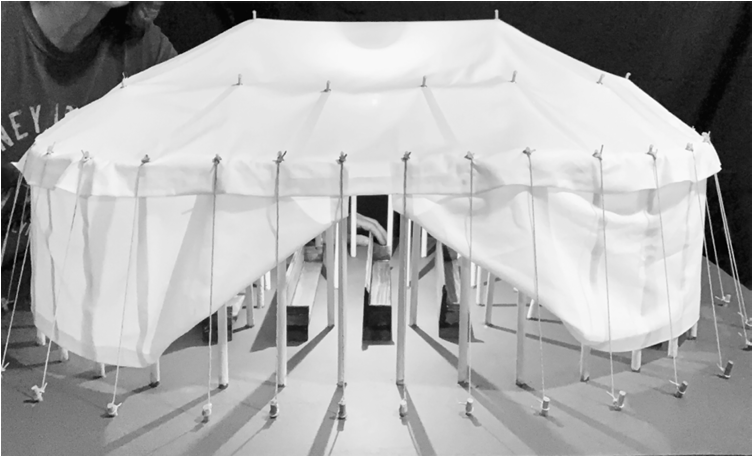
GL: Your mention of a snake-handling tent revival provides a nice segway to talk about the next piece, “Tent Revival.” You’ve written online that it was inspired by a picture of a revival held by the Ku Klux Klan and that it is crafted from the robe of a Grand Wizard. I spent some time pondering the piece and wondering why you used a real Klansman’s robe to make it when you could have used anything. And then I realized that, though the art piece is empty of people, should we imagine an actual revival taking place there, then all those Christians would literally be “under the hood.” It speaks to how they are not only implicated in these evils but being revived spiritually in the context of evil. It speaks to that Protestant doctrine of total depravity, how every person born cannot help but to act in service to sin without the grace of God, but here the taber- nacle of God’s grace is constructed out of a relic of that sin. And I remember, too, how a professor of mine in Japan remarked that while snow in Western cultures is often viewed as a symbol of purity, in Buddhist traditions a white blanket of snow serves the symbolic function of that which obscures sin, smooths out the contours of sin so that you can’t see it anymore. The more I thought about it, the more there was going on in this piece.
VLC: There is a lot going on in this piece, yet it’s a pretty simple message. The concept orig- inated one day after talking on the phone to an antique dealer out of Atlanta, Georgia. I had no- ticed on his website a tiny old vintage photo- graph of what I thought appeared to be a Revival Tent with a “Knights of the Ku Klux Klan” sign in front of it. Now, I have gone to (or was dragged to) plenty of church revivals in my youth under
Photograph courtesy of V.L. Cox
This Revival Tent is made out of an original Cyclops Klan robe that belonged to Roy Frank- houser Jr. in Pennsylvania. Boy, he was some- thing else. [Frankhouser was a Grand Dragon of the Ku Klux Klan, a member of the American Nazi Party, and later a leader in the Christian Identity movement.] And Roy had a following.
After reading the history of this robe along with historical and current events, I realize that a large population of Christians have, and con- tinue, to congregate “under the hood.” I’ve done extensive research of the history of the Klan, drove over 2,000 miles cross country a few years ago to be the first to see and read rare discovered doctrine and minutes of secret klavern meetings from 1922 and was shocked to see the blatant similarities from the past to today. “Are you a gen- tile or Jew?” “Were your parents born in the United States of America?” “What is your reli- gious faith?” were some of the initiation ques- tions asked. Documented images from the Library of Congress show Ku Klux Klan members marching in the street by the thousands only two generations ago under the banners “One God, One Country, One Flag,” “Jesus Saves,” or “For God, One Country and Each Other.” (Sound familiar?) As a business owner in the past, you were expected to be a member of the Klan, and if you weren’t or you rejected their doctrine, you were shunned politically, econom- ically and socially. It was like a bastardized ver- sion of a freak Chamber of Commerce of sorts.
“Being revived spiritually in the context of evil” is what we are seeing take place today. I never realized until now the depths that insecure people will go to to achieve a desperate sense of belonging and how spiritually fragile, scared, and lost people are to where they will instantly sell their soul, family and friends out to embrace the first so called religious “Savior” that walks through the door, even though the Bible specifi- cally warns us over and over against this.
I use a lot of historical relics in my work with this being constructed into a deadly symbol of a tainted house of prayer, cloaking the congrega- tion in white supremacy deceit while promising spiritual superiority and a false hope of salvation. And the primitive wooden church pews under the cloak of white supremacy are visually worn for a reason. They continue to be heavily used. White Supremacy, ferociously claiming the white pages of the Bible as its own, brutally twists and moves the black letters around at will but the last time I checked, and I’m pretty sure I’m accurate on this, the robe Jesus wore didn’t come with a hood.
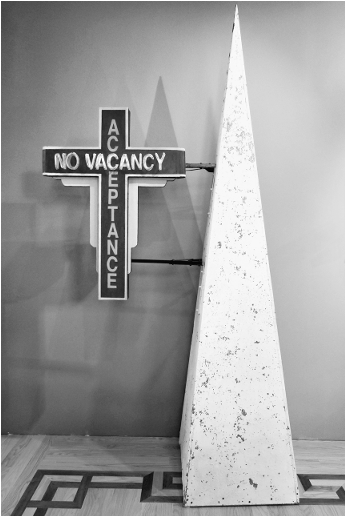
GL: Let’s wrap up with “No Vacancy.” It’s made in large part from the steeple of a Delta church, but I’ll be honest—after thinking about “Tent Revival,” I can’t see that white cone shape as anything but a Klansman’s hood. Is that some- what intentional?
VLC: Good catch. That’s exactly what it’s supposed to represent. I try not to be too literal in my creations, but I don’t think a lot of people grasped that visual. “No Vacancy” is created from an old 9-foot-tall church steeple from the Delta after reading the story the Arkansas Times did on a young man in northern Arkansas who received a letter in the mail from his church telling him he was immediately being removed from their membership records because he was gay, and then another story about a man who had to ac- tually move his deceased partner’s grave due to the threats in Baxter County. The worker for the monument company who was moving the tomb- stone was even approached and threatened by a man with a Bowie knife in a Wal-Mart parking lot, who asked “why he had that faggot’s head- stone in the back of the truck.”
The neon letters on the handmade cross ominously flicker off and on like a cheap, sketchy Motel sign on the side of the road, leaving the viewer wondering if there are any vacancies or not. And if there are? Is that really a place that you would feel clean and safe and where you would spend your time and money?
While creating “No Vacancy,” I was reminisc- ing upon a piece I did several years ago called “30 Pieces of Silver,” which was based on an experi- ence I had after being invited to visit a small rural country church in South Arkansas. I had briefly met and befriended a few of the younger members that attended there so I agreed to join them that next Sunday. Everything was going pretty much the way it normally does when I visit church, I was lip syncing through a few of the old hymns since I can’t carry a tune in a bucket, squirming while trying to get comfortable on the hard wooden pew since us Presbyterians are used to a little bit of cushion and padding, and won- dering where to politely position myself as a guest in the potluck line afterwards.
As we finished “Onward Christian Soldiers Marching Off To War” (which I always found to be an odd song for a church), the old white haired preacher in a shaky, shrill voice stood up behind the podium and began to preach. He hadn’t been three minutes into his sermon be- fore all of a sudden, he lunged forward on the
White Supremacy and bigotry that reside under steeples know no bounds. I don’t think this is what Christ had in mind when he told people to “love thy neighbor.”
GL: Attached to this steeple is a hotel sign you’ve fashioned into a cross, with the words “No Vacancy” running the horizontal, intersected by the vertical of “Acceptance.” And I can’t help thinking how that “no vacancy” both has and hasn’t been the rule in the Delta in a long time. You probably got this church steeple because the church itself was vacant. Chances are, whatever town was there or nearest had plenty of va-
Photograph courtesy of V.L. Cox
cancies. And while a good part of this vacancy is predicated upon economic factors, there’s more than enough also thanks to the very attitude of “no vacancy,” no room for people who are differ- ent. The “no vacancy” axis is like the flat of the Delta horizon, but it’s the “acceptance” axis that rises above.
VLC: I agree with this analogy. It’s not just the Delta though. Churches everywhere are strug- gling with numbers. That is, except for the reli- gious-political Mega churches who fleece their congregation to the tune of private jets, Man- sions, and Ferraris in exchange for smooth-talk- ing comradery and false superiority with “please vote for my tax break” sermons.
A little background: I am an ordained Pres- byterian Elder who has spent most of my life in a pew. Calling out greed, hypocrisy, and question-
The world changes. Progress happens. We learn and become more intelligent, Economic challenges come and go, leaving the past behind while issuing a new day of efficiency, new tech- nology, and hope. Being defiant and obstinate to “outsiders” or any type of progress, especially dur- ing extreme economic, climate, and environmen- tal changes in these Delta River towns and farming communities, will take a heavy toll. Water is literally drying up in some river areas due to heat or geographically rising in others due to melting polar ice caps, drastically impacting populated shorelines and economies. If not ad- dressed quickly, the reluctance towards diversity and change will leave endless communities be- hind, churches, and businesses abandoned and continue to create poverty and a sparse, mi- gratory population.
GL: Much of your art is constructed from the found objects of the Delta’s past. But do you think much about the future of the Delta? If so, how does that look to you?
VLC: I think about it all the time. I’m a vi- sionary. I see the value the Delta still has. I also know as I mentioned above, that with the scarcity of water from California through the panhandle and the Midwest breadbasket predicted to shift due to environmental change, the Delta could play a major role in future food production with education and the implantation of new technol- ogy, new crops, unification and modern distribu- tion and management despite changing water levels and flood zones. I may be naive, but with New Orleans surviving as long as they have below sea level (at least for now) with the right tools and structural ingenuity, I believe the Delta can not only survive but thrive.
These changes do not come cheap, however, and electing politicians who lazily do the back- float in hard earned American tax dollars, while arrogantly poking their fingers toward others, in- tentionally stirring the dangerous division of an- tiquated, time-consuming culture wars, has not helped the Delta with growth. Because the truth is they really don’t care. Stirring antiquated divi- sion is easy, lucrative work, but only for them. They know they are going to be just fine with all their political perks, bloated contributions, family privilege to skirt deadly discriminatory state laws if needed, and could not truly care less about the backbone of their working community, the hardworking poor or their minority neigh- bors struggling down the road.
Have you seen the billions of dollars spent on political campaigns alone? Can you imagine even half of that hard-earned contribution money that politicians literally beg you for being donated back into struggling communities in- stead? Real change will begin when the people put vengeful, media-driven, sport voting aside
Change will happen when we hold these re- ligious community anchors accountable when they are given the opportunity to welcome new residents from different backgrounds and tal- ented skillsets bringing fresh ideas and business into their community. Communities will flour- ish by encouraging these diverse communities to work together for a common goal of success and growth for the entire region instead of being sup- pressed and played like pawns on an antiquated chess board for cruel political folly and selfish fi- nancial and political gain.
I believe the Delta, due to its rich culture, hard-working people, and fertile resources can be one of the most influential places in the country if not the world if allowed, but only when people who have been intentionally misguided to be angry and fearful of change are encouraged to open their hearts and minds towards new people, fresh ideas, and new beginnings. Because as we all know historically, progress and change are in- evitable and we only have two choices: You either learn, adapt, become a part of it, and thrive, or you shut the world out, become angry and bitter and left behind.
If the rigid religious and political obstinance which is targeted and intentional, wary of any- thing new due to fear of losing control, con- tinues, then the rich, beautiful Delta will eventually become a vast ghost town with aban- doned buildings and empty communities. We see this with our own eyes as we drive down the Delta back roads as a hot, life-giving sun sets over what once were fertile crops and communities. Empty, dilapidated buildings, hand-painted wooden crosses, some with angry, judgmental messages, sprinkle the landscape, complimenting arrogant political billboards that continue to spew a message of fear, division and hatred. That transition, if not reversed, is already underway.