Reviews
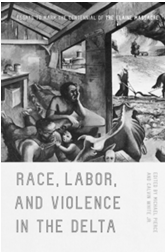
Race, Labor, and Violence in the Delta: Essays to Mark the Centennial of the Elaine Massacre. Editedby Michael Pierce and Calvin WhiteJr. (Fayetteville, Arkansas: Universityof Arkansas Press, 2022. Pp. ix + 248, acknowledgments, introduction,
notes, contributors, index. $29.95, paperback)
In Black Reconstruction, scholar and activist
W.E.B. Du Bois argued that emancipation pro-
duced a dramatic reversal of fortunes for African
Americans: “The slave went free; stood for a brief
moment in the sun, then moved back again to-
ward slavery” (New York: Russell and Russell,
1935, p. 30). Du Bois’s idea of freedpeople being
pulled “back toward slavery”—the title of the pen-
ultimate chapter of his book—is more than a
haunting diagnosis of the failed possibility of Re-
construction. Rather, it provides a way to under-
stand much of Black history for the rest of the
nineteenth and twentieth centuries. Every time
Black Americans organized, countervailing forces
attempted to thwart their efforts at improvement.
Such was the case in Elaine, Arkansas, when in
1919 whites murdered hundreds of Black share-
croppers who had begun to unionize, thereby
temporarily crushing hope for Black freedom in
the Delta.
In 2019, scholars and community members
commemorated the centennial of the Elaine
Massacre, which resulted in Race, Labor, and Vio-
lence in the Delta. Nine essays make a convincing
case that labor relations,
 techniques of
 op
pression,oppression, and the incessant striving for better lives fundamen-
tallyfundamentally shaped the Delta’s history. The first three essays examine aspects of labor and race rela-
tionsrelations from the 1870s to World War I, while the next three probe the interwar period with an em-
phasisemphasis on the 1920s. The final three essays ad-
dressaddress discrete topics that span the second half of the twentieth century. Some of the historians draw on previously
published research to produce new insights re-
latedrelated to the Elaine Massacre. From his prior ex-
aminationsexaminations of nineteenth-century labor
organizations in Arkansas, such as the Agricul-
tural Wheel and the Knights of Labor, Matthew
Hild finds patterns of interracial organizing and
violent white backlash demonstrated in both the
Cotton Pickers’ Strike of 1891 and the Elaine
Massacre. Jeannie Whayne taps her extensive
body of scholarship to situate the 1921 lynching
of Henry Lowery within the community net-
works of power rooted in the plantation econ-
omy of Mississippi County. Whayne interprets
Lowery’s murder as proof that whites had no tol-
erance for collective or individual acts that ques-
tioned their authority—whether that was
organizing a union in Elaine or requesting a
written statement of accounts from a planter as
Lowery did. Greta de Jong offers wisdom col-
lected from aspects of her three previous books
on struggles for social justice in the South, par-
ticularly after 1965. She shows that old and new
forms of violence continued to impact Black lives
during the late twentieth century.
Other contributors offer new insights and
point toward future areas of research. Cherisse
Jones-Branch challenges readers to rethink white-
produced narratives of Black women’s criminal-
ity after World War I and instead interpret their
actions as reflecting desire for opportunity. Mi-
chael Pierce disputes the claim made by some
scholars that white landowners sought Mexican
braceros after World War II due to a labor short-
age. By studying the activism of Ethel Dawson,
Pierce contends that Lincoln County planters
hired seasonal workers to drive down wages and
incentivize Blacks to leave the county to preserve
white political power. John A. Kirk explores the
continuities of Black activism and the discontin-
uities of white responses during the twentieth
century. He suggests that the authority for poli-
cing the color line moved away from mob vio-
lence and toward state and local law enforcement
as demonstrated by Governor Winthrop Rocke-
feller’s mobilization of the National Guard to
prevent whites from attacking Lance Watson and
his fellow marchers in their 1969 walk against
fear.
A final group of authors consider nightrid-
ing and forced labor as unique forms of coercion.
Through careful research in Arkansas news-
papers, Guy Lancaster documents the pervasive-
ness of nightriding before and after the passage
of Act 112 (a 1909 law intended to outlaw the
practice). William Pruden III examines federal
prosecutors’ attempts to punish night riders, con-
cluding that the Supreme Court’s ruling in the
1906 Hodges case must be understood within the
broader historical retreat from using Reconstruc-
tion-era measures to protect Black rights. Michael
Vinson Williams investigates the forced labor
camps of levee workers after the 1927 flood and
how the National Association for the Advance-
ment of Colored People and the American Fed-
eration of Labor attempted to improve labor
conditions.
Considered as a whole, these essays remind
readers not only of the Elaine Massacre—one of
the most horrific acts of racial violence in United
States history—but also, crucially, of the intersec-
tions of race, labor, and violence in the Delta in
the decades before and after this devastating epi-
sode. The book serves as a helpful introduction
to the region’s rich labor history. It is also an in-
spiration for others to continue investigating the
events, organizations, and trends that either re-
ceive glancing treatment, such as the Southern
Tenant Farmers Union as mentioned in Michael
Honey’s epigraph, or did not appear in these
pages. The authors compellingly demonstrate the
focusing power of a centennial. Each essay ex-
amines strategies of oppression, and many au-
thors find an indomitable spirit of resistance that
not even the worst forms of violence could drive
out of the Delta.
--Michael K. Rosenow
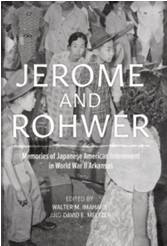
Jerome and Rohwer: Memories of
Japanese American Internment in
World War II Arkansas
. Edited by
Walter M. Imahara and David E.
Meltzer. (Fayetteville, Arkansas: The
University of Arkansas Press, 2022.
Pp. xxii + 228, foreword, preface, ac-
knowledgments, introduction, ap-
pendix, index. $29.95, hardcover)
The memories captured in this book are cru-
cial ones to help us acknowledge and understand
what really happened during the time of Japanese
American incarceration during World War II.
Every person affected went through many of the
same things—being informed by authorities in
California after the bombing of Pearl Harbor
that they would be sent away, having to live in
temporary sites such as horse stalls at racetracks,
taking a train trip across
the country to get to
camps (including the
two in Arkansas),
at-
temptingattempting to make a
home in tiny barracks—
but they each
experi-
encedexperienced it in their own
way. The accounts in
the book are full of
de-
tails,details, big things and
small things
remem-
beredremembered all these decades later. Taken together, they
reveal the personal struggles of all the people af-
fected—from realizing that, despite the fact that
they had been told they were being held mostly
to protect them from the surrounding populace,
the guards’ guns were pointed at them, not away
from them, to the daily humiliation of having to
bathe and use the toilet without privacy. Histori-
cal accounts can paint with a broad brush, but
seeing these finer brushstrokes has real value in
seeing the effects of conflicts and policies on real
people living their daily lives.
Living in Arkansas myself and having done
my own delving into the history of the Rohwer
and Jerome camps, I appreciated the vivid de-
scriptions by these Californians. James Ichinaga’s
account of Jerome is as follows: “If I were ever in
charge of punishing a group of people, this is the
place I would send them. The environmental ele-
ments were very hostile. It was hot and humid in
the summer, freezing in winter. . . . I remember
seeing those odd creatures called flying squirrels,
bats, many species of birds, those wonderful in-
sects called fireflies, and hearing the noisy croak-
ing of the frogs at night. To this day I have never
seen mosquitoes as huge as those in Arkansas” (p. 38).
Captured also in the book are the diverse de-
tails of what happened to people and families
after they left the camps as the war was drawing
to a close. Some returned to their homes and
farms in California—although not without care-
ful forethought. As Fran Inouye Imahara said,
“My father wanted us to go to Japan to live after
our release and applied for Japanese citizenship.
Relatives advised us there would be nothing for
us there. They canceled our request and we re-
turned to Fresno in 1946. We were very fortunate
to have a place to return to since a dear family
friend, a policeman with the Fresno Police De-
partment, looked after our home” (p. 54). Many
were not so lucky and had nothing to return to;
they made other plans, such as the Imaharas’
move to New Orleans, where they developed a
thriving landscaping business (p. xviii).
A few accounts have details that astounded
me. Clover Johnson said, “While [his friend]
Harry [Nagata] was in the service in the Midwest
or on [the] East Coast, he encountered fellow sol-
diers who had never seen anyone of Japanese an-
cestry before. Someone in command decided it
would be hard for the men to fight an enemy
they’d never seen. Harry Nagata was ordered to
dress up in the uniform of a Japanese soldier and
parade in front of the troops so they could see
and hate ‘the face of the enemy.’ Needless to say,
that was a horrible thing to do to a loyal Ameri-
can soldier and it breaks my heart every time I
think about it” (p. 70). Another account, by Joh
Sekiguchi, recalled a Boy Scout jamboree that in-
cluded boys from Jerome and Rohwer as well as
boys from nearby Arkansas City—noting the dif-
ferences in the boys’ food and supplies: “The
scouts from the two relocation camps . . . were
loaded into the back of supply trucks and rode
into town. . . . I remember one boy [from Arkan-
sas City] climbing in with the rest of us and I no-
ticed other boys from town in the other trucks.
It must have taken a lot of courage for them to
join a bunch of complete strangers—especially
strangers many folks considered to be ‘the
enemy.’ Some of the boys from the relocation
centers had brought their scout uniforms with
them when they relocated, but none of the Ar-
kansas City boys had uniforms” (p. 130). The Ar-
kansas City boys also ate from one big pot of
beans, while the camp boys had army-ration-style
food trucked in from the camps, including des-
sert. Finally, Tim Taira recalled learning years
after the fact the circumstances surrounding a
visit to Jerome by a group of Hawaiian soldiers,
who gave candy and cookies to the kids. He later
learned that this group had been from the 100th
Battalion, training at Camp Shelby, Mississippi,
as part of the 442nd, the much decorated Japa-
nese American regiment. As Taira said, “The
## Nisei [second-generation Japanese Americans]
from Hawaii had not been interned and were a
happy-go-lucky and gregarious bunch, quite dif-
ferent temperamentally from the mainland Nisei.
These differences were causing considerable fric-
tion during training, so their CO had an idea.
He sent busloads of the Hawaiians to Jerome. . .
. En route to Jerome the group was cheerful and
boisterous; during the return trip there was
stunned silence. They were shocked to see the
families of fellow trainees imprisoned behind
barbed wire. They understood the situation now,
and the friction between the two Nisei groups
stopped” (p. 148).
Acquiring and arranging all these accounts
was a huge task and one that was done carefully
and well. However, it is difficult to present a col-
lection of oral histories in a cohesive manner,
and that difficulty showed a bit in this book. The
accounts have many common elements that can
feel repetitive when reading cover to cover. The
accounts are also arranged in alphabetical order
by name, rather than by theme or location or
chronology, which can leave the reader a bit off
balance, encountering one new voice after
another without always having a sense of how
each story fits into the larger picture. Even the
very beginning of the book sets up this scattered
format, with a foreword written by three people,
a preface by one editor (but not the other), and
an introduction written by two people. Co-editor
Walter Imahara’s account is in alphabetical order
with the others, but I would have liked to have
seen his story at the beginning, framing the other
accounts and lending some cohesion.
Overall, the book is a valuable collection of
the voices of people who will soon be lost to
time—although their stories will remain—and it
will be a precious document in years to come to
people doing research on family members and
on the camps in Arkansas.
--Ali Welky
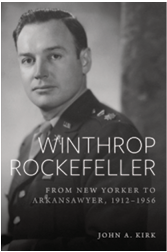
Winthrop Rockefeller: From New Yorker to Arkansawyer, 1912-1956. By John A. Kirk. (Fayetteville, Arkansas: University of Arkansas Press, 2022. Pp. xi + 267, acknowledgments, notes, bibliography, index. $24.95, hardcover)
In 1953, Winthrop “Win” Rockefeller, a
third-generation
member of one of
America’s wealthiest
and most powerful fam-
ilies, moved to Petit
Jean Mountain in Con-
way County. He built a
showplace Santa Ger-
trudis cattle-farming op-
eration, which he
named Winrock farms.
In 1991’s Agenda for Reform: Winthrop Rockefeller
as Governor of Arkansas, 1967-71, historian Cathy
Kunzinger Urwin analyzed his service as Arkan-
sas’s Republican governor from 1967 to 1971, but
his New York life has received little scholarly at-
tention. Until now. John A. Kirk, who is George
## Washington Donaghey Distinguished Professor
of History at the University of Arkansas at Little
Rock (UALR), examines his formative earlier life
experiences to develop a more complete and nu-
anced portrait of the man. Based upon the Win-
throp Rockefeller Collection, which is housed at
the UALR Center for Arkansas History and Cul-
ture, the Winthrop Rockefeller Papers at the
Rockefeller Archive Center (RAC), interviews
and other sources, Kirk argues convincingly that
his life in New York shaped his later career in
Arkansas.
Following a well-crafted introductory first
chapter, the author devotes Chapters Two
through Six to describing his childhood, educa-
tion, and earlier career in the oil industry. Born
on May 1, 1912 in Manhattan, Winthrop Rocke-
feller was educated at the Lincoln School, a prac-
tical learning-oriented institution, and the
Loomis School, which was a traditional, college
preparatory school. A poor student, he preferred
the kind of “hands-on” learning, such as the les-
sons in cattle-raising, he engaged in at Lincoln.
Notably, he and his brothers Nelson and David
received diagnoses of dyslexia much later in their
lives. Much to his family’s disappointment, Win-
throp’s poor academic performance resulted in
his resignation from Yale University in 1934.
Kirk refutes some Rockefeller family historians’
previous claims that an on-campus liaison led to
his dismissal from Yale.
To his family, his choice to enter the oil busi-
ness helped make up for his lack of academic suc-
cess. In 1934, he began learning each stage of the
business by starting work as a roustabout laborer
in Texas. He loved the experience—working in
the field, the adventure, and the people.
He inherited his family’s commitment to im-
proving race relations. During his time in Hous-
ton, Texas during the 1930s, he tried and failed
to interest white leaders in establishing a com-
munity health program for African Americans.
Through the experience he gained “valuable in-
sight into the difficulties in dealing with south-
ern race relations” (p. 80).
His oil career did not quite live up to his fam-
ily’s expectations. Returning from the oil fields
in 1937, he joined his father John D. Rockefeller
Jr. and his brothers in the family’s New York City
offices. In 1939, he began working in the foreign
trade department of Socony Vacuum, a deriva-
tive of his grandfather John D. Rockefeller Sr.’s
Standard Oil Company. As someone who dis-
liked working behind a desk, he struggled to find
his place in an office.
In Chapters Seven through Ten, Kirk details
Winthrop’s army career during World War II, in-
cluding his service in Guam, Leyte, and Oki-
nawa. He distinguished himself in the field of
battle, returning from the war a decorated com-
bat veteran. While in the army, he became
friends with Frank Newell. In the early 1950s,
Newell, an insurance broker from Little Rock,
showed him the property that became Winrock.
For this reviewer, who was less familiar with the
full extent of Winthrop’s military career, this sec-
tion was particularly informative.
The final two chapters cover his first mar-
riage to Barbara Paul “BoBo” Sears and his move
to Arkansas. At the time of their marriage in
1948, she was pregnant with his only son, Win-
throp Paul Rockefeller. Within eighteen months,
the couple separated and became involved in a
well-publicized, nasty, and drawn-out divorce,
much to the embarrassment of Winthrop and his
family. Their divorce was finalized in 1954.
As Kirk has shown, his life was very much
shaped by the “tension between seeking . . . to
fulfill the high demands of being a member of
the Rockefeller family . . . and . . . striving . . . to
become his own person” (p. 6). Moving to Arkan-
sas and building Winrock allowed him to con-
tribute to his family’s legacy—in his own way.
Kirk’s book is not hagiography. His subject
emerges as a socially conscious, civically engaged,
adventurous, courageous, and flawed individual.
More than fifty years later, his legacy lives on in
his adopted state. Thoroughly researched and en-
gagingly written, From New Yorker to Arkansawyer
should be essential reading for scholars of Arkan-
sas’s late twentieth century political history.
--Melanie K. Welch
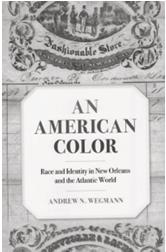
An American Color: Race and Identity in New Orleans and the Atlantic World. By Andrew N. Wegmann. (Athens, Georgia: University of Georgia Press, 2022. Pp. xvi + 238, acknowledgments, note on language, introduction, notes, bibliography, index. $29.95, paperback)
In the final chapter of his work, An American
Color: Race and Identity in New Orleans and the At-
lantic World, Andrew N. Wegmann references the
prevalent eighteenth- and nineteenth-century no-
tion that American society could not be shared
between white and non-white Americans. De-
spite this supposed incompatibility between the
white and black com-
 munities, the New Or-
leans mixed-race Creole
people forged a path
and identity for them-
selves, embracing the
ambiguous line between
white and black, and in
turn defining and rede-
fining themselves as
uniquely Creole within
the changing American
landscape. These are the people Wegman brings
to the fore as he analyzes the origins and devel-
opment of mixed-race middle-class Creoles in
New Orleans—from their French origins in the
1730s through to their embrace of their Ameri-
can home in the 1860s. For Wegmann, these
Creoles underwent a process of Americanization
in which they carefully crafted their cultural iden-
tity over more than a century to promote eco-
nomic and social uplift, as well as lay claim to a
place uniquely theirs within New Orleans and
greater American society. They were proud, edu-
cated, ambitious middle-class people who con-
stantly endeavored to promote their
community’s growth and claim to status in a con-
stantly shifting Atlantic World. In doing this,
they understood race, race science, and racial am-
biguity—manipulating these elements to their ad-
vantage while also forming a sense of identity
munities, the New Or-
leans mixed-race Creole
people forged a path
and identity for them-
selves, embracing the
ambiguous line between
white and black, and in
turn defining and rede-
fining themselves as
uniquely Creole within
the changing American
landscape. These are the people Wegman brings
to the fore as he analyzes the origins and devel-
opment of mixed-race middle-class Creoles in
New Orleans—from their French origins in the
1730s through to their embrace of their Ameri-
can home in the 1860s. For Wegmann, these
Creoles underwent a process of Americanization
in which they carefully crafted their cultural iden-
tity over more than a century to promote eco-
nomic and social uplift, as well as lay claim to a
place uniquely theirs within New Orleans and
greater American society. They were proud, edu-
cated, ambitious middle-class people who con-
stantly endeavored to promote their
community’s growth and claim to status in a con-
stantly shifting Atlantic World. In doing this,
they understood race, race science, and racial am-
biguity—manipulating these elements to their ad-
vantage while also forming a sense of identity
and belonging in a changing American land-
scape.
In constructing his argument, Wegmann ad-
dresses a historiographical record that, in his own
words, has “complicated and simplified a massive
antebellum population” (p. 3). In particular,
Wegmann identifies Ira Berlin’s Slaves Without
Masters as a landmark title that, while a substan-
tive account on free blacks, overlooked the com-
plexities of the Louisianan Creole population. In
particular, he suggests Berlin’s work overstated
and oversimplified the level of caste-subservience
experienced by all free people of color—as well as
removed these Louisianan mixed-race Creoles
from the historical narrative of America. Con-
sequently, the historiography since Berlin’s 1974
work has ignored these francophone peoples in
studies of the South, instead incorporating them
into Caribbean studies. This is the position Weg-
mann argues against in An American Color. He as-
serts that these New Orleans Creoles were very
much a part of the narrative of American history
and the greater Atlantic World; that they devel-
oped within and because of greater worldly
events; and that they shared many qualities with
free mixed-race peoples in other parts of the
American continent. In short, these New Or-
leans Creoles raised their status, forged a unique
identity, and positioned themselves socially bey-
ond the parameters of Berlin’s conclusions. Weg-
mann argues that these Creole people of New
Orleans were just as “American” as other ele-
ments of the country—and consequently, equally
deserving of consideration within the greater his-
torical narrative and history of the Atlantic
## World.
Wegmann’s argument is divided among five
chronological chapters in which he examines the
New Orleans Creole community through signif-
icant changes they experienced in the world
around them and how they subsequently met
those changes as a community. In chapter one,
the origins of this community under French rule
are explored. Significant to Wegmann’s analysis
here is the fact that the Creole population of the
nineteenth century had its roots in the conscious
manipulation of race and power within the con-
fines of French authority. For example, Weg-
mann asserts that “free women of color during
the colonial period utilized sex and race to carve
out [a] niche in the socioracial order” (p. 12)
when they chose to have relations with promi-
nent Frenchmen. Combined with the French
language lacking a word for a free person of color
until 1774, the free mixed-race community under
French rule was able to lay a substantive founda-
tion for future generations.
Following the transition to Spanish rule,
chapter two describes how the Creole population
continued to promote its own interests through
a manipulation of the race science that accompa-
nied Spanish rule. In particular, the Casta Sys-
tem of racial hierarchy allowed middle-class
Creoles to develop their identity and use their
light skin and free heritage for social elevation.
With the transition to United States authority,
as seen in chapter three, the Creole community
in New Orleans further embraced new cultural
mores to further elevate its status. By embracing
white culture and becoming propertied, New Or-
leans Creoles were able to elevate and assert
themselves as uniquely different. “To New Or-
leans white society, [Creoles] were not colored,
black, or negro. They were something else alto-
gether . . . ” (p. 61).
As the status of this Creole community
climbed in the years following the War of 1812,
it began imitating white American society by re-
fining its middle class through avenues like fash-
ion, family, and socializing. Like other free black
communities across the country, in their own
way, New Orleans Creoles were using class con-
sciousness and controlling the way they were per-
ceived in society to improve their station and de-
mand legitimacy within greater American society.
Subsequently, Wegmann’s final chapter explores
the ways in which the Creole community reacted
to the American Colonization Society and repa-
triation efforts during the nineteenth century. To
this end, Wegmann explores the nuances that ex-
isted between various mixed-race communities in
different parts of the country and their motiva-
tions to leave or stay. By the eve of the Civil War,
New Orleans Creoles had undergone a process
of Americanization, and saw their home not
abroad in Africa, but locally, where they had
grown and cultivated a uniquely American
Creole culture for over a century.
Through his analysis, Wegmann cogently ar-
ticulates the nuanced history of New Orleans
Creoles through over a century of political and
social change. He situates the community within
the greater narrative of United States history and
the Atlantic World, and in so doing, recontextu-
alizes important political and cultural historical
developments. Wegmann has not only made a
valuable contribution to the greater historiogra-
phy of mixed-race communities in the United
States, but also provided a social history that is
applicable to a plurality of historical fields—from
colonial to Antebellum America, and beyond to
the greater history of the Atlantic World.
--Travis C. Perusich
Katrina: A History, 1915-2015. By Andy Horowitz. (Cambridge, Massachusetts: Harvard University Press, 2020 Pp. 281, introduction, notes, acknowledgments, index. $36.00, hardcover)
Whether the author of this Barcraft Award
winner intended to create irrefutable justification
for the paradigm shift toward prioritizing vulner-
able populations in emergency management, it
appears he has done so while also adding a scan-
dalous historical context that public officials can-
not afford to ignore. Andy Horowitz illuminates
the need for such drastic shifts, and their com-
plex challenges, a century in the making with
Katrina: A History, 1915-2015. It pulls no punches
assessing Katrina’s aftermath, but also brings per-
spective from the detrimental impacts of com-
mercial dredging on Gulf Coast marshlands and
broken promises to share the extracted wealth for
a better future, all of which suffer in the name of
disorganization, disaster opportunism, segrega-
tion, and outright lies. Public policymakers, his-
torians, and students can apply these assessments
of both the good, but mostly the bad, lessons
from Katrina. At times undeniably demoralizing,
the writing seems designed to provoke meaning-
ful change with an infuriating narrative that
spurs its readers to action.
In recounting one man’s protest dating back
to New Orleans’ ill-begotten flood control plan
of 1927, Horowitz personifies decades-long warn-
ings and bitter debates in disaster policy that
seem to overlook the people most vulnerable to
catastrophic change. “But four decades after the
state engineers directed the Mississippi River to
flood his house, the catastrophe was not yet over
for him. Disasters can seem acute, his protests re-
mind, but their causes are long in the making
and their effects last a very long time” (p. 23). In
another example, a familiar refrain, levee failure
is attributed directly to cost-saving measures
enacted over time by the Army Corp of Engi-
neers. In a much less commonly understood
parlance, however, the author goes on to pain-
stakingly underscore years of indirect cause that
arguably became too overwhelming for any gov-
ernment agency or citizen group to overcome.
Looking back over nearly a century of unfettered
and unbalanced growth in the city, Horowitz un-
derscores the vulnerability of certain geographic
areas and populations in New Orleans from the
underappreciated lens of culture and heritage.
The early pages paint an intriguing picture
for those unfamiliar with New Orleans’ political
history. Even if one knows the Big Easy inti-
mately, there are throughlines to discover that
public officials and the social sciences grapple
with today. A century of half-measures leaves
New Orleans vulnerable to storm surge, and
more than two centuries of racism and segrega-
tion culminates in an irreparable relationship be-
tween New Orleans and many of its African
American citizens. These realities illustrate the
political backdrop when Hurricane Katrina
makes landfall. Calls to abandon certain parts of
the city in the wake of the 2005 storm are echoed
throughout, but the book also reminds us that
New Orleans has been sinking for a hundred
years as the result of dredging for transportation,
and later oil. Readers may recall pleas to save the
irreplaceable culture of New Orleans against calls
to finally let the city slip into the gulf after Hur-
ricane Katrina. What they may not remember are
warnings from scientists thirty years prior of this
inevitable result, which came alongside concerns
from citizens that the city did not seem to be able
to protect one area without flooding another.
“Despite the concerns raised at the public hear-
ing, the Army Corps announced in August 1975
that it would proceed with the project as de-
signed” (p. 89). The author extends both practi-
cal and cultural concerns from the paved streets
into the swamp itself, linking the ecosystem as in-
terdependent in regard to flood protections sur-
rounding the city. “But in 2005, forty years later,
a plodding bureaucracy and piecemeal federal ap-
propriations process had left the hurricane pro-
tection system unfinished” (p. 129).
The inevitable storm surge floods wealthy
and poor alike in neighborhoods borne of
drained marsh, only for the segregation still
upheld by tradition and economics to rear its
ugly head during a recovery that is ongoing to
this day. Unflooded low-income housing is de-
nied occupancy so that it can be razed, and dis-
placed citizens are outvoted regarding the future
of New Orleans before they are allowed back into
the city of their heritage. The underbelly of Lou-
isiana politics is again brought front and center
in a 1915 reboot for the modern era, and readers
are pointedly reminded of what is at stake.
“People died for no other reason than lack of or-
ganization” (p. 124). If the history leading to this
point is a sad reminder of how far we have come,
the recounting of Katrina’s aftermath in this
book is a gut-check for the wounds left to heal.
In these pages, one sees many examples
where unregulated progress and profit motive ig-
nore intangible concepts like culture and tradi-
tion. While it is hard to place monetary value on
such things, to ignore them is to ignore the
people they belong to, and, in many cases cov-
ered here, to deceive them. “Public efficiency and
private profits were difficult to reconcile, because
a totally efficient system of delivering public
funds to individuals would have yielded no pri-
vate profits at all” (p. 150). As with the flood
water, the funding only seems to move from one
place to another, never lifting all boats. The dis-
regard for sustaining the culture of New Orleans,
or more accurately the people who created it, is
juxtaposed with not only the occurrence of dis-
aster but our response to it. “As a process for
change, tradition is the opposite of disaster, in
which the present seems to arrive out of no-
where” (p. 189). The main characters in this work
are those who would stifle such tradition to
further their own self-interests in both 1915 and
in 2005. Katrina: A History, 1915-2015 does not
let us forget this fact, and offers no glossy finish
for the prejudices that often underpin such
thought. Anyone wishing to effect change for dis-
asters like Hurricane Katrina will find here the
political realities, historical injustice, and all
manner of obstacles they may face along the way.
--Jon Carvell
The Continuing Storm: Learning from Katrina. By Kai Erikson and Lori Peek. (Austin, Texas: University of Texas Press, 2022. Pp. xv + 142, prelude, postlude, acknowledgments, notes, index. $32.14, paperback)
Sociologist Kai T. Erickson observed in 2014
that Hurricane Katrina would be the most telling
storm of our era, not just because of the damage
it inflicted upon people and property, but be-
cause of what it revealed about our culture and
ourselves. Social scientists were eager to learn
more about the human costs of the disaster and
went to work soon after the storm passed, sifting
through reams of data, striving to make sense of
it. Among this group were some of America’s
best disaster researchers, their colleagues, and stu-
dents who lent support. The best of this work ap-
peared on The Katrina Bookshelf, the most
comprehensive social science coverage of a dis-
aster found anywhere in the literature. The Con-
tinuing Storm is the capstone of this series.
This book is a somber reflection, thoughtful,
with a measured academic tone. Yet, simulta-
neously, it is a brutally honest story of the abuse
suffered by some of New Orleans’ most vulner-
able citizens. It is a short, powerful read, essential
for those who want to deeply understand what
happened before, during, and after Hurricane
Katrina.
At the center of the narrative are the poor,
mostly Black residents of New Orleans, some eld-
erly, handicapped, and medicine-dependent,
stuck in Katrina’s path and unable to escape the
storm’s wrath. They died in floodwaters that
reached as high as their attics; they died swim-
ming through toxic sludge, trying to find some-
thing to hold on to as the water inched higher;
they died on bridges and overpasses, waiting for
help that was late in coming; some died in the
filthy squalor of the Superdome and the Conven-
tion Center, dehydrated, hungry and without
medication. Those that survived were hastily
loaded on buses or planes, headed for unknown
destinations, separated from some of their family,
and after a while living in a new place, feeling
like utter outcasts in their new environment. For
these souls, the hurricane is not over; it is a con-
tinuing trauma. Wherever these survivors go, so
goes Katrina.
The book succeeds in reorienting our percep-
tions of time and space as it relates to the hurri-
cane. As humans, we like to corral nature into
specific, often short,
timeframes. For exam-
ple, as a meteorological
event, Katrina was
short-lived; it began on
August 25 near south-
east Florida and ended
on August 29 over east
Mississippi. The storm
surge abated. The flood-
waters in the geo-
graphic bowl that is
central New Orleans eventually receded. But
human suffering will last a lifetime. Coastal
towns like Venice, Buras, and Waveland were
completely destroyed, having to build back from
scratch. Memories of what was lost and the grief
about those things have no official time stamp or
expiration date.
Regarding space, we like clear geographic
boundaries that we can identify and point to on
the map to remember those who suffered in that
part of New Orleans, such as the Lower Ninth
Ward and St. Bernard Parish. But in the travels
of those displaced from those places, Katrina
lives on. Wrenched from their homes and made
to feel unwelcome to return, Katrina followed
them wherever their diaspora took them.
Meanwhile, among New Orleans’ elite busi-
ness crowd, there was jubilation as they witnessed
the storm’s devastation. As affluent people living
on higher ground, they suffered less damage and
had the resources to get out of town as the storm
passed. Surveying the flooding in the poorer, pri-
marily Black district of New Orleans, some ex-
pressed thanks to God for the “gift.” The storm
did what they always wanted to do but could not.
Their town’s “criminal element” had just
boarded buses and was now gone. The city would
gentrify and do all possible to make it nearly im-
possible for the displaced to return. Possibly this
slight was the lowest depth of humiliation for
those in the diaspora, to be unwanted by their
city. They were uprooted from their homes,
treated like garbage, shuttled away, and barred
from returning. The New Orleans business
crowd wanted a smaller, taller, and whiter post-
Katrina city, and they got all that. It may be true
that no one reads Herbert Spencer anymore, as
Talcott Parsons once wrote. But these business
types wore their Social Darwinism on the sleeves
of their freshly pressed suits. The “unfit” of their
town had just been expelled. We learned from
Katrina that Social Darwinism was stitched into
the fabric of New Orleans and much of white
America, which stood by silently watching.
The Continuing Storm reveals the limits of a
neo-liberal democratic state in the current age to
protect its citizens after a disaster. In this pro-free
market, pro-business way of governing, the re-
sponsibility for disaster preparedness lies squarely
on the shoulders of the individual family unit
and local communities. Individual responsibility
rules the day. The fittest will survive and the rest
will fail. The federal government and state gov-
ernments can help with infrastructure projects or
resiliency initiatives and some limited forms of
aid. Still, it is not their job to replace your home
or to make you whole again. The political system
insists that to receive substantial assistance, your
local representatives must continually approach
the halls of Congress, hat in hand, to beg for
more relief money and prove that your district
needs it—an exhausting, years-long process.
Louisiana now encourages families to have
an action plan before the next storm arrives in
the Gulf. That plan involves adequate insurance,
savings, a roadworthy car, a “go” kit to save time,
and a place to meet family members during an
evacuation. Unfortunately, many of the vulner-
able poor in New Orleans lack access to these re-
sources today just as they did in 2005.
--Stan Weeber
