
Table of Contents
Arkansas Review: A Journal of Delta Studies
(formerly Kansas Quarterly)
“A Tainted House of Prayer”: Artist V. L. Cox on White Supremacy, Southern Culture, and Her Persisting Love of the Delta
3by Guy Lancaster
excavation (poetry)
15by laura vogt
Car Lot Cowboy (fiction)
16by Addison Griffis
Even Small Things (poetry)
22by Mary Ann Larkin
We Lost Bill Harrison (memoir)
23by M J Melneck
Roads and Bridges (fiction)
25by Robin Kozak
A Cordial Letter to Kaylee Muthart (poetry)
34by John Wall Barger
Refuge (fiction)
36by Kenneth Gulotta
Summer (poetry)
42by Leslie Hodge
The Early History of Streetcar Transportation in Little Rock, Arkansas, 1870–1948
44by Zuzana Chovanec and Timothy S. Dodson
Abecedarian for a Hometown Tornado (poetry)
59by Andrew Alexander Mobbs
For Whom the Writing Goes (creative non-fiction)
60by Damon Guinn
Delta Sources and Resources
67 The Hemingway-Pfeiffer Summer Writer’s Retreat
Hemingway-Pfeiffer Museum and Educational Center
Piggott, Arkansas
by Marcus Charles Tribbett
Reviews
68 Pierce and White Jr., eds., Race, Labor, and Violence in the Delta: Essays to Mark the Centennial
of the Elaine Massacre, reviewed by Michael K. Rosenow
Imahara and Meltzer, eds., Jerome and Rohwer: Memories of Japanese American Internment in
World War II Arkansas, reviewed by Ali Welky
Kirk, Winthrop Rockefeller: From New Yorker to Arkansawyer, 1912-1956, reviewed by Melanie K. Welch
Wegmann, An American Color: Race and Identity in New Orleans and the Atlantic World,
reviewed by Travis C. Perusich
Horowitz, Katrina: A History, 1915-2015, reviewed by Jon Carvell
Erikson and Peek, The Continuing Storm: Learning from Katrina, reviewed by Stan Weeber
Contributors
79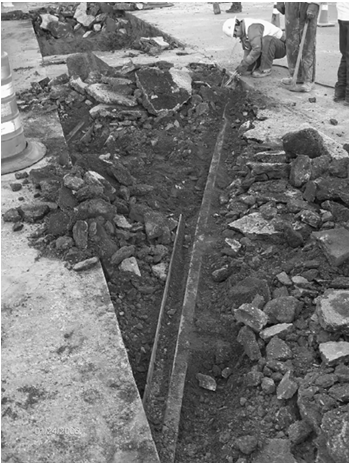
Editor’s note: In the image to the left, modern day construction workers uncover intact rails on East 3rd Street, Little Rock, remnants of the city’s streetcar railway system, permanently shut- tered about seventy-five years ago in 1948. See the fascinating article in this issue, pages 44-58, on this unique part of the city’s heritage.
Contributors
Jon Carvell is Clinical Assistant Professor of Disaster Preparedness & Emergency Management at Arkansas State University and served as the university’s emer- gency manager during the Covid-19 pandemic. He holds a BA in English and an MPA from Arkansas State University and got his start in emergency man- agement by volunteering for recovery efforts during the aftermath of various natural disasters in Northeast
Arkansas.
Zuzana Chovanec, PhD, RPA works as an archaeolo- gist with the US Army Corps of Engineers and is af- filiated with the Department of Anthropology at the State University of New York at Albany as a Volunteer Research Associate. Her areas of interest include his- toric preservation, cultural resource management, human-environment relationships, and the archaeol- ogy of Cyprus and North America.
Timothy S. Dodson MA, RPA is currently the Regu- latory Archaeologist for the Nashville and Mobile Dis- tricts of the US Army Corps of Engineers. He has published several peer reviewed articles focusing on archaeology and baseball.
Addison Griffis is a Mississippi writer and finance manager at a car dealership. His work is found in Appalachian Review and Roanoke Review. Addison is currently querying literary Western and magical Southern manuscripts for representation. Instagram is @addisongriffis
Damon Guinn is a writer and nonprofit professional who grew up in Jonesboro, Arkansas. He spent years writing for a humanitarian organization, traveling to remote communities around the world to gather and share stories about families battling extreme poverty. He now resides in Minneapolis, Minnesota, within eyeshot of George Floyd Square, where he works with Twin Cities Habitat for Humanity to advance racial equity in housing. Samples of his work are available at damonguinn.com.
Kenneth Gulotta writes fiction and poetry. He has an MA in creative writing from the University of Texas at Austin and a PhD in English from Tulane Univer- sity. A technical writer by trade, he spends his days solving puzzles that involve communication, design, and coding. Kenneth was born and raised in south Louisiana, but he has also lived in Austin, TX, Wash- ington, DC, and Baltimore, MD. He now lives in New Orleans with his wife and stepson.
Leslie Hodge has poems published or forthcoming in journals including Pigeon Pages, South Florida Poetry Journal, Spank the Carp (where she was featured in The Mind of the Poet), and The Main Street Rag. Leslie lives in San Diego and has deep family roots in central
Missouri.
Robin Kozak’s writing has appeared most recently in
Arkansas Review, Drunk Monkeys, Pleiades, The Rappa-
hannock Review, and Sequestrum. An authority on antique and estate jewelry, she currently is at work on her second novel.
Guy Lancaster serves as the editor of the online Ency- clopedia of Arkansas, a project of the Central Arkansas Library System, and is the author, co-author, or editor of several books on race and violence, including Amer- ican Atrocity: The Types of Violence in Lynching (U of Ar- kansas P, 2021) and The Murder of Oscar Chitwood in Hot Springs, Arkansas (co-authored with Christopher Thrasher and forthcoming from The History Press).
Mary Ann Larkin is the author of That Deep and Steady
M J Melneck earned the MFA degree from the Uni- versity of Arkansas in May 1980. His catalog includes the novel Old Music and many features, reviews, film scripts and short stories. He and his wife Pat and their spoiled rotten dog Max live in western Colorado where he writes about and photographs the nearby desert and mountains.
Andrew Alexander Mobbs (he/him/his), a native Arkansan, is the author of the chapbook, Strangers and Pilgrims (Six Gallery Press, 2013). A Pushcart Prize no- minee, his poems have appeared in Crab Creek Review,
Frontier Poetry, New Delta Review, Ghost Ocean Maga-
zine, and elsewhere. He co-founded the online lit mag Nude Bruce Review and will soon earn his MFA at Ore- gon State University.
Travis C. Perusich: Travis is a PhD candidate at the University of Arkansas, studying African American soldiers in the American Revolution. He earned his Bachelor’s degree at the University of the Ozarks and his Master’s degree at the University of Central Ar- kansas. He is a former member of the United States Air Force and a former public school teacher.
Michael K. Rosenow is Associate Professor of History at the University of Central Arkansas and is the au- thor of Death and Dying in the Working Class, 1865-1920 and articles about labor and working-class history.
Marcus Charles Tribbett is General Editor of Arkansas Review: A Journal of Delta Studies and Associate Profes- sor of English at Arkansas State University, where he also teaches for the interdisciplinary Heritage Studies doctoral program. He has published scholarly work on blues performers, on a nineteenth-century slave narrative, and most recently on contemporary novels by Jessmyn Ward and Tupelo Hassman.
Stan Weeber is Professor of Sociology at McNeese State University. He has written several papers about natural disasters, and wrote Post-Rita Reflections (2009), a professorial memoir of the Katrina-Rita era.
Melanie K. Welch was born in Little Rock in 1976 and graduated from the University of Central Arkansas in 1999, receiving a baccalaureate degree in history. In 1999, she received the Lucille Westbrook Local His- tory Award from the Arkansas Historical Association. In 2009, she earned a PhD in modern American his- tory from Auburn University. An independent histo- rian, her work has appeared in Arkansas Review, the Arkansas Historical Quarterly, and the Encyclopedia of Arkansas History and Culture.
Ali Welky is Associate Editor of the online Encyclope- dia of Arkansas, a project of the Central Arkansas Li- brary System, as well as a freelance editor for books and magazines, including the Oxford American. She holds a BA in English from Truman State University in Kirksville, MO, and an MA in English from the University of Central Arkansas in Conway. She co- edited the Encyclopedia of Arkansas Music (Butler Center Books, 2013) and edited A Captive Audience: Voices of Japanese American Youth in World War II Arkan- sas (Butler Center Books, 2015). She lives in Conway with her husband and two children.
Laura Vogt studied literature and history in undergrad and grad school, focusing on Shakespeare, folk tales, and the History of Mentalities. She also attended the University of Iowa Writers’ Workshop writing pro- gram in Dublin, Ireland. Her poetry is published in several journals, her prose has placed in a few contests, and her novelette Blue Beyond the Sea is available as a chapbook with Bottlecap Press. Her forthcoming debut novel In the Great Quiet is a historical fiction and fabulism blend based on her ancestor.