Delta Sources and Resources
Historic Arkansas Newspapers available for free as part of ## Chronicling America The Library of Congress’s Historic American Newspapers collection (online) by Katie Adkins and Darren Bell, Arkansas State Archives
Since 1905, the Arkansas State Archives (ASA) has collected and preserved official records and historical materials for the State of Arkansas. It has amassed a vast collection of state, county, and federal records, manuscripts, military records, newspapers, family histories, and genea- logical resources. Newspapers, however, are at the heart of the Arkansas State Archives and are the most requested resource in the collection.

The Arkansas State Archives has operated its newspaper microfilming program since 1957. Its archives contain the largest existing collection of Arkansas journalism, curating approximately 22,000 rolls of microfilm containing nearly 1800 titles and representing all 75 of the state’s counties, with an estimated page count exceeding 22 million. The Arkansas State Archives is the only institution in Arkansas that still microfilms historic and current Arkansas newspapers. In 2017 the Arkansas State Archives joined the Library of Congress’s (LoC) National Digital Newspaper Program (NDNP) and began to digi- tize its historic newspapers of record. Today, more than 300,000 pages of curated Arkansas newspapers are digitized with an additional 100,000 to be completed by the end of August
- Dates of these digitized newspapers range from 1819 (with the recent addition of the Arkansas Gazette) to 1959 with the Arkansas State Press, owned and operated by Daisy and Lucious Bates. These digitized newspapers are part of the Library of Congress’s (LoC) Historic American Newspapers collection and can be accessed for free at Chronicling America: https://www.loc.gov/collections/chronicling- america/. The digitized titles include several from Ar- kansas’s Delta region. Most chronicle the late nineteenth and early twentieth centuries and cover a range of topics and readership from the following communities: Arkansas Post, Brinkley, Carlisle, Dermott, Des Arc, DeWitt, Dyess, For- rest City, Gillett, Helena, Marianna, McCrory, McGehee, Napoleon, Newport, Osceola, Para- gould, Pine Bluff, and Stuttgart. The largest amount of content submitted from a single title comes from the Pine Bluff Daily Graphic, with daily and semi-weekly issues from 1893-1920. The Graphic chronicles an era of pros- perity in Pine Bluff, then the third largest city in Arkansas. During this time the city was a transportation hub and agricultural center for
Southeast Arkansas.
Many Delta newspapers selected for digitiza-
## Chronicling America.
The Delta region contributes newspapers published for African American and immigrant communities such as the Forrest City Herald. Af- filiated with the African Methodist Episcopal Church, the Herald promoted African American communities as well as church objectives. Seven issues from 1896 (the only remaining issues) have been digitized. Issues of the Negro Spokesman, from Pine Bluff, representing African American interests rather than any one political party, were published from 1938 to circa 1958; the two sur- viving issues are included. The Stuttgart Ger- mania, a German language newspaper, was published from 1895-1913 and served the immi- grant population that founded the town, Stuttgart, as a colony in the 1870s; nine issues exist from 1908. Most recently, titles were selected that dem- onstrate the environmental impacts of economic development particularly from communities in which agriculture, timber, mining, and oil pro- duction were significant, from 1819-1942. Issues of the Forrest City Times and Herald 1920-1928, and the Courier-Index, Marianna, 1921-1930 were included as a result of their role as central hubs
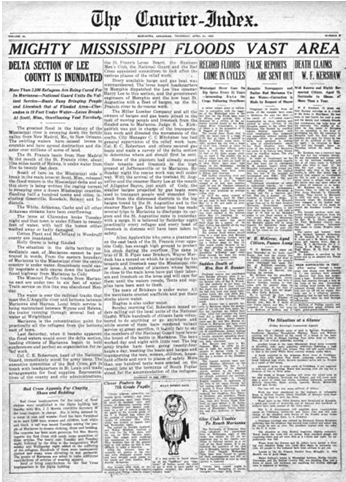
for refugees displaced from the 1927 Mississippi River flood. The Arkansas Gazette, founded in 1819 at Arkansas Post and at Little Rock since 1820, consistently promoted immigration and land sales, while documenting life in Arkansas settlements and early “agribusiness.” Collaborating with the Butler Center at the
Central Arkansas Library System, Historic Dyess
Colony Heritage Site managed by Arkansas State University, and Special Collections at the Uni- versity of Arkansas in Fayetteville, the Arkansas State Archives has assembled a nearly complete run of the Colony Herald, 1936-1937, from the Dyess Colony in Mississippi County. The colony offered relocatees modest houses with electricity and water and the opportunity to support them- selves by farming during the Depression. The Herald contained community news and farming The front page story of the Mariana Courier-Index: April 21, 1927 (The Great Flood). Image courtesy of the authors.
To learn more about the National Digital News- paper Program, visit https://www.loc.gov/ndnp/. For more Arkansas State Archives resources in- cluding search guides, lesson plans, topic guides, recipe booklets and activities for kids, visit https://ar- digital.contentdm.oclc.org/digital/collection/adnp.