Historic Arkansas Newspapers available for free as part of Chronicling America The Library of Congress’s Historic American Newspapers collection (online) by Katie Adkins and Darren Bell, Arkansas State Archives
Since 1905, the Arkansas State Archives
(ASA) has collected and preserved official records
and historical materials for the State of Arkansas.
It has amassed a vast collection of state, county,
and federal records, manuscripts, military
records, newspapers, family histories, and genea-
logical resources. Newspapers, however, are at the
heart of the Arkansas State Archives and are the
most requested resource in the collection.

The Arkansas State Archives has operated its
newspaper microfilming program since 1957. Its
archives contain the largest existing collection of
Arkansas journalism, curating approximately
22,000 rolls of microfilm containing nearly 1800
titles and representing all 75 of the state’s
counties, with an estimated page count exceeding
22 million. The Arkansas State Archives is the
only institution in Arkansas that still microfilms
historic and current Arkansas newspapers.
In 2017 the Arkansas State Archives joined
the Library of Congress’s (LoC) National Digital
Newspaper Program (NDNP) and began to digi-
tize its historic newspapers of record. Today,
more than 300,000 pages of curated Arkansas
newspapers are digitized with an additional
100,000 to be completed by the end of August
- Dates of these digitized newspapers range
from 1819 (with the recent addition of the
Arkansas Gazette) to 1959 with the Arkansas State
Press, owned and operated by Daisy and Lucious
Bates. These digitized newspapers are part of the
Library of Congress’s (LoC) Historic American
Newspapers collection and can be accessed for
free at Chronicling America:
https://www.loc.gov/collections/chronicling-
america/.
The digitized titles include several from Ar-
kansas’s Delta region. Most chronicle the late
nineteenth and early twentieth centuries and
cover a range of topics and readership from the
following communities: Arkansas Post, Brinkley,
Carlisle, Dermott, Des Arc, DeWitt, Dyess, For-
rest City, Gillett, Helena, Marianna, McCrory,
McGehee, Napoleon, Newport, Osceola, Para-
gould, Pine Bluff, and Stuttgart.
The largest amount of content submitted
from a single title comes from the Pine Bluff Daily
Graphic, with daily and semi-weekly issues from
1893-1920. The Graphic chronicles an era of pros-
perity in Pine Bluff, then the third largest city in
Arkansas. During this time the city was a
transportation hub and agricultural center for
Southeast Arkansas.
Many Delta newspapers selected for digitiza-
tion showed their support for the Democratic
party but there were exceptions to this. The
Southern Shield from Helena, for instance, was
published by Quincy K. Underwood, a nationally
prominent member of the Whig Party. The title
suspended publication during the Civil War after
secessionists burned its building in response to
its support of the Union cause. Published
between November 1860 and April 1861, Consti-
tutional Union from Des Arc contained argu-
ments for remaining in the United States as a
counter to the Citizen (1854-1869) which sup-
ported secession. The Citizen was known for
printing news transmitted via telegraph from
Memphis. Both newspapers are available on
## Chronicling America.
The Delta region contributes newspapers
published for African American and immigrant
communities such as the Forrest City Herald. Af-
filiated with the African Methodist Episcopal
Church, the Herald promoted African American
communities as well as church objectives. Seven
issues from 1896 (the only remaining issues) have
been digitized. Issues of the Negro Spokesman,
from Pine Bluff, representing African American
interests rather than any one political party, were
published from 1938 to circa 1958; the two sur-
viving issues are included. The Stuttgart Ger-
mania, a German language newspaper, was
published from 1895-1913 and served the immi-
grant population that founded the town,
Stuttgart, as a colony in the 1870s; nine issues
exist from 1908.
Most recently, titles were selected that dem-
onstrate the environmental impacts of economic
development particularly from communities in
which agriculture, timber, mining, and oil pro-
duction were significant, from 1819-1942. Issues
of the Forrest City Times and Herald 1920-1928,
and the Courier-Index, Marianna, 1921-1930 were
included as a result of their role as central hubs
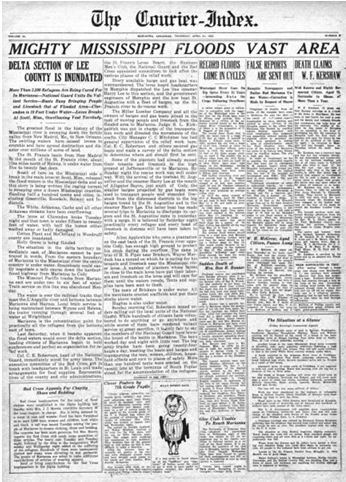
The front page story of the Mariana Courier-Index:
April 21, 1927 (The Great Flood).
Image courtesy of the authors.
for refugees displaced from the 1927 Mississippi
River flood. The Arkansas Gazette, founded in
1819 at Arkansas Post and at Little Rock since
1820, consistently promoted immigration and
land sales, while documenting life in Arkansas
settlements and early “agribusiness.”
Collaborating with the Butler Center at the
Central Arkansas Library System, Historic Dyess
Colony Heritage Site managed by Arkansas State
University, and Special Collections at the Uni-
versity of Arkansas in Fayetteville, the Arkansas
State Archives has assembled a nearly complete
run of the Colony Herald, 1936-1937, from the
Dyess Colony in Mississippi County. The colony
offered relocatees modest houses with electricity
and water and the opportunity to support them-
selves by farming during the Depression. The
Herald contained community news and farming
The front page story of the Mariana Courier-Index:
April 21, 1927 (The Great Flood).
Image courtesy of the authors.
techniques. The paper was suspended from mid-
January to mid-May 1937 as the colony was evac-
uated because of the 1937 flood. Singer Johnny
Cash, the most famous resident of the Dyess col-
ony, reflects on the rise of flood waters in his
childhood home in his 1959 song, “Five Feet
High and Rising.”
Newspapers relevant to the Delta region but
not originating from the area include the Arkan-
sas Homestead, Arkansas Farmer & Homestead, and
Arkansas Farmer (Little Rock). These titles focus
on agriculture statewide, dating from 1906-1930.
Another group of papers related but not originat-
ing in the Delta include a collection of populist-
related titles published in Faulkner, Pulaski, and
White counties from 1895-1938. The populist
movement originated in part with farmers’ frus-
tration with low crop prices, lack of access to
credit, and monopolies in transportation and
marketing. Issues of the Union Label Bulletin and
Union Labor Bulletin from Little Rock, 1903-1931
address concerns from various agricultural organ-
izations in the early twentieth century and are
now included on Chronicling America.
Since its migration to the Library of Con-
gress’s collections website, Chronicling America
now contains several Arkansas-specific titles not
submitted by the Arkansas State Archives. A col-
lection of miscellaneous African American titles
from the LoC were added in 2022. Included in
this collection were two titles from the Delta,
each single issues from 1900, the Pine Bluff Weekly
Herald, and the Reporter from Helena. Further ad-
ditions were made in 2023 when the LoC began
to reorganize their various online newspaper col-
lections under the Chronicling America name.
Two titles published in Japanese, by Japanese
Americans detained at the Rohwer Relocation
Center in Desha County, the Rohwer Outpost,
1942-1945, and Rohwer Relocator, 1945, are now
available as part of Chronicling America.
For a full list of Arkansas newspapers
currently digitized on the LoC’s Chronicling
America website, visit https://www.loc.gov/col-
lections/chronicling-america/dynamic-list-of-ti-
tles/ and search “Arkansas.”
The National Digital Newspaper Program is
a partnership between the National Endowment
for the Humanities (NEH) and the Library of
Congress. One cultural institution from each
state works alongside the Library of Congress to
digitize newspapers for that state, in grant cycles
of 100,000 pages at a time. The Arkansas State
Archives joined the project in 2017 and has digi-
tized Arkansas’s newspapers of record, papers
from underrepresented communities, and papers
that demonstrate the relationship between the
economy and the environment. All fifty US
states along with Puerto Rico and the Virgin Is-
lands have participated (or are currently partici-
pating) in this project. sts
To learn more about the National Digital News-
paper Program, visit https://www.loc.gov/ndnp/.
For more Arkansas State Archives resources in-
cluding search guides, lesson plans, topic guides,
recipe booklets and activities for kids, visit https://ar-
digital.contentdm.oclc.org/digital/collection/adnp.