
Delta Sources and Resources
Arkansas Museum of Fine Arts
501 E. Ninth Street
Little Rock Arkansas
by Sierra Tribbett-Collins
The Arkansas Museum of Fine Arts, located in Little Rock and better known colloquially as AMFA, serves as a testament to passion for the arts in the American South. The museum prides itself on its reputable permanent collection, which spans eight centuries of two-dimensional and three-dimensional art, and features both local artists and artists from across the globe. The gallery represents a significant arc of Western his- tory, from the Renaissance to the end of the nineteenth century. The temporary exhibitions are often equally impressive, exploring themes within certain art movements or in-depth looks at a featured artist’s career. AMFA offers free ad- mission to encourage residents to take advantage of its many amenities, including gallery tours, dining and shopping, art classes, and events such as concerts, lectures, and dance and film produc- tions. They also offer annual memberships with core benefits such as store and restaurant dis- counts, early access to temporary exhibitions, and invitations to member-exclusive events. Although the grand opening of the Arkansas Museum of Fine Arts took place in the spring of 2023, the history and impact of the museum has existed long before then. The seed for the mu- seum was first planted in 1914, when a group of intrepid women formed the Fine Arts Club with the incentive to bring the arts to Arkansas. Over twenty years later, in 1937, supporters and members of the club contributed to the creation of the Museum of Fine Arts in Little Rock’s Mac-
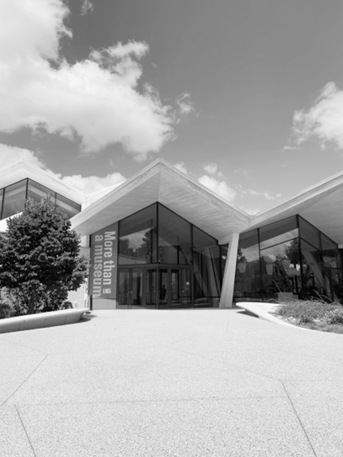
The exterior of the museum’s entrance.
Photograph by the author.
Arthur Park, the first museum dedicated to fine arts in the state of Arkansas. As the museum’s art collection continued to grow, a statewide cam- paign was launched in 1959, led by future gover- nor and first lady Winthrop and Jeannette Rockefeller. The campaign’s goal was to enlarge the museum significantly, serving all of Arkansas and encouraging residents to get involved. A new building for the Arkansas Arts Center, in ad- dition to the original building, was successfully opened in 1963, featuring temporary art exhi- bitions, sculpture courtyards, an art reference li- brary, a community theater, and a school of fine and performing arts. Over the next fifty years, the institution con- tinued to grow in both scale and scope, undergo-
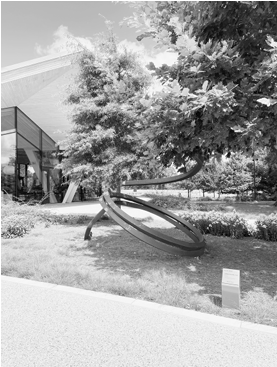
Outdoor architecture and native plants.
Photograph by the author.
was designed to “make it feel like a museum in a
park,” takes inspiration from the bluffs of Emer-
ald Park in North Little Rock, the Ouachita
Mountains, and the landscape of the Delta. The
exterior of the museum is just as visually appeal-
ing, featuring a pleated roof and glass-enclosed
spaces at each entrance. The north entrance re-
tains the original art deco facade that was first in-
troduced in the 1937 building. The exterior is
sleek and linear, preserving the historic elements
of the original building with the elegant ad-
ditions of the renovated architecture.
Inside the building itself, the museum is
bright and airy, with an open floor plan and two
stories of accessible galleries and classrooms. A
particularly unique amenity in the structure is
the Cultural Living Room, a large community
space with lounge furniture, art books, and a cof-
fee bar. The living room features floor-to-ceiling
windows, with a view of the courtyard and the
MacArthur Park neighborhood, and encourages
visitors to take their time and enjoy the space
comfortably. The museum also offers a reputable
gift store with works from AMFA-selected artists,
a 350-seat Performing Arts Theater, and the full-
service Park Grill, a contemporary American fare
restaurant that overlooks the grounds.
The galleries themselves feature both tempo-
rary and permanent collections. Visitors can cur-
rently peruse several temporary exhibitions this
summer. Downstairs, in the Robyn and John
Horn Gallery, visitors will first encounter the
65th annual Young Arkansas Artists exhibition.
This collection features 52 artworks created by
students from kindergarten through twelfth
grade from communities across Arkansas and
represents both the caliber of Arkansas’s teachers
and the power of art in the hands of young
artists. Notable works include colorful oil
paintings, acrylic self-portraits, clay model and
ceramic structures, and charcoal still lifes. The
range in the artists’ ages and abilities serves as an
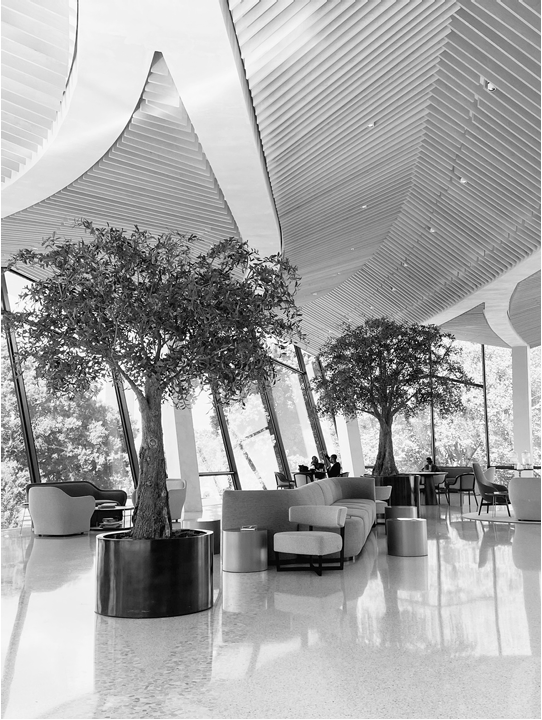
Inside the Cultural Living Room.
Photograph by the author.
inspirational reminder of the future of artistic expression. Upstairs, in the Harriet and Warren Stephens Family Gallery, another temporary ex- hibition explores the concept of time. A Month of Sundays: Art and the Persistence of Time borrows the Southern turn of phrase “a month of Sun- days” to demonstrate the way we experience time in our lives and in the environment, and features over fifty modern and contemporary works through painting, drawing, sculpture, and video. Ron Kleeman’s 1979 screenprint Gas Line, from the portfolio City-Scapes, tells the story of long waits in line for a Hess Gas Station during the worldwide energy crisis at the time of the Iranian Revolution. Bruce Comer’s surreal and dreamy oil painting About a-Quarter-to-Six depicts a rural isolated train station with a clock marking 5:45. Malvin Gray Johnson’s The Letter, an oil painting of a woman in the slow act of composing a hand- written letter, blends Western and African artistic influences and captures an everyday moment of Black Americans in the Harlem Ren- aissance. The collection is diverse and visually captivating, although previous exhibitions have notedly been more cohesive in their exploration of a theme or idea. In the Berta and John Baird Gallery, a smaller and more focused temporary exhibition depicts the life of artist Will Barnet through Will Barnet: Seasons of Life. Barnet was at the center of major American movements, and swung pro- foundly between realism and abstraction during his career. His earlier works documented social realities of the Great Depression, while his later work developed into abstraction in the postwar New York art scene. Barnet then returned to re- alism in the 1960s, when he created the famous screenprint series The Silent Seasons: lithograph paintings in his distinctively flat style that feature a solitary woman and a bird next to a window amidst the changing seasons of spring, summer, fall, and winter. The collection is a celebration of the artist’s eighty-year career, and the tender, quiet depictions of family life for which Barnet was most known. A controversial and perhaps more question- able exhibition in the Fine Arts Club New Media Gallery is British artist Mat Collishaw’s film Aftermaths. The seven-minute film portrays un- canny and grotesque sea creatures that mutate and swim through a dystopian world. Collishaw created these mutations through artificial intel- ligence, attempting to depict the paradox of the promise of new technology and its potential to destabilize and destroy our ecosystem. But the artist’s statement is unclear as to whether it con- demns or celebrates the usage of AI, seemingly arguing that the decay the film represents is not a warning but rather an essential in adapting to a new world. The film is haunting, perhaps not Inside the Cultural Living Room. Photograph by the author.
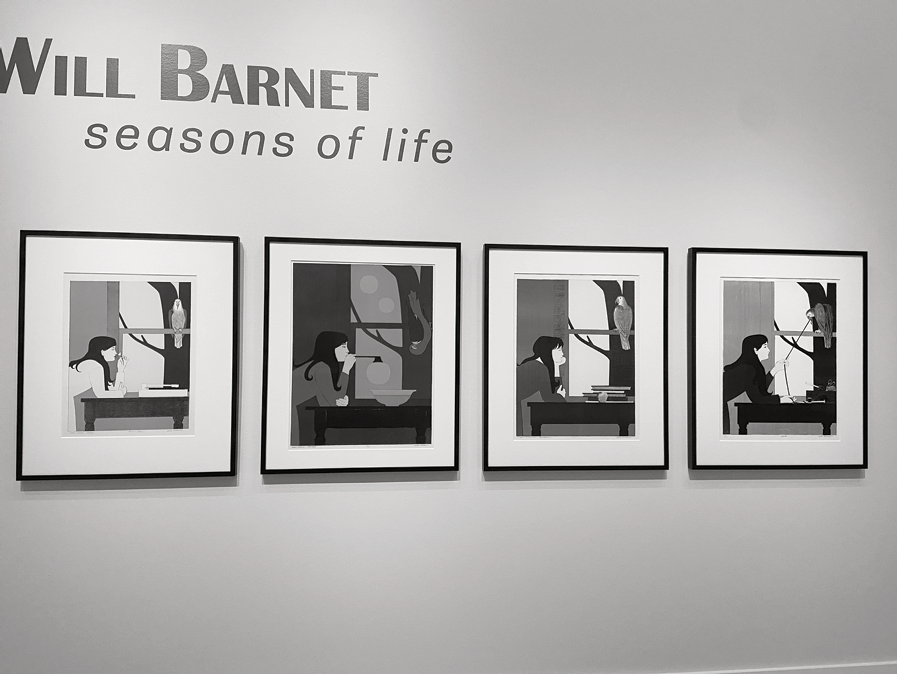
Will Barnet: Seasons of Life exhibit entrance.
Photograph by the author.