
Reviews
Choctaw Tales: Stories from the Firekeepers. By Tom Mould and Rae Nell Vaughn. (Jackson: University Press of Mississippi, 2025. Pp. xxix + 331, foreword by Chief Phillip Martin, preface to the second edition, preface to the first edition, annota-tions, notes, sources cited, index, and 45 photographs).
Tom Mould and Rae Nell Vaughn’s new book is the culmination of well over two decades of fieldwork with the Choctaw of Mississippi. Mould began working with the Choctaw as a doc- toral student, and he has written prolifically on Choctaw folklore, belief, and narratives. He pub- lished Choctaw Tales in 2004, and this new re- vised edition further develops important documentation and insights into their storytell- ing traditions. Mould used collaborative ap- proaches and teamed up with Vaughn, who is member of the Mississippi Band of Choctaw In- dians and an elected official and archivist for the tribe. This new volume includes a wealth of newly documented and published narratives, re- flections on the fieldwork process and collabo- rative research, and expanded selections of stories written in the Choctaw language. Mould and Vaughn pay tribute to the firekeepers who pre- serve and honor the legacy of Choctaw verbal art- istry. Their work continues to contribute the preservation of Choctaw cultural expression as well as adding important resources for sustaining and supporting efforts to preserve the language.
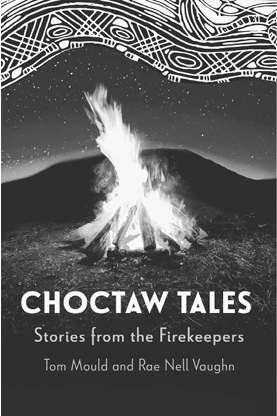
Their book is a major documentation of American Indian expressive culture within the Delta and surrounding regions. The authors draw from archival resources as well as ethno- graphic fieldwork with keepers of Choctaw tradi- tion. The initial work was encouraged by Choctaw leaders and educators who invited Mould to assist with the documentation of the narrative over thirty years ago. He has main- tained his early connections within various com- munities and further expanded his work to include a wide range of contributors to this proj- ect. A major section of the book is devoted to the storytellers, past and present, and Mould and Vaughn completed excellent documentation to give short biographic sketches of the tellers and
The bulk of the book consists of texts ar-
ranged by genres and themes. Originally, Mould
wrote of an emic genre named shokhanṉopa. This
term literally translates as “hog talk,” and it con-
veys rich meanings that relate to Choctaw ideas
about humorous discourse and the communi-
cative norms about who may tell these tales. Orig-
inally, Mould had termed another class of stories
as “talk of the elders.” These narratives are more
serious in content and tone, and they embody
deep truths within the culture. Following
Mould’s original writing, a new term has
emerged for this body of narrative. The Choctaw
coined the term hopáki ikhana to classify stories
connected more to tribal history than more re-
cently told narratives. This second class of genre
consists primarily of what they characterize as leg-
end, old stories, and history. Hopáki ikhana
would also include other etic genres—namely
myths and etiological narratives—but the story-
tellers, themselves, do not necessarily make these
kinds of distinctions.
Mould and Vaughn balance insider genres
with external terms in their organization of the
volume. Chapters consist of Creation Stories and
Myths, Supernatural Legends and Encounters,
Historical Tales, Prophecy, Jokes and Tall Stories,
and Animal Stories, followed by a selection of
nineteen stories that are told in the Choctaw lan-
guage. It is especially intriguing to examine these
untranslated stories and compare them with Eng-
lish translations to gain a sense of the lexicon and
syntax of Choctaw. There is a resurgent interest
in teaching the language, and the book provides
important resources for educators and language
enthusiasts.
The book is rich in its variety and scope of Choctaw folklore. Choctaw creation narratives are intriguing, and these stories continue as an on-going verbal legacy. One of my favorite selec- tions is the story of “Fani Losa and the Sun.” This selection is documented through an in situ recording of a 2024 telling by Ray Nell Vaughn to children. Fani losa is a black squirrel, who shows up in an old story about an eclipse. Vaughn’s transcription of the story provides a vi- brant representation of the telling, and gives readers a sense of her own abilities as a teller and her ways of engaging young listeners. Readers also will find accounts of important historical fig- ures. Among the most important is Pushmataha, a 19th century chief who supported Indigenous rights and died a suspicious death in Washing- ton, DC. These stories are important texts within the larger category of hopáki ikhana. Other figures also show up within this system, including a shape-shifter named Skate’ne as well as less di- rectly named figures such as na losa chitto, a demon-like figure, and nishkin chafa, a one-eyed supernatural figure who is part of their supernat- ural belief system. Other fascinating characters include the bohpoli. They are Choctaw little people, similar to gnomes or dwarves in Euro- pean folklore. They are seen as having their own societies, and they can be mysterious and even mischievous. Other stories represent them as being connected to tribal medicine and healing beliefs, and their presence shows parallels to other Indigenous traditions throughout North America.
Choctaw Tales: Stories from the Firekeepers is an important contribution that continues the work of Tom Mould and Rae Nell Vaughn to safeguard the traditional expressive culture of the Choctaw. The range of narratives and the various forms of presentation are excellent. There is an excellent overview of the historical context that sets the stage for gaining a strong appreciation of their verbal artistry as well as the sharp humor that is part of the tradition. The discussion both the texts and contexts is supported by a clear discus- sion of metacommunicative devices, including the use of attributive phrases that connect the contemporary tellings to Choctaw history as well as subtle distinctions that relate to various con- struction of history as the long past—or ttók in Choctaw—versus the more immediate past termed tok. These points are intriguing and in- teresting to consider. They provide a window into the contemporary context for the tellings and add to the ways readers may envision how the stories have been told and continue to be part of contemporary storytelling. In this respect, both Mould and Vaughn continue to contribute to the important work of the culture’s firekeepers.
--Gregory Hansen
Visual Chords. By Jianqing Zheng. (Raleigh, North Carolina: Broken Tribe Press, 2025. Pp. 100, $14.00, paperback)
Jianqing Zheng offers readers a historic and visual view of the United States through his re- cent collection of ekphrastic poetry, Visual Chords. Zheng, Professor of English at Mississippi

Valley State University where he founded and
edits the Journal of Ethnic American Literature and
Valley Voices: A Literary Review, has published
three other collections of poetry, The Dog Years of
Reeducation, A Way of Looking, and Soulful Dancer.
He’s also published four chapbooks of original
haiku, written over forty articles on poetry, and
edited or co-edited eleven scholarly books.
Visual Chords, one of two works published in 2025 (Soulful Dancer being the other), is divided into five sections. The first four sections of this book remain mostly focused on the South with the fifth section moving to other parts of the United States. In sections I, II, and IV Zheng re- flects on works by particular photographers: Do- rothea Lange, William Ferris, and Leo Touchet, keying readers through choosing quotes on their work from each photographer to open each
In Section I, readers will encounter poems
about photos captured by Dorothea Lange, some
quite familiar and others less so. I found myself
often visiting the virtual collections for each of
the photographers, trying to find the images
Zheng so vividly describes in this collection. In
this section, I felt struck by Zheng’s “Responses,”
a poem about a photo titled “I Am an American”
(and the book’s cover art). In this poem, broken
into four stanzas, Zheng explains the history be-
hind the photo with prose poetry in stanzas one
and three while allowing readers into a seeming
memory or reflection in stanzas two and four.
Zheng uses the technique of mixing prose and
verse poetry effectively throughout this collec-
tion.
Section III continues the theme of centering
the photos of one photographer, William Ferris.
Ferris was born in Vicksburg, Mississippi, and
has used his photography skills to document the
daily lives of people living in Mississippi, espe-
cially in the Delta region. In this portion of the
book, both Ferris and Zheng’s love of Mississippi
and the American South at large carries forward
brightly. One poem that sparked for me is “After
Church” which showcases a church in silence, be-
tween services. Here Zheng describes a fan left
behind in a pew as “a kitten curling up to reclaim
the good / of silence which sprawls like kudzu .
. . .”
In Section IV, Zheng’s focus turns to works
by photographer Leo Touchet, images that tend
to lean more abstract than ones chosen for other
sections of this collection. Touchet photographed
desert dunes and other natural landscapes as well
as “jazz funerals” in Louisiana among other sub-
jects. “Seeing the Shadows” from this section
ponders an image of the Monahan Sandhills
Dunes State Park, taking readers on a reflective
journey, seeing one image in many different ways
through this poem.
In Section II, Zheng’s poetry focuses on pho-
tography from various artists that are mostly well-
known. In this section, one poem that endured
for me is “Time Off for the Hillbilly Cat” which
describes a photo of Elvis Presley with his face
pressed to a mirror taken by Ben Mancuso in
1957. After sharing the details of this photo,
Zheng, in the next stanza, refers to “Maowang[‘s]”
pompadour hairstyle, referencing some of the
ways that Elvis is spoken about in China and of-
fering an image of people dancing to 1950s rock
’n’ roll in the wet streets of their own neighbor-
hood, imagery which offers juxtaposition to the
brooding visual of Elvis pouting at his own re-
flection. Section V showcases photos from many
different parts of the United States, again from
various artists. I found myself drawn to “Into Au-
tumn” after a photograph by Scott T. Smith. In
this poem, Zheng inserts the narrator into the
position of the photographer, letting this voice
guide the poem and tell a story. He uses this per-
spective in many poems in this collection, some-
thing that adds a layer of analysis into the poem
that is refreshing and allows the reader into the
story of the photo and the poem.
Many of the photos that Zheng references in this work could be described as having a voyeur- istic lens. Dorothea Lange, for instance, photo- graphed many people who were suffering the harsh consequences of poverty while she was her- self one-step (or more) removed from the circum- stances she was hired to document when she worked for the Resettlement Administration, later called the Farm Security Administration, during the Great Depression. Though the pho- tographs collected through projects initiated by the federal government provided invaluable doc-
I would like to have seen the addition of an author’s statement about these types of issues and concerns within photography and human- ities fieldwork in the past and in the present. Yet Zheng, recipient of the 2019 Gerald Cable Book prize, the 2001 Slapering Hol Press Chapbook Award, and poetry fellowships from the Missis- sippi Arts Council, most certainly has a deep love and appreciation for the American landscape and people, especially the landscapes found in areas with sparse populations and wide natural vistas. Further, the value of his poetic voice, reflecting upon the world with an eye towards the past and future and with an eye towards joy and resilience, most certainly rings through this work clearly and loudly.
--Lauren Adams Willette
This Leaves Me Okay: Race, Legacy, and Letters from My Grandmother. By Walter Pryor. (New York: Heliotrope Books, 2025. Pp. 214, foreword, acknowledgments. $20.00, paper)
Walter Pryor is a cum laude graduate of
Hendrix College and graduate of Georgetown
University Law Center. In his career, Pryor has
worked in multiple legal sectors such as law firms,
corporations, government, and higher education.
With the publication of This Leaves Me Okay, he
proves himself to be a gifted writer as well.
At the heart of the memoir is Lucille Hatch
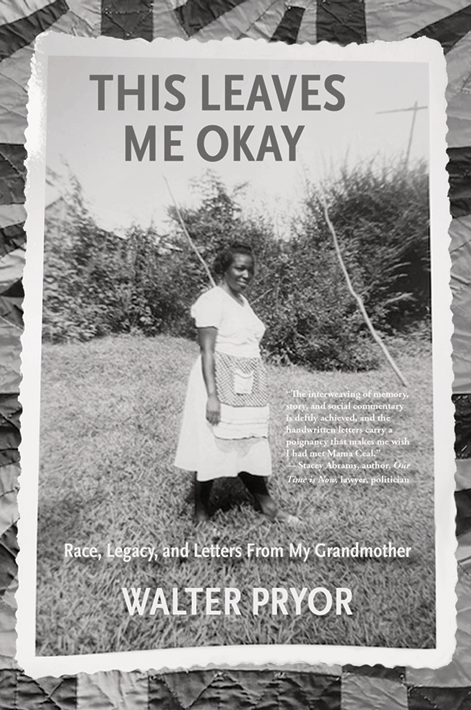
Eldridge—Mama Ceal—the woman who wrote her grandson weekly letters beginning when he was a small boy and continuing until her death. As an adult, Pryor recognizes the unique nature of the correspondence: “What is remarkable about her letters is that she sat down to write at
In addition to the letters, which are the foun-
dation of the book, Pryor also includes photo-
graphs, conversations with family and friends,
and speculative recreations of the events of his
grandmother’s life. The text of the memoir in-
cludes facsimiles of the handwritten letters and
Pryor calls attention to their reproduction: “It is
not surprising then that Mama Ceal’s letters
demonstrate that her grammar was fickle and her
handwriting sometimes unclear. Those details,
however, endear them—and her—to me even
more” (p. 20). With this material, Pryor pieces
together a family history that is both representa-
tive and remarkable.
The memoir begins with four-year old Lucille
and her younger sister Dessie Mae playing in the
yard of their uncle Jerry in Cassoe, Arkansas, in
1920. The two girls had been sent to live with rel-
atives after the death of their mother and their
father’s realization that he would not be able to
take care of two young children on his own.
Although Pryor begins with a scene from his grandmother’s childhood, the memoir does not follow a linear path. Facts about his grand- mother’s life, as well as his own, emerge poig- nantly through the juxtaposition of the letters and Pryor’s reflections on them. We learn much about Lucille’s life and consequently much about Pryor’s family history including the birth of La- Ruth, Pryor’s mother; the death of Pryor’s grand- father, Walter, from a tragic boating accident;
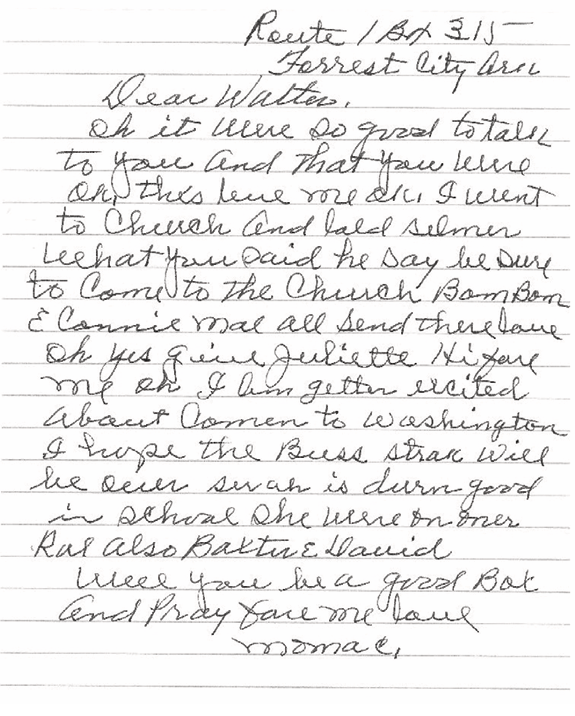
Image courtesy of Walter Pryor.
LaRuth’s move to her aunt Elizabeth’s home in
Forrest City, to attend better schools; and the
marriage of Pryor’s parents. Despite the doc-
umentation and preservation of his family his-
tory, which are valuable in themselves, Pryor’s
focus extends beyond the personal. The stories
recounted in the memoir emphasize the signifi-
cance of family, the importance of education,
and gratitude for one’s ancestors.
The nonlinear storytelling device allows Pryor to unravel meaningful parallels and con- trasts between his life and his grandmother’s. Pryor does not place the letters in chronological order. The first letter that appears in the book is not the first written to him but rather one from 1988 when Pryor is 22 years old. The letter be- gins “Dear Grandson, Well This leve me ok. Thank the Lord” (p. 20). Mama Ceal then ex- presses hope that he is well, gives him news of family and friends (including their pride in him),
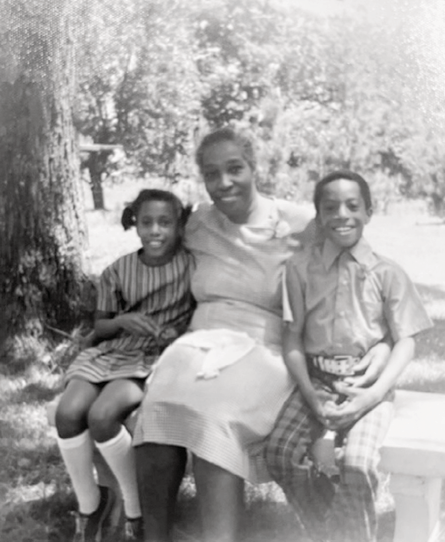
and grandaughter Jacquie (left).
Photograph courtesy of Walter Pryor.
advice to be good and continue praying, and
ends with a recipe for brownies (p. 20). Other
letters follow a similar pattern of Mama Ceal
sending her love to Walter, hoping he is well, up-
dating him on news from Forrest City, and ex-
pressing interest in Walter’s life. Each letter
allows Pryor to fill in details of his own life, pres-
ent-day reflections on how the past continues to
influence the present.
At the time he is writing the memoir, Pryor
and his wife Juliette are successful professionals
with a daughter in law school and a son interning
with an architect in Italy. As they listen to a hymn
one Sunday morning, Pryor thinks of Mama
Ceal and how far he and his family had traveled
from
her life as a maid for over forty years in rural
Jim Crow Arkansas to that day in which her
grandson who used to wear sandals made
from too small sneakers had purchased a
house in Martha’s Vineyard. . . . I wondered
what she would think and how she might be
in awe of this achievement had she lived to
see it. I wondered whether she would be
proud. For that matter, what would others
of our ancestors, for whom property owner-
ship may have seemed almost fantastical,
have thought? Had I become the “hope and
dream of the slave” that Maya Angelou wrote
about in her poem “Still I Rise”? (p. 33)
Pryor’s beautifully insightful memoir shares his life and recollections of a grandmother whose letters arrived even before he was old enough to read: Mama Ceal’s writing, he says, “told me that I was important enough to receive mail. That I mattered” (p. 201). He dedicates the memoir to his wife, daughter, and son as well as “all the an- cestors, families, and loved ones who hold us up and propel us forward” (p. 5). In the last words of the acknowledgments, Pryor encourages readers to do the same: “investigate the sheroes and heroes of your own family—deceased and liv- ing. Call their names. Celebrate them. Tell your children and loved ones about them. And whisper a quiet prayer of gratitude that they lived” (p. 213).
--Janelle Collins
Charles Portis for the Early
Twenty-first Century
by Bryan L. Moore
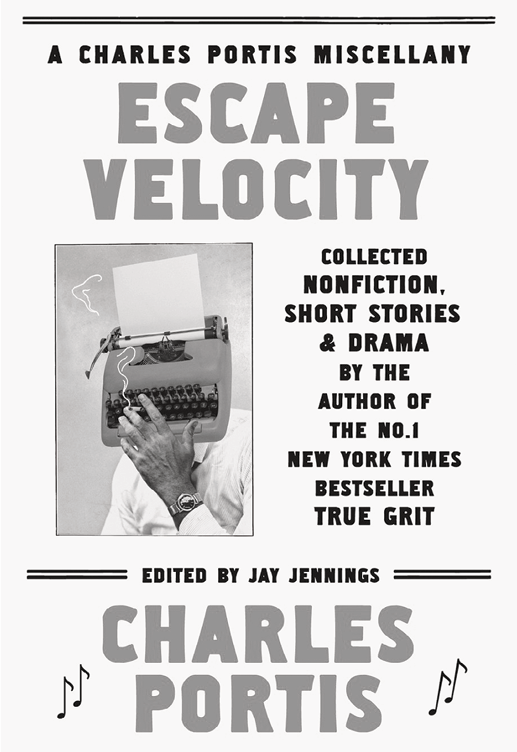
Escape Ve locity: A Charles Portis ## Miscellany. Charles Portis. Jay Jennings, ed. (New York: Overlook, - Pp. 364. $19.00, illustrations by Mike Reddy, paperback)
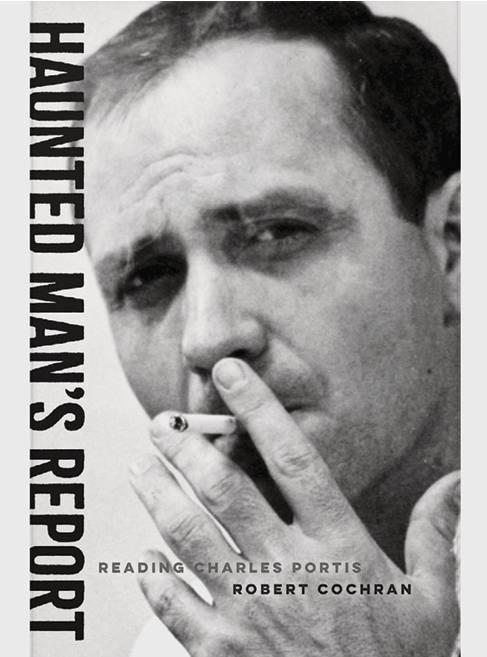
A Haunted Man’s Report: Reading Charles Portis. Robert Cochran. (Fayetteville: The University of Arkansas Press, 2024, Pp. 224. $25.95, b/w and color photos, paperback)
Reading Jay Jennings’s wonderful collection Escape Velocity: A Charles Portis Miscellany was for me an unexpected twenty-first century Portis bonus following the author’s death in 2020, and it appeared at just at the right time, amid our cur- rent decidedly unfunny national period. I was aware of this book when it was published, but something would always come up, and I did not read it until now. Perhaps I unconsciously tabled it in the knowledge that Portis-wise this would be it. I have admired Portis’s fiction since my brother recommended The Dog of the South to me in the early ’80s. When I read it, my reaction was strong and immediate. I didn’t know anyone
could write like that, could be so funny. Thirty years or so later, I read the novel for (I think) the fourth time, as I was dealing with a bulging disc in my back and an accompanying stabbing sciat- ica. I downloaded the novel to my reading device knowing it would make me feel better, and it was the best medicine, though thank God for opiates and Biofreeze patches. You know a book (or song, movie, etc.) is special when it helps you through a tough, unfunny time.
Yet my track record in selling him to others
More recently, I recommended The Dog of the
South to someone as the funniest novel I have
read. I was impressed that he read it, but when I
bumped into him a few weeks later, he said, “It’s
okay, but it’s not as funny as A Confederacy of
Dunces.” I agreed that that novel, which I read
not long after it was published, is funny, but I’ve,
again, forgotten what I said, as I felt offended and
defeated. It’s not like this person has no sense of
humor, but I’m not convinced his tastes go to-
ward Portis’s deadpan, which is not something I
can explain well. It might be a snobby question,
but did he get it? Portis’s drollness expresses the
center of our common oddness, our irrationality
and crankiness, as in a gentle brag about beating
a kid with short arms in three ping-pong
matches. Arguably, some of Portis’s jokes do not
work, and some have not aged well, yet his
trained eye for observation and pared style
grounds him in a long line of great realists, in-
cluding Flaubert and Chekhov, both of whom
made the trivial interesting and were extraordi-
nary deadpanners.
In 2012, Little Rock’s Butler Center for Ar-
kansas Studies did the world a great service by
publishing Escape Velocity, which collects Portis’s
nonfiction, short stories, and a play. The edition
reviewed was reprinted in 2023 by Overlook
Press, which has also done the world a great serv-
ice by reprinting all five of the author’s novels.
This printing adds a short story, “Damn!,” which
Portis published as a twenty-three-year-old jour-
nalism major at the University of Arkansas, fol-
lowing three years as a Marine (1952-55),
including service in the Korean War. Readers fa-
miliar with the author will notice in this slight
story the budding comic voice that would ap-
proach maturity after six years of newspaper re-
porting with his first novel, Norwood (1966). The
earliest newspaper pieces included show comic
traces, as in the opening sentence of the first
piece collected, from 1958, for the Memphis Com-
mercial Appeal on city Jaycees “capturing” a flat-
boat with “cap gun volleys and a lot of rebel
yelling” (p. 3). Similarly, in a 1962 New York Her-
ald Tribune piece (referenced above) the author
wins three matches of ping-pong against a kid:
“He had little short arms and all I had to do was
tip the ball over the net out of his reach” (p. 28).
The collection’s final published piece, “The
Wind Bloweth Where it Listeth” (Oxford Ameri-
can, 2005), is an examination of the old idea that
a hundred monkeys on typewriters would even-
tually write the complete works of Shakespeare.
The ear and sense of humor are intact into our
present century, as it is rough going for the mon-
keys, though it is perhaps the thinnest piece here.
In addition to many mostly brief newspaper pub-
lications, the book collects eleven works, a 2001
Editor Jay Jennings, who more recently ed-
ited the Library of America volume of Portis’s
Collected Works (2023), provides a good sampling
of journalistic pieces, though these are the only
ones I recall having read. They are in their way
as illuminating and welcome as the more literary
ones. Some of them, as shown, demonstrate Por-
tis’s comic precision and are all well-tuned to a
general newspaper reading audience. These in-
clude a Commercial Appeal story on Elvis Presley
and his mother and several “Our Town” columns
he wrote during his year and a half employment
for the Arkansas Gazette. More important because
more serious are eight news reports for the Herald
Tribune, where he was employed from 1960 to
1964, the final year as the paper’s London bu-
reau chief. In his Introduction, Jennings writes
that although Portis’s reporting has long been
“recognized for its excellence,” his civil rights re-
porting has been neglected by historians of the
era (xvii). Portis’s voice is restrained and sympa-
thetic in covering Civil Rights Movement events
in Alabama and Mississippi. In May 1963, Birm-
ingham was the center of the movement as police
used dogs and water hoses to attack Black chil-
dren nonviolently protesting segregation. Televi-
sion footage of these occurrences, which came to
be known as the Children’s March (or Crusade),
would create global outrage and eventually lead
to the Civil Rights Act.
A month later in Jackson, Mississippi,
NAACP director Medgar Evers was shot to death
outside his home. Portis’s report on the murder
is direct and economical as he allows the details
to do their work, including an extended quoting
of a fearless Evers from a year previous and his
wife, who said, “Nothing can bring him back, but
this cause can live on” (p. 56). In these pieces,
Portis builds trust with his readers by indicating
where the atrocities are coming from, who is kick-
ing whom. He quotes Eugene “Bull” Connor,
Birmingham’s Commissioner of Public Safety, re-
garding Reverend Fred Shuttlesworth, a key
leader in the Birmingham campaign of 1963, in-
jured by the police: “I been waitin’ a week to see
Shuttlesworth knocked down. . . . Too bad it was-
n’t a hearse.” Portis wonders about racist ruffians
taking such statements as a call to arms; he asks,
“What will happen if young, white roughnecks—
who have been the storm troopers previously
against Negro demonstrations—come on the
Birmingham scene?” (p. 37). As reporter, Portis
is occasionally (and justifiably) pointed, as when
he notes that a day after Evers’s murder, the Jack-
son police are tired and frustrated but “seemed
to draw relief by clubbing a Negro girl on the
head and a white ‘n----- lover’” (p. 57). He suggests
how such unjust acts lead to more injustices, in-
cluding threats against a free press: “The Jackson
police do not like to have people taking notes
when they are going about their business” (p. 58).
A very different piece of journalism is the first-person “An Auto Odyssey through Darkest Baja,” which may be read as a rehearsal for his novels The Dog of the South and Gringos, both of which are set largely in Mexico. It shows a keen eye for everyday details and ear for funny, idio- syncratic dialogue that never falls into cliches or triteness. It shows a fascination with travel and cultures featured in all his novels but the fourth, Masters of Atlantis, which celebrates mundanity in its own secret society universe. Like Norwood, which was published the year before, the narra- tive establishes the centrality of an automobile (often found wanting) and finances in general (often precarious), as he and an Arkie friend, Andy Davis, set out to drive down Baja Califor- nia from Los Angeles in a Studebaker truck. They pick up a hitchhiker, Miguel, who, Portis
The piece shows Portis as a practitioner of
New Journalism at a time when similar, much
more famous work began appearing regularly by
Joan Didion, Tom Wolfe, and others, including
Hunter S. Thompson, an excerpt of whose book
Hell’s Angels also appeared in the same 1967 issue
of the Sunday LA Times magazine Home as “Auto
Odyssey.” This piece and the 1991 Arkansas Times
first-person essay “The Forgotten River,” on trac-
ing the course of the Ouachita River across
southern Arkansas, where Portis grew up, into
Louisiana, made me wonder about an alternate
career the author might have chosen, a road not
taken. The nonfiction included provides a fuller
picture of how (arguably) the state’s greatest nov-
elist, after fighting in a war and covering one of
the most important eras in American history, re-
tired from journalism and in 1964 returned to
his home state for good to write fiction. Like Ray
Midge of The Dog of the South, Portis traveled
widely but never achieved “escape velocity” from Arkansas.
The five stories are welcome points of light from a writer known as a novelist. “Nights Can Turn Cool in Viborra,” a travelogue burlesque of a fictional place, and “I Don’t Talk Service No More,” which brings readers as close to the au- thor’s Korea experience as we are likely to get, are the two standouts, moderate though they are. The author’s only published play, the three-act Delray’s New Moon, was workshopped by the Arkansas Repertory Theatre in 1996. It revolves around the imminent displacement of some sen- ior citizens from their domicile, which is in the process of being, through shady dealings, con- verted into a glitzy club. This is the book’s longest work and is as satisfying as anything collected, as deadpans emanate from the mouths of mostly elderly Arkansans. Uncollected in the Portis LOA, the book is worth $19 for this play alone. Predictably, reading Escape Velocity made me yearn for more Portis. I wonder about Jennings’s subtitle word “Miscellany”—is there more, some- where? Not likely, though in 2025, Harper’s Magazine published “The Keys to Veracruz,” from an unfinished novel, The Woman from No- where, which seems like a cross between Masters of Atlantis in its (pseudo) hermeticism and Grin- gos, as it is set in Mexico. The notion of a major Portis female character is intriguing and, in that sense, comparable to Melville’s unpublished, lost novella The Isle of the Cross.
To date, Robert Cochran’s A Haunted Man’s Report: Reading Charles Portis is one of the very few (perhaps only) books on Portis, not including secondary sources on True Grit. It is the work of a Portis scholar and longtime University of Arkansas English professor who has published on a variety of subjects, including Vance Ran- dolph and Samuel Beckett. He taught a graduate seminar on the writer, and his research is metic- ulously documented. Clearly, Cochran is also, like me, a Portis fanboy who understands as well as anyone the rare gift of the novelist’s comic vi- sion of the world. On occasion, the book reads like a Portis CliffsNotes that recounts jokes from the novels, but Cochran mostly avoids this. Some Portis lovers may appreciate a well-organized, thought-out retelling with (surely reflecting at least some of the UA seminar) an often-enlight- ening examination of the contexts. Anyone who does not care for Portis’s writing will probably not be won over by Cochran (and certainly not by me). This is obviously not the place to begin
reading Portis; it is a book about Portis, by a
Portis fan, for Portis fans.
Casting his critical net widely, Cochran
draws from Homer (Norwood as Telemachus)
and Dante (True Grit’s Tom Chaney as thief
Vanni Fucci). “I Don’t Talk Service No More”
and Beckett’s Krapp’s Last Tape are, he writes,
“retrospective monologues by codger loners” (p.
148). He compares Portis’s (inarguably?) greatest
conman in a corpus filled with such characters,
Dr. Reo Symes of The Dog of the South (1979),
with Chaucer’s Pardoner, Melville’s herb doctor
in The Confidence-Man, and Twain’s duke and
king. These are certainly in the ballpark, though
it strikes me that Symes’s scheming is ultimately—
and typically for Portis—much more innocuous,
less bitter than the others. One might easily add
other similar characters, such as those populating
Flannery O’Connor’s fiction (e.g., Hazel Motes
or Manley Pointer). Cochran’s comparisons
made me think of an article I wrote on Portis
more than thirty years ago, as I was entering the
job market and eagerly welcomed any publication
to beef up my thin grad student CV. It was good
student paper, but it is not a good scholarly
article. (I got up to dig it out as I was drafting
this, but anticipating the cringe involved, I sat
back down.) I attempted to show how Portis,
though traditional in respects, is akin to post-
modern fiction writers born around the same
time as him such as Thomas Pynchon and Don-
ald Barthelme in their absurdity, though they are
absurdities of different types. Portis’s fiction, True
Grit excepted, is more purely comic, about the
gags themselves, than philosophical.
Cochran quotes a passage in which Symes
tells the novel’s young main character, Ray
Midge, about one of his schemes, the ridiculous
theme park idea of “Jefferson Davis Land.”
Symes says he would himself dress up as “Davis
in a frock coat and greet tourists as they stepped
off the ferry.” In the afternoons, General Lee
would appear, “take off his gray coat and wrestle
an alligator in a mud hole” (qtd. p. 73). A few
years after my article appeared, I read latter-day
postmodernist George Saunders’s brilliant 1996
debut collection CivilWarLand in Bad Decline,
partly because of the glowing Pynchon blurb on
the back cover, and I reconsidered whether my
article was really all that bad. Saunders’s readers
will remember that in the title story, the ridicu-
lously conceived theme park CivilWarLand, a
tasteless gimmick in a world shorn of good will,
is in the process of going belly up. A reader of
the Saunders story would see immediate similar-
ities, though I have no idea if Saunders has read
Portis or did so before writing his story.
(Saunders would revisit the bad theme park con-
cept in other stories.) Though Portis does suggest
some skepticism toward our thoroughly commer-
cialized world, it becomes a firehose in Saunders.
The subtitle, “Reading Charles Portis,” states clearly what this book is up to—the author’s reading of Portis, based on his research and
Readers and researchers can draw and find
value from the book as needed. He lauds Portis
the reporter but wisely points out some less than
stellar stories, such as “The Marchers: A Blue-
print for Protest” (not included in the Jennings
collection), which Cochran writes, “comes across
as a puzzling, peevish, even slapdash perform-
ance” (p. 18). He provides fresh information (for
me) about True Grit, which, he notes, “has out-
sold by a factor of at least five the author’s other
four efforts combined” (p. 45). He skillfully
navigates Portis’s occasional use of (at least
arguably) dated, insensitive language. His
thoughts on the complexity of his greatest
character, Mattie Ross, are open-eyed, as he
points out that though academics typically
conclude she is something of a bigot, such obser-
vations “have gained little traction outside the
faculty lounge” (p. 59). The concluding para-
graphs are, I think, persuasive in summing up
Portis as, overall, rather affirmative.
Many of the illustrations in the Cochran are interesting and, as far as I know, unique. (The Overlook Edition of Escape Velocity preserves the breezy Butler Center illustrations by Mike Reddy.) The photograph of George Maledon, real-life jailer and hangman for Judge Parker, who employs the (fictional) Rooster Cogburn, jumps out, and I had never seen the photograph of a young Portis as a Marine in full gear, leaning against a rock, presumably in Korea, writing in a notebook with a pencil. The author did not talk much or write explicitly about his service, yet his simple grave marker—Cochran’s photo of which is included—notes his name, dates, and (presum- ably) his preferred identity, “SGT US MARINE CORPS / KOREA.” I was initially surprised by the cover of the book, with a full-sized photo- graph of Portis smoking. Somehow, I had not seen it before. Given the strange, insidious, but undeniable idea that smoking makes anyone look cool, it seemed more like a book on Kerouac or Bukowski. (I asked AI if Portis ever quit smok- ing, and for what it is worth, it said he did not.) Available pictures of the reclusive author are a lit- tle scarce, so why not use this one? It is a rare Por- tis closeup, and it does make him look cool. Part of me loves this photo, but for some reason, per- haps for its daftness, the Overlook edition cover seems to me the better representation of the au- thor, who always preferred that readers know him through his writing. It uses a small insert of the same portrait, a portable typewriter hanging, obscuring his face, the cigarette inserted in the space between the keys.