
The A-State RD/RDN Guide
Everything You Need to Know About Becoming a Registered Dietitian Through A-State
Before You Read: Quick Answers
Program Selection
Choose the RD-Track Coordinated Program if:
- You want to become a Registered Dietitian (RD/RDN)
- You need the supervised practice hours required for RD eligibility
- You need a Verification Statement
- Your goal is to sit for the CDR credentialing exam
Choose the Non-RD MS in Nutrition & Dietetics if:
- You want advanced nutrition knowledge
- You are not seeking RD/RDN eligibility through the degree
- You do not need supervised practice hours or a Verification Statement
Contact dietetics@astate.edu before applying if you are uncertain which program best fits your goals.
Can I become an RD/RDN through the non-RD master's program?
No. The non-RD Master of Science in Nutrition & Dietetics is not an ACEND-accredited program and does not provide a Verification Statement. Students seeking RD/RDN eligibility should pursue an ACEND-accredited pathway, such as A-State's RD-track Coordinated Program. Students who already possess a DPD Verification Statement may use the non-RD master's degree to meet the graduate degree requirement before applying to a Dietetic Internship.
What's the difference between a Coordinated Program and a Dietetic Internship?
A Coordinated Program (CP) integrates graduate coursework and supervised practice into one ACEND-accredited program. A Dietetic Internship (DI) is a separate supervised practice program that students apply to and complete after meeting eligibility requirements. Because supervised practice is built into A-State's Coordinated Program, students do not complete a separate Dietetic Internship after graduation.
I already have a master's degree. Do I still need the RD-track?
Possibly. A graduate degree alone does not provide eligibility for the RD/RDN credential. To become an RD/RDN, students must complete an ACEND-accredited pathway that includes supervised practice and results in a Verification Statement. Depending on your educational background, prerequisite coursework may still be required before admission to the RD-track Coordinated Program.
Can I apply to a Dietetic Internship with the non-RD master's degree?
Generally, no. Most ACEND-accredited Dietetic Internships require applicants to have completed an ACEND-accredited Didactic Program in Dietetics (DPD) and possess a DPD Verification Statement. The non-RD Master of Science in Nutrition & Dietetics does not provide a DPD Verification Statement and, by itself, does not establish eligibility for most Dietetic Internships.
I'm currently enrolled in the non-RD program but want to become an RD/RDN. What are my options?
Students who decide to pursue the RD/RDN credential after enrolling in the non-RD program should contact the Program Director as early as possible. Prerequisite coursework and admission to the RD-track Coordinated Program are separate requirements and must be completed before entering the RD-track Coordinated Program.
Applying to the RD-Track Coordinated Program
Can anyone apply to the RD-track Coordinated Program?
No. Currently, applications are only accepted from eligible Arkansas State University students enrolled in either the BS in Nutrition & Dietetics program or the Graduate Prerequisite Program. Students interested in becoming an RD/RDN through A-State who are not currently enrolled in one of these programs should contact dietetics@astate.edu to discuss the most appropriate pathway.
Do prerequisite courses have to be completed at A-State?
No. Prerequisite coursework completed at other regionally accredited institutions may be accepted if determined to be equivalent to A-State’s requirements. However, completion of prerequisite courses at another institution does not by itself make a student eligible to apply to the RD-track Coordinated Program. Currently, applications are only accepted from eligible students enrolled in A-State’s BS in Nutrition & Dietetics program or Graduate Prerequisite Program. Students should contact the Program Director before enrolling in coursework elsewhere to discuss transferability and program eligibility.
How do I know which prerequisites I am missing?
Prerequisite evaluation occurs as part of the application process. Applicants should review the prerequisite list and compare it to their academic records before applying. If you have not completed all prerequisite coursework, or if you are unsure whether your previous coursework meets prerequisite requirements, select "No" when asked whether you have completed the required prerequisite courses. This will route your application to the Graduate Prerequisite Program, where remaining prerequisite requirements can be identified and completed before applying to the RD-track Coordinated Program.
Will my previous coursework transfer?
Transfer credit is evaluated according to Arkansas State University policies. Previous coursework may satisfy prerequisite requirements if determined to be equivalent.
I completed prerequisite courses at another college. Should I answer "Yes" or "No" on the application?
If you are not currently enrolled in A-State's BS in Nutrition & Dietetics program or Graduate Prerequisite Program, select "No." Applications from students who select "No" are routed to the Graduate Prerequisite Program, where prerequisite coursework and eligibility can be evaluated through the admissions process.
Admissions & Eligibility
Can I apply if my bachelor's degree is not in nutrition?
Yes. A bachelor's degree does not have to be in nutrition and dietetics. Students with degrees in a variety of academic disciplines may be eligible to pursue the RD/RDN credential through A-State's Coordinated Program after completing the required prerequisite coursework.
Do I need a DPD Verification Statement?
No. A-State's Coordinated Program does not require a DPD Verification Statement for admission. Students may be admitted without a DPD verification statement provided they complete all prerequisite coursework and meet admission requirements.
What GPA do I need to apply?
While GPA of 3.0 is required, applicants with an overall GPA below 3.0 may still be considered for admission. The admissions committee reviews the entire application, including performance in prerequisite coursework, academic trends, professional experiences, recommendations, and other admission materials. Strong performance in prerequisite courses may help demonstrate readiness for graduate-level study, even when the cumulative GPA falls below 3.0.
How competitive is admission?
Admission decisions are based on a holistic review of each applicant. Factors considered may include performance in prerequisite coursework, cumulative GPA, academic trends, recommendations, professional experiences, and personal statement. Meeting minimum admission requirements does not guarantee admission, and applicants with strong prerequisite performance may be considered even if their overall GPA falls below 3.0.
Can I apply before I finish all prerequisites?
Yes. Conditional admission may be offered if remaining prerequisite courses are completed before the program begins.
Is the GRE required?
No. The GRE is not required for admission to A-State's Nutrition & Dietetics graduate programs.
Program Structure
What degree will I earn?
Students who successfully complete the program earn a Master of Science in Nutrition and Dietetics (MSND).
How long does the program take?
The program is designed as a two-year master's degree. Students must complete all program requirements within six years of admission.
Can I complete the RD-track program part-time?
No. The RD-track Coordinated Program follows a prescribed sequence of coursework and supervised practice experiences. Students should expect full-time enrollment and are not able to complete the program on a part-time basis.
How many supervised practice hours are required?
Students complete a minimum of 1,080 supervised practice hours in foodservice, community nutrition, and clinical nutrition settings.
Are practicums online?
Generally, no. The MSND program is delivered fully online; however, supervised practice experiences are generally completed in person at approved foodservice, community, and clinical sites. Students typically complete practicums in or near the area where they live, although travel may occasionally be required to meet program requirements and achieve required competencies.
Practicum Questions
Do I need to find practicum sites before I apply?
No. You do not need to have practicum sites or preceptors identified when you apply or are admitted. However, students should begin working on supervised practice placement as soon as they commit to the program. Identifying qualified sites, securing willing preceptors, and completing required affiliation agreements can take considerable time and effort. A-State provides guidance and assistance throughout the placement process, but students who start early are typically the most successful in securing their preferred practicum experiences and locations.
Do I have to find my own practicum sites?
Students are responsible for identifying potential practicum sites and preceptors. However, A-State provides guidance throughout the process, maintains a database of previously approved sites and preceptors, and assists students who encounter difficulty securing placements. Students are not expected to arrange sites independently without support.
Can I use my current workplace as a practicum site?
Possibly. Many students complete supervised practice experiences at their place of employment when appropriate opportunities and qualified preceptors are available. However, students cannot earn practicum hours while "on the clock" performing their regular job responsibilities. Supervised practice hours must be completed during separate, approved learning experiences and cannot be counted toward paid work time. All sites and preceptors must be reviewed and approved by the program and must provide opportunities to meet required competencies.
Can I complete my supervised practice in another country?
No. All supervised practice experiences must be completed in the United States.
Will I have to travel for practicums?
Possibly. While the program works to identify geographically accessible placements, specific sites or locations cannot be guaranteed. Some students may need to travel or temporarily relocate for certain experiences.
Can previous work experience count toward supervised practice hours?
No. Students must complete all supervised practice hours required by the program regardless of previous employment or professional experience.
Do I need health insurance?
Yes. Students must maintain health insurance, automobile insurance, and professional liability insurance before beginning supervised practice experiences.
Program Logistics
Can I work full-time during the program?
Most students find full-time employment difficult during supervised practice. Practicums average approximately 25 hours per week, and most preceptors supervise students during regular weekday business hours. Students who work typically find evening, night, or weekend schedules most compatible with practicum requirements.
Can I complete the program while living outside Arkansas?
Yes. The program is delivered online, and supervised practice experiences may be completed in many areas throughout the United States. Currently, Colorado placements are not available.
Can I move during the program?
Possibly. Students considering relocation should contact the Program Director as early as possible since supervised practice placements and affiliation agreements may be affected.
After Graduation
What happens after graduation?
After successfully completing the MSND degree, 1,080 hours of supervised practice, and all program requirements, graduates receive a Coordinated Program Verification Statement. The Program Director then submits eligibility information to the Commission on Dietetic Registration (CDR), allowing graduates to register for the RD/RDN examination. Once the exam is passed, graduates may use the Registered Dietitian (RD) or Registered Dietitian Nutritionist (RDN) credential. Depending on the state where they plan to practice, additional licensure or certification requirements may apply.
International Applicants
Can I apply if my bachelor's degree was earned outside the United States?
Yes. Applicants with degrees from institutions outside the United States may be considered for admission if they meet program and university admission requirements.
How are international transcripts evaluated?
International transcripts are reviewed as part of the admissions process. Official transcripts must be submitted with your application. In many cases, Arkansas State University can complete an internal evaluation of international coursework. Some institutions do not issue official transcripts directly to U.S. universities. In those cases, applicants may be required to obtain a credential evaluation through a NACES-member evaluation service such as WES or ECE and have the evaluation sent to Arkansas State University. Applicants should work with the Office of International Admissions to determine what documentation is required for their specific situation.
Can I send my transcripts for review before I apply?
No. Transcript evaluation occurs through the admissions process after an application has been submitted. Faculty do not provide unofficial transcript evaluations before application.
Can I complete supervised practice in my country?
No. All supervised practice experiences must be completed within the United States.
Can I complete supervised practice in my state?
Usually. Students may complete supervised practice in many areas throughout the United States if appropriate sites, qualified preceptors, and affiliation agreements can be secured. Please note that supervised practice placements are not currently available in Colorado.
Will completing this program make me eligible for the RD/RDN exam?
Yes. Students who successfully complete all degree requirements, supervised practice requirements, and program competencies receive a Coordinated Program Verification Statement and may become eligible to take the CDR credentialing exam.
Need help with international admissions?
A-State RD-Track at a Glance
- Degree Awarded: Master of Science in Nutrition & Dietetics (MSND)
- Delivery Format: Fully Online
- Supervised Practice Hours: 1,080
- Credentialing Pathway: ACEND-Accredited Coordinated Program
- DPD Verification Statement Required for Admission: No
- Separate Dietetic Internship Required: No
- GRE Required: No
- Practicum Locations: United States only; CO placements not available
- Important Dates:
- Start Terms: Summer I and Fall I
- Summer 2027 Application Deadline: October 16, 2026
- Summer 2027 Admission Decisions Released: November 1, 2026
- Summer 2027 Student Acceptance/Denial Deadline: November 10, 2026
- Fall 2027 Application Deadline: February 12, 2027
- Fall 2027 Admission Decisions Released: March 1, 2027
A-State Graduate Program Prerequisites
| Upper-Level Course | Required Prerequisites |
|---|---|
| Lifecycle Nutrition | Basic Human Nutrition |
| Nutritional Biochemistry | Basic Human Nutrition; Concepts of Organic & Biochemistry; Anatomy & Physiology I with Lab; Anatomy & Physiology II with Lab |
| Nutrition Assessment | Basic Human Nutrition |
| Food Science | Basic Human Nutrition; Concepts of Chemistry with Lab; Microbiology with Lab |
| Nutrition Counseling | Basic Human Nutrition; Introduction to Psychology |
| Community Nutrition | Basic Human Nutrition; Introduction to Sociology |
| Medical Nutrition Therapy | Nutrition Assessment; Nutritional Biochemistry |
| Applied Statistics (Junior-level or higher) | Possibly College Algebra, depending on the statistics course selected |
Apply to the graduate prerequisite program: https://degree.astate.edu/online-programs/healthcare/ms-nutrition-and-dietetics/registered-dietitian/
Supervised Practice (Practicums)
A-State's Coordinated Program includes 1,080 hours of supervised practice across five practicums. Students complete supervised practice experiences in foodservice management, community nutrition, clinical nutrition, and outpatient settings. Experiences are completed at approved sites throughout the United States under the supervision of qualified preceptors.
The MSND RD-Track Student FAQ provides additional details on selecting practicum sites, preceptor qualifications, and expectations for each rotation: https://kb.astate.edu/books/department-of-health-sciences-risk-management/chapter/ms-in-nutrition-dietetics-rd-track-student-FAQ
Practicum 1 – Food Service (180 hours)
- Two sites: school/university kitchen + long-term care
- Assignments include inventory, job analysis, marketing event, mock audit, plate waste, and tray accuracy
Practicum 2 – Hospital Food Service (180 hours)
- Single site
- Assignments include inventory, tray delivery, menu costing, HACCP, scheduling, and mock audit
Practicum 3 – Community Nutrition (180 hours)
- Multiple sites (WIC, Extension, food banks, public health, nonprofits)
- Assignments include a nutrition program, blog post, and two nutrition assessments
Practicum 4 – Clinical (270 hours)
- Hospital + long-term care
- RD preceptors required
- Assignments include:
- nutrition assessments
- Swallow screen
- patient education sessions
- Case study
- In-service
- QA project
- NG tube assignment
Practicum 5 – Advanced Clinical/Outpatient (270 hours)
- Hospital + outpatient clinics (diabetes, dialysis, cardiac rehab, etc.)
- Assignments include:
- nutrition assessments
- Nutrient intake report
- patient education sessions (diabetes, ESRD, pharmacotherapy)
- Written case study
- NG tube assignment
Understanding Verification Statements
Why Is a Verification Statement Important?
A Verification Statement is the document that confirms you have completed the requirements of an ACEND-accredited program. Without the appropriate Verification Statement, you cannot establish eligibility for a Dietetic Internship or the RD/RDN credentialing exam.
Types of Verification Statements
DPD Verification Statement
- Issued after completing an ACEND-accredited Didactic Program in Dietetics (DPD)
- Required to apply to a Dietetic Internship (DI)
- DIs cannot accept applicants without a DPD verification statement
Dietetic Internship (DI) Verification Statement
- Issued after completing an ACEND-accredited DI and holding a graduate degree
- Grants eligibility to take the RD/RDN exam
Coordinated Program (CP) Verification Statement
- Issued after completing an ACEND-accredited Coordinated Program
- Includes both coursework and supervised practice
- Grants eligibility to take the RD/RDN exam
Components of Becoming an RD/RDN
Typical Pathway to Becoming an RD/RDN
- Earn a bachelor's degree and complete prerequisite coursework (if needed)
- Apply to and complete an ACEND-accredited pathway
- Take and pass the CDR credentialing exam
- Obtain state licensure (if required)
Component 1: Earn a Bachelor's Degree
- Must be from a regionally accredited institution
- If you did not complete an ACEND-accredited DPD as part of your bachelor's degree, you cannot apply to a Dietetic Internship (DI)
- Students without a DPD can still become RDs/RDNs through a Coordinated Program (CP)
A-State BS Program Note: A-State's BS in Nutrition & Dietetics is not an ACEND-accredited Didactic Program in Dietetics (DPD) and does not provide a DPD Verification Statement. Instead, it serves as a pathway into A-State's ACEND-accredited Graduate Coordinated Program.
A-State BS in Nutrition & Dietetics: https://degree.astate.edu/online-programs/undergraduate/health-sciences/bachelors-nutrition-and-dietetics/
Component 2: Complete ACEND-Accredited Coursework
Two Pathways to Becoming an RD/RDN
Route A: DPD + Graduate Degree + Dietetic Internship (DI)
- Complete an ACEND-accredited DPD
- Earn a graduate degree
- Apply to and complete a DI
- Earn a DI verification statement → exam eligibility
- No DPD verification = No DI eligibility
Route B: Coordinated Program (CP)
- Coursework and supervised practice integrated into one program
- Graduate degree included or completed alongside CP
- No DI application required
- Earn a CP verification statement → exam eligibility
- Ideal for students without a DPD
ACEND Program Directory: https://www.eatrightpro.org/acend/accredited-programs/program-directory
Component 3: Pass the RD/RDN Exam
- Administered by CDR
- Computer-based exam
- Eligibility granted after receiving a DI or CP verification statement
Exam Information: https://www.cdrnet.org/RDN
Component 4: Obtain State Licensure
- Licensure requirements vary by state
- State Licensure Map: https://www.cdrnet.org/LicensureMap
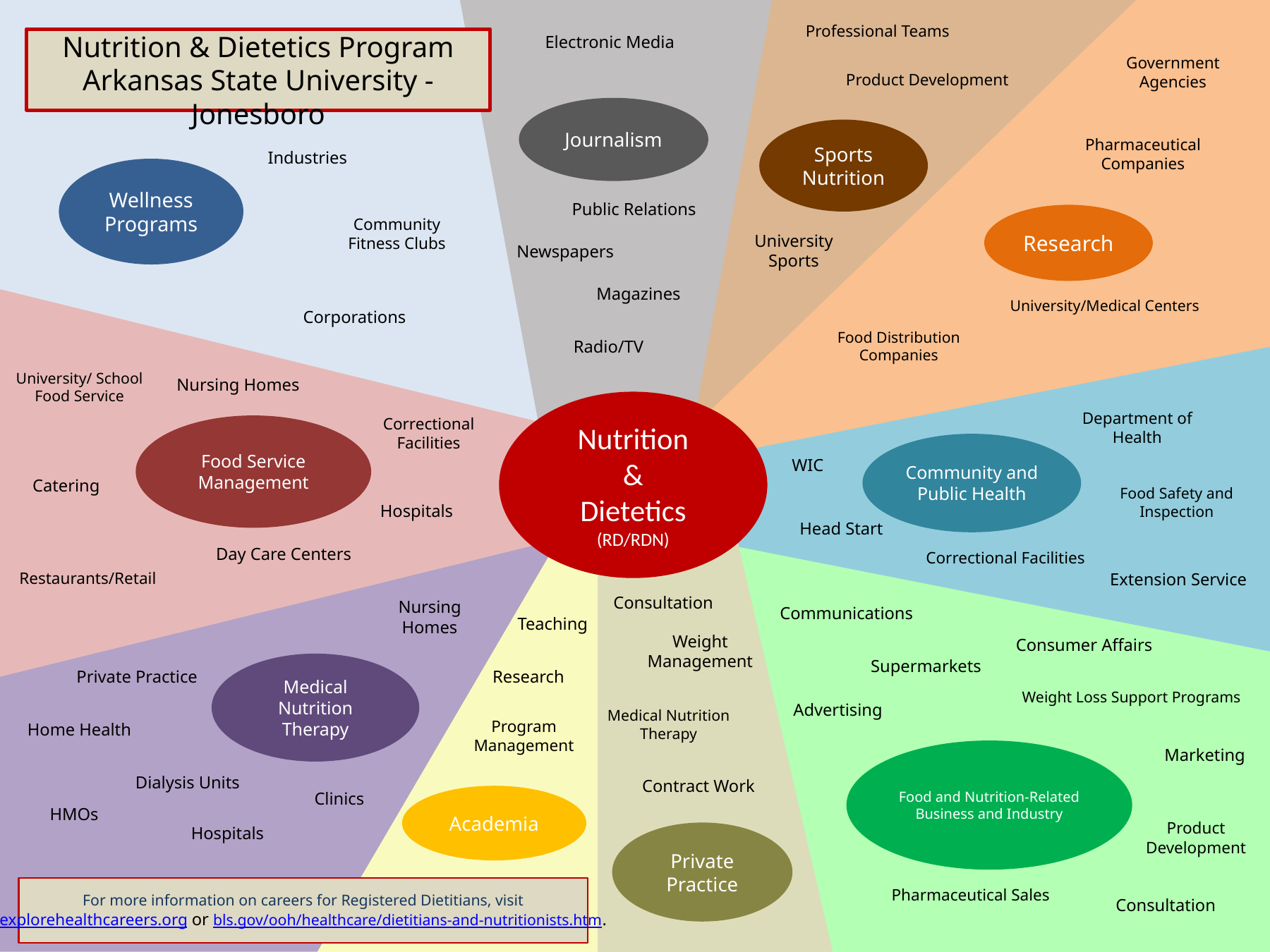
Career Pathways for RD/RDNs
Registered Dietitians work in a variety of settings including:
- Hospitals and health systems
- Outpatient clinics
- Long-term care facilities
- WIC and public health agencies
- Universities and colleges
- School nutrition programs
- Food and nutrition industry
- Corporate wellness programs
- Sports nutrition programs
- Private practice
- Dialysis centers
- Government agencies
- Research organizations
Resources & Contact Information
Dietetics Program
- Program Questions: dietetics@astate.edu
- MSND RD-Track Student FAQ: https://kb.astate.edu/books/department-of-health-sciences-risk-management/chapter/ms-in-nutrition-dietetics-rd-track-student-FAQ
Admissions and Enrollment
- Admissions: astateonline@astate.edu
- Registration Team: onlineregistration@astate.edu
- RD-Track and Graduate Prerequisite Program Information: https://degree.astate.edu/online-programs/healthcare/ms-nutrition-and-dietetics/registered-dietitian/
- A-State BS in Nutrition & Dietetics: https://degree.astate.edu/online-programs/undergraduate/health-sciences/bachelors-nutrition-and-dietetics/
Financial Aid and Tuition
- Financial Aid: onlinefinaid@astate.edu
- Financial Aid Website: https://www.astate.edu/admissions-and-aid/financial-aid-and-scholarships/index.html
- Tuition Information: https://degree.astate.edu/tuition/
Military Students
Military Student Services: militaryonline@astate.edu
Student Support Resources
- Access and Accommodations: https://www.astate.edu/student-life/student-support/index.html
- A-State Student FAQ: https://kb.astate.edu/books/student-FAQ/chapter/student-FAQ
- Academic Calendar: https://kb.astate.edu/books/academic-calendars
- University Bulletin: https://catalog.astate.edu/index.php
RD/RDN Credentialing Resources
- Commission on Dietetic Registration (CDR): https://www.cdrnet.org/RDN
- State Licensure Map: https://www.cdrnet.org/LicensureMap
- ACEND Website: https://www.eatrightpro.org/acend
- ACEND Program Directory: https://www.eatrightpro.org/acend/accredited-programs/program-directory
- ACEND Frequently Asked Questions: https://www.eatrightpro.org/acend/accreditation-process/frequently-asked-questions
- Academy of Nutrition and Dietetics: https://www.eatrightpro.org
- ACEND Accreditation Questions: ACEND@eatright.org