
How to become and RD/RDN
This page provides a complete, student‑friendly guide to becoming a Registered Dietitian (RD/RDN), including required steps, verification statements, ACEND accredited pathways, A‑State program prerequisites, supervised practice (practicums), career pathways, and frequently asked questions. It is designed to help prospective and current students understand the RD/RDN credentialing process and how A‑State’s Coordinated Program fits into that pathway.
A Registered Dietitian (RD) or Registered Dietitian Nutritionist (RDN) is a food and nutrition expert who has completed a graduate degree, 1,000+ hours of supervised practice, and a national registration exam.
Both RD and RDN titles are correct and legally protected. Usage is based on personal preference.
Learn more:
• Academy of Nutrition and Dietetics
• CDR “What is an RD/RDN?” and eligibility FAQs
• ACEND FAQs
Understanding Verification Statements
1. DPD Verification Statement
• Issued after completing an ACEND‑accredited Didactic Program in Dietetics (DPD).
• Required to apply to a Dietetic Internship (DI).
• DIs cannot accept applicants without a DPD verification statement.
2. Dietetic Internship (DI) Verification Statement
• Issued after completing an ACEND‑accredited DI and holding a graduate degree.
• Grants eligibility to take the RD/RDN exam.
3. Coordinated Program (CP) Verification Statement
• Issued after completing an ACEND‑accredited Coordinated Program.
• Includes both coursework and supervised practice.
• Grants eligibility to take the RD/RDN exam.
Component 1: Earn a Bachelor’s Degree
• Must be from a regionally accredited institution.
• If you did not complete an ACEND‑accredited DPD as part of your bachelor’s degree, you cannot apply to a Dietetic Internship (DI).
• Students without a DPD can still become RDs/RDNs through a Coordinated Program (CP).
A‑State BS Program Note:
A‑State’s BS in Nutrition & Dietetics is not an ACEND‑accredited DPD program. However, it prepares students to apply for admission to A‑State’s ACEND‑accredited Graduate Coordinated Program.
Component 2: Complete ACEND‑Accredited Coursework
ACEND now requires all programs providing supervised practice (DI and CP) to use DICAS for admissions.
Two Pathways to Becoming an RD/RDN
| Route A: DPD + Graduate Degree + Dietetic Internship (DI) | Route B: Coordinated Program (CP) |
|---|---|
| • Complete an ACEND‑accredited DPD | • Coursework + supervised practice integrated into one program |
| • Earn a graduate degree | • Graduate degree included or completed alongside CP |
| • Apply to and complete a DI | • No DI application required |
| • Earn a DI verification statement → exam eligibility | • Earn a CP verification statement → exam eligibility |
| • No DPD verification = No DI eligibility | • Ideal for students without a DPD |
Note on Graduate Degrees: Currently, the graduate degree may be in any field. This will change with the ACEND 2027 standards.
Component 3: Pass the RD/RDN Exam
• Administered by CDR
• Computer‑based exam
• Eligibility granted after receiving a DI or CP verification statement
Upper‑Level Prerequisites (24 hours)
• Lifecycle Nutrition
• Nutritional Biochemistry
• Nutrition Assessment
• Food Science
• Nutrition Counseling
• Community Nutrition
• Medical Nutrition Therapy
• Applied Statistics (junior‑level or higher)
Foundational Prerequisites (27 hours)
• Basic Human Nutrition
• Concepts of Chemistry with Lab
• Concepts of Organic & Biochemistry
• Anatomy & Physiology I with Lab
• Anatomy & Physiology II with Lab
• Microbiology with Lab
• Introduction to Sociology
• Introduction to Psychology
Prerequisites in Table Format
| Upper‑Level Prerequisite (27 hours) | Lower‑Level & Course Prerequisite (24 hours) |
|---|---|
| Lifecycle Nutrition | Basic Human Nutrition |
| Nutritional Biochemistry | Basic Human Nutrition Concepts of Organic & Biochemistry Anatomy & Physiology I with Lab Anatomy & Physiology II with Lab |
| Nutrition Assessment | Basic Human Nutrition |
| Food Science | Basic Human Nutrition Concepts of Chemistry with Lab Microbiology with Lab |
| Nutrition Counseling | Basic Human Nutrition Introduction to Psychology |
| Community Nutrition | Basic Human Nutrition Introduction to Sociology |
| Medical Nutrition Therapy | Nutrition Assessment Nutritional Biochemistry |
| Applied Statistics (Junior‑level or higher) | Possibly College Algebra depending on the statistics course selected |
A‑State’s Coordinated Program includes 1,080 hours of supervised practice across five practicums. The MSND RD‑Track Student Handbook provides additional details on selecting practicum sites, preceptor qualifications, and expectations for each rotation.
MSND RD‑Track Student Handbook
Practicum 1 – Food Service (180 hours)
• Two sites: school/university kitchen + long‑term care
• Assignments include inventory, job analysis, marketing event, mock audit, plate waste, tray accuracy
Practicum 2 – Hospital Food Service (180 hours)
• Single site
• Assignments include inventory, tray delivery, menu costing, HACCP, scheduling, mock audit
Practicum 3 – Community Nutrition (180 hours)
• Multiple sites (WIC, Extension, food banks, public health, nonprofits)
• Assignments include a nutrition program, blog spot, and two nutrition assessments
Practicum 4 – Clinical (270 hours)
• Hospital + long‑term care
• RD preceptors required
• Assignments include 3 nutrition assessments, swallow screen, 3 patient educations, case study, in‑service, QA project, NG tube assignment, teamwork reflection
Practicum 5 – Advanced Clinical/Outpatient (270 hours)
• Hospital + outpatient clinics (diabetes, dialysis, cardiac rehab, etc.)
• Assignments include 3 nutrition assessments, nutrient intake report, 3 patient educations (diabetes, ESRD, pharmacotherapy), written case study, NG tube assignment, teamwork reflection
This visual illustrates the wide range of career pathways available to Registered Dietitians (RD/RDNs), including clinical nutrition, community and public health, food service management, research, education, wellness, industry, government agencies, private practice, and specialized areas such as sports nutrition, product development, and medical nutrition therapy. 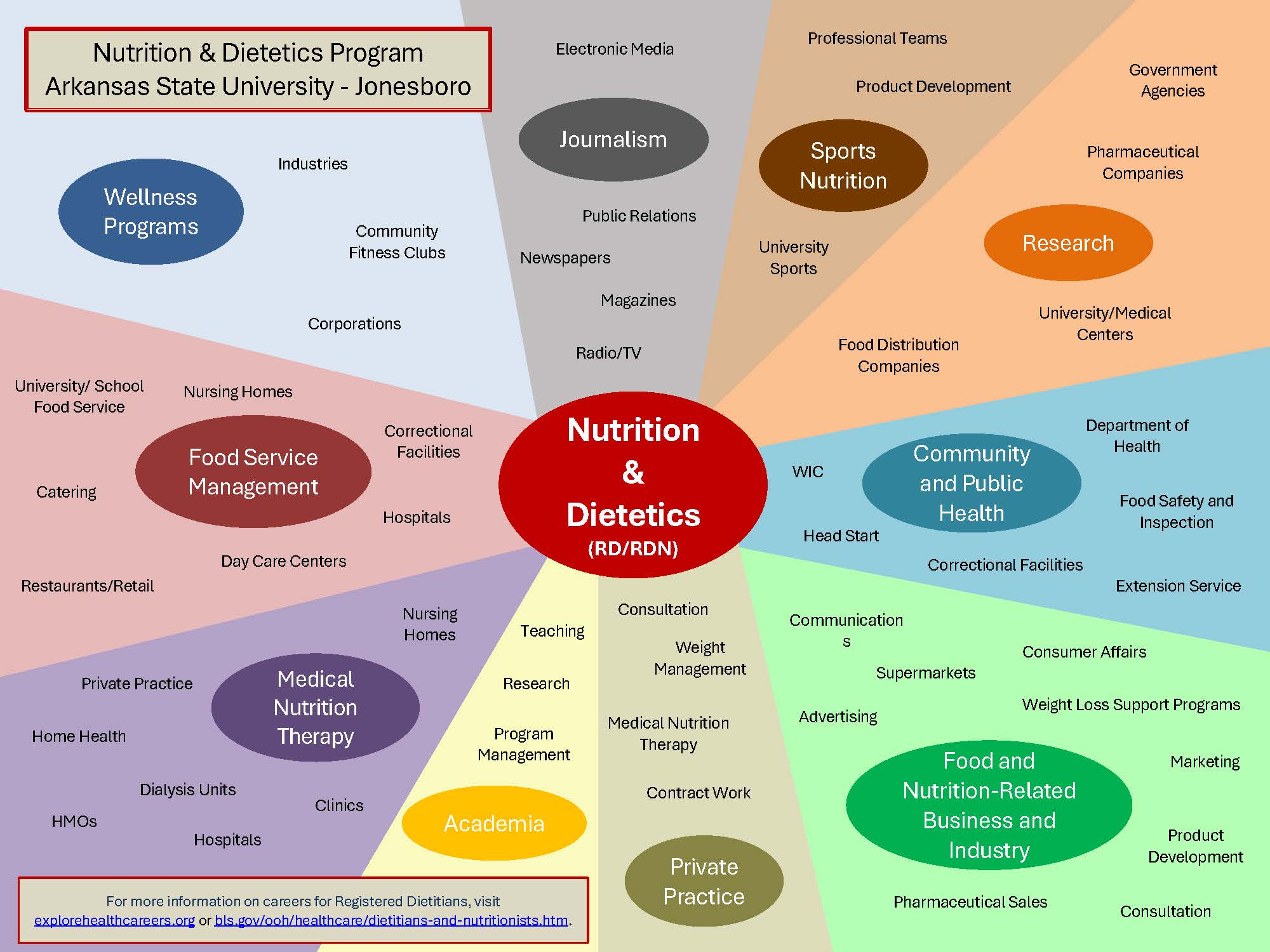
Frequently Asked Questions
1. Can I become an RD/RDN with just a bachelor’s degree?
No. A graduate degree is required for exam eligibility.
2. Can I apply to the RD‑track master’s if I don’t have a BS in Nutrition and/or Dietetics?
Yes. You must complete the prerequisite courses before admission.
3. Can I apply to the RD‑track master’s without a DPD Verification Statement?
Yes. A‑State does not require a DPD verification statement for admission.
4. Can I work full‑time or only nights/weekends and still complete supervised practice?
Unlikely. Practicums average 25 hours per week, and most preceptors work Monday–Friday, 8–5.
5. Does A‑State offer all prerequisites online?
Yes.
6. Can I apply to the RD‑track master’s before completing all prerequisites?
Yes. Conditional acceptance is possible if all prerequisites are completed before the program start date.
7. Does A‑State support supervised practice placement in all areas of the U.S.?
Yes, with the exception of Colorado.
8. Is the GRE required for A‑State’s graduate Nutrition & Dietetics programs?
No.
Program Questions: dietetics@astate.edu
ACEND Accreditation Questions: ACEND@eatright.org