
MRI Student Handbook
ARKANSAS STATE UNIVERSITY

MAGNETIC RESONANCE IMAGING PROGRAM
STUDENT HANDBOOK 2026-2027
GENERAL INTRODUCTION
This handbook has been compiled to acquaint students with the policies and procedures utilized by the professional program in magnetic resonance imaging. It is the responsibility of the student to read the entire handbook.
Students enrolled in the Magnetic Resonance Imaging Program are responsible for observing all policies and procedures stated in this handbook, in addition to any rules and regulations which are contained in the A-STATE Undergraduate Bulletin and/or the A-STATE Student Handbook. Failure to read this handbook does not excuse students from the requirements and regulations contained herein.
Students are expected to adhere to the highest standards of medical ethics in all periods of attendance in the clinical education centers. All clinical education centers, while separately located, are considered to be an integral part of the University campus. Any infraction of medical ethics in the clinical education center will be dealt with under the appropriate disciplinary policy of the University. It is the student’s responsibility to know what the appropriate policies and procedures are at each of the clinical education centers. This is covered during the orientation session.
The program, established in 2007, is currently accredited by the Joint Review Committee on Education in Radiologic Technology (JRCERT), 20 N. Wacker Dr., Suite 900, Chicago, IL 60606-2901, 312-704-5300. The program adheres to the STANDARDS established by the JRCERT, available on the JRCERT website at www.jrcert.org and the MRI Program Director’s office.
The curriculum is based on the MRI Curriculum published by the American Society of Radiologic Technologists, the Association of Educators in Imaging and Radiology Sciences, and the Section of Magnetic Resonance Imaging Technologists. A copy of this document may be found in the MRI Program Director’s office.
The Program Faculty of the MRI Program at Arkansas State University reserves the right to make any additions or changes in program policies as deemed necessary at any time throughout the course of the program.
Students will be notified of new policies and/or changes in program policies in writing.
Program Faculty
MRI Program Director: Kendall Youngman, MSRS, RT(R)(CT)(MR)
kyoungman@astate.edu; 870-972-3329
MRI Clinical Coordinator: Tyler Hester, MSRS, RT(R)(MR)(ARRT), MRSO (MRSCTM)
thester@astate.edu; 870-972-2555
MEDICAL LABORATORY AND RADIATION SCIENCES PROGRAM DIAGRAM
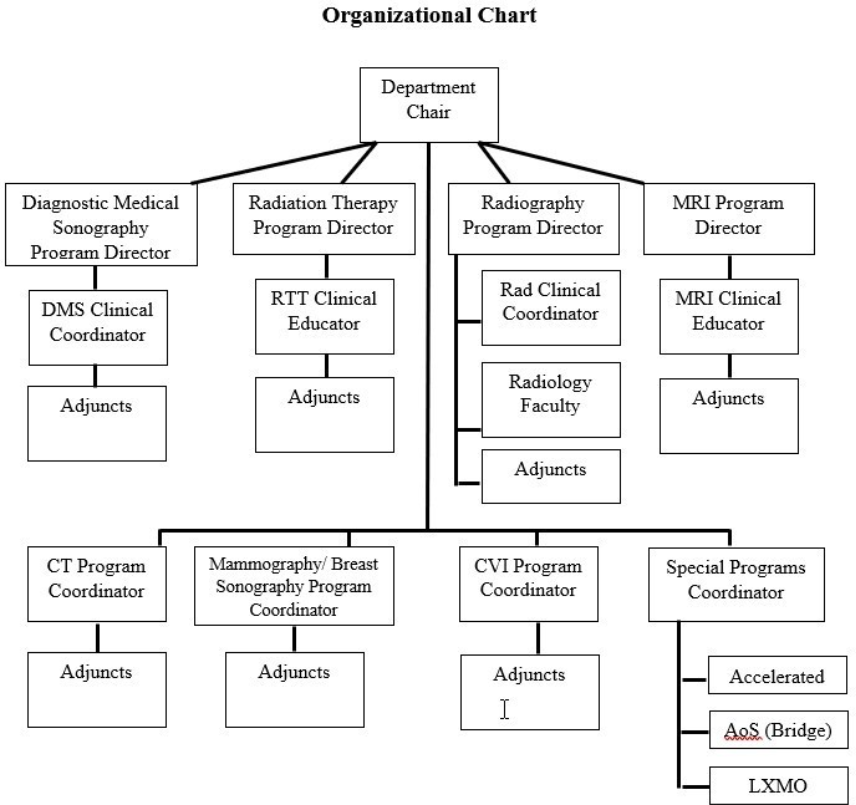
MISSION, PHILOSOPHY AND GOALS
University Mission
Arkansas State University educates leaders, enhances intellectual growth and enriches lives.
College of Nursing & Health Professions Mission
The primary mission of the College of Nursing and Health Professions is to provide quality education to students, graduates and health care providers in a variety of health disciplines. Recognizing its unique position in the Lower Mississippi Delta region, the College provides educational programs that are designed to promote lifelong learning based on the expressed needs of its varied constituencies. The College assesses the attainment of this mission in terms of the contributions its graduates make to health care in the Delta region and beyond.
Program Philosophy
The Magnetic Resonance Imaging Program was established to provide education and training opportunities for individuals seeking entry or advancement as registered MRI technologists. Our program is based on the concept that education is a continuing process whereby the learner determines goals, clarifies values, and develops such discipline and understanding as best meets individual needs for self-actualization. It is our goal to educate students for a successful professional career in the area of magnetic resonance.
Program Mission
The mission of the magnetic resonance program is to prepare competent, entry-level magnetic resonance technologists able to function within the healthcare community.
Goal: Students will be clinically competent.
Student Learning Outcomes:
- Students will apply positioning skills.
- Students will select image parameters.
- Students will utilize magnetic field safety measures.
Goal: Students will demonstrate communication skills.
Student Learning Outcomes:
- Students will demonstrate written communication skills.
- Students will demonstrate oral communication skills.
Goal: Students will develop critical thinking skills.
Student Learning Outcomes:
- Students will adapt imaging parameters for non- routine patients.
- Students will critique images for diagnostic quality.
Goal: Students will model professionalism.
Student Learning Outcomes:
- Students will demonstrate work ethics.
- Students will summarize the value of life-long learning.
AMERICAN REGISTRY OF RADIOLOGIC TECHNOLOGISTS CODE OF ETHICS
- The Radiologic Technologist conducts himself/herself in a professional manner, responds to patient needs and supports colleagues and associates in providing quality patient care.
- The Radiologic Technologist acts to advance the principal objective of the profession to provide services to humanity with full respect for the dignity of mankind.
- The Radiologic Technologist delivers patient care and service unrestricted by concerns of personal attributes or the nature of the disease or illness, and without discrimination, regardless of sex, race, creed, religion or socioeconomic status.
- The Radiologic Technologist practices technology founded upon theoretical knowledge and concepts, utilizes equipment and accessories consistent with the purpose for which they have been designed, and employs procedures and techniques appropriately.
- The Radiologic Technologist assesses situations, exercises care, discretion and judgment, assumes responsibility for professional decisions, and acts in the best interest of the patient.
- The Radiologic Technologist acts as an agent through observation and communication to obtain pertinent information for the physician to aid in the diagnosis and treatment management of the patient, and recognizes that interpretation and diagnosis are outside the scope of practice for the profession.
- The Radiologic Technologist utilizes equipment and accessories, employs techniques and procedures, performs services in accordance with an accepted standard or practice, and demonstrates expertise in limiting the radiation exposure to the patient, self and other members of the health care team.
- The Radiologic Technologist practices ethical conduct appropriate to the profession, and protects the patient’s right to quality radiologic technology care.
- The Radiologic Technologist respects confidences entrusted in the course of professional practice, protects the patient’s right to privacy, and reveals confidential information only as required by law or to protect the welfare of the individual or the community.
- The Radiologic Technologist continually strives to improve knowledge and skills by participating in educational and professional activities, sharing knowledge with colleagues and investigating new and innovative aspects of professional practice. One means available to improve knowledge and skills is through professional continuing education.
STUDENT POLICIES
Academic Advising
Each magnetic resonance imaging student will be assigned to a faculty member who will act as his or her academic adviser. Each adviser will have regularly scheduled office hours which are posted and other hours by appointment.
If a student plans to seek employment in addition to carrying a full-time academic load, this should be discussed with his or her adviser. A realistic workload is recommended. Under no circumstances should employment schedules interfere with academic or clinical responsibilities.
Regularly scheduled classroom and clinical activities may not exceed 40 hours per week.
MRI Program Course Descriptions and Schedules
|
Program name and description |
Semester |
Pre-requisites |
|
RADG 33103 Introduction to Radiography Introduction to the clinical environment, the latest imaging technologies, general patient care, venipuncture lab practice, and legal and ethical issues. |
Summer |
Program Admission |
|
RSMR 44703 MRI Safety and Instrumentation Provides knowledge of the history of MRI, basic MRI terminology, patient and personnel safety, types of magnets, magnetic field strength, radiofrequency hardware, gradient hardware, computer components, cryogens, and site planning. |
Summer |
Program Admission |
|
RSMR 44903 MRI Procedures I Provides knowledge of anatomy, pathology, scanning protocols, contrast administration, and contraindications for magnetic resonance imaging of the head, spinal column, and musculoskeletal system. |
Fall |
Program Admission |
|
RSMR 44953 MRI Physical Principles I Introduction of the concepts of basic physics and instrumentation for magnetic resonance imaging. Topics include nuclear magnetism, the Larmor equation, tissue characteristics, and imaging parameters. |
Fall |
Program Admission |
|
RSMR 44753 MRI Clinical Education I The course will provide beginning level content and clinical practice experiences designed for sequential development, application, analysis, integration, synthesis and evaluation of concepts and theories in magnetic resonance imaging. |
Fall |
RSMR 44703 |
|
RSMR 44863 Data Acquisition and Processing Explains the patient coordinate system and spatial localization, magnetic resonance imaging gradient system, data manipulation, and quality control practices in MRI. |
Spring |
Program Admission |
|
RSMR 44733 MRI Procedures II Provides knowledge of anatomy, pathology, scanning protocols, contrast administration, and contraindications for magnetic resonance imaging of the neck, thorax, abdomen, and pelvis. |
Spring |
RSMR 44903 |
|
RSMR 44853 MRI Physical Principles II Exploration of imagining options, spin echo, fast spin echo, STIR, FLAIR, gradient imagining, time-of-flight, and echo planar imaging. Includes a comprehensive analysis of image artifacts. |
Spring |
RSMR 44953 |
|
RSMR 44763 MRI Clinical Education II The course will provide intermediate level content and clinical practice experiences designed for sequential development, application, analysis, integration, synthesis and evaluation of concepts and theories in magnetic resonance imaging. |
Spring |
RSMR 44753 |
|
RSMR 44773 MRI Clinical Education III The course will provide advanced level content and clinical practice experiences designed for sequential development, application, analysis, integration, synthesis and evaluation of concepts and theories in magnetic resonance imaging. |
Summer PRN |
RSMR 44763 |
|
RSMR 44833 Advanced MRI Imaging Anatomy, pathology, scanning protocols, contrast administration, and contraindications for magnetic resonance angiography, venography, functional imaging, and cardiac imaging. |
Summer |
RSMR 44733 |
|
RSMR 44802 Imaging Information Management Explains the functioning of computers and computer concepts in medical imaging. Topics covered are HIPAA, PACS, and RIS in MRI and the imaging department. |
Fall |
Program Admission |
*May be offered in an online or hybrid format.
There are no additional fees associated with online (distance education) courses. Students whose financial aid depends on the traditional classroom setting should let program faculty know ASAP.
Academic Responsibilities and Standards
Textbooks
Each student is responsible for purchasing the required textbooks before the second meeting of the class. Because the same textbook may be used again in later courses, it is strongly recommended that before selling books, a student consults the magnetic resonance imaging faculty who will be teaching future courses.
Assignments
Each student is responsible for completing all reading, writing, and oral assignments made by the faculty. If a student is absent from class for any reason, he or she is still responsible for the material disseminated in class.
Classroom Etiquette
Each student is responsible for learning the content of any course in which he or she is enrolled and respecting the rights of fellow students in the classroom.
The instructor has the right to request any disruptive student to leave the classroom. Continued misbehavior in the classroom is cause for disciplinary action.
The use of any tobacco product, cell phones, and personal laptops (unless prior approval is granted) is prohibited in the classroom and/or in the laboratory.
You are solely responsible for what you post online. Inappropriate postings specific to patients, classmates or faculty that include discriminatory remarks, harassment or threats, or violations of professional codes of conduct are subject to disciplinary action. Your actions could adversely affect your standing in your health professions program which could include program dismissal.
You should be aware that future employers may view potential candidate’s websites. Students are advised to review their site (s) for any unprofessional images or language which could adversely affect successful employment upon graduation. Please make responsible decisions about your use of social media.
Students are allowed, and at times encouraged, to use various social media sites for educational or personal reasons. However, at no time shall students in the MRI program post or contribute to conversations that may, in any way, violate patient rights or damage the relationship between the MRI program and its clinical affiliates. Cyberbullying by any student within the program will not be tolerated.
Students are encouraged to join the SARIS-MRI Facebook page for job postings and other miscellaneous announcements. As always with any form of social networking, please be aware that postings may be seen by others. This not only includes personal postings, but postings in which the student may be “tagged” by another. School administrators and employers have the right to discipline, dismiss, or refuse to hire based on social media postings.
Course Syllabus
Within the first two class meetings of the semester each instructor is required to provide each student in the course with a syllabus. The syllabus will contain a description of the course, the goals and/or objectives of the course, the method of evaluating and grading students, make-up policy, and a description of written or oral assignments.
Evaluation and Grading
The program has established standards of grading that supersede the University’s grading policy and that are consistent with the minimum passing score on the certification exam for Magnetic Resonance Imaging.
The grading scale used is:
A = 90% – 100%
B = 80% - 89%
C = 75% - 79%
D = 60% – 74.99% F = < 60%
Due to the uniqueness of the MRI program and the responsibilities of the MRI technologist, a high level of academic and technical competence is required of all students in the program. Therefore, a grade of “C” or better is required in all RSMR courses for a student to progress in the professional program. In order for a student to successfully complete this course, the student must have an average of 75% or greater on exams [unit exams and the final exam].
If an overall weighted average of 75% is not achieved on exams, then the exam average will be posted as the final grade for the course. Written and other assignments will not be included in this calculation. Please note: An overall weighted average or weighted exam average of lower than 75% (ex. 74.99%) is failing. A letter grade of “D” or “F” will be assigned. If a 75% average is achieved on exams, assignments that make up the remaining weighted percentage will be added to the exam average. If the written assignments (ex. quizzes, worksheets, etc.) portion lowers or raises the overall grade, that score will be posted as the final grade for the course.
Standards of Academic Achievement
If the cumulative, semester, or session grade point average falls below 2.00, the student will be placed on academic probation. At the end of the next semester or session of enrollment, the cumulative grade point average must be at least 2.00 for the student to remain in the Magnetic Resonance Imaging Program.
A student who receives a grade below “C” in any of the MRI courses may not continue in the MRI Program. The policy and procedure for readmission into the Magnetic Resonance Imaging Program is clearly outlined in the A-STATE Undergraduate Bulletin.
Clinical evaluations will be completed each semester and may be used to set goals for future clinical assignments.
Cheating and Plagiarism
The maintenance of academic standards and integrity includes the obligation of honesty. A student wo uses dishonest or deceitful means to obtain a grade is guilty of cheating; a student who submits another’s work as his or her own without adequate attribution is guilty of plagiarism.
Submission of clinical hours, competencies, or evaluations other than those hours and achievements actually performed is also considered cheating. According to College wide practice, cheating and/or plagiarism will result in disciple action according to the following:
First offense: The student will receive a zero on the assignment/test. If in a clinical situation, his/her clinical grade will be lowered one letter grade.
Second offense: may result in dismissal from the program. Cheating and/or plagiarism will result in disciplinary action and may result in dismissal.
Copyright Violation
It is illegal to copy any copyrighted material unless permission has been obtained from the copyright owner. A student guilty of copyright violation may face sanctions by the Magnetic Resonance Imaging Program, A- STATE, the State of Arkansas, and/or Federal authorities.
Expenses
In addition to the normal university tuition, fees, and book costs, a student in the Magnetic Resonance Imaging Program will incur additional expenses. These expenses include, but are not limited to:
- Transportation: Each student is responsible for transportation to his/her assigned clinical site. Transportation and all costs incurred for travel to the clinical site is the sole responsibility of the student. A valid driver’s license is required prior to the start of clinical rotations.
-
Uniforms: Each student is responsible for providing his/her own uniforms, including lab coat and shoes. Uniforms and lab coats must be monogrammed identifying the student as an A-State MIRS student.
Vaccination and skin testing: Students ADMITTED to any program in the College of Nursing and Health Professions must present the following immunization and test documentation:
- Rubella and rubeola (Arkansas statute).
- Mumps and varicella vaccination or titer (clinical affiliate (hospital) requirements when working with infants and children).
- If no hepatitis immunization or titer, then must begin the Hepatitis B vaccine series prior to enrolling in a clinical practicum class.
- TB skin test each year that the student is enrolled in a clinical practicum. If skin test is positive, documentation of treatment status must be submitted.
- Flu vaccination each year that the student is enrolled in a clinical practicum.
- COVID vaccination (exemption paperwork permitted by limited clinical sites).
- Cardiopulmonary resuscitation (CPR) certification is required before taking any practicum courses. Certification status must be maintained and documentation submitted to the appropriate department throughout enrollment in any program.
- Drug screening: May be required prior to attending site specific orientation.
Liability Insurance:
Proof of professional liability insurance is required before a student can begin clinical education. You may apply online at http://www.hpso.com/. If applying for liability insurance with HPSO, select “Radiologic Technician/Technologist” as the profession.
Background Checks:
Criminal background checks may be required by the College of Nursing and Health Professions and/or individual clinical sites. The appropriate forms and applicable fees will be distributed to students prior to the start of the clinical rotation.
Clinical Software Fee:
- Trajecsys: The radiologic sciences programs at A-State enrolled in a clinical software program http://www.trajecsys.com/ Students are charged a one-time fee for annual use of the software program. This fee will be attached to the first clinical course.
- Verified Credentials (one-time fee): All incoming students are conditionally accepted into the MRI program dependent upon successful completion of a background check. Background checks are purchased through a CNHP based Verified Credentials within the first two weeks of the program start date. Records are reviewed by the Department Chair and any concerns are addressed with the affected student and the Dean of the College of Nursing and Health Professions. Drug screenings may be required by certain clinical sites. Removal from the program is possible based on background check and/or drug screening results. Students will also be required to upload immunizations, TB skin tests, MRI safety sheets, CPR certification, and other necessary clinical information into their MIRS based Verified Credentials account.
- CloverLearning Subscription: The MRI program utilizes a supplemental learning platform for educational videos and and assignments. Students are charged a one- time fee for annual use of the online program. This fee is attached with MRI Physical Principles.
-
Change of Address
The Department of Health Professions, Radiologic Sciences Programs and University registrar’s office (http://registrar.astate.edu/) should be notified promptly of changes in name or address. Correct phone numbers should be filed with the Department of Health Professions and the Magnetic Resonance Imaging Program so that students can be reached in case of an emergency.
Health & Safety
-
Health Examination:
Students are required to submit a completed health form and to have a physical examination prior to entering the clinical site. The required health form is to be completed by a physician and returned to MRI Program Faculty prior to the beginning of clinical rotations during the Fall Semester.
-
Health Care:
The on-campus Student Health Center is open Monday through Friday for the benefit of students. A description of services and the hours of availability are listed in the Undergraduate Bulletin and on the A-State website at https://www.astate.edu/a/student-health-center/. Except for the services of the Student Health Center, the University assumes no responsibility for health care costs.
-
Illness:
If the student is ill and unable to attend the clinical rotation, the MRI clinical supervisor and MRI Program Faculty must be notified as soon as possible prior to the scheduled starting
time.time. A student is expected to use goodjudgmentjudgement in determining whether or not to attend the clinical rotation because of illness. If the student is ill and unable to attend class,Ifthestudentisillandunabletoattendclass,-
-
Injury: Should a student become injured or acutely ill during the course of assigned clinical duties, the clinical site to which that student is assigned will provide treatment and emergency care, with any charges for treatment being the sole responsibility of the student. Any injury, however minor, occurring while on duty at the clinical site must be reported to the clinical supervisor and the appropriate incident form completed with copies to the MRI Program Director at A-STATE.
-
Health Insurance: Students are strongly encouraged to have current health insurance for clinical rotations. Arkansas State University offers each student the opportunity to purchase an accident and hospitalization insurance policy through a reputable insurance company. A-State assumes no responsibility for collecting premiums or for paying claims. Professional liability insurance should not be misconstrued as including health insurance coverage.
-
Pregnancy: In compliance with the Nuclear Regulatory Commission (NRC) regulations, a female student who becomes pregnant has the option of whether or not to inform program officials of her pregnancy. If the woman chooses to voluntarily inform the officials of her pregnancy, it must be in writing and indicate the expected date of confinement (delivery). In absence of this voluntary written disclosure, a student cannot be considered pregnant. If the student does voluntarily disclose her pregnancy, she does have the option of continuing the educational program without modification of interruption. Another option can include modification in clinical assignments. At any point in time, the student may provide a written withdrawal of declaration. If the pregnant student chooses to disclose her pregnancy, she will receive counseling to inform her of the possible risks associated with magnetic and RF exposure to the fetus. To limit such risks, a declared pregnant student will not be permitted to perform duties within Zone IV during actual scanning. With the understanding of such risks, the pregnant student will be required to sign a form releasing the university and the program of any responsibility should problems develop with the pregnancy. The Pregnancy Release form is found in the Program Documents section of this handbook.
-
Communicable diseases may require that one or more of the following protective measures be taken. The student may be:
-
Required to use reverse isolation techniques while working with non-high-risk patients.
-
Reassigned to a non-patient care area.
-
Relieved from clinical duty until he or she is no longer contagious.
Magnetic Field Safety
The magnetic resonance (MR) system has a very strong magnetic field that may be hazardous to individuals entering the MR environment or MR system room if they have certain metallic, electronic, magnetic, or mechanical implants, devices, or objects. Students are expected to undergo an MR screening process as part of their clinical agreement to ensure their safety in the MR environment.
For a student’s own protection and the protection of those in his/her supervision, he/she is required to immediately notify and report to MRI faculty any trauma, procedure, or surgery they experience or undergo where a ferromagnetic object or device may have become introduced within or on them. This will permit appropriate screening of the student to determine status change in the safety of permitting that student into MRI Safety Zones III and/or IV. The MR Screening Form for Individuals is found in the Program Documents section of this handbook.
Radiation Safety
Due to the unique concerns and health risks associated with ionizing radiation, students enrolled in the MRI program are not allowed to observe, assist, or hold patients inside any room that is actively conducting an exam utilizing ionizing radiation. Students ARE allowed to assist with patient transport, sterile trays, or other patient care related tasks whenever ionizing radiation is not in use.
Campus Safety
Safety is a shared responsibility at Arkansas State University, which is reflected in an organizational structure with multiple departments responsible for often interconnected pieces of campus safety. From protecting the public to protecting your rights, members of the campus community can find information on each of these essential functions at https://www.astate.edu/safety/ .
Physical and Mental Performance Requirements
Because of the nature of the work required in the Magnetic Resonance Imaging Program offered at A-STATE, the applicant must be:
-
-
Able to reach, manipulate, and operate equipment necessary for exam procedures.
-
Able to move, manipulate, and observe a patient or client as necessary for the profession.
-
Able to visually assess patients, medical test results and the working environment to correctly decide the appropriate action to take for the benefit to the patient/client.
-
Able to clearly communicate, both verbally and in writing, with the patient, client, family members, medical personnel and others.
-
Able to disseminate information relevant to patient care and work duties, and also hear clearly enough to gather information relevant to patient care and work duties.
-
Able to make appropriate judgment decisions in an emergency or where a situation is not clearly governed by specific guidelines.
-
Able to demonstrate emotional stability and psychological health in day-to- day interactions with patients/clients, staff, family members, and others in routine and non-routine decision-making processes, and on the daily execution of didactic and clinical assignments.
-
Able to maintain professional demeanor and conduct under extremely stressful circumstances.
-
Able to lift at least 50 pounds.
-
Able to safely work in the MRI suite – Magnetic Resonance Imaging students should wear no implants or have devices surgically implanted that are deemed non-MRI compatible.
STANDARD PRECAUTIONS POLICY STATEMENT
The Magnetic Resonance Imaging Program enforces current A-STATE policies on communicable diseases. Any student suffering from a contagious infection will be asked to provide medical documentation that the contagious phase has passed prior to continuing in class. This is to insure minimum risk to others.
Because many people who carry highly infectious pathogens (e.g., AIDS virus, hepatitis A & B, etc.) are not aware of it, all students and faculty will strictly adhere to this policy. These safety guidelines are designed to protect the students, faculty, and patients from the spread of infectious diseases.
Wear gloves at all times when working with patients where blood/body fluids are evident or likely; i.e., open wound trauma, barium enema tip insertion, IV injection.
Wear gloves when wiping blood/body fluids from equipment. Use appropriate cleaning chemicals.
Wash hands after handling any blood and body fluids. Wash hands frequently during patient care activities.
Dispose of linens soiled with blood and body fluids in appropriate containers.